Muslims and terrorists

China has been busy this week quashing Muslim terrorists and defending stability in China, as the government asserts, or possibly just stifling Muslim belief and the ethnic minority, Uygur Muslims, as supporters might contend.

On Monday the Chinese police announced that they raided a suspected terrorist training camp in the Xinjiang Uyghur Autonomous Region, killing 18 alleged terrorists in the process and seizing a hoard of hand-made grenades that were both completed and being made. Chinese police claim that the East Turkestan Islamic Movement, which the United Nations considers a terrorist organization, ran the camp.

Some eight million Muslim Uyghurs, who are ethnic Turks, live in the Xinjiang province, and some groups of Uyghurs are violently petitioning to establish an Islamic state independent of China.

The training camp may well have been a terrorist training camp. However, it’s difficult to ignore the timing, on Sunday, of China’s increased urgency to target Uyghurs and to denounce Rebiya Kadeer, an exiled dissident and nominee for the 2006 Nobel Peace Prize, as a separatist and “terrorist.” Rebiya Kadeer has been based in the U.S. since March of 2005; she was jailed six years ago for “leaking state secrets,” which was, in effect, communicating with her U.S.-based husband about Chinese reporting on the Uyghurs.


George Eliot, English novelist

It’s never too late to be who you might have been. —George Eliot, English novelist

It’s never too late to be who you might have been. —George Eliot, English novelist


Jean Renoir, French director, actor, and author

The awful thing about life is this: Everyone has their reasons. —Jean Renoir, French director, actor, and author

The awful thing about life is this: Everyone has their reasons. —Jean Renoir, French director, actor, and author


Iraq in 2006

As revelers rang in 2007, the Iraqi ministries released grim statistics for 2006: 14,298 civilians died violent deaths. Add to that the violent deaths of soldiers and police and the number rises to 16,273. The AP reached an independent count of 13,738 deaths.


Cabbie joints

Cabbie joints Cricket scores, chicken tandoor, and commiseration.

Ashfaq Khan enters Lasani, and heads directly for the restroom at the back of the restaurant, calling out “Kya haal hai?” (“How’s it going?”) to acquaintances.

The television is tuned to Geo TV, a local Pakistani channel, which is now showing the news, largely ignored by the drivers clustered around the tables, who look up from their conversations only for the cricket scores. In this almost exclusively male, South Asian milieu, cabbies are able to relax, chat with other drivers clustered over the tables, or speak loudly into their hands-free cell phone sets. A Hindi and Punjabi hum washes over the restaurant.

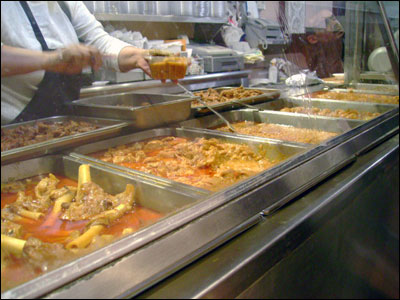
Khan returns with his slow, shambling gait. His middle-aged face is good-natured, open. He lacks the on-the-ball keenness of a veteran driver, having only been a cabbie for two years after a long stint as a parking lot attendant came to an unceremonious end. He picks up his order of chicken curry at the steam table, and settles down by himself to await his fresh naan bread. “Sometimes I call my friends and we eat together,” Khan, 40, says. “But I don’t want to waste their time. Time is money.”

It is just after 10 p.m. on a Monday. Most shops are shuttered, and the crowd that swells the streets during the day is heading home to bed. As business slows down, cabbies begin thinking about dinner. Switching on their off-duty lights, they pull up to the curb along 29th Street between Fifth Avenue and Broadway, where Lasani has sat for a decade now. Restaurants like Lasani are havens for the city’s South Asian cabbies. While other busy urbanites spend top dollar to sit at the bars while celebrity chefs ignore them, the cabbie joints clustered around Manhattan’s “Curry Hill” in the East 20s, on Church Street near the World Trade Center, and on the Lower East Side opposite Katz’s Deli, have cheap food and clean bathrooms — a must for busy drivers. Here, they can exchange juicy stories about goings on in the back seat, complain about the taxi medallion system, discuss the ins and outs of the U.S. immigration system, and know they will find a sympathetic ear.

Khan is no fan of the driving life, but he appreciates the fact that he can set his own pace. “See, right now, I’m hungry, so I come down to eat,” he says. “You don’t need to wait for a break. You are your own boss.”
Dreams of home

According to Schaller Consulting, a New York taxi industry research firm, New York’s $1.82 billion taxicab industry employed 42,900 yellow cab drivers in 2005, 91 percent of whom were immigrants. A large number of them — 39 percent — came from Bangladesh, Pakistan and India.

The immigrant driver will almost never possess his own medallion — an official permit required by New York State. This piece of aluminum is what separates ordinary cars from cabs. But at $350,000, the cost of obtaining the medallion is often too much for recent immigrants. So, instead of buying, they lease them from wealthier owners at around $700 a week.

While the security and profit potential of ownership is a distant dream for many drivers, the taxicab industry has always been a magnet for fresh-off-the-boat immigrants, offering a ready job and the prospect of take-home cash at the end of the shift for those willing to endure tedious hours behind the wheel. In the thirties, the job belonged to Irish, Italian, and Eastern European immigrants. The eighties saw a wave of South Asians taking the wheel, drawing friends and relatives into the industry in their wake.

“They are often people with dual class identities,” says Vijay Prashad, professor of International Studies at Trinity College, Hartford, Connecticut, and author of The Karma of Brown Folk, a sociological study of the South Asian Diaspora in the United States. “They have aspirations.” Many cabbies come over as students, hoping to put themselves through school by driving at night, but many years later, find themselves stuck behind the wheel. Then there are cases like the small-scale farmers of Indian Punjab, who had to seek greener pastures when the government’s 1980s “green revolution” initiative brought in mechanization and favored wealthy farmers, Prashad says.

Many of these men leave their families behind in the hope of bringing them over when they are able to find higher paying jobs. For most, obtaining a measure of stability can take years. Until then, they drive cabs, share apartments with friends and relatives in South Asian enclaves in Jackson Heights, Richmond Hill, and Astoria in Queens, along Coney Island Avenue in Midwood, and Sheepshead Bay in Brooklyn. They try to stave off loneliness among the comforting sights of sari and gold jewelry shops and with people like themselves. This homesickness leads them to the humble, hole-in-the-wall South Asian cabbie cafes of Manhattan, with evocative names like Pak Punjab, Lahore Deli, and Chutney.

Among these restaurants, little regional touches dictate where cabbies choose to stop. Nuances like the channel playing on television, the newspapers on offer, and the language of banter make these restaurants a home-away-from-home for many drivers.

Then there’s the food. Bangla Curry on Church Street at Reade Street, and the Shipa Kasturi Pavilion on Lexington Avenue at 26th Street, for instance, feature a good selection of fish curries, favorites of Bangladeshi drivers weaned on a diet of rice and fish on the Ganges-Brahmaputra River delta. Pakistani restaurants make a fine art of naan bread, and a few restaurants offer only vegetarian entrees, catering to Indian vegetarian drivers.

Some places, like Lasani and Chandni, located on either side of the A.R. Rahman Mosque, enjoy a more diverse patronage. At Lasani, a calendar from the Tayyab Brothers Grain Market in Pakistan adorns one wall. Another bears a poster advertising prayer timings at the A.R. Rahman mosque.

Several times a day, devout Muslim drivers drape their jackets on chair backs at Lasani, wash up for prayers in the restroom, and then go downstairs to the basement mosque. “Then they come upstairs to eat,” says Komal Sultana, Lasani’s co-owner, who employs Pakistani, Bangladeshi, and Arabic cooks to serve up regional specialties. “That’s the most important thing. If they don’t get good food, they won’t come.”

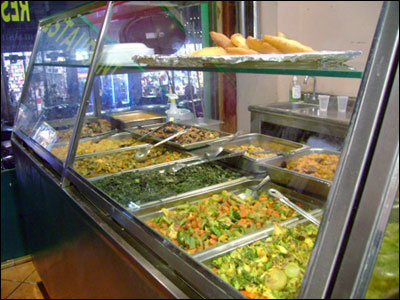
On her steam table, spicy red tandoori chicken (in the authentic style of the town of Lahore in Pakistani Punjab) and lamb gosht keep company with whole fried fish for Bangladeshis, and mild, aromatic squash and eggplant stews in the Arabic style for African drivers.

The spread is tempting, but cabbies have to watch what they eat, Ashfaq Khan says, as he carefully consumes a side of shredded lettuce that most other diners ignore. “If you’re gonna be sitting a long time, you get a lot of diseases,” he says, echoing the concern of a number of drivers, who, since they have to pay out-of-pocket for health insurance, often forego it altogether.

Cabbie stresses

Khan works for 10 hours on weeknights and 12 hours on weekends — Friday and Saturday nights being the most lucrative for any driver. He pays $700 a week to lease his medallion from a private owner, and an additional $50 a day for gas — a total cost of $1,050 a week. During the week, Khan can make a profit of $80 to $90 on a good day. On bad days, he may break even. Weekends are better, yielding a profit of $200 a day or more.

Even so, it takes two incomes to make ends meet. Khan’s Trinidad-born wife is a travel agent, and is gone during the day when he is home. “Sometimes we’ll see each other during the weekend,” he says as he pops a few candied fennel seeds — an after-dinner breath freshener — into his mouth. “Sometimes I go home early, wake her up, and we talk.”

On top of the bad hours, he has to deal with the Saturday night revelers. “They’re drunk and spend all the money in the bars.” With stresses like these, Khan is not long for the taxi industry. He plans to someday get an automobile or refrigerator mechanic’s certification, and then buy a house. “A man can dream,” he says, half-smiling.

It’s the hard aspects of the driving life that have convinced Bangladesh-born Mamnun Ul Huq that cabbies need to band together. Ul Huq, a 44-year-old cabbie, often visits cabbie joints to get drivers to enroll in the New York Taxi Workers’ Alliance. He eats most of his meals at home — he pauses to blow on his coffee at a Curry Hill Dunkin’ Donuts — visiting the restaurants only to meet his cabbie brethren. “It’s good food, but too much oil,” he says with a grimace.

Since its inception in 1997, the NYTWA has been trying to organize yellow cab drivers. So far, it has gathered around 7,000 members, Ul Huq says, about 16 percent of his fellow drivers.

Besides visiting the restaurants, Ul Huq often uses the Bangladeshi Citizens’ Band radio network to announce NYTWA’s plans of action. “People need to unite to get what they want,” he says, “especially in a job with unreliable working conditions, where a man can get stabbed on duty.” In March 2005, a passenger plunged a knife into Ul Huq’s neck, missing his aorta by centimeters. It took a 10-hour surgery to treat the wound, he says. These “crazy guys,” as they are called, can strike without warning. As late as last year, two Bangladeshis — a yellow cab driver and a livery cab driver — were sent into a coma when they were attacked, victims of what are believed, from eyewitness accounts, to be hate crimes.

The difficulties of being a cabbie are so great that even Ul Huq, as involved in cabbie-welfare work as he is, may quit the industry. “After the stabbing, I can’t sit for hours,” he says. “I’m trying to get some business plans together. Let’s see.”


Strange Shore

Best of In The Fray 2007. African refugees on Chicago’s North Side.

We have all heard stories about war, displaced people, and refugees throughout the world. As outsiders it is easy to think that once these people have been removed from immediate harm, all their problems are solved.

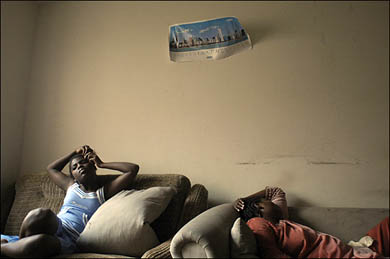
Tucked away on Chicago’s far north side amid university students and professors lies a growing community of African refugees. The new residents hail from all of Africa’s war-torn corners and struggle to make new and better lives in a foreign city.

The Mambo family of Burundi is representative of this growing community. Asiya Mambo, and her children, Aline, 14, Bea, 14, Vote, 5, and Lelia, 2, came to the United States in September 2005 because of the Hutu-Tutsi conflict in Burundi. Asiya’s husband is still in the camps looking for a way to come to the United States.

Asyia and her family traveled for five years among refugee camps throughout Africa and ended up in Mozambique. Originally from Burundi, her two nieces, Aline and Bea, 14, now speak five different languages because of their constant moving. Each member of Asiya’s family faces different challenges in their new lives in Chicago — from building a new social circle, to adjusting to a new school system, to finding a job. These images attempt to show the rebuilding of a shattered existence.

[ Click here to enter the visual essay ]


Yearning

PLEASE NOTE: We have transferred all the user accounts on our oldinthefray.com site to this site. Use your username and password to login. If you forgot your password, select "forgot password?" in the menu above to reset it. Or, click here to register for a new user account.

With Saddam Hussein’s recent execution, we have been promised that the former dictator’s end spells the dawn of democracy in Iraq. Yet Hussein continues to haunt Iraq, from the Kurds who remain tormented by their inability to convict the dictator of genocide, to the sectarian violence engulfing the country. From the martyrs to the victims to the criminals to ordinary people, the past infiltrates the present, not just in Iraq, but around the world as we embark on 2007.

In this issue of ITF, we inaugurate our new site, InTheFray.ORG, with the publication of more of the high-quality, inspiring, and groundbreaking writing and art you have come to associate with ITF. Here we examine the many ways the past informs the present.

We begin in New York, where Vidya Padmanabhan discovers how cabbies — many homesick for their native India or Pakistan — find belonging and business advice in the city’s Cabbie joints, South Asian restaurants. And in Brooklyn, a former police officer’s granddaughter grows nostalgic for accountability and responsibility as Alexis Clark considers the police brutality responsible for Sean Bell’s death in Lead by example.

Afterwards, we visit Chicago’s north shore, where Beth Rooney captures the colorful lives of African refugees as they attempt to rebuild their war-torn lives on a Strange shore. Halfway across the globe, Melissa Lambert sees a civil war’s toll when she ventures On the edge of Mozambique, where rebuilding remains a complicated process, one that breathes life, however mysteriously, into tourists’ fantasies of beauty and belonging.

Reflecting on the roots of her own ignorance about Africa, OFF THE SHELF Editor Nicole Pezold reviews Charlayne Hunter-Gault’s book New News Out of Africa. As she reveals how many of the continent’s countries are embracing democracy and eliminating poverty and disease, Hunter-Gault offers strategies for the media to highlight the “real” Africa.

Meanwhile, in Amman, Jordan, Best of ITF So Far writer Rhian Kohashi O’Rourke takes A sip of Egyptian Tea as she recounts how an older doorman finds humor and camaraderie in a young, clumsy American woman. Back in the United States, Larry Jaffe, the International Readings Coordinator for the United Nations Dialogue among Civilizations through Poetry program and the Co-Founder of Poets for Peace/United Poets Coalition, reflects on growing up Jewish in Sub Urban America and muses on the intolerance and ignorance that loom today. Speaking of coming of age, Megan Hauser reminisces about the realities of using optical illusions to protect herself in Bad eyewear can mark a child.

Rounding out this month’s stories and launching our newest department — the Activist’s Corner — is Folklore photography, former ITF Travel Editor Anju Mary Paul’s interview with photographer Martha Cooper about documenting urban culture and using the camera to inform, transform, and inspire awareness and change. Each month the Activist’s Corner will feature an interview concerning the challenges faced by contemporary activists and offer ideas for how busy people can improve their communities. This department will also feature links and other resources from grassroots organizations of interest to you, our readers.

Along with the Activist’s Corner and a more aesthetically pleasing site, InTheFray.ORG allows readers to post their own profiles, connect with other members, set up personal blogs, and upload images and video and audio files. In coming months, we plan to launch additional features, including video and audio podcasts.

Now that we’ve launched the new site, we’re looking for testimonials from readers aboutwhat InTheFray means to them. If you can help us, please emaileditors-at-inthefray-dot-org with any words you want to share. Pleasemake sure to include your full name and city.

We hope you enjoy our new home and encourage you to email us at editors-at-inthefray-dot-org with feedback on the new site.

Happy New Year!

Laura Nathan
Editor
Buffalo, New York

P.S. We would like to dedicate this new site to Oya Hadimli, a friend of InTheFray, who passed away in November. Thank you for inspiring us with your vision and passion for a world without borders.


On the edge of Mozambique

200701_ttlg1.jpg

Two newlyweds discover that the foreign and the familiar aren’t always polar opposites.

We are looking over the menu at a small restaurant on the beach in Beira, Mozambique. The borders of this city hang into the ocean; appropriately, Beira means “the edge” in Portuguese.

Although it is dinnertime on a Saturday night in the heart of the country’s second-biggest city, only one other table in the restaurant is occupied. Upstairs is a deserted discotheque; to the right is an empty pool hall. Our table is right on the beach, and the restaurant’s weak lighting barely illuminates the whitecaps as they break on the sand.

The menu is impressive: ten pages of pastas, meats, fish, and fancy drinks. Of the four people at our table, three of us have lived in Brazil, so we are naturally thrilled to see some Brazilian delicacies on the menu. When the waiter comes, we order only to find out that they don’t actually have any of those dishes available. Further into the ordering process, we find out that they don’t have much of anything. I politely ask for the pasta alfredo. “We don’t have that,” replies the waiter in a heartfelt, apologetic tone. I request the pasta with garlic instead. They don’t have that either.

“Which of the pasta dishes do you have tonight?” I inquire.

“No, that’s what I mean,” says the waiter. “There’s no pasta.”

Deterred, I reopen the menu and motion to my husband, Joe, to make his order. He discovers that there is no stroganoff, nor chicken, nor shrimp. Of the full page of fish dishes, only one is available. Joe takes some time to regroup.

“Do you have the vegetable salad?” I ask.

“Sorry, no.”

We all end up ordering pizza.

While we’re waiting for the food to arrive, Joe and I step out of the wall-free restaurant onto the smooth sand. A twelve-inch-wide piece of concrete juts out of the sand and leads out into the ocean. I walk on the concrete while Joe holds my hand, suspicious of my balance. We can see the concrete disappear into the sea and we stand there on the edge, deeply disoriented. It doesn’t feel like we are right by the shore. Waves rise up like monsters and crash all around us. We could be in the middle of the ocean, on a boat somewhere, lost at sea. I am dizzy from the sloshing and pounding and frothing of the waves. I could lose my balance, fall into the water and be lost forever. The stars glint and glimmer on the ocean’s dark surface; all at once, they are trapped by two vast skies. I tilt my head back to meet them, and my head swims with all the light — there is nothing so limitless as the African sky. If you’re not careful you could tumble into it, head over heels, heart over feet, to that blurry horizon where ocean becomes sky, where no one could ever find you again.

When the dizziness is too much for me, I jump off the concrete and join Joe on the beach. We write notes to each other in the sand until the waves wash them all away and we’ve gotten our feet wet. We have been married for only a few months; every day is still a honeymoon.

The waiter beckons to us. Our pizza has arrived. Although we ordered different kinds, the food all looks pretty much the same.

As we are finishing our meal, two obviously intoxicated women stumble to the table next to ours. I don’t know what they’re on, but it is pretty clear what they’re after. They can barely sit up in their chairs, but they are making eyes at my husband. I am slightly angry, but mostly I am filled with pity. I try to imagine what I will do if they make my husband an offer; I can’t decide what exactly, but I’m certain it will be awkward for all of us.

A restaurant security guard comes over and asks the two women to leave the premises. One argues loudly with him; the other, with glazed eyes and frizzy, explosive hair, is slumped over the table like a corpse. The guard has to physically remove them both from the restaurant.

The waiter comes over to apologize. “Some people have no shame,” he laments.

While we pay the bill, I think about the two women and what their lives are like. Sometimes we are so quick to assume that people have made choices, when really life can be a blinding sandstorm of disappointment. What happened to these women? How did they get where they are at this moment? How can lives dissolve so quickly, like so many handfuls of salt cast into the open ocean?

As we leave the restaurant, we notice the two prostitutes in the street. The silent one is laying in the dirt as a puppy laps at the hem of her jeans. The loud one is standing over her, shouting something at the security guard who is watching from across the street with his arms folded over his chest.

We drive away into the night, moving west until we can no longer hear the rushing sound of the waves.

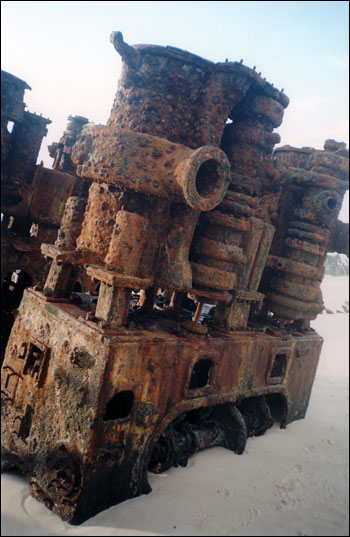
Three hours north of Beira is Gorongosa National Park, one of Mozambique’s remaining big game parks. A couple of months have passed since our first pizza dinner on the beach, and we are starting to realize the many ways that Mozambique’s civil war, which ended in 1992, still affects everyday life. I am no longer surprised by restaurants with long menus that only serve thin pizzas. As we have visited schools, orphanages, and health centers, we have seen the more vital ways that the civil wore tore down this country. People are still trying to build it up.
When we arrived at the park today, after a dusty early morning drive, we went in search of bottled water and found, instead, the park’s director.

“We don’t have any food here,” he said. “As you can see, we are still trying to rebuild.”

It didn’t take him long to explain that Gorongosa used to be the best game park in Africa — nay, the world. He said that before the war, people came from all over the planet to see Gorongosa’s animals. During the war, however, all the game parks in Mozambique were virtually destroyed. The rebels used one park as a base of operations and many animals were killed for food because local populations were starving. Since then, it has been difficult to draw tourists to visit the game parks. Most people go to Kruger Park or other famous game parks in neighboring South Africa, Swaziland, and Zimbabwe.

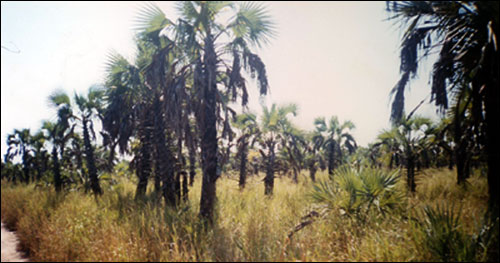
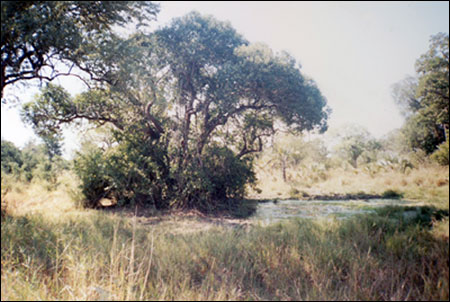
Despite all this, we are sort of tourists, and the clouds are perfect. The landscape seems to change and undulate as each moment passes. One minute we are surrounded by feathered trees, when suddenly the horizon comes into view and the tall grasses sway in the wind, ruffled like ocean waves. There are few animals, but I am content with the trees. Joe and I are riding on the top of a land cruiser straining our eyes for a glimpse of a baboon or warthog. We missed the lions — apparently, they are sleeping. We are searching for the elephants, but they are shy.

As we drive further along the dirt roads, bumping over potholes and brushing grasshoppers off our arms, reality fades away until I can remember it just vaguely, the way you remember how salty seawater feels on the back of your neck when you are living in the desert. I can’t remember what Africa is, or America, or even the planet Earth. It is just me, the husband that I am leaning on, and an azure sky that stumbles into the horizon and bumps into one especially tall gnarled tree. When I look closer I see that the tree is filled with monkeys.

What was apparent our first week here becomes increasingly clear as the months pass by: There is more than one kind of post-war reconstruction happening in Mozambique. Some people have dedicated themselves to attracting tourism to the game parks and nightlife, but the real and most vital kind of reconstruction is happening quietly, little by little, in individual homes. Things fall apart and get torn down; every moment is a good time to start the process of fixing. I have met social workers, teachers, volunteers, nurses, government officials, and aid workers who are dedicated to building up individuals and families and communities. They are the ones who will really reconstruct this country and every other country, and eventually, if all goes well and their wishes are granted, the whole star-speckled universe.

Despite the amazing differences, every place is strikingly similar to all the others. Wherever you go, there are happy people and sad people and empty restaurants and blue skies and, occasionally, eternally tall trees filled with noisy animals. There is nowhere in the world like Mozambique, and by that I mean it is just like home.


Bad Eyewear Can Mark a Child

Best of In The Fray 2007. How I learned to be sneaky and failed.

I was prescribed glasses fairly early on — after my vision had become suspect when I began walking into walls and stepping on Muffin, our aging Lhasa Apso. In 1979, on my fourth birthday, my father tried to take a picture of me in my Little Orphan Annie dress, but as he called my name, I could only look around with a blind and aimless gaze. In a flurry of despair, I was rushed out onto the porch, where I promptly failed a set of amateur sight tests administered by my mother. This failure sealed my fate of bespectacled childhood.

Now, those were the days of spartan provisions in the field of eyewear, before the time when designers manufactured children’s accessories to mimic their fashionable adult lines. Options were limited. The children’s section at the optometrist’s office consisted of 11 inches of shelf behind the counter with one or two horrific styles in your choice of mousy brown or black. They flattered no one. Constantly reminded of this fact by my sensitive classmates, I would remove the culprits the first chance I got, which was always during my walk to school. My glasses were octagonal, a sort of stop sign design that was mildly popular in the late 1970s. Though I detested these glasses, I knew they were expensive, so every morning I would gently slip them into my backpack like a pair of endangered cockroaches. I praised myself for my cunning and my mature considerations of value. On my return walk home, I would delicately pull the glasses out again, confident I had fooled everyone into believing I had 20/20 vision.

I couldn’t see the board. For nearly three years, my mother attended parent-teacher conferences where she was scolded for failing to provide her daughter with corrective lenses. My mother would argue. My teachers would sigh. My mother would return from school, confused and frustrated, and find me sitting six inches in front of the television. In a weary voice she would ask me, “You’re not wearing your glasses at school, are you? Don’t you know you’re ruining your vision? Do you want to go blind?” I would be irritated by the distraction and only unglue my eyes from the screen long enough to toss a few languid apologies in her direction. After quickly confirming that nothing of great import was happening on The Love Boat, I would then add a few tears for effect in the hopes of finalizing the discussion. I knew my mother wouldn’t understand the sublime genius of my scheme or realize I had sacrificed my precious vision to save myself from endless social torment. Undaunted, she would position me in front of a mirror and say things to my reflection like, “This is the person you really should be saying sorry to. Right here. In this mirror.” I would sniffle in agreement and nod ferociously at our looking-glass counterparts, but I wasn’t really sorry. My only remorse came from missing what happened to Isaac and Gopher in Puerta Vallarta and having to suffer through my mother’s amateur child psychology tactics.

For second grade I was assigned to Mrs. Rizzo’s class. I remember it as a hazy year, mainly because I couldn’t see anything, but it was compounded by Mrs. Rizzo’s maternity leave. Her absence made her seem mysterious, like a distant uncle who died of snakebite. In her place during those months was Miss Savage, a youngish spinster with radical ideas and enormous smoke-colored glasses. The dark lenses must have hampered her vision, because she compulsively followed each line of text across the page with her finger whenever she read. Although I did like her for letting us chew gum, the finger-reading made me somewhat suspicious of her.

One wintry morning, after watching me squint and stall and crane my neck in my third attempt at reading the day’s assignments on the blackboard, Miss Savage spoke in an uncharacteristically commanding tone. “Why don’t you go and get your glasses?” she said, more a demand than a query. “But I don’t wear glasses,” I heard myself begin to whine when she interrupted me with a voice that was louder than her rhinestone-studded eyewear: “I know they’re in your bag.”

I knew at once I was defeated. It was the end of an era, and nearsighted as I was, I had grown to enjoy my time in the fuzzy world of neck-thrusters and squinters. I pushed my tiny chair away from my desk and trudged back to the coat closet, slowly, guiltily, like a criminal approaching the guillotine. My pink unicorn sweater felt hot from shame and the burning eyes of my classmates who had all turned to watch me slink to the back. I reached into my matching unicorn backpack, fumbled around for my glasses, and pulled them out. The class was silent and time stood still.

I don’t recall the walk back to my desk. Like a dream, the next thing I am aware of is sitting down, bent in half, cowering. I am wearing my glasses, those hideous harbingers of sight, and am mortified, unable to lift my head. Everyone has crowded around, and I can feel 26 pairs of naked eyes peeking at me over the desk. Seated on my left, Miss Savage lays one hand on my shoulder and uses the other to adjust her monster-sized super glasses. I hear her sigh with the effort. She clears her throat and announces to the class that I have something to share. The newfound perkiness in her voice, indicating she would no longer be alone in her goggled freakishness, makes me skeptical. Feet shuffle in anticipation as I quietly wonder how life will be different for me now.

I look up. I am greeted by faces I do not recognize, though the voices are familiar. The strange heads stare at me for a moment, then, unimpressed and bored, their bodies sit back down. Exhausted, I tentatively lean back in my chair.

I do not see the future and the mockery I will eventually endure: the flat-chested jokes, the lesbian taunts, the geek jeers. Those will come later and will be just as anxious.

For now, I see the present clearly and breathe. Looking back at me, Miss Savage begins the lesson.


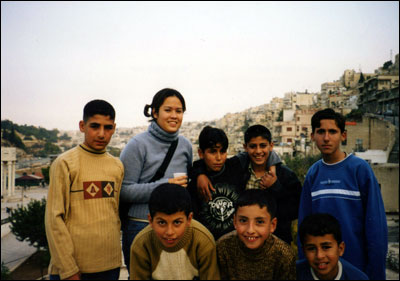
A sip of Egyptian tea

200701_egyptiantea2.jpg

A doorman in a foreign land shares stories with an American visitor.

Amman, Jordan, is on its way to becoming a modern city in the Middle East. High rise buildings dot the landscape, and Mercedes and BMWs shoot through traffic circles. In the basements of every high rise and apartment building, you will find a “boab” who is sharing his living space with the tenants’ cars. The boab is a jack of all trades: he is a 24-hour live-in doorman, the building’s guard, a maintenance man, a personal grocery shopper, and the car washer. Indispensable but nearly invisible.


My name is Abu Hassan. People laugh at me because of my small feet. They are almost a size 4. No matter how I try, I can't hide them. I wear sand-colored open-toed sandals, like the ones we have back in Egypt. But here, in Amman, I wear sweatpants and not a long gallebeya, my traditional Egyptian robe that conceals my feet.

What's my daily routine? It's simple really. I wake up before the sun rises and wipe down each of the cars in the apartment building. There are 18 in total and they are all lined up. The six-story building is old and badly needs to be sandblasted. It's not nearly as nice as the one my son Mohammed works in down the road, but both buildings have the same owner. He is fair and occasionally generous.

I have my own room on the ground floor right beside the elevator, more space than I ever had in Egypt. There, we were six, packed in a tiny room. It was always filled with flies. The flies crowded around our babies' eyes when they slept, especially in the summer.

Now I have an entire bed to myself. I even have an extra one for when my son visits. There are no bugs, and I own a small black and white TV.

After washing and polishing each car early in the morning, I come back to my room and put my copper kettle on my small stove and wait until it whistles. I snatch it off the flame just as it is about to fully let out its piercing song so that I don't wake up everyone in the building. I mix in five spoons of sugar and dunk a tea bag that seeps its ochre goodness into the boiling water.

The glass warms up my fingers, which are rigid from the cold cleaning water outside. Unlike Egypt during the winter months, it snows here in Amman.

After my break, I sweep the entire entrance to the apartment building. The 14 pesky kids who live here leave little piles of candy wrappers in every nook you could imagine — between the cracks in the pavement, the grooves of car tires, and the tops of the entrance bushes. Every day I am forced to go on a trash hunt to keep the place spotless as they giggle and watch. As soon as I've cleared the entire area, they run to their school buses, leaving whirlwinds of dust and trash behind them. And I have to start sweeping all over again.

If it's a good day, the foreign woman on floor two may ask me to clean her apartment or help her fix things. She tips well, perhaps an American trait. She's clumsy, speaks broken Egyptian Arabic, and has a strange talent for breaking things.

She asks me to come up once a month to help her with repairs. I never know what to expect.

Last time, she had somehow ripped her curtains off their hooks. I've never known anyone who managed to do that. The time before, she had yanked the handle off the toilet. It took me a week to figure out that one. She then cracked her wooden bed frame in two. And one time she blew up her glass coffeemaker.


I call her Ruru, and that's what the kids call her too. At least she's able to distract them, by playing football with them after school so that I can get about my business.

Best of all, she loves my tea. She comes by once a day to chat, and I laugh. From her stories, I can tell that she's not just clumsy at home; she takes her klutziness into the world. Over tea and sometimes a tobacco waterpipe, or sheesha, she tells me stories — about her experiences at work and her convoluted attempts to buy things.

She calls pillows "beans." And when she tries to say "beans," she uses the word for "money" instead. Her Arabic is mangled, but she talks with her hands and reminds me of being back home in Egypt.

Ruru lived in Cairo for three years and has carried our humor with her. She seems to trust me more than others, because I can understand her even when her words make little sense.

Ruru is friends with the apartment building owner, so I feel extra kind towards her. I always put an additional scoop of sugar in her tea, even though she says it will make her lose her teeth. In return, she brings me treats. She knows what my favorites are: dried apricots and strawberry milk.

I pray that Ruru marries someone good. Someone who can fix many, many things.


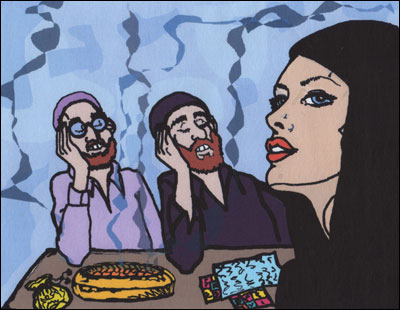
Sub urban

Childhood innocence meets grown-up hate.

I was raised in suburbia
without stigmata.
Jews and Christians roamed
a land once inhabited
by cucumbers, wheat and potatoes.

The wheat became white bread
as did the schools and playgrounds
but soon the fields were no more.

We played soldier killing krauts & nips.
We played cowboys and Indians.
I always wanted to be the Indian
Native American Jew.

We learned to kiss at parties
playing games of post office &
spin the bottle.

Not once did we play
CIVIL RIGHTS LEADER OR
FRIEND.

Our mothers taught
us to get along
with each other
and not be harbingers
of secret hates.

Except the boy down
the street
had parents who hated
Jews
&
Negroes.

There were no Negroes
in the neighborhood
so they centered
their hate on the Jews.

My mother did not understand
ANTI-SEMITISM. She spoke
perfectly pure ghetto before
it was popular.

But that did not stop
the Nazis from being intolerant.
The only museums they had
were dedicated to KRISTALLNACHT
a night of pogrom.

What’s a mother to do?

Today when I think of the Holocaust
I see the bodies piled like timber wood
and the sweetish smoke of burning flesh
the stripping of consciousness
along with gold fillings and JEWelry.

But Mom did not know that the people
down the street hated her because of her blood
and the hate hand-me-downed to their offspring
who wore HH tattooed on his red-haired forehead.
He prevailed that hate through 12 years of school.

Today the president of Iran says the Holocaust
never happened. I challenge him to walk with me
through my childhood and through the streets of
Terazin. Perhaps he can come with me to Auschwitz.

I will make sure he takes out his nose filters &
earplugs, removes his blindfold.

personal stories. global issues.