Lead by example

The Sean Bell case is 50 shots too many.

There was a time when I would try to stick up for police officers. My late grandfather, Warren Brown, was in law enforcement for 35 years in Cleveland, Ohio. He was a detective in the juvenile unit and was highly respected in the community he policed. As far as my own experiences, I’ve never had any altercations with cops. When I had the unfortunate experience of being mugged one night on my way to a party in Harlem, I found the investigating officers to be extremely sympathetic and professional. When I got pulled over for speeding on a few occasions, I never received an obnoxious or cold reprimand. But, unfortunately, my interactions are a far cry from those of my two brothers, my male cousins, and male friends — all of whom have something in common. They are all black men.

Sean Bell and Amadou Diallo were also black men, who were gunned down in a spray of bullets by police officers. Fifty shots were fired in Bell’s case, 41 shots in Diallo’s. How many for the next? And that question must be asked because there will definitely be another tragic killing, as long as policemen continue to perceive black males as suspects. The Diallo case is closed. It is now common knowledge that the police got it wrong when they cornered Diallo. One of the four cops who was indicted testified that Diallo had matched the profile of a wanted rapist and had reached for what they believed was a gun. It turned out to be a wallet. And Diallo, a hardworking immigrant from West Africa, was unarmed.

Although a jury acquitted all four cops in the case, New York City later reached a $3 million settlement with Diallo’s family, who had filed a wrongful death civil suit.

There are still no answers for the Bell case. In fact, it has yet to yield indictments. But what is known is that Bell was unarmed, and no weapon was found on him or in his car. We also know that one officer alone fired 31 times. There have been protests around Manhattan led by civil rights leader Reverend Al Sharpton. New York Mayor Bloomberg said in a news conference right after the shooting that the “50-odd shots fired” were “unacceptable or inexplicable” but noted the need for an investigation to “find out what really happened.”

What needs to be said is that this latest shooting death was excessive, an egregious example of police brutality by the NYPD, and an honest snapshot of the way some officers treat blacks in urban communities. Because no charges have been made yet, the identities of some of the officers involved in the Bell case have yet to be revealed. Although the cops include two blacks and a Hispanic, I fail to see the significance. Police brutality is police brutality, and whether or not an officer is black or white, there is still an unspoken trend that allows cops of all colors to get away with aggressively interacting with black males.

My grandfather policed Cleveland’s Eastside, a predominantly black, lower-income community. He investigated gang activity, picked up truants and thieves. He also drove around in an unmarked car, and he wore plain clothes. My grandfather was proud to be a detective, and he earned the respect of the community by setting an example. He was a professional, not a bully. And perhaps that’s what went awry in the cases of Amadou Diallo and Sean Bell. If the officers involved respected Diallo or Bell as human beings, not as guilty black male suspects, then maybe those men would still be alive.

My grandfather had to interact with violent youths, and he also had to turn the other cheek when the “N-word” and racial jokes were part of the everyday locker room banter. There were times when his job was stressful, dangerous, and tense. For sure, the undercover officers in the Bell case have been in stressful situations themselves. But my grandfather didn’t take his anxiety and anger out on the people he was paid to protect and to serve. He respected them. My grandfather never fired 31 shots at an unarmed person. And he never killed anyone. What a shame that the officers in the Bell and Diallo cases can’t have that track record.


Folklore photography

A conversation with photographer and cultural activist Martha Cooper.


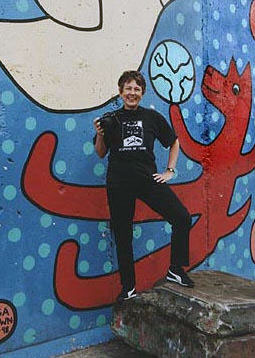
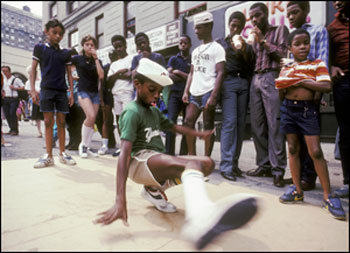
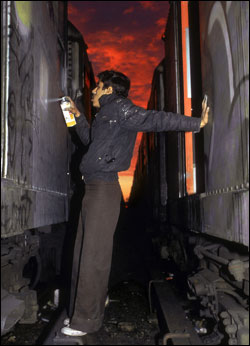
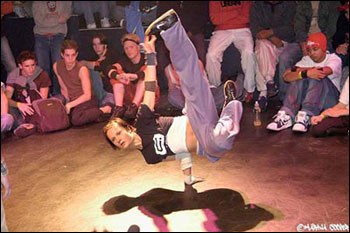
From the time Martha Cooper received her first camera — a Baby Brownie — while still in nursery school, she has been in love with photography. Sixty years later, Cooper is a renowned documentary photographer based in New York City. She worked for the New York Post as a staff photographer from 1977 to 1980, but she is best known for her pioneering work in the 1970s and 1980s, documenting the emerging hip-hop scene. Her book Subway Art (Thames & Hudson), published in 1984 in collaboration with Henry Chalfant, raised subway car graffiti to an art form and is still considered a classic text for graffiti artists today. In 1994, she published RIP: Memorial Wall Art (Thames & Hudson) that showcased the practice of spray-painting murals on city walls and subway cars to commemorate recently deceased friends and relatives. Since then Cooper has collaborated on many other projects that portray little known aspects of urban folklore. Her latest book (together with Nikki Kramer) is We B*Girlz (PowerHouse Books, 2005) about female break-dancers. Cooper recently talked with former ITF Travel Editor Anju Mary Paul about her projects past, present, and future, the increasing appreciation for urban culture in New York today, and the difficulties of getting published. But first, we had to convince Cooper that she was an activist.

The Interviewer: Anju Mary Paul

The Interviewee: Martha Cooper

I’m active; I don’t know if I’m an activist. It’s a subtle form of activism that I do — it’s not like picketing. Do you know about Citylore? I’ve worked for them for 20 years. They’re a non-profit community organization that documents, among other things, the ethnic communities, festivals, arts, traditions, and urban folklore of New York City. This is their 20th year and I’ve been involved with them as director of photography for the entire time.

Did you become interested in Citylore because your own interests are so closely aligned with urban culture?

Yes. I did an early project on “play” which evolved into a book called City Play. That sort of led to my introduction to Amanda Dargan and Steven Zeitlin, who had similar interests and then they founded Citylore. They do poetry gatherings, public programs; it’s not just photography. Their mission statement reads: “As cultural activists we are committed to the principles of cultural equity and democracy. We believe that cultural diversity is a positive social value to be protected and encouraged; that authentic democracy requires active participation in cultural life, not just passive consumption of cultural products; and that our cultural heritage is a resource for improving our quality of life.” So, yeah, I guess I’m a “cultural activist.” Let’s go with that one!
How did you get into this field in the first place, connecting photography and urban culture?

I grew up with photography because my father had a camera store. And I wanted to travel. As soon as the Peace Corps was formed, I joined. I was in the Peace Corps in Thailand from 1963 to 1965. Then I decided I liked traveling around and looking at different cultures. I wanted to be an anthropologist. So I did a year of graduate work and then decided that I really didn’t want to be an anthropologist! It was too analytical. I just wanted to look at the stuff, take pictures and things. So I decided I wanted a job that would combine photography and anthropology, but there really wasn’t a good path to do that at the time.

So you pretty much created the job for yourself?

I did. Of course, there is a history of ethnographic photography. And there are actually some books on it. And now I think there’s even an organization: Visual Anthropology, but I haven’t followed what they’re doing.
Did you start taking photos of urban culture through your job at The Post?

I was very attracted to New York City for no reason I can put my finger on. I knew all the publishers were here and I wanted a career in photography. At the time I was living in Rhode Island, but the things I wanted to photograph fell more in the category of “urban folklore,” so when I came to the city, I naturally sought out the things that interested me and took pictures of them. And then I found out that there is a field of urban folklore, so I connected with those people who were doing research in this field. A very early project I did was called “Brooklyn Rediscovery.” We produced a slim little pamphlet Making Brooklyn Home that we are constantly going back to for information about these places. It covered typically urban and New York City things like pigeon flying, playing bocce but using old railroad tracks under the El as opposed to a court, playing skelly, which is a game only played in New York City, and the giglio (pronounced jil-i-o) festival in Brooklyn, which is still going on. We did extensive research with urban folklorists on this project. There’s a core group of folklorists in the city and I kind of fell into it and that’s where I still am.

Do you find that interest in urban folklore within New York has grown since you first started?

Yes. I think that people are much more aware and so I don’t shoot it as much anymore because I don’t like to go to these festivals and find hundreds of photographers there. When I was the only photographer, I felt I was discovering something interesting and unusual, and preserving it. Photography is a great way to preserve history. It’s cheap and one person can do it; you don’t need a film crew. But now, when I go to many of these festivals, I just feel like I’m elbowing other photographers. In a way, that’s a good thing. It means that New Yorkers are more aware and participating in cultural activities that are out of their own culture. But I like to be the discoverer.

Do you find yourself moving more overseas to do projects? Is the U.S. maxed out?

I don’t want to go overseas to do projects. What I found is that even though it’s a lot of fun to travel, it’s too hard. It’s hard to do a continuing project and connect with people and be able to go back. I’m always arriving and being told, “Oh, you should have been here last week! That’s when we really had the big thing,” or “Wow! It’s coming up next week,” but I’ve already gotten my ticket home.
What projects are you working on now?

There’s a neighborhood in Baltimore called “SoWeBo” — South West Baltimore — after Soweto in South Africa. The name of it appealed to me as much as anything else. And I found a little house there. There are no stores, there are no Starbucks; it hasn’t gentrified yet. There’s a liquor store, I think. But I met this couple and they said, “We’re going to make this place into Georgetown!” And all this is right on my street. A block away there’s one of the oldest stables in America. They have 18 horses and they have these guys called “A-rabs”, and they go round the neighborhood with horse carts selling produce. There’s another Baltimore tradition of painted screens. People paint their screen doors and windows so you can’t see in through them. There aren’t that many left; the screen painters have all pretty much passed away, but I did see a few. And this is all in my neighborhood. This is urban folklore in Baltimore.

How do you choose your projects?

Something about it has to excite me in order to invest so much time and money in it. I like to feel that I’m investigating something that hasn’t been extensively covered before, though in the world today, that’s practically impossible. But graffiti was like that, and when I started covering hip-hop, the words weren’t even in use. And I got into that through break-dancing, which I’d never seen before and wanted to pursue. And my neighborhood in Baltimore, I feel that there has not been any documentation about it.

A lot of other projects are just given to me. I do them with somebody because it’s their project, not mine. I’m pretty much a jack-of-all-trades; I’ll do anything. I’m fortunate that I don’t have to go out looking for work; work comes to me. At this point, I don’t even have a portfolio.

Do you have any dream projects in your head?

Well, the Baltimore project is the one that’s kind of taken over my imagination right now. The thing that’s different about Baltimore is that it’s all my own. I’m not working with anybody else; it’s just me so I’m completely free to decide what I want to shoot and how far I want to take the project. There’s no pressure to satisfy someone else; I just have to satisfy myself. And when I get a good picture, it’s very exciting. When I see kids playing in inflatable pools on the sidewalk, I get a buzz! So Baltimore in some ways is my dream project because I can take what I’ve learned in the last 20 years and apply it to a fresh site. There’s nothing like going to a new place to get your juices flowing. But I can also come back to New York easily. It’s like traveling — I call it my “country house” even though it’s very urban. Going there evokes the same kind of joys of traveling, but without the inconveniences. I can go back and forth. For instance, I was in Baltimore for the past three days, I came back here for two days, and tomorrow I’m going there again.

There are other projects that I would like to do. For instance, I lived in Japan for a couple of years in the 1970s. And I’m trying to put those photos together into a book. I have enough photos for a hundred projects. So I’m now thinking I should start to put them together.

Has it been hard at times to get other people interested in the projects you’re interested in?

Yes. It’s definitely hard to get them published. For instance, for years I’ve documented vernacular architecture. I have huge files on vernacular architecture in New York that I have on my computer. And I’ve had all kinds of book proposals out and I’ve gotten grants to do this, but I’ve not been able to get a publisher. And when you look at architecture books in stores and you see all this formal architecture but there’s not even one book on urban vernacular structures. My photos have to do with surviving in the city and finding interesting ways to ply your trade without spending a lot of money; for example, by squeezing a tiny store between buildings. And there’s all kinds of personalized things: door-handles, signs, awnings, and menu holders. There are many different ways that individuals transform the city. That’s my theme. But I’ve just not been able to get anywhere with this in terms of publishing it. My idea was to simply publish it as a little book similar to the one I did on memorial walls. And I have contacts with publishers — it’s not like I’ve never been published. But they just look at it and say, “Nah, won’t sell,” but I think it would sell. I just think that people walk up and down the street and they don’t notice these things.

I remember you told me how much trouble you had getting Subway Art published.

Exactly. But when I did get it published, the same publisher published Memorial Art and I would have thought—it’s an architecture publisher—that I would have been able to talk him into this one too. But I have not been able to get anywhere. What I’ve decided is that the longer I wait, the more interesting these photos become as the city changes. Most of the structures are already gone. It’s hard to get these projects out there. And if they’re not published, what’s the point really? I shoot for my own pleasure of course, but to me, a project isn’t really successful until it’s in some form that is tangible and public.


Spread the good news

200701_AFRICA_ART.jpg

Charlayne Hunter-Gault reports there’s more happening in Africa than we thought.

In 1997, when I landed in Mali, West Africa, as a volunteer with the U.S. Peace Corps, my knowledge of the place was based mostly on broadcasts of the 1980s famine in Ethiopia and the fantasies of Joseph Conrad. The first night, I was awakened by a distant thumping and couldn’t go back to sleep as I imagined my hosts drumming around a fire, enacting some ancient, possibly savage, rite. It was only through the light of many days that I learned the noise was from women pounding millet and sorghum, which they rose before dawn to do for the day’s meals.

The root of my assumptions about Mali and Malians was a diet of bad news — and badly reported news — on Africa that even the most discriminating Western publications have found difficult to resist. “[We] constantly face an American view of Africa that’s been mediated through stereotypes,” Frederick Cooper, a historian at New York University, once told me. “For an Africanist, reading The New York Times was just as depressing in 2004 as it was in 1964, or probably worse. In 1964, they were at least reporting on new things happening. Instead every reporter wants to rewrite “Heart of Darkness.”

Most foreign coverage of Africa is by journalists who parachute into a place and wrap a story in a matter of hours or days; they don’t know the background and fail to give adequate context to the issues and events they are covering. Instead, they fall back on what journalist Charlayne Hunter-Gault calls “the four D’s of the African apocalypse — death, disease, disaster, and despair,” plus corruption, which have become a convenient short-hand for most news about the continent. In Hunter-Gault’s latest book, New News Out of Africa: Uncovering Africa’s Renaissance (Oxford University Press, 2006), she argues that there is a world of news to report beyond this and that Africa is now experiencing the earliest quivering of a rebirth that values democracy, human rights, civic life, and women’s empowerment. Hunter-Gault takes this argument a step further by insisting that the endlessly bleak and clichéd accounts have actually colored the rest of the world’s perception of Africa, discouraging foreign engagement and investment, and leading to pessimism and confusion there and elsewhere.

Hunter-Gault, who won two Emmys and two Peabody Awards for her coverage of Africa, is well-suited to make this case. She was first sent to South Africa in 1985 on assignment for PBS’ MacNeil-Lehrer News Hour, and was till recently the Johannesburg Bureau Chief for CNN. She bases her assertions on her own detailed reporting — including multiple interviews with Nelson Mandela, his successor as president of South Africa Thabo Mbeki, and a host of other high-level government officials — and the work of a small group of colleagues. She starts the book with what she knows best both professionally and personally: South Africa’s transition from apartheid to real democracy, weaving in her own experience in the U.S. Civil Rights Movement, during which she helped desegregate the University of Georgia as its first black woman student.

For Hunter-Gault, 1994, the year apartheid officially ended and South Africa held its first truly democratic election, was a major turning point for all of Africa. The transition has not been without its challenges, she writes. South Africa, for example, has more than five million people living with HIV — the highest number in the world — and a staggering majority of the population was, until a decade ago, totally disenfranchised from education, health care, civic life, and professional opportunities.

The journalist acknowledges this in her deconstruction of the South African government’s policies on HIV/AIDS, affirmative action, and the economy, but also offers nuggets of hope and progress. While president Mbeki has been criticized for his ambiguity on the extent of the AIDS crisis, she gives him the benefit of the doubt and touts the country’s program of free antiretroviral drugs, and the fact that it spends far more than any other African nation (about $2 billion between 2003 to 2006) on treating the disease. She also discusses the country’s urgent efforts to increase access to education and employment for its majority black population. This is critical if South Africa is going to compete in a global market, but it has also overwhelmed many universities, whose budgets are contracting under the burden of so many needy students. Hunter-Gault contends that this dire problem has spurred innovations, such as the CIDA (Community and Individual Development Association), a free university for business and management education supported by corporate donors.

Based on her American experience, she notes that the sudden creation or implementation of laws can take generations to be fully felt. “It is through the prism of the United States’ history that I daily bear witness to the changes occurring in South Africa, and that is the yardstick against which I measure its progress.” But in this dance forward — and back — Hunter-Gault sees South Africa as the most powerful black-led country in the world and believes that it has the potential to lead not only its own Renaissance but that of an entire continent.

With South Africa at the helm, all of Africa is taking its first uncertain, but meaningful, steps toward democracy. She writes: “[T]here is a second wind blowing through the continent today: the forty-eight countries of sub-Saharan Africa are attempting to break free of the lingering legacy of colonialism, as well as many of the demons of their own design.” This new movement, she says, is most evident in the founding of NEPAD, or New Partnership for African Development, in 2001 and the formation of the African Union in 2002.

NEPAD, led by South Africa’s Mbeki, Algeria’s Abdelaziz Bouteflika, Egypt’s Hosni Mubarak, Nigeria’s Olusegun Obasanjo, and Senegal’s Abdoulaye Wade, has vowed to eliminate poverty by concentrating on sustainable growth and development, promoting Africa in the global arena, and accelerating the empowerment of women. The African Union, meanwhile, replaced the Organization of African States, originally formed in the 1960s to support decolonization across the continent, but subsequently used as a bulwark for defending dictators’ sovereignty (and oppression) of their respective nations. The new organization has its eye on African unity and development, through the creation of democracy and conflict resolution. Hunter-Gault acknowledges that these institutions are young and must still prove their mettle in the face of ongoing tensions in Central Africa and the genocide taking place in Darfur.

But for the world to hear and understand any of the changes afoot, they must be well reported. Those on the frontlines of reporting this “new news” are African journalists. Many still contend with limited training or access to computers and the Internet, as well as government harassment and threats — Zimbabwe and Sudan presenting the direst cases of silencing foreign and domestic journalists alike. Yet there is an increasing crop of independent, homegrown media, who are providing a more nuanced perspective of the events and people in Africa. Even in the harshest of conditions, Hunter-Gault cites instances where “guerilla type-writers” are getting the word out, posting their stories surreptitiously in the continent’s burgeoning Internet cafés.

However, African journalists cannot report the news alone. Hunter-Gault advises more collaboration between Africans and their foreign colleagues both to help cover extremely sensitive stories, where the international press may be more immune to government pressures and retaliation, and to gain more informed perspectives by working closely with counterparts on the ground.

Above all, she counsels journalists to “come in right” — or report the news honestly and fairly — an expression taken from an encounter she had with a member of the Black Panthers, while covering that organization in Harlem in the 1970s for The New York Times. “[This phrase] has served me well, making me particularly sensitive to trying to strike a balance between stories of war, conflict, corruption, poverty, pestilence, and disease, on one hand, and on the other, stories that tell us of the people who live amid all that and yet survive, endure, and sometimes prosper despite the odds. These people are the embodiment of new news, but they rarely, if ever, hold news conferences.”

Without downplaying the real challenges facing African nations, Hunter-Gault should not be dismissed for her optimism. With the rise of the Internet, foreigners have fewer excuses than ever for ignoring what happens there, while African journalists and citizens are increasingly discovering the power of information. Africa may have experienced a Dark Ages, replete with foreign invasion, pestilence, societal breakdown, oppression and exploitation — from within and without. And yet, if we look closely as Hunter-Gault suggests, we might see the first stirring of the continent’s own, true Renaissance.


CK Williams

Poetry was just something that existed in the world, like granite. —C.K. Williams

Poetry was just something that existed in the world, like granite. —C.K. Williams


The odds of dying

As children across America greedily tore open presents on Christmas day, the Iraqi Interior Minister Jawad al-Bolani announced a grim statistic: 12,000 Iraqi policemen have died since the US-led invasion began in 2003. With the total number of police numbering at approximately 190,000 officers, that means the odds of an Iraqi policeman dying are around 1 in 16.

Despite the odds of dying, joining the police offers a prospect of employment, and according to Interior Minister Jawad al-Bolani, when we call for new recruits, they come by the hundreds and by the thousands.


Kill or covert

"It's an incredibly violent video game… Sure, there is no blood. (The dead just fade off the screen.) But you are mowing down your enemy with a gun. It pushes a message of religious intolerance. You can either play for the 'good side' by trying to convert nonbelievers to your side or join the Antichrist." —Clark Stevens, co-director of the Campaign to Defend the Constitution, speaking about the PC game Left Behind: Eternal Forces, in which players can convert or kill non-believers.

The game is based on the Left Behind series of novels by Tim LaHaye and Jerry Jenkins, which takes place in the apocalyptic post-Rapture world, in which Jesus has raised true believers in him to heaven while non-believers were left behind to face the Antichrist. Over 60 million copies of the books, which are ostensibly based on the Book of Revelations, have sold since 1996.

Those who play Left Behind: Eternal Forces may choose to join the Antichrist’s minions and play for his team, which includes fictional rock stars individuals with Arab and Muslim-sounding names.

Jeffrey Frichner, president of Left Behind Games, blithely dismissed accusations of racism and religious intolerance with the statement that, "Muslims are not believers in Jesus Christ." The ramifications of being a non-believer in Frichner’s scheme, then, is that they ought to be slaughtered if they cannot be converted.


personal stories. global issues.