Iceland after the fall

Notes from an icy island on the anniversary of its meltdown.


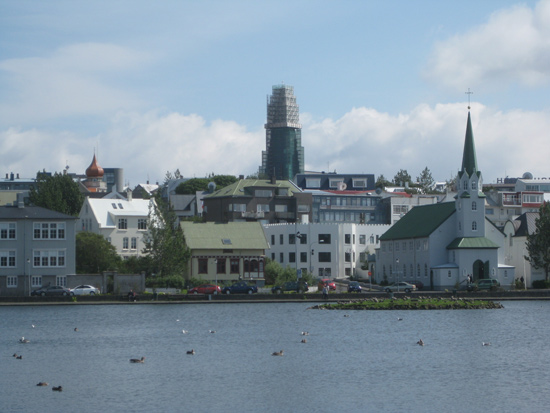
Undulating, moss-covered lava fields and grey skies surrounded me on the drive from Keflavik Airport to downtown Reykjavík, dubbed “101” or “the 101” by local hipsters. Speeding eastward along Route 41, I could see Faxaflói Bay spread out on my left and on my right; off in the far distance, sat the remnants of the former United States Air Force base. The surrounding landscape has been favorably compared to the surface of the moon, although I could not imagine the lunar surface looking so inviting. Navigating through the narrow streets of Reykjavík proved easier than I had anticipated, and after locating my small hotel on the western edge of the city, I checked in, refreshed myself, then left on foot for Laugavegur, Reykjavík’s commercial nerve center. It was barely eight in the morning.

Until its economy imploded in the early weeks of October 2008, Iceland had been for me, as it was for many of my contemporaries, best known as the home of a famous chess match, a U.S.-USSR summit that didn’t go so well in the 1980s, and a few quirky musicians. So it was a shock to discover that not only had the global financial tsunami lapped at the shores of remote, mysterious Iceland, but that the whole thing had nearly gone down in the span of a weekend. Who knew Iceland had such weapons of financial mass destruction? And who knew that it would end up turning these on itself?

Nearly a year after Iceland had almost fallen apart, I decided to visit Reykjavík to see for myself how Icelanders were faring. For the natives, rebuilding meant painful economic restructuring conducted under the glare of the international spotlight — and the attention was not always welcome nor, for that matter, kind. To me, Iceland’s collapse evoked pity and fear, as in it I saw reflected the fearful outcomes that might have struck my own fortunes had the U.S. economy not been so robustly buttressed.

A journey to Iceland, therefore, would be a touristic form of catharsis, an attempt to purge the unease of living in an economically unsafe world with a reassurance that if the Icelanders could keep themselves afloat, then there was hope for the rest of us. Call it a “recession vacation” or “vulture tourism”; either way, I wanted a front-row seat to one of the preeminent stories of the young millennium: a Western European democracy attempting to recover from total financial apocalypse and save itself from becoming the go-to punch line for the Great Global Financial Crisis of 2008.

The lay of the land

That first morning, I strolled through Austurvöllur, the public square facing the parliament building and the site of frequent protests, though on this morning the only signs of discontent were a row of placards planted along the edge of the sidewalk. No one else was around at the time, suggesting that whichever protest these signs had garnished had either taken a recess or was in preparation mode for later in the day. Though they were written in Icelandic, the boldface type, exclamation points, and earnest handwriting implied a manifest objection to the current state of affairs — though it seemed the height of Icelandic politeness that these signs, clearly left overnight, had stood at the edge of the square unmolested. Although it was only a few weeks past midsummer day, I felt the need to bundle up under fleece and winter coat, and thought perhaps I was being overcautious by allowing the “ice” in Iceland to convince me I had walked into a nation-size refrigerator.

In good time I navigated my way to Bankastraeti, and, as I had anticipated, the banks of Bankastraeti had been emptied — both literally and figuratively. The ghosts of decimated balanced sheets and lost savings accounts of nationals and foreigners were eerily called to mind by the residue of signage that had been haphazardly removed yet still lingered in faint sun-bleached traces on walls and windows. If trauma can be said to leave traces of heightened emotion in the places where such tragedies occurred, then Bankastraeti oozed the psychic residue of intense suffering and made me shudder. It felt unclean and unsafe.

After a short distance, Bankastraeti morphed into Laugavegur. The cityscape, such as it was, rose gently up a hill, but upon reaching the main drag, I found Laugavegur and its side streets littered with broken bottles, garbage, and puddles of multicolored liquid drying in the cool morning, as if a cyclone had ripped through the world’s largest liquor and vomit store and dumped the refuse across central Reykjavík. More ominous, however, were the shop windows. Although it was clear that the stores and boutiques were in business, filled with merchandise and accepting all major credit cards, almost every one of them had displayed somewhere on the glass the word útsala. Sale. Clothes, souvenirs, sunglasses, books, bicycles, even Dolce & Gabbana were discounted at 50 percent, 60 percent, 70 percent off. Deserted art galleries were another common feature, most of them depressingly emptied and abandoned, while others, barely operational, had unpurchased wares clearly visible through somber windows.
 

In the mercantile mise-en-scène of Lagevular, I could perceive a palimpsest of Iceland’s mercurial rise and fall. The functional if not entirely imaginative architecture of the row of shops betrayed a recent past life as a thriving yet quaint high street. Then, when the good times and good money rolled in, these storefronts were swiftly appropriated for high fashion, big-ticket luxury consumer goods, piled Gucci-high and Prada-deep. Yet with all these trappings, it was still easy to determine that these establishments had not been originally fashioned for fashion; the interiors were too plain, too dull. What I observed that morning was the third and saddest phase: the fire-sale panic of desperation, útsala signs superscripted over these august labels like diacritical marks of economic depression.

To get a better look at the city, I made my way up to the majestic Hallgrimskirkja, the Lutheran church that commanded an impressive view over all of Reykjavík. Its massive front, built to resemble pillars of columnar basalt, was unfortunately obscured by scaffolding, providing an unflattering backdrop for the majestic statue of Leif Erikson perched out front. Seen from the top of Hallgrimskirkja, Reykjavík in the Saturday morning sun lacked the gravitas one would naturally expect from a world capital. Suspended, as it were, both geologically and symbolically betwixt America and Europe, it lacked both the Old World weltanschauung of London or Paris and the New World, nouveau riche glitz of New York City. It was clear, however, that from its most recent financial gambit, Iceland was struggling to become a significant something — if not a mirror of its peers, then a distinctive North Atlantic equivalent — and this desire for that distinctive something-ness could be seen in the manic architectural eruptions on its fringes, mainly in the suburbs and along the waterfront in the form of glass and steel monoliths and Scandinavian-inspired high-rises.

Yet a collateral benefit of Iceland’s quest for something-ness has been Reykjavík’s transformation into a multicultural metropolis. With a population of nearly 120,000 (over 200,000 with suburbs included), greater Reykjavík accounts for nearly two-thirds of Iceland’s population of 320,000, 7.4 percent of which are foreign citizens. The majority of these are Central and Eastern Europeans. However, a substantial portion of this figure is made up of Africans and Asians. Up until the crisis hit, Iceland’s surging economy had necessitated the rapid importation of mass labor, mostly for the construction and service sectors. In 2000, the foreign population of Iceland numbered only 7,271, mostly in Reykjavík. By 2007, however, the boom was heating up, and 18,563 foreigners were living and working in Iceland. By the end of 2008, the year the banks crashed and the economy soured, the immigrant population stood at 23,421.

In absolute terms, 23,421 might not seem so significant. For Reykjavík, however, the sudden introduction of outsiders was not so much culture shock as culture electrocution. This sudden, rapid influx of foreigners propelled suburban expansion in Reykjavík (“do not shoplift” signs around the city are written in six languages, including Polish and Vietnamese). It also led to a serendipitous collateral industry: foreign restaurants. Indian, Chinese, Mexican, Italian, and even Nepalese restaurants dot the city and draw brisk business.
 

Saturday night runtur

Upon leaving Hallgrimskirkja, I heard a low rumbling accompanied by a loud hiss and the sound of breaking glass coming from below. I scrambled around a corner only to be nearly run over by a convoy of massive street-sweeping trucks. These large, cubical creatures slowly grazed on the filth lining the roads, scrubbing away the glass, trash, and puke with gigantic rotating brushes and sprays of pressurized water. In mere minutes, all traces of the mess were gone, and the beasts lumbered on to filthier pastures. Standing in the midst of what had only moments before been a trash heap, I was astounded that such chaos could be so smoothly transformed into order.

The disarray I had witnessed was not in fact the result of Iceland’s transformation into a dystopian trash heap, but rather the leftovers from the previous night’s runtur, the world’s most amicable kegger. On Friday and Saturday nights, a drinking ritual is reenacted, where Icelanders shed their northerly reticence, drive in circles, and — especially in the case of Reykjavíkians — drink themselves into a state of friendliness. Whether on the streets or in the bars, when Icelanders get excessively drunk, they don’t get mean; they get nice.

Eager to join in the festivities, I spent the rest of the day in low-energy pursuits, mainly museums and people-watching. Austurvöllur was crowded with locals and tourists, and the only indicator of disquiet was a lone protester standing in front of the parliament building. Surrounded by his poster and banging a gong, the white-haired man spent the afternoon howling invectives into a megaphone. Meanwhile, nearby throngs of Icelanders relaxed, sunbathed, and took advantage of the free Wi-Fi in the square, hardly noticing the man with the gong.

Later that night, I engaged Icelandic culture on its own alcohol-fueled terms. Returning to Laugavegur, I found the streets transformed into a spontaneous celebration and packed with revelers. Well-dressed adolescents with Hoxton fins and popped collars comingled with larger, older, more tastefully clad folk walking, driving, staggering, and occasionally singing their way across the city. I found myself greeted and smiled at by random strangers, tipsy teens apologized sincerely for accidentally bumping into me, and scores of 20-somethings honked and waved at me from their cars. The streets, especially Laugavegur, were choked with cars which were in turn choked with smiling occupants. Revelry, merriment, and politeness were in fluid abundance under the fuchsia glow of a sun that refused to dip too far below the horizon. If there were any harsh financial difficulties being suffered by those present, I could sense none of it amongst the runtur revelers that night, at least as long as the beer and brennavin (the local caraway-flavored schnapps) flowed, nor did it seem appropriate that night to spoil everyone’s pleasure by asking about unpleasant topics.
Instead, I literally went with the flow, in this case the flow of people, cars, and drink, which swept me down Laugavegur, up Hverfisgötu, and all through the backstreets and alleys, from bar to bar and club to club. I philosophized with strangers (in English, of course) and at one point observed two rowdy drunks being counseled to calm down by the police — and their complying without complaint. As I sat in the back of a gay bar at 4:00 a.m., umpteenth drink in hand, rockabilly band playing American hits, and women in scarves and poodle skirts dancing the night away, I was overwhelmed with an inexplicable sense of optimism.

As the hours passed and the midnight sun gave the sky a rose-tinted hue (although this could have easily been the effect of my bloodshot eyes), the litter accumulated, glass bottles were broken on sidewalks and in gutters, and puddles of puke blossomed anew on the pavement like wildflowers after an 80-proof rainstorm. This time, however, I wasn’t so worried as I was earlier that day. Perhaps it was too much of a leap to see in the runtur a metaphor of Iceland’s attitude about weathering its own grim economic forecast. That is, despite the hardships of the present, maybe all the driving in circles, drinking, and wild abandon would eventually get fixed somehow and by someone else, preferably whilst everyone was asleep. Then again, maybe this time the hangover of financial runtur might not be so easily sprayed clean by the even-handed application of state resources as Reykjavík’s streets were every weekend morning. Still, it was a comforting thought, as I made my way in the general direction of my hotel, that someone else was going to clean up this mess.

When financial hardship is not enough, add humiliation

The facts of Iceland’s economic collapse, like Sunday morning in Reykjavík, are startlingly bright, hard to ignore, and well known to everyone. The triumvirate — some would say the bankocracy — of Landsbanki, Glitnir, and Kauphthing banks had gambled big and lost bigger, the ratio of debt to the gross domestic product (GDP) being the neighborhood of around €50 billion to €8.5 billion. The nationalization of these institutions set off a chain of events resulting in austerity measures, political unrest, gallows humor, and the mass spontaneous combustions of Land Rovers by owners who preferred to destroy their vehicles and collect the insurance rather than be forced to pay them off. Unemployment, which had been 1 percent in 2007, had risen to 9.1 percent by February 2009 before settling to 7.2 percent the following October. The GDP sank 3.3 percent in the first three quarters of 2009.
And then there were the humiliations. As a price for breaching global financial decorum and actually falling apart, Iceland would suffer the shame of the public stockade. U.K. Chancellor of the Exchequer Alistair Darling famously invoked an antiterrorism law in order to protect the funds of British citizens who had deposited money in Iceland banks. At the news that the International Money Fund (IMF) had agreed to provide funds to stabilize the Icelandic economy, a mob of angry protesters assembled in front of the Althing, Iceland’s parliament building, demanding Prime Minister Geir Haarde’s resignation. President Olafur Ragnar Grimsson created a mild diplomatic stir when, in an attempt at self-effacing obsequiousness, he offered the Russians use of the abandoned U.S. airbase at Keflavik, apparently in exchange for a helper loan. (The offer was politely declined.) Michael Lewis, writing for Vanity Fair, added to the feast-of-fools atmosphere by describing in comic-horror vignettes the testosterone-juiced ineptitude underpinning the risky financial machinations of Iceland’s banks, while Icelanders were portrayed as chauvinist, sexist, and entirely inept xenophobes.

Iceland as financial terrorist. Iceland as fourth-world country. Iceland as Russia’s toady. Iceland as a financial idiot playing with nuclear weapons and getting radiation burns. To these one might add one more characterization that surfaced in the press just as Iceland was well under water: the ever-so-embarrassing detail that a majority of Icelanders reportedly “[did not] deny the existence of elves”and that consequently major construction projects had to wait for certification that no elves would be harmed. Iceland as elf-believers. It seemed that — in the case of Iceland’s recent historical catastrophe, anyway — the first time for Iceland was both tragedy and farce.

These were not appealing narratives, particularly for a country that had been, until recently, the poster child for the transformative power of bold financial risk-taking. A nation of speculator-spenders, buoyed by yen swaps and ebullient optimism, had seen its worldwide profile rise so precipitously that when the end came as spectacularly as it did, there was nowhere to hide from the shame of it all — the end came on too fast. The Reykjavík daily newspaper, Morgunblađiđ, reported that 50 percent of Icelanders aged 18 to 24 were considering leaving for good, no doubt to avoid the shame of living in a state with such clumsy bankers and politicians.

The “Library of Water”: the cure for tourist guilt

There was one other form of humiliation laid over the bad figures and the bad press afflicting Iceland: a spike in tourism, the ironic upside of having one’s currency devalued so viciously. Tourist shilling is a special form of humiliation, one that compresses economic necessity and local hospitality customs with the need to “perform” one’s self and one’s identity for the entertainment and edification of eager outsiders. Tourism certainly brings in the foreign capital, but at times the cost to one’s self-esteem can be as devastating as the financial meltdown itself, and in Iceland’s case, the 2009 tourism numbers sped upward almost as soon as news of the country’s collapse in October 2008, whereas Europe’s tourism industry declined across the board. It seemed that many like me had targeted Iceland for a recession vacation of their own.
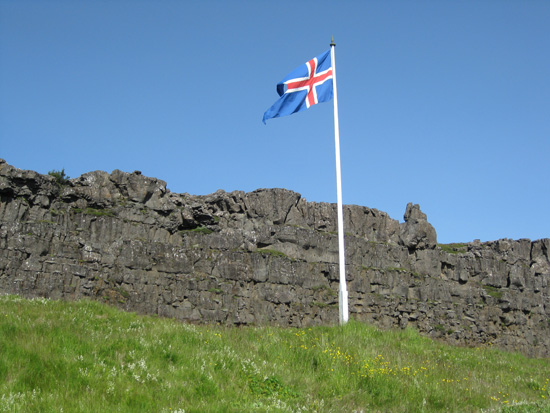
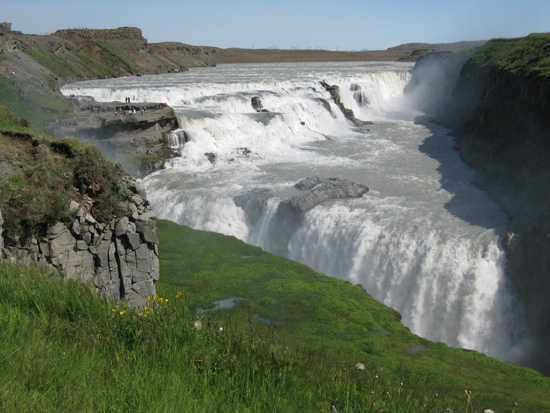
Thus, over the next few days, I gingerly set forth to look for signs of economic recovery in ways I hoped would inflict the least embarrassment both for them and for me — call it tourist guilt. Unfortunately for my guilty conscience, my first stop turned out to be the most well-trodden of tourist haunts — the Golden Circle. Hovering over Reykjavík like a halo of geological wonders, the Golden Circle comprises an impressive array of natural and historical sites: the _ingvellir, the site of Iceland’s ancient parliament, founded in 930 A.D.; Gullfoss, a spectacular waterfall; and the Haukadalur Valley, home of Geysir, from which all geysers are named. The route took us past volcano craters both dormant and extinct, mirror-smooth lakes bursting with char, and a vast geological rupture that ran like a long, thin valley for miles. It was the Mid-Atlantic Ridge exposed to plain air, the meeting point of the American and European plates.

Over the next few days I spread out and covered more ground, the pangs of tourist guilt gently subsiding under the spell of Iceland’s brooding panoramas. I hitched a ride to Nesjavellir to see a geothermal plant, and later that day I caught a bus to Skógar and hiked up a segment of Sólheimajökull, an easily accessible arm of the Mýrdalsjökull glacier. Decked out with crampons and an ice ax, and avoiding crevasses and sinkholes, I made my way up several kilometers of aquamarine ice bespeckled with the ash and pebbles of a century-old eruption. Underneath the ice cap lurked Katla, a volcano that had last exploded in 1918 and whose threatened reawakening was a constant source of gossip and fearful speculation for the locals.

Along the way and at every stop, contrary to what I had heard about Icelanders’ legendary reticence, the locals I met and interacted with seemed willing enough to opine on the landscape, geology, local mythology, and crisis facing their country. The common refrains I heard were variations of familiar bromides about waiting things out and hoping for the best. Their responses brought to mind a house I saw near a mountainside on the trip back from the Golden Circle, a small, bright green summer cottage that happened to be completely surrounded by boulders the size of baby brontosauruses. Having been built so near a mountain ridge on an island prone to earthquakes, the builder was just asking for trouble; and yet when the big one hit, the house was miraculous spared. There was bold fatalism in that house, similar to the shrug that I saw Icelanders interject as they reflected on their economic travails.
On my last extended day trip, I met the chattiest Icelander, Magnús. I was set on visiting the seaside town of Stykkishólmer, resting on the southern edge of the Breiðafjörður fjord on Iceland’s west coast and apparently home to the best runtur in Iceland. My intention was to pay a visit to a particular art installation titled “Vatnasafn” (“Library of Water”) by the American artist Roni Horn, which consisted of water samples taken from various natural sources — mostly glaciers — from across Iceland and placed into tall, clear, pillar-like cylinders.

Magnús, my driver, spoke without ceasing, digressing with authority on biology, geology, architecture, and Icelandic history and mythology. He expounded on the sagas and showed me a path allegedly worn into the solid lava of Berserkjahraun by two feuding Vikings. At another point he stopped the car and asked me to listen to the landscape with him. Though it was an odd request, especially coming from someone who spoke so much, I indulged him, and for a few choice minutes together we stood at the side of the road, the sound of wind rushing down steep hillsides.

Back in the car he asked, “Would you like to try hákarl?”

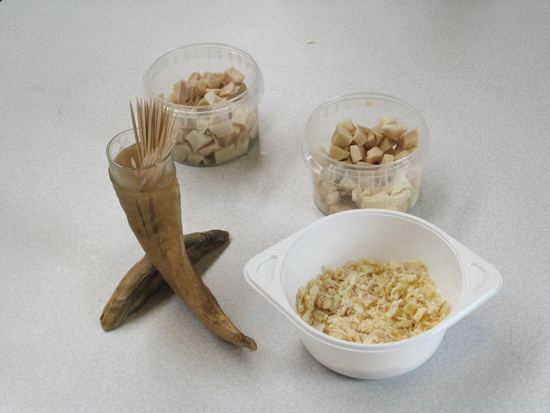
For the uninitiated, hákarl is the preserved flesh of Greenland shark, famous for its nauseating smell and taste which reportedly once made Gordon Ramsay throw up. Catching Greenland shark the traditional way involves hooking it, wrestling it into your sailing vessel, then severing its spine below the skull while avoiding having your own spine snapped by its hideous jaws. Since the flesh is saturated with uric acid (the better to survive cold North Atlantic waters), Greenland shark meat is sliced into large sections, buried for several weeks, then hung to dry — or, if you prefer, rot — for many months afterward. The resulting product is a spongy meat the color of alabaster, usually cut in cubes, reeking of violent death. I was game.

After reaching Bjarnahöfn, an out-of-the-way farm at the end of a long, unpaved driveway, I found ways to delay the inevitable tasting that would surely cause me intestinal distress: I admired the horses, breathed the fresh air, and speculated on the unusual tools I saw hanging on the wall outside one of the buildings. A few meters away I saw a trailer with a blue tarp, its edges held down by ropes. I observed a child approach the tarp and lift one of its corners, revealing the sliced corpse of a recently caught shark. The proprietor of the farm was a longtime hákarl maker from a long line of hákarl makers, although on that day he was away, so Magnús introduced me to the hákarl maker’s grandson, who proudly showed off a collection of hooks and curio memorabilia arranged in a makeshift museum. Weird stuffed animals stood sentinel over ancient fishhooks and yellowed photographs of unsmiling fishermen. A well-preserved fishing boat was propped up on one side of the museum-shed, surrounded by desiccated shark faces and other seafaring accoutrements.

Set out on a table, unassuming yet foreboding, was a container of hákarl, with no alcohol chaser within easy reach. Even from a distance the smell was overpowering, and I hesitated before impulsively taking the plunge, spearing a piece with a toothpick and popping it in my mouth. My strategy was to chew and swallow quickly, then run for the door to projectile vomit — it would be over in seconds. Surprisingly, I was not overcome, neither by fumes nor flavor. As I chewed warily, the aroma, texture, and mouthfeel reminded me of the kinds of dried fish I used to eat in Hawaii where I grew up, minus the queasy formaldehyde-like after burn, though when offered I gently refused a second taste. That I had bested Gordon Ramsay just once was enough of a victory for me.

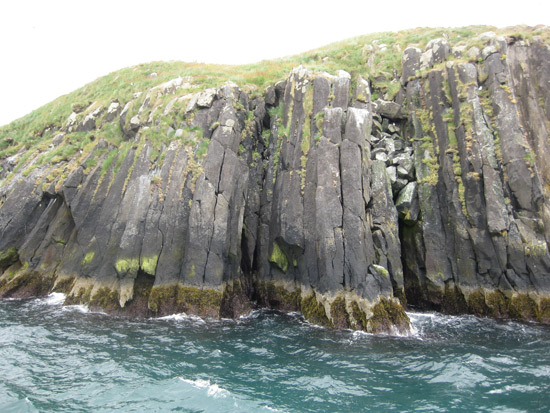
Shortly thereafter we headed on to Stykkishólmer, Magnús’s hometown. I was dropped off near the harbor with instructions on when I’d be retrieved. Breiðafjörður, the bay upon which Stykkishólmer sits, contains thousands of islands of varying size and a diverse array of birds and sea life, and I would have been remiss not to go out for at least a few hours and explore. I caught a tour boat that took me around some of Breiðafjörður’s major islands, remote and forbidding, crammed with puffins, guillemots, gulls, and even an eagle. The islands were unruly masses of columnar basalt rising vertically (and sometimes horizontally) out of the depths of the sea so steeply that the boat could sidle within arm’s reach of a cliff without threat of running aground. The stone looked like so much rebar gathered, twisted and misshapen with scant tufts of greenery tossed in to enhance the island effect. I could understand the impulse to design Hallgrimskirkja after these formations, as the islands themselves exuded a cathedral-like solemnity (minus Hallgrimskirkja’s fascistic undertones). The empty homes of especially brave farmers were planted on select islets scattered in the bay, and I noted the sheep grazing away, oblivious to us and their precarious isolation.

Back at Stykkishólmer, I hiked up the tallest hill to get a view of the harbor and environs and to visit the former town library, which had been altered to be the home of Roni Horn’s “Vatnasafn.” As I walked in, I was invited to put surgical booties over my shoes so as not to disturb the rubber flooring laid down as part of the installation. I found the columns of water scattered throughout the open rooms, and on the floor were words, mostly in English, expressing different moods: happy, sad, indifferent. As the light shifted during the course of the day, different moods would be emphasized by the refracted light of the water. From one of the large bay windows I could see a fancifully designed white church made out of stylish, modernist gestures (I later learned that Magnús had taken part in its construction, although he was not a churchgoing man himself). In another I saw a two chairs and a table with a half-played chess game. It was quiet, sunny, and warm inside the artwork, a welcome respite from the cool summer air outside, and yet I wondered, as I left, what had happened to the real library that “Vatnasafn”  had replaced.

On the drive back to Reykjavík, I drew up the courage to ask Magnús about his views of the economic distress. He knew things were bad, but living in Stykkishólmer, so far from the center of things, was both insulating and isolating, and he seemed content to let things work themselves out. As we drove through landscape dotted with volcano cones and craters, he mentioned the 1973 Eldfell eruption on the island of Heimaey. Faced with the loss of the harbor so crucial to the island’s economic survival, Iceland engineered a heroic rescue operation that involved pumping millions of gallons of seawater onto the advancing lava, cooling and diverting it. Despite the substantial destruction of property and a mass evacuation, the herculean effort succeeded in holding back the lava, and Heimaey was saved. And as if to add triumph upon triumph, the islanders managed to generate electricity and hot water from the residual volcanic heat and resurface the tiny local airport with the volcanic fallout.

Perhaps this is how Icelanders saw themselves and their relationship to the crisis looming before them. Hovering in the nether realms of the national sub-conscience, the Eldfell response showed how Icelanders could save property, prevent mass emigration, and turn destructive heat into productive energy through persistence, engineering, and a bit of luck. It was a tempting thesis, and I tried it out on Magnús. He shrugged the summer-cottage-in-the-boulder-field shrug.

The whales of July

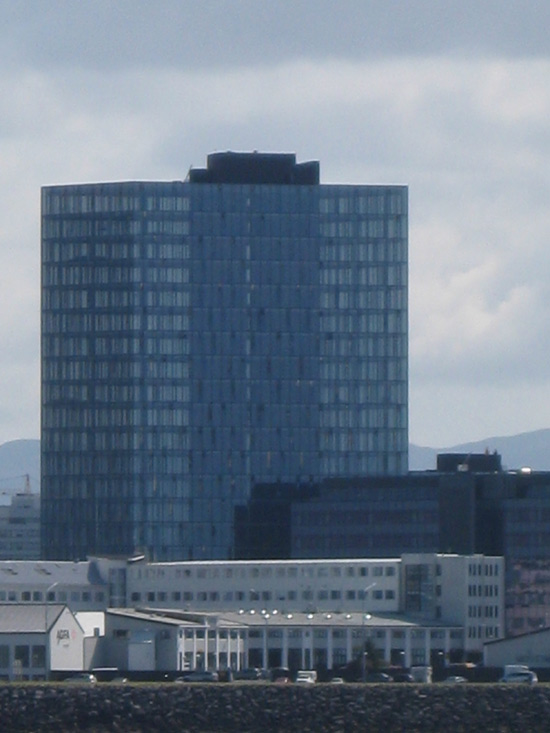
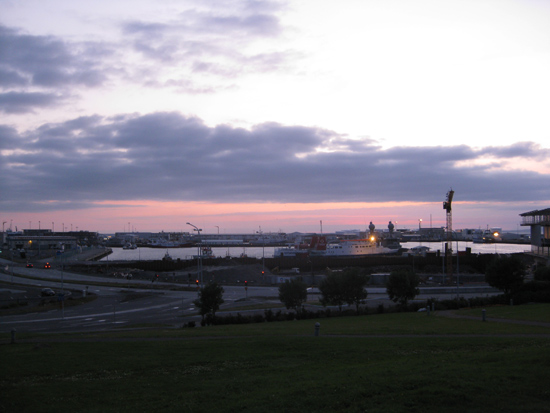
On my final afternoon in Iceland I went whale-watching in Faxaflói Bay. As we chugged out of the harbor, I could see stark reminders of the building boom gone bust: half-built or empty buildings lining the shore. A sliver of an office tower, clad in floor-to-ceiling glass windows, stood imposing but hollow.

Although the puffins were unaccommodating that afternoon, the whales were abundant, and an especially frisky humpback emerged from the deep and whipped the tourists into a photo-taking frenzy. It spouted, flipped its tail several times, and approached so close to the boat that I could smell its fishy breath whenever it exhaled. Several minke whales later joined in.

On the return trip I befriended two women, an Icelander named Johanna and her co-worker, a Chinese exchange student. Both attended university and were taking the day off from their part-time hotel jobs. We spoke generally about the whales and the lack of puffins, then later compared digital pictures of the sea life.

I delicately brought up the subject of the economic crisis.

“It was crazy,” she began. “Too much money and not enough workers. Every high school student had a full-time job. Every day they would come home from classes and then start working.”

She said that even before the crisis it was the Icelandic way to graduate: incur debt buying homes and other luxuries, then spend a lifetime paying it all off. Generous government housing subsidies had set the stage for the madness that followed, and more easily available credit accelerated home-building and housing speculation ad absurdum. I asked her if she had felt the same compulsion to borrow and spend as her peers had, but she claimed she hadn’t.

“We’re probably going to join the EU,” she said with a sigh as we clung to the observation deck bars. “Things will probably get worse before they get better. But I’m not worried.”

“So you’re optimistic,” I suggested.

“Oh God, no,” she replied. “I’m moving to Vienna to live with my boyfriend. There aren’t any jobs here.”
 

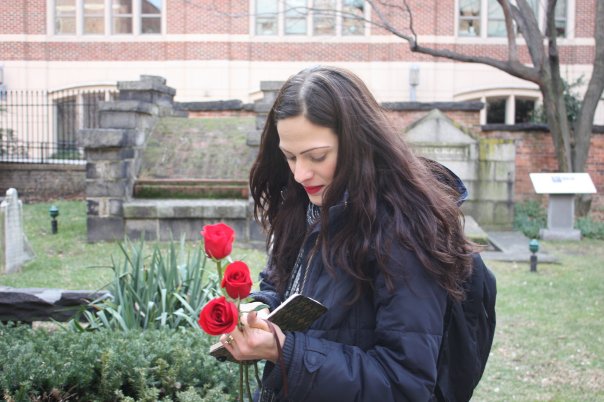
Cynthia Pelayo writes a note to Edgar Allan Poe before leaving her own tribute at his grave.

Toasting Poe

Best of In The Fray 2010. A dreary midnight when a yearly visitor was “nothing more.”

I prepared as I would for any other overnight at a cemetery in the middle of January—by pulling on three layers of clothing and making sure I had all the essentials. The essentials for this stakeout were a camera, a notepad, pencil, a hot cup of tea, and Edgar Allan Poe.

With his complete works secure as an application in my iPhone, I pulled on my black knit hat and heard a tapping. I spun around to find my husband giving me the pressing nod that all husbands give to their wives as a nonverbal cue to hurry up. I looked at the time and panicked. It was 11:36 p.m., and time to go.

The hotel clerk called us a taxi, but after waiting twelve minutes we took off sprinting through the streets of downtown Baltimore. We had flown in from Chicago just for this night and wanted to make it to our destination before midnight.

Cynthia Pelayo writes a note to Edgar Allan Poe before leaving her own tribute at his grave.

As we turned down Fayette Street, it was no surprise that a crowd of about 50 people had formed outside the Westminster Hall and Burying Ground in front of both sets of tall, black gates. We caught our breaths and checked the time. We had made it. In a few minutes, this crowd of strangers, who had traveled from all over the United States, would mark Poe’s 201st birthday.

Some people greeted us with smiles or nods, others with the question on all our minds: “Do you think we’ll see him?”

“Him” being the Poe Toaster, the mysterious black-clad figure who has appeared at Poe’s grave every year for the past sixty-one years. First documented in 1949, the Poe Toaster raises a toast of cognac and leaves behind three long-stemmed red roses at the author’s grave. One rose is presumably for Poe, the second for his wife, Virginia Poe, and the third for his mother-in-law, Maria Clemm. To date, the Poe Toaster’s identity has remained secret, making him—or her—one of America’s true mysteries.

Poe himself loved a good mystery. He is credited with writing the first detective story, starring his curious investigator C. Auguste Dupin. Yet even a master detective like Dupin couldn’t unravel the circumstances surrounding the cause of Poe’s death, which remain unsolved to this day. Speculations have come and gone as to how he wound up delirious in a Baltimore gutter, only to later die. He was then buried to no fanfare in an unmarked grave in a family plot at the rear of the cemetery. Eventually he was moved to the other side of the cemetery to rest beside his wife and mother-in-law beneath a white monument engraved with his image.

A headstone engraved with a raven and an epitaph that reads “Quoth the Raven. ‘Nevermore’” marks his original burial spot. And it is here that the Toaster prefers to leave a tribute, and near which I stationed myself for the night.

With my gloved hands gripping the black bars and my face pressed close to the cold metal, I refrained from participating in any graveyard chatter. I didn’t want to risk missing the Toaster.

Poe had reached out to me with “Annabel Lee” when I was an angst-ridden preteen convinced that no one understood my sorrow. Later, “The Raven,” “The Masque of the Red Death,” and “The Murders in the Rue Morgue” would inspire me to become a mystery writer.

I came here this evening to thank him, my guide and my mentor.

At 12:20 a.m. a girl screamed, “I see someone!” She pointed out over the cemetery, her face tinged with awe and fear. I looked in the direction of her finger and saw a silhouette. The shadow of a man crept across the tombstones and vaults and then disappeared. Then suddenly, shouts erupted as we saw the flip of a man’s cape. I screamed for my husband, who had gone off to take pictures. He rushed to my side and shook my arm in congratulations. “You saw him, honey!”

I was completely thrilled. We waited for Jeff Jerome, the curator of the Poe House and Museum, to appear at the gate to ceremoniously present the three roses and bottle of cognac as proof. When he did walk out at 12:43 a.m., he only waved before returning to the church where he kept watch on the burial grounds. My heart sank. Whatever we saw, it wasn’t the Poe Toaster.

The celebrations resumed, because it was, after all, a birthday party, with a group reading of “The Raven.”

After a few hours the group dwindled to around 30 diehards. Paranoia set in as our eyes played tricks on us. At one point a gentlemen shouted, “I believe the Poe Toaster is one among us!”

He even pointed at me, perhaps because I had been mostly quiet.

There has never been any definitive evidence left by the Toaster to reveal his or her identity. All we know is that the original Poe Toaster left a note in 1993 stating that the “torch” had been passed. Later, another note indicated that the role was passed on to a son after the older Toaster died.

As the group grew impatient, we decided to sing “Happy Birthday” to Poe to help lure the Toaster out. Our chorus rang through the moss-covered graves, and the final note brought a charge of electricity. A young man cracked open the Poe book and announced he was going to read his favorite Poe poem, “A Dream Within a Dream,” written in 1849, the year of Poe’s death. The poem was fitting for such a moment; right then we all could easily have said, “All that we see or seem is but a dream within a dream.”

As it neared 5 a.m., I felt a growing pang of anxiety in the pit of my stomach. The latest that the Poe Toaster had ever left the tribute was at 5:30 a.m. in 1990. Was he—or she—running late? Was it even possible that the Poe Toaster would run late for such an important event? The idea of a no-show had never seemed possible to me.

Cynthia Pelayo's tribute of three red roses and a bottle of cognac is left at Poe's grave.
Cynthia Pelayo’s tribute of three red roses and a bottle of cognac is left at Poe’s grave.

At 5:35 a.m., Jerome and his fellow watchers approached the gate slowly, their faces solemn.

“He didn’t show,” Jerome announced.

“What happened?” I asked.

As Jerome padlocked the gates, he shrugged and smiled again, his grey mustache moving with his words. “I don’t know. The guy could have the flu.”

They left, and before long, we decided to call it a night. At Poe’s grave I decided to read my favorite poem, “The Bells,” which was published posthumously. Reading as loudly and clearly as I could, I hoped that wherever the Toaster was, he would hear and finally pay his tribute.

“Oh the bells, bells, bells! What a tale their terror tells.”

In one final show of desperation, I pressed my face to the gate and shouted, “Please Poe Toaster! I promise I will not reveal your identity if you come out now.”

There was silence.

Shakily, I said, “You have to come. It’s his birthday.”

Tears flowed down my cheeks, and I couldn’t believe that for the first time in his history the Toaster failed to arrive. I thought of Poe’s death and how he was not initially praised for his writing but was mocked as an alcoholic and buried without any salute. I did not want Poe to think we, like the Toaster, had forgotten.

Later that morning, after feeling as if I’d been stood up for the prom, I realized I needed to stop at a liquor store and a flower shop.

With three red roses in hand and a bottle of cognac, my husband and I returned to Poe’s grave, anticipating it’d be already covered by people from all over the world. But there was nothing.

I wrote a note, opened the cognac, and took a long swig before pouring some over the moist dirt. Then I set the roses and note on the tombstone. I had come here to witness the Poe Toaster, and in a Poe-like plot twist, became one.


Making History Out of Footnotes

Best of In The Fray 2010. A look at one man’s take on the reality of Gaza through his unique brand of comic art.

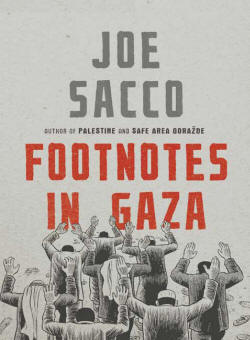
Joe Sacco's Footnotes in Gaza

The massacres of 386 Palestinians in two Gaza Strip towns—Rafah and Khan Younis—by Israeli soldiers in 1956 have not left much of an imprint on history. At the time, the media was preoccupied with the Suez Crisis, and as a character in Joe Sacco’s new graphic novel Footnotes in Gaza laments, Gaza is a place “where the ink never dries” before the next calamity happens. Footnotes is Sacco’s impassioned attempt to set the historical record straight, to make the massacres more than a footnote.

“History can do without its footnotes,” he says. “Footnotes are inessential at best; at worst they trip up the greater narrative.”

Sacco himself only learned of the massacres from a brief mention in The Fateful Triangle, Noam Chomsky’s indictment of America’s pro-Israeli policies that was published in 1983. In 2003, he returned to Gaza—where he had previously traveled on assignment for Harper’s during the second intifada—to investigate the killings. Footnotes draws from his interviews with witnesses and survivors, examinations of Israeli archives, news stories, and United Nations photos.

Like Art Spiegelman (Maus) and Ed Piskor (Macedonia), Sacco is a master of what could best be described as “graphic journalism,” his two previous books—the award-winning Palestine and Safe Area Goražde—also using the form. In Footnotes, he alternates images of Gaza in the 1950s with images from present-day Gaza. One drawing, for example, shows neat rows of houses that made up a refugee camp in 1956; that is contrasted with an image of the same camp today, rocks holding down shabbily built roofs, a sea of satellite dishes on top of them. Similarly, when Sacco’s Gaza subjects tell their stories, images of them in the 1950s are juxtaposed with images of them now, their faces showing the toll of a hard life.

Sacco’s method has a tremendously compelling quality, in that his juxtaposing technique evokes a sense of what might have been, as readers grapple with the subjectivity of each storyteller’s memory. In one scene, Gazans debate over when exactly a family member died and was buried. Their memories are eroded from the passage of time—and from pain. The technique also evokes a sense of continuity, weaving together the past and present, and demonstrating the inexhaustible nature of the Israeli-Palestinian conflict.

As if to demonstrate just how intertwined the past and present are in Palestine, Sacco touches on the death of Rachel Corrie, an American activist who was run over by an Israeli Defense Forces bulldozer while she protested the demolition of a house in Rafah in 2003. On the same day that Corrie was killed, Ahmed El-Najjar, a Rafah resident, was shot by Israeli forces in the head, chest, and leg, reportedly while standing in his own doorway. As Corrie’s body lies in the morgue, surrounded by the flashes of photojournalists’ cameras, El-Najjar is left alone by the media, tended to by only his family. “The killing of a Palestinian in Gaza is a routine occurrence,” Sacco observes. “His loss will cause not a ripple outside of his immediate circle of family, friends, and neighbors.” In one chilling image on one page, Sacco expresses the book’s message: death and destruction are so commonplace in Gaza that the details become simply footnotes, existing only in the memories of Gaza’s residents.

If one aspect of Sacco’s work must be criticized, it might be his apparent inability to leave anything out. Footnotes in Gaza is 432 pages thick (compared to Palestine, which comes in at only 288 much narrower pages) and, at times, feels cluttered. Fortunately, it’s split into sections and can easily be read piecemeal once the reader passes the introduction.

Footnotes does not provide a broad history of the Israeli-Palestinian conflict, nor does it answer any of its big questions. And though it is not a sequel to Palestine, those without much knowledge of the intricacies of Israel’s and Palestine’s histories would do well to go back and read Palestine first. But Footnotes provides an intimate look into the lives of ordinary Palestinians whose memories of 50 years of conflict are permanently ingrained into their outlook on life. It is one man’s take on the reality of Gaza, brought to vivid life by his unique brand of comic art.


Missed connections

Some years ago, a co-worker had accompanied a friend as moral support to a band audition. My co-worker, M, saw a lovely-looking guy exiting the audition room with a saxophone. She worked up the nerve to introduce herself and they chatted about random things: the weather, the L train, the Beatles vs. the Stones, and then the friend was called to perform. During the hubbub, they went their separate ways and never exchanged phone numbers. This is not an unusual story, except for what happens next.

But first there's a little something you should know about M. She was a helpless romantic. She believed in Prince Charming and messages in bottles and that all you need is love. She had plans to get married at Cinderella's castle with Jiminy Cricket singing "When You Wish upon a Star." For Halloween she always dressed as a princess. She was the original daydream believer.

Knowing this, it may not come as a surprise that in the days following her chance encounter, M pined for the sax player. She dreamed of the perfection that was him and before the week was out she'd picked names for their three kids. She finally called the company that had hosted the audition and begged for his phone number. The receptionist must have admired M's chutzpah. She relayed the message to Mr. Sax Player and gave him M's number. He called her and they went on a date. (By the way, this scenario is only remotely plausible if you are in your early 20s like M and her sax-playing man. Then it's earnest and heady and just a touch clandestine. After a certain age it kind of crosses the line to desperate and stalkerish.)

It's not just M who was fabulously optimistic in her pursuit of true love. Patrick Moberg proved me wrong (see "When a woodchuck could chuck wood post, June 3) and fell head over heels on the 5 train a few months ago.

Moberg isn't alone in his search for Ms. Right. Just yesterday there were 100 posts on Craigslist in NYC searching for a "missed connection," whether that took place on a platform or in a Starbucks. Let's say you saw your future husband on the subway but, for whatever reason, you couldn't speak to him. Just post an ad and sit back until your honey comes a-calling.

"i think you live in greenpoint because i've seen you maybe 3 times on the G. you were wearing a blue shirt and white shorts maybe, with long dirty blonde hair in a pony tail. you had a bag that said "ralph" on it. you got off at 5th ave and it saddened me. i've got dark hair, i was wearing jeans and a green collared shirt. i don't think you'll read this, but hopefully next time i will be courageous and make the damn move."

"It was Saturday night around 10 pm at the 2 or 3 train going to brooklyn. You had a slimless shirt with white and blue stripes, some blue jeans and some tennis shoes with a roster logo. I tried to keep eye contact from you, i was wearing some shorts and a green tshirt. I got off the Eastern park way museum stop. I wanted to say hi and talk to you"

"me: at the southern end of the car. Glasses large photo bag. Kept looking your way. You: other end of car. Blue dress. Red hair. Kept looking my way, thought it was at me, could be wrong though. A clown got on the car at union or ninth." (My note: only in NY)

Alas, it seems that you would have a better chance of finding true love at a "foot and back rub" place on the Lower East Side. Moberg wasn't going to take any chances on the love of his life. He decided to create a webpage to find his lady: www.nygirlofmydreams.com. In a city of eight million people, it took him 48 hours to find said girl of his dreams, one Camille Hayton, living in Brooklyn, originally from Melbourne, Australia. Hayton's girlfriend spotted her sketched likeness on the website and called her.

The results? My former co-worker M married someone else and apparently is pregnant with their first baby. Moberg and Hayton dated for two months, but they've decided to "just be friends."

An "A" for effort to all parties involved. It gets me thinking. Maybe someone is looking for me and I don't even know it! I wonder what my ad would look like.

You: Gurl with ipod dozing on 2 train. U R so k-ute. Don't worry. It's ok.

Me: sittin' a little too close w/ my backpack. What language do you speak?

(See the "You are so cute" post, October 15.) 


American education: Down the drains?

At Change.org, there is an honest look into "The Myth of Public Education" by Megan Greenwell:

"But that notion of public universities increasingly belies a less-attractive truth: many public colleges are too expensive for even middle-class students, and they're not providing enough financial aid. A study out this month from advocacy group The Education Trust underscores the growing problem: rising tuition and changing priorities for financial aid have priced many poor students out of their states' flagship public universities. As Kati Haycock, president of The Education Trust, wrote in the report, 'No longer widely accessible, their treasure is bestowed disproportionately on the children of America's economic and political elites.'"

 At the same site, there is also an article about America's drop-out epidemic. Marian Wright Edelman says:

"One-size-fits-all school zero tolerance disciplinary policies are responsible for the growth in the number of school-based arrests of poor and minority children, funneling them into the juvenile and criminal justice systems at younger and younger ages. So many are suspended, expelled, even arrested, for nonviolent infractions such as being 'disruptive' or 'disrespectful.' In the past, many of these problems would have been resolved in the principal's office or referred to a pastor or social worker or by calling the parent (who may no longer be in the house). Too many children today end up with an arrest record and are labeled a troublemaker, increasing the likelihood of dropping out of school."

No surprise that some professors and scientists routinely say that kids in India and China will take over America in the next decade. Next week we will look into Indian and Chinese education systems and why so many foreign students want to attend U.S. universities.


Love and marriage, Filipino-style

When I was 13 years old, I'd decided that if Pat Benatar was right and love really was a battlefield, then I'd be proud to fight for the grandeur of romance, show off all of my scars, and maybe lose a few emotional appendages, too.

By the time I was 16 years old and my father revealed that he'd had two children out of wedlock, and that he and my mom were considering divorce, the idealism of happily ever afters had sunken in so deeply that it wouldn't bleed out of me, no matter how many times my heart broke.

And so it's been, despite  the unhealthy dysfunction of my parents' rollercoaster marriage, and my own many strange and twisted experiments with sex, love, and fidelity: I have always held on to the ideas that love is one of the most beautiful things anyone can know, and that the hope of an enduring, loving, and fully supportive marriage is an ideal worth fighting for.

Even though my American peers and I all know about single-parent households, divorce, remarriage, and blended families, there is a legitimacy behind it all, a logic telling us that what matters is not how a family is made, but the definite love and respect between a family's members. We carry this knowledge like a badge of superiority, an assured and assumably accurate claiming of life experience and maturity. Sure, bad things happen; sure, marriages end and parents divorce; sure, many teenagers navigate the quicksands of dating and relationships at the same time that their parents re-enter those same assailing conditions, but that's life. We act out, we drink too much and do drugs, we go to therapy, we become promiscuous, we cry on our friends' shoulders, and then, eventually, we trudge on with the business of growing up and getting over it all. Throughout these battles, our reverence for love and marriage remain intact.

Apparently, it's a different love story in the Philippines.

There is no divorce in the Philippines, no empathy for unwed mothers or their bastard children, no faith in the loyalty of men, and no hope in happily ever afters. A hard crust of distrust coats the layers of bitterness which enshroud the Filipino's romantic experience, and try as they might to shake off the negativity, "common sense" and experience have taught their lessons well: the only happily ever afters are the ones that exist after you've contorted your romantic ideals into an unrecognizable blob of compromise and resignation.

Women are expected to fulfill their supportive and nurturing role of "girlfriend" or "wife" regardless of their partner's loyalty or lack thereof; cheating and adultery among men is not only accepted, but expected. When a woman cheats, she's a slut or a whore or a lunatic. But when power-wielding men do it, when down-and-out men do it, when young men do it, and when old men do it, the common reaction is "But of course!" Either they do it to show off their power, or to show that they still have some kind of power, or because they have the power of youth, or because they're losing the power of youth. One thing is clear: love in the Philippines is an epic power struggle, and women are not the only ones losing.

Children grow out of these relationships feeling awkward and uncertain about their worthiness of love and their claim on a legitimately successful life. They question the value of romantic relationships and doubt their own ability at finding everlasting love. They half-believe what the culture dictates: that they are somehow less desirable as human beings because their parents do not have a storybook romance and marriage. It is in this climate of hostility that far-fetched notions of acceptable loves are brewed and the significance of the institution of marriage is devalued.

Because there is no divorce in the Philippines, and also because women who have children out of wedlock sentence themselves and their offspring to eternal criticism and condemnation, there is a pervading sense that the solution to the mistakes of romance is not to learn from it all, grow, and move on, but to get married and stay married. And even though some teenagers are lucky to have a teacher deplore this ill-advised measure, the idea of marriage as panacea has sunken deeply into the core of Filipino culture. Shame on you for having sex before marriage. Shame on you for having children before being wed. Shame on you for being born out of wedlock. Shame on you for separating with your spouse and shacking up with someone else. In a country whose culture dictates that everyone know everything about each other and that they all wield the power of judgment, shame is powerful. For these reasons, marriage becomes a last-chance or last-ditch-effort at keeping one's life together and not a lasting tribute to love.


Hope for Haiti


It is not all about money, folks. When it comes to international disaster relief, yes, money is the big thing, but it is not the only thing. If you cannot send money, then please spread the word around among your friends, family, and co-workers; maybe someone will be able to. Right now aid agencies are saying that they are not looking for money more than relief materials from the public.

I have decided to donate my one-week online earnings to Save the Children for their work in Haiti. You know during times like this, it is the children, women, and people with disabilities who suffer the most. As a mother, I was drawn toward children.

Here is a list of organizations now accepting online financial donations:

Save the Children

 Yéle Haiti

SMS text “HAITI” to 90999 to donate $10 to Red Cross relief efforts 

You can also visit Google's Haiti crises page for more. And here is part of a  press release I received from Tampa, Florida, just to show that every bit helps:

Spinelli, president of the Association to Conserve Tampa Water, and Aquafree Toothbrush will be joined with Kalos International and the Haitian Association Foundation of Tampa in a major press conference today with emergency officials announcing local efforts by Tampa residents to assist in the earthquake that caused a major disaster in Haiti. The press conference will take place today, Thursday, January 14th at 12:00 p.m., Hillsborough County-John F. Germany Library, 900 North Ashley Drive  in Tampa. The city of Tampa recently went through a water shortage, which is happening in Haiti right now. Over 100,000 water-less Aquafree toothbrushes invented by a local resident will be handed out to children and families in Haiti.


Boxers or briefs?


Yesterday marked the "Ninth Annual No Pants Subway Ride," wherein thousands of exhibitionist New Yorkers got down to their skivvies and boarded the subway. For what, you ask? Well to get a date, silly.

"It's a place to meet people that's not your traditional bar scene," said Brady Kirchberg, 26, who was taking part in his third no-pants ride. At least we singletons now have another option beyond eight-minute dating and online dating. It sorta eliminates a lot of awkward moments later on, no? Though I should note that the temperature hovered at about 20 degrees yesterday, so you'd have to take that into account.

As you'd expect, most New Yorkers were fairly blasé about the whole thing. Gintas Norvila said, "It's the first time I've seen it. It looks very interesting," and went back to reading Dostoevsky's Notes from Underground.

Here's a clip from last year's No Pants Ride.

Grape ape. (Buffy Charlet)

Best of In The Fray 2009

It is somehow fitting that the new year begins in the dead of winter. The silence of the snowy landscape, the frozen lakes and the darkness all seem to reinforce a single depressing message: the world is dead. Give up. There is nothing more to hope for. For the last week, overnight lows here along the north shore of Lake Superior have reached -25°F, which, for those who use a temperature scale that makes sense, is awfully, miserably cold. Still, with the dawning of a new year, I am reminded that the world is not dead, that spring will come again and that life is a circle, endlessly repeating.

It is in the tradition of this time of year to take stock of what has come to pass in the previous year, and we at In The Fray do not feel the urge to stray from that tradition. It is with this in mind that we look back over the previous year and select some of our favorite pieces. We were blessed with a year of wonderful submissions, but (in no particular order) Sentenced by Buffy Charlet, Albion, New York by Andrew Marantz, and Colette Coleman’s From the Inner City to Indonesia all stood out, as did One Soldier, Many Stories by Sarah Seltzer, Lean Over: There Is Something I Must Tell You by Lynn Strongin, and Into the Light by Niclas Martin Rantala.

Thank you to all of our contributors over the past year, thank you to our readers, and thank you to those of you who donated your time and/or your money to help keep In The Fray magazine publishing. As a reader- and contributor-supported website, it is the talented and generous people who are involved in this site that allow us to keep publishing. Please consider donating to help support In The Fray in 2010.

Thanks again and Happy New Year!


Merry Christmas and happy New Year: Chinese government style


According to Reporters Without Borders

"Arrested in December 2008, Liu spent nearly a year in prison before being formally charged with subversion on 12 December. His trial on 23 December was accompanied by a high degree of police surveillance. Dozens of foreign journalists, foreign diplomats and Liu supporters were kept away from the courthouse. Liu’s wife, who had wanted to attend, was prevented from leaving her home.

This is not the first time that the Christmas period has proved to be particularly dangerous for Chinese human rights activists."


Jonathan Fryer, a freelance writer who writes for the BBC and The Guardian, has also commented about Xiaobo's sentence in his blog. He calls the whole episode shameful.

"Shameless governments have a habit of doing nasty things over Christmas, when they hope most of the world’s journalists aren’t looking — or are on holiday. Think the Soviet invasion of Afghanistan, Israel’s Operation Cast Lead and now China’s disgraceful sentencing of the dissident writer Liu Xiaobo to 11 years in prison for his political and human rights activities. Perhaps best known abroad as the founder of Charter 08, the Chinese group calling for constitutional reform, Mr Liu has been a sturdy champion of fundamental rights since he took part in the quashed 1989 pro-democracy movement. His jailing, for an unusually long time, is a moral outrage which should be protested most strongly by all decent politicians and NGOs around the world."

Here is Xiaobo, speaking to the PEN American Center about free press and freedom of speech. This video is at YouTube.

With all China has achieved in last decade, it is really shameful that they chose to end it by sentencing for eleven years a man whose only mistake was advocating for freedom. China has successfully integrated capitalism into its communist structure; how long will take for the country to embrace and integrate democratic values too?


Internet opens doors to…old and forgotten favorites


My music taste has expanded infinitely over the years, but the Internet has always been a tool to keep up with current music – to explore up-and-coming bands. My taste in older music – the Bob Wills, the Simon Fraser and Debolts, and the Benny Goodmans – was always relegated to tangible music portals, to the vinyl, CDs, and cassettes that over the years would get broken or cracked or lost or forgotten.
But as I shift into finding what's feasible from the comfort of my couch, I'm finding that Internet sites such as Last.fm, YouTube, and Pandora are goldmines for digging up old music friends as well as the new. In fact, the magnitude of media on the Net these days provides an interconnected database of old music that isn't available in most traditional collections. And so I came to re-familiarize myself with the Memphis crooner, Roy Orbison, while browsing YouTube the other day.   
Known for his powerful, delicate voice, Orbison was known for his ballads (most will recognize “Pretty Woman”) and died at the zenith of the resurgence of his popularity in the late 1980s. Over the years, I had forgotten about the late Orbison and his quiet reflections on love until my scavenger path led me the other day to a clip of him singing on YouTube at a benefit also starring Mick Jagger and Elivis Costello. There he stood center stage, black shades and all, belting out the classic “Crying.”
My point is not that you should listen to Orbison, or stay plastered to your computer screen from January to March. And, really, nothing can replace the sound of vinyl or the tangible tracks if you have access to them. But it sure is satisfying to stumble upon a rare live concert clip or forgotten track while surfing the Web on a frosty winter afternoon.

personal stories. global issues.