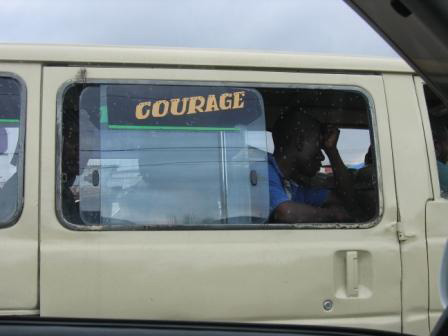
Courage, the thread that holds together the fabric of life in Haiti.

Haiti, Before the Ground Shook

Best of In The Fray 2010. On clichés, coping, and catharsis.

Until a few short weeks ago, Haiti was a country rarely mentioned in the international press, except in annual rankings of the world’s economies, where it ineluctably squirmed at the bottom. Now it’s a story that writes itself; a bonanza to foreign correspondents and non-governmental organizations everywhere.

In the face of the disaster there, the typical departure points for a personal essay seem oddly trivial. The scale of the destruction, the pull of the human tragedy, and the naked fact that the world’s attention is a Johnny-come-lately to the morbid party in Port-au-Prince halt conventional approaches to journalism. Of course, the unique position of Haiti is that nature’s wrath has made an already dire humanitarian situation even worse, thus practically writing the script for the stream of news coverage. But it has also made Haiti, a place many reporters were visiting for the first time after the earthquake, a perfect storm of high-pitched clichés about people living on $1 a day and the poorest country in the Western Hemisphere. Since my first experience of Haiti, I’ve wanted to avoid writing about the clichés.

I visited this ramshackle one-third of an island for the first time in the summer of 2005. I was a graduate student at New York University, and when I first moved to New York, my first hosts in the city were Haitian. I decided to return the favor by writing about the lives Haitian immigrants face when they immigrate to America. As I began talking to journalists, preachers, nurses, and street vendors who shared stories about their previous lives on the island, I wondered why, in the face of such Third World-realities that existed in Haiti—a mere 700 miles from the United States—the country was contractually spurned by cable networks and newspapers. I flew into Port-au-Prince with the vague ambition to find an explanation.

Bougainvillea drape over countless fences, walls, and gardens in Haiti.

Mischievous, Twisting Beauty

Even before the earthquake pulverized the already crumbling city and crushed the living breath out of its people, and long before the cameras swooped in on the scene, the sporadic news out of Haiti was reliably grim. Reflecting the well-worn, though true, dictum that Haiti is a failed state, the stories again seemed to write themselves: dysfunctional government, urban blight, environmental degradation, unrivaled rates of illiteracy, hunger, violence, disease. The tender but more shielded beauty of the place seemed to escape notice—and even when it did impress itself, the news rarely got out.

The immediate, most vivid image of Haiti’s beauty to me is the clusters of bougainvillea wrapping the facades and fences of houses like some kind of jubilant pink ivy. From their perches on stone walls, their outrageously bright flowers seem to wink at visitors and whisper that looks are deceiving. That beneath all the misery and sadness, there’s actually a tradition of pride, humor, and a lust for life that puzzles and enchants.

It is not easy to put a finger on what exactly makes Haiti a country that anyone would want to visit, return to, or let alone live in. But if you ask the people who do live there, it is a very special place. Haitians often refer to their homeland as Ayiti cherie—dear Haiti—as if it were an abandoned child left in their care by abusive parents. The dictators, demagogues, and military despots that have governed it in bad faith for decades invite the easy allegory. Still, that a people should speak so fondly of a place that, to an outsider’s eye, gives back so little lends new meaning to the phrase “love of the land.”

A boy looks at passersby near his makeshift home in Port-au-Prince, before the earthquake.

In the Haiti I saw, cynicism is rare, but a mischievous sense of self-deprecating irony is plentiful. It is born out of a tradition of hardship that has taught people to pat misery on the back and shake its hand for being a trustworthy companion. Ask a Haitian person how they’re doing, and you’re likely to hear a double entendre: “N’ap boule”—everything’s good—which literally means “we’re burning,” presumably because of the tropical climate there, but also due to an existence seared by an unceasing struggle for survival.

What I discovered during that summer in Haiti and when I went back a few months later—beyond the disheartening realities of life and the people’s openhearted acceptance of them—was something I was completely unprepared for. In spite of the vast differences between the geopolitical, ethnic, temporal, and spiritual coordinates of this tiny Caribbean country and those of my only slightly larger European homeland, incredibly—almost illicitly—I felt that I’d come home.

Parallel Lives

In the uncomfortable period of Bulgaria’s transition from socialism to democracy in the ’90s, many of us inhabited the same survivalist reality Haitians have faced for years: young men half-worked, half-loitered, selling contraband car radios and cell phone chargers out of makeshift stores; grandmothers bought inexpensive Maggi chicken bouillon cubes to season a pot of soup; jitney drivers fastened the rickety doors of their vehicles with bits of linen rope while standing passengers doubled over to avoid bumping heads into the low ceiling. I am just old enough to remember the darker era of breadlines and coupons, which was also the time of two hours on, two hours off for electricity, home-brewed alcohol, and special shipments of bananas and oranges (only for New Year’s).

These experiences were not only humbling but also laughable, and thus the inconveniences, insufficiencies, and improvisations of our daily lives gave us a whole new language: the vernacular of making do and doing without, a treasure trove of practical jokes that the whole country would share. Bulgaria’s first post-socialist late-night talk show host, Slavi Trifonov, built his early career partly on making people find humor in scrimping, at once lampooning and lauding their learned instincts to reuse the aluminum lids from jars of homemade preserve season after season or spend a day “at the beach” under the laundry lines on a sunny balcony.

Street art of startling high-precision brush strokes — as if poised to deliver a view of life unmuddled by the grind of getting by — adorns many a roadside painter's corner.
Street art of startling high-precision brush strokes—as if poised to deliver a view of life unmuddled by the grind of getting by—adorns many a roadside painter’s corner.

In Haiti, as in Bulgaria, people alter, adjust, and adapt. In Cap Haitien, on the northern coast, the upkeep of horses is costly, so tour guides use petite donkeys to lead tourists up a winding dirt road to the top of the Citadelle Laferrière, a UNESCO-designated World Heritage Site and a symbol of the country’s erstwhile independence. In Port-au-Prince, people without running water but who can afford to get it delivered store it in cisterns in their yards, where the sun warms it just enough for a nightly shower. And on the half-hour stifling flight between these two cities, the pilots of the low-flying charter planes compensate for the lack of air conditioning by opening the cockpit windows and cracking jokes with their passengers.

The long traditions of self-reliance in the former French colony and that of stern, necessary resourcefulness in the former socialist republic are both legacies of debased, nepotistic, tyrannical, and sometimes barbaric governance. But the nations forced to make resilience and inventiveness part of their collective characters could not be any more different, culturally as well as organizationally. Clearly Bulgaria’s economic and political transition cannot compare with Haiti’s unbroken agony. And yet, the two countries seem to travel on strangely parallel paths.

Courage, the thread that holds together the fabric of life in Haiti.

To embark on the path to political and economic liberation after decades of Cold War psycho-tyranny, Bulgaria needed an event no less cataclysmic than the fall of the Berlin Wall. More than 20 years later, it is still bumping along, unsteadily but determinedly, on the road to honest and progressive governance. Like a faint transcultural echo, the shattering of the ground in Haiti too may have begun extricating it from the morass of economic calamity and international obscurity. And so, to begin clearing its past of the wounds of brutish dictatorial regimes that robbed its coffers and set in motion a wheel of unending misery, Haiti just may have needed the clean slate afforded by the earthquake—however perverse that may sound—to start rebuilding its own ailing organism, brick by brick, dream by dream. Ironically, this extravagantly insensitive proposal is one of the oft-repeated clichés about Haiti after the earthquake, but when spoken in earnest and not with the glib ease of punditry, it is a cliché I hope will become a self-fulfilling prophecy.

Click here for a glimpse of the author’s earlier experience in Haiti.


My winter ponder-land

Today is the anniversary of my grandmother's birthday. She would have been around eighty-five years old. I actually had a dream about her last night (not remembering that it was her birthday); kind of like a refurbished memory of when I stayed with her in her apartment.

She would give me Dole pineapple juice and Oreo cookies or make me some slamming grilled cheese sandwiches with real Velveeta cheese. When I woke up this morning, I was quite confused. "Is she still alive?" I thought. As reality began to sink in with the light of dawn, I remembered that she had really died ten years ago.

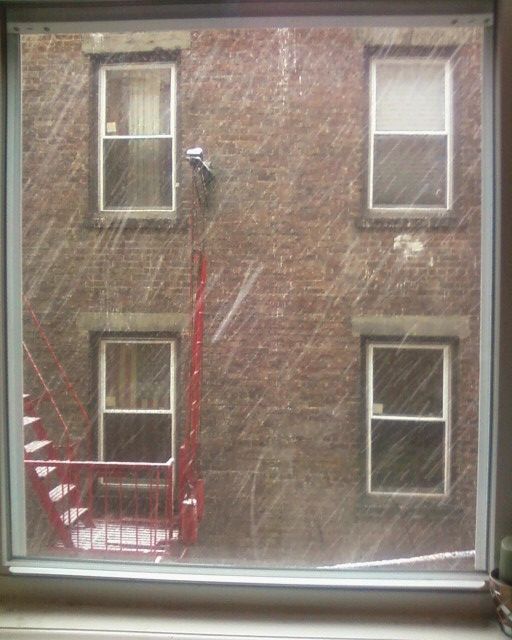
Sometimes when I have the recurring dream of my grandmother being alive, I look for the hidden meanings, or I think that she is trying to spend time with me from the spirit world. It makes me feel stuck in a portal puddle of the past. This time I was not in the mood to entertain the thought. I may have been distracted by the sounds of cars splashing newly formed puddles. I read on the Internet that we were going to have a "wintery mix of rain and snow" this morning. The rain falling from the sky all of a sudden turned into mini-cotton iceberg chunks that are now starting to silently paint the sidewalk like puffs of talcum powder on a baby's butt. What's the point? I'm not sure yet.

I've been yearning for the sunshine, that fragrance of spring that you smell coming around the corner when the temperature begins to rise. Nothing seems subtle on the East Coast. We all know when it's winter. We all know when it's summer. Spring and fall seem to be quick transitional seasons for what's to come. At least this is how I naturally think. Maybe it isn't about what's to come at all. It's about, well…now. The snowflakes are looking and moving like falling swan feathers at this very moment. The winter may be an ugly duckling that will turn into the beautiful swan of spring. Here I go again with the hidden meanings. The snow is speaking to me. Either that or I need to go and take my omega fatty acids and vitamin D.

I must accept (the fact or defense mechanism) that I have this lesson to learn from the snow (I could learn lots of lessons from the sun and ocean, too). I am listening to the snow. I am reminded of how when my grandparents moved from Brooklyn, New York, to Southern California to be closer to us growing up. Those memories are a precious gift. Somehow, I don't recall seeing them relishing in the sunshine. I can only hear them complaining about how lousy the bagels and pizza are in California.  

Happy birthday, Grandma. This one's for you. I miss you.


Holy cats and dogs!

Only a chosen few will be taken in the Rapture. The rest of us will be left down here to suffer for eternity. And your little dogs, too.

A large number of people way more than will actually be saved in this Rapture-thingy think they will get to go upstairs. Believing so must give them a sense of joy, maybe even  hope. But this is tempered by a major concern what about the beloved pets?

Well, would-be-Rapturees, it's your lucky day! For 110 dollars and 15 dollars per additional pet, rest (in everlasting peace) assured that Rover will go to a good atheist home after you've magically disappeared.

Y'all, there's a menagerie of musings in my head about this.

To begin with apparently, this is not a joke. In fact, there's more than one site offering such a service. But it is most certainly a scam. 110 dollars? Whoever created this is a genius!

I want in on this. For 110 dollars, even 10 dollars per person (greed is a sin, you know), I'll take care of your dry-clean only clothes and furs after you've gone. You don't want the damned heathens looting your walk-in closets and tossing your silks in common washing machines, do you? Hell no!

Ok, in all fairness, one site does include the following note: "A portion of income generated from advertising on this site is contributed to community food shelves/food banks in Minnesota and New Hampshire." But just a portion, mind you. Not the whole amount to feed the living humans here and now that would be crazy!

Next, a question about the souls of the cute and furry. If God created all creatures, why don't the animals get to go, too? One trip on the Arc all those millenia ago and that's it? Is peeing on the rug really such a terrible sin?

There are 6.7 billion people on Earth. We are all sinners, some more than others. I'm thinking this Rapture selection will be very small, very exclusive. So, how will we know when it has happened? So many people disappear everyday, and we don't even notice. How do we know the Rapture hasn't already happened?

Also, what if you just happen to be kidnapped or disappear or die naturally and lay undiscovered, Rre-rapture, but the network of atheists doesn't know? What if Snowball ends up starving in your apartment, and later on, gets taken in by devil-worshipping (e.g., liberal) neighbors or given to a kill pound by relatives? And you've paid $100 or more for nothing!

I guess a sucker is left behind everyday.

While browsing through these sites, I did have a reality-based idea and was pleased to find that others had thought of it too. Military pets. There are networks out there for soldiers who don't have anyone to take care of their pet during their overseas deployments. I love that there's an alternative for military personnel to giving up their pets for good and never seeing them again. They sacrifice so much to serve their country it's not too much to ask to come home to a best fuzzy friend. One program even has sponsors like Pedigree and Whiskas these are not scams, they're just awesome.

Obviously, I have not done my usual thorough research. I don't know the details about the Rapture or where the religions stand on animal souls. Nor do I want to. I have better things to do with my time. But, occasionally I like to take a break from health care, tea parties, foreclosures, and endless wars and amuse myself. So please, don't enlighten me. Don't correct me. Instead, use that energy to volunteer at an animal or human shelter and do your little part to make the world a better place. Because, honey, we're all stuck here.


HELP! I need somebody!


I find myself caught in one of those "circles of life" not like the big happy ones seen in The Lion King but rather the type that you keep living through, over and over and over again. You can't jump out. You just keep trying things in hopes that the circle would, at least, widen or in hopes that you will be pulled out.

Let's be honest: the great life is saved for the elite. Recently I read an article stating that opportunity is not about luck, it is about money. Wealth attracts wealth. How often are the destitute saved from their poverty and given a lifetime of success? It happens. However, it does not happen often. Especially not now when talent is everywhere.

Thanks to globalization, talent is no longer unique. One can learn skills in simple DIY steps for free. In the good old days, rare gems were discovered among the wild; people could manipulate others easily and make them believe that their skills were sought worldwide; Bartolomeu Dias even "discovered" an entire country and returned to Portugal to brag about his findings, regardless of the inhabitants that had already been living there for years. Today, everything can be cross referenced; gems can be located and purchased without one having to leave their own comforts; the cheapest option can be found with a click  and the world is no longer a mystery to anyone.

I find myself  sitting at my computer, once again questioning the point of it all. I spent the last 17 years studying; I now have two degrees, a wealth of useless knowledge, and no job. I would like to believe that the recession is to blame, but the truth is, I don't have the qualifications for most of the jobs that I want.

I've done the three years in retail working in an airless store room. I've saved up, I've splurged, and now I'm broke and wondering what to do next with little hope left in the dream that I have held onto since a child.

My friend suggested that I take a leap of faith and start my own movie business. "Move towards your dream and all shall fall into place," she had advised.

You need money to start your own business. You need money to get into the famous and recognized film schools that are guaranteed to land you your dream career. The movie business is strictly for the elite. To apply for financing you need a convincing business and marketing plan. You need a business. To register your business and website and get yourself on your feet, you need money. Renting equipment is sometimes more expensive than buying your own equipment. Almost nothing is affordable. It's as if I am doomed to be a slave to the system.

Education -> average job -> mediocre life.

Those words of my guidance teacher reverberate at the back of my head hauntingly: "You can have your dreams, Tharuna, but they have to be sensible."

In South Africa, the film industry is small. Only the best, the ones who could afford the private educational institutions, have a real chance of getting in. And only the "previously disadvantaged" are given free opportunities. The middle class have to fight for it. The problem is that my past is like an overly decorated Christmas tree with bad investments (people included). I would be all teeth and claw if I knew that this, starting my own movie business, was the right decision. That I could trust my partner. That there was a guarantee that people would be willing to finance a girl with only a dream and some talent.

There is no guarantee, is there?


Flocking to U.S. universities


You are encouraged to think, for a change. In the Indian education system I suffered through for three years (my high school years), I was pushed to learn everything "by heart" and not to think about why and how. You are essentially trained to be a mirror, just showing the world what your text book shows to you.

But not all is bad with the Indian education system. Math and pure science education is much better than in the U.S. or Europe (at least at the high school level). The labs and equipment, however, are a different story. At the college level, because of the emphasis on being a mirror, the quality of math and science training falls. That is why, despite having thousands of very hardworking and diligent students, India is not a powerhouse when it comes to research and development.

In light of these facts, it is quite surprising that the U.S. government is not promoting its universities as universal talent magnets. Look at how Australia markets itself as the place to be for international students. With tough rules on employment limitations, U.S. universities are actually losing talent to Europe, Australia, and Asia.

Fore more on Australia's efforts to attract foreign students, check out this website. Why can't the U.S. do the same?


The all magical Valentine’s Day


Being a Valentine's Day non-enthusiast by rule, I surprised myself today by wearing a pink dress and entering a shopping mall to watch the movie Valentine's Day with my friends (all Valentine's Day groupies). The movie which I likened to Love Actually and was keen to see turned to out to be a confirmation that Valentine's Day is indeed a shallow, commercialized, and manipulative celebration of everything but love (a viewpoint that, until now, I have been reluctant to agree with).

For one, all the lead actresses in the movie were abnormally skinny and all the men (even the geeky ones) were clean shaven, slim, and somewhat defined. In fact, the entire cast seemed to be chosen according to how good they looked naked the men barely kept their shirts on and the women strutted around in tiny skirts or their men's oversized shirts. Additionally, the quality of acting was equivalent to the quality of materials used in low-cost housing. With the movie having an equally poor plot (or rather, too many poor plots), I wished that I had rather spent my Sunday morning helping assemble ill-suited materials to build low-cost houses for those who are poverty stricken. I would have seen more love doing the latter than I did during the entire 125 minutes of Valentine's Day.

The movie asserted the view that love is indeed shallow. In one "loving" relationship, Taylor Swift plays a ditzy, conceited school girl going out with Taylor Lautner because he was hot and athletic and, wait for it, he stayed with her and "loved" her regardless. Watching her act made me feel as if someone was massaging my eyes with sandpaper and left me with that I-know-why-Lautner-broke-up-with-Swift-in-reality feeling. Even more experienced actresses like Jennifer Garner failed to evoke any emotions in the viewer due to the haphazard plot sequence, ill-developed characters, and the lack of true love. Garner's character, who initially asserts that she had found "the one," simply dismisses the fact that this aforementioned "one" was in fact married with kids and simply moves on to loving her best friend. In another love story, child star Bryce Robinson spends the entire day waiting for his flowers to be delivered so that he may pass it on to his love. In a cheap twist, it turns out that the boy has a crush on his teacher. This problem is solved in five minutes after a one-on-one heart-to-heart in which the teacher offers him a more suitable recipient and Robinson moves on to deliver his long awaited bouquet to his same-aged best friend.  In this way, former loves were continually dismissed within seconds and replaced with better options which ultimately reinforced everything that love is not. Moreover, all love stories failed to contain even a gram of true romance: lines were cheap, characters were easy, and objects of affection could simply be purchased. Also, nobody truly cries when they have their hearts torn to pieces (in my own relationships, knowing that the guy I loved was a jerk never stopped me from drowning my room in tears). The only poignant line in the movie was delivered by Shirley MacLaine (the old wise one), who stated that when you love someone, you love them for their entirety and not only for the good bits. Sadly, this line fell into a deep haystack, lost in our inability to engage with any of the characters (there were just so many!) and their inability to truly love.

The saddest part of the whole movie was that it accurately represented the reality of most Valentine's Day followers (and even haters, perhaps). In my own experience, the first Valentine's Day that I remember was when I was 11. I was the lonely girl who had chosen to follow the steps of Mr. Bean and send myself a Valentine's Day card. I remember hating myself because I thought that only the pretty and popular ones deserved to be pampered on Valentine's Day. Having then attended an all girls high school, Valentine's Day always began with the delivering of roses to and from schools of the opposite sex and always ended with me watching the 'special' girls glowing behind their bunches of roses (allegedly, the amount of roses that you received on Valentine's Day equated to how popular you would be perceived by your peers). By the time that I had reached campus, I had grown into a Valentine's Day hater, spreading the words "love sucks" to all who cared to listen while secretly wishing that someone among the six billion would be spending the day thinking about only me.

Today, however, after watching Valentine's Day, I feel a sense of joy knowing that, in 23 years, I had not once received a Valentine's Day gift nor spent the day celebrating love. I'd like to think that love is more than everything that Valentine's Day represents and that romance still lives within the fast-paced and technological confines of contemporary society. Maybe I am just another dreamer who has read one too many Nicholas Sparks novels…I'd rather dream than settle.


From the department of redundancy department

There is a beautiful mansion near my apartment which is on the National Historic Register. Built in 1900 for William Childs (developer of Bon Ami cleaning powders), it sits on the grand avenue of once-private residences directly across from the park. Now the mansion is home to the Brooklyn Society for Ethical Culture, a non-profit group hosting various programs and seminars. Not too long ago, they installed a banner out front stating that they are against torture. Did I miss something here?

Of course they are against torture. Who wouldn't be? Who is going to stand up and disagree with that? (No, actually I am all for torture.) Why restate the obvious? It's kind of like announcing you think Hitler was a bad man.

This leads me to the recent announcement by the MTA to let straphangers know that groping on the subway is wrong. Correctamundo, MTA! It seems safe to say that there are certain things we all know are wrong. Fondling your neighbor on the subway is one of them. But the MTA is spending a good bit of money rolling out a campaign to tell us this anyway. They want to encourage riders not to be afraid to speak up after a study showed that 63 percent of women have been sexually harassed on the subway. There will be a hotline to report such unpleasantness. But all good intentions aside, can this really even curb the problem?

A similar campaign on the Boston T resulted in an increase of reported incidents, which is to be expected, but there was no increase in apprehending the offenders. It all boils down to a he said/she said kind of thing. I mean, it's not like the guy leaves any fingerprints.

Full disclosure: I have only been groped on a particularly crowded section of Bourbon Street during Mardi Gras but never on the subway. As your faithful subway reporter, I took an informal poll. Only one friend had a tale to tell. She boarded the 2 train at 14th Street during the evening rush. Everyone was crowded and pushing their way in, kind of like the subway in Japan where the conductors will "help" you by using your body as leverage to squeeze more people on the train. (I suspect these women need the groping hotline more than anyone.)

My friend was subway surfing, where you don't have a pole to hang onto or a door to lean against you're just riding the wave of the train. A heavyset, tall man was facing her. Every time the train jerked and lurched forward, she felt what she described as an elbow poking her. It was hard to tell exactly what an elbow? Someone's backpack? because the train was so crowded. She insisted I mention here that she was wearing a long coat which did its part to camouflage the offending poker. She started to get suspicious. Was it? Wasn't it? Then her apprehension was confirmed. The train stopped moving but the poking didn't. I asked if she would have called to report the incident if there were a hotline back then. She doubted it. "What good would it have done?"

Maybe hotlines like this aren't really meant to catch the wrongdoer but provide some false sense of security to the rest of the riders. We want to feel like something is being done. We insist upon action. Not doing something, anything, despite how ridiculously futile, is the equivalent of letting the offenders win. Reminds me of the random bag searches the local police conducted here after the London bombings. With seven million riders each day, what did they really expect to find in the backpack of Joe Commuter? But it made us feel better, even if just for a few moments.


I am my own god


Hi. My name is Tharuna and I am "addicted" to social networking sites. There are two in particular: Twitter and Facebook. My friend believes that these sites have become the new alcohol/cigarettes/shopping sprees with added benefits like lower cost, easy access, and greater satisfaction. This provides one explanation for why they are spreading like an ink stain, barrier-less and reaching all age groups, races, and social classes.

There are many reasons for craving the use of social networking sites. In the rapid paced world that we live in, the giving of attention to those who want it is scarce. With global financial and employment calamities, most parents are working harder and leaving their children somewhat neglected. With women striving to reach the sky of the corporate world, relationships tend to be strained while partners become more demanding. Even parents tend to be neglected by their working-class offspring.

Social network sites, on the other hand, are attention-giving whores. They suck in people who are lonely or shy or depressed and provide them with instantly gratifying attention. You have the ability to chat with new people when the old ones have grown tired of you and subsequently get rid of them when you have grown wary of their tales by simply pressing "delete." No long, drawn-out explanations required and, if you were clever enough to not give out your details, no Cable Guy-type stalkers to ruin your life. It's clean. It's simple. It's a social happy pill.

However, at the same time, it breeds a society of demanding and conceited narcissicists. In the realm of the Internet, we become our own celebrities. We fragment ourselves in the same way celebrities do, sometimes creating whole new personalities online. We believe that our stories and daily activities are important and interesting enough for the world to know. We get sad when people fail to acknowledge and be amused by our outpourings. In a way, we have become our own gods, begging to be worshipped. The more friends or followers you have, the greater you are.

Avid site users are generally aware of their addictions. Like all addictions be it smoking, drinking, eating, loving, or shopping there are long-term effects that ultimately change you.

Hmmm…Maybe I should detox.


The same differences

I woke up on New Year's Day in a rather conventional manner: lungs recovering from high exposure to secondhand smoke, wallet empty, choked back tequila aftertaste, and a head full of hope. It was a completely new disposition for me. There were no resolutions for change and betterment; only ends and beginnings.

I thought that this was my own revelation. I imagined everyone else was hurrying to find ways to better themselves: joining gyms, throwing out their bottles of alcohol and packs of cigarettes, and penciling their families and friends into their busy schedules. But, I realized that I was wrong.

Like animals, humans have set behavioral patterns. For example, cats have their own personalities: some are wild and anti-social, some love human attention, some are afraid of heights…but ultimately, they all act in a certain way. They play in the same way, they all bury their excrement, they all learn how to clean themselves even when there is no adult cat to teach them. They are inherently conditioned to behave as cats.

With the Internet allowing people to connect from all over the world, we are more aware of our world, more knowledgeable about other cultures and nationalities, more open (in most cases) to differences between us, and more willing to help.  It has made the world a smaller place and has made me reassess my own uniqueness.

Being a diehard for the movie Fight Club, I never considered myself to be truly unique; however, I did assume that I had my own quirkiness that separated me from everyone else. This assumption was soon shattered while scrolling through various Facebook groups. Things that I considered to be uniquely me, things that I had thought only I did had groups with over a million followers. Things such as constantly calling my mum even though I didn't need her for anything; making animal noises in shopping malls and laughing at strangers who turn around; and thinking, as a little girl, that the moon followed me wherever I went.

We are all different, yet we are all the same. If nothing else, knowing this makes stand-up comedy easier.


The act of returning to normal

On a sunny day in May, I sat on the side of the highway, feeling sorry for myself and watching cars zip by. I’d been coaxing an old Jeep Cherokee into motion for the past six months, and about three-quarters of the way between Duluth and Rochester, my best arguments failed, leaving me stranded. As I crested the hill on the south side of the Cannon River valley, the car’s engine roared, much too loud, then coughed and died.

This is my story of recovery. It is not as dramatic or grandiose as A Million Little Pieces or a million other recovery stories, but it is mine and it is true. I was drinking too much and not going to school enough. I was broke, my credit cards were maxed out, and I was exhausted. I was living my life for each individual moment, neglecting any subsequent moments, and paying a price for such self-indulgent behavior. As I sat waiting for the tow truck to pick me up, I realized the time had come for me to put away childish things and grow up.

In our February issue, we turn our eyes to recovery. Mark Murphy writes of love, loss, and recovery in his poetry titled Pomegranates, singing telephones, and night’s cloak. In her piece Toasting Poe, Cynthia Pelayo finds disappointment and recovery when she visits Edgar Allen Poe’s grave. Chelsea Rudman tells of her trip to Israel and her conflicting emotions in her piece, The Kotel. Jillian C. York reviews Footnotes in Gaza, a comic art take on life across the border in Gaza. We end with a look at Iceland’s recovery from its recent economic meltdown in Kekoa Kaluhiokalani’s Iceland after the fall.

Recovery is, by definition, the opposite of trauma, be it self-inflicted or imposed by the outside world. I would like to think the two are correlated: that every trauma has a corresponding recovery. But I know that this is not true. There are always those who do not recover, who will not recover. That is what makes recovery so precious: It is not like spring; it does not always come. There are no guarantees, and therefore it is always to be treasured.

I am a writer/editor turned web developer. I've served as both Editor-in-chief and Technical Developer of In The Fray Magazine over the past 5 years. I am gainfully employed, writing, editing and developing on the web for a small private college in Duluth, MN. I enjoy both silence and heavy metal, John Milton and Stephen King, sunrise and sunset. Like all of us, I contain multitudes.


Pomegranates, singing telephones, and night’s cloak

Three poems that speak to love, loss, and recovery.

Pomegranate

I imagine the scent of pomegranate.
 It stains the night air, like the smell of those Roman girls
dancing untamed around a shaft of stone.
 Across the hallway you are sleeping, the blood of martyrs
upon your tongue, the seed from our earlier love-making
coursing between your thighs, a talisman, a pledge.

 Long after midnight in another apartment — a telephone
is singing — a lover calling to his love. Soon I will be calling
to you across an ocean of secret tears — our last farewell
but a memory carried on the wind, our only thoughts then
   of arrival and reunion.

 When we meet again, you will wear the ancient wreath
of pomegranate, and so the caged bird shall sing once more
of freedom, as two hearts become one.

Silver ring
for Nora L. Hollin

Night has come unlooked for, once more,
with its assassins’ cloak, huge and worn
torn from the day, the light, copious hope, memory,
as though its coming could extinguish
the intended’s dream of belonging.
Ah! love cannot forget the ragged miracle
of the blind dove and lame grackle,
nor the drinkers’ fall from grace —
but life is hard for the poor, the path dreary and baked,
but nothing is forgotten, not the wild white rose,
nor the wild apples stolen from the tree —
the silver ring is everything, wilder than the rabid wind,
lighter than air, all that is worth living,
the blinding kiss upon the platform,
the promise of always took upon the knees.

The crossing

Now only the crossing matters
as we talk into the night,
our every word locked
with the secrets of the stars,

the dilemmas of the flesh
pressing urgently in air,
each possibility sowed in earth,
warming the heart with song.

Amid the benediction of rain
one heart waits for another,
awaiting elucidation, in time
even the unknown must be known —

what good to point to the rose,
the heaving breasts, the lyrical body
if the idea of the rose is superior
to the rose you hold?

Now only taking your clothes off
for the camera counts,
the small matters of love,
soon the crossing will take shape

as the divinities of sex bid us
to lie down with each other,
immersed in discovery, poised
between beauty and illusion.


The Kotel

A return to the past.

I admit my instinct was to say no when two friends urged me to take a free trip to Israel my senior year of college. I had known for years that even as a half-Jew I qualified for Birthright, a program that uses a combination of funds from wealthy donors and the Israeli government to send young American Jews on a free trip to Israel. But I never thought I would actually go. Raised as a Unitarian Universalist by a Jewish father and lapsed-Catholic mother, I wasn’t sure that my self-prescribed brand of Judaism (Passover in spring, Yom Kippur in fall, little prayer in between) made me qualified to claim a trip to Israel as my “birthright.” And I was squeamish, to say the least, about Israel’s less-than-savory policies regarding the Palestinians. As I explained to my father, “I don’t really know if I agree with all of Israel’s … foreign relations.”

“I think you’ll find a lot of Israelis agree with you,” he said. “Look, not every American agrees with what the government is doing here, right?”

I tried again. “But I’m not … very observant.”

He shrugged. “Neither are they, for the most part.” I confirmed this with Thomas Friedman’s From Beirut to Jerusalem, a guidebook to the 1980s Middle East that became my pre-trip primer on Israel. Friedman reported that Israelis tend to be more secular than American Jews, conceiving Judaism as a nationality besides a religion. “[The sense] in Israel,” Friedman writes, “[is that] the sky is Jewish, basketball is Jewish, the state is Jewish, and the airport is Jewish, so who needs to go to synagogue?”

Somewhat convinced, I signed up for Birthright. I pretended I would play reporter rather than pilgrim, picturing myself as a young, female Thomas Friedman who would jot dispassionate notes on the natives. Friedman, though objective in his coverage of Israel and its neighbors, is also Jewish, and, as it becomes clear in his book, viewed Israel as a possible prism through which to understand his own background. I wanted this too.

The much-feared test of my Jewishness came right at the beginning of my trip, when an Arkia flight attendant asked me for my Hebrew name at check-in. “I … I don’t have one,” I stammered.

She raised an eyebrow and asked softly, “And why is that?”

“Because … I didn’t make bat mitzvah,” I bumbled, unwittingly compounding my sin, as Hebrew names are given at birth. She scribbled something in Hebrew on a sticker and slapped it on my passport, then gestured me toward security. I stalked off, flushed and wondering if my passport now bore the Hebrew for “stupid goy.”

I was even more determined to “catch up” with the “real” Jews. During a stretch of insomnia somewhere over the Atlantic, I spent a few hours learning the alefbet from my friend Jordan. By the time we landed in Israel, I was sounding out written Hebrew left and right, decrypting words letter by letter to anyone who would listen. “Yi-teuh-zu-ah!” I read off a sign as we stumbled sleepily off our red-eye into the Israeli morning.

“Almost. Yetzi’ah,” said Jordan, smiling.

“Exit.”

“Good!”

Our big orange tour bus was waiting for us at Ben Gurion Airport. We met our guide, Saar, a towering, camel-faced man who sported a full beard and a gnarled ponytail of dreadlocks. The Birthright itinerary wastes no time — our bus whisked us from the airport straight to Jerusalem for a day of touring. On the bus ride, I asked my friend Joelle to teach me the Hebrew numbers from one to ten. We didn’t have a pen or paper, so she taught me aloud, repeating the numbers again and again. Outside the windows, a brown land of pomelo and date trees faded into sparse desert and then finally gathered into a low ridge of hills concealing Jerusalem.

Echad, shtayim, shalosh …” One, two, three … I frowned, not knowing how to say four in Hebrew. .

Arba,” said Joelle, dozing against a window pane.

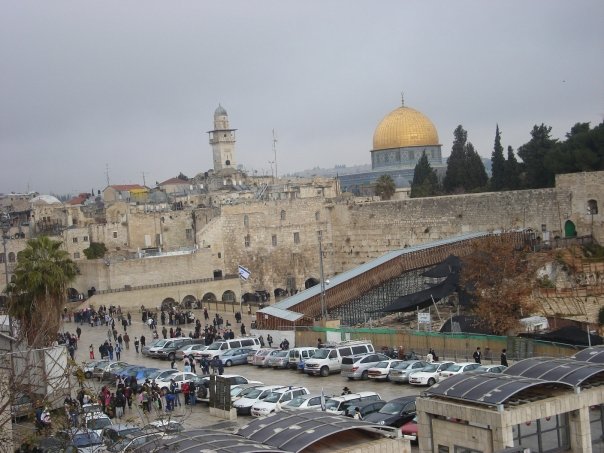
Just outside the city center, we stopped at an outlook to take pictures. Blocky white buildings crowded the misty hills. The black and gray shapes of squat domes and pointed arches dotted panorama of stone. In the distance, we could see the golden crown of the Temple Mount. It looked exactly like the pictures I had seen painted on plates at my father’s cousin’s house: biblical. It was the place to which all Jews vowed to return every Passover: “Next year in Jerusalem!”

Then we headed straight for the most sacred part of Jerusalem, the Old City. Its tiny quarters — 0.35 square miles — house five ethnic neighborhoods, a few shopping arcades peddling trinkets, countless archeological digs, and some of the holiest sites in monotheism. Inside its massive, 500-year-old walls, sand-colored arches frame the maze of alleys and stairwells that spill down Jerusalem’s steep face, funneling visitors from the modern to the ancient. Feral cats stalk courtyards. Arab merchants hawk T-shirts and pomegranates from tiny shops and stalls.

Saar led us between museums and falafel stands, stopping every 10 minutes to point out this historic tower or that holy monument, punctuating his words with wild gestures from his plate-size hands. “Yeh-ruh-sheh-lai-uhm,” I slowly whispered aloud, squinting at the inscription on a Roman-era frieze and realizing, with a tingle of pleasure, that I was reading the Hebrew word for Jerusalem.

Then we arrived at the Kotel, the Western Wall. The Kotel is all that remains of the Second Temple, the last Holy House where Jews worshipped together as a nation in the days of David. At 62 feet high, it towers above visiting pilgrims, but its 187-foot length is a mere fraction of its original span. The temple was built in 515 B.C. and stood for six centuries until the Romans destroyed it, save its western wall, in 70 A.D. This is why the Kotel is also known as the Wailing Wall: Jews are meant to bemoan the ruin of Judaism’s holiest place of worship. Ancient Jewish law decrees, in fact, that Jews should rend their clothing upon sight of the Wall.

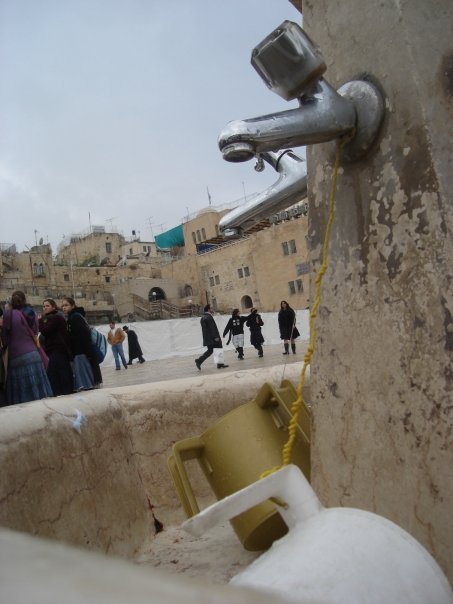
Today, only the ultra-orthodox haredim wail and moan at the Kotel, but their long black skirts, hats, and suits go unrent. But ritual still dictates the movement of everyone who visits. The face of the wall is divided in two by a long fence — men go one way, women, the other. I stood at the entrance to the women’s side for a long time, staring at the scrap of paper on which I was supposed to write a prayer. Watching the tide of black-robed, plain-clothed, and long-skirted pilgrims ebb and swell around the foot of the wall, I couldn’t help but picture the millions of Jews who had bowed, sobbed, and prayed here, whispering prayers in the language still inscribed on the rocks at my feet. Some of those pilgrims, I realized, must have carried the very genes that had gone on to battle their way through pogroms and purges, escaping eastern Europe onto a boat carrying people to America, including my 14-year-old great-grandmother, who never saw her parents again, whose lineage was passed down to my grandmother, who passed it to my father, who passed it to me. They were once here. And now I had returned.

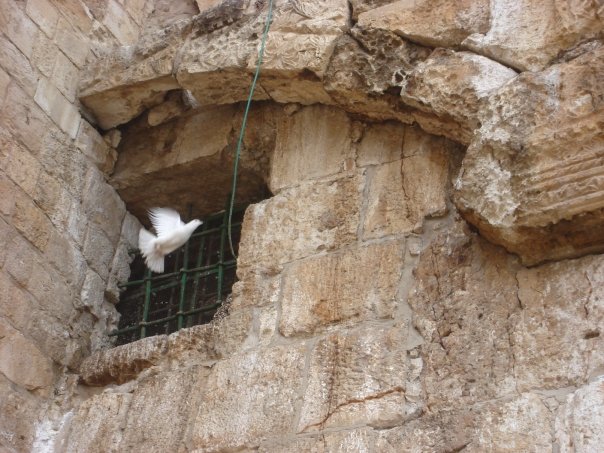
I wrote a prayer on my paper and folded it into a tiny square. I squeezed through the masses and reached the wall itself. The stones were huge, massive, each block as tall as I could reach. I slipped the prayer into a crack, a white speck joining thousands, then touched my fingers to the wall and kissed it, as one kisses a prayer book after touching it to the Torah. I stood for a long time. Then I walked away backward, as one must, keeping my eyes on the Kotel for as long as I could.

I am an atheist. But here, I prayed.


Chelsea Rudman is an international development professional and freelance writer who lives in Washington, DC. Her writing has previously been published in the NY Press and Matador Travel.

personal stories. global issues.