Toward the end of her life, my grandmother went shopping for birthday and holiday gifts in her own apartment. Some years I received pantyhose; others, a milk glass vase or a brass alligator nutcracker.
Although I never used the last present I received from her, I kept them: three pristine, precisely creased, embroidered muslin handkerchiefs. They have survived college in one state, graduate school in another, and the arrival of my own family in a third. Aside from the figurative ties they give me to my grandmother, whose nose I have inherited, I have always considered them valuable.
But value has a different meaning when it comes to eBay.
One day I was browsing its “clothing, shoes and accessories: vintage” category when I found a listing for an inordinate amount of women’s handkerchiefs. In fact, 238 lots were for sale that very week. The cheapest, a set of four holly-embroidered Christmas hankies, was going for 99 cents. The most expensive, an assortment of 154 floral “everyday ladies” hankies, was on sale for under $60. At 38 cents a pop each, these weren’t exactly Caspian caviar.
On a visceral level, I was a bit disappointed in these anonymous sellers. I know that many dealers bought these products from estate sales and have no attachment to them other than the scant money they paid. But other sellers are daughters and granddaughters who may have cleaned out closets after the owner’s final stroke or battle with cancer. Isn’t the hawking of these long-held possessions akin to the selling of memories?
And at rock-bottom prices, no less.
Sentiment aside, I have no practical use for these tiny patches of gauze, trimmed with faded cross-stitch and permanently scarred with folds. What does one do with such items? Turn them into appliqué lampshades? They’re more suitable for polishing the furniture than they are for clearing the sinuses.
But thanks to my robust love for fiction and a vivid imagination — something else I inherited from Grandma — I can visualize one of these lace-and-linen confections tucked up her three-quarter sleeve.
Each brings back a piece of her. The off-white one with the scalloped edges reminds me that Grandma Min pickled the neighborhood’s best herring in sour cream sauce, heavy on the onions the way my dad and I like it. The eggshell one, with the crocheted border, takes me back to her fragmented square of a linoleum kitchen table, where I sat in my nightgown, watching as she cooked breakfast. She always salted the eggs before scrambling them rather than after, making them taste so much better. The handkerchief that was imported from Europe — and still in its original packaging — takes me to my grandmother's girlhood during World War I. She escaped in a covered wagon driven by her mother across the continent to a ship that would take them to America.
Although in the final decade of her life, Grandma Min blew into disposable tissues like the rest of us, and these vintage handkerchiefs are no longer intended for use, their personal history will always be nose-worthy.
Chances are, my own grandkids are going to receive them, and while they may be initially puzzled, perhaps in the end, they will discern the handkerchiefs’ true value.
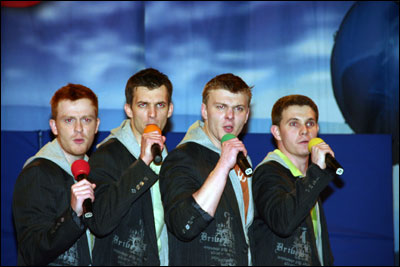
Semyon, Alexei, and Paul (from left to right) rehearse their take on “Beauty and the Beast.”
It is 6:30 p.m. and the brash young comedy team the Illegals have only half an hour left before the women in the Russian hair salon kick them out. Half an hour is not a lot of time, they figure, but it’s enough to run through their comedy routine one more time.
As the sound of an upbeat melody starts rolling, Semyon, Ruslan, Alexei, and Paul take two steps toward the mirror wall of the room, raise their arms, and smile smugly. Then they break into a flurry of short skits and absurdist one-liners, all in Russian.
“Do you have anything for the head?” Ruslan asks, looking pained, in one scene.
“Here, take an ear …” answers Alexei.
Looking in the mirror after every joke, the Illegals pretend to see the blinding stage lights and the cheering audience that will greet them in two weeks at the popular Russian comedy competition called KVN.
KVN, roughly translated as the “Club of Humor and Wit,” is a team game show, where students from different colleges, cities, and countries compete by presenting comedy sketches, humorous musical numbers, and improvisation. It is fast-paced and intense; one of the show’s creators once described it as “intellectual football.” With no direct equivalent in other cultures, KVN is an essential component of modern Russian life and a popular import of Russian-speaking immigrants around the world.
The fifty-year-old tradition started after the death of Stalin. As Soviet control began to ease in the late 1950s and 1960s and television sets became more common in Soviet households, a group of Russian university students created a unique television game show. At first, KVN was a question-and-answer game based on a Czechoslovakian show and similar to Western models. Although the teams had to give correct answers, witty answers were also allowed. Soon, the producers began to emphasize humor, making up amusing contests and assigning the teams funny skits to prepare.
With lightheartedness rarely seen at the time and humor normally reserved for the underground subculture, the nationally televised show immediately captured the Soviet imagination. During each game, life on the streets would cease, and the next day, everyone would discuss the jokes they’d heard. KVN aired through 1971, expanding to more and more teams from different cities and Soviet republics, but then was cancelled due to criticism from government officials. It was revived only at the dawn of glasnost, when emerging liberties and disarray in the government allowed for less control of what was being said on television.
A humorous critique of the world in the form of popular entertainment, KVN has continued almost unchanged since Soviet times. In Russia and other ex-Soviet republics, being a “KVNshik” can make one a celebrity on par with famous professional comedians. Away from its television audience, however, KVN is — for some 40,000 Russian-speaking immigrants in the US, Israel, Germany, and even Australia — not a road to fame, but a unique national tradition worth holding onto in a foreign land.
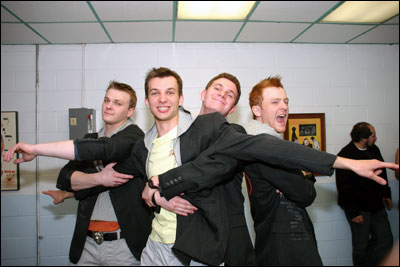
Ruslan, Alexei, Semyon, and Paul (left to right) in the green room.
Looking in the mirror, the Illegals rehearse a scene from one of the three essential contests forming any KVN game, including the upcoming quarterfinals. Each game starts with the “Greeting,” where a team introduces itself with short tidbits of humor, loosely connected miniscenes, and dialogues. Then they move on to the “Warm-Up,” an improvisational contest in which each team has thirty seconds to come up with a funny answer to a question. Then comes the “Homework,” usually the longest and most theatrical part of the KVN game. It is akin to a sketch from Saturday Night Live and is rehearsed in advance. The Homework skit needs a lot of preparation, and each teammate has to be on top of his game.
For the Illegals, one of the key moments in the Homework is a scene borrowed from “Beauty and the Beast.” Ruslan — a blond, blue-eyed, big-boned Byelorussian — plays the merchant, whose three daughters (Paul, Alexei, and Semyon) ask him to bring back gifts.
“What would you like, my oldest daughter?” Ruslan asks.
“Bring me a decorated shawl,” replies the redheaded Paul, “from Gucci!”
“What would you like, my middle daughter?”
“Bring me an older sister who is not stupid,” says Alexei, the tallest of the three “daughters.”
“What would you like, my youngest daughter?”
“Bring me alimony for three years from that Beast!” answers Semyon, carefully enunciating every word.
At the end of the scene, everyone starts talking at once. Paul gets criticism for his bad pronunciation of “Gucci.” He repeats it several times, giving more punch to the “cci.” Semyon blushes deeply as he tries to argue with Ruslan about the wording of the skit. Meanwhile, twenty-five-year-old Alexei — the team’s oldest member — smiles to himself like a satiated cat. His hair is sticking out and worn-out jeans hang on his tall, thin body. Over the clamor, he hears Sasha, the team’s music assistant and only man behind the scenes, scolding Ruslan.
“You show off too much,” Sasha says. “And you eat up lots of words.”
“He is fine, leave him alone!” says Alexei protectively. Putting his hand on Ruslan’s shoulder, he tells him, “You are a star.”
Other, less poignant criticism continues to echo through the room as everyone gets ready to leave. Ruslan, who has the springy walk of a boxer and a childish smile, tells the skinny, stylishly dressed Paul that he does not like him as an actor. “Do you like me as a man?” Paul says flirtatiously as everyone chuckles.
“Bunch of homos on this team!” says the dour KVNshik as he walks out into the cold Brooklyn night.
The Illegals, whose four members currently live in three states — New York, New Jersey, and Pennsylvania – are a truly heterogeneous team. Unlike the majority of Russians who immigrated as Jewish refugees, Ruslan and Alexei both moved to the US three years ago, using a four-month visitor exchange program to stay on the new continent. Before the two friends met, Alexei and a few other young illegal immigrants created a KVN team based in New Jersey and named it, appropriately, the Illegals. At first, many KVNshiks, who have lived in the US since the biggest wave of Russian immigration in the early 1990s, thought the laid-back style of the Illegals was strange. Others, however, saw in their style a way to improve KVN’s American league.
“I first met them at the KVN festival in 2003,” remembers Sergei, a member of a Chicago team and a friend of the Illegals. “They brought freshness and youthful inspiration into the game. I immediately wanted to meet them. Their acting ability and quality of humor put them on a level higher than the other teams in the league.”
Yet so far, the Illegals have not been very successful. They left their first game due to disagreements about the judging. Then, they regrouped to incorporate some members of a team from Philadelphia — Semyon and Paul among them.
Semyon, who has attentive eyes and an apologetic manner of speaking, did not participate in KVN back in Russia, but loved to watch the games on TV. Unlike Alexei and Ruslan, he is not an illegal immigrant. After he moved to Philadelphia with his parents five years ago, he found out about the local league and created his own KVN team. “I wanted artistic realization,” he explains. “Some people paint, others play a musical instrument, and I play KVN. It’s a great feeling when you’ve written something, performed it, and the audience liked it. I feel artistic satisfaction.”
Semyon invited his childhood friend and neighbor, the redheaded Paul, to join the team. Paul, who had just moved from Israel, did not remember much Russian. But he was stylish and funny and had a good attitude. “I basically came to KVN for sex,” Paul says impishly. “But now I am the one who has to supply all the chicks.” Outside of KVN, Semyon and Paul work and go to college. They are majoring in film and hope to make a documentary about the plight of young illegal students like their teammates.
The last member to join the Illegals was Ruslan. Although he contributed professional KVN experience from Russia, the team still lost last season’s semifinals. “I went to rehearsals like a fool with a notebook and a pen,” says Ruslan. “And everything just ended in drinking.” Although Alexei’s official response to Ruslan’s complaint is “Nothing brings people together like vodka,” he blames their loss on razdolbaistvo — a slang word that means irresponsibility, carelessness, and even laziness.
“Razdolbaistvo is both our flaw and our style,” he says. “We can’t get together, we can’t rehearse, we can’t figure out the music. That’s why we lost at the semifinals last year. We were funny, but unorganized.”
The Illegals onstage during the “Homework.”
Less than two weeks before the game, Ruslan is having breakfast with Alexei at a Russian restaurant in Brooklyn. A rowdy group of men drink vodka and argue about yesterday’s hockey game. It is noon. As they wait for a steak, chicken livers, and apple blintzes, Ruslan explains that he has been playing KVN since he was thirteen.
“I even remember the first joke I had to say,” he says, his blue eyes gleaming. “We had this scene: an ad for Aeroflot. The guy looked out the window and said ‘Oh, look, flying elephants.’ And I took his glass away and said ‘Okay, that’s enough for you.’”
“You ripped!” says Alexei mockingly as he digs into his steak.
“When I first started, I didn’t write my own jokes and didn’t really act onstage,” continues Ruslan. “I learned how to write jokes, how to feel the text. So, KVN is not about talent, but experience.”
“I had talent, but I’ve killed it working with these guys,” says Alexei with a sigh. “People told me to go into acting.”
“Well, people told me that, too,” says Ruslan defensively.
“No, no, they lied. Besides, I was the one who told you that. Anyway, I didn’t want to go to acting school, because I like it as a hobby, not as a profession. I’ve always played the role of a fool, and an actor is more than just one character of a fool. My first role ever was to play a fool, and then the second, and the third, and it stuck. But I sort of act like a fool in life, too. Maybe that’s why this role is easier for me.”
Alexei, who became a KVNshik when he entered university in Russia, thinks he should quit competing after this season. “This game is for the young,” says the twenty-five-year-old. “I need to quit soon. I am way too old and KVN takes away so much time.”
“It takes away health, too, since we need to drink a lot,” interrupts Ruslan.
“Time and nerves,” finishes Alexei, who goes to college and keeps a night job at a Russian TV station.
“A great classic once said that KVN is not a game, it’s a lifestyle. Of course, no one knows what that means, but it sounds beautiful,” says Ruslan. He turns more serious and adds, “Someone who once participated in the games, I mean like fully — writing, acting, and stuff — cannot just quit.”
But Alexei doesn’t want to dwell on the serious. “Anyway, to come back to talking about talent,” he says. “Me and him play pretty much all the roles. Wait, what the hell do those two do?”
“Well, one is a redhead, so if something goes wrong, we can always blame him.”
“He also makes great tea.”
“Yeah. And the other one, Semyon, he is just a nice Jewish boy who doesn’t do much.”
“Every team needs to have one, you know,” concludes Alexei.
In Russia and many former Soviet nations, every KVNshik nurtures the hope of becoming a celebrity. But in the US, where an independent KVN league started ten years ago, stardom is out of the question. Although in format and style the American KVN league mirrors the High league of Russia, it does not have millions of fans. The teams sponsor themselves, auditoriums rarely fill up to capacity, and only a few KVN games make it onto a local Russian TV channel.
However, the enthusiasm of local KVNshiks like the Illegals makes them stand out among the mass of Russian immigrants. They do not resemble the majority of older Russian Americans, who, having left the old country for good, severed all ties with modern Russia. They are also not like many younger Russians, who grew up in the US and know little about their country of origin.
Instead, the comedians grew up in the post-Soviet Russia of endless possibilities. They emigrated not because they had to, but because they could. They are media-savvy children of globalization — in their spare time, they browse Russian websites and watch Russian satellite TV. Unlike some immigrants who are completely detached from the life of a cold country thousands of miles away, young KVNshiks often exist in a strange niche between here and there. On the one hand, they have Russian friends, Russian wives, Russian vodka. On the other, they are integrated in American society — they graduate from schools like Harvard, Berkeley, and NYU and work as programmers, businessmen, or lawyers.
But living in this niche, American KVNshiks find themselves at a disadvantage. Surrounded by a different culture, they have neither the structural and financial support enjoyed by Russia’s nationally televised KVN, nor the possibility to achieve true stardom as Russian-speaking comedians. Even their humor reflects their unique situation. To entertain their small, immigrant audiences, they often turn to localized jokes about the immigrant experience, be it Brooklyn restaurants or linguistic mix-ups.
When he first saw American KVN, Alexei thought it was very amateur. “Three years ago it was just horrible,” he says. “The favorite theme was when a dude dressed up like a woman, came out onstage, and said something. The first time I saw that, I realized that you can’t perform here. But everything has been changing and looking more like the real thing. If there are no young teams who want to compete, there can be no KVN. What would be left are the older teams. They are nice guys and their humor may be fine for this audience, but they are not helping KVN evolve. We need more young teams, especially guys from back home.”
With their experience from “back home,” the Illegals are trying to raise the level of the American league by bringing humor that is both poignant and not immigrant-specific. Their other choice would be to give up KVN completely. But even with this amateur league and a limited audience, playing KVN is worth their time. It is a tradition, a form of identity, and a way to preserve their culture.
“We can spend a whole evening talking about KVN and not even notice it,” says Alexei. “It has become part of our lifestyle.”
The KVN teams gather onstage to hear the final results.
At 11 p.m. on a Thursday, Alexei is working the controls at the Russian TV station. With little time left before the game, he is surprisingly calm.
“We still have a lot to work on, and we only have one day left — that’s definitely a big minus,” he says. “At the same time, we are funny dudes, we look cool onstage, and we are pretty good actors. I don’t remember a game when we totally rehearsed. If one joke doesn’t get through to the audience and then the second, people see that the team did not rehearse. But if the first joke gets to them and the second, then the audience is in the right mood, they clap and cheer and don’t pay attention to the little mishaps, because everything is absorbed by the overall atmosphere.”
His deep voice leaves the hope for that magic atmosphere lingering in the empty control room. “Even though we are jerk-offs, everyone still wants to win. We all have problems, work, school, some of us have both work and school, not enough time, but you gotta have more in life than work or school.”
Alexei wants to win this season because he is not sure the Illegals will play next year. It’s not only his age. He is also worried that Ruslan may go back to Belarus. Although he has just received his work permit, Ruslan is waiting for a travel visa to see his friends and parents back home. For now, he refuses to buy a car, because he doesn’t want “to get anything that would tie me to the US.” If he does not get the visa before the end of the year, he will leave the country for good. At least in Belarus, Ruslan — the kind of person who sees the world “as if it’s made up of punch lines” — has a bigger chance of becoming a real KVN star.
Two nights later, there is commotion outside the dressing rooms of the Jewish Community Center in Philadelphia. Leather-clad Russian men smelling of liquor swagger down the hall, with Russian women in short skirts and heavy makeup trotting behind them. The women smile confidently, leaving a trail of sweet perfume.
Two women come back to the green room of the Illegals, with cigarettes and cans of Red Bull for the teammates. Semyon and Alexei open the cans and drink. All four Illegals put on hip, dark-gray jackets, beige slacks, and bright-colored shirts. The female admirers straighten out the men’s jackets and put gel in their hair. With only a half hour left before the game, the room is tense. There are endless bottles of cognac and juice on a table surrounded by drinking visitors. Semyon is angry and nervous because Ruslan has been drinking heavily.
“I’m gonna kill that fucker!” he yells. “How can he do this? The game is about to start! Where the fuck did he go?!”
Someone walks into the dressing room and asks, “Why do you guys look so gloomy?”
“Why should we be happy if we’re losing?” says Alexei, half to himself. He circles the room, muttering his lines and squinting nearsightedly. Sergei from the Chicago team tries to rally him. “Capture the audience, this scene is totally on you. If you capture the audience, you’ll rule, I promise you!”
Alexei nods absentmindedly, but does not speak. Ruslan comes back. He does not seem very drunk. “I’m always nervous before the game,” he confesses. “But when the fanfares sound, it goes away.”
Five minutes before the start of the game, the Illegals gather in a tight circle, put their hands together in the center, and yell in chorus, “We swear to you, O goalkeeper, that we will never lose!” They jump up, screaming and making punching gestures.
“I’ll destroy everyone!” bellows Alexei.
The female fans line up to kiss the teammates and wish them luck. An entire minute is filled with a seemingly endless “mma, good luck, thanks, mma, good luck, thanks …”
“It’s like we’re leaving for war,” Semyon says.
The auditorium is almost full. There are no empty seats, someone jokes, just unsold tickets. E. Kaminskiy, an experienced KVNshik from a legendary Russian team of the late 1980s, hosts the game. The jury, consisting of older KVNshiks, two of last year’s champions, and a TV newscaster (the only woman), sit in the first row. Five teams are competing tonight: NYU (famous for winning ten years ago), ASA College (famous for ever-changing members), the Philadelphia team (famous for attractive members), Nantucket (famous for constant intoxication), and the Illegals (famous for razdolbaistvo).
The game starts with the Greeting. “The Greeting is a chance to conquer the audience,” Sergei notes. “It’s all psychological. You need to click with the audience from the first phrase, with your energy and charm. If the audience reacts to you, then you’re the king.”
In order to pack in many disconnected jokes into the fast-paced Greeting, KVNshiks often imitate the format of TV ads, with their spicy one-liners. When the Illegals take the stage, Alexei announces, “American masochists ask to increase the punishment … for masochism in America!” The young audience is quiet. They process the joke. Then, they erupt in laughter. In another scene, Ruslan (who likes “current” jokes) plays Alexander Lukashenko, the Byelorussian president. After he won the elections, he says, “Dick Cheney called to congratulate me. He invited me to go hunting …”
After the Greeting, the Illegals are in third place. But this is no time for distress. They have to prepare themselves for the improvisational Warm-Up — what Alexei calls the most telling contest in KVN, as it allows the participants to show off their true ability in spontaneous comedy. With only half a minute to think, the teams have to answer each question as wittily as possible.
“In the last Winter Olympic Games, the athletes from Zimbabwe did not win any gold medals. Why?” reads out Kaminskiy.
The Illegals stand in a circle, whispering, laughing, and nodding. Finally, Ruslan approaches the microphone. “That’s because in the last Summer Olympics, Zimbabwe’s diver died of happiness when he finally saw water!” The audience cheers loudly — nothing like a bit of dark humor to please the Russians. After several questions, the judges once again reveal the score for each team. The Illegals move up to first place.
The next and last contest is the Homework. The Illegals have constructed their Homework performance around the childhood of each of the four members. First, Semyon announces that when he was a kid, he wanted to be a banker. In the bank, Semyon offers his customer (Ruslan) a $100,000 credit line.
“A hundred thousand?!” cries Ruslan. To the music from Pulp Fiction, he pulls out a gun and points it at Semyon. “Attention, everyone, this is a robbery!” He turns to Alexei, another customer at the bank. “Don’t move!” he yells. “Or I’ll shoot his brains out!”
“You are bluffing,” says Alexei, calmly.
“Why the hell am I bluffing?!”
“Because he doesn’t have any brains.”
After Semyon is dead, Alexei flees the bank and Ruslan hides from the cops under Kaminsky’s podium, where he finds “a remote control for the judges.” Suddenly, a newscaster — also played by Alexei — interrupts with “breaking news from the scene of the robbery.” Ruslan, it turns out, is a correspondent sent to cover the robbery he has just committed. Smugly, Ruslan says that no one has seen anything. “There is only one witness,” he says, pointing the gun at KVN’s host in the corner. “But he didn’t see anything, either.”
In the next scene, Paul comes out onstage to confess that he always wanted to be “a tall, broad-shouldered blond,” rather than a skinny redhead. At least he has acting talent, he says, and the Illegals break into the scene from “Beauty and the Beast.”
The final scene is from the childhood of Alexei and Ruslan — two thickheaded thugs.
“I can read thoughts,” says Alexei.
“People’s thoughts?” asks Ruslan.
“Yeah, people’s … c’mon, help me out!”
Ruslan raises a cardboard sign and Alexei proceeds to read it. “Thoughts,” the sign says.
When Ruslan ends up robbing Alexei, Paul and Semyon emerge in police uniforms and arrest them.
“And that is how we all met,” concludes Ruslan, as they take a bow.
Tonight, there is nothing stopping the Illegals. They have the charm and the energy, and they are prepared. The audience loves them. Most importantly, the judges love them. Tonight, the Illegals finally win.
Now, they only need to survive the after-party.
Update, August 3, 2013: Edited and moved story from our old site to the current one.
Sasha Vasilyuk Sasha Vasilyuk is a writer based in New York City. She was born during a cold Russian winter and grew up in the golden hills of the San Francisco Bay Area. Her essays and articles on art, culture, business, travel, and love have been published in the Los Angeles Times, San Francisco Chronicle, Russian Newsweek, Oakland Tribune, and Flower magazine. She received the 2013 North American Travel Journalists Association silver medal for her Los Angeles Times cover photo "Barra De Valizas." She is currently working on a collection of essays about her year-long solo journey around the world.
Dear Reader,In The Fray is a nonprofit staffed by volunteers. If you liked this piece, could you please donate $10? If you want to help, you can also:
Demonstrating an intolerance that is noxious, bizarre, and antithetical to living in a globalized world, the founder of PraiseMoves – a recently concocted “Christian alternative to yoga” – is demonizing yoga, of all things. PraiseMoves founder Laurette Willis was, apparently, stunned to learn that yoga was related to Hinduism, and now decries the practice, suggesting that the mental components of yoga can lead, apparently, to something approximating possession: “If there's nothing in your mind, you're open to all kinds of deception… While I don't believe Christians can become possessed, I do believe we can become oppressed by demonic spirits of fear, depression, lust, false religion, etc.”
While the movement’s idiocy may neuter its effectiveness, the motivations for PraiseMoves are both destructive in its encouragement of religious division and demonization as well its curious inability to acknowledge religious dialogue and shared religious practices that have evolved through inter-religious contact. If Ms. Willis were to be told that the Christmas tree is a practice that has rich pagan roots, she might be nudged to reconsider her intolerance. Although factionalization and the rhetoric of religious and ethnic division has gained currency and publicity, Ms. Willis would do well to be reminded that religious practices neither developed in a vacuum, nor are they static: they are dynamic processes that have developed through intellectual exchange – polemic and violent as well as syncretic and peaceful – both within and with other faith communities.
As technology spreads into the future, the obsolete are left behind. New things are created, while past creations decay. Nature begins to take apart what man once struggled to assemble. There is a threshold that is hard to pinpoint, when a manmade object becomes nature again. The difference between the two becomes blurred, and the beauty of this transition becomes visible: Concrete cracks with plant life. Iron and steel bleed rusty stains. Years of paint stratify walls. Wood warps and buckles to the elements. Trees grow upon the tar roofs of skyscrapers. Detroit is this transition.
Through the RELICS installation, man once again alters nature by extracting these objects, interrupting their return to the earth, and using them to create a contemporary museum of natural history. Patrons of this reliquary room sensually engage the history of Detroit, encompassed by energy and information. The viewer is overloaded by input, not unlike the artist’s own experiences while exploring forgotten sites. The senses are flooded, and one becomes fully aware of his/her surroundings — in the present moment — triggered by objects of the past.
Like everything and everyone, Detroit is moving and changing through time. Transiting cycles of birth, death, and rebirth; the City is our creation, and therefore, reflects our behavior. In the 300-some years since being named “the strait,” Detroit has gone from pure marshes and forests teeming with wildlife, to expanding farmland and industry that expended and veiled the fertile ground, to a state of post industrial wasteland with a waning population. Inhabitants have steadily fanned out of the core in a concentric pattern, leaving the civic center for nature to reclaim with infinite persistence. Now, a state of renaissance and rebirth is blossoming in the city’s core, and the natural cycle continues. The RELICS installation attempts to capture this state of transition and present the viewer with questions regarding art, history, and time — especially the dramatic changes over the last 100 years. How long, in this ever-changing landscape of our present world, does it take for something to be forgotten?
RELICS aims for a communication with viewers regarding what we, as civilized creatures, are creating, destroying, and leaving behind. It is meant to spark reveries and inspire conversation with strangers, and simply, to overwhelm viewers with the sheer mass of information, memory, and energy generated by thousands of relics of the future.
Logistics
At last count, over 400 wooden “boxes” make up the reliquary walls that create this installation. Each box measures 18” x 18” on the face, with a 12” depth. The boxes are made of medium-density fiberboard, 6 tons of it, and assembled in a chasing pattern with wooden screws and glue. The content of each box is secured by a variety of adhesives and hardware, whether recessing within the cube or protruding beyond the face. Each box rests upon those below, and is secured to the others and a supporting wall (unless free standing). Box construction places all weight upon the vertical boards, with added strength from wall to wall, or box to box pressure. Weight of individual units varies from about 10 to 100 pounds, with the heaviest being in the minority. The entire installation is modular and adaptable to any space, utilizing each site individually, but a large area with high ceilings is ideal. The boxes are open to the elements and human contact — naturally, they may change through travel and exposure. Some have been sold, others have been destroyed and/or recycled, and new boxes continue to be created. The installation is reconfigured and updated according to location and theme; hence, a detailed architectural plan of the potential exhibition area is necessary to determine the size and dimensions of this reincarnation.
For Hanukkah this year I may have received the most meaningful gift I’ve ever been given. My family isn’t all that big on the gift-giving associated with that time of year. Like many people, it’s more about the time we spend together as a family than the price tags or the presents. We get simple things, like Dutch chocolate letters, an old tradition from my dad; or useful things, like teacups or socks or warm sweaters. And to be honest, this year I didn’t even want a gift. Everyone was happy and healthy, and that’s all that mattered.
However, my mom surprised me this year. When I was in high school she taught me how to knit, and I had spent many years slowly knitting colored squares with the intention of one day creating a quilt. She started making squares as well, and when I went away to university we stored the squares and the yarn in our guest room. Unbeknownst to me, my mom had taken on the task of sewing together not only squares that both she and I had made but added those to squares my dad’s mother had made as well: a three-generation quilt.
I was completely stunned. I knew that my mom must have spent countless hours painstakingly arranging all the squares and sewing them together. Her inclusion of pieces from my oma (“grandmother” in Dutch) gives the quilt an added meaning. My oma passed away when I was fourteen, just as I was beginning to know her. She and her husband, who died when I was three, were both Holocaust survivors. I feel as if I’ve spent the rest of my life searching for pieces of them, tying stories, pictures, and memories together in an attempt to hold on to her.
I know a few people who have their grandparent’s pocket watch or a piece of jewelry belonging to a great-great relative. Or maybe it’s an old photograph that they carry in their wallet. These objects remain almost invincible to time, preserving the memories of their past owners and keeping them alive.
Aside from objects, stories that are passed from generation to generation also keep memories from dying. Also, sometimes people name their children after those who have passed on as a way to give honor to their memory.
As for my grandmother, I try to weave the stories my family has told me about her with my own memories as well as physical objects. Before she died, a Holocaust museum in Florida interviewed my grandmother. I listened to the tapes, searching for answers into who she was. She described her experiences about being in a line that separated the people who will live from the people who will die, and about where they slept, ate, and cried. Her spirit and determination comes through on those tapes so vividly, it’s almost as if she’s next to me and we’re having this intimate conversation. I want and need to keep her memory alive for my children and their children too.
In the meantime, the quilt lays on my bed, protecting me from the unknown secrets in the night and keeping me warm. My squares, which are sometimes slightly misshapen or hampered by mistakes, intertwine with those of my mom, pieces that are uniform, brightly colored, and cheerful. My eyes follow the stitches to my oma’s squares, neat, tightly bound, and of deep, rich shades of brown and orange that were popular in the seventies. And maybe it sounds silly, but I know she’s there with me. It’s as if her soul shines through the yarn. Perhaps physical objects are our most powerful relics after all. Either way, they certainly keep our bodies and our hearts warm.
Dear Reader,In The Fray is a nonprofit staffed by volunteers. If you liked this piece, could you please donate $10? If you want to help, you can also:
For Chanukkah this year I may have received the most meaningful gift I’ve ever been given. My family isn’t all that big on the gift-giving associated with that time of year. Like many people, it’s more about the time we spend together as a family than the price tags or the presents. We get simple things, like Dutch chocolate letters, an old tradition from my dad; or useful things, like teacups or socks or warm sweaters. And to be honest, this year I didn’t even want a gift. Everyone was happy and healthy, and that’s all that mattered.
However, my mom surprised me this year. When I was in high school she taught me how to knit, and I had spent many years slowly knitting colored squares with the intention of one day creating a quilt. She started making squares as well, and when I went away to university we stored the squares and the yarn in our guest room. Unbeknownst to me, my mom had taken on the task of sewing together not only squares that both she and I had made but added those to squares my dad’s mother had made as well: a three-generation quilt.
I was completely stunned. I knew that my mom must have spent countless hours painstakingly arranging all the squares and sewing them together. Her inclusion of pieces from my oma (“grandmother” in Dutch) gives the quilt an added meaning. My oma passed away when I was 14, just as I was beginning to know her. She and her husband, who died when I was 3, were both Holocaust survivors. I feel as if I’ve spent the rest of my life searching for pieces of them, tying stories, pictures, and memories together in an attempt to hold onto her.
I know a few people who have their grandparent’s pocket watch or a piece of jewelry belonging to a great-great relative. Or maybe it’s an old photograph that they carry in their wallet. These objects remain almost invincible to time, preserving the memories of their past owners and keeping them alive.
Aside from objects, stories that are passed from generation to generation also keep memories from dying. Also, sometimes people name their children after those who have passed on as a way to give honor to their memory.
As for my grandmother, I try to weave the stories my family has told me about her with my own memories as well as physical objects. Before she died, a Holocaust museum in Florida interviewed my grandmother. I listened to the tapes, searching for answers into who she was. She described her experiences about being in a line that separated the people who will live from the people who will die, and about where they slept, ate, and cried. Her spirit and determination comes through on those tapes so vividly, it’s almost as if she’s next to me and we’re having this intimate conversation. I want and need to keep her memory alive for my children and their children too.
In the meantime, the quilt lays on my bed, protecting me from the unknown secrets in the night and keeping me warm. My squares, which are sometimes slightly misshapen or hampered by mistakes, intertwine with those of my mom, pieces that are uniform, brightly colored, and cheerful. My eyes follow the stitches to my oma’s squares, neat, tightly bound, and of deep, rich shades of brown and orange that were popular in the ’70s. And maybe it sounds silly, but I know she’s there with me. It’s as if her soul shines through the yarn. Perhaps physical objects are our most powerful relics after all. Either way, they certainly keep our bodies and our hearts warm.
Tom Hayden is living proof that one person can make a tremendous difference in the course of a lifetime. Perhaps best known as a member of the Chicago Seven, Hayden helped organize street demonstrations against the Vietnam War at the 1968 Chicago Democratic Convention. Hayden began his life in activism as a founding member of the widely influential group Students for a Democratic Society. Active on a host of issues in the early 1960s, he was arrested and beaten in rural Georgia and Mississippi as a Freedom Rider. He later became a community organizer in Newark where he helped create a national poor people’s campaign for jobs and empowerment. When the Vietnam War invaded American lives, Hayden became an increasingly vocal opponent through teach-ins, demonstrations, and writing. Due to his involvement in the 1968 protests, Hayden was indicted with seven others on charges of conspiracy and incitement. After five years of trials, appeals, and retrials, he was acquitted.
Hayden spent the 1970s organizing the grassroots Campaign for Economic Democracy in California. He was elected to the California state assembly in 1982, followed by the state senate ten years later. He served in public office for eighteen years until his retirement in 2000.After 40 years of activism, politics, and writing, Tom Hayden remains a leading voice for ending the war in Iraq, eradicating sweatshops, saving the environment, and reforming politics through greater citizen participation. Recently, InTheFray Travel Editor Michelle Caswell spoke with Tom Hayden via email and learned how those committed to reshaping America might put their ideas into action.
The interviewer: Michelle Caswell
The interviewee: Tom Hayden / Los Angeles
You have recently been working on behalf of No More Sweatshops!, a California-based workers’ rights organization that has been pressuring public agencies to end the practice of buying sweatshop-made products. Has the ‘no tax dollars for law-breakers’ campaign had any recent successes you would like to talk about?
After an interminable struggle and wait, the cities of Los Angeles and San Francisco signed monitoring contracts with the independent and pro-worker Workers Rights Consortium (WRC), [in December 2006]. They should be able to do four site visits this year as well as obtain complete disclosure of factory sites and subcontractors.
How are all of the issues you advocate for — an end to sweatshop labor, conserving the environment, ending the war in Iraq — related?
I would say they are connected through Machiavellian power structures as well as … in the new populism we see. While organizations have their reasons to keep the issues separate, no one can deny that Iraq is about oil and that anyone concerned with global warming, for example, should be equally passionate about global suffering.
You devoted the early part of your career to fighting for civil rights as a Freedom Rider in the South. Four decades later, schools are segregated across the country and the economic gulf between blacks and whites is still astounding. In your opinion, was the civil rights movement a success? What went wrong?
Yes, the civil rights movement prevailed against the Machiavellians in achieving voting rights, civil rights, and the end of the Dixiecrat political coalition at the time. To a lesser extent, the movement’s energies were directed towards jobs, for example, in the demands of the March on Washington in 1963 and the War on Poverty of 1964. We ran into two walls. First, the war in Vietnam sapped any resources to confront the battles at home. Second, the end of segregation removed the incentive for the plantation economy, and there was no public sector jobs strategy to fill the void of employment. Had the assassinations not happened, the political energy might have been renewed successfully.
While there have been some major protests against the war in Iraq and public opposition to the war is growing, we haven’t seen nearly as big of an outcry as in the 1960s protests against Vietnam. Why is this, in your opinion?
Actually the 2002 and 2003 protests were larger and earlier, and the American public came to regard Iraq as a “mistake” faster than during Vietnam. But the comparative images do make the Sixties appear grander, if I can use such a word. As [for] reasons, in the Sixties it was necessary to be in the streets because there was no inclusion. As a result of the Sixties, much of the consciousness came “indoors,” to the classrooms and neighborhoods, so to speak. But also the end of the draft has been a big factor in subduing potential restlessness on the campuses.
Do you think young people are apathetic today? What can we do to instill a culture of activism among young people?
It’s up to each generation. We had no elders in the 1960s; the question for people like me is how to be an elder, not a leader, today.
Can you speak about your work advocating for U.S. Congressional hearings on exiting Iraq?
After the 2004 elections, I was terribly afraid that the Democrats who were anti-war were shell-shocked by defeat and in danger of retreating further away from an anti-war position. I became involved that year in helping stir some interest in the progressive Democrats taking an open interest in what is now the subject of the moment — not how stupid it was to invade Iraq, but how … the movement and its political allies [can] design or demand a blueprint for withdrawal. Since 2005, most of the Democrats and some Republicans have come around to the need for an exit plan including a withdrawal deadline. They won’t go much further unless really pushed during the upcoming presidential elections by activists on the ground.
Many young idealists from the 1960s gave up their activism as they got older. Why have you stuck with it? What motivates you?
My own story is connected to the story of these times, and I seem drawn to following the stories to their end. I also remain easily angered by bullies and killers, and don’t understand why anyone would get tired of holding them accountable.
What do you think is the future of the Democratic Party? Do you think it is possible to advocate for change within a two-party system? How can the left take back the Democratic Party? How have you managed to make the shift from protesting the Democratic Convention to being a delegate without compromising your ideals?
I believe in the creative power of independent social movements, but also that when those movements grow large enough they will [and should] flow into electoral politics like a tributary of a great river. I don’t think the Democrats can be “taken over” because at their core they are embedded in the Machiavellian elite. But the rank and file of the Democratic Party can and will propel very progressive candidates to certain offices where the movements are strong, and they can even challenge in the presidential primaries during crises like this one.
How can people get involved? What is something that someone can do right now to make a difference in his or her community?
I hope that people can connect their work on a personal level with larger strategies for change. An example, but only one, would be to get in the face of military recruiters at your local campuses. Not only will you save some kid’s life, but you will contribute to shutting off the military manpower (“cannon fodder,” we used to say) necessary to keep the Iraq War going. The war will end when enough people-power pressures the pillars of the policy, if you see what I mean.
Before I arrived in London, a local friend supplied me with a list of must-sees: Buckingham Palace, Harrods, St. Paul’s Cathedral. I diligently check items off the list, impressed, but uninspired. The last sight on the list is noted with two stars — Postman’s Park. The trouble is, I can’t find it.
I study my map, scanning street by street as if playing a word-find jumble, without luck. The persistent drizzle is wearing down my patience, so I stop a cabbie for directions. He points to a green speck on my map only a few blocks away. Then he puts his finger to his lips and drives off, and I sense that I’m about to be let in on a special secret.
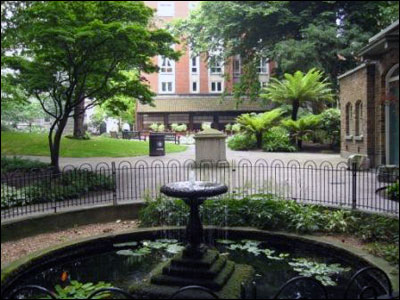
The park is empty save for a woman smoking a cigarette, a black bird with a bright orange beak, and me. The bird lands at my feet and hops toward me, holding one foot up as if injured. Here, next to the noisy, crowded streets of downtown London, I finally feel I can get acquainted with the city Shakespeare called “this other Eden.” Postman’s Park, tucked between looming office buildings and steps from the hoards of tourists at St. Paul’s, is as humble as a park could get — no life-size bronze statues, no Sound of Music hills, no majestic elms. What it has is this: tidy lawns, blooming perennials, a few koi in a small fountain, and a series of plaques.
The plaques make this rather unremarkable park remarkable. Under the eaves of a loggia where the woman and I are sitting, ceramic tiles commemorate ordinary people who died trying to save the lives of others. “Edmund Emery from Chelsea leaped from a Thames steamboat to rescue a child and drowned on July 31, 1874.”“Solomon Galaman aged 11 died of his injuries September 6, 1901, after saving his little brother from being run over in a commercial street.”
My first impression is to fill in the blanks in my mind. I see a cobblestone road filled with horse-drawn carriages traveling in all directions and the Galaman boy darting after a ball. Solomon pushes his brother out of the way just as a carriage overtakes him. But then I feel a little cheated because I don’t really know if that was how the event transpired. There isn’t enough information. I want to know more — like how Solomon’s mother handled the news and if Mrs. Emery was proud of her husband’s bravery. Most of all, I want to know why. Why did Robert Wright of Croydon enter a burning house on April 30, 1893, to save a woman even though he knew there was petroleum stored in the cellar? Did he recognize the woman, or did he just hear cries for help and decide to act? But I will never get more than the paltry details written here.
These tiles were the brainchild of painter and sculptor George F. Watts, a socially conscious Victorian rebel of sorts who disliked the upper classes. During his own time, he was very successful and was called “the English Michelangelo.” In 1887, the Queen’s jubilee year, Watts wrote to The Times requesting a memorial be built to record examples of everyday heroism and self-sacrifice. Nothing came of the letter, so he decided to go it alone. He paid for the first 13 plaques to be built on this wall in the former churchyard of St. Botolph’s, still located at the west end of the park. After Watts’ death in 1904, his widow continued working to bring the total to 53. The most recent date I can find is 1927.
The black bird flies away, maybe to find someone willing to share his lunch. Then the woman stubs out her cigarette and leaves too, and I am alone. Her heels clicking on the stone path get fainter and fainter. I have that illusive feeling of being sealed and protected from the outside world — the sounds of the double-decker buses and salesmen hawking souvenirs cannot permeate the gates of the park.
It’s not hard to imagine Mark Tomlinson and Ellen Donovan and Herbert Maconoghu, each dead about 125 years from some heroic act, sitting along side of me. Theirs is an invisible weightiness, a presence here in Postman’s Park that forces me to wonder if I would come to the aid of another, no questions asked. Would I have what it takes to run into a burning building to save three children like Alice Ayers did? Could I jump into a river for a boy entangled in weeds like William Donald? Without the pressure of my life on the line, it’s easy to say yes, I would do the right thing. But I don’t know for sure.
It's official. The question mark has been removed. A panel of scientists for the Intergovernmental Panel on Climate Change (IPCC) has released their report on global warming and states unequivocally that "human activity" is the major cause for this plight.
And the report predicts dire consequences for the earth. Droughts, rising sea levels, rising average temperatures, heat waves, stronger tropical storms, basically more of what we've been experiencing lately. For Americans that means more Hurricane Katrinas, more stifling hot and longer summers, as well as warmer winters. Retirees may not have to move to Florida or California anymore; besides, those places might be flooded. Global warming has already been predicted in Europe with the consequences being that the northern countries will benefit while the southern ones will languish. The excellent article in the Financial Timessays that rising temperatures will let northerners vacation closer by thereby leaving typical warm getaways such as Greece to deal with their hotter temperatures and related problems themselves.
So what good is the report? In it, governments are urged to do something about this problem. In an interview with Reuters, French President Jacques Chirac said, "Faced with this emergency, now is not the time for half measures. It is the time for a revolution, in the true sense of the term. We are in truth on the historical doorstep of the irreversible." On Thursday night before the report was released, several European monuments turned off their lights as a symbolic gesture showing concern for climate change.
The United States government has tried a few times to be more active in controlling its impact in global warming. The benchmark for greenhouse gas emissions controls is the Kyoto protocol, which the Bush administration pulled out of for lack of proof that global warming is man-made. Now that the proof is here, perhaps Mr. Bush will take a more active role in reducing greenhouse gases for which the United States is the worst offender. In 2003, Senators John McCain and Joe Lieberman co-sponsored their self-named Climate Stewardship Act only to have it shot down by the Senate. Perhaps now this important bill will be welcomed and put into use rather than kicked so easily to the curb.
It is also interesting to note that the IPCC report was released one day after former Vice President Al Gore was nominated for a Nobel Peace Prize for his efforts to bring about awareness of global warming. If global warming is the new "it" thing of the year, then let it be and let us start changing for the better.
Global warming is a serious problem, and the world is slowly beginning to realize the consequences of individual as well as big business contributions to it. It took 2,500 scientists organized by a United Nations special panel to realize that global warming is caused by human activity. Now it will take the 6.5 billion-plus people on the planet to take the threat seriously and drastically change their habits in order to keep the world habitable.
It isn't the woman walking through a dark alley way or the woman who "wants it" who becomes the next victim of rape and sexual assault. It isn't a woman deemed sexy by middle-class society. The assailant isn't large, black, and waiting for her, and he isn't a stranger in most cases. These are the myths surrounding rape and sexual assault that cloud our media and further attack men and women who are victims of this violent crime. With such hefty assumptions furthered daily by the mainstream, it should be no shock that rape is the violent crime that goes unreported most often.
Statistics abound regarding the numbers of women affected by rape and sexual assault. The predominant statistic circulated among rape educators reads “1 in 4 women will be affected by sexual assault or rape in her lifetime.” That is 25 percent of roughly half the world’s population – 25 percent that will be violated in some way by another person against her consent, against her will. The legal system is failing our victims, failing our men and women by taking one of the most devastating violent actions and getting it caught up in the bureaucracy of legal red tape. A woman in Florida reported a rape, but instead of following through with the prosecution of the incident, she was jailed when a former warrant surfaced. A statement by the Florida college student also says an employee of the jail refused to administer a second dose of the “morning after” pill.
The woman received an apology from the Tampa police, according to the article, but it doesn’t remove the devastation.
Instead of consoling victims, or helping those who brave their own fears and report a rapist, we as a society too often chastise them, smear their names in the media and dehumanize them even further.
Have you looked at the Duke lacrosse rape case ? Perhaps, a better question would be “Who hasn’t?” Though the facts of the altercation are grey at best, given the intense media campaign coupled with commentary by leaders in all walks of life.
This case, beyond any other, has made it painfully clear that the American nation needs a shift in mentalities when it comes to victims of rape and sexual assault. Immediately, this woman’s claim was lessened because of two key factors and perhaps misconceptions when it comes to speaking about rape and sexual assault. First, society discredited this woman because of her deviant profession – an exotic dancer. As a sex worker of sorts, it was believed that she could not be raped. A career choice, made for whatever reason, does not take away a woman’s ability to give consent.
Secondly, the woman involved was a woman of color accusing young white men from a prestigious university. The combination of the two factors built a case against her in the public eye, regardless of other issues in the case. All of the cards were already against her.
I can imagine the fear that goes along with such a situation, in knowing that no one is going to believe you, yet persisting with identifying high-profile sexual assailants. Am I saying that I, without a shadow of a doubt, believe in this woman’s claims, inconsistent story and all? No. But, the vast majority of survivors or victims of sexual assault and rape do not lie about their experiences. I owe her the same benefit of the doubt.
Rape isn’t only a woman’s issue and never should have been assigned to that domain. The violent act itself is most commonly perpetrated by men against women, and that in and of itself is enough to break down the stereotype that men “don’t have to worry about it.” The chilling statistic that declares that 1 in every 12 men will be raped or sexually assaulted adds to the mounting case that society is ultimately dismissing a horrible phenomenon, that at one point or another, will affect most people in the country in some way or another. It is fortunate that each individual in this country will not have to deal with the atrocities of rape and sexual assault personally. However, in some way or another, most will be touched through the life of a survivor – a sister, mother, aunt, grandmother, best friend, partner, or other individual. Rape is not something we can close our eyes to.
Rape and America’s inconsistent, at best, attitude towards it didn’t disappear with the 20th century. It still exists and will continue to do so until someone says it’s time for the violence, the legal bias, the media judgement, and the acceptance to stop.
The longer we treat rape as a four-letter word, unspeakable except for in hushed tones, the more victims will amount and the fiercer battle we create for ourselves as human beings.
We use cookies to improve your experience while you navigate through the site. Cookies that are categorized as necessary are stored on your browser, as they are essential for the working of the site’s basic functionality. We also use third-party cookies that help us analyze and understand how you use this site. These cookies will be stored in your browser only with your consent, and you have the option to opt out of using them.
Necessary cookies are essential for the basic functionality and security features of this website. These cookies do not store any personal information.
Any cookies that are not necessary for the website to function and are used to collect user personal data via analytics or other embedded content are termed non-necessary cookies. It is mandatory to procure user consent prior to using these cookies.



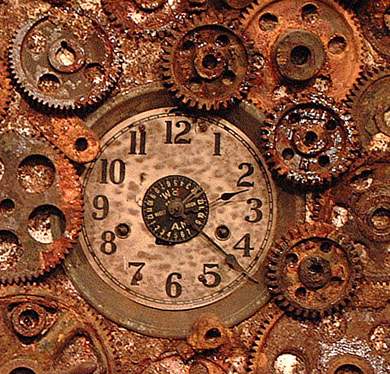
 Detroit’s transition from past to present.
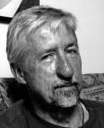
 A conversation with Tom Hayden on being stirred by bullies and killers.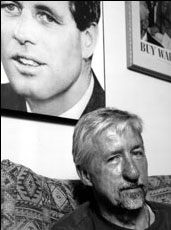

 Explorations of history and heroism in London.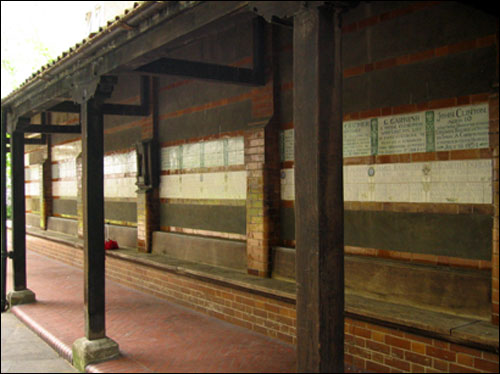

 Say Hello to Kitty...