Surrender monkeys

I don’t know, but like some spellbinder straight out of a Tolkien book, President Bush has worked his magic again.

Democrats were failing to muster the required votes in the House to override Bush’s veto of a war-spending bill last week, and given the sad state of anti-war assertiveness within Democratics on the Hill, it seems Bush’s desired no-strings-attached funding may not be beyond hope.

Despite polls vastly supporting the Democratic positions in the war-torn nation  polls like the April 26 Gallup questionnaire indicating 57 percent of Americans support setting a timetable for removing troops from Iraq, whereas only 39 percent supported Bush’s proposal to keep troops in as long as necessary to achieve victory  the Democratic leadership still appears weary to stake a stand against the administration policy of indefinite deployment.

As Senator Russell D. Feingold of Wisconsin told The New York Times, "There is virtually no one in our caucus who does not want to be associated with trying to get us out of this war. The only thing that is slowing some of them is the fear that somehow they will be accused of doing something that will put the troops at risk. The desire for political comfort is still overwhelming the best judgment even of some Democrats."

Translation: The Democrats are so afraid of making any politically exploitable misstep on Iraq or looking soft on national security that they are failing the American people and the troops.

Nothing “supports the troops,” to use the inane slogan the administration PR geniuses coined so effectively, more than getting them out of harm's way in an endless, goal-less conflict which has catastrophically increased instability in the region and continues to aid terrorist recruiters in finding new members.

I am with Senator Hillary Rodham Clinton of New York. The Democrats should revoke the war powers granted to the president and send Bush a memo straight from the majority of Americans: The game is up. Add an end to this open-ended debacle and do what is truly best for the troops. Stop making their enlistments and tours of duty in Iraq longer.

The only thing Democrats would surrender by setting a withdrawal date from Iraq, after all, is another failed policy by what history will surely remember as one of our worst administrations.


The labeling of a genocide

Who “wins”?

The definition of genocide — “the systematic and planned extermination of an entire national, racial, political, or ethnic group,” according to The American Heritage Dictionary — little informs us how to distinguish between a violent conflict and one that crosses into genocide.

Recognizing genocide is as much a political contest as it is a moral imperative. And in the court of international opinion, victims — and perpetrators — fiercely contest the labeling of a conflict as genocidal.

What was the first genocide of the 20th century?

If you said the Nazi Holocaust, you would be only semantically correct. The word “genocide” was not coined until 1943 when Raphael Lemkin, a Polish Jewish legal scholar, combined the Greek prefix for family, tribe or race (genos) and the Latin suffix for massacre (cideo) to describe what was happening in Germany at the time. If you answered the 1915 Armenian genocide at the hands of the waning Ottoman Empire, from which Lemkin first developed his ideas on the genocide, you would be closer, but still not correct.

The first genocide of the 20th century took place in Africa. But unlike the genocides in Rwanda and Darfur, where the victims and perpetrators are Africans, it was a German colonial occupying force that exterminated the Herero people in South West Africa (present day Namibia) between 1904 and 1907. The Germans laid siege to the Herero community, massacring close to 80 percent of the population and forcibly moving the rest to concentration camps.

Germany came late to the scramble for Africa and intended on making huge strides to transform their territories by relying on their significant industrial prowess to subdue both man and nature. Initially, Germany tried to legitimate their presence in the Herero homeland through legal means, but when a group of Herero rose up against what they perceived as an unfair German occupation, the response was swift and dramatic. After a crushing defeat in the Battle of Waterberg, the Herero were forced to leave their land and tens of thousands were slaughtered by the German army. “I believe that the nation as such should be annihilated, or, if this was not possible by tactical measures, have to be expelled from the country,” said General Lars Von Trotha, Kaiser Wilhelm II’s choice to lead the campaign.

It was in Africa that the Germans first began their use of concentration camps, a harbinger of what was to come within Germany 40 years later against undesirables like Jews, Gypsies (Roma) and homosexuals. Herero inmates were used as slave labor and experimented upon by German imperial scientists. In fact, Eugene Fischer, a young German geneticist who began his work on race-mixing in the Herero concentration camps, was a seminal influence on Adolf Hitler. Hitler eventually elevated Fischer to the top position at the University of Berlin where his star pupil was Josef Mengele, a leading architect of the German Holocaust.

In terms of the percentage of the population killed, the Herero genocide was more successful than the Holocaust, the Rwandan genocide and the killings in Darfur. Less than 20 percent of the Herero population — or fewer than 20,000 — survived. There are a little more than100,000 Herero living primarily in Namibia today and in smaller communities in Angola and Botswana. That a vibrant and diverse Herero community exists at all represents a tremendous recovery.

Given the historical significance, why don’t people know about the Herero? The answer is related to several factors that tell us much about the politicized nature of labeling a conflict as genocidal. Lacking a significant diaspora in the West, the Herero have never been able to demand recognition from the international community in the way Armenians and Jews have attempted to ensure their history is never forgotten. In 2001, a private foundation representing the Hereros did sue the German government and corporations in American courts. However, the German government successfully argued that the1948 Genocide Convention could not be applied retroactively. A century after the genocide took place, Herero groups did receive an apology from the German government in 2004, but no direct compensation was ever provided to the community.

Somewhat perversely, the term genocide has become so politically loaded that it has little meaning as a descriptor of contemporary ethnic and racial conflicts. Instead, it more accurately reflects the political standing of the targeted group in the West. As such, the application of the term has become more akin to a linguistic sweepstakes whereby persecuted minorities are awarded with recognition if and only if they can “win” the term’s application to their situation.  The downside of all this is the term inhibits us from recognizing the relative frequency with which minority groups are persecuted. We have become primed to care only when a conflict emerges in the international consciousness as genocidal — rendering others just forgettable.


Something borrowed, something new

200705_lethem.jpgA close reading of Jonathan Lethem’s novel You Don’t Love Me Yet.

200705_lethem.jpgA few years ago, author Jonathan Lethem found himself well on his way to becoming the Philip Roth of Brooklyn with his two most well-acclaimed novels, Motherless Brooklyn (1999) and The Fortress of Solitude (2003) — both colorful and incisive accounts of his hometown borough — quickly propelling him into the somewhat reluctant role of a Brooklynite mouthpiece.

It was for this very reason that Lethem felt compelled to set his new novel, You Don’t Love Me Yet, in the complex maelstrom that is Los Angeles. It’s a bold move, not only because of the notorious competition between New York and Los Angeles, but because Los Angeles is a difficult place to penetrate — even for those who live there.

“There’s that famous Joyce quote about ‘artists need silence, exile, and cunning,’” Lethem told me over the phone in late March, “and I guess I’d just been looking for that ‘exile’ part of things; working from the margins, doing preposterous things, disavowing one’s credentials.”

The novel — Lethem’s seventh — stars Lucinda Hoekke, a bass player stumbling into her thirties while living in Echo Park, an up-and-coming, yuppie-hipster Los Angeles neighborhood. Like many of the city’s residents, Lucinda works odd jobs as she tries to make it with her wannabe rock band. Her latest career move is answering phones at the Complaint Line, an anonymous help line conceived by her conceptual artist friend. Eight hours a day she fields complaints from callers responding to randomly placed stickers that read, “Complaints? Call 213-291-7778.” (The number really works: Try it.)

It’s there that Lucinda falls for a regular caller named Carlton Vogelsong — affectionately nicknamed “the Complainer” — who confides to Lucinda at length about his sexual escapades, but also about his feelings of emptiness and dissatisfaction with life. The Complainer also happens to be a professional slogan writer and, indeed, his utterances beguile the wayward Lucinda, who makes note of them and passes them on to her band’s lead singer and songwriter. The Complainer’s words soon become the lyrics for some of the band’s best songs, calling the material’s ownership into question as the band starts to grow more popular. As the songs take on a life of their own, no one is quite sure just where they originated.

The plotline recalls Lethem’s essay “The Ecstasy of Influence,” which was published in the February 2007 issue of Harper’s Magazine. The essay explores the phenomenon of cultural borrowing and appropriation, and the effects of intellectual property rights. “The demarcation between various possible uses is beautifully graded and hard to define,” wrote Lethem in that essay, “the more so as artifacts distill into and repercuss through the realm of culture into which they’ve been entered, the more so as they engage the receptive minds for whom they were presumably intended.”

Appropriation is essential to creative vitality, Lethem reminds his readers, and strict copyright laws are consequently detrimental to artistic innovation. The essay urges consideration of the world of art and culture as a sort of public commons, impervious to possession by a singular person. “Copyright is a ‘right’ in no absolute sense; it is a government-granted monopoly on the use of creative results,” writes Lethem. “Whether the monopolizing beneficiary is a living artist or some artist's heirs or some corporation’s shareholders, the loser is the community, including living artists who might make splendid use of a healthy public domain.”

In that spirit, Lethem has initiated a project through his website called Promiscuous Materials that offers up his stories and lyrics at no cost for other artists to use, rework, and reinterpret at will. Already, artists such as One Ring Zero and John Linnell from They Might Be Giants have recorded songs to Lethem’s lyrics, and some short films are in the works.

Lethem has also recently announced that he will option out the film rights to You Don’t Love Me Yet to a filmmaker of his choice in exchange for just 2 percent of the profits once that film is made. In addition, both he and the filmmaker will give up ancillary rights to their respective creations five years after the film’s debut. By offering this nontraditional option, Lethem hopes to spark a reexamination of the typical ways in which art is commodified. “I also realized that sometimes giving things away — things that are usually seen to have an important and intrinsic ‘value,’ like a film option æ already felt like a meaningful part of what I do,” he writes on his website. “I wanted to do more of it.”

Lethem is not the originator of the battle against the increasingly tight grip of copyright laws; he points to Open Source theory and the Free Culture Movement as influences, as well as longtime collage artists like the American experimental band Negativland. But as a successful mainstream author, Lethem is a uniquely compelling advocate. “Almost everyone you find clamoring for strengthening the public domain or for reexamining the regime of intellectual property control that’s so typical right now is not so much like me,” Lethem told me. “I think there’s a really kind of sad abdication of this conversation by more established artists. That’s why I felt that I had a role to play in this talk.”

Projects such as Promiscuous Materials and the You Don’t Love Me Yet film rights option are potent responses to the rampant propagation of intellectual property rights — more effective, probably, than the latent messages encoded in the plot of Lethem’s new novel. It would be easy to create parallels. For instance, in the book, when the Complainer learns that the band’s hit songs contain his lyrics, he burrows his way into becoming a member — “Do you want to destroy the band?” the drummer asks the Complainer when he claims credit for the songs. “How could I want to do that?” he responds. “I basically am the band.” But this unpopular addition results in the band’s demise. Thus, the Complainer’s aggressive move to assert creative ownership ultimately destroys the artistic product.

Yet Lethem is quick to downplay the connection. “Of course, it comes out of a similar instinct, but it’s not like the book was written as a heavy way of bearing down on any idea. It sort of glances off those thoughts. But the book is, I hope, a little too frisky to seem like it’s got a big and ponderous agenda like that.”

As advised, it’s best to read You Don’t Love Me Yet as a light and playful “sex and rock ‘n’ roll” novel rather than overestimate its relation to Lethem’s crusade against what he calls “usemonopoly.” Though some reviewers are dismayed by the novel’s slightness as compared to the wondrous complexities of Lethem’s more major works such as Motherless Brooklyn and The Fortress of Solitude, it is not definitively disastrous for an author to maintain some equilibrium of tone and substance. As the Complainer says in the novel, “You can’t be deep without a surface.” Jonathan Lethem has sufficiently proved his depth as a writer; let us allow him his surface.


Alone in the forest

Discovering the kindness of strangers in Cuba.

A truck had dropped me off at a crossroads. But instead of driving away, the well-meaning driver was still trying to tell me something. Probably, “No cars are coming. You’re in the middle of nowhere. Are you crazy? What are you doing, little lady?”

I got the gist, even though I didn’t speak Spanish. I started walking, and as the distance between us grew, I could hear him yelling that maybe this was a bad idea, and he motioned for me to get back into the truck. He honked again.

But I kept on walking. No time for debate.

I passed a man wearing a suit and a felt hat, who was also headed for San Diego de los Banos, a town known for its thermal baths. He was just standing there, waiting in the middle of nowhere, as if it were a bus stop. But there was no bus stop. No car or another person in sight.

Perhaps he is still waiting there.

The man said that San Diego de los Banos was a long way off — 15 kilometers at least. But rather than join him, standing in the countryside, with the chance that a car may never show up, I decided that if I walked fast enough, perhaps I could still reach the town by nightfall.

It was now 3:30 p.m. The sky was overcast. About three more hours of sunlight left. Remembering the distance of bygone high school cross-country races, I calculated that 3.1 miles equaled five kilometers. If I can walk three miles per hour, surely I can reach town by dark, I thought. It is doable.

So I began walking. And I walked and walked.

And not a single car came by.

The road through the countryside rose and fell, and soon, the flatness of the land gave way to a forest of pines and cedars. Not far from here, Che Guevara had moved his headquarters into a cave during the Cuban Missile Crisis. It was just me and this forest, and if I shouted, I’d spook myself.

Suddenly, two men emerged from nowhere, walking next to their bikes. Perhaps there was a house tucked away in the forest that I couldn’t see. I began to walk a little faster, but the two men were gaining on me.

Why are they walking next to their bikes? I asked myself.

My duffel was heavy, and I tried to pick up the pace, but they were getting closer.

I could totally be raped and robbed right now, I thought, clenching my teeth.

I stopped and let them overtake me. A teenager with his father on a bicycle ride, it appeared. They happened to be walking next to their bikes because the hill was on an incline.

“Hola,” they said, after I gamely raised my hand and said, “hi.” I knew I was safe after I asked them how far San Diego de los Banos was, and the man replied with a wave of his hand into the distance, “twelve kilometers. It’s far away.” I reassured him that I was hoping to flag a car that came this way. He nodded, and they soon passed me.

I walked a few more kilometers when I saw two other men approaching from behind — again walking with their bikes.

There is nobody around, so I am really at their mercy here, I began to think. Suppose I get killed in this forest. The Cuban police might take a week to identify my rotting body from my passport photo. My imagination was getting the better of me again; I began to wonder how much media coverage the story would get at home.

And then, the men were next to me. One of them offered to put my bag on his bike. I said no, that I can carry it myself. Now there is a ploy, I thought. Put the tourist’s bag on the bike and ride off.

It was not until the younger of the two men smiled sympathetically and said something about confianza that I softened. I said “si,” and put my duffel on his bike. I recognized the word from the French confiance, which means “trust.”

And so began our 12-kilometer ride to San Diego de los Banos, where the two men lived. The sun emerged, and the skies then revealed the depth of their blue heights, with wispy clouds soaring high above. When we would reach the summit of a hill, I would sit atop the horizontal bar of the bike, “sidesaddle,” in front of the younger man, and hold onto the inner handle bar while he, wearing my backpack, would steer us both downhill, with the older man following close behind.

We’d breeze past palm trees and lush vegetation, the young man applying the brakes generously and carefully avoiding the road’s potholes, until the hill petered out. Then the three of us would hop off the bikes and walk them up to the next summit, get back on, and ride downhill again.

A strange grunting noise seemed to follow us each time we stopped. And then came a long squeal.

Poking out of the slits of two sacks tied onto each bike were two snouts, each sniffing the air as if to figure out what was going on. We were biking with a couple of hogs.

Musica,” joked the younger man as we navigated down yet another hill.

As we approached town, we passed people who looked up and stared. Sometimes, I heard laughs and “Chiiiiina.”

I am American, but I let people think I was from China during this trip to see Cuba on my own. “Chairman Mao!” some would offer generously in a eureka moment of finding common ground. “Lejos,” or “far,” people would say, in remarking how long my plane trip must have been from Asia.

I often got those comments while walking — or waiting for transport.

This is a country where you often have to stick your thumb out to get somewhere, especially when off the beaten track, because of a shortage of buses. No hitch aboard a tractor, truck, or even motorcycle sidecar prepared me, however, for the possibility of catching a ride aboard somebody’s bicycle.

When the younger man had first motioned for me to jump on his bike, I balked. How did he want me to sit, I wondered. Did he want me to straddle it?

“You’re from China,” he said, laughing. “You don’t know how?” He then stuck out his butt to demonstrate that the best way was to sit sideways.

I do know this. I would probably still be walking in the dark in that uninhabited forest, were it not for those two men. Not once did a car pass along the road that entire time.

We made it to town just before nightfall.


The culture of being

200705_adopt2.jpgTransnational adoptees come of age and search for home.

Jennifer Cerami garnered a flirty smile from the guard at the Colombian consulate in midtown Manhattan. She was 27, with dark eyes and curtain of long hair. Around her in the waiting room sat a scattering of Colombians with official business back home. It was her first visit, in August of 2005, and Cerami looked uncertain, but not out of place. She cradled a stack of old papers and photographs.

When her number was called, Cerami leaned in to the window, whispering.

“I was adopted in Colombia.”

“Don’t worry,” the consular officer told her, leaning in from the other side. “We all have secrets.”

Like many adoptees, Cerami’s story has several beginnings. One of these is with Linda and Michael Cerami, a young couple from Lindenhurst, Long Island, a blue-collar community of single-family homes and above-ground pools. A high fever had damaged Linda’s fallopian tubes. Michael had lupus, which made domestic adoption difficult. So Linda began to look for a newborn overseas.

Since then, every April, on Jennifer’s birthday, Linda told her daughter this story.

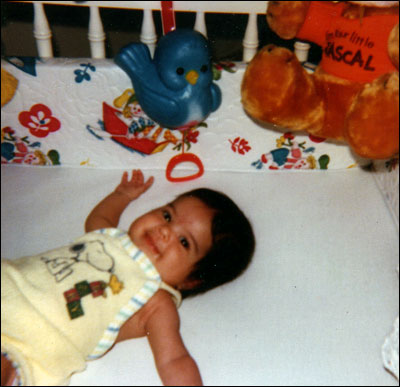
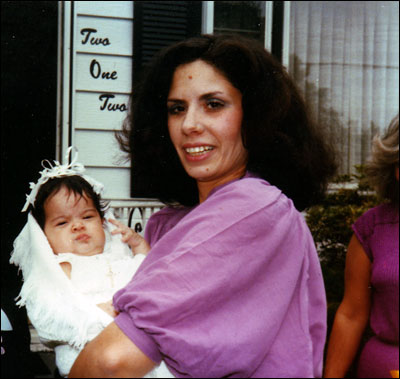
“We wanted a baby very badly,” Linda would say. “And we had to go very far to find you, all the way to a country in South America. I put in the papers, and nine months later, the call came telling us that a beautiful baby girl was waiting for us in Bogotá. You had been left on the doorsteps of the orphanage. Your father and I flew down. No, we never met your mother. But we met the woman who took you in. She led us in to a room with rows and rows of bassinets, and said, ‘Guess who your daughter is?’ Well I walked down the row right past you. But your father stopped there in front of your crib and started crying. And that’s how we were blessed with a wonderful daughter, who is you.”

Jennifer’s adoption was a big event in the closely-knit neighborhood. The Heinzes and the Duffys brought their children to the Cerami front yard for the baby’s arrival, and their daughters — Teresa, Sabrina and Rebekah — became Jennifer’s life-long friends. Summers were games of hide-and-seek and Red Rover, lemonade stands, collecting fireflies. “You wouldn’t have found anything Colombian in our house,” Cerami says. “Nothing.”

Cerami thought of herself as white but there were things every now and then that didn’t jibe. When in second grade other children wrote “basketball” and “butterfly” for words that begin with B, she chose “Bogotá.” While they burnt to red in the sun, Cerami merely darkened. By the time she was ready for prom, Cerami could see the irony of choosing Rodrigo, the only other Latino she knew, for a date.

At Boston College things began to get perplexing for Cerami. She was recruited to the Latino student union, OLAA, though she spoke no Spanish. At a meeting of AHANA, a campus minority group for Asians, Hispanics, Native Americans and African Americans, the leader played “I Believe I Can Fly,” then gave a speech Cerami calls “don’t let the white man bring me down.”

“What was I supposed to do?” Cerami says about storming out of the meeting. “The white man raised me.”

During her second year she moved into the romance language dorm on campus, and studied some Spanish. For a school publication, she wrote an article called “What kind of Latina am I?” “I love my mother dearly,” it reads, “but she raised me as she was raised — Italian.”
Taking the country out of the children

Last year, the U.S. State Department issued immigrant visas to over 20,000 foreign-born orphans, up from roughly 2,000 in 1969. Nearly 200,000 of the 1.6 million adopted minors living in the U.S. are foreign born. Today, exchanging children is a $1.4 billion industry, with travel and adoption agencies, visa wallahs and psychologists to fill every available economic niche.

Inter-country adoption flows in the wake of foreign war and poverty. Developed nations sheltered Koreans after the Korean war. Romanians and Russians followed the fall of Ceausescu and Communism in the early nineties. China’s one-child policy bolstered its top ranking among donor countries in the last decade. But as China’s supply levels off, Ethiopia, Liberia and other African nations are now opening up. In Latin America, and Colombia in particular, the orphan boom came in the wake of civil conflict of the late 1970s and 1980s, which means the largest group of Latino adoptees like Cerami is currently coming of age.

Still, modern international adoption has only been going on for 50 years. It remains an unfinished social experiment, bred from compassion, infertility and post-war economic divides. The legality, propriety and ethics of transnational adoption — its effect on parents, children and societies — is still hotly contested. What began as an idea about “saving kids” has turned into an acute expression of a global society. New laws, such as the Hague Adoption Convention, designed to protect children from trafficking, are allowing transnational adoptees greater access to their pasts. Both cosmopolitan and provincial, adoptees magnify the broader changes in the way we answer the basic question of where we come from.

The biggest development in the history of transnational adoption, though, is the death of the myth of a “clean break” from biological and cultural roots. Today, agencies encourage adoptive parents to foster multiple identities, through organized “culture camps” or sponsored trips home. “Cultural citizenship” spurs South American-themed wallpaper, dress-up clothes, and peculiar show-and-tell moments. As cultural anthropologist Toby Alice Volkman describes in the academic journal Social Text, transnational adoption “forges new, even fluid, kinds of kinship and affiliation on a global stage.” In other words, transnational adoptees, with their socially-constructed identities, are the avant-garde of the present global age.

Jerri Wegner, who has three adopted Colombians of her own, helps educate new families on managing their children’s identity. “I tell parents,” she says, “that we have to take our children out of Colombia in order to bring them home, but we never have to take Colombia out of our children.” Her agency, Friends of FANA, organizes Spanish-language camps in Colombia, and country-themed gatherings in upstate New York, where kids are fed Colombian food and encouraged to play soccer wearing Colombia’s yellow national team jersey.

Hollee McGinnis, a sociologist at the Evan B. Donaldson Adoption Institute who studies identity in adoptees, wonders whether this is the best approach. She argues that “culture camp” may unnecessarily complicate the development of a healthy identity. Her research describes two layers of culture that every adoptee has. The first is an “external” layer of food, attire, language and history — things anyone with a little curiosity can pick up. But the second layer of culture is more elusive: “the culture of being,” which can only be acquired by living it. “It’s how you walk, interpret the world, your internal values,” McGinnis says. “Most adoptees lose that.”
A shifting sense of home

The Colombian in Cerami’s face is visible, but she moves like a girl from Long Island, with a wide, forward-pressing gait. These days, Cerami works as an analyst at Ann Taylor’s online marketing division, in Midtown. Before that, she did a stint on the floor for Sephora. She squeezes appointments in before racing off to the New York Sports Club, then heads home to a Lower East Side one-bedroom where her open laptop chirps with instant messages. She talks to her mother every day. “I had fights with my mother just like any teenager,” she says, “but now she’s my best friend.” And still, Cerami holds on to a desire “to be from some place.”

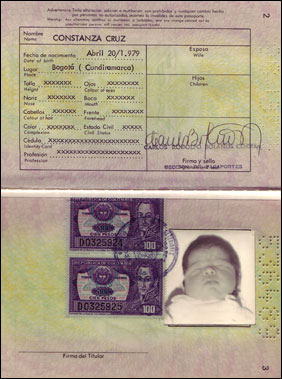
Like for many adoptees, Cerami’s search began with documents. Her first came in a DHL envelope, just a week after her visit to the consulate: a birth certificate. “Not a mystery solved,” she says, “but more like answers to questions I didn’t realize I had.” Her own name is Constanza Cruz. She had not been left on a doorstep.

That winter, Cerami got in touch with her orphanage in Colombia. A friend’s wedding in South America had given her an excuse to stop off in Bogotá, the first time any Cerami had returned to Colombia since Jennifer was three months old. Through a contact at the consulate, Cerami sent out an announcement on Colombian radio asking Constanza Cruz’s mother to call, but nobody responded. Colleagues at Cerami’s office, who had been following her revelations, offered donations for the orphanage, which Cerami planned to visit. Come Christmas, Linda drove her adopted daughter to the airport.

“I’m afraid I’m not going to feel,” Cerami told her mother in the car. “I’m afraid I’m going to go down to this country and be completely not affected by what I see. My life is not going to change. This isn’t going to have a connection with me, and what does that mean then?”

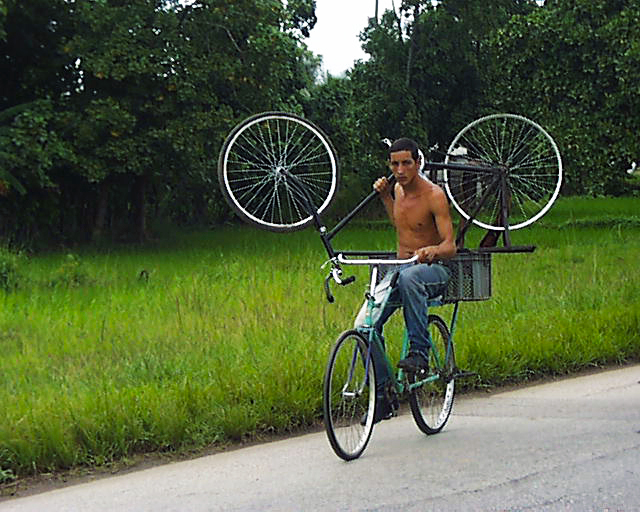
A man brings a spare bike home from the repair shop in Candelaria, a town on the road from San Diego de los Baños. October 1999. (Alastair Smith)

Alone in the Forest

Discovering the kindness of strangers in Cuba.

A man brings a spare bike home from the repair shop in Candelaria, a town on the road to San Diego de los Baños. October 1999. Alastair Smith

First in a two-part series. Click here for the second part.

A truck had dropped me off at a crossroads. But instead of driving away, the well-meaning driver was still trying to tell me something. Probably, “No cars are coming. You’re in the middle of nowhere. Are you crazy? What are you doing, little lady?”

I got the gist, even though I didn’t speak Spanish. I started walking, and as the distance between us grew, I could hear him yelling that maybe this was a bad idea, and he motioned for me to get back into the truck. He honked again.

But I kept on walking. No time for debate.

I passed a man wearing a suit and a felt hat, who was also headed for San Diego de los Baños, a town known for its thermal baths. He was just standing there, waiting in the middle of nowhere, as if it were a bus stop. But there was no bus stop. No car or another person in sight.

Perhaps he is still waiting there.

The man said that San Diego de los Baños was a long way off — fifteen kilometers at least. But rather than join him, standing in the countryside, with the chance that a car may never show up, I decided that if I walked fast enough, perhaps I could still reach the town by nightfall.

It was now 3:30 p.m. The sky was overcast. About three more hours of sunlight left. Remembering the distance of bygone high school cross-country races, I calculated that 3.1 miles equaled five kilometers. If I can walk three miles per hour, surely I can reach town by dark, I thought. It is doable.

So I began walking. And I walked and walked.

And not a single car came by.

The road through the countryside rose and fell, and soon, the flatness of the land gave way to a forest of pines and cedars. Not far from here, Che Guevara had moved his headquarters into a cave during the Cuban Missile Crisis. It was just me and this forest, and if I shouted, I’d spook myself.

Suddenly, two men emerged from nowhere, walking next to their bikes. Perhaps there was a house tucked away in the forest that I couldn’t see. I began to walk a little faster, but the two men were gaining on me.

Why are they walking next to their bikes? I asked myself.

My duffel was heavy, and I tried to pick up the pace, but they were getting closer.

I could totally be raped and robbed right now, I thought, clenching my teeth.

I stopped and let them overtake me. A teenager with his father on a bicycle ride, it appeared. They happened to be walking next to their bikes because the hill was on an incline.

“Hola,” they said, after I gamely raised my hand and said, “Hi.” I knew I was safe after I asked them how far San Diego de los Baños was, and the man replied with a wave of his hand into the distance, “Twelve kilometers. It’s far away.” I reassured him that I was hoping to flag a car that came this way. He nodded, and they soon passed me.

I walked a few more kilometers when I saw two other men approaching from behind — again walking with their bikes.

There is nobody around, so I am really at their mercy here, I began to think. Suppose I get killed in this forest. The Cuban police might take a week to identify my rotting body from my passport photo. My imagination was getting the better of me again; I began to wonder how much media coverage the story would get at home.

And then, the men were next to me. One of them offered to put my bag on his bike. I said no, that I can carry it myself. Now there is a ploy, I thought. Put the tourist’s bag on the bike and ride off.

It was not until the younger of the two men smiled sympathetically and said something about confianza that I softened. I said “,” and put my duffel on his bike. I recognized the word from the French confiance, which means “trust.”

And so began our twelve-kilometer ride to San Diego de los Baños, where the two men lived. The sun emerged, and the skies then revealed the depth of their blue heights, with wispy clouds soaring high above. When we would reach the summit of a hill, I would sit atop the horizontal bar of the bike, “sidesaddle,” in front of the younger man, and hold onto the inner handle bar while he, wearing my backpack, would steer us both downhill, with the older man following close behind.

We’d breeze past palm trees and lush vegetation, the young man applying the brakes generously and carefully avoiding the road’s potholes, until the hill petered out. Then the three of us would hop off the bikes and walk them up to the next summit, get back on, and ride downhill again.

A strange grunting noise seemed to follow us each time we stopped. And then came a long squeal.

Poking out of the slits of two sacks tied onto each bike were two snouts, each sniffing the air as if to figure out what was going on. We were biking with a couple of hogs.

Música,” joked the younger man as we navigated down yet another hill.

As we approached town, we passed people who looked up and stared. Sometimes, I heard laughs and “Chiiiiina.”

I am American, but I let people think I was from China during this trip to see Cuba on my own. “Chairman Mao!” some would offer generously in a eureka moment of finding common ground. “Lejos,” or “far,” people would say, in remarking how long my plane trip must have been from Asia.

I often got those comments while walking — or waiting for transport.

This is a country where you often have to stick your thumb out to get somewhere, especially when off the beaten track, because of a shortage of buses. No hitch aboard a tractor, truck, or even motorcycle sidecar prepared me, however, for the possibility of catching a ride aboard somebody’s bicycle.

When the younger man had first motioned for me to jump on his bike, I balked. How did he want me to sit, I wondered. Did he want me to straddle it?

“You’re from China,” he said, laughing. “You don’t know how?” He then stuck out his butt to demonstrate that the best way was to sit sideways.

I do know this. I would probably still be walking in the dark in that uninhabited forest, were it not for those two men. Not once did a car pass along the road that entire time.

We made it to town just before nightfall.

November 2, 1999

First in a two-part series. Click here for the second part.


Petitions

It's time for you, the little guy, to take a minute to try to make the world a better place. Then tell two friends. And have them tell two…

First, on June 26, the ACLU hopes to deliver a 10,000-signature petition to Congress urging them to:

1. Restore habeas corpus and due process.
2. Pass the Restoring the Constitution Act of 2007.
3. End the torture and abuse in secret prisons.
4. Stop extraordinary rendition: secretly kidnapping people and sending them to countries that torture.
5. Close the detention center at Guantanamo Bay and give those held there access to justice.
6. Investigate wrongdoing and ensure those who broke the law are held accountable.
7. Restore American values and the rule of law.

I know it's a tall order, but a girl can dream. So please, go sign it (via Boing Boing, of course).

After you do that, take another minute to help out the fellow little guys. From the Free Press website: "Postal regulators have accepted a proposal from media giant Time Warner that would stifle small and independent publishers in America. The plan unfairly burdens smaller publishers with higher postage rates while locking in special privileges for bigger media companies." Now, is that fair? Don't we just hate that? Then go sign it.


It’s not you, it’s them

There should be a rule on how grandiose a self-gratifying claim can be. For example, last week Bill O’Reilly used his Web and newspaper column to glad-hand himself for “knowing” that Rosie O’Donnell would leave “The View.”

Reading it, you would have thought Mr. O. was pulling strings behind the scenes as some well-respected newsman, instead of just being a steamy pile of upper-class, Bush-voting crap.

But that’s Bill: he makes outlandish claims because he thinks he’s bigger than Guy Fawkes Day. This week, however, Bill has gone too far.

People who watch his drivel on TV will be familiar with his recent inspired ranting against Virginia Beach Chief of Police Jake Jacocks, who did not call Homeland Security over Alfredo Ramos, an illegal immigrant, who had had four run-ins with the law. This has Bill miffed  and maybe rightly so  because on March 30 Ramos killed 17-year-old Alison Kunhardt and 16-year-old Tessa Tranchant when he drunkenly hit their car. Of course Bill felt Ramos should have been sent back to Mexico already, before this tragedy occurred.

Virginia Beach’s Jacocks didn’t share this idea because Ramos had not been a violent offender. More pragmatically Jacocks said he didn’t want to get federal authorities involved, possibly because Feds don’t play well with the locals; Feds like to have a lot of power and that’s something of an issue with people who like freedom. This fact has got Bill, who apparently thinks the Feds should have a camera in every home and a tracker on every computer, angrier than a pit bull in a room full of cats.

Under duress with the bad press he was getting all around, Jacocks changed the policies of his department.

What does Bill say?

“After my reporting battered the government of Virginia Beach, it has changed its dangerous and irresponsible policy. But Jacocks got in a last shot calling me, your humble correspondent, ‘pathetic.’”

Did you read that? He claims it was his reporting that changed things and then has the audacity to call himself humble. I’d call that an oxymoron if that were not two syllables more than what O’Reilly is.

The fact is that Bill wasn’t the only person “reporting” on the Ramos case. It got a lot of attention in the press (I’m betting he got it from the AP) and the public was angered. O’Reilly didn’t do anything, the people did. But The Culture Warrior is not above hyperbole.

My whole point is that people responding to the policies of their government make changes  not middle-aged white men pontificating from inside of a box. Anyone who thinks they do may require therapy.

However, maybe Bill is on to something. Maybe everyone with a forum for opinion should use that to make claims that they are the ones that make the differences.

All right, here is mine: I’m the reason Lindsey Lohan is doing so well with rehab. You see, I’ve publicly stated that she is a “hotty” several times but that I don’t like “drunks.” Hearing this Lindsey must have chosen to turn her life around.

Now I’m off to cause a thunderstorm in Wyoming and end the LAPD’s violent ways. Thank god I have this forum, or nothing would ever change. Aren’t I swell? I did a great job.


Embrace the pale!

May is Skin Cancer Detection and Prevention Month. That means my anti-sun habits are not just acceptable this month but trendy, too. 

I could make many excuses for how pale I am. I'm a bookworm  all those hours indoors reading. I'm part Irish  we're not a sun-friendly people. My skin doesn't tan, it blisters  well, that's not an excuse, just a painful truth. Besides all that, tans just don't do it for me. On myself or anyone else. I understand the image  J. Lo, Paris, jet-setters in general with exotic tans and a big purse that costs enough to feed a small nation. I also understand the economics behind the advertising  so much profit to be made off the bronzing powders, sprays, lotions, and tanning business, trying to look like an heiress. Intellectually, I get it (if you don't, read the NY Times article spelling it out for you). Personally, I don't like it. I have better things to do with my time than damage my skin. And if I were forced to be on the towel next to you, you'd get an earful from me.

To begin with, it's your health, stupid. A tan is skin damage. Even if the possibility of skin cancer (higher than ever before) means nothing to you, I'll appeal to your vanity. You may like to carry around Gucci bags, but do you want to look like one? Are you going for a crocodile look or something?

Now, this rich-girl image. A century ago the heiress look  only the poor worked outside and tanned  was pale. So pale in fact that they used arsonic-based cream to whiten their skin, which would naturally kill some of them or at least make them extremely ill. Do you think skin cancer from sun damage is any different?

Behind the image: last I heard Paris Hilton had been sentenced to 45 days in prison. Wow  that's hot. Like, burning skin hot. I'm sure some time in "the yard" will allow her to keep her coloring.

I also understand that not all young women out there know how to be their own person. They need an icon from a magazine cover to aesthetically mimic. I can provide some pale versions, some anti-crocodiles. First, Nicole Kidman. Come on  what's not to like? Oscar winner, the richest of all rich girls, and a UNIFEM Goodwill Ambassador. Next, a French version: Julie Delpy. Is anything more chic than a French woman? Last (but not least, I just can't think of more pale actresses at the moment), a youngin', Michelle Trachtenberg. From the NYT article: "In the May issue of Allure magazine, [she] said the pressure to bronze is her pet peeve with beauty advisors at makeup counters. 'They're like, 'Maybe you'd like to warm up your skin tone'…And I'm like, 'No, I'm going to embrace the pale.'" 

That's right, people  embrace the pale!


The case of Abdel-Monem Mahmoud

The case of Abdel-Monem Mahmoud, a blogger and member of the Muslim Brotherhood is the second of its kind in Egypt, a country where press freedom has greatly deteriorated in the past few years, according to a report released by the Committee for the Protection of Journalists (CPJ) on May 3, International Press Freedom Day.  The report, entitled “Backsliders,” listed Egypt in seventh place, after Ethiopia, Gambia, Russia, DRC, Cuba, and Pakistan.  Following Egypt were Azerbaijan, Morocco, and Thailand.

Abdel Kareem Soliman was the first blogger to be arrested in Egypt.  He was sentenced in November 2006 to four years in prison for insulting Islam and President Hosni Mubarak.  His trial lasted five minutes.

Monem is quite a different personality from Soliman; a member of the Muslim Brotherhood, he was previously arrested for “belonging to an illegal organization” when he met with Brotherhood members to organize an anti-war rally.  Monem is a devoted human-rights activist, and was among the first to go to Darfur to speak with high-ranking officials there.

He also spoke out about the arrest of fellow Egyptian blogger Soliman, despite his personal disagreement with Soliman's statements against Islam.  In a post written on March 7, 2007 (originally in Arabic) in Monem's own blog, Ana Ikhwan (“I am a brother”), Monem defended Soliman, saying:

To begin with, I disagree with the opinions of Abdel Kareem, but I believe that it’s unfair for the security forces to treat him this way, punish him for his personal opinions, and sentence him for his so-called “contempt for the president.” I believe that this behavior is unfair to a young man who, along with his friends, will not change his ideas simply because he fears punishment at the hands of the security forces.

The post, translated to English by Fatima Azzahra El Azzouzi, is here.

More coverage on the case of Abdel-Monem Mahmoud can be found at the Free Monem site as well as at Global Voices Online.

personal stories. global issues.