- Follow us on Twitter: @inthefray
- Comment on stories or like us on Facebook
- Subscribe to our free email newsletter
- Send us your writing, photography, or artwork
- Republish our Creative Commons-licensed content
Stricken with the loneliest of illnesses, people with rare forms of cancer have built their own online communities.
Savage, a Boston Globe correspondent and ITF contributor, was awarded the Pulitzer Prize for national reporting. This story was originally published June 4, 2001.
“No man is an island,” the poet John Donne assures us. But on October 5, 1998, I had a hard time sharing his optimism. That was the day I found out I had LMS — leiomyosarcoma, a rare cancer of soft muscle tissue that strikes fewer than four people out of a million.
But despite those numbers, I never really felt alone. Today, people with extremely rare medical conditions around the world are banding together via email groups. It is, in every sense, a revolution in terms of patient empowerment, one that has quickly spread in the past couple of years.
Cancers like LMS are among the loneliest of illnesses. While those with more common cancers can usually find a network of others in the same city who have the same condition and who are going through the same thing, my chances of ever meeting another LMS patient seemed slim.
Only a few years ago, that isolation would have been my new reality. It certainly was for Orland Hetherington, a native of Ontario, Canada, who had LMS diagnosed in 1994. “I spent two years trying desperately to find another living soul with LMS,” Hetherington said. “I was alone with this and scared. I became somewhat obsessed with finding someone else on the planet with LMS and searching harder for more and more information.”
In March 1997, LaDonna Backmeyer, an LMS patient in Rock Island, Illinois, found Hetherington on a cancer online support list. She asked him to help her start an online discussion group specifically for LMS patients and their families and friends. From just four members then, that email group has grown to more than 560 subscribers.
For a while, I was one of them. The group instantly welcomed me to its ranks with both personal notes of understanding and a barrage of advice on treatment options and research information that helped me know more about what lay ahead during my recovery.
The group “has given information to several hundred patients since its founding,” Backmeyer said. “Some of the patients check in for a small amount of time in order to get the information they need; others find a group of welcoming friends, and they stay.”
All this from a machine
In my case, the group helped me learn about a then-experimental surgical technique developed by Dr. Steven Curley at the M.D. Anderson Cancer Center in Houston. I flew to Houston and underwent Curley's surgery, which removed all traces of tumor from my liver in December 1998. As of my last trimonthly check up, I remain cancer-free without having had to undergo chemotherapy.
In October 2000, Curley was quoted in a U.S. News & World Report article about a successful new generation of cancer-fighting techniques; because of the help of the LMS group, I found him two years before the general public learned of his existence.
There are similar email lists for about sixty other cancers. All are the offspring of a single group list started three years ago by the not-for-profit Association of Cancer Online Resources, founded by Gilles Frydman, a New York City computer entrepreneur. Frydman's wife was stricken with breast cancer and found information through an email list that helped her avoid a mastectomy.
"I started to look at how cancer patients use the Internet," Frydman said. He found that people with a variety of cancers all seemed to end up on a single, general-cancer email list. "I thought it was outrageous that only people suffering from very common forms, like breast and prostate cancer, got their own specific mailing list. So it seemed to me that what we should do was create a mailing list for every known type of cancer." Today, there are more than 125 email groups, with a total enrollment in the tens of thousands.
"Everyone comes to this support group with no idea of the vast information that is going to be shared with them," said one LMS group member, Cynthia Whitson of LaGrange, Georgia. "We all just come to selfishly help ourselves find the way through the maze of doctors, facilities, treatments, and side effects. We find that we become a part of an emotional movement to collectively find the answer to each one's question."
For many, helping others on the list find answers becomes a way to cope themselves. "I had every intention of getting off the group during this three-month break between treatments while I waited for the next scan date," Whitson said. "But you can't leave it. It becomes a part of your life, just as cancer will forever be a part of your everyday life."
Many members of these rare-cancer communities attest to this sense of involvement–becoming, in the words of Donne’s poem, not an island but a “part of the main … involved in Mankind.”
“The list, for me, has meant longer time here on Earth and incredible satisfaction in trying to help others with LMS,” In The Fray Contributor
Watching Al Jazeera International, that lovely channel which U.S. companies for some reason refuse to pick up and which I will miss very much next time I'm there, I caught a short program on the abuse of Sri Lankan maids in Dubai. Obscure, it seemed.
So I did the only reasonable thing a net-savvy girl as myself might do — I Googled. S-r-i L-a-n-k-a-n m-a-i-d-s D-u-b-a-i.
HI WE ARE LOOKING FOR SRILANKAN FEMALE MAIDS AGE RANGING FROM 25 – 30 YEARS. INTERESTED FEMALES PLEASE WRITE US.
I found post after post requesting, very specifically, young women from Sri Lanka. But why? The answer is obvious, of course: the UAE has become a relatively wealthy country, and it's no secret that its workforce is made up of migrant workers, mostly from East and South Asian countries.
Sri Lankan women in particular, however, seem to suffer the most in the UAE. According to Third World Network, "The Sri Lankan embassies and local non-governmental welfare agencies get an average of 400 complaints a month about physical and verbal abuse and there are some 300 Sri Lankans in the United Arab Emirates (UAE) prisons."
Another reason that so many Sri Lankan women come to the Emirates to work in private homes is that by law, Emirati residents can only sponsor a maid from India, Sri Lanka, the Phillipines, Indonesia, and Bangladesh. More often than not, these maids are found via Internet sites, brought in for approval, and sometimes sent back if their appearance or health is not ideal.
Now, the governments of Sri Lanka and Nepal are making it more difficult for women to work in the Gulf states because of an overwhelming number of abuse reports filtering into embassies.
The first step to solving this problem seems like a no-brainer. Sexual harassment laws in the UAE apply to professional workers but not domestic workers. According to Gulf News, women of the UAE are likely to report sexual harassment in the workplace — therefore, it seems likely that if the laws which apply to foreign professionals were to apply to domestic workers as well, there would be an upswing in the number of reported abuse cases.
As for the next step…I don't know. What do you think?
“Four years after the start of the conflict the blood of more than two hundred thousand murdered Darfuris stains the deserts of Darfur. The lives of the local population lie in tatters, as does the reputation of the international community.”
—Ismail Jarbo, a survivor of the Darfur conflict and a participant in today’s Global Day of Darfur, which is occurring in more than 35 capitals to mark the fourth anniversary of the conflict. According to the UN, approximately 200,000 people have been killed in the conflict while millions have been made homeless.
Whenever we have a special event at my school, like our pre-spring-break party day, just about every branch of the military shows up to recruit. They spread out their free gifts on a table and entice students to sign up and join. The marines do it best. They bring a pull-up bar and an inflatable obstacle course. They challenge students passing by to test their strength, to see if they can do enough pull-ups to be a marine. They have the kids race each other through the obstacles to decide who would make the best marine. These tactics are nearly fool-proof when applied to teenage boys. The chance to beat each other in tests of strength and prove their athletic prowess in front of girls holds an overwhelming allure. It even works on some of the female students.
I have a problem with this recruiting because of how the military targets it. In my district, which is rural, many of the students come from low-income families. I attended a private high school where, although not everyone was wealthy, we certainly all had financial flexibility. I never once saw recruiters at my high school. The military targets poor schools where students have few options for their post-high-school lives. They offer what seems like a great opportunity: the chance to earn money for college. Ten years ago, I might have agreed that this is a good option for many students. They go to boot camp, put in a few years of service, and then go to college for free to pursue their dreams. But, today, I cannot in good conscience encourage any of my students to sign up. They will have to go to war. Some of them will die.
I certainly do not mean to detract from or disrespect those who have chosen to serve in the military. These people believe in what they are doing and exemplify bravery. But, the idea that many new recruits feel they have no other options because of poverty is not fair. No one should be enticed to serve and die simply because they are poor.
I smell a rat. Okay, not a rat and I don't actually smell anything. It's more like I have a vision. One in which thousands of eyes are transfixed on televisions, ears hooked up to headphones awaiting the latest dirt to be dished up from this week's celebrity mistake.
Friday's lucky pick, Alec Baldwin, gets to replay his parental faux paux in front of millions of jaded people. Despite his abject apologies, he has found that his loss of control has resulted in temporary suspension of his visitation rights with his daughter.
While leaving a hurtful voice message for your child is immature behavior, I am more interested in why so many of us find the Baldwins' personal pain to be of such interest. It is highly improbable that there is one among us who has not engaged in similarly hurtful behavior. As a mother who is currently caring for her sons alone, my first reaction to the Baldwin incident, was "thank God no one is interested in snooping into my life." Full of relief that no one caught me yelling at my teenager or crying with despair as my ten-year-old threw yet another temper tantrum, I actually took a moment to think about the child involved in this fiasco.
As adults, when a person close to us is criticized, we may not agree with the criticism, and we may even be angered at the messenger. However, we are generally able to separate our own ego from the person being judged. Children, on the other hand, closely identify with those people important in their lives. Parents, especially, occupy hallowed ground within a child's sense of self. Growing up, I remember an incident when a close neighbor mentioned that she felt my father came from poor stock. She went on to say that my father had always been kind to her and that my mother was one of the finest people she knew. I don't know what prompted this woman, who my sister and I considered to be a surrogate grandmother, to share this insight with us. I do remember the shame that I felt as she made the comment. After all, what did that say about me? This man was my father after all. So I ask myself, what is Ireland Baldwin feeling about herself right about now? Does she feel the undeserved shame that I felt so strongly at the suggestion that my father was less than up to snuff? Does she look at herself only to find unworthiness in her reflection?
As all the pundits weigh in on Baldwin's "bad" behavior, be it tsking for the shame of it or showing support by pointing out their own mistakes, I will remember the child who asked for none of this, caught up in our obsessive need for celebrity gossip. In the case of parental foibles, we don't need to look toward Hollywood and Alec Baldwin; a stop in front of the bathroom mirror should suffice.
A harmful detriment to people’s health comes from outside forces. You can paint your house whatever color you like as well as design the interior, but you can’t control things like how loud your neighbors play their music or the jackhammer noise from when they decide to renovate.
Living in a city gives off a hum of noise from things like traffic, construction, and air conditioning units. Noise pollution can ruin sleep, create headaches, and essentially lower the enjoyment of life. Watch below for more on this problem:
For more on New York City’s noise control laws, visit their Department of Environmental Protection.
keeping the earth ever green
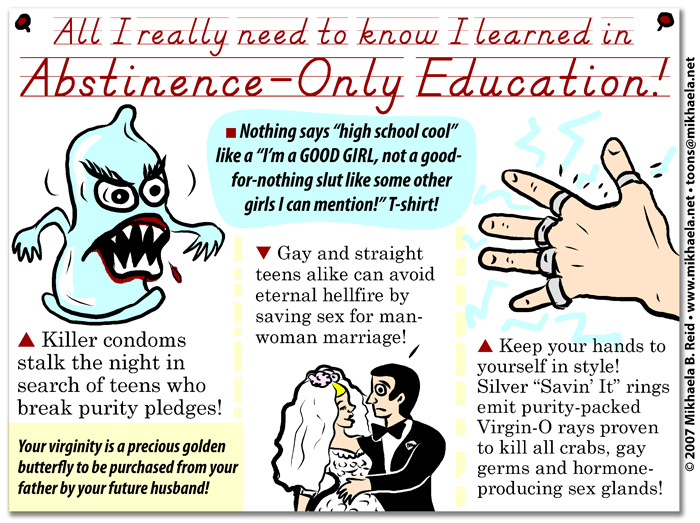
So I'm reading through Mother Jones online and, dear Lord, is that Bill Donohue's name? In Mother Jones? Who contacted the dark side first? Donohue just led the crusade to have "anti-Catholics" Melissa McEwan of Shakespeare's Sister and Amanda Marcotte of Pandagon removed from the Edwards campaign. Mother Jones is one of my favorite liberal rags. An unholy alliance indeed.
But as I am open-minded, I read it. I'm so glad I did. I heard about the Domino's Pizza founder and nut job Tom Monaghan last year. Monaghan, a strict Catholic, is funding the construction of a right-wing Christian town in Florida. No porn, no contraception, all church. But the laws, you say? No problem — just make friends with former governor Jeb Bush who "made Ave Maria Town a special tax district like Disney World, giving the self-appointed Board of Supervisors (run by Monaghan's development partner) widening powers and exempting the town from state and local laws." And Big Brother is literally taking care of that pesky constitution. Sa-weet.
In this Eden-on-a-swamp, the average home will cost $1.95 million dollars. So much for helping the poor. But I'm sure God will understand when he hears this point of view: "One future resident, construction manager Darryl Klein, who has six children, had told me earlier that he'd moved his family from South Carolina because Ave Maria represented 'the ideal American community. It'll be a place where you know your neighbors. We'll be around like-minded people. The kids that play with my kids — they'll go to the same church as us. And we'll be accepted.' "
Yeah — being white wealthy Christians makes it hard to fit in anywhere else. On Earth. You poor outcasts, you.
While Donohue was trying to talk casually to a bunch of the Ave Maria University students, an official Hitler Youth broke it up: "Whoa, whoa whoa… Is this, like, an interview? With the media? You can't say anything to him — that's official policy." A school director compared students like this to military personnel, keeping order in and outsiders out. I've seen lots of pictures of Christ with his arms closed and his goons at the gates.
Once Donohue got a few anarchist students to talk, off-campus of course, the real fun began. " 'The first time I ever kissed a guy,' a gentle, soft-spoken Ave Maria freshman named Mersadis said over her mozzarella sticks, 'I thought it was disgusting. And now I don't want another guy to kiss me before marriage.' She took a sip of her iced tea, then continued. 'In high school, I found myself looking at every girl and asking, "Has she given up her virginity? Is she still pure?" Here, I've stopped asking. I know everyone is.' " I'm sorry — I can't type when I'm laughing this hard.
As for the boys: " 'We don't believe in the separation of church and state,' one student named Aaron said, 'and this country should orient itself toward Christ. The foundation of Western civilization rests on Christendom, which means that America owes its existence to the Catholic Church.' " Funny — our forefathers, who created America, did believe in separation of church and state. But no worries — contradictions follow, as usual: " 'The offertory in the new Mass,' griped Aaron's friend, an energetic and sandy-haired youth named Mike, 'is essentially a Jewish table grace.' " Well, Jesus was Jewish, and there was no such thing as Catholicism before he lived and died. So much like America "owes it's existence" to Catholicism, Catholicism owes it's existence to Judaism, so maybe they should lighten up on the disdain for the originators of this free land and learn more about the peace-loving, charitable religion that they claim to live by.
But disdain, and downright hate, for other cultures, religions, and even other Christians is the norm at Ave Maria, as Donohue finds: "I leafed through Ave Maria's campus paper, the Angelus. University president Nicholas J. Healy Jr. writes a column for each issue. In one he calls Islam 'a hostile and aggressive religion,' and goes on to lament a 'widespread loss of the Christian moral vision,' most evident in Europe, where 'birth rates far below replacement levels have already allowed millions of Muslims from North Africa and the Middle East to…heavily influence the political agenda.' " Actually, the majority of North Africans came to Europe after World War II when A) colonialism was over and the white man was suddenly AWOL, and B) when European countries (especially France) actively welcomed and recruited low-wage workers from these countries to help them rebuild their cities after bombing each other to dust and burying a great many of their citizens. This, by the way, was also about 20 years before the pill showed up on the radar, so birth rates — a.k.a., sluts aborting their babies and taking the pill — doesn't have a damn thing to do with it. But I'm sure no one at Ave Maria wants Blacks or Arabs to — gasp — have political influence.
Still, they like to fool themselves. Aaron, the student mentioned earlier, claims, " 'If you are devout…the calling of celibacy is not a problem.' " That's why priests are best known in the world for molesting children. I'm sure these all-American, privileged young men will have no problem controlling their natural, inevitable human urges.
Again, because I am open-minded, I expect there are a few dissenters who will one day escape and join the clutches of sinful reality: "Not everyone at Ave Maria shares Aaron's self-certainty and resistance to change. In fact, one student tracked [Donohue] down outside a dorm and in urgent, secretive tones said, 'Don't use my name, but I saw you talking to Aaron, and you should know that most people here think he has very extreme views on modernism.' " I was just disappointed that Donohue did not give anymore ink to the more moderate voices on that campus.
As this was written by Donohue, I expected slobbering praise. Instead, he paints a decent picture of a faith as misguided as any radical Islamic fundamentalism. He sees fascism, ignorance, and sheltered kids without a clue about the real world. Donohue correctly understood that these self-made martyrs can't handle living in a world that they can't control, so they're making their own little haven of denial and repression.
I'd like to thank Mr. Donohue for giving a liberal feminist such as myself (raised Catholic, to boot) a thumping good read.
When far-right candidate Jean-Marie Le Pen won a place in the second-round presidential elections in 2002, beating out the Socialist candidate, Lionel Jospin, the French seemed startled. They had given themselves little to choose from: right or more right.
Capturing just fewer than 17 percent of the vote in 2002, Le Pen, leader of the controversial, anti-immigrant National Front, set the stage for Jacques Chirac’s landslide victory in a bizarre contest of two conservatives.
Now, with Chirac’s term coming to a close and another round of presidential posturing upon them, the French look forward to a much more traditional, balanced field — at least politically.
In the French version of what Americans might label a presidential primary Sunday, conservative Nicolas Sarkozy and Socialist Ségolène Royal won pluralities to qualify for the second and final round of elections next month.
Speaking at a rally in Poitou-Charentes region, Royal promised a new future for the French people, troubled by immigration and a struggling protectionist economy.
Many French people “do not want a France ruled by the law of the strongest or the most brutal, sewn-up by financial interests, where all powers are concentrated in the same few hands,” the Times quoted her as saying. “I am a free woman, as you are a free people,” she added.
Those words carry an interesting subtext for American politicos gearing up for the 2008 presidential race. Like Hillary Clinton in the U.S., Royal seeks to become the first female president in her country.
Royal’s prospects look uncertain. Current public opinion polls in France show Sarkozy up eight points, but with record turnouts at the polls around France — more than 84 percent of France’s 44.5 million registered voters cast ballots — it looks like this election might be harder than usual to predict.
Whatever the outcome, it means a return to a new take on an old favorite in France: left verses right.
I love Hillary Clinton. Not because I think she’s a strong female figure in a world flooded with idiotic figureheads like Paris Hilton and her gang of spoiled leeches, but because she entertains me.
I’m not fooling around. When people ask me who my favorite entertainer is, I always say Hillary Clinton.
OK, that’s a lie, but she could be, especially now that she’s on the campaign trail to become the first female president in history.
Saturday Hillary said that if elected president she would appoint her husband to a position of “roaming ambassador.” Billy-boy would travel to and fro making nice-nice with the nations of the world President Bush has pissed off. My estimate is that he’ll be gone for two years or more.
According to the AP, she told a crowd gathered in Marshalltown, Iowa, "I can't think of a better cheerleader for America than Bill Clinton, can you?"
But even reading that direct quote, what I heard her say was, “I can’t think of anything better than to make damn sure Bill is as far from my interns as possible, can you?”
She also said that Bill told her he would do anything she asked, which is why she says she’s putting him to work. In other words, Bill asked how he could help her, and she said, “You can fly your ass around the world undoing wrongs like Scott Bakula in ‘Quantum Leap’ for all I care, buddy boy.”
All kidding aside though, I think she’s got the right idea. We don’t need the entire government working to better relations to the rest of the world. We’ve got the Hillary doctrine: Let’s just use Bill Clinton to solve the problems.
Look at it this way: Whether it’s a tsunami or a hurricane, Bill has been doing much better than our current government at helping people desperately in need. He’s like Jimmy Carter, but with a raging libido (none of that lame “lust in my heart” crap from Bill) and the uncanny ability to make bad situations look great.
Where did Bill get his skills? I’m not sure; I only know he kicks ass.
Yes, NAFTA was a bad idea, and so was “Don’t ask, don’t tell.” And that whole impeachment deal was entirely lame, though not all of that was his fault. But look at how good he made those bad things look? It was amazing.
Now none of those missteps matter much because Bill is still adored, so Hillary should hold onto him like a Kennedy holds onto a bottle of fine wine or Bush holds onto bad ideas. (See? I’m an equal opportunity basher.)
So rock on, Hillary. Don’t bother with your own policy ideas — just use Bill. We like him.