Cornerless City

Best of In The Fray 2007. A view of Cairo from the outside in.

I’ve been walking down the streets of Cairo for weeks now, but I’ve never been to a corner. A map of the city’s geography slowly surfaces in my imagination, peopled with various urban landmarks. But in my vision of Cairo, the corners are nowhere to be found.

There are, of course, places where the sides of a block meet at an angle. In other cities, however, corners parse and define elements of urban space, reminders that there is a manufactured grid underlying the people and pavement. In my native New York, corners help orient a civilization that can no longer locate itself with respect to the stars. But here, corners are an afterthought. Edges and angles ebb and flow in a dance between spaces and crowds, like air pockets in clay — incidental to a social thicket that defies any preconceived scheme.

Here, corners are not actually extinct, but rather are like an obsolete tailbone. The newer outlying neighborhoods, where wealthier Cairenes reside, do mimic the clean edges of “developed” metropolises around the world. And the major commercial thoroughfares do fit into roughly perpendicular lines. Still, the Cairo I see, where pedestrians and vehicles blur in the frenetic, dust-caked streets, is fueled by a gnarled urban core that has little use for the conventional corner.

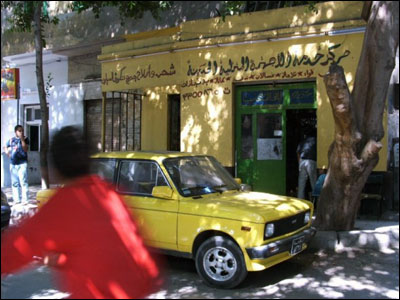
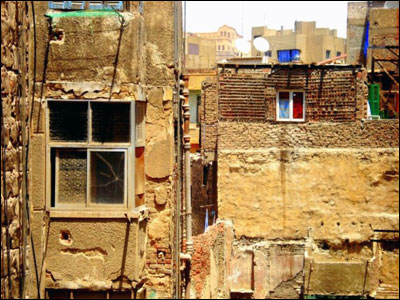
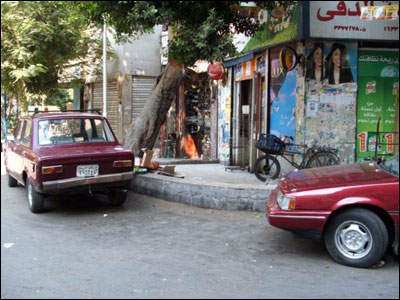
Here, spasmodic traffic neither follows rules nor needs them. Carts of cactus and melon butt against crookedly parked fiats. Clouds of lush trees erupt from scorched ground over an architectural jumble of postwar-socialist concrete slabs, high-rises, and European-style townhouses.

Cairo has plenty of squares — plazas known as midans, which are loftily titled after heroes, or “liberation” (tahrir), or the Sphinx. But these spaces are far from the manicured quadrilaterals characteristic of Western cities. To reserve a corner in the chaos just for hailing a cab or meeting a friend would seem an utter waste.

In the Dokki district where I live, when crumbling sidewalks kiss their cross streets, they typically curl narrowly around the foot of a cement stack of apartments. The “corner” might be colonized by a tree jutting from the concrete, or pensive men — maybe cabbies, maybe poets — sitting and puffing shisha from standing metal pipes. Pedestrians find it easier to share the adjacent asphalt with taxis and donkeys.

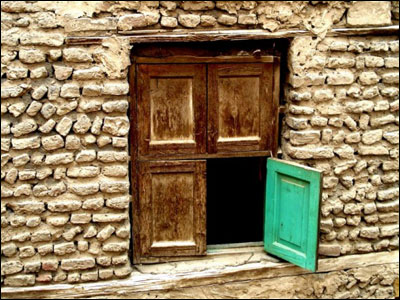
Cairo’s layout evokes the lyrical cursive of the Arabic script. Walls, alleys, and other spaces are distinct facets in the landscape, but they sometimes weave into each other, matted and coiling. Even the bricks seem somewhat elastic; the architectural contours rearrange themselves mischievously when you’re not looking to make you lose your way.

When you expect to turn a corner, you happen upon a roundabout, where traffic spools into a haphazard knot encircled by storefronts and cracked cement. Or a twist in your path zigzags into a bazaar of Orientalist clichés, like the Khan Al-Khalili suq, where hawkers haggle with tourists over brass lamps, papyrus posters, and other contemporary relics.

Follow another strip and find it suddenly swallowed by the entryway of a brightly lit mosque, where legions of beat-up shoes stand guard. Inside, socks and foreheads softly touch the carpet, and men check their cell phone messages amid an arabesque of delicate shadows.

In the Zamalek district on Cairo’s central island, artists have spun a would-be dead-end into a buoy of cultural happenings. At the terminus of 26th of July Street — named for the day Egypt took over the Suez Canal — the Culture Wheel harbors concert halls, lecture rooms, and photo galleries. On one side of the venue, beneath chugging traffic, a tiled pavilion flanking the murky belt of the Nile offers refuge to wistful minds.

Despite its physical anarchy, the city falls reflexively into a structured rhythm. Every day is punctuated by five moaning calls to prayer that swell up through the loudspeakers of mosques in simultaneity. For a few minutes, all of Cairo sings with the same tension, aligning the churning crowds into one spiritual refrain.

While the lack of straight lines and angles can feel liberating, it can stifle an outsider. Sometimes each turn reminds me of my alien status as passersby jeer in Arabic and stare. The sharpest corner I’ve encountered, perhaps, is the one that my foreignness backs me into, though I know I will escape by retracing my path back to the order and predictability of America.

But Cairo’s fluid landscape has always enough give to absorb outside elements. The Persians, Romans, and modern imperialists of every sort have occupied the city in turns. The sheer weight of its past collapses borders, mashing together churches and mosques and skin tones of every shade.

In a region percolating with war and paranoia, Cairo spins in relative peace on its own axis, slippery with honey and grease, and the sweat under headscarves and three-piece suits.

You don’t have to be here long to sense the odd joy — hushed but proud, a reason for the city to resonate praise to God each day. Without corners, it’s hard for me to grasp this place and how it plods on with such flair. But I’d rather that Cairo keep its secrets to itself and roll on as it always has, slipping through history’s fingers.

Sherif Megid is a Cairo-based photographer, filmmaker and writer of short stories. His works are inspired by the history and images of the street where he grew up, Sharaa El Khalifa in Islamic Cairo. He has published two collections of short stories and recently held an acclaimed exhibition of his street photography in Cairo.


We All Want Love to Win Out. But Whose?

Best of In The Fray 2007. The ex-gay movement and the battle over what it means to be whole.

Snow is falling on Tremont Street, and people are shouting. Hate is curable and preventable! Conversion therapy kills gay teens! Jesus, cleanse this temple! The steps of the Tremont Temple Baptist Church are filled with snow and people pushing up against a line of riot police and shivering in the surprise of a violent October snowstorm.

Inside, a kid in an argyle sweater and glasses sits next to his mother in the crowded pews. The muffled din of protesters bursts its way into the church every time the security guards open the doors. Tom M. (who asked that only his last initial be used) came to this conference because he loves his mom and wants to show his support for her. His mom came because she loves Tom and she’s worried about him getting into drugs, contracting AIDS, and going to hell.

Over the summer, Tom, who is 20 and a college student, finally told his mom, who is Greek Christian Orthodox and a doctor, that he’s gay. Instead of dragging him to the family priest, as Tom expected, his mom went on the Internet. She learned that Dr. Joseph Nicolosi, the president of the National Association for Research and Therapy of Homosexuality (NARTH), would be speaking on “the condition of male homosexuality” at the next “Love Won Out” meeting — a traveling conference series created by the Christian powerhouse Focus on the Family — so she bought two plane tickets from Cleveland to Boston.

They were a little late getting to the conference, and by the time they arrived, protesters had lined the steps of the church. Tom felt embarrassed and ashamed as they were escorted into the building, bag-searched, and given orange identification bracelets, but he decided to go through with it for the sake of his mom.

A few rows away from Tom sits Josh Greene (who asked that his name be changed), a young man in a tight white T-shirt and yarmulke. Unlike most people at events like “Love Won Out,” Josh, who’s 28, is Jewish Orthodox, not socially conservative — he’s in favor of gay marriage, and doesn’t believe homosexuality is necessarily bad. Most of his friends are gay, and he pretty much dates only men. He has lived in Manhattan, New York City, his whole life, surrounded by gay-affirmative culture. Josh is at the meeting because for the past three years, he has been seeing a private reparative therapist trained by Dr. Nicolosi. Even though he has same-sex attractions, he doesn’t believe he was born gay.

“Love Won Out” is here today in Boston to send the message to the state of Massachusetts — which in May 2004 became the first state to allow gay marriages — that gay people can turn straight. Tom and Josh — two gay men — sit among the people inside the church, many of whom are raising their hands into the air and praying. They pray for the queers outside, and for the depravity that has seeped into the community. They pray along with the pastor, who says: “They’re standing out there and it’s snowing. It’s bitterly cold. I can see the hurt, the anger, the hatred in their eyes.” Some people are looking a little shaky. A couple of cops have come inside to stand guard, and a woman clutches her purse while telling her friend that not even the Disney channel is safe anymore.

There’s an audible sigh of relief when Melissa Fryrear, director of gender issues for Focus on the Family’s government and public policy division, starts tapping the microphone. She says that in Kentucky, where she’s from, they do two things well: fast horses and big women. Melissa, a bubbly gal of generous proportions, came all the way to Boston to spread a little sweetness over the bitter pill a lot of folks in the audience are having trouble swallowing. It’s called being gay. But Melissa, who “used to be 99.9 percent a lesbian” but is now “seeking a tall red-headed man in his early 40s, who loves football and might look great in a Scottish kilt,” came here to spread what she calls a message of hope: Homosexuality is not immutable; there is no such thing as the perfect family; and there are lies being put forward by the enemy, not the truth.

Arguing over the definition of success

The Boston conference was a first for both Tom and Josh, but both had done their homework on the history of “Love Won Out” before attending. Developed in 1998 by Focus on the Family — an evangelical Christian nonprofit that works interdenominationally to preserve traditional family values — “Love Won Out” is touted by its organizers as a response to the “gay propaganda” being embraced by many American schools and churches. Focus was concerned by the cultural shift toward widespread acceptance of the gay lifestyle, and felt that many people were confused about what to believe. “Love Won Out” was created to answer those questions, primarily through testimonials of former homosexuals who claim to have turned heterosexual.

One such former homosexual is Alan Chambers, president of Exodus International, the world’s largest Christian ex-gay organization. Focus regularly hires Chambers and other Exodus representatives to promote the message at “Love Won Out” that change is possible. At today’s conference, Chambers’ speech on “Hope for Those Who Struggle” is aimed specifically at people who are unhappy living the gay lifestyle, and one thing Chambers really enjoys is giving hope through metaphor.

“Ever been on an airplane and gotten dehydrated?” asks Chambers. “You know you’re supposed to drink water instead of Coke, but you really want to order the Coke instead. But contrary to what they say, Coke isn’t the real thing. It may quench your thirst, but it doesn’t do what water is intended to do.”

People nod their heads and chuckle; it seems true enough. They’re here today, most of them, because they’re gay or love someone who is, and in Chambers’ estimation, that’s bad because — like Coke — homosexuality isn’t natural and good for you. The belief that homosexuality is unnatural forms the underlying basis of reparative or conversion therapy, a form of psychotherapy meant to change a person’s sexual orientation from gay to straight, and groups like Exodus draw heavily on reparative literature. (Parents, Families, and Friends of Lesbians and Gays [PFLAG], a gay-affirmative organization, notes on its website that reparative therapy has no support from major medical and mental health professional organizations.)

Chambers doesn’t sugarcoat his message by telling people it’s easy to change from gay to straight, but that’s because he doesn’t have to. Most “Love Won Out” attendees already agree that homosexuality is like Coke: It won’t necessarily kill you, but it’s not going to improve your health. Moreover, the idea of a perennial battle against cravings and desires is a familiar one to religious fundamentalists, who make up a large part of the audience at these events. So when Chambers talks about the necessary suppression of urges and tells the crowd “there is no such thing as a struggle-free life,” the crowd doesn’t wonder why indulging certain urges would be bad.

Except for Tom. Chambers has been explaining that homosexuality is “cannibalistic” and “a medication that keeps us coming back over and over again” and “like living off credit cards — it’s a counterfeit to make us feel better for a period of time.” And Tom has been rummaging around in his book bag. When Chambers opens the floor for discussion, Tom pulls out a copy of The Advocate, a national gay and lesbian publication, and raises his hand.

“Have you heard of John Evans?” asks Tom, whose mom sits beside him, looking troubled. Chambers, too, seems uneasy, but admits that he does know Evans, who, as cofounder of the ex-gay group Love in Action, later renounced that organization as misleading and harmful to gays. Quoting Evans, Tom goes on: “Since leaving the ex-gay ministry I have seen nothing but shattered lives, depression, and even suicide among those connected with the ex-gay movement.” Then he asks Chambers, “What’s your opinion of Evans, and how can you continue to preach this information when a founder saw after a few years how wrong it was to try and change the way people are?”

Not a bad question. In fact, no one really knows how well transformational ministries and reparative therapy work, which is to say that people measure success and failure differently, and in the jargon of groups like Exodus, someone who “struggles with same-sex attraction” isn’t “gay” because “homosexuality” doesn’t “exist.” To be gay in this estimation means simply to take on the political and social identity of gayness; heterosexuality is the natural and indisputable norm, regardless of homosexual feelings, because a man’s body and a woman’s body together enable humankind. No one’s denying homosexual urges exist; the question is what to do with those urges. Chambers analogizes it this way: “Your feelings lie to you all the time. If there’s a piece of chocolate in front of me, of course I want to eat it, and my feelings say yes. But eating chocolate isn’t good for me, and if I eat enough of it, it could make me die.”

Then there’s the issue of whether change is possible, and how to measure it. According to reparative therapist Jim Phelan, it’s important to recognize the difference between change and success. “Very few people change,” he says, noting that only a third of his clients reach true heterosexuality. “But many have success, which is measured differently for each person. For some men, success means being married and having sex with their wife and not thinking of a man when they do.”

But Chambers doesn’t mention the issue in his response to Tom. “Well,” says Chambers, “we can live how we choose. I see very little despair in ex-gays. What John Evans says has not been my experience. Next question?”

Josh raises his hand and asks for more specifics in terms of the methods and techniques Exodus uses to help strugglers.

“We’ve got over 130 member ministries, and all of them are different,” Chambers explains. “We don’t endorse shock therapy or aversion therapy. Our most important thing is not that people change their sexual orientation, but that they change their relationship with Jesus Christ.” Adjusting his yarmulke, Josh looks somewhat puzzled, but Chambers quickly moves on to another question, this time from a woman who wants to know about expectations for those who are struggling with homosexuality.

“You can expect a life of struggle with sin, but you can also expect joy incomparable,” advises Chambers, adding that even his worst day in heterosexual life is still better than his best day in the gay community.

The symbolism of suffrage, of an existence driven by struggle against temptation, isn’t lost on religious members of the audience, but to others, such language seems hypocritical. “I have a problem with the term ‘struggle,’” says Wayne Besen, a gay rights activist and author of Anything But Straight: Unmasking the Scandals and Lies Behind the Ex-Gay Myth. “That’s a false term when it comes to the ex-gay ministries, because a struggle suggests that you have a chance to win. If you don’t, it’s not a struggle. It’s a slaughter.” Besen, who spent years documenting the ex-gay movement by interviewing ministry leaders and attending ex-gay groups undercover, claims that for most people who get involved in reparative therapy, trying to change their sexual orientation is fruitless. “In six months, these people are going to be just as gay as the day they walked in the door,” he says. “What struggle? I have never seen a struggle, I’ve just seen misery.”

But Chambers is focused on hope. He turns the question on the audience, asking what they hope for. The answers spill forth: Freedom for my children. The joy you talked about. The right answers. The compassion to understand. That God will take over the heart of anyone who just wants to get homosexuality out. To feel about girls the way I feel about guys.

This isn’t just about God, or Biblical interpretation, or converting people to Christianity, or impressionable youth, or the culture wars, or the political agenda of the religious right, though all are reasons why the ex-gay movement has recently experienced a drastic increase in size and scope. It’s about people knee-deep in emotional pain. But the key players in the ex-gay movement have their eye on a much bigger bounty: the establishment of a Christian nation.


Take back our families

Donna Jackson, president of Take Back Our Streets — a Newark, New Jersey, community-based organization — led a protest in early August outside City Hall, calling on its mayor, Cory Booker, to resign over the brutal murders of three college students and the wounding of another. Iofemi Hightower, 20; Dashon Harvey, 20; and Terrance Aeriel, 18, were gunned down outside a Newark elementary school. Aerial’s sister, Natasha, survived — with a gunshot wound to the head.

Jackson’s reaction is indicative of a common problem among people living in impoverished and violent neighborhoods: the blame game, which is all too convenient and predictable in times of crisis. Amid all the grief, shock, and anger after these killings, I think this tragedy should be used as a time for self-reflection, which is something people tend to shy away from when hit by a devastating event in their community.

I am dismayed by the inability of people, like Ms. Jackson, who refuse to address the crux of a problem. There is a breakdown in family values and morality in our community. I say this not because I am a conservative, which I am not. I say this because I grew up in a loving and supportive household with two parents, who also came from nuclear families. I magnify this point not to criticize single-parent households but to advocate for success and opportunities that I don’t think are as easily achieved when one adult is faced with rearing children under despondent conditions. Many citizens of Newark face this reality on a daily basis.

There are too many uneducated and dysfunctional teenagers and adults who are having children they cannot possibly rear successfully. Although we know that at least one of the suspects in this case is an illegal immigrant with previous indictments, I venture to guess that the suspect was from an unstable and hopeless environment.

We have a virus growing. It takes the form of babies out of wedlock, poor academic achievement, and low self-esteem. We are not being truthful with ourselves if we think the resignation of a mayor will yield a lower crime rate. If children were raised to stay in school, stay away from guns and drug activity, we would have a much higher success record when it comes to the war on crime.

Yes, politicians are responsible for making sure neighborhoods are adequately policed and schools remain safe. But parents must be present in their children’s lives at all times, so they don’t fall prey to the streets. If Ms. Jackson wants to lead a protest, I encourage her to protest against the inactions of incompetent, deadbeat parents.

Alexis Clark / New York


The Bushism of all Bushisms

Every holiday season, there are calendars to be sold as presents full of the asinine things our president has said. We think they’re funny, doubt he said some things, and roll our eyes at others. Some of us have read quotes that infuriated us. But Bush’s remarks on Wednesday comparing Vietnam to Iraq topped them all in absurdity.

To begin, the brains behind this pathetic PR tactic: "Freedom’s Watch, a conservative group, plans to launch a $15 million advertising campaign in 20 states today. The group’s spokesman, former Bush press secretary Ari Fleischer, says the goal is to tell people that the buildup of U.S. troops in Iraq is working" (USA Today). Now check out the Salon article about Fleischer and Freedom’s Watch: …"the manipulative style of the Freedom’s Watch ads — and the apparent decision to air them against wavering Republicans — signals desperation, not strength." The perfect description of Bush talking about Vietnam as if he’s turned his head to history, blocked his ears, and chanted, "I’m not listening, la la la la."

The highlights:

"Bush said that like World War II, the Korean War, and the Vietnam War, the war in Iraq was an ‘ideological struggle’ as he again depicted the conflict as part of the broader U.S. ‘war on terror.’" (Yahoo News) 

"In a speech to army veterans in Kansas City, Mr. Bush invoked one of America’s biggest military disasters in suppport of keeping troops in Iraq…He said that there had been lots of critics of U.S. involvement in Vietnam at the time — mentioning, among others, Graham Greene and a Washington Post columnist — and implying that, with the benefit of hindsight, they were wrong, just as critics of the Iraq war will later be seen to be misguided." (The Guardian UK)

"Three decades later, there is a legitimate debate about how we got into the Vietnam War and how we left…Whatever your position is on that debate, one unmistakable legacy of Vietnam is that the price of America’s withdrawal was paid by millions of innocent citizens whose agonies would add to our vocabulary new terms, like ‘boat people,’ ‘reeducation camps,’ and ‘killing fields.’" (Yahoo News)

Ironic how the war in Iraq has left us with a vocabulary that includes Abu Ghraib and Haditha. Now here is what the many prestigious historians and experts had to say: 

"Vietnam historian Stanley Karnow said Bush is reaching for historical analogies that don’t track. He said, ‘Vietnam was not a bunch of sectarian groups fighting each other,’ as in Iraq. In Cambodia, the Khmer Rouge toppled a U.S.-backed government." (USA Today)

"Robert Dallek, author of several celebrated biographies of recent U.S. presidents, including Lyndon Johnson, told the Los Angeles Times: ‘It just boggles my mind, the distortions I feel are perpetrated here by the president.’

‘We were in Vietnam for 10 years. We dropped more bombs on Vietnam than we did in all of World War II in every theater. We lost 58,700 American lives, the second-greatest loss of lives in a foreign conflict. And we couldn’t work our will,’ he said.

‘What is Bush suggesting? That we didn’t fight hard enough, stay long enough? That’s nonsense. It’s a distortion,’ he continued. ‘We’ve been in Iraq longer than we fought in World War II. It’s a disaster, and this is a political attempt to lay the blame for the disaster on his opponents. But the disaster is the consequence of going in, not getting out.’

The New York Times also talked to Dallek, who pointed out that the slaughters of the Khmer Rouge in Cambodia ‘was a consequence of our having gone into Cambodia and destabilized that country.’

…The Washington Post quoted Steven Smith, senior fellow at the Council on Foreign Relations: ‘The president emphasized the violence in the wake of American withdrawal from Vietnam. But this happened because the United States left too late, not too early. It was the expansion of the war that opened the door to Pol Pot and the genocide of the Khmer Rouge. The longer you stay the worse it gets.’" (Editor & Publisher)

"’It is undoubtedly true that America’s failure in Vietnam led to catastrophic consequences in the region, especially in Cambodia,’ said David Hendrickson, a specialist on the history of American foreign policy at Colorado College. ‘But there are a couple of further points that need weighing,’ he added. ‘One is that the Khmer Rouge would never have come to power in the absence of the war in Vietnam — this dark force arose out of the circumstances of the war, was in a deep sense created by the war. The same thing has happened in the Middle East today. Foreign occupation of Iraq has created far more terrorists than it has deterred.’" (International Herald Tribune)

"Historians have cited the U.S. intervention and bombing campaign (spanning 1965-1973) as a significant factor leading to increased support of the Khmer Rouge among the Cambodian peasantry. Historian Ben Kiernan and Taylor Owen have used a combination of sophisticated satellite mapping, recently unclassified data about the extent of bombing activities, and peasant testimony to argue that there was a strong correlation between villages targeted by U.S. bombing and recruitment of peasants by the Khmer Rouge. Kiernan and Owen argue that ‘Civilian casualties in Cambodia drove an enraged populace into the arms of an insurgency that had enjoyed relatively little support until the bombing began.’ In his study of Pol Pot’s rise to power, Kiernan argues that ‘Pol Pot’s revolution would not have won power without U.S. economic and military destabilisation of Cambodia’ and that the U.S. carpet bombing ‘was probably the most significant factor in Pol Pot’s rise.’" (Wikipedia entry for Khmer Rouge) 

In an article in the Walrus Magazine, Kiernan and Taylor Owen wrote that recent evidence reveals that Cambodia was bombed by the U.S. far more heavily than previously believed. They conclude that ‘the impact of this bombing, the subject of much debate for the past three decades, is now clearer than ever. Civilian casualties in Cambodia drove an enraged populace into the arms of an insurgency that had enjoyed relatively little support until the bombing began, setting in motion the expansion of the Vietnam War deeper into Cambodia, a coup d’état in 1970, the rapid rise of the Khmer Rouge, and ultimately the Cambodian genocide.’" (Wikpedia entry for Ben Kiernan)

Bush, Sr. in 1991 on invading Iraq: "Trying to eliminate Saddam…would have incurred incalculable human and political costs. Apprehending him was probably impossible…We would have been forced to occupy Baghdad and, in effect, rule Iraq…there was no viable ‘exit strategy’ we could see, violating another of our principles. Furthermore, we had been self-consciously trying to set a pattern for handling aggression in the post-Cold War world. Going in and occupying Iraq, thus unilaterally exceeding the United Nations’ mandate, would have destroyed the precedent of international response to aggression that had hoped to establish. Had we gone the invasion route, the United States could conceivably still be an occupying power in a bitterly hostile land." (Originally from the memoir, A World Transformed, by George H. W. Bush and Brent Scowcroft. Quoted in What We’ve Lost by Graydon Carter)

And finally, in a video that surfaced this week on YouTube, Dick Cheney echoes the previous remarks exactly. He even uses the word "quagmire."

Usually our president’s silly remarks are spontaneous, unplanned. But this was a prepared speech. There had to be speech writers involved, drafts, and revisions. Wasn’t there anyone along the way, however lowly the positions, who read it and said, "Um, hold the phone"? Or have they all lost their minds along with their credibility?


My book, The Missing Class, is now available

The New York Times mentions my book The Missing Class: Portraits of the Near Poor in America in Sunday's edition. I coauthored it with Princeton sociologist Katherine S. Newman, and Senator John Edwards wrote the foreword. The book focuses on the nearly one in five Americans who live just above the poverty line, a population much larger than those living in poverty.

The Missing Class: Portraits of the Near Poor in America

NOTE: You can find The Missing Class at your bookstore, or order it on Amazon or Powells.com. (Use these links and a portion of the sale price goes to InTheFray.)


Sorry that I’ve been away from this blog for so long. One of the reasons for the delay is that the book I co-authored — The Missing Class: Portraits of the Near Poor in America — has just come out. The New York Times mentions the book in Sunday’s edition.

I co-authored The Missing Class with Princeton sociologist Katherine S. Newman. Senator John Edwards wrote the foreword. The book focuses on the nearly one in five Americans who live just above the poverty line, a population much larger than those living in poverty. They work long hours, sometimes at multiple jobs, but they do not receive many public benefits (which are for the poor) and lack real financial security. In fact, some of the families we write about eventually fell back into poverty after a layoff, divorce, illness, or other crisis.

My hope is that through the stories of the nine families profiled in this book, we can bring more attention to this ignored population and inspire discussion about policies that could keep these hard-working Americans from slipping back down the economic ladder. Poverty takes a toll not just on the families who suffer it, but also on society in general, which must bear the collective costs in ruined health, growing crime, blighted neighborhoods, and wasted potential. We should be doing more to help these families avoid such a fate.

There will be some book events and radio/TV interviews in the coming months. Please check this blog (inthefray.org/politicalprose) for the latest schedule. And please spread the word!


UPDATED 9/26/07: Please see more recent posts for an updated schedule.

Victor Tan Chen is In The Fray's editor in chief and the author of Cut Loose: Jobless and Hopeless in an Unfair Economy. Site: victortanchen.com | Facebook | Twitter: @victortanchen


Dads

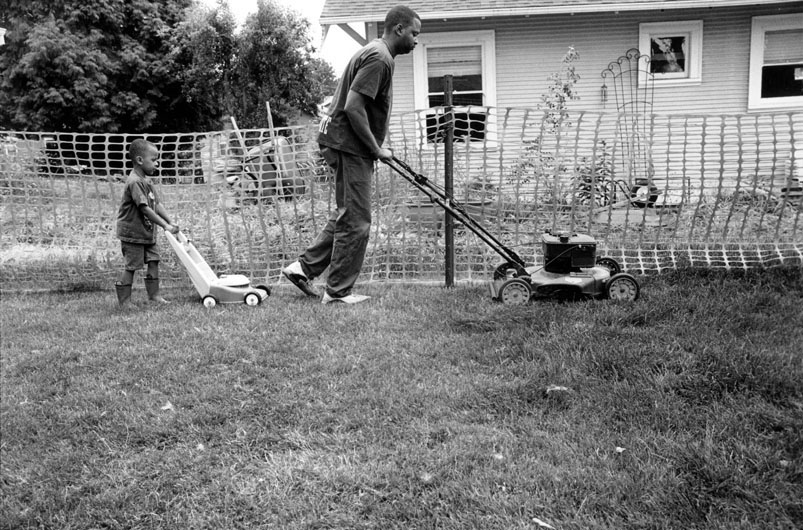
dadsthumbnail.jpg A tribute to fathers from all walks of life.
dadsintro.jpg 

Photography is like a religion, but after my son was born, I had a dream that the house was on fire and I had to save my negatives or my son, so I saved my son. Being a dad is the thing I enjoy most in my life.

I realized from a policy standpoint that as a country we were totally ignoring fathers. We weren’t looking at a dad as an integrated part of a family. I realized that we weren’t valuing men.

What tied together the dads I photographed is lots of fatherhood programs. These focus on relationships – listening to your wife and being responsible. In a relationship you need to give people what they need and want, not what you think they need and want.

The picture of the man and father mowing the lawn – that shows the importance of men as role models. The picture of the man being fed ice cream – he’s a father who’s dressed like he’s in a gang. In the [fatherhood] program, he went back to school and started taking care of kids. That’s what’s inspiring in the different [fatherhood] projects I saw – what good fathers these men were.

Non-white fathers and poor fathers are seen in a different way [by society] and I hope that comes through in these pictures. Everybody is capable of being a good or bad parent. I made so many mistakes raising my own son. Nobody’s a perfect parent and nobody’s got no redeeming parent qualities. These guys really were becoming better dads. I hope these pictures will help people realize how important dads are.

[Click here to enter the photo essay.] 


Surfing for peace

"God will surf with the devil, if the waves are good…When a surfer sees another surfer with a board, he can’t help but say something that brings them together."
Dorian Paskowitz, 86, an avid surfer and retired doctor.  Dr. Paskowitz crossed the Israel-Gaza border on Tuesday and donated 12 surfboards to surfers in Gaza.  Dr. Paskowitz, who is Jewish, is part of a larger Surfing for Peace movement, which seeks to bring together Israeli and Palestinian surfers.  He was moved, he says, when he read about two Gazan surfers who shared one board.  The beach in Gaza is accessible by Palestinians, but the Israeli military monitors the beach and controls Gazan airspace above it and the coastal waters beyond it in the Mediterranean Sea.


Save Yourself by Telling the Truth

The message being sent to Iranian scholars abroad is the same one being given to intellectuals at home: “You are not welcome here anymore.” Those who have had a taste of Iran’s jails and interrogation — including scholars and writers of my generation who work for reformist media in Iran and the British sailors who were recently detained by the government — know what I am talking about. They, too, have endured psychological torture and false charges.

Camelia Entekhabifard, author of the recently published Camelia: Save Yourself by Telling the Truth — a Memoir of Iran, writing in today’s New York Times about reform in Iran.  

Entekhabifard refers to the recent crackdown on Iranian scholars, including the case of Haleh Esfandiari. This week, Haleh Esfandiari, 67, a prominent Iranian-American academic and director of the Middle East program at the Wilson International Center for Scholars, in Washington, D.C., was freed on a bail of $320,000.  She was imprisoned in Iran when she returned to the country to visit her 93-year-old mother.  She remains accused of spying for the U.S. and for Israel. 

Entekhabifard was herself arrested when the judiciary closed down Zan, or “woman,” the newspaper she worked for in Iran, in 1999.  Although she was in the U.S. at the time of the shutdown, she was arrested when she returned to Iran.  At the age of 26, she was arrested and held in solitary confinement for three months, during which time she confessed to crimes that she had not committed.  


Environmental detriment of bottled drinks?

The detriment of the unenvironmentalness of bottled water have recently been the cause celebre in the media. There were lots of similar reports about the plastic waste that bottles have made and how bottled water doesn’t necessarily taste any better or have less bacteria than tap water. It was even reported that cities and towns’ local governments have been trying to tout the natural deliciousness of tap water to stem the plastic waste created from the bottled variety. Studies and statistics were cited on how many hundreds of thousands of plastic bottles end up on the planet just from bottled water alone. But these so-called media giants who jump onto any sort of trendy — ahem — "news item" only skimmed the surface of this subject.

History of bottled drinks encased in plastic
Beverages including soda and water began to be bottled in plastic in 1970 and 1968 respectively. Starting in the 1980s, the plastic used for bottling was of the PET (polyethylene terephtalate) type, which is recyclable. This type of plastic became the plastic bottling standard.

Number of bottles from water or other drinks
Nowhere in any of the media "reports" on the bad-for-the-environment-plastic-bottles-from-bottled-water stories were there any statistics about any of the other beverages in plastic bottles. What about the annual numbers of plastic soda bottles produced vs. bottled water? If some of the people who drink bottled water now are ones who used to drink soda, the number of bottles strewn about the Earth could possibly be the same.

International Bottled Water Association President Joseph Doss told the Agence France-Presse that their industry alone should not bear the brunt of the criticism: "If the debate is about the impact of plastic packaging on the environment, a narrow focus on bottled water spotlights only a small portion of the packaged beverage category and an even smaller sliver of the universe of packaged products. Any efforts to reduce the resources necessary to produce and distribute packaged goods — and increase recycling rates — must focus on all packaging."

Health benefits from drinking water vs. soda
No matter where the water comes from, bottled or from the tap, it is much more healthful than chemical-laden soda pop. If there are these negative reports about how bottled water is bad for the environment, people might instead pick up some soda, thinking that there are no bad reports about that.

Plastic bottles can be recycled
Like stated previously, all plastic bottled drinks use the standard PET plastic, which is recyclable. Even if the bottles are thrown into the trash, most likely in large urban areas, someone will pick through the garbage specifically looking for plastic bottles so they can cash in the deposit.


The best thing for the environment is definitely not buying plastic bottled drinks. But, if the bottle is the only thing a drink can be purchased in, it’s good to know that at least the bottles can be recycled — and drinking water is definitely much better for one’s health than soda.

keeping the earth ever green

personal stories. global issues.