- Follow us on Twitter: @inthefray
- Comment on stories or like us on Facebook
- Subscribe to our free email newsletter
- Send us your writing, photography, or artwork
- Republish our Creative Commons-licensed content
We live in a time when faith can get easily politicized, thrown into an opponent’s lap like a hot potato. But don’t let all of the talk of organized religion fool you. We also live in a time when faith can be tailored to fit an individual’s needs and beliefs.
In this issue of InTheFray, we explore some of faith’s personal, social, and cultural manifestations. Belton-Martell Mickle journeys to Ghana to discover his roots — and the importance of the Diaspora to African development. And ITF activist’s corner editor Anja Tranovich tackles a classic hotspot for belief in her interview with Palestinian-fighter-turned-peace-activist Ashraf Khader. The two discuss Khader’s work with Combatants for Peace, the difficulties of renouncing violence in a land plagued by armed conflict, how inciting violence led him to fight for peace, and his group’s hope for a politics without militarization.
Rounding out this month’s stories, cancer patient Robinette Pelka uncovers the waiting room’s dark underbelly and creates her own rituals for enduring this melancholy space.
If you haven’t donated to ITF yet, I hope you’ll do so. The past year has been an exciting time for InTheFray — we launched our new site at inthefray.org, our writers received national awards, and we expanded our content with a new section devoted to activist interviews and an eclectic assortment of articles from five continents. But we need your help to continue providing high-quality writing and photography on topics that matter. In the coming year, we plan to broaden our pool of talent by increasing the compensation paid to our contributors and staff. We will also raise awareness of the magazine through targeted marketing and advertising. We hope that you will join us in our mission to inspire conversations about identity and community, foster tolerance and unity, and help society come closer to a vision of justice, transparency, and opportunity for all people. Please support our efforts and visit inthefray.org/donate to make a donation. You can even use it as a tax write-off!
Thanks for reading!
Laura Nathan
Editor
Buffalo, New York
Best of IMAGINE 2007
When the violin is silent
the bird kneels low towards a shelter
when the frozen roads of winter
deceive how city and hill differ
I often see within the palaces of wishes
within the sweet smelling woods of greater countries
my love that would stand taller
than any other Icelander
he that once stayed with me
like a tone within the string of the violin
for eternity my wishes of peace for those that have passed
will follow him
even if the line is broken
even if the string is torn
I have given him one wish
my thoughts forever where he walks
Frændi þegar fiðlan þegir
The original Icelandic poem and inspiration of the song “When the violin is silent”
by Halldór Laxness
Frændi, þegar fiðlan þegir,
fuglinn krýpur lágt að skjóli,
þegar kaldir vetrarvegir
villa sýn á borg og hóli,
sé ég oft í óskahöllum,
ilmanskógum betri landa,
ljúflíng minn sem ofar öllum
íslendíngum kunni að standa,
hann sem eitt sinn undi hjá mér
einsog tónn á fiðlustreingnum,
eilíft honum fylgja frá mér
friðarkveðjur brottu geingnum.
Þó að brotni þorn í sylgju,
þó að hrökkvi fiðlustreingur,
eg hef sæmt hann einni fylgju:
óskum mínum hvar hann geingur.
Related pieces:
POEM — Songbird
PHOTO AND WRITTEN ESSAY — Journal of the Ladybug
Best of IMAGINE 2007

You didn’t want howling machines
to prolong the inevitable
the fake life morphine reality
Please don’t die until I am with you
I have plenty of grace to your liking
I will read at your beside the poets you love
I shall read for you about life and the angel of death
I will brush the dried blood from your thick hair
Sing for you the lullabies forgotten
from your youth
Please wait for me
Songbird spreading its wings towards the light
Your life fades out
your face faultlessly smooth
Through your half-closed eyes
I see stars
Infinity and the universe
Yet death does not come at our mortal bidding
As you slept the angel of death came for you
embraced you with ocean-blue cloak
and as you left with him
you sang in my dream
“Did you know, your friend is dying?”
You smiled and vanished into the beyond
The day passed in flight
In transit between our world and your world
So far yet so close
Finally on a distant soil
I embraced your lifeless body
still lukewarm
I kissed your face with a thousand kisses
howled “mama, mama, please come back
be warm again”
but nothing was capable of pulling you
from death’s embrace
Peace found, mercy from life’s heavy burdens
And I let go, I rejoice with you at the core of my grief
with your book of life singing in my heart.
Related pieces:
SONG—When the violin is silent
PHOTO AND WRITTEN ESSAY—Journal of the Ladybug
My mother was one of those unforgettable people. She was a great musician, composer, friend, and catalyst. She did not, however, have the same passions for the role of being a mother. She knew and felt guilty about this fact in her later years. My picture of her is not the same picture most people carry in their memories. For them, she was a friend, a composer, a drinking buddy, and was fun to be around. Her love for others was not far from the unconditional love I so deeply craved as a child.
When she died, I decided to make new memories based on other people’s impressions of her. I am doing this in two ways: I am making a book of memories in a biography form, and I am making a day-to-day installation of death being part of my everyday life. In order for you to understand the process and the reason for the Ladybug’s journey, I will share with you something you might either find disturbing or beautiful. My aim is to make something beautiful from something ugly; my responsibility of creation is like this. I feel the pain; I transform the pain into joy. I experience death; I transform death into life. Grief is an evolution of loss. By transforming loss into gain, I can heal the wounds from the past.
My mother suffered from a disease, a disease that began when she was a child. It is called a severe, delusional sense of guilt. It started when her younger brother died in a car accident at the age of seven. She somehow got it into her head that she had something to do with his death; she didn’t lend him her yellow boots before he went off on his bike. During that time, no one talked about grief or loss. People just bottled it up and carried on. This guilt became larger than life and too much to cope with, and when she had her first taste of liquor to ease the disease, she was struck by another disease called alcoholism. The combination of these two diseases is usually lethal. And so, it was her fate to drink her talents, her voice, her music, and her life away in a haze of dysfunctional behavior, primarily toward herself. My mother lived in Denmark for many years, a self-made expatriate outlaw from her native island, Iceland.
She had one especially beautiful gift few people possess: She had the same respect for everyone, no matter if a person was a vagrant lady or the president. It was not unusual to have a person of the elite pay my mother a visit at the same time as a person from the streets of Reykjavik was using her sewing machine. She showed the same interest in people close to her as to the people she barely knew. Today, I see this as an almost enlightened state of being.
Like so many true artists, despite all her faults, she was greater than life. During her last years on this planet, she lost the connection with her creative muse. She withdrew further into her disease and self-destructive patterns. She told no one how ill she was as she dealt with lung cancer on her own in another country: no drugs, no operations, no hospitals. She was doing this death battle as was done in the old days: She knew her time on this planet was coming to an end, and she didn’t fight it. She didn’t want to change anything.
No one knew she was coughing up blood until she finally fell down bleeding on the floor in her local grocery shop, died, and was revived. Her fall was great, but greater still was her ability to make no fuss over life and death. She stayed for one day at the hospital, and she spent that day calming family and friends, telling us not to worry. She believed she would be home the following day. I could hear that her voice was frail. I managed to convince her that it was a good idea that my brother and I fly to Denmark to visit with her at the hospital. She sounded ill, yet she had not lost her pitch-black humor. The day before, she lost one-third of her blood on the floor in the shop. She never did anything halfway.
Early next morning, as my brother and I were boarding the plane for Denmark to stay with her at her deathbed, we got a call; our mother had passed away in her sleep during the night. It was the most difficult journey I have ever taken. To hold the grief within — a tsunami of emotion — because it is not socially acceptable to lose it in public spaces like planes, my brother and I made sure not to look at each other. We just breathed shallowly to keep it all in. And, in perfect harmony with the dramatic flair of my everyday life, the low-budget plane was full of dentists, including my own dentist, who was getting drunker as each moment passed. The only thing missing was for them to start singing one of my mother’s songs.
When the long journey was finally over, we arrived at the hospital where my mother had taken her last breath. In a surreal way, we had to run around this big and impersonal hospital to find her body and the rest of her belongings. Since it is totally socially acceptable to sort of lose it around death, I did when I finally got to see her shell. And as I was kissing her lifeless face, stroking her hair full of blood, and sensing that she was really gone, I was granted the true realization of the fact that indeed my father was also dead, despite wishful thinking for 20 years.
My father walked into an ice-cold river on Christmas Eve some 20 years ago. He didn’t know how to swim, and thus his mission was suicide. His body was never recovered, so his death was always a bit unreal. Later, my husband played the same suicidal game. His bones, however, were found five years later in the beautiful and breathtaking landscape of the glacier where the entrance to the center of the Earth is supposed to be, at least according to Jules Verne. Thus, that death was also unreal. Yet in this process, I realized the value of the ritual of death. I realized the importance of tears rolling down into the fabric of death: touching, smelling, feeling, and making new memories beyond death.
My brother and I had to leave Denmark before the remains of my mother would be transformed into ashes. We were told we could have the urn with her ashes sent to us. My mother had a boyfriend; they had managed to stick together, based on resentment, for a long time. Perhaps they loved each other, but they had a strange and destructive way of showing it to each other. The boyfriend didn’t want to have a wake for my mother, nor did he want to take part in her funeral in Iceland. He decided to save some money on the shipment of my mother’s ashes. Instead of sending her remains the way they are usually are sent — via plane in a sturdy, solid box — he sent my mother’s remains the inexpensive way: via regular mail. He placed the box with the urn inside a bigger box, and wrapped some newspapers around it. When the ashes arrived, the contents of the box rattled a bit.
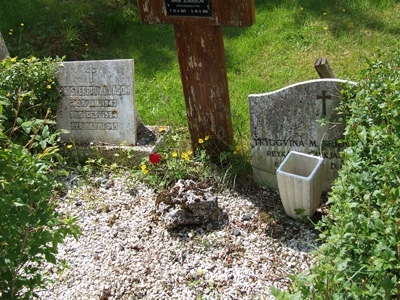
My mother had specifically asked for her remains to be scattered into the same river that my father had walked into. My brother and I thought that was too depressing. We wanted to have a grave, at last, to visit. Visiting her at our father’s suicide point just didn’t feel right, despite the beautiful landscape. My grandmother wanted to honor my mother’s last wishes, so there was a rift in the family about this. Being a chronic diplomat at times like this, I got a brilliant yet illegal idea: split the ashes. Some could be put in the old graveyard next to her brother and her father, and some could be scattered in the cold river to be united with the spirit of our father. In Iceland, the laws say that ashes must either be scattered in one place or be buried. So after all, it was good that she came in the regular mail — we could do whatever we felt was right.
I had offered to split the ashes between the urn and a container that looked like an old milk carton. I had the box next to my bed; I was imagining how dramatic it would be to perform this task. Finally, one night before the burial ceremony, I took the box to the living room. I opened it slowly and found out that the lid of the urn had opened and the ashes had scattered all over the bigger box. I thought, “What the fuck, shit, damn should I do?” In a panic, I took the box out to the balcony, and then I thought, “She never liked being placed in a box anyway,” and I laughed, hard. This was just too bizarre, like a Charlie Chaplin film. I took the container out and tried to pour the ashes back into it and the urn, but so much of it had spilled out that some of it was on the balcony, some of it was on my hands, and some of it took flight with the sharp wind. At this point I thought, “Why not take this all the way? This is not half as disgusting as I thought it would be. This is like beautiful shells, like beach sand,” and I liked it.
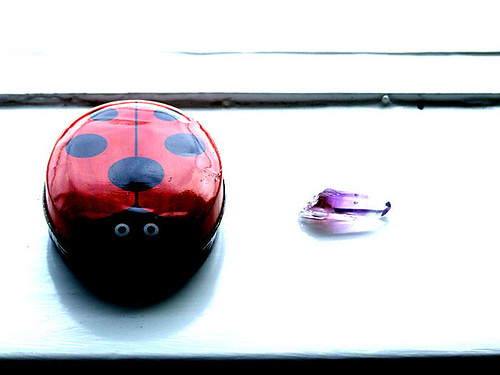
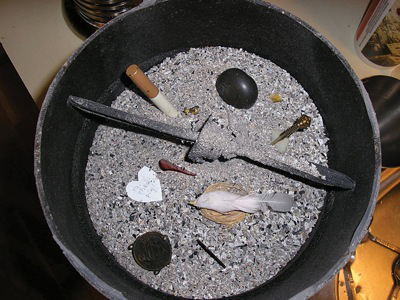
So I got out my ladybug box. I had kept my children’s baby teeth and a lock from each of their first haircut in it. I emptied it out and poured some of the ashes into the belly of the ladybug. I decided to place inside the urn stuff that reminded me of my mother. I knew she would be happy to have certain personal items close to her earthly remains. I placed a little guitar pin, a lighter shaped like a cigarette, and a heart-shaped piece of paper that said “I love you” in her ashes. It felt really good. Then I took some photos of the urn, and thus the photo journey began. Later that night I had to blow my nose, and I realized that I had literally snorted my mother into my nose, because the stuff that came out of my nose was ash. I realized that my mother and I had gone full circle. I used to be in her belly, a part of her, and now she was in my bloodstream, thus a part of me. And this was beautiful and funny at the same time. I was at peace.
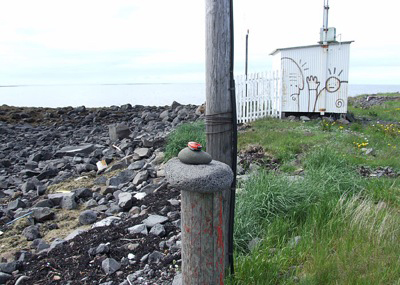
Shortly after we scattered her ashes and buried the rest, I was chanting. I had the ladybug on my altar. I suddenly got a very strong sense that my mother wanted me to take the ladybug with me as I went around my daily life. So I did. This photo journey is the making of new memories, the full circle, the forgiving — the alchemist of life changing poison into healing medicine. No one can escape death, yet we, in our modern-day life, have alienated the ritual of death from our daily lives, from our hearts, from our core being. This is my attempt to create a new ritual from an ancient one.
When I was a kid, my great-grandmother died at my grandfather’s home while performing her daily ritual of foot bathing. My grandparents kept her body in their bedroom for a few days. There she was, so peaceful in her casket, for family and friends to experience the moment of “good-bye,” to create new memories in the peaceful ambience of a private home. This ritual has almost vanished. People now die in old people homes. If you are lucky, you get to see the body during a hurried ceremony, and then it is all over.
The ladybug concept can be used by anyone who needs new memories, who needs to weave life into death, and to change grief into joy.
[Click here to enter the photo essay.]
Related pieces:
SONG—When the violin is silent
For a young cancer patient, it’s an especially nerve-racking place.
We need funny stories, warm blankets, and magazines just to keep our minds from focusing on the waiting room, the gateway to chemo land. It must be different for other kinds of patients — nurses and doctors don’t necessarily remind them of death.
The first time, my mother and I walked toward the room in silence, holding hands. I’d collapsed without warning in a Miami shopping mall. Eight days before, I’d had an emergency 12-hour brain surgery to remove the softball-sized tumor wanting to kill.
The hallways were cold and quiet. The green chemotherapy sign grew closer, and our hands grasped tighter. More people arrived: an older couple, a young girl in her 20s, a young boy with his mother. Others fell asleep or watched the TV at full blast.
Only a few people in front of us — maybe it will be quick.
They called my name. Not bad — only about 45 minutes.
A hippie, peaceful-looking doctor with gray hair and blue eyes walked into the examining room. He laid out the chemo plans, like a syllabus for the semester.
“Not bad,” I said. My oncologist laughed, and gave me a funny look. He saw my lack of fear. And he introduced me to another patient, who was in remission.
I’m nowhere near remission. Most of my senses — sight, sound, taste, touch — are gone, buried beneath many painkillers and my mostly-covered head.
But every other week, I’m back in this waiting room, on alert, as if on call, as doctors are every day.
I see familiar faces and new ones, the new ones looking just like mine did on my first day. I also see people throwing up, and bald, grey, tired people, loss of life in their eyes.
I meet a guy with a similar brain tumor situation. We compare our surgery scars. We compare other things that occur to us. Attitude still has to keep on rising around life.
We’re all competing. Will I get my chemo fast, or have to wait for hours in a full waiting room? Do I have a fast nurse, or is she a bumbler? Is the IV needle–nurse going to be good, or to have no clue of how to find my vein, and give me a bruise?
I can see cancer as just a cross to carry, or to briefly battle. I think about all of this while I’m waiting. So I always hope the wait will be short.
Again I find strength in myself. Each time chemo is finished and the waiting room waits as well, I feel I’m receiving an angel’s guidance.
Ghana woos its black diaspora.
When most Americans start looking for their roots, they probably begin by leafing through family photographs or talking with family members. But black Americans are reefed intricately between a montage of history books and countless unanswered questions.
As a descendent of African slaves and white Europeans, the disconnect of my roots comes full circle on the sand where I’m standing now: in Elmina, Ghana. I’m sweating, thinking of ancestors who 400 years ago were so violently deracinated from their homes and scattered around the world. Anger and sadness play tug-of-war for my unknown relatives in Cuba, Haiti, and Brazil.
But the winds of the Atlantic comfort me. I exhale, and release all the horror of past transgressions. It is only through this journey home that I can find peace. It’s my own Sankofa. That’s the word in the local Twi language for going back to your roots.
African Americans like me pilgrimage to Africa each year, hoping to bring closure to our tumultuous past. So many tourists and new permanent residents have arrived that Ghana has developed special outlets to welcome us.
“Our people really have no clue as to what Africa really has to offer,” said Jerome Thompson, 64, president of Ghana’s African-American Association. Johnson, who once lived in Fort Washington, Maryland, said he decided to move to Ghana after he discovered, during visits with his church, how culturally rich the country was. “If African Americans come over with their knowledge, patience, expertise, and work together with the Ghanaians, there’s nothing that they won’t be able to obtain here that they couldn’t do in America,” he added.
Noticing the diaspora connection with Africa, Ghana’s Ministry of Tourism and Diaspora Relations created the Joseph Project to build upon pan-African foundations in the spirit of American civil rights leader W.E.B. DuBois, who took Ghanaian citizenship, and Ghana’s independence leader and first president, Kwame Nkrumah. The project’s primary goal is to celebrate Ghana’s 50 years of independence, and to use 400 years of slave trade, colonial exploitation, and cultural economic strife as a springboard for Africa to reunite with the African diaspora.
“The diasporans are such an important part of African development,” said E.V. Hagan, the tourism ministry’s director of research statistics. “The Joseph Project is the perfect outlet for diasporans and Africans to reconcile their pasts to build a positive future.”
Capitalizing on Ghana’s appeal to African Americans also seems a perfect vehicle for promoting economic development. Some 5,000 African Americans are said to be living in Ghana.
“The AU [African Union] fervently wants to make the Diaspora a sixth region of Africa,” said Dr. Erieka Bennett, founder of the new Diaspora African Forum in Accra.
There are even plans to introduce a diasporan visa, a lifetime visa for those with African roots.
The beautiful plush landscape and black cosmopolitan feel of Accra seems to make the transition easier. And the Ghanaian community embraces the diasporans warmly.
“I feel elated that my brothers and sisters are coming back to Africa,” said Eric Nortey, 30, a Ghanaian who lives in Accra. “Black Americans are my favorites. They are intermediates between black and white. They are finally coming back to build upon the civilization that they were stolen from.”
Despite 400 years of slave trade, 210 million African lives lost, and a complete disconnect from cultural identity, the African spirit has proven resilient. As I peer into the night sky and reflect upon my experience here, something in the distance catches my eye. It’s a curious celestial phenomenon, on a canvas of green, yellow, and red: the Black Star of Ghana. The star is a symbol of hope and life — perhaps a sign to diasporans of our connection to our beautiful Mother Afrika.
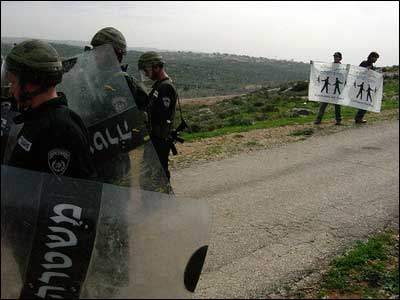
Ashraf Khader’s group, Combatants for Peace, brings Israeli military veterans and former Palestinian fighters — people who have actively fought against each other — together to advocate peace.
“After brandishing weapons for so many years, and having seen one another only through weapon sights, we have decided to put down our guns and to fight for peace,” reads the group’s mission statement.
Combatants for Peace organizes meetings between former fighters of each side of the conflict, protects threatened communities, and presses the Palestinian and Israeli governments to stop the cycle of violence.
Khader discusses the difficulties of renouncing violence in a land plagued by armed conflict, how inciting violence led him to fight for peace, and his group’s hope for a politics without militarization.
Interviewer: Anja Tranovich
Interviewee: Ashraf Khader
You’ve personally fought against Israelis in the struggle for Palestinian liberation. What did you do?
Like many Palestinians living in the West Bank, I threw stones and then Molotov cocktails. I also took part in organizing protests and recruiting people to resist the occupation. Once, the Israeli army caught me and forced me to clean a very long road under the threat of their guns.
But I don’t want to talk about what I did in the past, because I don’t believe in violence anymore.
Really, you have to understand that in the first intifada, just raising the Palestinian flag could lead to one year in prison. Despair causes many Palestinians to forget nonviolence and revert to armed conflict, with the belief that this will make their voices heard. Some are filled with hate for the Israelis as a result of a lost family member or friend to violence or prison.
Once this is understood, it is easier to analyze hatred, prejudice, and despair. These sentiments grow out of a lack of understanding that there is a real partner for peace on the ground — one that is not represented by either government.
Part of Combatants for Peace’s mission statement is that “We no longer believe that the conflict can be resolved through violence.” What changed your perspective — from being involved in the violence to thinking the conflict can’t be resolved through violence?
Though members of Combatants for Peace paid a high price for their violent activities, both physically and emotionally, they did not witness any change on the ground. The occupation continues, the societies remain polarized, and we realized that we were a part of this cycle rather than part of the solution. Throughout the world, this may seem perfectly logical, but within the context of Israel and Palestine, it is revolutionary.
How did the group begin?
The group began when a group of Israeli soldiers, who refused to serve in the Occupied Territories (refuseniks), and a group of Palestinians, who had served prison sentences in Israel, began speaking about a peaceful solution based on nonviolence and dialogue.
It started in 2004, but remained largely underground until our public launching in March of 2006.
The organization has a membership that fluctuates between 150 and 170 members from each side, Israeli and Palestinian. These members are governed by a 14-member steering committee that is also composed of equal numbers of Israelis and Palestinians who meet in our central office in Al Ram [Israel].
There are plans right now to expand our presence on the ground by creating a number of smaller groups that are geographically distributed in the north [Tulkarm-Tel Aviv], the middle [Ramallah-Jerusalem], and the south [Beersheva-South Mount Hebron]. These smaller, more autonomous groups will meet to decide their actions on a local level before sending coordinators to the steering committee for approval. We envision these groups becoming small, tightly knit, autonomous units, able to understand and react to the particular conditions in their area.
This allows us to expand our presence and visibility, but will also make it much easier for Palestinians especially to attend events in the face of movement restrictions.
Do you work with other groups?
Ta’aeosh [coexistence] is one organization we work with, but we are hoping to expand our cooperation as well; our garden project also has many more partners.
In general, Combatants have worked with communities rather than organizations. This weekend, for example, we are assisting Palestinian farmers in Tulkarm and Hebron with the olive harvest, and protecting them from radical settlers who often attack during this time.
How will you protect them from radical settlers who might attack? Do you go armed?
We don’t use violence in any way. We bring Israeli peace activists, media, and international activists with cameras to prevent the settlers and the army from [starting a] conflict.
[Abir Aramin, the 10-year-old daughter of] one of the founders of Combatants for Peace, Bassam Armin, was recently shot by Israeli solders close to her school in Anata. Combatants aligned with other groups and began a project to build a playground in Anata where children can play safely. The killing was a sad testament to the need for groups like Combatants for Peace.
How is fundraising going for the Abir Aramin’s playground project?
We are making progress in our first stage of funding, but are very far off from the second, much larger stage.
What do other veterans of the conflict think of Combatants for Peace?
Combatants is a volunteer-based, grassroots organization that depends upon the commitment of our members. This commitment is continually tested by our communities and those who believe that peace is not possible. Members are accused of being naïve, collaborators, or worse, yet we choose to continue anyway. We are able to do so by the overwhelming moral support we receive from the international community that helps to reaffirm our position and assure us that we are not alone.
Is it hard for supporters of either side of the conflict to support or advance a politics without militarization?
It is hard to fight against the perception that there are no partners for peace. Yet our existence is proof that this claim is wrong. Without proving this, there is no reason to believe that peace without militarization is possible. The more our message is spread, the easier our job of convincing people otherwise becomes.
What do you hope will happen in the next five or 10 years in Israel and Palestine?
The end of the conflict based upon a just, secure, and mutually agreed upon solution that is in accordance with international laws and norms … and we hope this happens sooner than five to 10 years down the road.
A new study says that feminists are not ugly spinsters, that feminists actually have it better (what with being respected as human beings and all) romantically and sexually. I knew that. So why am I not doing a hiney-shaking victory dance? Because, dangit, it’s a biased study in a journal called Sex Roles. Also, we cannot read the study for ourselves. Even if I happen to like the results, I still need to see it for myself.
Not that a single study, done by anyone without any bias, would make a difference for feminists anyway. We’re doomed to keep paying for our foremothers’ aesthetic shortcomings, no matter what we stand for now and no matter if it benefits men, too. I’m still going to hear, in response to admitting I’m a feminist, "But…you’re wearing lipstick…you’re pretty." ♦
So yesterday I was in my car, waiting to take a corner, at a full stop, a good 10 feet away from passing cars, when a white-haired old man on a bike (at least in his late 60s and without a helmet) flipped me off, mouthing something about trying to kill him. He made me laugh. But he might want to try a helmet if he’s so concerned about living longer — the viagra doesn’t make your skull harder, you know. ♦
Die A Little by Meghan Abbott — the new goddess of fiction noir — will be made into a movie with Jessica Biel. You know how I feel about books being made into movies — it’s like being told you’re going to be punched in the face, and I squeal, really — bruises are so my color. Once it’s over, I’m just pissed off and hurt. ♦
If you are like me and you enjoy bowling but cannot knock down a pin to save your life, I’ve learned a trick: if you’re right-handed, bowl with your left. It had been three hours and half the group went home, so I picked up the 10-pounder to see what would happen… I tossed it with my south paw and got a strike. After that, eight pins. Try it. ♦
Back in February I had the misfortune of buying a new computer with Vista pre-installed. These have been the most trying eight months of my life. In fact, my penny-pinching uncle’s computer, still running on Windows 95 (I’m not even kidding) runs faster than a machine with Vista. Until a friend of a friend who works with computers said to dump Norton AntiVirus. Hallelujah, it worked. Apparently, Norton and Vista cannot co-exist peacefully. So I picked up a copy of CA AntiVirus ($40 at Staples with a $30 mail-in rebate. Sa-weet) and I can’t believe the difference. It doesn’t take 10 minutes for Word to open. The machine doesn’t have a crippling panic attack if I try to download an attachment. Spread the word. ♦
Finally, I’ll give you $20 bill (Monopoly money — a freelance writer doesn’t have $20. Silly rabbit.) if you can identify which show is playing on the TV: