John F. Kennedy’s address on religion

JFK's famous 1960 "religion speech."

Democratic presidential candidate John F. Kennedy gave the following address to the Greater Houston Ministerial Association on September 12, 1960, at the Rice Hotel in Houston, Texas.

Reverend Meza, Reverend Reck, I’m grateful for your generous invitation to state my views.

While the so-called religious issue is necessarily and properly the chief topic here tonight, I want to emphasize from the outset that I believe that we have far more critical issues in the 1960 campaign; the spread of Communist influence, until it now festers only 90 miles from the coast of Florida — the humiliating treatment of our president and vice president by those who no longer respect our power — the hungry children I saw in West Virginia, the old people who cannot pay their doctors bills, the families forced to give up their farms — an America with too many slums, with too few schools, and too late to the moon and outer space. These are the real issues which should decide this campaign. And they are not religious issues — for war and hunger and ignorance and despair know no religious barrier.

But because I am a Catholic, and no Catholic has ever been elected president, the real issues in this campaign have been obscured — perhaps deliberately, in some quarters less responsible than this. So it is apparently necessary for me to state once again — not what kind of church I believe in, for that should be important only to  me — but what kind of America I believe in.

I believe in an America where the separation of church and state is absolute; where no Catholic prelate would tell the president  — should he be Catholic — how to act, and no Protestant minister would tell his parishioners for whom to vote; where no church or church school is granted any public funds or political preference, and where no man is denied public office merely because his religion differs from the President who might appoint him, or the people who might elect him.

I believe in an America that is officially neither Catholic, Protestant, nor Jewish; where no public official either requests or accept instructions on public policy from the Pope, the National Council of Churches, or any other ecclesiastical source; where no religious body seeks to impose its will directly or indirectly upon the general populace or the public acts of its officials, and where religious liberty is so indivisible that an act against one church is treated as an act against all.

For while this year it may be a Catholic against whom the finger of suspicion is pointed, in other years it has been — and may someday be again — a Jew, or a Quaker, or a Unitarian, or a Baptist. It was Virginia’s harassment of Baptist preachers, for example, that led to Jefferson’s statute of religious freedom. Today, I may be the victim, but tomorrow it may be you — until the whole fabric of our harmonious society is ripped apart at a time of great national peril.

Finally, I believe in an America where religious intolerance will someday end, where all men and all churches are treated as equals, where every man has the same right to attend or not to attend the church of his choice, where there is no Catholic vote, no anti-Catholic vote, no bloc voting of any kind, and where Catholics, Protestants, and Jews, at both the lay and the pastoral levels, will refrain from those attitudes of disdain and division which have so often marred their works in the past, and promote instead the American ideal of brotherhood.

That is the kind of America in which I believe. And it represents the kind of presidency in which I believe, a great office that must be neither humbled by making it the instrument of any religious group nor tarnished by arbitrarily withholding it — its occupancy from the members of any one religious group. I believe in a president whose views on religion are his own private affair, neither imposed upon him by the nation, nor imposed by the nation upon him as a condition to holding that office.

I would not look with favor upon a president working to subvert the First Amendment’s guarantees of religious liberty; nor would our system of checks and balances permit him to do so. And neither do I look with favor upon those who would work to subvert Article VI of the Constitution by requiring a religious test, even by indirection. For if they disagree with that safeguard, they should be openly working to repeal it.

I want a chief executive whose public acts are responsible to all and obligated to none, who can attend any ceremony, service, or dinner his office may appropriately require of him to fulfill; and whose fulfillment of his presidential office is not limited or conditioned by any religious oath, ritual, or obligation.

This is the kind of America I believe in — and this is the kind of America I fought for in the South Pacific, and the kind my brother died for in Europe. No one suggested then that we might have a divided loyalty, that we did not believe in liberty, or that we belonged to a disloyal group that threatened — I quote — "the freedoms for which our forefathers died."

And in fact this is the kind of America for which our forefathers did die when they fled here to escape religious test oaths that denied office to members of less favored churches — when they fought for the Constitution, the Bill of Rights, the Virginia Statute of Religious Freedom — and when they fought at the shrine I visited today, the Alamo. For side by side with Bowie and Crockett died Fuentes, and McCafferty, and Bailey, and Badillo, and Carey — but no one knows whether they were Catholics or not. For there was no religious test there.

I ask you tonight to follow in that tradition — to judge me on the basis of 14 years in the Congress, on my declared stands against an ambassador to the Vatican, against unconstitutional aid to parochial schools, and against any boycott of the public schools — which I attended myself. And instead of doing this, do not judge me on the basis of these pamphlets and publications we all have seen that carefully select quotations out of context from the statements of Catholic church leaders, usually in other countries, frequently in other centuries, and rarely relevant to any situation here. And always omitting, of course, the statement of the American Bishops in 1948 which strongly endorsed church-state separation, and which more nearly reflects the views of almost every American Catholic.

I do not consider these other quotations binding upon my public acts. Why should you?

But let me say, with respect to other countries, that I am wholly opposed to the State being used by any religious group, Catholic or Protestant, to compel, prohibit, or prosecute the free exercise of any other religion. And that goes for any persecution, at any time, by anyone, in any country. And I hope that you and I condemn with equal fervor those nations which deny their presidency to Protestants, and those which deny it to Catholics. And rather than cite the misdeeds of those who differ, I would also cite the record of the Catholic Church in such nations as France and Ireland, and the independence of such statesmen as De Gaulle and Adenauer.

But let me stress again that these are my views.

For contrary to common newspaper usage, I am not the Catholic candidate for president.

I am the Democratic Party’s candidate for president who happens also to be a Catholic.

I do not speak for my church on public matters; and the church does not speak for me. Whatever issue may come before me as president, if I should be elected, on birth control, divorce, censorship, gambling, or any other subject, I will make my decision in accordance with these views — in accordance with what my conscience tells me to be in the national interest, and without regard to outside religious pressure or dictates. And no power or threat of punishment could cause me to decide otherwise.

But if the time should ever come — and I do not concede any conflict to be remotely possible — when my office would require me to either violate my conscience or violate the national interest, then I would resign the office; and I hope any conscientious public servant would do likewise.

But I do not intend to apologize for these views to my critics of either Catholic or Protestant faith; nor do I intend to disavow either my views or my church in order to win this election.

If I should lose on the real issues, I shall return to my seat in the Senate, satisfied that I’d tried my best and was fairly judged.

But if this election is decided on the basis that 40 million Americans lost their chance of being president on the day they were baptized, then it is the whole nation that will be the loser, in the eyes of Catholics and non-Catholics around the world, in the eyes of history, and in the eyes of our own people.

But if, on the other hand, I should win this election, then I shall devote every effort of mind and spirit to fulfilling the oath of the presidency — practically identical, I might add, with the oath I have taken for 14 years in the Congress. For without reservation, I can, "solemnly swear that I will faithfully execute the office of president of the United States, and will to the best of my ability preserve, protect, and defend the Constitution — so help me God.


Is there a religious test in politics?

In this special edition of InTheFray, we focus on the interplay between religion and politics, especially during the singular and sometimes downright peculiar events of Campaign 2008, but we also go beyond U.S. presidential politics.

The complete line-up is to your right. Some stories offer a history of church/state issues in the United States. Others explain the consequences of recent developments, such as the look at the unhappy track record of President George W. Bush’s faith-based initiatives in Spreading the faith — and the funds. Some of this month’s articles report on conflicts between religion and politics abroad in places like Afghanistan. Others look inward, such as ITF senior editor Anja Tranovich’s interview with gay evangelical Rev. Mel White and Dr. Farnad Darnell’s personal essay on being Muslim/Mormon.

The question that inspired this edition — “Is there a ‘religious test’ in politics?” — was addressed two centuries ago in the U.S. Constitution, which specifically bans such a test “as a qualification to any office or public trust under the United States.” But in a broader sense, Americans have been struggling all along with this question in many ways. (See ITF Executive Director Victor Tan Chen’s time line highlighting more than 300 years of battles between "church and state")

Has religious conviction become a de facto requirement for presidential candidates in the half-century since the election of John F. Kennedy as the nation’s first (and so far only) Catholic president? 

“I believe in an America where religious intolerance will someday end,” Kennedy said in his famous speech on religion in 1960, “… where every man has the same right to attend or not to attend the church of his choice, where there is no Catholic vote, no anti-Catholic vote, no bloc voting of any kind …”

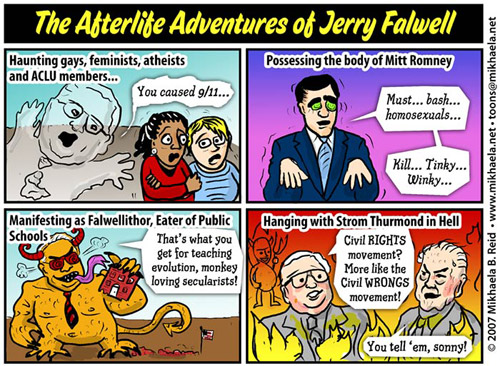
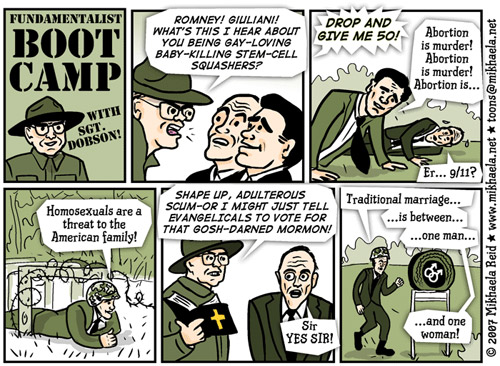
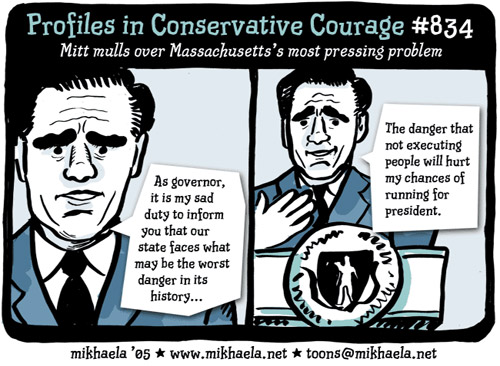
Kennedy delivered that speech out of fear that his religion would deter many Americans from voting for him. In 2008, another presidential candidate, Mitt Romney, delivered a speech about religion and politics that consciously evoked the JFK address. Like Kennedy, Romney feared that Americans would not vote for him because of his religion, which in Romney’s case is Mormon. But some critics suggested the core of Romney’s argument was the exact opposite of Kennedy’s — intolerance of the irreligious rather than religious tolerance. “Freedom requires religion,” Romney said, “just as religion requires freedom.” (See more on Romney — including a fascinating contrast with his father George — in our interview with Randall Balmer, author of God In The White House.)

But the speech that has earned more comparisons with Kennedy’s during this campaign season was delivered by Barack Obama. Though Obama’s speech focused on race, it was brought about by religion: The speech was Obama’s response to attacks on his former pastor’s sermons. (Mark Winston Griffith comments on Obama’s speech in the context of politics and the black church in “The black church arrives on America’s doorstep.”)

For all this attention, Campaign 2008 does not seem to have clarified the issue of the role of religion in politics — or that of politics in religion.

“This political season has only heightened the confusion over the future of religion in the nation’s culture and politics,” Walter Russell Mead wrote in the March 2008 edition of the Atlantic Monthly, one of several publications to devote recent editions to the subject of religion.

Now InTheFray enters … into the fray. And so can you — add your answer to our round-up of views on whether there is a religious test in politics. Then take OUR religious test in politics, our quiz, and see if you know which 2008 presidential candidate said, “When discussing faith and politics, we should honor the ‘candid’ in candidate — I have much more respect for an honest atheist than a disingenuous believer.”

The answer — along with much in this edition — may surprise you.

Jonathan Mandell
Guest Editor
New York


Religion advocating for the environment

According to the media, one of the latest green movements is happening in churches, synagogues, and mosques around the country. Several news organizations have already done stories about people from different faiths who all have the same goal of saving the environment.

The Weather Channel’s "Forecast Earth" profiles Baptist pastor and environmental advocate Dr. Gerald Durely, who was inspired by the environmental film The Great Warming. Dr. Durely says in the piece: "As one who believes that the Earth is the Lord’s and the fullness thereof, is that we have an obligation to ensure that what God has created, we keep together." The pastor has taken his environmental message and movement to his congregation because he says it will "make a difference for my children, my grandchildren, and generations to come when we begin to conserve and do what it is on this Earth that is so important."

ABC News looked into a North Carolina church that for the second year in a row is having a so-called "carbon fast" for Lent:

"Lent is a traditional time when we talk about reducing," said the United Church’s pastor, Richard Edens.

Lent is the 40-day period in which Christians fast and atone to prepare for Easter. This year the congregation has weekly themes; for example, one week they save water, another week they eat only locally-grown produce. And they are part of a growing international movement of carbon-fasters.

New Jersey Jewish News reports on a Jewish environmental organization’s call to synagogues to become more environmentally friendly by changing their old incandescent lightbulbs to energy-efficient ones:

"We’re trying to make our synagogue more energy-efficient, so it was a natural process," [Kevin Fried of Montclair, NJ’s Bnai Keshet synagogue] said. "We’re doing our part to help the environment. A couple of weeks ago we held a screening of An Inconvenient Truth (Al Gore’s documentary on global warming) and had CFLs [compact fluorescent lightbulbs]" on hand for people to see and purchase.

The article also features other energy-saving tips from the Coalition for the Environment in Jewish Life.

CNN reports on the "greenest" Canadian Church that is a model of eco-renovation. Father Paul Cusack of St. Gabriel’s Parish says he is "trying to raise the consciousness of people through the beauty of creation." And asks his parish: "What are we going to do as individuals in this community to change our lifestyle or anything else to facilitate the healing of the Earth?" The renovated church itself is a model of environmental-friendly architechture.  Among its Earth-friendly features are large windows to draw in solar heat and a living wall that is a natural air purifier. And as Father Paul says, "It’s not words that make the difference, it’s actions."

The Washington Post and Newsweek‘s "On Faith" section online addressed interfaith environmental care. Eboo Patel’s Interfaith Youth Core brings together Evangelicals and Muslims to work for the greater good. Patel writes:

The Holy Qur’an teaches that God created Adam to be His servant and representative on Earth with the primary task of caring for the beauty and diversity of creation…In my Muslim outlook, I believe this is moving creation in line with the intention of the Creator.

Among Patel’s interfaith initiatives are Earth Day programs involving different faiths.

keeping the earth ever green

*Please note that ever green is religion neutral and does not advocate for or against any religion, but I am always happy to report on anyone or anything that is helping the environment regardless of motivation.


Spreading the faith — and the funds

How much has the Bush administration’s faith-based initiative helped to blur the line between church and state?


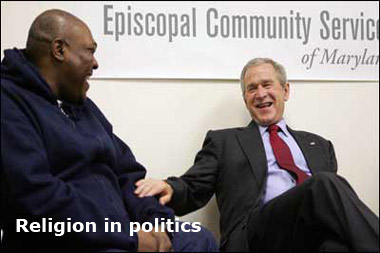
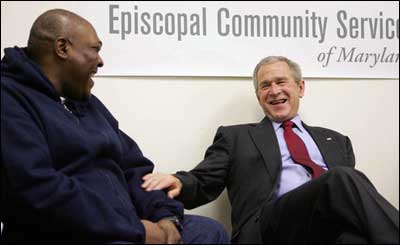
In the basement of a row house in East Baltimore, Maryland, Adolphus Moseley, who had served time in jail for cocaine possession, was listening to a visitor who had been arrested decades earlier for drunken driving.

“I understand addiction,” George W. Bush was saying, according to a reporter allowed to overhear the conversation, “and I understand how a changed heart can help you deal with addiction.”

President Bush was talking about himself, of course. In the last year of his presidency, he seems to have become more candid about a problem with alcohol that he has often talked about more vaguely in the past: He had quit drinking at the age of 40, and has attributed his continuing sobriety to vigorous exercise, and religious faith.

But the president was in Baltimore for what he might call a higher purpose. He was visiting the Jericho Program, which works to help recently released prisoners succeed outside of prison. Jericho is run by Episcopal Community Services of Maryland, one of some 5,000 religiously oriented groups throughout the United States that, during the Bush administration, have received funds from the federal government to provide various social services.

The day before, in his final State of the Union address, Bush had trumpeted what he had intended from the start of his presidency seven years earlier to be a key part of his domestic agenda, his so-called faith-based initiative.

His visit to Baltimore, like his faith-based initiative itself, may not have gone completely as planned. When Moseley suggested that the city could use more programs like Jericho, Bush replied: “There are programs like that all over the city. They are called churches.”

“They are not sincere, like Jericho,” Moseley said.

The president seemed taken aback, according to press reports. “My only point to you is there are a lot of faith-based organizations that exist to help deal with very difficult problems,” Bush said. “It starts with the notion that there is a higher power that will help people change their thinking.”

Mixed legacy

For the past seven years, Bush has hoped to change the thinking of America about the involvement of the state in church activities. But many observers see at best a mixed legacy.

Some who support Bush’s goals say that they have not been fulfilled, or point to inequities: One report showed that federal funding awarded to black churches is disproportionately low.

But opponents question the whole concept, accusing the president, in the words of a recent editorial in The New York Times, of having “worked to blur the line between church and state.”

It is not just the achievements of his faith-based initiative, but its very definition, that is also in something of a haze.

By the way that President Bush talks about programs such as Jericho, it would be easy to infer that it is their religious orientation that makes them effective. But studies are inconclusive about the degree to which faith-based organizations are any more effective at providing social services than secular ones. And — to pick the program that Bush chose to highlight — Bonnie Ariano, Jericho’s director, says that there is no religious content to their program.

“Sometimes a client will ask to say a prayer,” Ariano says, “and we will ask the other clients if that is okay with them.” The role that faith plays in the program is in motivating the organization to work with the poor.

Indeed, anything more would be unconstitutional. The U.S. Supreme Court has ruled that federal money cannot be used to fund religious worship, religious instruction, or any kind of religious proselytizing, since these activities would violate one of the core principles upon which the nation was founded: the separation of church and state.

It is this principle that critics of varying beliefs see endangered by Bush’s faith-based initiative. Some worry that the government could wind up funding religious ideology. Others are concerned that the government money could interfere with religious activity. Still others are most disturbed by the fact that the religious institutions getting federal funding are exempt from many federal civil rights and labor laws.

Faith and the feds

Government involvement with religious organizations did not begin with the Bush administration. During the Great Depression, government looked to religious groups to help address the social ills of that era. Many years later, Congress and President Bill Clinton once again turned to those of faith. During Clinton’s second term, the Charitable Choice laws were passed, which clarified the rights and responsibilities of faith-based organizations receiving funds for certain social service programs.

Bush campaigned to bring these organizations further into the federal fold on his way to the White House. Once elected, he signed a number of executive orders. One stated that faith-based organizations should get an equal chance at receiving federal dollars, and the other created the White House Office of Faith-Based and Community Initiatives.

In 2006, $2.2 billion dollars was awarded to faith-based organizations to aid such needy constituents as the homeless, at-risk youth, recovering addicts, returning offenders, and people with AIDS. The number, according to the White House, represents a 41 percent increase over 2003, although some have disputed this figure.

The Criticisms

1. Proselytizing

Critics charge that religious views have dictated the policies and practices of a range of federally funded programs.

Many of the pregnancy resource centers funded by Bush’s initiative were found to be providing false or misleading information about abortion, according to a 2007 report by the House Committee on Oversight and Government Reform. Callers to the center were told that “having an abortion could increase the risk of breast cancer, result in sterility, and lead to suicide and ‘post-abortion stress disorder.’”

“Abstinence-only” and other religiously inspired views reportedly led to the cessation of funds awarded to nongovernmental agencies in developing countries to provide condoms or to educate people about their use.

Department of Justice officials in charge of a program that funds faith-based organizations that run halfway houses told investigators they assumed these groups were exempted from the religious activities ban if chaplains or “organizations assisting chaplains” were involved. But this stance “could be read as allowing all providers of social services in these settings to engage in worship, religious instruction, or [proselytizing],” regardless of whether the religious activities are voluntary on the part of the participant, according to a report in 2006 by the General Accountability Office, an official government watchdog.

2. Inequity

One research group has found that the money distributed by the Office of Faith-Based and Community Initiatives has not been awarded evenly among religious groups.

Only 2.5 percent of black churches have received funding from Bush’s faith-based initiative, a survey by the Joint Center for Political and Economic Studies showed.

“The administration has not been successful in informing the black ministers about the nature of the program,” David Bositis, senior political analyst for the Joint Center told Black Enterprise.

3. Politics over faith

Even while Bush is criticized for pushing the government’s relationship with religious groups too far, others allege he has acted as if he has done more than reality would bear out.

David Kuo, who was the second-in-command at the Office of Faith-Based and Community Initiatives, has accused Bush of manipulating religion for political gain. Most recently, he coauthored an op-ed in The New York Times excoriating Bush for not doing enough. “Every nonpartisan study has concluded that the initiative has not delivered the grants, vouchers, tax incentives, and other support for faith-based organizations that the president originally promised,” the piece said.

The rise in funding to faith-based groups announced by White House was indeed misleading, according to a piece in The American Prospect. The article says the administration juggled the numbers to make it look like a rise. It points out that certain agencies were already distributing grants to these groups, but had not been part of the original tally.

4. Special arrangements

The government may be doing more than offering funds to religious groups. Since 1989, Congress provided hundreds of special arrangements, protections, or exemptions for religious groups, according to a two-part series in The New York Times in 2006. The story points out that these advantages give religious groups an edge in the competition to provide social services, whether they are government-funded or not.

A number of states have also exempted religious child-care programs from certain oversight, including Texas under Bush’s tenure as governor. There, religious groups were exempted from the need to license their programs under legislation pushed through by Bush. Although few groups took advantage of the new law, at the facilities that did, abuse of the law was 10 times more likely to occur, according to a study by a local watchdog group. The state no longer exempts religious groups from licensing. 

5. Undermining religious independence

Ironically, even many of the potential recipients of these grants are worried about their effect.

A letter signed by a 1,000 religious leaders representing a wide range of beliefs stated that they are concerned the funds would encroach upon their activities: “The flow of government dollars and the accountability for how those funds are used will inevitably undermine the independence and integrity of houses of worship.”

As Rev. Ted Fuson, pastor of the Culpeper Baptist Church, told the Jewish World Review: “The folks that send the money tend to tell you what to do with it and rightfully so, if you are taking tax dollars.”

The future

Will the faith-based initiative end with the Bush administration?

The answer is unclear. According to Christianity Today, all remaining presidential candidates have “voiced support for federal funding of faith-based social services. So far, however, none has unveiled a specific plan for the White House’s Office of Faith-Based and Community Initiatives.”

Meanwhile, the concept has spread beyond the federal government. More than 100 mayors and 35 governors now have faith-based offices.


Burning it all down

We’ve inherited several assumptions about life.

Some day you will have a nice home to call your own.

A spouse and a baby.

Travel. You’ll spend money on stuff you don’t need. Stuff you do need.

There it is. Life. As a consumer.

I don’t know if I ever thought much about it as a child, other than assuming It would happen eventually. Indeed, being the fringe, red-haired, counter-cultural type, I didn’t even envision spending $10,000 on a wedding. Which I still hope I don’t do. But "grown-up life" did happen. Just in a very different way. I don’t have the house, the money (though, I’m working on it), or the spouse. And I’m finding that most of the post-modern gen doesn’t either. For one reason or another. So, why are we different from our parents and their parents?

These last few weeks I’ve stumbled upon several articles that have caused me to ponder how traditional roles crash up against the Gen X and Y protective casings. Those plastic-clam shells that frustrate the Old.

In The Washington Post’s March story, "My House. My Dream. It Was All an Illusion," reporter Brigid Schulte interviewed an immigrant woman who made a really bad decision. She and her husband bought a $430,000 home in Alexandria, Va., that they couldn’t afford. Through the manipulation of a friend and mortgage miscommunication, the Ortiz family found its dream of home ownership ending in foreclosure. 

She didn’t read the small print. If you are ignorant and manipulated, the things that once meant stability can be taken away.

When I was a beat reporter in a small town in the middle of Nevada, I worked with a guy who, upon hearing any news of business manipulation, would say: "burn it down." He meant burn down the institution. I think that’s what post-mods have been doing. It doesn’t work for us. So we burn it all down. In many ways, that leads to creative re-growth.

But, sometimes, in very few instances, it leads to utter shit. Most the time (not all the time) our parents have one thing up on us. They know how to communciate. With each other. And I don’t mean via email or text messaging.

Relationships. A relationship. The thing everybody wants but nobody can keep. The plot twist (or conflict) in every movie. My Yoplait. Your Powerbar. Emily Yoffe’s March 20th Slate.com column argues that couples should wait until after marriage to have children. The age of single parenthood began about 25 years ago, I think. Many of us dreamed of "finding the one." Instead we got pregnant. And someone ditched out. Why is that? Yoffe blames a lack of commitment. She has a few impressive statistics. She says that the institution that many Gen X and Yers call "archaic" is actually a social structure that benefits the couple and offspring. Yet, I really wonder if our age, raised on convenient yellow cake and instant gratification pudding, can make that commitment. Not, I believe, when we are manipulated into relationships. Or when wants and needs are miscommunicated. Or when conceptions of love and marriage are completely misunderstood and relational wisdom is gleaned from pop culture. And all of that is the norm in this age. 

Finally, a bit of sage advice for the struggling consumer in this declining gilded age. Tighten your belts. My grandmother used to say that. I don’t think we know the meaning of the phrase.


Book news

From Lunch Weekly:

Author of French Women Don’t Get Fat Mireille Guiliano’s guide for women in business, exploring issues of balancing career and personal life, risk taking, career advancement, leadership, branding, etiquette, mentoring, communication skills, and personal relationships…

Is anyone else tired of being sold the myth that French women are just perfect at everything? Don’t get me started, especially on Mireille Guiliano, who strikes me as completely full of merde.

From The New York Timesnaughty fun with science

In her previous books, "Stiff" and a follow-up, "Spook," Mary Roach set out to make creepy topics (cadavers, the afterlife) fun. In "Bonk," she turns to sex, covering such territory as dried animal excreta used as vaginal "drying agents"; a rat’s tail "lost" in a penis; and a man named William Harvey, patent-holder for a rolling toaster-size metal box outfitted with a motorized "resiliently pliable artificial penis." In short, she takes an entertaining topic and showcases its creepier side.

And then she makes the creepy funny.

And guess what? It’s illustrated!

Also from PL:

Carlos Ruiz Zafón’s El Juego del Angel (The Angel’s Game), a prequel to The Shadow of the Wind set in 1920s Barcelona, combining a love story, a mystery, a fantasy and an exploration of literature…"

The Shadow of the Wind was incredible, so I cannot wait for this one.

From Boing Boingthe trouble with finding good occult materials (and getting the evil eye from a skeptical librarian): 

Cecile Dubuis wrote a master’s dissertation for University College London titled "Libraries & The Occult." I’ve only read bits of it, but the challenge she identifies is that occult books are, by their nature, anomalous and hard to categorize, much like the phenomena discussed in their pages. As a result, they are often unsearchable in the context of traditional library classification systems. From the dissertation: "The occult seems to be one of the least considered subjects when it comes to classification. This can often result in materials being divided among other subjects such as philosophy, psychology and religion. This can make it difficult to find occult materials."

I remember seeing something on Wit awhile back about the same subject, with some help from the New York Public Library:

The New York Public Library has an extensive collection of materials on the occult. The General Research Division collects a wide range of topics including esoteric magic… spiritualism and witchcraft. There are particularly strong collections on divination and Theosophy. The Science, Industry and Business Library collects materials on alchemy and flying saucers. Books on oriental mysticism and yoga are collected by the Asian and Middle Eastern Division. The Slavic and Baltic Division collects, in the original language, the works of Russian mystics, such as H.P. Blavatsky, and the Schomburg Center for Research in Black Culture collects titles on voodoo, santeria and related topics.

Parapsychology, the branch of psychology which deals with the scientific investigation of paranormal or psychic phenomena, is collected by the General Research Division.


It may not be the ideal collection, but it’s an ordered beginning. I’m sure scholars were already aware of it, but to the occult laypeople, dig in.

The U.K. Telegraph has an interview with Isabel Allende, my own personal Sheherezade, about her new memoir, The Sum of Our Days:

…she was once told by the Chilean poet Pablo Neruda that she was possibly "the worst journalist in the country," incapable of objectivity and prone to invention. "Wouldn’t it be better to turn to writing novels?’"he suggested.

The rest of us will never be both insulted and set on the right path by one of the greatest poets. Our simple lives are so inferior.

Finally, a startling, upsetting, but eye-opening new nonfiction book. From Salon:

During the four years that Benjamin Skinner researched modern-day slavery for his new book, "A Crime So Monstrous," he posed as a buyer at illegal brothels on several continents, interviewed convicted human traffickers in a Romanian prison and endured giardia, malaria, dengue and a bad motorcycle accident. But Skinner, an investigative journalist, is most haunted by his experience in a seedy brothel in Bucharest, Romania, where he was offered a young woman with Down syndrome in exchange for a used car.

"There are more slaves today than at any point in human history," writes Skinner.

There’s just nothing else to say about that.

personal stories. global issues.