Life after the theocracy

In Afghanistan, everything, whether good or bad, comes to an end.

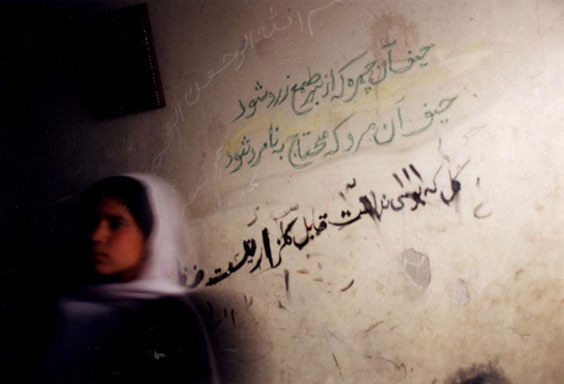
Afghan girl

 
One of the first female faculty members at the resurrected education university in Kabul, Afghanistan, rummaged through her desk in the office of the English department, a narrow room with a single window.

We had just spent the morning with her, observing her colleague as he taught an English class. She said she had something to show us, a gift from her students. But after opening and slamming metal drawers shut, she sighed. She couldn’t find the photograph she was looking for, so she described it to us: Some of the male students had found a broken stair railing with vertical metal bars. They all held it up to their faces like they were in prison, and posed with exaggerated expressions of misery. One of them displayed a handmade sign: “Guantanamo University.”

“That was my gift,” the young professor said, rolling her eyes like an exasperated mother. I felt a stab of shame in my country’s government.
 

And now the Americans

If we are to believe the American point of view, the recent history of Afghanistan could be divided into pre- and post-Taliban, one of the world’s most infamous theocracies.

The Taliban years, from the mid-1990s until the U.S.-led overthrow after September 11th, seem to us a nightmare of medieval proportions: adulterers and thieves stoned and hanged in public, ancient Buddha statues destroyed, burqa-clad women beaten with sticks for showing an ankle or for wearing fingernail polish, music and kite-flying prohibited.

We Americans were all too eager to portray post-Taliban life as an explosion of long-denied freedoms. Women threw off their burqas and went to beauty parlors. Girls returned to school. Kites, pop music, and Bollywood flicks filled the skies, airwaves, and cinemas, and the newly installed Democratic government and constitution would soon usher in a new era of hope and modernization.

Of course, now we know the liberation of Afghanistan has proven more complex.

Nearly seven years after the U.S.-backed Northern Alliance made its triumphant entry into Kabul, President Hamid Karzai and NATO struggle to keep even Kabul under their control. The Taliban have regained control over much of the south and the volatile regions along the Pakistani border. Regional leaders — many of them affiliated with the Northern Alliance, which fueled the brutal civil war that preceded the Taliban — govern with equally draconian restrictions on women. In many provinces, local villages have chosen to side with the re-emerged Taliban over NATO and the new government; they reason that at least life was orderly, free of suicide bombings and rampant opium trafficking, under the old regime.

Four years ago, when I visited Afghanistan with photojournalist Stephanie Yao, I was struck to discover that nearly all the Afghans I met saw the United States as just another foreign occupier. (The Taliban originated in Pakistan.)

“First we had the British,” a longtime Kabul resident, a woman of about 60, told me. “And then the Soviets. And then the Americans came in to fight the Soviets. Then the mujahedin [the anti-Communist resistance fighters who started a civil war after the Soviets left]. After that, the Taliban. And now the Americans again. We’ll see if they do any better than the others. Probably not.”

Meeting the English professors

I recall first meeting the woman I shall call Fahima by accident, as my group and I were being escorted from one dull official meeting to another. At a teacher-training college, streams of students whisked past us. The young women and young men never mixed, but they wore modern clothes, by Kabul standards. The men wore jeans and western-style button-down shirts in bright solids and plaids. The women were in trim two-piece ankle-length skirt sets and modern headscarves that were close-fitting, not the voluminous shawl-like ones most other women in Kabul wore. I felt disconnected from them; I wanted to know them and their lives, but they glided past us like fish in an aquarium.

I cannot remember why Fahima was different, how we managed to stop and talk to her and Hamid (also a pseudonym) — both young professors in their late 20s. Maybe they overheard us speaking English to each other and said something to us, or maybe we heard them talking in English. I do recall making eye contact with her, and being drawn by her lively, dark eyes. She was surrounded by men, her male colleague and three male students; mixed-gender groups were unusual. She was tall, taller than some of the men, and her tailored gray skirt and top seemed to accentuate this. She told us they were all professors and students in the English department, and that now, particularly since the American invasion, this was the “hot” major.

Russian used to be the sought-after major, she said. Once there were hundreds of Russian majors at the university, and now there were about a dozen. The Soviets were yesterday’s occupier. Now everyone, from the United Nations, to construction companies, to journalists, were willing to pay top dollar to English-speaking, trustworthy Afghan workers, interpreters, or fixers. The students flanking her puffed up with pride as she talked about how only top applicants were accepted into the department.

“Will you come visit us in our department later?” Fahima asked, as our escort from the dean’s office started shifting from one foot to the other. We had another meeting to get to. We agreed to come by later.

Waiting for the grass to grow

“Come in, come in,” our two new professor friends beckoned us into the office, which had two proper desks, and several haphazardly arranged student desks, the kind with the chair attached. Hamid rushed around to arrange the student desks into a comfortable configuration for us. Then, to be official, or perhaps because it was the only space left for them, each of them took their seats behind their two desks.

Their desks, jammed together, took up nearly the entire length of the room. The female professor had to walk all the way around her colleague’s desk, a breezy sweep of gray fabric and trim white headscarf, and work her way into her desk, which was closer to the door. He took his place after her, easing into his. The ease with which they did this, the proximity of their desks, spoke of an intimacy that defied their propriety. Of course, we never saw them once touch, and they never held eye contact with each other for more than a second — even that would have been considered brazen outside of this liberal university campus. But their fondness for each other occupied the little air in the room. We settled into our seats, talking about all manner of things.

Fahima told us about her ill-timed entry into teaching. After her education was interrupted several times by the civil war, she finally graduated and was hired by the college. The year was 1995. Unfortunately, she barely finished a year before the Taliban took control of the city and banned female teachers and students.

“I spent five years at home. I read my books and dictionaries as much as I could,” she said, her English accented and precise. Some of her female students came to her family’s home, where their professor secretly tutored them. But as the Taliban became increasingly extreme, she feared what would happen to her if she got caught — and her anxious students stopped coming. “All I wished I could do was stand in class one day and teach my students. I prayed for it.”

The college was one of the few in Afghanistan that had close to a 50-50 male-female student ratio in 2004, but a female professor was in the distinct minority. Women comprised only 15 percent of university faculty in the country. Fahima knew how important she was to her female students.

“They sew clothes for me,” she said, motioning to the sleek gray outfit she wore — a sort of Muslim-friendly skirt suit, with a slightly fitted button-up top and a long, flowing skirt. These gifts from students were welcome, she said, given that the cash-strapped university couldn’t afford to pay her a living wage. The young women had a special bond with her, she admitted, often seeking her out for personal advice.

“I hope when my female students see me, they know what is possible for them.”

Then, realizing she had been talking about herself for a while, she turned to her male colleague, who had been listening attentively. “Well, what about you? Let’s hear about your stories.”

He waved her off, shaking his head. “I have no good stories,” he said. “Only yours are good.”

All of us women cajoled him until he offered that he loved soccer. “I was a footballer,” he said.

“Was?” I asked.

“Before the Taliban, he was a very good player,” Fahima said. “He played for a professional team.”

His easy smile became broader as he lowered his head sheepishly. He said he had not played seriously for years. Though he wore a baggy button-up shirt and jeans, I could see the strength of his legs in the way he stood, feet slightly apart as if ready to defend the goal, and the athleticism in the broadness of his slightly squat torso. But of course, I was not supposed to be noticing these things. Away from the relative freedom and permissiveness of the college campus, our Afghan American interpreter had laid out the rules clearly for me: No eye contact with men.

Not eager to get in any kind of trouble, I took her lead and got used to studying the carpet or some other focal point on a wall as I talked to men. But here, on campus, I immediately sensed the slack in the rein. I found myself using the additional freedom I had to study men in subtle ways, noticing all the things that even a light gaze now and then could pick up. Even our interpreter, thoroughly accustomed to both Afghan and American ways of being, reacted to it.

“He has pretty eyes,” she whispered to me at one point on campus, out of either professor’s earshot. I nodded immediately, having noticed his heavy-lidded, golden-hazel eyes as well, so often crinkled in a smile. Of course, Fahima, who worked with him day in and day out, could not have been blind to this either.

“But of course, it’s quite a miracle he can play football — soccer — so well,” she continued the discussion, a glint in her almost-black, almond-shaped eyes, “since he is so short.”

Her laughter came musical and easy, and he let out an open-mouthed gasp in mock offense. He feigned indignation, but couldn’t stop the smile from creeping up on his face. Clearly this was a running joke between them. She was one of the tallest Afghan women we met in our time there, her lithe frame appearing to stand an inch or two higher than her colleague’s with her heeled shoes on.

I wanted to know more about his competitive soccer days, so I asked. That was more than a decade ago, he said, and seemed at a loss to describe a time so far removed. I pressed on a bit. “What were the games like? Whom did you play? What did your uniforms look like?”

His expression clouded. “The Taliban didn’t like us wearing shorts. When we played in Kandahar, the Taliban shaved our heads and imprisoned us for two days. Our hair was too long and our beards too short. Soon, we just stopped playing. There wasn’t really space for football.”

Much has been made of the Taliban’s conversion of Kabul’s soccer arenas into public execution sites, like modern-day coliseums for the aforementioned hangings and stonings. But I knew this was not what he meant. Space was in the mind and heart; the capacity to relish sport that was subsumed first by the civil war and then by the Taliban’s harsh rule, and the poverty that overtook the city during both eras.

He grew quiet. I tried to shift to a brighter perspective.

“Well, now that the Taliban are gone, are you playing again?”

The professor raised his eyebrows, as if he had never really contemplated the idea, even though nearly three years had passed since the overthrow. Everyone in Kabul seemed so busy, so frantic to catch up with the sudden new world order — going back to school, learning English, angling for lucrative contractor jobs. Soccer seemed frivolous.

“No. Maybe someday I will,” he said. He turned to the window, as if trying to see through the university walls to the brown rubble and dirt roads outside. “Someday when grass grows in this place.”

 
Liberation in the classroom?

Later that afternoon, Fahima sat with us as we observed Hamid teaching his English III class. The students were working on identifying subjects, verbs, and objects in sentences. Their professor was encouraging them to come up to the white board to write sentences and then underline the subjects, verbs, and objects in different-colored dry-erase markers. It reminded me of the sentence-diagramming exercises I so dreaded in middle school English.

The male students were eager, their hands shooting up at every opportunity. But the women’s hands remained firmly on their desks or in their laps, and they avoided eye contact with their teacher. One broad-shouldered male student, wearing a snug-fitting white polo shirt, went up to the board twice. The second time, he wrote “I like to swim” in large letters, skewed at a strange angle because of his somewhat forced stance. Our interpreter laughed and whispered to me that he seemed to be flexing his muscles as he wrote. There was no mistaking it; that was exactly what he was doing. The telltale arms-akimbo stance and exaggerated motions, uncapping and recapping the different-colored pens — some male behaviors are universal, apparently. 

The professor finally called on Lima, a petite, pale girl in a light-brown outfit and cream-colored headscarf. Fahima whispered that Lima was a top student, much better than the boys who had gone up before her. Lima stared at her shoes as she walked quickly up to the board, snatched a pen, and wrote her sentence in small, timid handwriting. She bit her lower lip as she found each of the colored markers, underlining words as if this all couldn’t end soon enough. It was the best, most complex sentence that had been written, with conditional tense and dependent clauses.

“Very good. Excellent,” her professor encouraged her.

She slunk back to her desk quickly, with a slight smile on her face.
 
I knew it was easy to exaggerate in our minds the significance of that moment. The idealistic, feminist, American part of me wanted to think that something revolutionary had happened. That little by little, each woman student the professor coaxed to the front of the room was changing Afghanistan. That somehow, that turn up at the board incrementally altered each woman.

But when I talked to some of the female students later, I learned that many of them doubted they would pursue careers after their education. Their parents would resist any job that would require living away from home, thus limiting their options. Even jobs in the city would be difficult to get to, since few had their own transportation. There were still few female drivers on the road, despite the lifting of Taliban restrictions on women driving. And they were expected to marry soon, with no guarantee their husband and in-laws would approve of them working.

Fahima admitted she was a rarity — a woman of nearly 30, whose father was comfortable with her pursuing a career and remaining single, for now. Her father was disgusted by families — particularly uneducated rural ones, she said — who married their daughters off as young as eight years old in order to benefit financially from the arrangement.

Ultimately, the shortsightedness brought on by poverty would likely be the worst enemies of her female students’ budding careers. Though a bilingual woman working or teaching for an non-governmental organization, or interpreting for the United Nations, would make good money for her family, many parents pushed their daughters to marry early for economic reasons. Not only would the bridewealth paid by the husband’s family provide much-needed cash, but marrying off a daughter would also mean one less mouth to feed.

An educated daughter might catch the eye of a more affluent family’s son, and she might be better taken care of with her in-laws than with her parents. The students at the college were from middle-class families for the most part. But in Afghanistan, to be middle class is still a struggle. In reality, the economic exchange system of marriage had been in effect for centuries, millennia even. In harsh times, that could be relied on. The whispered promise of education and employment for Afghan women felt alien and unreliable in these times.

Still, I engraved Lima’s slight, self-satisfied smile in my memory. I wanted to remember it, for what it was worth. 

Fahima who was sitting in the corner of the room with us, suddenly had a gleam in her eye. She smiled and stage-whispered to us as the teacher walked toward the front of the room: “Maybe we should lower the board, because now Hamid is going to write something.”

We stifled our giggles. The class seemed unfazed and unaware. Hamid stopped for a moment and glared at Fahima. But then his stern look broke into a smile, and he shook his head. Barely missing a beat, he grabbed a marker and began writing the homework assignment on the board.

After the class, alone with Fahima in the cramped English department office, we teased her about her colleage. She raised her dark brows in an exaggerated gesture of surprise, shook her head fiercely, and then furrowed her brows to say, “No, no, no. We are just friends and colleagues.” Her English was, as always, crisp and formal, but I could detect the hint of a chuckle behind her declaration.

 
Graduation

Later that week, we went with our two new professor friends to the school’s graduation ceremony — the first for the three-year program since the Taliban’s overthrow. The women who received their diplomas that day, in a local restaurant banquet room, were the first female university graduates in a decade. The occasion was festive, beginning with a reading of Quran verses, and ending with a live band that alternated between deafening Persian synth-pop and Pashtun folk music.

Young women in colorful, sparkly outfits and headscarves posed for pictures with their proud parents. They sat talking to each other and fingering their colorful pink-and-turquoise diplomas, while the boys danced with abandon. The women feigned a lack of interest in the young men taking turns on the dance floor, twirling, clapping, and writhing until their faces glistened with sweat. Fahima told me the women would dance later, when the men finished.

In America

After our visit to Afghanistan, I learned that our professor friends would be coming to the University of Indiana. I lost contact with them, but I couldn’t help wondering if the time they spent traveling together may have caused love to flower.

As Afghanistan’s fragile post-Taliban hope fractured into dwindling U.S. and NATO control, suicide bombings, and growing daily death tolls, I felt that wish was hopelessly romantic. Did I expect the two of them to taste American freedom, fall rapturously into each other’s arms, then return to Afghanistan and, by the sheer force of their love and determination, save all the college-aged women? I wanted a Hollywood ending — just as we Americans had envisioned fixing Afghanistan as a matter of casting off the Taliban like a burqa, as the sunshine of freedom heralded a new day.

If I learned anything from my time in Afghanistan, it was that only Americans, not Afghans, saw the overthrow of the Taliban as a defining “before and after” moment. For most, the near quarter-century of war and unrest that had preceded 2001 — the endlessly changing regimes, each one brutal and ineffective in its own way — had numbed them from investing too much importance in the end of a theocracy and the beginnings of a U.S.-installed democracy.

But it was the final twist in this story that delighted me with the surprise of discovering lost friends, and blindsided me with the realities of the threatening, lawless place this so-called democracy has become.

When the original version of this piece was posted online, I immediately heard from the young man I am calling Hamid for the first time in years. He and his female colleague were indeed at the University of Indiana, getting their master’s degrees. It was a dream come true, he said. He had even started playing soccer again, but had been sidelined by a knee injury.

But their dreams came with a price back home. Fahima’s family had been threatened because she had gone away to study at a U.S. university. This kind of affiliation with America was cause enough for extremists to attack.

I had read news accounts of this growing climate of fear, the threat of an unseen but ever-tangible form of vigilantism that pervaded Afghan life now. Four young actors from the Hollywood movie The Kite Runner were relocated to the United Arab Emirates by the movie studio, for fear of repercussions resulting from a culturally inflammatory rape scene. Last year, prominent female radio journalist Zakia Zaki was shot dead in her home north of Kabul, after criticizing warlords. It was the third such murder of a female Afghan journalist in two years.

I apologized to my worried friend, but he interrupted me with his own apology. We had so much fun when you came and interviewed us, he said.

“It’s not at all like it was then. We all felt free to talk to you,” he said, his voice heavy. “Kabul is so different now.”


Monk Rambo

In Myanmar, home of the world’s longest civil war, some of the Buddhist monks have joined the violent resistance.


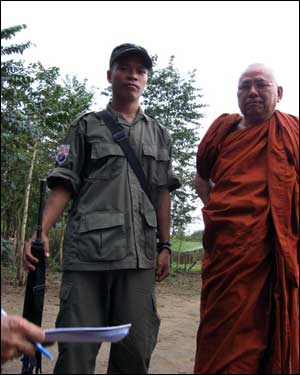
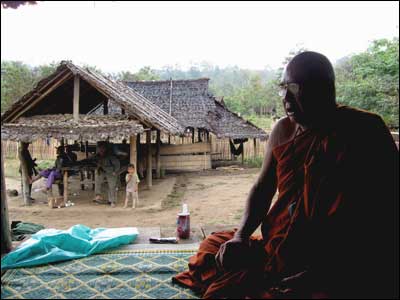
In a jungle encampment in eastern Myanmar, 67-year-old monk Saw Wizana sits meditating in orange robes. Behind him, hundreds of men with semi-automatic weapons line up in military formation and march in circles around a field. They are preparing for another battle against Myanmar’s military government.

Saw Wizana and the soldiers are Karen, the largest ethnic group in Burma. They have been fighting the government for 60 years in what has become the world’s longest running civil war. While tens of thousands of monks caught the world’s attention last August and September for their massive nonviolent protest, some Buddhist clergy in Burma — including Saw Wizana — insist that violent resistance is the only viable strategy against the ruling junta. Today, monks from both schools of thought continue to battle the military dictatorship. They say they belong to the same revolution.

Saw Wizana argues that as a Buddhist monk, he supports the controversial Karen armed struggle because he says it saves lives.

“We want to use a peaceful way like Martin Luther King, like Gandhi, but the military regime doesn’t accept it. That’s why we have to pick up arms,” he said. “Of course we want peace. Everyone wants peace. But it doesn’t work. That’s why we need weapons. We only use them to defend ourselves.”

The Saffron Revolution, brutally suppressed

The Buddhist country of Myanmar, named Burma until 1989, is among the most oppressive in the world. Pro-democracy advocates are routinely imprisoned, and ethnic groups like the Karen are regularly attacked by the military government.

Until recently, because of the government’s stranglehold on dissent, only the Karen rebels have openly confronted the dictatorship. But in August and September of last year, when tens of thousands of monks became involved in what originated as pro-democracy and student protests against rising fuel prices, a nonviolent resistance was reborn.

After days of nationwide protest dubbed the “Saffron Revolution,” the monks were brutally beaten and shot at by the military.

Monk Saw Wizana says the tragic result of September’s protests, in which at least 31 people were killed and hundreds imprisoned, proves that nonviolent resistance won’t work against the Burmese dictatorship.

“Nearby countries like Sri Lanka, Laos, Cambodia, and Thailand — they are all Buddhist countries, and they wouldn’t hurt monks,” he said. By contrast, in Myanmar, he added, “monks were tortured by the military soldiers and forced to worship their torturers.”

Buddhism and armed struggle 

Saw Wizana — an imposing, heavyset man with gold wire frame glasses and rolls of orange fabric — has been a monk for 37 years. He spent four years in prison between 1984 and 1988, and was forced into hard labor as punishment for challenging the government.

“I was in the forest with several young students I was teaching. When we were sleeping, the military shot my students because we are Karen,” he said. “I told them they were breaking the law, and because I talked back to them, I was put in prison.”

He insists the Karen armed struggle is not in conflict with Buddhism because it is protecting life.

“We have to use it together with religion,” he said. “Use weapons for defense and religion to keep us courageous.”

Of the armed groups that have fought Myanmar’s dictatorship, all but the Karen have surrendered. The Karen National Union (KNU) comprises Christian, Buddhist, and Animist ethnic Karen people, and has suffered major troop losses over the decades. The KNU estimates its forces are outnumbered by government forces at least 25 to 1.

The KNU is also criticized for planting landmines, recruiting child soldiers, and instigating violence in civilian areas — accusations they deny.

At KNU headquarters, Saw Wizana is known as “Monk Rambo.” Other monks say they too understand the Karen armed struggle. One of them, 53-year-old Oh Bah Seh, was a leader of last year’s protests and says he does not condemn the Karen war. He is neither Karen nor part of the KNU movement. “No one wants violence, but because of the inhumane persecution [by] the government, that is why some came to take arms to fight the evil system.”

He, however, practices nonviolent resistance, like most other Buddhist monks. He says that as he was being beaten with a stick during the September protests, he still continued chanting loving kindness toward his oppressors.

Nonviolence is key, others say

Twenty-eight-year old Ghaw Si Tha, another leader of September’s peaceful marches, said nonviolence is key to a Buddhist resistance.

“We must go on chanting love, as we are monks. Even though they use force, even though the regime doesn’t follow the Buddhist precepts, we have to be faithful to love,” he said. “We believe that only love can produce success. That’s why we march with loving kindness, peacefully without violence.”

In Myanmar, political resistance by Buddhist monks dates back to British colonial times when Buddhist clergy helped fight for independence. The Buddhist clergy are a venerated group, seen by the general public as leaders. Today, Myanmar’s 400,000 monks are a group outnumbered only by the military.

Although unwilling to give specific details, monks Ghaw Si Tha and Oh Bah Seh say there are plans for future nonviolent protests in Burma. Many suspect August 8 — the 20-year anniversary of the massive pro-democracy protests, as well as the opening of the Beijing Olympics — to be a day to watch in Myanmar.

“Now, in this way, we Buddhist monks are also doing the same thing as the Karen fighters,” said Oh Bah Seh. “Revolution.”

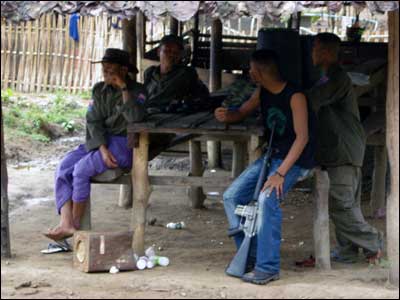
Karen National Union resistance fighters take a break from training at Karen National Union Headquarters. (Anna Sussman)  


“the meek, the meek” and other poems

Four works of poetry that touch on and explore the themes of religion and politics.


the meek, the meek

i.
 
in him like the sewing needle of god’s mother; is lightning.
 
in you a koan.
 
ii.
 
now that she wants the surgery removed
they tell her
the womb
is a hook
that looks like a womb.
 
iii.
 
everywhere work.
stalks
pitch
 
the golden blood
of brooms.
 
iv.
 
mother in her rocker
her eyes
tire swings
her tongue
 
a cat’s tail.
 
v.
 
fourteen
my sister
martyrs herself
under the monkey
mad
in the stoplight.
 
vi.
 
in a church
hangs a coat
with a man
in it.
 
vii.
 
does not break loose
like they say
 
all hell.

visitation

the children
in a dry tub
     their shed clothes
tight
at the necks
of dolls.
 
     crash
of mother
in the kitchen
fathers
 
in different cars
aiming
for bottles.
 
god inhabits
a plaything
     separates
each finger.
 
the oldest
puts one hand
on his head
and forces it down.
 
the youngest
comes up for water.
 
the middle
child
 
on his way home
from school
yesterday
 
saw the devil
prying horns
from a tree
 
and felt very much alone.

mother, rewrites

she will claim

channel 7     1973

had
 both
  god

& static.

that from a hole
in the ceiling
a man’s mouth
whispered
then
spit

                at her
                on the couch.

she will
put you

on the prayer chain.  you will be watching tv

the phone will ring

                it’s William
                but you can call me Bill.

mother this is just.
mother this is just.  a way
 
of
keeping.

                you know
she stood there
with her military
man

and could feel
the baby
                so okay

with dying.

a precise kingdom

the thing inside

     a bullet my brother

made up. I shot you while you

slept.  then clicked his thumb

down.

**

      if you run away I will break

favorite

lines

      you speak of war.

**

alone, loaded up with light. in that room

the bus drove by.

     the baby’s head is orange the plastic

broken

arm of the most coveted

     toy

          also orange.

**

brother I understand

     this city named

you.  I ask the locals

     a better word          they hand me

license plates.

**

the bone car dead behind you.
the small

     unique

     body of your daughter
          back in the states.

you crush it, into your side, it stays

with you, it’s a fragile

spear.  badly made.

**

          it stays with you, a child’s tooth in the pillow.

     bite mark on a cloud.  dream of exit

before entering          the bar          where the local argument

is more about
how far you ran
with a headless

doll.


Faith-based politicking

The author of God in the White House talks about the ratcheting up of religion, or at least of the rhetoric of religion, in presidential politics; the “abortion myth” in the rise of the Religious Right; and why religion is best left “on the margins of society, not the councils of power.”

How did America go from a president elected after urging voters to forget about his religion to, 40 years later, a president who made religion central to his campaign, declaring Jesus as his “favorite philosopher”?
 
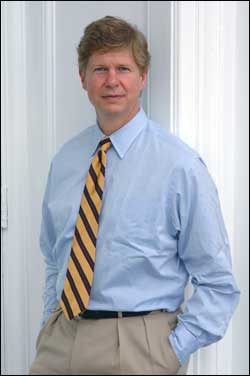
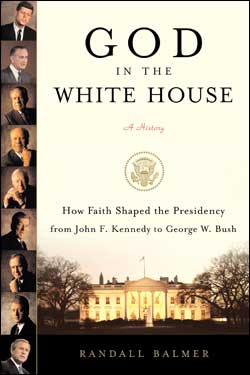
Randall Balmer, a professor of American religious history at Barnard College and editor-at-large for Christianity Today, tries to answer this question in his 12th book, God in the White House: A History: How Faith Shaped the Presidency from John F. Kennedy to George W. Bush.

Balmer, who describes himself as a left-leaning evangelical Christian — his last book was Thy Kingdom Come: How the Religious Right Distorts the Faith and Threatens America, talked with InTheFray about the role of religion in presidential politics, the “abortion myth” in the rise of the Religious Right, and why religion is best left “on the margins of society, not the councils of power.”


Interviewer: Jonathan Mandell
Interviewee: Randall Balmer

God in the White House ends before the 2008 presidential campaign begins. What role has religion played in this campaign, and how does it differ from previous presidential campaigns?

The most intriguing element of the 2008 presidential primaries was the attempt by Mitt Romney to become the Republican nominee. He’s not the first Mormon to run for the White House, of course. Joseph Smith, the founder of Mormonism, made a run in 1844, though it was cut short by his assassination at the Carthage jail. And Orrin Hatch, Republican senator from Utah, made a brief try in the 2000 campaign season. The most remarkable precedent, however, was Mitt Romney’s father, George, the governor of Michigan, who was the early favorite in the Republican primaries in 1968.

I happened to be living in Michigan at the time, and I have no recollection whatsoever that George Romney’s Mormonism was an issue in 1968. His candidacy eventually imploded when he professed to have been “brainwashed” about Vietnam. In the course of doing research for God in the White House, I looked back at the 1968 campaign to see if somehow I’d missed it, but it simply had not been an issue.

But 40 years later, it became clear — to everyone but Mitt Romney, it seems — that the former governor of Massachusetts would not be given a pass on his Mormon faith, unlike his father.

Why do you think there was such a difference in the reaction to George Romney’s and to Mitt Romney’s Mormonism?

What I call the “Kennedy paradigm” of voter indifference toward a candidate’s faith prevailed in American presidential politics from the 1960 campaign through the 1972 campaign. But then Nixon’s corruptions set the stage for Jimmy Carter’s out-of-nowhere run for the presidency in 1976.

I also think, frankly, that Mitt Romney played it all wrong. He went to the George Bush Library in College Station, Texas to give what reporters were calling his “JFK speech.” But Romney was handicapped in that the two central arguments that John Kennedy used in his 1960 speech to the Greater Houston Ministerial Association were unavailable to him. In that memorable address, Kennedy unequivocally affirmed his support for the separation of church and state, and he renounced all government support for religious schools. Because Romney was pandering after the votes of the Religious Right, however, whose leaders believe in neither of those foundational principles, Kennedy’s arguments wouldn’t play.

I think that a better model for Romney would have been Joe Lieberman, not JFK. When Al Gore named Lieberman to the ticket in 2000, he faced a flurry of questions about his Judaism. Was he Orthodox or merely observant? Why didn’t he campaign on the Sabbath? Unlike Romney, who grew testy whenever anyone asked him about his faith — “I’m not a theologian; I don’t speak for my church” — Lieberman faced those questions directly and without evasion.

What did you make of the surprising success of Mike Huckabee, a candidate whose day job had been as a Baptist preacher? How unprecedented was this?

I’ve tried to determine the last time an ordained minister made it this far in the primaries. It was, I believe, Jesse Jackson in 1984. Pat Robertson made a run at the Republican nomination in 1988, but he resigned his ordination just before announcing his candidacy.

But Jackson didn’t emphasize his religion, and Robertson didn’t have the electoral success that Huckabee had for at least part of the primary season. When is the last time we had such a successful candidate who connected the dots between his religion and his politics in such boldface?

The last time, I think, was Jimmy Carter. I make the case that Carter was the only president we’ve had in the last half century who actually sought to govern according to the principles he articulated in his campaign for the White House.

You also point to the irony that his presidency led, in a way, to the rise of what you call the Religious Right — the re-introduction of evangelicals into worldly affairs after more or less hibernating for 50 years after the Scopes evolution trial of the 1920s.

One of the great paradoxes of presidential politics over the last half century is that evangelical Christians, who helped propel Jimmy Carter to the presidency in 1976, turned dramatically against him four years later.

What became clear to me, as I was working through the archives at the Carter Center, is that Carter himself was utterly blindsided by the Religious Right in the run-up to the 1980 election. He didn’t see it coming. When he finally hired a religious-affairs liaison — a Baptist minister — it was really too late.

You document what you call the “abortion myth” in the birth of the Religious Right.

To hear the leaders of the Religious Right tell it now, they became politically active in direct response to the Supreme Court’s Roe v. Wade decision on abortion, which was handed down on January 22, 1973. According to this scenario, these hitherto apolitical ministers reluctantly entered the political fray out of their own moral outrage over the Roe decision. These leaders of the Religious Right even characterize themselves as the so-called “new abolitionists,” in an effort to equate their opposition to abortion to the opposition of antebellum evangelicals to the scourge of slavery.

The truth, however, is rather more complicated. The Southern Baptist Convention, hardly a bastion of liberalism, passed a resolution at its gathering in St. Louis in 1971, calling for the legalization of abortion — a resolution reaffirmed in 1974 and again in 1976. When the Roe decision was handed down, several evangelicals, including the redoubtable fundamentalist W. A. Criswell of First Baptist Church in Dallas, applauded the ruling as marking an appropriate distinction between personal morality and public policy.

I call this the “abortion myth” because abortion had little — almost nothing — to do with the emergence of the Religious Right. The Religious Right did indeed arise in response to a court decision, but it was not Roe v. Wade. It was a lower court ruling in 1971 called Green v. Connolly, which upheld the Internal Revenue Service [IRS] in its ruling that any organization that engaged in racial segregation or discrimination was not, by definition, a charitable organization, and therefore had no claim to tax-exempt status. In the ensuing years, the IRS sought to enforce that ruling, and acted against various private “segregation academies” (schools founded in response to the Brown vs. Board of Education Supreme Court decision of 1954 that ordered public schools desegregated). The IRS also targeted a fundamentalist school in Greenville, South Carolina, called Bob Jones University, and it was this action that triggered the evangelical activism that became known as the Religious Right. Only later, in preparation for the 1980 presidential election was abortion cobbled into the political agenda of the Religious Right.

Your book makes clear that evangelical, Baptist, fundamentalist, Christian Right, and Religious Right are not all synonyms, as they may appear to be to the outsider. Could you explain the distinctions?

By no means are all evangelicals part of the Religious Right. It’s probably fair to say that a plurality, perhaps even a majority, of evangelicals list toward the right. But even that is changing, especially among younger evangelicals, who are increasingly concerned about such issues as global warming, the war in Iraq, and this administration’s persistent, systematic use of torture. They care little about issues of sexual identity, and they’ve grown weary of what passes for debate over the abortion issue.

As for nomenclature, I prefer the term “Religious Right” to “Christian Right” or other variants. Frankly, as a Christian, I don’t find much that I would identify as “Christian” in the actions and agenda of the Religious Right.

Are Baptists by definition evangelicals?

Historically, it’s probably fair to say that all Baptists were evangelicals in that they believed in the centrality of religious conversion, the inspiration of the Bible, and the mandate of evangelism. Today, however, some Baptist groups are more theologically liberal and would probably resist — even resent — being called evangelical. Having said that, I would argue that the largest Baptist denomination — the Southern Baptist Convention — is thoroughly evangelical.

You say that the reason why abortion and homosexuality became the focus of the Religious Right is that they could no longer focus on divorce.

When the leaders of the Religious Right embraced Ronald Reagan — a divorced and remarried man — as their political savior in 1980, they dropped almost immediately their long-held objections to divorce. Not that they began advocating divorce; I’m not suggesting that at all. But I went through the pages of Christianity Today, the flagship magazine of evangelicalism, to chart the frequency of articles condemning divorce in the 1970s and again in the 1980s. I forget the numbers, but the denunciations of divorce in the pages of Christianity Today dropped virtually out of sight after 1980.

You seem to write mostly about evangelical Christians when discussing the interplay between religion and politics. Are they by far the largest factor in the heightened mix? Where, for example, do Catholics — who reportedly make up 24 percent of the U.S. population — figure in this interplay?

The leaders of the Religious Right have been very effective in cooperating with conservative Roman Catholics on political issues, especially abortion. This has led to some political successes, although I don’t think the Religious Right has much to show for its activism over the past several decades, aside from judicial appointments. One of the things that I find fascinating is the extent to which politically conservative evangelicals have relied on conservative Catholics for their political ideology and their ability to bring intellectual heft to the Religious Right. It strikes me as no accident that George W. Bush’s appointments to the Supreme Court have been conservative Roman Catholics. That suggests to me that the Religious Right itself simply doesn’t have a strong “bench” of ideologues, so they look to the Catholics.

The cooperation between conservative Catholics and politically conservative evangelicals, however, has had at least one happy effect: The level of suspicion between evangelicals and Catholics has dissipated considerably. When I was growing up as an evangelical, for example, my parents told me that I would be disowned if I married a Catholic. Those prejudices may not have disappeared, but they have abated considerably.

In God in the White House, you write: “My reading of American religious history suggests that religion always functions best from the margins of society, not in the councils of power.” What do you see as the major pros and cons to the heightened attention to religion in politics in the U.S. as a whole and, in particular, in presidential politics?

I personally have no objection to quizzing presidential candidates about their faith. The problem lies more with the voters than with the politicians, who, after all, merely parrot back to us what they think we want to hear. So if we ask candidates about their faith, let’s first of all listen to the answers. More important, let’s interrogate those claims.

Suppose, for example, that when George W. Bush declared that Jesus was his favorite philosopher on the eve of the 2000 Iowa precinct caucuses, someone had asked: “Governor Bush, Jesus, your favorite philosopher, calls on his followers to be peacemakers, to love their enemies, and to turn the other cheek. How will that affect your foreign policy, especially in the event of, say, an attack on the United States?”

Or: “Governor Bush, Jesus expressed concerned for the tiniest sparrow. Will that sentiment find any resonance in your environmental policies?”

I suspect that if we, the voters, began seriously to interrogate the faith claims and the religious rhetoric of our politicians, one of two things would happen. Either they would seek to live up to those claims — as no president over the last half century other than Jimmy Carter has done — or they would cease making empty statements that are utterly devoid of content.


Muslim/Mormon

Best of In The Fray 2008. Caught between heritage and faith.

I remember sitting in Wisconsin while the coup in Iran was being broadcast on television in February 1979. Bearded clerics and their black-clad disciples had their fists and banners in the air, while they forced the Shah into exile and the country into a Muslim theocracy where politics and religion became married. I was just nine years old, but I remember thinking, “Don’t hurt my people.”

I was born in Iran, sometime in December 1969. Only days after my birth, I was left on the doorstep of a police station in Gorgan. The authorities took me to the capital, Tehran, and put me in a government-run orphanage that had been founded by Empress Farah Pahlavi, the wife of Shah Mohammed Reza Pahlavi.

Then one day in 1976, I was pulled out of school and driven back to the orphanage, where I met a short dark-haired woman wearing a rain coat and glasses. She spoke a strange language that made me giggle. Later she would tell me that I reminded her so much of her son David when he was that age, that she immediately knew I was the one she wanted. The Holy Spirit had guided her to me, she said. Indeed, she believed the Holy Spirit had led the family to Iran just so they could find me.

At the time, the family was living temporarily in the industrial seaport town of Bandar-e ’Abbas. She was teaching English to adult Iranians, while her husband was working for a British company that built ships for the Iranian navy.

So I was adopted — into a family of Mormons.

The family I joined was certainly American. For much of my childhood, my new father, mother, two older sisters, three older brothers, and I lived in a two-story Victorian house in Sturgeon Bay, Wisconsin, a lazy, beautiful town of shipbuilders and tourists. I learned to play Tag and Kick the Can, helped mow the lawn, participated in Little League games, sailed, biked, and went to garage sales and barbeques.

When I got older, I played football, sometimes as a running back, but mostly in the “left-back” position — as in “left back on the bench.” I watched our 13-inch black-and-white television like any other American kid, but maybe with a bit more attention to events like the Iranian Revolution.

But even more than being an American, I was a Mormon. At eight years old, I was baptized into the church. At 12, I was ordained a deacon, which meant I could pass the bread and water for the sacrament to the congregation. At 14, I was ordained a teacher. At 16, I became a priest, which meant I could say the prayer on the bread and water. At 18, I was made an elder.

And then I went on my mission for which my parents had been saving up money in a piggy bank since my baptism. I remember receiving the letter from the Salt Lake City, Utah headquarters of the Church of Jesus Christ of Latter-day Saints, informing me where I would be serving God.

I opened the letter, hands shaking and afraid to read the words, with thoughts of an exotic mission to some far-off place in South America or a French-speaking part of Africa. I had taken French and Spanish in high school and put those languages on my application.

Then I learned where I was going, the one place I would have never imagined: “You have been called to serve in the Nevada, Las Vegas Mission.” I spent two years in Sin City knocking door to door, baptizing and participating in the baptism of 24 adults and children.

With the religion came attitudes that seemed like bedrock principles. I learned that abortion is an abomination, divorce is a disgrace, and Democrats are just wrong about nearly everything.

After my mission I did what was, once again, expected of me: I got married.

Looking back at it now, I remember having doubts about my faith as young as 12, when I become a deacon. I felt like a fake at church, and I had an urge to be a rebel. But having been adopted, my fear of being rejected by my family was stronger than my need to question them or the church, so I did what I was supposed to.

But one event began to turn this upside down. My wife and I got a divorce. Under the Mormon faith, she was to write a letter to the church to obtain permission for our divorce and then send me a copy for my approval and signature. (Being the man, I didn’t have to write my own letter.)

It wasn’t until I started conducting research on Iranian Americans for my master’s thesis that I was struck by the parallels between the life of the Muslim I would have been in Iran and that of the Mormon I became in America.

Both religions were founded by men who suddenly had a vision of God — one god being “Allah,” the other being the “Heavenly Father.”

While both cultures revere women in their roles as mothers and emphasize the strong bonds of family, both are also male-dominated and oppressive to women on many levels.

Women in Orthodox Muslim culture have to wear a veil to cover their bodies; women in Mormon culture have to dress conservatively. Divorce is frowned upon by both cultures, and if divorce is necessary, the burden of proof is on the woman. Men are in positions of power in both religions — they are imams and clerics in Islam, and prophets and general authorities in Mormonism.

My study of these two religions led me to look at other religions. Then, one sunny afternoon in June 2002, I had a sudden moment of clarity while reading a passage in an English translation of the Quran that read just like one of the 10 commandments of the Bible. If the Quran and the Bible and the Book of Mormon and the Torah all have the same “moral guidelines,” why does each religion think it better than the others? What is the basis for centuries of religious wars, the clash of civilizations, the modern threats of terrorism, and religious-inspired nuclear annihilation?

I found myself feeling both disappointed and relieved. I was disappointed that it had taken me so long to understand what now seems self-evident to me, and relieved that I suddenly, after all these years, realized it was okay to question.

In looking at other religions and their political associations, I recognized the fears instilled in both religions. In Iran, to turn away from Islam is to deny Allah, for which punishment might equate to death. In Mormonism, to deny the “one and only true church” might lead to a punishment of loss of a social network and friends.

I often fight between my own belief of what should be and what I was taught: the hell of not following what I questioned about the church versus an underlying fear of going to “hell” when I had been taught the “truth.” I was fully inculcated with the fears, teachings, and beliefs of Mormonism, and it is difficult to deny that while a child can leave a church, the church may not leave the child.

To answer my own questions, I have looked elsewhere for a foundation of beliefs that do not resonate with such orthodox theocracies. I have found that my ultimate truth is the blending of all religions’ positive teachings and the forsaking of their fear tactics. In short, to teach love is my ultimate truth.


Taking the long view on religion and politics

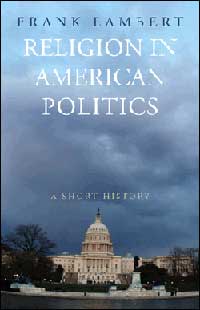
A look at Religion in American Politics: A Short History by Frank Lambert.


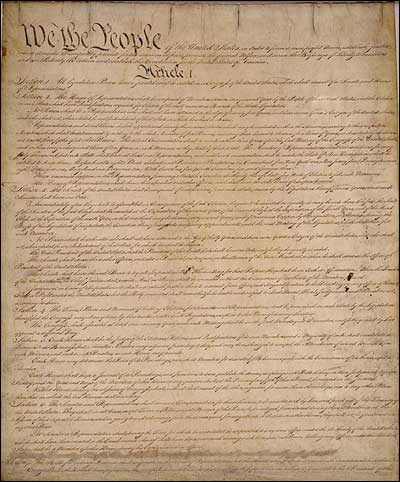
During the Constitutional Convention of 1787, Charles Pinckney of South Carolina advocated the addition of the following phrase: “but no religious test shall ever be required as a qualification to any office or public trust under the authority of the U. States,” prompting a brief but intense examination of the role of faith in politics from the earliest days of American history. Those against the phrase believed that Enlightenment liberalism negated the need for such a test. Advocates of the phrase believed the requirement of a federal ban on religious tests would preserve the tests already practiced by the states at the time.

Fresh from their own contentious state conventions, the delegates sought to avoid the subject of religion in the Constitution. They trusted that the practice of religious freedom in general would prevent any one sect from dominating all others and casting undue influence over politics.

The honeymoon of religion-free politics was short-lived, however. Just three years later, a de facto religious test dominated the 1800 presidential election. Thomas Jefferson believed firmly in a private faith, between a man and his God. John Adams advocated that faith belonged in the public sphere, with the ultimate goal of preserving morality. Adams explained his loss of the presidency by reasoning that Jefferson’s camp framed the election in terms of religious liberty or religious orthodoxy; given those options, Adams, years later, didn’t fault the American people for choosing religious freedom over the risk of the establishment of a national faith.

Now, more than 200 years later, much has been made of religion in this current election cycle. Despite the constitutional separation of church and state, the two have in fact had a long, convoluted, intertwined history, as explored by Frank Lambert in his new book, Religion in American Politics: A Short History. While no official faith-based litmus test has ever been established for those running for elected office, Lambert, a history professor at Purdue University, posits that the influence of religion is, and has been, both foreground and background in American politics.

In America’s early days, the Founding Fathers put their trust in the idea that religious pluralism would defend against any one sect or faith becoming too powerful. This was despite the fact that vying factions argued either that it was folly for the young nation not to acknowledge the work of providence in its creation, or, in order to avoid widespread religious conflict and oppression, that it was critical that no religion be nationally established. The resulting lack of federal — and later state — support mobilized religious groups to work within the political system to achieve their goals.

The role of religion in American life, and politics in particular, has resurfaced numerous times throughout American history. In his book, Lambert examines the roots, evolution, and developments of this relationship through the days of westward expansion, the rise of industrialism, the Gilded Age, post World War II, the rise of the conservative-leaning Moral Majority of the 1980s, and the dynamic between the Religious Right and the Religious Left as we approach the 2008 election.

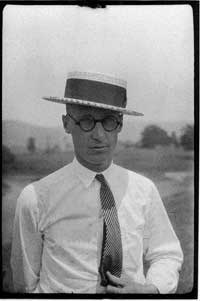
Time and time again, the issue of faith has shaped and influenced American history. In the early 1800s, congressional approval of Sunday mail delivery was seen as a choice between the obligation of a Christian nation to keep the Sabbath holy and the federal government’s obligation to provide a national economy with the infrastructure necessary for growth. The Scopes trial of 1925 crystallized the conflict between science and religion, as John Scopes stood trial for violating the law that prohibited the teaching of Darwinism in public schools. Meanwhile, religious groups of the day resisted the growing influence of scientific thought on the basic tenets of faith — for example, the view of the Bible as a historical document instead of God’s literal word, or the use of technology in the form of radio with the growing influence of orators who celebrated their faith and motivated their followers.

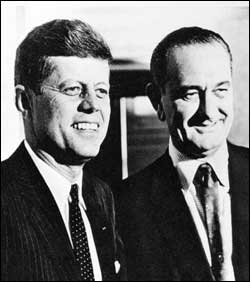
In the 1960 election cycle, voters rejected an unofficial religious test in the Nixon/Kennedy race, merely requiring that their candidates reflect general Protestant heritage and values — a civil religion — allowing for the election of the Catholic Kennedy. Twenty years later, born-again Christian President Jimmy Carter, seen as a man of character and values, and who was elected in the wake of the turbulent Nixon administration, was repudiated by evangelical supporters after he failed to align his administration with their goals. This was another watershed moment at the crossroads of religion and politics that contributed to the dominance of Moral Majority in the American political landscape of the 1980s. It also contributed later to the election of George W. Bush, a candidate who, in effect, responded affirmatively to an unspoken religious test, an assurance to conservative Christians and evangelicals that his goals and theirs were aligned.

Lambert examines the centuries-long evolution of the relationship between politics and religion, and its ebb and flow in response to social, cultural, and economic concerns. His work shows that the arguments made by the Founding Fathers as a basis for their foregoing a religious litmus test, that religious conflict would jeopardize the “more perfect Union” that they’d worked so hard to attain, show an eerie presentiment. As the political right and left ratchet up their rhetoric in the run up to the 2008 presidential election, there is a divisive religious undercurrent that remains.

In 2007, the signs were clear that the unofficial religious test still existed as mainstream media reported on voters’ concern about Mitt Romney’s Mormon faith. He stated in a December 2007 speech at the George H.W. Bush Presidential Library that “Our Constitution was made for a moral and religious people.” And in early 2008, Barack Obama, who had been quoted in 2006 as saying that it is a “mistake when we fail to acknowledge the power of faith in the lives of the American people,” was forced to defend his membership at Trinity United Church after the pastor of the church was reported to have made racially divisive statements.

The eight major eras Lambert chooses to examine more closely in his book reflect times of great change and opportunity in America — economically, politically, and socially — which is expressed in both politics and religion. The book weakens slightly in the middle, but is buttressed by a very strong beginning and ending.

Perhaps Lambert’s most successful achievement with his book is the correction of the perception that this phenomenon is anything new, or that it will go away any time soon. The book is light on suggestions for a resolution; but Lambert’s framing of his discussions so firmly in American history seems to suggest that only by reigning in all sides, in keeping with the Founding Fathers’ original intentions, can the tide of increasing vitriol be stemmed.


Is there a religious test in politics?

Responses from our contributors and readers.

We asked contributors and readers to answer this question, which refers to the U.S. Constitution ban on a “religious test” to hold public office in America. The question could be answered as narrowly focused or as generally as desired, touching on the interplay between religion and politics in American society — what’s good and what’s bad about it.

Here are their responses. Join in and add your comments and opinions. What do you think?


Larry Jaffe , writer and Poet Laureate for Youth for Human Rights
(Los Angeles, California)

From the United States Constitution, Article VI, section 3:

“The Senators and Representatives before mentioned, and the members of the several state legislatures, and all executive and judicial officers, both of the United States and of the several states, shall be bound by oath or affirmation, to support this Constitution; but no religious test shall ever be required as a qualification to any office or public trust under the United States.”

In my humble opinion, we have lost the meaning of religion, and those who “swear” by their faith believe more in dogma than the spirit. Thus, “religious test” would not even be an accurate statement given today’s standards. It is not religion we see mixed with politics, but dogma. It is not appreciation of God or spirit, but a belief system one must adhere to in order to belong to the “winning” side. Religion, in the truest sense of the word, is a set of beliefs concerning the cause, nature, and purpose of the universe, and often containing a moral code governing the conduct of human affairs. Politics of late, and perhaps always, certainly lacks moral code; simply witness the latest presidential primaries.

Furthermore, religious tolerance, perhaps one of the most important aspects of being religious, is all but abandoned. It is important to treat another’s religion as you wish yours to be treated. We have seen that when religious dogma mixes with politics, we lose all sense of religion.

Ryan Fuchs, mechanical engineer, blogger (Minneapolis, Minnesota)

The religious views (or lack thereof) should be no more relevant to their office than their sex or the color of their skin. The drafters of our Constitution understood this and bothered to state exactly that quite clearly. Many voters, however, are happy to be comforted with the knowledge that someone thinks as they do beyond the pertinent issues. In order to gain sway with this group, a candidate will advertise their religious beliefs. This has become the norm in elections of late. So much so that a growing number of people think the Constitution should be altered to make faith in a god necessary. I think that’s as silly as the desire to teach “creationism” in public schools. You’re free to have faith in whatever you choose. So am I. And so is anyone running for a public office.

John Amen , writer, musician, and founder and editor of The Pedestal Magazine (Charlotte, North Carolina)

Well, in theory politics and religion aren’t supposed to mix; i.e., a politician ought to be able to run a successful campaign regardless of his or her religious leanings. But we know that isn’t the case in America, at least currently. Bottom line, you’re not going to get elected to any significant office in America unless you espouse Christian principles. Clearly this is the case as far as getting the Republican vote but, in the end, I think it’s true with the Democratic vote, too. If you’re not a “Christian,” you’re fundamentally “the other,” regardless of all the PC talk, etc. This might change at some point. I mean, we’re looking at having a woman or African American in office, so that’s huge progress. Perhaps we’ll experience progress, too, in the relationship between politics and religion. But right now, if you espouse too loudly anything that departs from what’s considered essentially Christian, you’re probably not going to get very far.

Shawn Sturgeon, writer, author of Either/Ur (The River City Poetry Series) (Denver, Colorado)

There has always been an unofficial religious test for political candidates in the United States, since in the broadest terms, religion is concerned with the morals and values of a community. The question that challenges each generation of Americans is this: Who will write the test? We find the nature of the conflict over religion in American political life in two contradictory mottos engraved on the money we spend daily — “In God We Trust” and “E Pluribus Unum.” The first motto represents one way of deciding who writes the test: Let a single group with a sincere but narrow ideology determine the candidate who best represents “the good life” as they understand it. The second motto represents another approach: Respect differences of opinion and practice while achieving a consensus that “the best life” excludes no one. Personally, I favor the latter approach, but what does a poet know? Now I need to get back to chasing beaches and flowers.

Pris Campbell, writer , clinical psychologist (West Palm Beach, Florida)

If we’re talking theoretically, yes, of course they should. A candidate should be judged on his or her qualifications, alone. That’s not the way voters’ minds work, though, and sometimes with good reason. It’s only human nature to look at a candidate’s beliefs/religious associations, since we feel, at some level, those two things could play a role in political decisions. Take the flap with Obama’s minister, for example. When I saw the videos of him denigrating white people, calling us the U.S. of KKK, saying that 9/11 was a punishment … well, to know that this man was like family to Obama floored me. It also dramatically increased my leeriness about his potential presidency. A white minister could never be televised making racial statements and not damage a close political friend in the process. Obama has only said that his friend had the right to say what he thinks (which he does), but he’s not gone further, as of this writing, to say he disagrees adamantly with the anti-white statements.

The flap with Obama’s minister is even worse than when John Kennedy was running for office. The outcry was “Do we want the Pope to run our county?” I still remember that campaign. People were terrified over that issue. Now, if a Catholic ran, it would be a moot point. I wonder how a candidate who was close friends with a TV evangelist telling us he’s been called by God to collect money from little old ladies living on tiny SS checks would fare? Bottom line, beware of your bedfellows. Religious or not, they may kick you in the kneecaps when you least expect it.

David Paskey, graphic designer and songwriter (Chicago, Illinois)

I am not a fan of labels, so while I am reluctant to call myself a “Christian,” I would say that I aim to be a follower of Christ. My beliefs are not just an area of my life; I see them as something that runs through all of the parts of my life and the decisions I make. But I think it is important that a candidate realize that she/he would be serving the whole of the populace, those of many backgrounds and beliefs, including the belief in no God. So it is important to make choices that best serve the basic human rights and needs of the populace, while using one’s personal beliefs as a motivator to continually seek what is best for the public. I do not think it right to require a person to adhere to any belief in order to hold office. However, I feel it is human nature that people tend to elect a person who seems to hold their common interests and beliefs at heart, whether those beliefs be Christianity, Islam, Agnosticism, Scientific Inquiry, etc. Who the “right person for the job” is seems inextricably tied to the voters’ own beliefs. But once elected, it is important to remember that you serve the whole of society, not just the people who believe as you do or elected you.

Barton Smock, InTheFray contributor (Columbus, Ohio)

Is there a “religious test” in politics? One that can be passed, anyway? I don’t think so.  Voters have their pencils, and boxes that mark a soul. And politicians sharpen those pencils accordingly. If a test exists, it is merely of a need to get the right students in the classroom. I don’t doubt that many in office hold personal, strong beliefs of moral content in regards to religion, and vice versa, but I am not one to believe that these personal beliefs are on display in full. They are parsed and directed. And when they are on display in full, when they are not personally exclusive, they are uncompromising and damaging. See the current administration. And, in a possible misquoting of a William Stafford poem, the Aztec design has God in a pea that is rolling out of the picture. We say god is everywhere, but how did he get out of the pea? What I believe has been given to me, mostly, by others. So, as humans, I think it is our responsibility to remain human.  The internal is more external than we think. If one wants to name it god, or post it on the refrigerator like so many totems, so be it. God should be in the picture, so long as he remains in the pea.

Joel Lowenstein (Charlotte, North Carolina)

I believe strongly in the First Amendment’s separation of church and state. This separation is the fundamental difference between a theocracy and a democracy. The question of whether we are, as a people, to follow the dictates of conscience or those of organized religion can be a contentious one. We must only look at history to see the failures of governing from a religious pulpit. The puritans left England to escape religious persecution; at that time the government and the church were practically one and the same. The safeguards written into the First Amendment were put there to protect the citizenry from religious intolerance, to prevent religious prejudice and persecution.   There should be no political religious test, lest we fall prey to religious zealotry or xenophobes and are all decreed heretics.

Joel Lowenstein is a military veteran who was conscripted into the service during the Viet Nam era; he was honorably discharged from the service in 1972. He resides with his wife and two daughters in Charlotte, North Carolina, where he currently is the owner and president of a for-hire maintenance repair, home improvement corporation.


Views on politics and religion from around the web

While the intersection of politics and religion is the theme of this month’s InTheFray, a quick look around the Internet makes it clear that we’re not the only ones talking, thinking, and writing about it.

ReligionLink

“ReligionLink is produced by the Religion Newswriters Foundation, the educational arm of the Religion Newswriters Association (RNA). It is funded by a grant from the Pew Charitable Trusts. RNA is an independent, nonpartisan organization of journalists, who cover religion for the secular media.”

Religionsource

“The American Academy of Religion operates Religionsource, which is supported by Lilly Endowment Inc. and The Pew Charitable Trusts. Religionsource provides journalists with prompt referrals to scholars who can serve as sources on virtually any topic related to religion.”

The Roundtable on Religion & Social Welfare Policy

“Formed in January 2002 with a grant from The Pew Charitable Trusts to the Research Foundation of the State University of New York, the Roundtable on Religion and Social Welfare Policy was created: ‘To engage and inform government, religious and civic leaders about the role of faith-based organizations in our social welfare system by means of nonpartisan, evidence-based discussions on the potential and pitfalls of such involvement.’”

Pew Forum on Religion & Public Life

“The Pew Forum on Religion & Public Life, launched in 2001, seeks to promote a deeper understanding of issues at the intersection of religion and public affairs.”


“Religion & Politics,” The Pew Forum

“The United States has a long tradition of separating church from state, yet a powerful inclination to mix religion and politics. Throughout our nation’s history, great political and social movements — from abolition to women’s suffrage to civil rights to today’s struggles over abortion and gay marriage — have drawn upon religious institutions for moral authority, inspirational leadership and organizational muscle.”

“According to an August 2007 poll by the Pew Forum and the Pew Research Center for the People & the Press, the vast majority (69%) of Americans agree that it is important for a president to have strong religious beliefs. However, a sizable majority (63%) opposes churches endorsing candidates during election campaigns. Just 28% say churches should come out in favor of candidates, but that number has grown slightly since 2002 when only 22% held this opinion.”

“‘First Freedom First’ Offers 10 Church-State Questions to Ask the Candidates,” Americans United for Separation of Church and State, February 2008

“This year’s crop of presidential hopefuls has talked about where they go to church, how they interpret the Bible, what they pray for and other spiritual matters.

“But where do they stand on crucial religious freedom issues like ‘faith-based’ initiatives, ‘intelligent design’ and church-based politicking?”

Spirituality

A blog hosted by Utne magazine with a regular roundup of faith-based topics.


Thomas Jefferson’s letter to the Danbury Baptists, January 1, 1802

“Believing with you that religion is a matter which lies solely between Man & his God, that he owes account to none other for his faith or his worship, that the legitimate powers of government reach actions only, & not opinions, I contemplate with sovereign reverence that act of the whole American people which declared that their legislature should “make no law respecting an establishment of religion, or prohibiting the free exercise thereof,” thus building a wall of separation between Church & State.”

One Vote Under God: The Role of Faith in the 2008 Presidential Campaign

“One Vote Under God attempts to provide a comprehensive, interactive portrait of the ways in which faith has been invoked in the race for the White House in 2008.”


“Who Would Jesus Vote For?” The Nation, March 24, 2008

“In a time when the much-ballyhooed evangelical political machine shows unmistakable signs of flying apart and scattering in uncertain directions, here was a momentary return to the old order.”

“Obama and the Bigots,” Nicholas D. Kristof, New York Times, March 9, 2008

“Yet the most monstrous bigotry in this election isn’t about either race or sex. It’s about religion.”

“Can Religion Lead to Peace?” Marshall Breger, Moment Magazine, October/November 2007

“Like the dog that didn’t bark, the absence of religious content speaks volumes about the assumptions that drive conventional diplomatic wisdom in Washington. Foreign policy professionals instinctively recoil at the notion that religion can or should play an important role in foreign policy. They see religion as a ‘private matter,’ according to Tom Farr, former director of the State Department’s office of international religious freedom, ‘properly beyond the bounds of policy analysis and action.’”

God-o-Meter, Beliefnet.com in partnership with Time Magazine

“The God-o-Meter (pronounced Gah-DOM-meter) scientifically measures factors such as rate of God-talk, effectiveness — saying God wants a capital gains tax cut doesn’t guarantee a high rating — and other top-secret criteria (Actually, the adjustment criteria are here). Click a candidate’s head to get his or her latest God-o-Meter reading and blog post.”

“Religion as a political weapon,” David Domke, USAToday, December 3, 2007

“Though the Founders sought to avoid the communion between politics and faith, presidents of the past three decades have thought, and acted, otherwise. Carter ran proudly as a Southern Baptist but honored the church-state line while in office. But beginning with Reagan, that distinct line began to fade.”

Mitt Romney in a speech at the George Bush Presidential Library, December 6, 2007

“There are some who would have a presidential candidate describe and explain his church’s distinctive doctrines. To do so would enable the very religious test the founders prohibited in the Constitution. No candidate should become the spokesman for his faith. For if he becomes president he will need the prayers of the people of all faiths.”

“Politicians Can’t Serve Two Masters,” Randall Balmer, WashingtonPost.com, February 22, 2008

“I see precious little evidence that any of the candidate’s declarations of faith — all of them claim to be Christians — have a direct impact on their policies.”

“Faith & Politics: After the Religious Right,” E.J. Dionne, Jr., Commonweal, February 15, 2008

“Notice what is happening here: the new politics of religion is not about driving religion out of the public square. It is about rethinking, again, religion’s public role. It is the latest corrective in our ongoing national debate over religious liberty, not a repudiation of religion’s social and political role.”

“Reclaiming God,” Mimi Hanaoka, InTheFray, June 25, 2005

“With 63 percent of church-going Americans voting Republican, it seems self-evident that the vocal and visible Christian right would enjoy a monopoly on political influence. Now Patrick Mrotek has decided to pit faith against faith and has founded what he hopes will be the voice of the Christian left: the Christian Alliance for Progress .”

“President Bush’s God,” Mimi Hanaoka, InTheFray, May 22, 2006

“‘I worked for two presidents who were men of faith, and they did not make their religious views part of American policy.’”

Eleanor Roosevelt on religion, InTheFray, November 30, 2006

“…the domination of education or of government by any one particular religious faith is never a happy arrangement for the people.”


The Founders’ attitudes toward religion, by Jill Lepore in The New Yorker
"Far from establishing a religion, the Constitution doesn’t even mention God. At a time when all but two states required religious test for office, the Constitution prohibited them. At a time when most states still had an official religion, the Bill of Rights forbade the federal government from establishing one. The Constitution and the Bill of Rights were controversial when they were written and they’ve been controversial ever since…."


The Black Church Arrives on America’s Doorstep

Best of In The Fray 2008. What Obama’s race speech didn’t acknowledge.

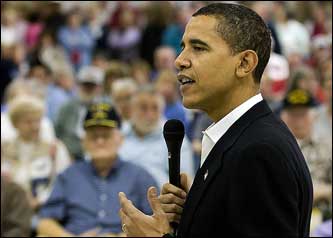
Presidential candidate, Senator Barack Obama (D-IL) makes a stop at the Iowa Veterans Home in Marshalltown, Iowa.

Those who personally witnessed Barack Obama’s Philadelphia speech on race were riveted by what many consider to be an address of historic importance. Given the sobering nature of the moment, ovations from the Constitution Center audience were few and far between. However, at least one remark by Obama drew applause: It was his recalling of the well-worn saying that the “most segregated hour in American life occurs on Sunday morning.”

This truism pushes out beyond the pews and continues to be played out long after Obama’s speech ended. Whether critical or laudatory of Obama’s words, the predominantly white editorial voices in the mainstream press largely agreed that Reverend Jeremiah Wright’s comments were scandalous, racist, and far afield of sober public opinion.

On the other hand, many of my fellow black folk and people of color understand why Obama had to distance himself from Wright’s remarks, but they don’t necessarily disagree with those remarks themselves. (In the same way, many people of color understand that Michelle Obama’s comments about being proud of the United States for the first time in her life were politically clumsy, but not the least bit unreasonable.) They might not openly discuss this around an integrated office watercooler, but such expressions of sympathy with Wright’s point of view can be found in side conversations at the office, inside people’s homes, in Internet chat rooms, and in the barber shops and hair salons that Obama references in his speech. And despite Obama’s claims to the contrary, this conversation is happening across generational lines, among the embittered and the upbeat alike.

Even the comments by Wright considered to be the most incendiary — the idea that the violence directed against Americans on September 11, 2001, was karmic comeuppance for America’s legacy of imperialism and violence abroad — resonate widely in the black community and in houses of faith. Just like Obama condemned Wright’s remarks, Elijah Muhammad sanctioned Nation of Islam Minister Malcolm X because he made the “chickens coming home to roost” comments about the assassination of John F. Kennedy, comments that also tread on what is considered to be sacred political ground.

Reverend Wright is hardly a fringe figure on the American religious scene. The church where he pastored until recently, the Trinity United Church of Christ, has over 10,000 members. The reason Wright’s views figure so prominently at Trinity and countless other black churches is because the black church, going back to the time of slavery, has always been the place where black folks have indulged in conversations considered subversive.

Furthermore, Reverend Wright is not unlike countless other kente cloth–clad ministers throughout the country with sizable followings who are critical of everything from right-wing politics to hip-hop music. These messages are inseparable from a promotion of self-determination, self-help, and self-love, which some might dismiss as Black Nationalism.

In the same way the black church incubated so much political activity during the civil rights movement, Trinity United Church of Christ was compelling enough to Barack Obama that he was a member for 20 years and gave tens of thousands of dollars to it. For politically conscious black folk — particularly members of the middle class who are acutely aware of glass ceilings — their church can provide a space where racial justice is viewed in spiritual terms, a sanctuary where hard truths can be spoken and where righteous political action can be inspired. The Bible — a text that champions struggles against state power, oppression, and injustice — is the perfect trumpet of this message.

While Obama bravely waded deeply into the waters of race, he profoundly understated how much Reverend Wright speaks for a great deal of black people across the country, including Obama himself. That is something from which neither America nor candidate Obama can hide.

Mark Winston Griffith is senior fellow for economic justice at the Drum Major Institute for Public Policy.


‘Church-state’ in the United States

A time line of the interplay between religion and politics.

1620: The Mayflower Compact
Religious radicals seeking to “purify” the Church of England are run out of the country, and cross the Atlantic on a ship called the Mayflower, settling in what is now Massachusetts. Upon landing, the so-called Puritans draft the Mayflower Compact, considered the first written constitution in North America, in which they state their journey had been “undertaken for the glory of God, and advancement of the Christian faith,” and they were now forming a “civil body politic.”


1636: Roger Williams founds Providence
The Massachusetts Bay Colony banishes Roger Williams, a radical clergyman who preaches freedom of religion and the separation of church and state. Williams and a small group of followers buy land from the Indians and establish Providence, Rhode Island. A beacon of religious liberty in early America, Rhode Island is at one time the only colony not to have anti-Quaker laws on its books.

1681: William Penn founds Pennsylvania
William Penn, a Quaker convert from a wealthy English family, obtains a colonial charter and founds Pennsylvania on land purchased from Indians. The colony becomes home not only to the much-persecuted Quaker minority — subject to exile and execution elsewhere for their anti-authoritarian and nonviolent views — but also to a wide range of other religious groups unwelcome in other colonies. Penn drafts a colonial constitution far ahead of its time, the Frame of Government, which codifies principles of religious liberty and the balancing of power across different branches of government.

1779: Virgina Statute for Religious Freedom
Three years after penning the Declaration of Independence, Thomas Jefferson drafts the Virginia Statute for Religious Freedom. The statute forbids the government from dictating religious beliefs, arguing that “Almighty God hath created the mind free” and “civil rights have no dependence on our religious opinions, any more than our opinions in physics or geometry.” The Virginia General Assembly takes seven years to enact the statute, but Jefferson cites it in his epitaph as one of his three greatest achievements.

1787: Constitution
The Founding Fathers complete the Constitution, which states in Article Six that “no religious test shall ever be required as a qualification to any office or public trust under the United States.” Article Six also allows public officials to affirm, rather than swear, their support of the Constitution, a passage aimed at accommodating the Quaker minority, who were forbidden by their beliefs to swear oaths.

1791: First Amendment
Congress ratifies the Bill of Rights, whose First Amendment declares that “Congress shall make no law respecting an establishment of religion, or prohibiting the free exercise thereof.” These 16 words, the so-called establishment clause and free exercise clause, become the bedrock of constitutional law concerning the separation of church and state and the freedom of worship.


1797: Treaty of Tripoli
The U.S. Senate ratifies a treaty with Tripoli aimed at stopping Barbary pirates from terrorizing American shipping. The treaty declares that “the Government of the United States of America is not, in any sense, founded on the Christian religion.”

1802: “Separation of church and state”
Thomas Jefferson first used the phrase “building a wall of separation between church and state” to describe the First Amendment in a letter to the Danbury Baptist Association.


1827: Ezra Stiles Ely, Christian crusader
Presbyterian minister Ezra Stiles Ely preaches “The Duty of Christian Freemen to Elect Christian Rulers,” a sermon calling for the election of candidates who “know and believe the doctrines of our holy religion.” His movement amounts to a 19th-century version of the Christian Coalition, except that the early Christian political agenda focuses not on abortion or homosexuality, but on the evils of Sunday mail delivery.

1833: Last established church
The Commonwealth of Massachusetts officially rescinds support of an established church. It is the last state to do so. (At the time of the Revolution, most states had an official religion.)

1920: Prohibition
Decades of agitation by religiously inspired temperance activists culminates in the 18th Amendment, which bans the sale, manufacture, and transport of alcohol. Support for Prohibition is strongest among certain Protestant denominations, and the teetotaler cause brings together diverse constituencies, including the Women’s Christian Temperance Union, African American labor activists, and the Ku Klux Klan. Thirteen years later — after speakeasies mushroom throughout the country and illegal booze sales make gangsters rich — the amendment is repealed.

1925: The Scopes trial
John Scopes, a Tennessee high school teacher, violates a state law that bans teaching that “man has descended from a lower order of animals.” His trial unleashes a titanic struggle between supporters of creationism and evolution, who find their paladins in famed attorneys Clarence Darrow (for the defense) and William Jennings Bryan (for the prosecution). While trained chimpanzees parade outside the courthouse, inside the proceedings soon descend into a rambling discussion of what in the Bible is factual. Scopes loses and is levied a $100 fine, but the losers in the court of public opinion are Christian evangelicals, savaged by the press as “yokels” and “morons.”

1928: Catholic runs for president
Al Smith, the Democratic governor of New York, becomes the first Roman Catholic to become a major party’s nominee for president. Facing allegations that he would be a pawn of the Pope, Smith declares his belief “in the absolute separation of church and state.” Smith’s candidacy is greeted with great hostility, including Ku Klux Klan cross-burnings, and Republican Herbert Hoover trounces Smith on Election Day.


1947: Court endorses “Wall of Separation”
In Everson v. Board of Education, the Supreme Court rules 5-4 that government funding to bring students to and from their parochial schools does not violate the First Amendment’s establishment clause. But this decision also said the Founders intended a “wall of separation” between church and state. “Neither a state nor the Federal Government can set up a church. Neither can pass laws which aid one religion, aid all religions or prefer one religion to another.”

1954: “Under God”
Congress adds the words “under God” to the Pledge of Allegiance.

1956: “In God We Trust”
A federal law establishes “In God We Trust” as the official motto of the United States. It appears on U.S. currency.

1960: Catholic wins presidency
John F. Kennedy, a Catholic, faces Richard Nixon in a closely fought presidential race. In an effort to defuse anti-Catholic sentiment, Kennedy gives a speech before a group of Protestant ministers in Houston, Texas, in which he states: “I believe in an America where the separation of church and state is absolute, where no Catholic prelate would tell the president (should he be Catholic) how to act, and no Protestant minister would tell his parishioners for whom to vote.” Two months later, Kennedy wins by a mere 0.1 percent margin in the popular vote.


1962: Public school prayer banned
In Eagle v. Vitale, the U.S. Supreme Court prohibited prayer in the public schools as a way to prevent “the indirect coercive pressure” that occurs “when the power, prestige and financial support of government is placed behind a particular religious belief.”

1976: Jimmy Carter, evangelical president
Jimmy Carter, a born-again Christian, is elected president of the United States, bringing evangelical faith out of the political wilderness. In a Playboy interview published weeks before his election victory, Carter admits to having looked on women with “lust” and having committed adultery in his “heart.”


1979: Moral Majority
Televangelist Jerry Falwell founds Moral Majority, a conservative Christian political organization that fervently opposes abortion, gay rights, the Equal Rights Amendment, and arms talks with the Soviet Union. With a membership in the millions at its peak, Moral Majority dominates an ascendant Republican Party throughout the 1980s, transforming the Religious Right into the establishment voice of American evangelicism and a potent force in national politics.


1987: Religious expression permitted in public places
The Supreme Court throws out a ban by the Los Angeles airport on leafleting by members of Jews for Jesus. This is the first of several “free speech” rulings over the next two decades that allow religious expression in public or even government settings, as long as it is initiated by private individuals or groups, rather than government officials. The Court ruled, for example, that a Christian student club in an Omaha public high school could meet after class.

2003: George Bush, “compassionate conservative”
President George W. Bush, a self-identified “compassionate conservative” strongly favored by evangelical Christian voters, says that God told him to invade Afghanistan and Iraq. Four months after the U.S.-led invasion of Iraq, Bush announces to a Palestinian delegation that the Almighty spoke to him with the words “George, go and fight these terrorists in Afghanistan” and “George, go and end the tyranny in Iraq.”

{mosimage}

Victor Tan Chen is In The Fray's editor in chief and the author of Cut Loose: Jobless and Hopeless in an Unfair Economy. Site: victortanchen.com | Facebook | Twitter: @victortanchen


The Boiling Point


Mikhaela_icon.jpgFaith and foolishness: a retrospective.


Here is a showcase of some of Mikhaela’s recent cartoons having to do with religion and politics. Click on the links to the left to view a cartoon. Enjoy!

—The Editors

{mospagebreak title=Casualties of the Primary Wars} 

Casualties-of-the-Primary-W.jpg


{mospagebreak title=President Huckabee, the early years} 

president-huckabee.jpg


{mospagebreak title=President Giuliani, the early years}

president-giuliani.jpg


{mospagebreak title=Extreme Godmania Showdown}

  extreme-godmania-showdown.jpg


{mospagebreak title=The afterlife adventures of Jerry Falwell}

the-afterlife-adventures-of.jpg


{mospagebreak title=Fundamentalist Boot Camp}

fundamentalist-boot-camp.jpg


{mospagebreak title=Profiles in Conservative Courage #834}

profiles-in-conservative-co.jpg


{mospagebreak title=The brighter side of … a Bush Supreme Court}

the-brighter-side-of-a-bush.jpg


personal stories. global issues.