Blog


Abandoned Christmas trees: plastic stands still attached

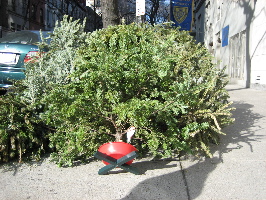
The holiday season is over. The most obvious sign is the dried-up, discarded Christmas trees thrown out onto the sidewalk. Most waste-disposal companies have tree recycling programs that pick up the trees easily, create natural compost, and leave biodegradable shavings behind. What poses a problem is when the tree stand is still attached.

For the next week anyone can walk down a random block in New York City and see piles of old Christmas trees waiting to be picked up and recycled. Look closer and notice that a few of these trees' owners couldn't be bothered to make a little extra effort to actually remove the tree stand. They just threw it away with the tree. Maybe they think to themselves that they can just buy another tree stand next year, what's another $20? And probably that's what tree stand manufacturers want because more sales for them means duh more profits.

The City of New York Sanitation Department has its own Christmas tree curbside recycling program. Their website specifically states that: "residents should remove all tree stands, tinsel, lights, and ornaments from holiday trees before they are put out at curbside for removal." A quick call to their public info office confirms that they will not pick up trees if they are not au natural — meaning if there is anything artificial still attached to the tree, it will not be collected. When the tree is not collected for recycling, that means it ends up in a landfill, cluttering up the world rather than being dispersed naturally.

In a few thousand years the tree might actually biodegrade, but the plastic stand attached to it will still be here. How many chemicals were leached into the air and water to make that plastic stand? How many chemicals will be leached into the air and water from that same stand when it is lying in the landfill?

If there are approximately five stands left on discarded Christmas trees on one block in Manhattan, with Manhattan compromising 6,718 blocks (according to survey work laid out by the Fund for the City of New York), that would be approximately 33,590 trees not recycled and the same number of tree stands left to clutter the landfills. If these owners had taken maybe five minutes of their time to remove the stands and stored them to use for next year, that would be $671,800 less they would have to pay collectively for a new stand next year plus 33,590 less plastic tree stands languishing in the landfill. Once landfills get filled up, new ones need to be created, which in turn creates higher taxes for you.

Recycling Christmas trees is good for the season, good for the environment, and good for the cities and towns with these types of programs. What's not good is a lazy approach to throwing a used tree to the curb without stripping it bare. The biggest loser here is you. You will ultimately pay for the higher taxes it will inevitably cost to build and maintain more and more landfills and all this because someone didn't remove their tree stand.

keeping the earth ever green


Mystery odor: what you can’t smell actually hurts you more

There was a scare in the air in New York City on Monday morning. The cable and local tv stations were all over the story. The cause was a so-called mystery odor permeating the air. Was it a biological weapons attack? Was it cancer-causing chemicals? Mayor Michael Bloomberg was quick to announce that the odor was not harmful, yet the actual source of the smell is still a mystery; fingers now point to New Jersey. But the media frenzy over this tiny blip of an environmental air concern was as usual overwrought.

The media likes to attract viewers and that means sensationalizing the so-called news. Only when it seems like there is some sort of instantaneous event, i.e., a bad smell, that vast media coverage is warranted. Cable and local TV news are the worst offenders because they have so much airtime needed to be filled. They jump on events like mystery odors because it actually gives them something to do, something to talk about, something to ahem fill the air with.

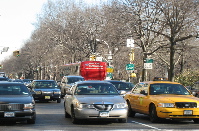
Every day there are more harmful, non-odorous toxic pollutants spewed into the air than during the few hours this mystery odor was smelled. Anyone living in the city is breathing in carbon monoxide emitted from the thousands of vehicles driven daily. Anyone who opens his or her apartment windows can see evidence of polluted air in the form of little black particles that blow in and dirty up the sill. These same black particles and toxic gases are breathed in every minute, every hour, every day that you are alive. Where is the media report about that?

According to the Environmental Protection Agency (EPA), there are six common air pollutants: ozone, nitrogen dioxide, carbon monoxide, particulate matter, sulfur dioxide, and lead. Breathing in any of these pollutants isn't good for you. They can cause anything from neurological disorders to asthma or ultimately death.

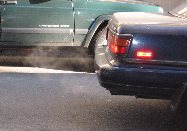
Carbon monoxide is a poisonous gas released primarily from vehicles. It is odorless yet you breathe it in everyday, and in concentrated amounts it can be fatal. Not only is this gas dangerous to you, it also has caused the "greenhouse effect" that has led to global warming.

The federal Clean Air Act of 1990 put caps on vehicle emissions levels and has had success in reducing the amount of carbon monoxide blown into the air. According to the EPA, in 1992 only 15 years ago carbon monoxide levels "exceeded" these emissions caps in 20 cities, which meant that more than 14 million people were overexposed to this harmful gas.

Even though emissions levels of carbon monoxide have fallen significantly under the Clean Air Act regulations, clean, non-polluted air is still not what the vast majority of Americans breathe everyday. What you don't smell is much more dangerous and definitely warrants more media coverage than one half-day mystery odor.

keeping the earth ever green


Muslims and terrorists

China has been busy this week quashing Muslim terrorists and defending stability in China, as the government asserts, or possibly just stifling Muslim belief and the ethnic minority, Uygur Muslims, as supporters might contend.

On Monday the Chinese police announced that they raided a suspected terrorist training camp in the Xinjiang Uyghur Autonomous Region, killing 18 alleged terrorists in the process and seizing a hoard of hand-made grenades that were both completed and being made. Chinese police claim that the East Turkestan Islamic Movement, which the United Nations considers a terrorist organization, ran the camp.

Some eight million Muslim Uyghurs, who are ethnic Turks, live in the Xinjiang province, and some groups of Uyghurs are violently petitioning to establish an Islamic state independent of China.

The training camp may well have been a terrorist training camp. However, it’s difficult to ignore the timing, on Sunday, of China’s increased urgency to target Uyghurs and to denounce Rebiya Kadeer, an exiled dissident and nominee for the 2006 Nobel Peace Prize, as a separatist and “terrorist.” Rebiya Kadeer has been based in the U.S. since March of 2005; she was jailed six years ago for “leaking state secrets,” which was, in effect, communicating with her U.S.-based husband about Chinese reporting on the Uyghurs.


Iraq in 2006

As revelers rang in 2007, the Iraqi ministries released grim statistics for 2006: 14,298 civilians died violent deaths. Add to that the violent deaths of soldiers and police and the number rises to 16,273. The AP reached an independent count of 13,738 deaths.


Yearning

PLEASE NOTE: We have transferred all the user accounts on our oldinthefray.com site to this site. Use your username and password to login. If you forgot your password, select "forgot password?" in the menu above to reset it. Or, click here to register for a new user account.

With Saddam Hussein’s recent execution, we have been promised that the former dictator’s end spells the dawn of democracy in Iraq. Yet Hussein continues to haunt Iraq, from the Kurds who remain tormented by their inability to convict the dictator of genocide, to the sectarian violence engulfing the country. From the martyrs to the victims to the criminals to ordinary people, the past infiltrates the present, not just in Iraq, but around the world as we embark on 2007.

In this issue of ITF, we inaugurate our new site, InTheFray.ORG, with the publication of more of the high-quality, inspiring, and groundbreaking writing and art you have come to associate with ITF. Here we examine the many ways the past informs the present.

We begin in New York, where Vidya Padmanabhan discovers how cabbies — many homesick for their native India or Pakistan — find belonging and business advice in the city’s Cabbie joints, South Asian restaurants. And in Brooklyn, a former police officer’s granddaughter grows nostalgic for accountability and responsibility as Alexis Clark considers the police brutality responsible for Sean Bell’s death in Lead by example.

Afterwards, we visit Chicago’s north shore, where Beth Rooney captures the colorful lives of African refugees as they attempt to rebuild their war-torn lives on a Strange shore. Halfway across the globe, Melissa Lambert sees a civil war’s toll when she ventures On the edge of Mozambique, where rebuilding remains a complicated process, one that breathes life, however mysteriously, into tourists’ fantasies of beauty and belonging.

Reflecting on the roots of her own ignorance about Africa, OFF THE SHELF Editor Nicole Pezold reviews Charlayne Hunter-Gault’s book New News Out of Africa. As she reveals how many of the continent’s countries are embracing democracy and eliminating poverty and disease, Hunter-Gault offers strategies for the media to highlight the “real” Africa.

Meanwhile, in Amman, Jordan, Best of ITF So Far writer Rhian Kohashi O’Rourke takes A sip of Egyptian Tea as she recounts how an older doorman finds humor and camaraderie in a young, clumsy American woman. Back in the United States, Larry Jaffe, the International Readings Coordinator for the United Nations Dialogue among Civilizations through Poetry program and the Co-Founder of Poets for Peace/United Poets Coalition, reflects on growing up Jewish in Sub Urban America and muses on the intolerance and ignorance that loom today. Speaking of coming of age, Megan Hauser reminisces about the realities of using optical illusions to protect herself in Bad eyewear can mark a child.

Rounding out this month’s stories and launching our newest department — the Activist’s Corner — is Folklore photography, former ITF Travel Editor Anju Mary Paul’s interview with photographer Martha Cooper about documenting urban culture and using the camera to inform, transform, and inspire awareness and change. Each month the Activist’s Corner will feature an interview concerning the challenges faced by contemporary activists and offer ideas for how busy people can improve their communities. This department will also feature links and other resources from grassroots organizations of interest to you, our readers.

Along with the Activist’s Corner and a more aesthetically pleasing site, InTheFray.ORG allows readers to post their own profiles, connect with other members, set up personal blogs, and upload images and video and audio files. In coming months, we plan to launch additional features, including video and audio podcasts.

Now that we’ve launched the new site, we’re looking for testimonials from readers aboutwhat InTheFray means to them. If you can help us, please emaileditors-at-inthefray-dot-org with any words you want to share. Pleasemake sure to include your full name and city.

We hope you enjoy our new home and encourage you to email us at editors-at-inthefray-dot-org with feedback on the new site.

Happy New Year!

Laura Nathan
Editor
Buffalo, New York

P.S. We would like to dedicate this new site to Oya Hadimli, a friend of InTheFray, who passed away in November. Thank you for inspiring us with your vision and passion for a world without borders.


The odds of dying

As children across America greedily tore open presents on Christmas day, the Iraqi Interior Minister Jawad al-Bolani announced a grim statistic: 12,000 Iraqi policemen have died since the US-led invasion began in 2003. With the total number of police numbering at approximately 190,000 officers, that means the odds of an Iraqi policeman dying are around 1 in 16.

Despite the odds of dying, joining the police offers a prospect of employment, and according to Interior Minister Jawad al-Bolani, when we call for new recruits, they come by the hundreds and by the thousands.


Kill or covert

"It's an incredibly violent video game… Sure, there is no blood. (The dead just fade off the screen.) But you are mowing down your enemy with a gun. It pushes a message of religious intolerance. You can either play for the 'good side' by trying to convert nonbelievers to your side or join the Antichrist." —Clark Stevens, co-director of the Campaign to Defend the Constitution, speaking about the PC game Left Behind: Eternal Forces, in which players can convert or kill non-believers.

The game is based on the Left Behind series of novels by Tim LaHaye and Jerry Jenkins, which takes place in the apocalyptic post-Rapture world, in which Jesus has raised true believers in him to heaven while non-believers were left behind to face the Antichrist. Over 60 million copies of the books, which are ostensibly based on the Book of Revelations, have sold since 1996.

Those who play Left Behind: Eternal Forces may choose to join the Antichrist’s minions and play for his team, which includes fictional rock stars individuals with Arab and Muslim-sounding names.

Jeffrey Frichner, president of Left Behind Games, blithely dismissed accusations of racism and religious intolerance with the statement that, "Muslims are not believers in Jesus Christ." The ramifications of being a non-believer in Frichner’s scheme, then, is that they ought to be slaughtered if they cannot be converted.