
The art of photographing the young and in love

A review of Margot Herster’s photography.

Editor’s Note: The author is Margot Herster’s step-mother-in-law and friend.
    
For the millions of adults in their 20s reared by baby boomer parents determined to instill in their children self-esteem fueled by fulfillment and encouraging entitlement, questions arise when personal objectives meet up with love. Margot Herster examines issues facing her generation:

Can two young adults pursue separate lives driven by individual interests and goals and also create a life as a couple? Where does the individual life end and the couple’s life begin?  Is sacrifice inherent in a relationship to survive? How quickly must adulthood be reached and to what extent can an individual control the quality of life if it is designated to begin at a specific age instead of at a point of readiness?

In Margot Herster’s poignant photographs, she reveals the loneliness of struggling with these issues even as an intimate relationship progresses. Does loving someone ease assimilation into adulthood or make one more vulnerable to the trappings created by expectations?

The isolation of an emergent self poised slightly apart from the elements of daily life is demonstrated by photographs of physical intimacy against the backdrop of unpacked boxes, randomly strewn personal items in an otherwise unadorned urban apartment, wall hangings propped on the floor, a television turned on in a room facing an uninhabited couch, and the constant pressure of time passing as internal conflicts remain unresolved.  

The courage to admit such a dilemma exists — between pursuing a relationship and allowing one’s ego free reign — is riveting in its naked honesty. In spite of the camera lens’s brilliant focus, the beguiling composition invites interpretation. Herster’s color palette illuminates her photos’ content and creates an optimistic layer over darker themes. Our eyes search each shot to find plausible hope for romance to win over self, or in the very least to hold its own. It is Herster’s expertly measured degree of hope for a dual victory that her work entices us for second, third, and multiple more searches.

Herster also manifests the hesitant interaction in a relationship: a fragment of a woman’s head barely visible in a mirror’s glass is in the foreground as a man leans his half-toweled body against a wall constructed so narrowly that the confinement it creates elicits an involuntary intake air. This keen photograph illustrates the elusive component inherent in the transition from a solitary life to a fully disclosed committed relationship. We are voyeurs snatching glimpses of this couple as they engage, retreat, and attempt tentative steps towards a life of their making. Will this life be worth the effort?    

Another photograph places the man in the relationship outside the apartment. We see him through the window as he sits on the fire escape. Smoke in hand, he stares where we cannot see. The light from inside the apartment casts a shadow across his profile suggesting that physical escape does not provide relief from the emotional conflict of relationships, growth, and meeting adult expectations. We are suspended with him as the answers he seeks remain out of view.  

The artist and her model

I met them, Margot Herster and her model, several years ago. My first impressions have not changed. They are people with stories — ones I want to know.

She hadn’t yet spoken before I drew a conclusion about her. Her presence alone commanded that she not be categorized. I knew from the static in the air created by her entrance that getting acquainted with her would be time consuming. She possesses this level of control. But like a benevolent ruler protecting her subjects, she carries herself without offense, aware of her obligation to not give more information than a situation calls for. Not until the time is right. I liked her immediately.

He is as striking as she is, but he is less guarded.  His charismatic face hints at the substance of life — love, compassion, strength, pain, curiosity, and questions, always questions, and suitable, if not in quantity at least in quality, answers. He charms and entertains without guile. His duty is to bring smiles — some joyful, others thoughtful — and he is a master at it.

Most of all, I took notice — how could one not — that when the two of them are in close proximity, he frames her with an arm, a look, a word. Is it his essence that produces this effect or hers? Does she procure it, or does he offer it up as the standard for their relationship?

He is the model; she is the artist. There is a private contract between them. But in her work you can see it. The viewer is aware of the give-and-take between them that keeps their personal and professional relationships dynamic from the constant shift in power; first one, then the other, taking the lead.  

However, the nuances of their covenant remain a mystery for future discussion. I have questioned each of them attempting to delve into these enigmatic regions, but intuition tells me their reticence to expose more now is to keep the relationship incubating. When they are ready, and the time is right, they will reveal their new insights through art. I will be waiting.


A state of (dis)integration

America’s schools are again separate and unequal.

Jonathan Kozol is pissed off. In his new book, The Shame of the Nation: The Restoration of Apartheid Schooling in America, the prominent author and activist is angry at federal courts for slowly chipping away at the landmark Brown v. Board of Education decision, thereby reinstating a system of apartheid in the nation’s public schools over the last 12 years. He’s enraged by elected officials and school administrators who have implemented a militarized curriculum in inner-city public schools that revolves around standardized tests and vocational training for mediocre, low-paying jobs that will forever trap children in a cycle of poverty. And he’s ticked off at white liberals who, while dedicated to the ideals of integration in theory, send their own children to expensive private schools or elite public schools that are notably devoid of color.  

Apartheid is a strong word, usually reserved for describing South Africa’s late system of racial segregation, coupled with extreme political and economic discrimination. But this is an apt description of the state of public education Kozol paints. After a brief period of progress in the decades following the 1954 Brown decision, most cities have reverted back to a dual system of education — one for whites, and one for children of color. Citing dozens of cases, Kozol argues that courts at both the state and federal levels have waged what is essentially a war on school desegregation since the 1990s. “The proportion of black students in a majority white school has decreased to a level lower than any year since 1968,” he writes. “Almost three-fourths of black and Latino students attend schools that are predominantly minority,” and more than two million attend schools in which 99 to 100 percent of students are nonwhite.

In virtually every instance, courts have upheld the ability of middle-class white parents to “carve out almost entirely separate provinces of education for their children.” Legal advocates for children seem to have entirely abandoned the goal of integration, asking merely for “adequate education” on behalf of poor children rather than “equal education” — something Kozol, a Civil Rights movement veteran, believes should be a guaranteed constitutional right. Perhaps most shockingly, considering the history of segregation in the United States, this new era of separation is largely being played out in the north and west rather than the south. The four most segregated states for black students are New York, Michigan, Illinois, and California, while Kentucky has the most desegregated schools in the nation.

Despite the force of his big picture argument, Kozol is strongest when he is speaking with individual students at troubled inner-city schools — and he visited 60 schools in 11 states while writing this book. What these young people tell him, and what is confirmed by his own observations, is that our schools are failing to provide the essential resources to grow educated, thoughtful citizens capable of succeeding in the larger world. Kozol describes a strict, militarized environment in which teachers use stick-and-carrot methods to prepare students for high-stakes standardized tests, the results of which determine each school’s future funding — or even existence. Such schools do not encourage creativity or independent thinking, do not offer music, art, history, or science, and do not allow students to have a recess break or even talk at lunch. Many of the schools that Kozol visited are housed in buildings that should be (or have already been) condemned, are infested with vermin, contain toxic levels of lead paint, and are so overcrowded that there are not enough desks for the students.

In classrooms around the country, Kozol meets students who are known by their teachers and each other as their test scores and not their names. “There is something deeply hypocritical in a society that holds an inner-city child only eight years old “accountable” for her performance on a high-stakes standardized exam,” he writes, “but does not hold the high officials of our government accountable for robbing her of what they gave their own kids.” What they give their own children is a world of opportunity that is systematically denied to poor children of color. Their own sons and daughters receive, at virtually any cost, an education wholly sheltered from the complexities of real-world problems like race, class, and injustice — problems that poor children of color do not have the luxury of ignoring.  

Kozol excoriates as well those white liberals who literally lie, cheat, and steal in order to garner their children spots at elite, overwhelmingly white, public schools. These institutions, such as Stuyvesant in New York City, often require prohibitively expensive testing and the advice of an admissions coach to gain entry. It is no wonder that these schools, though public, have virtually no black and Latino students, though many of them are situated in racially diverse neighborhoods. For Kozol, who worked for 40 years in urban Boston schools, the choice is clear: If an education isn’t good enough for your own children, then it isn’t good enough for anyone’s children.

As Kozol argued in his National Book Award-winning precursor, Savage Inequalities, access to education remains, ultimately, a question of economics. How can you expect two children to have the same opportunities when there is a tremendous gap in the amount spent on them? In the Chicago area, for example, kids in the wealthy, overwhelmingly white Highland Park and Deerfield districts are lavished with $17,291 in resources per pupil per year, while their darker, poorer neighbors within the city of Chicago (where I attended public school) receive less than half — only $8,482 per pupil per year. The numbers are similar in metropolitan areas across the country, as Kozol shows in a detailed appendix.  

Kozol notes that the same people who lavish their children with $30,000 tuitions at private institutions argue passionately that spending more money on inner-city children won’t improve their educational predicament. Rather they blame public education’s failure on unmotivated teachers, uninvolved parents, and ill-prepared students. Yet how do communities galvanize teachers, parents, and students without sufficient resources? “That which cannot be named as a potential cause [for the failure of public education] cannot be touched upon in looking for a plausible solution,” Kozol argues.

Kozol points out that these disparities send the message to inner city children of color that they are simply not worth as much as their white counterparts. Unfortunately, they are hearing this message loud and clear. “You’re ghetto, so you sew!” a student told Kozol regarding the sewing classes that were offered in lieu of college preparatory courses at his predominantly Latino high school in Los Angeles. Another student, an astute fourth grader from an all-black school in the South Bronx, asks Kozol, “What’s it like, over there where you live?”

Kozol constructs a convincing case that something must be done to equalize education, but this book is a call to action with no game plan. “‘A political movement is a necessary answer,’” Kozol quotes Harvard education professor Gary Orfield. “‘There are people right here in this room who could begin a movement if they have the will and the resolve.’” Indeed, many of Kozol’s readers might be inspired to found a movement, but after reading this book they will still not have the faintest idea how to get started.

Still, Shame of the Nation is required reading for anyone interested in the future of race relations, public education and civil rights in the United States. We are fortunate to have an activist as engaged and unrelenting as Kozol to remind us that separate is never equal — not in 1896 when a post-Reconstruction Supreme Court declared it to be with Plessy vs. Ferguson, not in 1954 when the same court declared it never to be with Brown, and certainly not in 2006 when our public schools have regressed back to a de facto system of racial apartheid. Like Kozol, readers will be pissed off — and ashamed — to discover how far we’ve fallen.  


Songs from a Kansas stage

Kansas’ Old Settlers Inn is the best-kept secret in music.

When Miner Seymour started recruiting performers to Old Settlers Inn 12 years ago, he couldn’t pay them much, so staying the night at his family’s house was part of the deal. At breakfast, Miner asked performers for names of others he should call to book.

When he called singer-songwriter Susan Werner’s agent to see if Werner would come to south-central Kansas to play, Werner’s agent said, “Why would I send her out there?”

This is a story about a one-room venue in a small town. It’s the story of an Ohio transplant who envisioned a space for creativity. It’s a story about a piece of culture that blurs red state identity and paints a different picture than news reports on the state school board, evolution or Thomas Frank’s book What’s The Matter With Kansas?, which pondered why Kansans vote against their own interests. This is the story of the gathering power of music.

Old Settlers Inn is in Moundridge, a town of almost 1,600 people. It’s about an hour from Wichita and a half hour from Hutchinson. It’s an area thick with Mennonite culture and religion, where some people have distinctive Moundridge speech patterns and last names. There are six Mennonite churches, a history of high school debate and forensics championships, and an obsession with Moundridge Wildcats basketball. It’s an unlikely place to start a music venue for national performers.

Yet Old Settlers Inn has become a musical stand-by in the region. It’s the anchor date for performers on a circuit that includes Kansas City venues, West Side Folk in Lawrence, the Birdhouse in Manhattan, the Listening Room in Hastings, Nebraska, and sometimes the Blue Door in Oklahoma City. Cheryl Wheeler, a country-folk songwriter from New England, has termed this the “Silo Circuit.”

Old Settlers draws people from bigger cities to Moundridge for music. Almost half the crowd now drives in from Wichita, Kansas’s largest city. There are 40 zip codes in Miner’s audience database.

Still, Miner expects new performers to be skeptical. He imagines musicians driving toward Moundridge from Kansas City according to his directions: Highway 50, then 150, then 56 through the Flint Hills. He imagines they are surprised that Kansas isn’t flat at all. He imagines them driving west to where the land flattens, between the towns of south-central Kansas, where winter wheat pushes green shoots into wide, square-mile fields. He imagines them driving into Moundridge on a Sunday afternoon, when there is hardly a car on main street, and wondering, “Who the hell set this up?”

Main street, where Old Settlers sits behind a limestone storefront, is called Christian Avenue. The corner Conoco station is always open and the Country Kitchen is full on German Buffet night. Further down the block, The Lean-To bar has closed for good.

Inside the inn

Old Settlers isn’t a real inn, but people spend about a dozen Sunday evenings a year there, eating soup and listening to music in a long, narrow room with beige walls and black soundboard borders. A high white ceiling stretches above rough wooden floorboards and the stage, which emerges from the long left wall and is only a few feet off the floor. It’s covered in large marbled tiles and the wall behind it is painted as a marble arch over blue sky and wispy clouds. The face and dove of Picasso’s L’homme en Prole a la Paix, which he reportedly drew for the peace movement, is incorporated into the arch. A painted banister creates the vision of a performer on a circular, outdoor balcony in front of a perfect sky.

For the audience, the 150 seats are less romantic. Wooden folding chairs flank three sides of the stage and fill the floor. Some listeners sit on the bleacher pieces and church pews in the back of the room.

Behind the performance room is the lavender-walled kitchen, where people line up at the counter for the soup-of-the-day. Valetta, Miner’s wife, sells her famous cobbler and key lime pie. At the end of the counter a poster of Wendell Berry’s Manifesto: The Mad Farmer Liberation Front hangs on the wall, declaring:

Love the quick profit, the annual raise,
vacation with pay. Want more
of everything ready-made. Be afraid
to know your neighbors and to die.
And you will have a window in your head.
Not even your future will be a mystery
any more …

Across the room, a poster advertises cider made in the Seymours’ orchard. Another wall is filled with autographed photos of Old Settlers’ performers, including Greg Brown, Tim O’Brien, Darrell Scott, Cheryl Wheeler, Janis Ian, Martin Sexton, Jeff Black, Susan Werner, Slaid Cleaves and Guy Davis. On the edge of this collage is a sign that says “Peace is Patriotic.”

The congregation

On the day of a show, professors, teachers, students, farmers, doctors, lawyers, business people and artists start arriving around 4:15 p.m. Miner, who wears a bushy, golden-grey beard and button-down plaid shirt, spends his time between the main room and a huge closet used as the performer’s dressing room. In his strident, ornery voice, Miner chats up the crowd and checks in with the musicians. It’s a mostly 30-and-older crowd, some dressed in suit jackets, some in sweatshirts, some in overalls. They are music aficionados who bring Miner new music to listen to. They are also friends who simply trust him to put on a good show.

People here know each other, and some have been at every show since Miner started Old Settlers. Once the entire front row — all season-ticket holders — went out for dinner before a show. Before the show starts, people mill and talk to each other. The ones who drove from out-of-state are soon chatting with regulars.

After 12 years, the Old Settlers audience is still mostly out-of-towners, although there are some local regulars. In general though, the population of Moundridge and the Old Settlers audience do not reflect each other. Miner thinks people like to go to other people’s towns to do things. After all, it’s a nice Sunday drive through rural Kansas. But he feels like Moundridgers still think, “If it’s in our town, how good can it be?”

Small stories

When songwriter Louise Taylor drives across Kansas, heading to her home in Arkansas, she likes listening to Midwest agriculture reports on the radio and trying to decode the beef and grain prices. Sometimes, Louise stops in Kansas and stays overnight at Miner and Valetta’s house. She first met them in 1996 when she played at Old Settlers Inn, and she’s been back to play three times since. Miner and Louise have become good friends, and Miner recently became her agent — his first shot at the enterprise. Louise says the main reason Miner is her agent is because of Valetta’s cherry pie.

Louise believes that people from small towns are more willing to listen to the kind of storytelling she does in her songs. Louise and Miner both say Midwesterners aren’t inundated with shows like those on the coasts, and Kansans are eager to have performers come to them.

When a song moves the crowd at Old Settlers, Louise and Miner can tell. There are no hoops and hollers. Instead, there’s a slight pause — a silence — after the song and before the applause begins.

When she plays at Old Settlers, Louise casts spells on the audience with her poetry and her heavy voice. She’s tall and imposing with a sturdy smile and long, curly brown hair. She fuses her singer-songwriter craft with country-blues, jazz textures, and finger-style guitar playing.

There aren’t many frills about Old Settlers, but Louise says it’s the perfect environment for performers. There are warm personalities, food, and a ready and willing audience. Old Settlers’ performers are treated — and paid — well. Miner can guarantee performers an unusual bonus for a venue this size: $1,000 and a full house. That’s because Miner doesn’t try to make his own living off the ticket price, which now averages $15 a show. Plus, the venue’s good sound and good stage aren’t terribly common in the world where Louise plays.

Coming home

There wouldn’t be an Old Settlers Inn if Miner hadn’t met his wife Valetta while doing pro bono accounting for a Columbus, Ohio, medical clinic. Valetta, who had just returned from working in Africa, was a nurse at the clinic. She was a farm girl from Kansas, not the kind of girl Miner was supposed to marry. His wealthy Ohio family expected him to be a professional, he knew, and to marry a Theta. But this wasn’t what Miner wanted.

In 1985, after living and working in the Northwest — and getting married — the Seymours moved to Kansas. Miner had been studying architecture and doing construction work, and he and Valetta began building a house next to the farm where she grew up. It was a few miles outside Moundridge, on North Old Settlers Road. Soon, their daughter Kate was born.

Valetta knew the Mennonites who farmed the flat fields and lived in Moundridge, but Miner had no connections to the area. He couldn’t believe people identified each other by which church they attended. He didn’t have a group — or a place — with which he identified. But he could relate to the Mennonite values of living simply, pacifism, and a passion for four-part singing.

The small town wasn’t an easy place to be a newcomer; regional history runs deep. Moundridge was born of railroad routes and transplanted roots of homesteaders from Europe, Canada, and other parts of the Midwest. The largest group of immigrants were the German-speaking Mennonites who migrated from Russia to the area in 1874 and brought with them a new winter wheat, which eventually made Kansas the leading producer of hard wheat. Around Moundridge, people still farm the grain.

The Seymours can see the horizon — the curve of the earth — from their front porch. Miner slowly fell in love with Kansas. Although standing in the middle of an empty square mile used to spook him, he likes the vastness now. Once, when they were snowed in on the day of an Old Settlers show, Miner and Valetta strapped on their cross-country skis and sailed across the stubble fields into town.

Putting down roots

It was soon after the move to Kansas in 1985 that Miner saw a building for sale on Moundridge’s main street. After living in the Northwest, he couldn’t believe the low price. He bought it immediately for $11,000 from the VFW without any idea what he’d use it for.

Then, he began to think about what he’d put into the 110-year-old structure that once held a pool hall, senior citizens center and a VFW. He and Valetta thought about opening a film house or a puppet theater for kids. The bottom floor was leased to a pizza joint, and pizza ended up paying the mortgage. The top floor, accessible only up a narrow, precarious and peeling stairway, was empty. It had been used for bingo and parties, so there were restrooms and a food service area.

Eventually, Miner’s songwriter friend Anne Zimmerman told him there was a shortage of venues for her kind in Kansas. Miner got his answer.

The first show at Old Settlers was in 1993, after the upstairs walls had been stripped of decades of wallpaper and painted white with mint green trim. Seventy people came to hear the Waffles, a local old-time string band, play on the foot-high, corner stage. Valetta made chowder and bread to sell to the crowd. People sat at square tables, coffeehouse style. Miner made $37.

By the time The Kennedys drew 80 people to a show in March 1994, Old Settlers had hosted 12 shows and Miner still worried every Sunday if people would show up. At one show, only 27 people had come, and four shows had ended in a net loss for Old Settlers. A few Moundridge residents came to shows at the beginning, but the majority of people came from surrounding small towns.

The Kennedys had been touring with Nanci Griffith’s Blue Moon Orchestra. At the time, Miner didn’t even know who Nanci Griffith was. But Pete Kennedy befriended Miner and started providing names of performers who might play there. In February 1995, songwriter Brooks Williams was the first to attract concertgoers from Wichita.

Tending the flame

As Old Settlers’ popularity grew, Miner decided to move the venue downstairs to increase seating and accessibility in 2001. The pizza place below had folded and left a kitchen and dining area. Miner did all of his own construction work. He brought down the wooden folding chairs he’d bought at a rental yard in Hutchinson. He also brought down the wooden theater seats, grouped in threes, that he acquired from Moundridge High School. He used two church pews and elevated wooden bleacher seats from a tiny high school in northeast Kansas. Seating is tight, but Miner has tried to make it more comfortable by providing foam seat cushions, printed with the Old Settlers logo — a candle with rays of light arcing outward.

Old Settlers Inn is now operated by the non-profit Acoustic Arts Association, which Miner started. It includes five board members and is directed by Miner. There is also a radio program on KMUW called New Settlers Radio Hour, which plays live shows from Old Settlers and other places in the area. Miner uses his connections from Old Settlers to bring musicians to local colleges and larger performance venues.

The Seymours have never expected to make a living from the venue, and Valetta works as a nurse practitioner in nearby Hesston. On show days, a local family runs the kitchen and makes and serves the soup, bread and dessert. But Valetta is also in the Old Settlers kitchen after the show, helping clean and wash dishes. People are employed to do this (they get free tickets), but Valetta can’t help herself. Miner says it’s how she is — it might have something to do with her farm-girl roots.

Musical testimony

By now, Miner has used Old Settlers to put down roots in the region. For him, developing Old Settlers Inn has been an exercise in creativity, and his goal has always been to foster an artistic space. The soul of Old Settlers Inn has everything to do with why Miner loves living in small-town Kansas. It’s the phenomenon of the clerk at the bank, the guy at the lumberyard, and the waitress at the café in the next town also being on your sports team or members of a committee to which you belong. They shop at the same grocery store. And maybe go to the same church on Sundays. Old Settlers is a hybrid soul that feeds on this community’s desire to hear stories and songs from beyond south-central Kansas.

One recent evening, Old Settlers hosted musician Paul Thorn for a Saturday night show. A few minutes after 8 p.m., most people were snug in their seats. Miner hates announcing anything in front of a crowd, so as the house lights go down he asked Billy, Paul’s agent, if he wanted to do it.

“Welcome to Settlers Inn!” Billy said. The crowd didn’t care that he left off the “old,” and they erupted with applause and hoots. In the swinging kitchen doors, Paul waited in a western-style, white button-down open at the collar, jeans and black lace-up shoes with heavy tread. He used to be a boxer, and in 1987 he shared the ring with Roberto Duran on national television. After he quit boxing, Paul worked in a furniture factory and started playing local gigs at night. Since then, he’s been onstage with folks like John Hiatt and John Prine. Clearly, he has some song material behind his shaved head and stubble beard.

Paul walked through the chairs and applause and into the spotlight onstage. He sat down in the chair, about three feet from the audience, grabbed his acoustic guitar, and smiled. Then he played a full night of southern gospel, soul and country-blues.

Paul told the crowd he wasn’t used to going to a new town and having such a big turnout; usually, no one knows who he is. He narrated stories to the audience in his slow, thick southern accent and at one point invoked his heritage as a preacher’s son. “I feel like testifying tonight,” he yelled to the crowd, and then moved into the song “Ain’t Love Strange.” At one point, he got two women on stage to sing backup. On his more spare and serious songs, Paul turned inward and closed his eyes, but the audience was perched and listening until the end.

And that’s why Old Settlers Inn isn’t a bad place to testify. The story continues, on Sunday after Sunday in Moundridge, before the work week begins. At 2 p.m., Miner drives in to town, opens up Old Settlers, and prepares the stage and dressing room. Within an hour, performers show up for sound check. Then the cooks arrive, and at 4 p.m., the doors open. The parking spots on main street begin to fill up as people arrive at Old Settlers Inn to meet their friends. They look forward to hearing stories. They gather to listen.


Grappling with ghosts

In its post-colonial era, France rethinks its identity.

On a warm October night in Paris, a crowd assembles on a left-bank bridge overlooking the Seine. Dusky blue clouds hover on the skyline; Notre Dame Cathedral looms behind.

Spilling into the street and blocking traffic, 200-odd people gather in one of Paris’ perpetually clogged tourist arteries to commemorate a massacre that occurred in the vicinity 44 years earlier. On a north corner of the Saint-Michel Bridge, a plaque reads: “In memory of the many Algerians brutally killed during a peaceful demonstration, October 17, 1961.”

“I was thrown into the Seine, but I escaped,” says Mr. Tahar, an Algerian-born French resident in his 70s. “The police lined us up and asked who could swim. Those who said they could had their hands bound behind their back and were tossed over. I pretended I couldn’t swim,” Mr. Tahar adds, without a flinch. He is accompanied by another elderly man whose eyes well up with tears. The latter won’t give his name but says he, too, was there.

It was on that night, with France in the midst of a brutal war to suppress then-French Algeria’s independence movement, that 20,000 to 30,000 French Muslims and their supporters staged an unarmed protest against a discriminatory curfew in Paris. Police Chief Maurice Papon, once a Nazi collaborator who detained over 1,500 French Jews during the World War II German occupation, deployed forces to suppress the demonstration.

The following morning, officials announced only three deaths. Worldwide, media accorded the event relatively little attention, and public access to records was swiftly banned. Access to archives remains highly restricted.

Nearly half a century later, France has only begun to seriously consider what many historians say really happened that night: around 200 protestors shot, beaten to death, or drowned, 200 unaccounted for, and thousands arrested or tortured. In 1991, historian Jean-Luc Enaudi published The Battle of Paris, 17 October 1961, which set a new estimate of deaths at “at least 200.” Maurice Papon attempted to sue Enaudi for libel in 1999, but the latter won the case. Since then, though official estimates have not changed and those of historians vary, mainstream media and increasing numbers of scholars consider Enaudi’s figures plausible.

Nonetheless, October 17 has not yet been fully integrated into the country’s memorial fabric. The events of that night seem to occupy an uneasy place in France’s imagination, despite increased media attention, documentaries, and a feature film Nuit noire, released in October 2005. France has yet to officially recognize the massacre, and when Paris’ Socialist mayor, Bertrand Delanoë, inaugurated the Saint-Michel commemorative plaque in 2001, he was met with opposition from several conservative city officials. There is no “consensus of memory” around the massacre.

Henri LeGrand, a 72-year-old Parisian originally from Fort-de-France, Martinique, says he participated in the demonstration and witnessed “terrifying” violence. “I could have lost my life,” he said, explaining that the police asked for his “papers” and then advised him to leave the scene after confirming he was not Muslim. “They told me I’d better get out of there because there’d be shooting everywhere. On my way home … I saw people being beaten … I saw police throwing people over bridges.”

LeGrand is an activist and former educator. With his kind and slightly haggard features, worn collar, and nearly impeccable English — he lived in the United States for several years — he evokes the verbose muckraker Ralph Nader. Saying he has suffered heavily from racism and “colonial mentalities” as a French Antillean, he believes France refuses to face its past. Telling of being blacklisted in the 1950s for dodging the draft to fight in the Algerian War, Mr. LeGrand says France systematically fails to confront its colonial history.

But current trends suggest otherwise. If colonial history remained fairly obscured in France until a few years ago, today October 17 is a haunting symbol of a colonial legacy that has never been more passionately debated. Even while “collective colonial memory” remains hazy and taboos persist, Gallic society is in an unprecedented introspective mood regarding its past empire.

The legacy

French colonial history sweeps across four centuries and two main periods. The first era includes the annexation of modern-day Quebec, Louisiana, and the French Antilles in the Caribbean. That empire culminated with the independence of Haiti and the abolition of slavery in 1848.

The second empire began when France invaded Algeria in 1830. Over the course of the 19th century, France established Indochina in present-day Vietnam, Cambodia, and Laos, and secured protectorates and trading posts over enormous swathes of the African continent. Algerian independence in 1962 marked the formal end of French colonial power.

The Algerian War in particular is a scar on the French imagination. The North African country was considered a full-fledged part of France for over a century. The war, which erupted in 1954, divided both native French and Algerians so sharply that it resembled a civil conflict. Comparable to the Vietnam War for its psychological impact, a majority of French and Algerians counted family members fighting in the conflict.

Independence resulted in Europe’s most massive exodus since World War II: the brusque flight of roughly one million people to France. The relocated included Pieds noirs (residents of Algeria who were of French descent), Jews who had found refuge in North Africa during the Spanish Reconquista, and harkis, native Algerians who fought to maintain French rule. The displaced, most of whom had never set foot in France, often resettled in Marseille and other southern hubs, where large communities remain today. Suffering from stigmatization and cut off from their birthplace, these colonial refugees are living testaments to a past that continues to haunt.
The specters of empire

That past is increasingly being confronted, head-on. Recent years have seen a vigorous stream of films, academic conferences, dissertations, and books addressing the specters of empire both directly and implicitly.

A 2005 film with Juliette Binoche and Daniel Auteuil, Caché, portrays a man tormented by his cruel treatment of an Algerian boy orphaned by the 1961 Paris massacre.

At generally traditionalist French universities like the Sorbonne, colonial history and “theory” have suddenly become hot topics, with social science and literature departments reluctantly embracing the primarily Anglo Saxon discipline of postcolonial studies.

A bestselling book, The Colonial Fracture, attempts to draw historic connections between social ills like racial and ethnic discrimination and unresolved colonial tensions.

The bestseller’s argument, called sensationalist by some critics, found resonance when riots swept through hundreds of economically depressed suburban areas around the country in November. Mostly involving French adolescents whose parents and grandparents emigrated from North and West Africa, the riots prompted newly pressing questions around postcolonial France’s success in integrating and fully including ethnic minorities. Many analysts pointed to soaring unemployment rates and discrimination in hiring and housing among young French Arabs and blacks.

The riots intensified soul-searching around colonial history. When Prime Minister Dominique de Villepin called a state of emergency November 9, asking “sensitive” municipalities to enforce curfews, some saw irony in reinstating colonial-era laws drafted in the heat of the Algerian conflict in 1955. In short, the riots have only intensified and lent a sense of urgency to France’s introspection.
Official reckoning?

The government, too, has made gestures signaling a more forthright approach to colonial history. Some recent legislative measures demonstrate this.

Often, the shift boils down to vocabulary. After decades of referring to the Algerian War as a “pacification” campaign or “maintenance of order,” a law passed in 1999 required officials to use the term “war.” Then in 2001, Guyanese deputy Christiane Taubira helped pass a bill bearing her name that made it obligatory to define slavery as a “crime against humanity” — particularly in school textbooks.

Diplomacy has also changed its tune. On an official visit to the eastern Algerian town of Sétif in February 2005, the French ambassador to Algiers called a 1945 reprisal campaign in the town “inexcusable” and a “massacre.”

He was describing the events of May 8, when, on the same day that the Nazis capitulated in Europe, French forces responded to a series of violent riots in the town by opening fire and killing between 15,000 and 40,000 civilians, according to widely varying estimates.

The ambassador’s comments marked France’s first formal acknowledgement of the town’s suffering.

Lost grandeur?

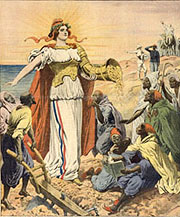
But current interest in colonial history is not limited to shaping semantics or recognizing atrocities. If some see colonialism through a prism of oppression and violence, others regard the period with wistful regret. Some argue that French colonial power brought valuable infrastructure to undeveloped nations, implying that ex-colonies have been worse off since — and that France just hasn’t been as grand.

While extreme-right groups and certain Pieds-noirs organizations make up the most vocal proponents of this positive take on empire, the center-right government took a dramatic role early last year.

In February 2005, the conservative-majority National Assembly passed a law calling for recognition of colonialism’s “positive” aspects, sparking an emotional polemic in France. One article of the legislation stipulated, notably, that history educators at secondary and university level should recognize “the positive role of the French presence overseas, particularly in North Africa …”

The law, ostensibly aimed at Pieds-noirs, harkis, and certain veteran’s groups reclaiming increased recognition, applauded “the national contributions [made by] repatriated French citizens.” It has drawn heavy criticism and calls for repeal from historians, educators, and human rights groups. Protests in Martinique and Guadeloupe prompted Interior Minister Nicolas Sarkozy to cancel a meeting with Martinique’s most celebrated poet, Aimé Césaire, in early December: Césaire refused to honor the meeting, citing his opposition to the legislation.

After months of controversy, the Chirac administration has recently moved to modify the polemical bill. After a January press conference in which Chirac promised the law would be “re-written,” arguing that shaping history should not be the province of the state, he called the Constitutional Council on January 25th to assess the validity of the law’s most contested article. While indicating that he supports the eventual omission of that article, Chirac wishes to retain the sections of the law that commend veterans and expatriated civilians.

On the Paris street, reactions to the law seem to fall along generational divides. “It’s a good measure … it recognizes … the people who helped develop those countries,” says Youf Aimé, a 67-year-old Parisian and retired printer. “In Algeria especially, they’re asking for us [back] again. It’s like [Algerians] were abandoned.” Mr. Aimé believes, however, that decolonized France is more economically sound. “It’s better now, with the money no longer going over there … it stays here now,” he adds.

In Saint-Denis, a working-class suburb north of Paris, a group of freshmen theater students say the law is misguided. “I think students should be left to think for themselves … nothing should be imposed on them,” says Chlöe, 18. Saïd, also 18, adds: “A historian’s job is to be objective. I don’t think colonialism had a positive side.”

Some see colonial nostalgia in the measure. Claude Lauziu, Professor Emeritus of History at Université Paris VII Denis Diderot, assembled a petition to overturn the law, drawing 1001 signatures from fellow historians. He analyzes the polemic as a “battle of memory” between intellectuals eager to bring more critical analysis to colonial history, and center and extreme-right wing “nostalgics” who mourn the “lost grandeur” of the French Empire. Himself a Pieds-noirs, Lauziu opted for Algeria’s independence because “It was not our France … the France of torture.”

While he notes a significant rise in research and media coverage of colonial memory, Lauziu believes a majority of French society remains basically indifferent to the debate.

“Young people, especially, very rarely talk about [colonial history] or feel concerned with it. It’s essentially a battle between fringes,” he said.

It does seem questionable whether the general public takes a passionate interest in the country’s colonial legacy. But media images suggest nostalgia for empire remains in France — on a mainstream level.

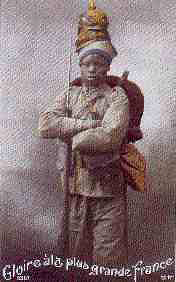
Last year, Paris metro tunnels and bus stops were plastered with a Negrita rum ad featuring a black woman in a head wrap, alluding to colonial clichés of the sensual slave. Banania, a popular drink for children, continues to use a grinning, wide-eyed Senegalese cartoon infantryman as a mascot, virtually unchanged from its early 20th century guise. Raja, a film released in 2003, portrays a wealthy middle-aged Frenchman’s efforts to seduce an adolescent Moroccan girl working at the former’s villa in Marrakech. As colonial critiques gather steam, so, it seems, does the popular appetite for nostalgia.

Why now?

It’s tempting to ask why these parallel — and polarized — views of colonial history have come to the forefront now. Why not a decade ago?

Françoise Lorcerie is a sociologist at France’s National Scientific Research Center (CNRS) in Aix-en-Provence. She attributes new interest in colonial history — both of the critical and nostalgic variety — to intense questioning around immigration, discrimination and national identity beginning in 1998.

On one hand, she says, self-reflection led to society taking ethnic diversity into account: no easy feat under France’s universalist concept of citizenship, which is supposedly blind to difference.

The 2004 ban on “ostentatious” religious symbols like the Islamic veil in French public schools and administrations, and the explosive debate that followed, underlined France’s difficulty in reconciling a notion of the “universal” citizen with the reality of cultural and religious diversity.

But Lorcerie believes that what it means to be French is shifting.

“This [soul-searching] modified the parameters of the question ‘Who are we?’” says Lorcerie. “[France had to] recognize that its ‘interior borders’ are ethnically diverse. Then a new national identity had to be forged, taking diversity into account.” To do this, she argues, probing a colonial history thus far “never mourned” became imperative.

According to Lorcerie, the new spotlight on ethnicity and integration also helped intensify a tendency toward nationalism and xenophobia in France — leading to a surge of colonial nostalgia. Citing Jean-Marie Le Pen’s passage to the run-off in the 2002 presidential elections and public rejection of the European constitution earlier this year, Lorcerie insists “nationalist regression” is variably present along the political spectrum, from extreme-right xenophobia to extreme-left hostility at globalization.

Nationalism and fear of difference, Lorcerie explains, inspire nostalgia for the “former grandeur” of colonial France, a time when the “interior borders” of national identity seemed clear.

However, the researcher remains optimistic about France’s future as a multi-ethnic, postcolonial society. “I think the general sentiment is that we can live together,” she says. “More research is needed, but young people seem much less contaminated by nationalist fears.”

Living the remains

Barbes is a north Paris neighborhood where vintage tabacs, African markets, hookah bars and McDonald’s headily coexist. The streets are often packed with bargain hunters sifting through piles of discount clothes and wares. Tiny fliers advertising fortune tellers crunch underfoot. Southward, many of the residents are Muslim and of North African origin. A few blocks north are large West African communities.

Like every other quartier populaire in the city, Barbes is undergoing slow but certain gentrification. Virgin Megastore and Sephora cosmetics shops are springing up where family-owned boutiques once stood. Wealthier Parisians are buying and moving into apartments whose prices continue to soar. Barbes seems to exemplify the increasing proximity and overlap between working class communities and affluent ones in the City of Lights. It also gives a clear picture of just how ethnically and culturally diverse Paris is.

At the trade school where I teach English to future bank employees, students have slipped into French, unwilling to contain their animated debate on ethnic and racial discrimination in broken English.

They are drawing from their own experiences.

“Why should I have to work four times harder than others? I don’t want any special privileges, but I want to know that if I work as hard as someone else, I’ll get an equal shot,” says Mireille, 23, who was born in Ivory Coast, but came to France when she was three.

“I don’t feel like I belong anywhere,” she explains. “I’m cut off from my birthplace but nobody treats me like I’m French here.” Another student agrees. “Even if you’re born here, [if] you’re not white, or you have a different religion, people treat you like a foreigner.”

“I’m not justifying [the riots], but I understand why those kids do it,” interjects Ramata, 20. “How else can they get people to pay attention to their situation? I don’t think a peaceful demonstration would have interested the media as much.”

Tatiana, 24, raises her voice. “I really disagree! They’re just trashing their own communities. There’s a better way.”

Everyone seems to agree on one thing. “What makes me angry is the way people treat my black or Arab friends differently,” says Sophie, 22. “We’ll go into a bar and the waiter will use [the formal] vous with me, then turn to my friends and use [the informal] tu). It’s so degrading.”

Murmurs of agreement erupt around the room.

Getting a clear picture on discrimination in France is tricky: current laws prohibit classifying by race, ethnicity or creed in official studies. However, according to INSEE, France’s National Institute of Statistics, the jobless rate is as high as 20.7 percent for the general population in “sensitive urban zones,” compared to an already morose national rate averaging just below 10 percent. For young adults in “sensitive zones,” the numbers skyrocket to about 40 percent.

Daunted by the prospect of potential employers sending CVs headed with names that “sound ethnic” to the bottom of the stack, it’s not uncommon for French Arabs or Africans to adopt pseudonyms in hopes of landing interviews — echoing a similar problem of American employers discriminating against “black names” on résumés.

Recently, non-profits like SOS Racisme have staged “testing” campaigns proving candidates with the “wrong” color, name or address often get turned away, while similarly credentialed white candidates are not. In 2002, the Moulin Rouge was fined for discriminatory hiring after one such test. Last June, France created the “High Authority against Discrimination and for Equality” (HALDE), where discrimination victims can plead their case. Also last year, 40 top French companies, including Airbus, signed a charter committing to fair hiring.

For many, these measures would have been welcome years ago.

Eric, 35, lives with his wife and eight-year old daughter in the northeastern city of Metz. Born in Cameroon, Eric has lived in France from age five. Raised in one of Paris’ most brutal housing projects, he studied economics before going abroad to earn his Master’s degree in Marketing and Communications at Central Missouri State University. He then worked four years as a supervisor in a telecommunications firm in Houston, Texas.

Though he defines his time in Houston as “my best moment … the first time people treated me like a man,” he eventually returned to France to be with his family.

“I was raised by a single mother. I want my daughter to have a full-time father,” he says.

Gliding between French and English, Eric relates his painful search for a position that matches his qualifications. That search, after three years and roughly 2,000 résumés sent out, has yielded, he says, only three or four interviews.

“My worst experience was when I arrived for an interview, and the manager looked at me incredulously: ‘It’s you?’ Even if I have the best CV and the strongest motivation, they’re going to hire someone [else].”

An aspiring novelist who admires American writers like Toni Morrison and Paul Auster, Eric says he has no intention of leaving France. “My life is here with my family. And why should I have to go abroad? I have work experience and a degree. I prefer to stay and fight.”

“These days, I mostly worry about my daughter. What can I do to give her a chance? I want to fight so she doesn’t fall into the same trap.”

Define that trap? “Black or Arab, French society perceives you as coming from far away. Take someone from Martinique or Guadeloupe. They’re fully French, yet people often treat them otherwise. But nobody ever insinuates that Nicolas Sarkozy, whose parents are Hungarian, is a foreigner. Why is that?”

Eric rejects the idea of affirmative-action type programs. “I don’t want my daughter to learn I got a job because I’m black,” he said. “It should be like a jungle: the strongest should win the game.”

He pauses. Then his voice trembles.

“The problem is, you don’t understand why you’ve failed. It’s ridiculous … three or four times, I’d say it were a problem of competence. But 2,000 résumés? That’s frightening. Either I’m the world’s biggest idiot, or something’s wrong here.”

More brief silence. Eric concludes: “But you know, I had all odds against me and I made it. I’m proud. I’ve worked very hard, sometimes 18 hours a day. No way will I leave because of racist people. I’m going to be a citizen of this country.”

Eric’s experience echoes others’. But not all seem scarred by persisting discrimination in France. Sonia Tebbakh, a postdoctoral fellow and visiting scholar at Oxford, grew up in Grenoble, a city bordering the French Alps, to Algerian parents. She wrote her doctoral dissertation on French North African (Maghrebi) political identity. One section of her research explored the role of colonial memory and history in that identity.

Growing up in a community with few immigrant families, Tebbakh attended a school in a neighborhood more affluent than her own. Despite her difference, she says, she never felt stigmatized.

“I guess I’ve been sheltered — I wasn’t raised in the projects,” she says. “Also, academia is a specific milieu where most people are … less prone to discriminate.”

Believing that the French school system didn’t “allow Franco-Maghrebis to reconstitute their own cultural memory,” Tebbakh undertook to find answers herself.

“My parents have spoken very little about their experiences. But [they] come from a farming milieu, so they weren’t necessarily equipped to transmit memory, to explain the context of those experiences.”

Comparing French colonial memory to “a hot potato that everyone shifts around in their hands and has no idea what to do with,” Tebbakh says conflicting versions of that memory have not yet been reconciled. For those who lived through the colonial period, painful associations are nearly universal. But lingering “misunderstandings” result because few efforts have been made to open dialogue between communities, Tebbakh explains. “Taboos and continued silence create frustrations … and with new generations, [colonial] memory grows dimmer,” she says.

For younger Franco-Maghrebis, “[colonial] memory has little substance. It’s fragmentary and based on rather general family myths.” Drawing from anonymous interviews conducted for her dissertation, Tebbakh notes that young Franco-Maghrebis often associate their feelings of rejection from French society with the sufferings of their parents and grandparents under colonial rule.

“People use colonial memory to explain their exclusion … and to make a ‘neocolonial’ link,” Tebbakh says. “There’s often this belief that colonial power structures are still prevalent and can explain discrimination today.”

While saying that “colonial reflexes might still be at work” in contemporary society, the scholar finds it “annoying” when some attempt to explain discrimination solely in those terms.

“I’m not convinced racist attitudes are principally linked to colonial history,” she says.

Despite her skepticism, Tebbakh believes breaking through silence and encouraging dialogue about colonial history might help heal social barriers in France.

The (sweet?) hereafter

Several months have passed since stories of “France burning” stopped flooding the wires. Combined with the still-raging controversy over the February 23 law, the three-week November riots, which incurred an estimated €200 million in damages, have left far greater marks on the way French society perceives its heritage and its future. As passionate interest in problems of poverty and class in the United States eventually subsided following Hurricane Katrina, perhaps the current French preoccupation with colonial memory and equal opportunity will wane as well.

But debate being one the French national sports, it is just as likely that these inward-looking identity questions will keep France rapt for a long while to come.


A kinder, gentler jailer

Personal information on detainees was withheld solely to protect detainee privacy and for their own security…. [Disclosure] could result in retribution or harm to the detainees or their families.…

Personal information on detainees was withheld solely to protect detainee privacy and for their own security…. [Disclosure] could result in retribution or harm to the detainees or their families.

—Lt. Cmdr. Chito Peppler, U.S. military spokesman in Guantánamo Bay, on why the Pentagon refused for four years to release the names of the prisoners held at the offshore prison, until a federal judge ordered it to do so this week.

Ever since it started shipping prisoners arrested in Afghanistan and Pakistan to prison facilities at Guantánamo Bay, Cuba, the Bush administration has fought ferociously to keep them away from the rule of law and the skeptical eye of the international community. First, the suspects were planted upon a plot of occupied land that the U.S. government contends it leased but the Cuban government claims was taken by force. (When’s the last time you “leased” a car from your Honda dealer at gunpoint?) Then, it refused to allow the prisoners to see lawyers or family, classified them as “enemy combatants” to advance a flimsy legal argument for holding them indefinitely without charges, and prevented any outside group (except, after a while, the International Committee of the Red Cross) from gaining access to the prisoners. Even after incidents of torture came to light, the administration continued to refuse to release the identities of the prison’s occupants — until The Associated Press filed a Freedom of Information Act lawsuit and a federal judge ruled against the government, demanding that the relevant documents be handed over on Friday.

Following their usual practice of letting no bad deed go un-spun, the Bush administration is suddenly making itself out to be a kinder, gentler jailer. The identities of Guantánamo’s prisoners, says a Pentagon spokesman, were withheld “solely to protect detainee privacy and for their own security.”

Privacy? Security? Sir, have you no sense of irony?

It is truly awe-inspiring to watch a government spokesperson say these things with a straight face. It reminds me of how the Pentagon, when faced with a rash of attempted suicides at the Guantánamo prison, started reclassifying them as “manipulative self-injurious behaviors” — because anyone who wants to kill himself is just being “manipulative.”

Of course, it is possible that the Guantánamo prisoners, wasting away for years in their cells with no connection to the world outside, are really pining for privacy. They don’t want anyone else to know or care about what happens to them. Their detainment is, after all, a private matter to be discussed between the prisoner and his jailer. Perhaps they’re afraid of identity theft or telemarketers.

It is possible that the prisoners fear for their safety, too. Inside the Guantánamo prison, they’ve been pampered — with repeated beatings and sexual abuse, having feeding tubes shoved up their noses without sedatives, being chained in a fetal position for hours until they defecate upon themselves. Outside, who knows what may happen to them?

There are surely some very bad men holed up in Guantánamo. But after five years of this human rights (and public relations) disaster, there is still no compelling reason why the prisoners being held there can’t be charged with crimes, given fair trails, and then, if found guilty, sentenced and punished. Does the Bush administration persist in its Orwellian policies because of mere stubbornness or because it lacks any evidence that many of these men were actually al-Qaeda fighters (as a review of the Pentagon’s own data concluded)?

Or maybe the government has just grown attached to its little gulag in sunny Guantánamo. What would the 500-some prisoners do without the Bush administration to look after their privacy, security, and tendencies toward “manipulative self-injurious behavior”?

Maybe this is what George Bush meant when he talked about compassionate conservatism. At Guantánamo, Big Brother knows best.

Meanwhile, the rest of the world knows nothing.

Victor Tan Chen

Victor Tan Chen is In The Fray's editor in chief and the author of Cut Loose: Jobless and Hopeless in an Unfair Economy. Site: victortanchen.com | Facebook | Twitter: @victortanchen


Out of America

What the guidebooks to Guatemala don’t tell you about traveling in uncharted territory.

Exasperated by the armies of tourists in San Pedro, a friend and I take a short trip around the shores of Lake Atitlán on the back of a pickup. Few tourists dare to try this local form of transportation, since the roads are rumored to be full of bandits. We didn’t see any, and had a wonderful afternoon.

Tired of Washington, D.C.’s middle-class office workers screaming their shopping plans via cell phone to an entire bus, and its rich Georgetown University students name-dropping about their latest “awesome class with Madeleine Albright,” I flew to Guatemala last December, thinking it was far enough off the beaten track to be a natural getaway.

I couldn’t have been more wrong.

A single night on the shores of Lake Atitlán left me wondering whether I had left the United States at all. More than 20 English-speaking bars, screening the latest Hollywood blockbusters on portable LCD projectors, long ago transformed the once-traditional village of San Pedro into a winter break party-town filled with fun-craving American students looking for cheap beer and pot, I discovered.

Counting on the fingers of one hand the remaining days of my vacation, I determined to find some isolated, peaceful Mayan village with no tourists, whose traditional heritage was preserved intact; somewhere I could savor the beauty of this foreign land with only the locals to keep me company.

That was my thinking when I decided to head to Todos Santos, a tiny settlement squeezed between the ranges of the Cuchumatanes Mountains in the northwest of the country, five hours by bus from Huehuetenango, the nearest town.

On route to Todos Santos on the “chicken bus” — endearingly known by this name for the passengers’ propensity to use it for carrying chickens, and also ducks, pigs, and other domestic animals.

Village: Under construction

It was only when Todos Santos first appeared in my bus window when we turned a corner that I started wondering if I might have made another mistake. For some reason, the spot so gloriously described in my travel guide as a natural wonder, where tradition has kept the place intact for thousands of years, didn’t quite match the landscape I saw in front of me.

Steel poles protruded from the tops of the many single-storey buildings that made up the town, seemingly waiting for a time when the owners would have the necessary means to add a second floor. Where the houses were finished, their tops were covered with rusting metal roofs placed there three to four years ago, judging from their incipient state of oxidation. The thatched roofs and dilapidated barns of the solitary mountain villages in my native Romania had a more “traditional” air to them than anything I had seen here so far.

As I headed up the village’s main street and past the local market, I spotted yet another couple of American tourists. Even Todos Santos was not free of them. They were wearing lavish, white woolen shepherd’s outfits (undoubtedly stemming from a desire to fit in), laughing over some joke and buying fried chicken.

I gave them the customary American grin as I passed, and took a left at the southern corner of the town center — just as my travel guide indicated — looking for a cheap and hospitable place to stay. A small “hospedaje” sign nailed to the entrance of a house caught my eye. (Many Guatemalan families have turned their homes into backpacker hostels ever since the civil war ended in the late nineties.) I walked into what seemed like a living room opening out onto a central courtyard where a couple of girls were using a machete to cut some vegetables. There were no other guests in sight — and no Americans — and that was reason enough to make me decide to stay.

Although the travel guide wrote an ode to the beauty of Todos Santos, all I could see in the town center when I arrived was another “chicken bus,” a plain-looking church, and a woman returning from shopping with a bag full of vegetables.

When my rooming arrangements were settled, I took a short stroll around town, looking for some form of local entertainment. Not far from the town center, I knew I had found it when I heard music and loud voices coming from inside a small building. I was happy to come across the local pub. At one table people were playing cards; at another a group was laughing heartily while passing around a bottle of rum. There was only one thing wrong with this picture: everybody in the room was wearing a blue uniform. I had entered the police station.

I walked around a little while longer but couldn’t find a bar. Maybe because everyone in Todos Santos preferred the company of their family (or co-workers) when they felt like drinking, I reasoned.

Without much ado, I resigned myself to the idea of spending the rest of the day alone. I had one promising thing to look forward to after all: the sauna I had ordered for the evening when I rented my room.

A new metal roof in the village supposedly unchanged for thousands of years — this roof is still spotless, thus couldn’t have been more than a few months old.

“You’re not going anywhere!”

I headed back to my hostel, invigorated by the thought of my sauna. Behind me, trailed a group of assorted children, shouting “hola” to my back at accurately timed intervals.

But just as I was climbing the steep cobblestone alley back to my hostel I was startled by a burst of shrill wailing and crying, followed by prolonged moans of inconsolable grief. Looking up, I realized that the cries were spilling out from a window just about where my room should be.

Even the children behind me froze in their tracks.

¿Que paso?” I asked them nervously but they shrugged their shoulders in bewilderment.

With caution, I entered the house, crossing the living room to the inner courtyard, and tiptoed toward the kitchen. The lady of the house — a fast-speaking, no-nonsense woman in her 50s — was busy selecting firewood, pouring water into gigantic pots, and removing corn from the bottom of a sack. I hesitated from interrupting her.

“What happened?” I finally whispered again in Spanish.

She didn’t acknowledge my presence at first. Then suddenly she looked up, as if to ask what I was doing in her kitchen.

“What do you mean, ‘What happened?’” she shouted at high velocity.

Before I could attempt an answer, the cries from somewhere within the house began again. She raised her head to listen for a moment.

“Oh, that,” she said and resumed her housework. “The grandmother just died.”

My eyes bulged. I looked up in the direction of the wailing, wondering what was the appropriate thing to say. I felt genuinely sorry for the woman’s loss, but wasn’t sure what Guatemalan etiquette demanded. Fearing to do the wrong thing, I simply tried looking somber and observed a moment of silence in my head.

I was thinking about why my landlady had used the definite article in Spanish, “la” and not “mi abuela” as if the old woman had been everyone’s grandmother, when it hit me: I would have to spend the night under the same roof — maybe even in the same room — as the corpse. I would be sleeping with a dead body in a remote village in the middle of the mountains! Scenes from Night of the Living Dead and Dracula immediately came to mind and I panicked. (You would too if you had been born in a part of Romania called Transylvania.)

“That means I have to go! I must pack! I must find another hotel room!” I tried explaining in incoherent Spanish.

“What do you mean, find another hotel room?” my hostess thundered. “You are not going anywhere!” She gave me a menacing look. “You already paid for the room. And besides, the sauna is fired up and almost ready to use. What should I do with all the burned wood? Let it go to waste?”

She was right. There was no way I could leave now. It would have been simply rude.

I was still feeling guilty when a brigade of villagers dressed in brown suede jackets and cowboy hats entered the house and began hauling all the living room furniture out into the courtyard.

This was my chance to redeem myself. Without understanding what was going on, I grabbed a piece of furniture too — an armchair — and ran with it into the courtyard.

In 10 minutes, we had emptied the living room of all its contents, leaving only a massive refrigerator of the kind bars keep for storing cold beverages. But a few of us heaving together managed to move even that giant to a new location inside the courtyard.  
As my new workmates pumped my hand after a job well done, I blushed with gringo pride. Just then, another monster — this time of sturdy oak, painted a deep maroon — entered the room we had recently emptied: the coffin.

Now it all became clear: the living room was to be the place where grandma would lie in state for her last face-to-face gathering with the village. Pall bearing looked to be the next outdoor group activity, so I was most relieved when the lady of the house came rushing over to tell me my sauna was finally ready.

I took a trip up the mountain to admire the vista from above. I was a little disappointed when I realized the village was still “under construction.” None of the age patina characteristic of a traditional village — such as we have in Romania — was present here.

Last Rites

Naked except for a towel wrapped around my waist, I was not quite dressed for a wake.

My landlady had led me to a corner of the courtyard, to a bathroom where I had just taken off my clothes. My sauna was supposedly at the opposite end of the courtyard. I would have to walk past the kitchen and the newly assembled crowd to reach it. (By now half the village was chanting hymns in the courtyard.) However, my landlady’s matter-of-factness and the general chaos all around gave me enough courage to brave the crowds. But as I tried to whiz head-bowed through the assembly, the cold mountain air nipping at me, I was accosted by a silent, fast-moving girl of no more than 10 who handed me a thin candle stuck into an empty Coke bottle and motioned to me to follow her.

The structure she led me to resembled nothing so much as a fallout shelter, barely taller than a doghouse and sporting three wooden doors clumsily stacked one upon another as an entrance. I later found out the three doors provided for different levels of ventilation. If you wanted more air, you opened all three; if less, you cracked open just one of them.

I crawled through the entrance on all fours trying to hold on to the towel and my bending candlestick at the same time, while from the doorway, the girl quickly explained in Spanish how everything worked. Before she left, she dropped a molded bar of soap next to the wax-spotted plate on which I laid the candle.

The inside of the sauna smelled of smoke. Next to a smoldering fire in the corner, four copper vessels were arranged in the order of the temperature of the water they contained. My honorary seat was made of five wooden boards placed side by side on top of a drainage hole. Even with my feet folded under me, I could barely sit upright. A little taller and I would have gone through the burned earth ceiling now grazing my head.

With the girl gone, I removed my towel and proceeded to mix the water in the pots with gusto. The faint sounds of chanting trickled in from the cold, and the smoke from the wooden fire tickled my nostrils. I poured a cup of birch-scented water onto my shoulders careful not to hit the ceiling, and let it slide over my skin. As the chanting outside turned into a ritual beat and the water kept falling over me, the experience started to resemble an ancestral Mayan ritual.

As night fell, the cries from the funeral assembly grew louder. I peeked through the cracks of my hideout and saw the grandmother for the first time as she was slowly carried downstairs in her giant maroon coffin. She looked at peace but the women around her were wailing and throwing their hands to the sky. I watched her slowly disappear into the living room, like an apparition from another world.

But I felt her admonishing eyes still on me after she was gone, scolding me for using the firewood she probably chopped herself and brought to the house the day before. What was I doing in the midst of this people whose language I barely spoke and whose customs I didn’t understand, shamelessly pampering myself in the midst of their grief? I felt as fake as the American tourists clad in their shepherd’s coats. A single tear of sorrow and regret, mixed with sweat from my heated forehead, trickled down my face — my small acknowledgement of this old woman I had never known.

A girl was carrying food on her head as I was returning to the village on a rarely traveled footpath. She didn’t see me as I took a picture.

Two’s company

Once I had put my clothes back on, I tried mingling with the crowd but the odds were against me as my Spanish wasn’t good enough to express my condolences. I didn’t even know if condolences were expected of me anymore. The crowd seemed to have shed its earlier forlornness and to the sound of reggaeton music coming from the kitchen, people were loosening up.

Feeling even more out-of-place now, I thoroughly welcomed the arrival of a confused tourist, attracted by the crowds and the flames from the cooking fire that had by now reached camp-site proportions. He was a tad surprised when he learned what the crowds were really about, but since this seemed to be the only spot in town (other than the police station) vaguely resembling a social scene, he chose to stay.

My landlady brought us two beers and, with them in hand, we went to the living room to pay our short respects to the reposing grandmother, and then found a relatively quiet corner to sit and chat.

It felt good to find someone who related to this whole strange affair from the same perspective I did. For once, I was happy to be just another tourist, and to have another one to talk to.

We shared impressions from our respective travels and exchanged itineraries. The 50-something-year-old American was traveling the same route as I was, but pretty much in reverse.

We gave each other tips about places to visit and places to avoid. We even agreed to see each other again a few days later in a bar in Antigua, our joint final destination. Hanging out with an American backpacker didn’t seem like such a terrible ordeal anymore.

I went to bed content, thanks to a few beers, my visit to the sauna, and a good conversation. Having the body of a dead grandmother downstairs in the living room now seemed the most natural thing in the world.

When I was finally ready for bed, I returned to my room on the second floor. Underneath it, people were still paying respects to the grandmother, who was lying in her coffin in the living room.

As expected, I never saw the American tourist again. The next day, as I checked out of the hostel on the way to the bus station, I threw a last look at the coffin, unmoved from its location in the living room. I knew I wasn’t going to see my Mayan grandmother again either.

Bouncing in my bus seat as Todos Santos disappeared behind me, I realized I wasn’t all that different from my fellow tourists. I finally accepted that, like them, all I’d truly wanted from my vacation was a place to relax and unwind. And that’s what my vacation to Guatemala had been, even if I had had to share it with a dead grandmother. The adventure to places where no man had gone before would just have to wait a little longer.


The party’s over

A post-Katrina visit proves to the author that New Orleans, the city that raised her, will never be again.

My uncle’s house in eastern New Orleans on Christmas Eve.

Hundreds of miles from the abandoned neighborhoods and shattered spirit of my hometown, I was able to deny the extent of the devastation Hurricane Katrina caused. For months after the storm, I assured everyone that New Orleans would rebuild bigger and better. That is, until I stood among scattered pieces of what had been knickknacks and decorations among the wood and metal splinters of what had been homes. I used to frequent those neighborhoods of the Lower Ninth Ward, Gentilly, and eastern New Orleans. They had been populated with my family and friends who now find themselves scattered throughout several states.

The sights stole the iota of holiday cheer I’d managed to muster. It wasn’t the mile after mile of devastation so much as the fascination of tourists treating catastrophe like carnival and the hubris of unaffected New Orleanians protecting their interests instead of welcoming back devastated brothers and sisters. This wasn’t my friendly city. My city —  as I’ve always known it —  died in Hurricane Katrina. My city’s heart broke with the first levee breech. Whatever New Orleans comes back as, it’ll never be the same. The reality of the tragedy will forever cover the city like red beans over rice.

My New Orleans had always been a welcoming place where jazz and cups of café au lait were as common as suntans in South Florida. My New Orleans was a place where you could buy daiquiris at a drive-thru and sip them on the lakefront, as you watch people mingle and blast their cars’ monster sound systems. My New Orleans was a place where you could smell the pralines cooling and the gumbo simmering before you hit ya mama’s front door.

Poverty is ever-present there, but so is a party. Poor or rich, you could have a good time. I miss the plight and the party when I’m away. My heart yearns as much for Mardi Gras parades as it does for the sight of not-too-talented kids out in the French Quarter tap-dancing to earn tourist change.

But on my first post-Katrina trip home, I see no party, hear no jazz. I just see vultures skulking about, picking at others’ sorrows in areas that look like hybrids of a war zone and a ghost town.

My trip home starts strangely. For one thing, flights to New Orleans have been infrequent and expensive. I land in an airport that could have fit inside Louis Armstrong International five or six times over. There are no jazz murals on the walls, no invitations to Harrah’s Casino.

This is Baton Rouge and, although only 90 minutes away from my city, it might as well be another state. Baton Rouge doesn’t sound the same. It doesn’t have the Superdome to welcome me on my way home. It doesn’t have a “We Never Close” restaurant offering me overstuffed shrimp po’ boys. It lacks daiquiri shops on corners or rows of housing projects referenced by native-born rappers.

But then again, New Orleans doesn’t have some of those things either. Not anymore.

My parents’ kitchen in eastern New Orleans on Christmas Eve.

I spend my first night in a hotel, so aware of my distance from New Orleans and what had been my parents’ home that rest seems unthinkable. I lay awake part of the night thinking about what I won’t see. There won’t be poetry readings every night. There won’t be towering Live Oaks decorated with Christmas lights in City Park. There won’t be shark fin soup dinners at restaurants in Little Vietnam.

My first full day features glimpses of what Katrina left and elected officials neglect —  thousands of cars still sit where the lake’s water left them —   in driveways, on lawns, or in the middle of streets, their frames covered with a thick brown haze. Ghost towns feel livelier than this. There’s no Christmas hustle outside stores, no transit buses running people uptown. I went downtown, passing the Superdome and Convention Center, where media covered Katrina’s aftermath. They appear untouched compared to the broken bricks and hollowed-out homes in my neighborhood. I recall those news broadcasts from the days after the storm, and how I searched for a glimpse of my neighborhood. The story and scenes, however, remain unchanged: poor blacks abandoned and suffering.

I cursed everyone who judged and opined but wouldn’t condescend to go there, get dirty, and help. I cussed out Kanye West, the Congressional Black Caucus, and especially FEMA and President Bush, but none of them could hear me. Bloated bodies floated for days in murky water or lay slumped aside Interstate shoulders. I’d thought about driving there to help, but I knew my Corolla couldn’t get me through the damage in Mississippi and Alabama.

And I don’t know what I could have done if I did go. I felt helpless. I felt alone. I didn’t have friends from New Orleans living near me in Florida, so the hugs and assurances of others could only help so much. They couldn’t understand the pain of knowing that almost everything you’ve known as home —  every house, church, school, and store —  was saturated in murky, oily water. The pain hadn’t lessened with time, but I’d hoped my visit for Christmas would find progress and cause for encouragement. But seeing home after home tagged with spray paint helped little. Red paint meant it would be torn down, orange meant it might be salvageable.

I’d always thought of New Orleans as a small town passing for a big city. But driving through abandoned neighborhood after neighborhood, I’m struck at how big it seems, how vast the damage has been. The Catholic Church where I had my first communion is now an empty brick building with only stained glass windows for decoration. Lakefront Arena where I’d attended concerts and basketball games is stripped and shattered.

These three homes in the Carrollton section of New Orleans, as seen the day after Christmas, burned down when water pumps and electricity failed days after Hurricane Katrina struck.

I walk through the shell that had been home since I was 12 and saw water marks on the walls that stood far above my five feet. The turkey platter we usually used at Christmas still sits in a broken cabinet in the kitchen, covered in dirt. My mom refuses to save it. “How could I eat turkey on that and not see all that filthy water it sat in?” she asks. Our family dog, a ceramic Dalmatian we named Albert after my dad, is destroyed. He’d been the closest thing to a pet my dad would allow. “He just started falling apart when we picked him up,” my mom tells me.

Even my family feels different. Our Christmas dinner morphs into a three-day journey to the temporary homes of relatives who’d once lived minutes away. Conversations at these gatherings range from talk about the latest Ray Naginism to recollections of 40-year-old yearbooks that floodwater turned into mashed potato-like mush.

My mom and her sister talk about choir robes they’d saved from churches and gospel music conventions more than 20 years ago. They talk about new appliances and apparel they’d bought — all of which met the same flooded fate. Bibles were lost, they say. Baby toys, school memorabilia, all gone.

“All those things kids gave me over the years,” my mother recalls. After 30 years of teaching in New Orleans, she’d amassed bookshelves full of gifts from former and current students. Katrina claimed them all.

As sad as it is, at least we are able to celebrate somewhere near the city. So many people from my middle class neighborhood, my high school, and the churches I attended, find themselves spread across the country, thinning out the city’s soul across state lines and time zones.

Those who remain in New Orleans, the people lucky enough to have undamaged homes, seem disinterested in the plight of people like my family and friends. They’ve been hesitant to temporarily give up their green space to accommodate trailers for displaced neighbors. Newspaper reports quote their selfish reluctance to bring down their suburbs by accepting returning residents. Their behavior seems strange, since most of the people I know who want to return want to be near their homes and rebuild their hometown.

The mother of a childhood friend summed it up in an email forwarded to me. In it she said, “We’ve found the people who are least supportive, least understanding, least willing to share that part of New Orleans that belongs to all of us, are those who did not lose their homes. We’ve learned that, in New Orleans, charity does not begin at home.” Such messages coupled with the throngs of visitors laughing and snapping photos of fallen homes enrage me.

So, as I stand in the Lower Ninth Ward watching a tour bus roll by after a Lexus SUV, I finally reach my limit of sorrow. At that moment, I find myself no longer a writer or professional, but a grieving child. I am a child of New Orleans, realizing the city that raised me will never be again.

Are you amused?” I start yelling as the tourists snap pictures. “People died here. It’s not fucking Disneyworld!”

I turn to a friend and ask him where I am. He doesn’t really have an answer. We both know then that this isn’t my New Orleans. It never will be again.


Arrange me, arrange me not

In India, marriage is a very complex process.

A Brahmin priest presides over the fire with offerings of coconut and turmeric, flowers and fruit.

The temperature is a sultry 97 degrees when the Air India flight touches down at 2:14 a.m. in Chennai, the city formerly known as Madras. My brother and I have just come from New York City to visit our parents, who are living in India for the year. My American mother is settling easily into retirement in this country she has previously experienced only as a visitor. My Indian father is hard at work back in the land of his birth after 46 years in the United States.

We have also come for my cousin’s wedding. Four hours after we land, the festivities begin on my uncle’s rooftop under a temporary thatched structure that provides a refuge from the strong morning sun. From this roof a good arm could toss a hefty stone and hit the beach where the tsunami’s wave struck in 2004, but today the sea is calm. This morning it is just our side of the family — aunts, uncles, cousins and their kids and one beloved grandmother Paathi — along with a handful of priests, half-naked men with cell phones tucked into their dhotis. All the elements of any Hindu religious function are there: a small fire fueled by dried cow dung and ghee; silver platters filled with gifts and offerings, such as silk fabrics, fresh turmeric, bananas, and gold jewelry; and an abundance of fragrant flowers.

My cousin is 31, the youngest of three brothers but the first to get married. This has been more than a minor point of contention. As a general rule of matrimony, sons should be married off by, say, 30, in a logical descending fashion from eldest to youngest. Daughters start “ getting introduced” in their early 20s. With each trip to India, my unmarried status seems to become more and more of a pressing issue. Paathi repeatedly asks when I’m getting married. “Apparam, apparam,” I answer evasively. “Later, later,” although at 35, I’m already a decade behind the coupling and copulation curve. “Can we find you a boy? We can find one here. We can find one in America. Will you marry an American?” Anyone, she implores. Just get married. The obsession wears thin on my hopelessly romantic self, and Dr. Seuss rhymes float through my head. “I will not marry him, Sam-I-Am, I will not marry your choice of a man.”

Most of my cousins’ marriages are arranged. Resumes are exchanged that include educational and employment standings, the marital status of siblings, specifications of caste and subcaste, and declarations of lineage. Attractiveness and height-weight proportions also are matched appropriately. It’s a market thing really, where one advantage can help offset a less favorable characteristic. Maybe it’s not red, but it has a really nice stereo system and power steering. Astrological signs also play a major role, but ultimately the match is a practical one. We romantics do the exact same thing on many levels, but somehow it feels less official. There’s more time for mulling.

The groom leads his new wife across the stage by the big toe.

My cousin is marrying a woman he has known for six weeks. They met over dinner — with both their families present — and agreed to spend the rest of their lives together. Between the meeting and the wedding they hardly saw each other. He didn’t want her to discover that he drinks and smokes, and I imagine she had her private habits as well. When he later found out that she has terrible vision and wears contacts, he felt betrayed. I don’t know what she thought the first time she saw him smoking with a beer in his hand, but perhaps it was close to the same.

The wedding begins early the next morning, and my cousin’s house is chaos. It’s still dark outside, as I sit in the main room, wrapped up in 18 feet of shimmering green silk trimmed with gold thread. I savor my tumbler of Indian-style coffee, with its hint of chicory, loads of sugar, and sweet creamy water buffalo milk. I feel like the eye of a storm, trying to stay out of the way. The groom pulls freshly laundered underwear off the drying rack. An aunt pulls a plastic comb through her long hair and then distractedly weaves it into a braid. The sound of my uncle’s morning puja prayers drifts from the corner, where he prostrates himself in front of the large wooden wardrobe filled with burning oil lamps and pictures of deities. I send his wife off to finish getting dressed and take over the task of cutting to length the intoxicating fresh strands of jasmine blossoms that the women wedding guests will tuck into the long braids that travel down their backs. There is a rush to leave the door by 5 a.m., an auspicious time on this auspicious day to begin new endeavors, according to the Hindu calendar. When we leave, the clock reads 5:10, and I wonder if anything that may go wrong in their lives could be traced back to this very moment, when we couldn’t quite get it together and walked out the door 10 minutes late.

In the stifling mandapam, or wedding hall, none of the 300 guests pays much attention to the activity on the dais. Instead they visit with each other or roam about, trying to find a breeze or an effective ceiling fan. Every time I’m about to complain about the heat, I need only look up on stage, where the couple is planted on the floor, dripping with sweat, in front of a smoky fire. The 26-year-old bride sits stiffly in her nine-yard sari and heavy gold jewelry. My brother and I bring water to our cousin, whispering promises of an ice-cold Kingfisher Lager as soon as possible.

I have yet to see the bride and groom look at each other.

The rest of the morning is a Sanskrit litany performed by the priests. They pour ghee onto the small fire that burns at the center of the ceremony, as gifts are exchanged, fruit blessed, and children and fertility prayed for. Neither bride nor groom seems to have a clue what to do. My cousin has not been a practicing Hindu, and his bride works in a call center answering our 1-800 help calls during our QuickBooks crises. They lean their bodies toward the priests, listening carefully to their instructions and following their directions.

At certain moments, the lights for the video camera illuminate the stage, refracting off the smoke, and we all focus our attention on the couple. My cousin leads his bride across the stage by the big toe of her intricately henna-decorated foot. They walk around the fire seven times, making a promise with each round: to cherish one another, to be lifelong friends, to provide for their children. After another female cousin and I help the groom fasten a string around the bride’s neck, they have officially “tied the knot,” but the ceremony continues for another two hours. We the guests drift upstairs for lunch.

After an afternoon siesta, we return to the mandapam to eat again, an evening meal made up of no fewer than 24 separate dishes, an onslaught of tastes and textures, including rice and curries, sambar and rasam, pappadams and pooris, chutneys and pickles. Men ladle hefty portions from stainless steel buckets onto fresh green banana leaves, and we eat, scooping up the feast with our fingers. The sounds from the traditional musical performance drown out our attempts at conversation, and cousins wait impatiently for it to end so they can put on Tamil and Hindi film music. Once the musical coup is complete, we all dance in a bouncing clump of sweaty bodies, silk saris saturated, shirts stuck to men’s torsos like wet paper. Every part of my body is sweating, my eyelids, my ears, my fingernails.

My other cousins call on me to use my authority as an elder female cousin to drag our new family member onto the dance floor, but the bride begs me, “Please, Meera. Nooooo.” I am torn between respecting her self-consciousness and wanting her to feel welcome among these strangers. Earlier in the day, she sat on her father’s lap and relinquished her family’s lineage to become the 83rd immediate family member of my grandfather’s clan. There is no turning back. Tonight she will sleep in my cousin’s bed, under the same roof as his parents and grandmother, a stone’s throw from the sea. It is the start of a new life. I pull her into the circle, and we dance.


Judy strikes again

You’re probably all already familiar with Judith Miller, from The New York Times.  She’s the one who posted most of the bogus Iraq weapons stories and later did time for refusing to talk about her involvement in the Scooter Libby and Valerie Plame incident.

Now she’s involved in this case, backing up the Shin Bet in its claim that it didn’t torture Mohammed Salah.  What a strange career this woman has.

More later on how these things are connected…

Pete DeWan


Try your hand at Oscar trivia, win prize

It’s Oscar time, when carpets are red, modest stars are few, and pools are entered with pencils not diving into waters of blue.  A little further down we’ll get to the first annual Great Oscar Quiz where you could win a special ITF prize, but first let me comment on Sunday’s Academy Awards telecast.  

I am as guilty as the next critic of getting wrapped up in the Oscar race but not enough to rant about jilted films or individuals who didn’t receive a nomination or my picks vs. those of Academy members — there are plenty of others doing that around the country.  I just want to comment on the ceremony itself and its place within our culture.

For years, the Oscars were simply a blip on the radar with only those in the industry and really hard-nosed fans caring at all.  Only after Jaws brought in the era of the blockbuster and magazines, such as People, and entertainment news programs began proliferating did the awards “show” begin to gain more attention from regular Joes and Janes who began to take an interest in the nominations and watch to see who wins on the big night.  That’s when the ceremony became an institution and began to be beamed around the globe as a sort of three-hour commercial for American culture.  

The awards were started, as all awards are, as a sort of slap on the back for those making movies.  The founding fathers of the Academy, many of which were pioneers in the medium, came up with an excuse to put on a fancy dinner party, get drunk, and show off to each other.  It has now become big business for a lot of folks, least of which are the filmmakers themselves.  More money is spent just on campaigning for nominations than some countries’ total GNP. The show also reflects the American way of life on many different levels.  It propagates our image of wealth and grandioseness.  It reflects our democratic system of government but at the same time our cultural emphasis on the individual. It promotes what is our largest export — entertainment — but also how we are a people who, for the most part, come from emigrant families and continue to welcome those from other countries to reap the rewards of a free society.  And lastly, the ceremony is something that binds us as a nation, even for those who do not watch. It is a ritual, much like the Fourth of July or Thanksgiving, that is both unique to us and a comfort because it is a reminder that our way of life continues to be strong, vibrant, and envied throughout the world.

Okay, now to the quiz.  There are 15 questions — some are very difficult and others, not so. All years in the questions or answers reflect the year the films were released, not the year the actual ceremony takes place, unless otherwise stated.  For instance, if I asked what film won Best Picture in 2004, your answer would be Million Dollar Baby even though the ceremony took place in 2005.  Please email your answers to rich_burlingham@inthefray.com by Sunday, March 5, 2006, 5 p.m. PT.  The winner(s) will be notified by email and, at that point, asked for a mailing address to send your special ITF prize.  Anyone can enter, but only one entry is allowed per email address.  Unfortunately, only emailed entries will be accepted.  Please write your name and email address along with your answers within your email to make sure we know whom to contact.  In the words of Edward R. Murrow — or should I say Best Actor nominee, David Strathairn — good night and good luck.

The 2005 Great Oscar Quiz

1. What 2005 nominated actor appeared in a 1991 film that also featured an actor nominated in the same category?

2. Which 1960 winner was Debbie Reynolds referring to when she said, “Hell, I even voted for her”?

3. Two of this year’s Best Picture nominees were filmed in black and white. What was the last black and white film to win Best Picture?

4. What star of NBC’s The West Wing performed a rendition of Proud Mary with Snow White (Eileen Bowman) on an Oscar telecast that came to epitomize the over-produced musical numbers that since have been curtailed, and what was the date on which the telecast took place?

5. What 1975 winner was escorted to the ceremony by twin sons he or she had not seen since 1968?

6. What was the original category title for what is now Best Picture, used for the first three ceremonies beginning in 1927?

7. Walt Disney has the record for most nominations ever at 59, but what living individual (Oscar night categories only) has the most career nominations on his or her resume (45 and counting), including this year’s nominations?

8. What presenter revealed to Joan Rivers on the red carpet before the 1994 awards that “I just got over excited in the car”?

9. What 1946 Best Picture loser but now classic film was praised by a New York Daily News editorial saying, “It momentarily restored this reporter’s faith in human nature — quite some achievement after you’ve spent some time in the newspaper game”?

10. What was the only television film to be adapted to the big screen and win Best Picture?

11. Who is the only Oscar to win an Oscar?

12. What film holds the record for the most nominations without a single loss?

13. Who was the first Best Actor nominee to be nominated for portraying another Best Actor nominee?

14. Who are the only twins to win Oscars together and for what film?

15. Which 2005 double-nominated individual began his or her career on the TV sitcom One Day at a Time?

Tie-Breaker Questions — only used if multiple winners for above:

What Oscar-winning actor, presenting at the 1994 awards ceremony, was brought to the stage by the announcer saying he is, “Unique. Original. His nationality is Actor”?

Who will win the 2005 Oscar for Best Live Action Short Film?
a) Ausreisser (The Runaway)
b) Cashback  
c) The Last Farm  
d) Our Time is Up  
e) Six Shooter

Rich Burlingham

personal stories. global issues.
