Killing feminism

“[It is] the death of the sisterhood… An end to the millennia during which women of all classes shared the same major life experiences to a far greater degree than men…. In the past, women of all classes shared lives centred on explicitly female concerns. Now it makes little sense to discuss women in general. The statistics are clear: among young, educated, full-time professionals, being female is no longer a drag on earnings or progress.”

Alison Wolf, a professor at Kings College London and author of “Does Education Matter?,” a contentious article in Prospect magazine in which she contends that the emergence and success of elite women in well-paid jobs has essentially tolled the death knell for feminism and “female altruism” and is proof that women have finally broken through the glass ceiling. Educated women, she argues, will earn as much as men and slightly less then men if they have children. Women, according to Wolf, have been lured by career success away from careers in fields that have a caretaker component, such as teaching. The temptation of a successful career acts as a disincentive to having a family, which has led to “grave consequences,” including a decline in birth rates.

Critics of Wolf’s argument point to structural and financial mechanisms that suggest that the glass ceiling has yet to be broken through, at least properly. Significantly, women are typically the beneficiaries of long-term maternity leave.  Meaning, effectively, that even the “elite women” that Wolf highlights must choose between a career and a family at some point since women are still typically saddled with child-rearing duties. Even financially successful women are asked to bear the brunt of parenting duties, should they choose to have children, and thus bear a double burden. If such women choose not to have children, they are accused of forsaking parenthood and held responsible for a declining birthrate. Either way, successful women seem to lose.  

Jenny Watson, chair of the Equal Opportunities Commission in the UK, cites reduced promotion, less pay, a dearth of women in higher-ranking posts, and a lack of flexible work opportunities as proof that women with children suffer, on balance, compared to their male counterparts.

The glass ceiling, then, still looks pretty much in tact.

Mimi Hanaoka


Place your bets

Russ Feingold’s censure resolution is going to be debated in the Senate Judiciary Committee.

There’s been an ongoing debate in the blogosphere about the effects of the resolution.  Right Blogsylvania claims it will help Republicans by rallying their base.  Left Blogistan claims that the Republicans are scared.

It looks to me like the Republicans are trying to split the difference.   They aren’t squelching the debate, so maybe they think it will help with the more committed members of their base.  However, they did release the news as a one-sentence statement on a Friday evening and are holding the hearings on a Friday as well.  Getting bad news out on Friday afternoons is a traditional way of mitigating the impact since fewer people follow the news on weekends.

Will this be the scandal that finally sticks, so we can start to recover from our permanent Constitutional crisis?  Or will it disappear like torture and rendition and suspending habeas corpus and ignoring the Geneva Conventions and lying about Iraq’s weapons and outing CIA agents and setting up secret prisons and I had better stop this list if I want a blog entry and not a research paper.

Make your bets now and take a look at Glenn Greenwald once a day for ongoing developments.

Pete DeWan


File under: mysteries, riddles, enigmas

I don’t have anything clever to say here, but why is the Pentagon releasing a report accusing Russia of having moles in our military and giving troop plans to Saddam?  They’ve apparently had the report for a while and have just decided to declassify it.

Taking the most optimistic view, I could imagine that they are trying to back Russia off so they can flip Lukashenko out of power in Belarus.  Sometimes the national interest and moral principles are not contradictory, even for the Bush administration.

A more pessimistic view might be that it has something to do with the “Great Game” of getting pipelines across Central Asia.

Who knows, though?  It might just be a poke in the eye by old Cold Warriors like Rumsfeld and Cheney with a visceral distrust of Russia. Sometimes their diplomacy seems to be driven by nothing more than childish spite.

It’s hard to guess with these people.

Pete DeWan


Stoned rolls like ‘60s morality play

It was to one man’s credit that, after more than 40 years, the Rolling Stones are still censored on national television and still rein as one of the top touring bands in the world.  That man is Brian Jones, who founded the band in 1962, only to be kicked out five years later after becoming the poster boy for the ‘60s experimentation with hard drugs and free love.  He passed on in 1969 at the age of 27, found dead at the bottom of his pool on the rural estate, Cotchford Farm, once owned by Winnie the Pooh author, A.A. Milne.  Even though toxicology reports showed only traces of drugs and alcohol in his system, the coroner deemed his death that of misadventure.  Murder rumors were rampant with several conspiracy theories including those implicating Jones’ band mates, Mick Jagger, Keith Richards, Charlie Watts, and Bill Wyman.  Several books have been written about Jones and his death, even one by one of those present at the house at the time and featured in the film, Anna Wohlin (Tuva Novotny).  All the theories forge into one in the new indie film made of Jones’ life, called Stoned.

Stephen Woolley, producer on films such as The Crying Game and Interview With A Vampire, took ten years to get the film produced, and he was so engrained in the subject that he decided to also direct the film himself.  He, along with writers Neal Purvis and Robert Wade (Billy Elliot, The Italian Job, Die Another Day), smartly kept the film as raw as Jones’ life and music and creates a ‘60s morality play with Jones (Leo Gregory) as a sort of Othellian fallen king with an Iago in the form of a builder, Frank Thorogood (Paddy Consdine), who is given a job more as watchdog than craftsman and who becomes Jones’ pet but one treated more like a mongrel than companion.  Thorogood slowly becomes intoxicated and addicted to Jones’ lifestyle, even trying drugs, but when he is finally sacked because he’s really not that good a builder, he turns on his lord to knock him off his throne.

They say that there is a fine line between genius and madman, and unfortunately Brian Jones couldn’t keep the madman in check.  At the end of the film, the character, either in a post mortem state or as flashback, reveals that what he didn’t like about being happy was that it was boring. This sums up his life — he was never one to be bored and would do almost anything to prevent it. Woolley smartly tells a story of this genius/madman and not the Rolling Stones; even the music featured is not Stones songs but those reflective of Jones’ taste, his life, or the era. Woolley also uses Jones as an allegory to the rise and fall of the flower power movement.  Jones was not only a remarkably talented musician but also a visionary who set fashion trends and pushed rock music into a new era.  The film nicely captures the frenzied, drug- and sex-filled era by its visual style, music choices, and chaotic editing, cutting between the last three weeks of Jones’ life and the rest of his tumultuous past.  

Musically, Jones’ was a fan of American soulful blues, especially that of the legendary Robert Johnson, who also died young.  He wanted the Rolling Stones to take rock and roll to a new bluesy direction, and he succeeded.  But when his hedonistic lifestyle took over, with drug convictions preventing him from touring in the U.S. and his addictions saddling his ability to play at recording sessions, other powers took over and he was kicked out of the band.  The Rolling Stones kept their bad-boy image and blues-based music but ventured more towards a pop sound in their post-Jones era.  

I think Stoned will be used in film and history classes as a tutorial in ‘60s youth culture.  It captures the era better than other similar films have done before, such as Oliver Stone’s The Doors or Bette Midler’s Joplinesque portrayal in The Rose.  To Woolley’s advantage, he wasn’t dealing with big icons like Janis Joplin or Jim Morrison and was able to show a very honest and balanced portrayal of Brian Jones who, as in real life, could easily be loathed and loved at the same time.

The British cast, mostly unknown to Americans, are all quite good, and even those playing Richards and Jagger capture the essence of their young legendary characters without trying to mimic.  Of all the famous souls in the film, Keith Richards, as portrayed by Ben Whishaw (HBO’s Rome, Layer Cake), comes away the most sympathetic as the one band member always sticking up for Jones and his desire to keep the band seated in the blues and his protection of Jones’ lover, Anita Pallenberg (Monet Mazur), who finally became fed up with Jones’ abuse and selfishness and moved on to Richards.  It’s a stark contrast to the walking corpse image we see today, and it’s refreshing knowing that these “boys” were once young, passionate, and hungry with desire to explode onto the world’s chaotic stage.

Stoned is in limited theatrical release at Landmark Theaters across the country beginning March 24th.  Go to www.landmarktheaters.com for more information.

Rich Burlingham


“To the Netherlands”

“The film is meant for people not yet in Holland to take note that this is normal here and not be shocked and awed by it once they arrive.”

— Ayaan Hirsi Ali, Somali-born member of the Dutch Parliament, speaking about  To the Netherlands, an educational film released by the Dutch government and targeted at potential immigrants who must take the new entrance exam in order to enter the country.  The film contains images of gay men kissing and of a sunbathing topless woman; there is an edited version for people in countries, such as Iran, where possession of such images is illegal.  The 15-minute exam that went into effect March 15 is administrated at 138 embassies worldwide and tests applicants for rudimentary Dutch language skills and information about Dutch law and culture.  Potential questions include whether hitting women and female circumcision are legal and where Crown Princess Maxima is originally from (Argentina).

Opponents decry the measure as a naked attempt to discourage immigrants from Muslim countries. Immigration Minister Rita Verdonk — known as “Iron Rita” — has recently spearheaded the campaign for more stringent immigration requirements. Immigrant advocate Abdou Menebhi, who is Moroccan-born, stated: “They are trying to find every pretext to show that people should not come to the Netherlands because they are fundamentalist or not emancipated. They confront people with these things and then judge them afterwards.”

The more restrictive immigration policies were implemented partially due to the controversy sparked by the murder of Theo van Gogh (great-great-grandson of the painter) as a result of his controversial 10-minute short film Submission about the abuse inflicted on Muslim women. Ayaan Hirsi Ali, who wrote the film, also received death threats. Van Gogh planned on making a three-part series about the subject. The second film was to be a treatment of the same issue from the perspective of Muslim men.  

Mimi Hanaoka


Another day, another fraud

It’s astounding that the federal government can’t seem to put forward a legitimate case against any terrorism suspects.  Without going through the litany of previous missteps, here’s some of what is going on now:

In the Lodi terrorist case, the chief informant has been making ridiculous claims about the presence of several Qaeda bigwigs in the town, including Ayman al-Zawahiri.  I’m sure that doesn’t speak to credibility or anything.

In the trial of apparently insane Moussaoui, the prosecutors have been coaching witnesses to protect insurance company interests.

In the trial of an associate of Sami al-Arian, who has already been declared not guilty, the FBI blatantly misrepresented the contents of wiretaps to the court.

In an Albany case, the court denied a defense motion to appeal on possibly illegal wiretaps for reasons that will remain secret.

Another day, another trumped-up terrorism charge.  How many of these could possibly really be cases of framing the guilty? How long will it take to execute Mohammed Sacco and Abdul Vanzetti?

Pete DeWan


Ememies, Ememies!

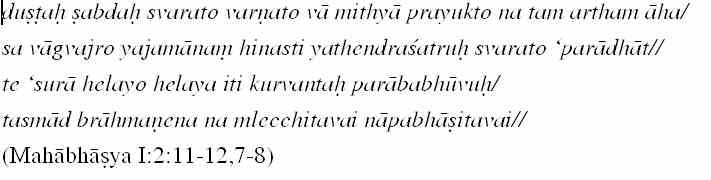
A word defective in accent or phoneme is a sound used incorrectly; it does not convey its purpose. Speech is like a thunderbolt, striking at the sacrificer who mistakes “who is slayer” for “whose slayer.”

The asuras, shouting “Ememies, ememies!” were overpowered. Therefore, a wise man will not speak a language that is not his own or pronounce words incorrectly.

translated from the Sanskrit by Motýlí Voko


Sanskrit poemThe sacrificer is Tvashtr the Creator whose three-headed son Vishvarupa the Multiform had been killed by Indra the Conqueror. As a punishment, Tvashtr excluded Indra from drinking soma, the magic juice, during the sacrificial rituals. Indra, nevertheless, sneaked in and drank most of the soma. The magic juice made him sick and gushed from all of his openings. Tvashtr, livid with rage, took the juice that was left and poured it into the sacrificial fire chanting “May the one whose slayer is Indra grow!” (The correct formula would have been “May the one who is slayer of Indra grow!”)

When the juice reached the fire, a being possessed of the powers of fire and juice sprang into existence. Since he developed while rolling (vrt), he was called Vrtra the Roller, and since he had no feet, he became a snake. Because Tvashtr said “grow!” Vrtra indeed grew, consuming food wherever he extended, pushing the oceans back. Indra bribed fire and soma with cakes to come over to his side. Powerless, Vrtra lay shrunk like a leather bag emptied of its contents. When Indra rushed forth intent on killing him, Vrtra pleaded with him: “Do not kill me, for you are now what I was before. Only cut me into pieces, do not make me disappear.” Indra replied: “Okay, you will become my food.”

The asuras and the devas were offsprings of Prajñāpati, the Lord of Wisdom. When it came to dividing the inheritance, the asuras claimed speech, the devas asked for mind; the asuras received the earth, the devas got the sky. The devas plotted against the asuras, asking Mind (he) to make a move at Speech (she). Despite initial failures, Mind seduced Speech, who came over to the side of the devas. The asuras, cut off from their chief weapon, babbled “Ememies, ememies!” and were crushed by the devas.

adapted from the Brahmanas by Admiral Babočka


About the lines and the stories they refer to: The science of grammar, the principle branch of Indian linguistics, builds on the ancient Vedic distinction between correct linguistic usage, which produces sounds that have the power to bring about reality, and incorrect usage, which reduces language into an impotent tool of daily communication. The Brahmanas are fascinating texts that, through a vast range of interpretative techniques, attempt to make sense out of the magic juice-driven creations of the Vedic seers.

Jan Vihan is a contributing writer for In The Fray.


Green in the face

If an Israeli group wants to march in New York, do you allow Neo-Nazis into their parade? If African Americans are marching in Harlem, do they have to let the Ku Klux Klan into their parade? … People have…

If an Israeli group wants to march in New York, do you allow Neo-Nazis into their parade? If African Americans are marching in Harlem, do they have to let the Ku Klux Klan into their parade? … People have rights. If we let the [Irish Lesbian and Gay Organization] in, is it the Irish Prostitute Association next?

—John Dunleavy, chairman of New York’s St. Patrick’s Day parade, telling The Irish Times why lesbian and gay marchers should be kept off the streets, in the closet, on the other side of the rainbow, etc.

There are rules to follow when making analogies. One is that they be logically consistent. To my knowledge, there are no Israeli Neo-Nazis, or African American KKK members. But there are Irish gays and lesbians — including New York’s newly elected council leader, Christine Quinn, who condemned Dunleavy’s remarks.

Just how petty can the parade’s organizers be? They banned not just the Irish Lesbian and Gay Organization but also the Irish Lobby for Immigration Reform, an advocacy group supporting undocumented Irish immigrants (an estimated 40,000 in the U.S.). Perhaps the organizers forget that many of their ancestors were terribly persecuted immigrants themselves, who escaped famine in their own land to face racism and poverty in America — back at a time when America’s borders were open and there was no such thing as an “illegal alien.”

That said, I have to admit I can’t get too worked up over this parade issue because I find all parades to be boring. I’m sure there’s something I’m missing here. But really, what’s so exciting about standing outside in frigid weather watching grown men in funny costumes walk down the street and wave? It’s so 19th century.

Which basically sums up the mentality of the parade’s organizers.

Victor Tan Chen

Victor Tan Chen is In The Fray's editor in chief and the author of Cut Loose: Jobless and Hopeless in an Unfair Economy. Site: victortanchen.com | Facebook | Twitter: @victortanchen


Joe isn’t always wrong

Let me start by saying that I think Joseph Lieberman is a sanctimonious, backstabbing, spineless opportunist, one of those wretched politicians who make their living attacking their own party.  Digby documents an all-too-typical Joementum move.  Let me also add that I’m perfectly happy with conservative Democrats, even when they have to vote against things I believe in to keep their districts happy.  It’s not the positions Lieberman takes that are infuriating, it’s his parroting of Republican talking points.

But this goes too far, as does this.  Supporting the right of Catholic Hospitals to refuse to offer contraception or abortion is not equivalent to supporting rapists, nor is it even equivalent to supporting those positions themselves.

Basic freedom of conscience in this country allows individuals to act on their own morals, so long as this does not directly harm another and is not discriminatory on inalterable ascriptive characteristics like race.  Refusing a woman contraception may not be moral in my mind, but it certainly falls within the range of legitimate moral decisions for someone else.  The same is true for the pharmacist who does not offer birth control pills.  Let the employer deal with it and keep the state out of the decision.

That said, definitely support Ned Lamont.

Pete DeWan


On being ghetto fabulous

Being fashionably ghetto fab these days is all about relating. Relating to the streets, to the hard knock life, to the college dropout. And fashion takes that relating into the world of retail, where what you wear is more important than who you are, and what you’re wearing declares that you’re down. When being fabulous means being ghetto, the fashion world once again co-opts culture, first from hip-hop, then Asian culture, then Latino culture, to co-opting what it means to be poor.

Fashion takes the creativity and ingenuity that comes from being poor and uses it for its own means. When J. Lo was riding on the six, what do you think she was wearing? Not the fur-soaked line of clothing she’s peddlin’ these days. But today’s underprivileged young girl is now expected to outdo herself — she’s the fashion icon who’s flat broke. She’s expected to show us the way to ghetto fabulousness. And how? By scraping together the scarce funds for a Fetish skirt, a Baby Phat top, or a pair of AKADEMIKS jeans. And for what? To look like what she already is — to look like she’s from the streets.

But dropping a couple of fiddies for a piece of mass-manufactured clothing to look like you know the ghetto life is not only counterintuitive, it’s counter-creative. Growing up poor involves creativity that comes from NOT having, not from buying a carefully crafted image of what “being ghetto” is supposed to look like, courtesy of a coddled celebrity.

But that’s not the message in fashion. Fashion takes what it likes and maligns and terrorizes it into submission until any meaning of culture is gone. Putting Buddha on a t-shirt does not a Zen master make. Taking a spiritual figure revered by millions, whose wisdom has been studied and time-tested for thousands of years, and reducing him to a fashion statement? Or turning the sounds of frustration and inevitability of hip-hop into a quest for mo’ bling, mo’ money, mo’ designer labels that a kid from the street can’t afford?

It’s good to look poor is fashion’s message, just as long as you’re not. Otherwise, how’re you supposed to buy all the brand-name crap they’re selling?

They say people in fashion are creative. Yet just as everything and everyone else, ideas have to come from somewhere. And drawing upon the resourcefulness and inventiveness of kids living in poverty to make a fashion statement isn’t very original. And it sure as hell ain’t ghetto fabulous.

Desiree Aquino

personal stories. global issues.