Homecoming

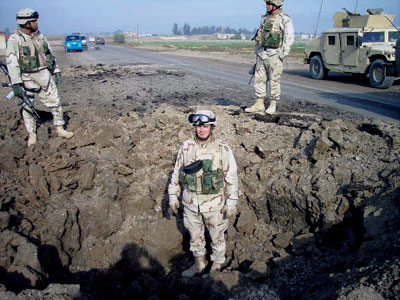
An Iraq war veteran returns on the Q train.


I thanked a fellow soldier for dropping me off at the train station. The man behind the glass waved his hand when I tried to pay the fare and pointed to the metal door. I smiled and hurried to hop on the train.

The Q train would take me right where I wanted to be. For the first time in almost 16 months, I was on the subway. Everything looked too familiar. The only strange thing was my clothing. My desert uniform, faded from the bright Iraqi sun and stretched from frequent washing; my worn-out boots, rucksack on my back, and the look on my face surely gave me away as a soldier returning from overseas.

I struggled to be oblivious to the curious faces turned toward me. I had no desire to answer any questions or acknowledge them. I was enjoying the ride, knowing that I would not return to Iraq ever again. Though familiar, the surroundings looked different, as I imagined they would after my absence.

The real reason this particular ride felt so different was that I was traveling on my own. There was no company of comrades by my side. I also missed the feel of my assault rifle’s sling around my shoulder.

I challenged my mind to think about something else. But how could I? I caught myself eyeing every movement, every detail around me, not because I expected something to happen, but because I had learned to be observant.

It was one hour before midnight, yet there were so many people out — not an unusual sight in Brooklyn. In some 30 minutes, I would be walking into my parent’s place. My wife was also expecting me there. I could hardly picture what it would be like to see them. They would never stop asking questions.

Just then, I noticed a poorly dressed couple drunkenly arguing with each other as they entered, their voices rising above the drumming of the wheels. The sleepy passengers stayed clear and disregarded them. Two teenagers with coffee cups raced over to the empty spot on the bench near me.

A person can expect anything to happen on a train in Brooklyn at that hour, I thought.

The doors opened and closed. My mind raced back. I remembered Iraq, the last evening when I was sitting outside the tent before boarding a bus to the airport. An explosion could be heard in the distance beyond the wire. I didn’t care. There was nothing I could do. For me, it had been scarier waiting to go on patrol than actually patrolling. But that evening I rejoiced because I had finished my tour, I wasn’t going on patrols anymore, and I was ready to fly home. As usual, it was more than 90 degrees that evening. The blazing sun and stifling heat emanating from the ground made it difficult to stay alert for a prolonged time.

The heat-trapping bulletproof vest and gear added at least 20 pounds on me. Soldiers complained about the weight and discomfort, but wore them during missions and inside the camp when ordered. At the end of every patrol, I always appreciated cool air. That was in the past now.

Holding the handrail, I glanced over my right hand and recalled the patrol on a hot day in May when an antitank grenade and another explosive were thrown at the vehicle I was driving. That day, it was my turn to drive the last vehicle in convoy. The grenades carry a copper charge that, when heated, turns into plasma that can slice through armor. This particular charge penetrated the transparent armor in front of me and stopped inches from my hands. Later I found small, burned dots over my sleeves.

The adrenaline rush was surreal. Such charges are the most lethal weapon used against the coalition forces in Iraq. I couldn’t believe how lucky I was as I stared at my bloody hands. The dust and smoke all around made it nearly impossible to discern whether everybody was alive. The blown-up tires added to the frenzy, as I tried to control the vehicle. The explosions damaged the gunner’s ear, but otherwise we were okay. Then the pain settled in. It was nothing I couldn’t tolerate, but my hand swelled and I was unable to use it for a few days.

When we finally stopped and secured the area, I was surprised to find that Iraqi civilians weren’t afraid. In fact, it was just the opposite. They gathered around, watching mostly in silence. It was not the first time we had come under attack, but this was the closest I had come in harm‘s way. The attackers dispersed, as they did most of the time, leaving us no chance to fight back. I was taken to a medical facility, and my patrols stopped for a while. I found out later that no useful information had been obtained from the bystanders. I didn‘t blame them.

I was glad to learn that the gunner did not sustain serious injuries in the attack. My hands also healed in time. The speck — shrapnel too small to be surgically removed — could be seen on an X-ray of my right hand. Although the incident happened more than five months ago, I remembered it clearly.


The train exited the tunnel and was approaching a stop. The doors opened, and the cool night air rushed in. No new passengers entered the car. Those who remained inside seemed oblivious of me as well as of everything else around us. The quarrelling couple was silent, and the teenagers looked out the window behind them. A few seats became available, but I chose to continue standing. I had spent too long sitting on a bus, traveling to the armory where the army finally released me.

As the train started to slow, the teenagers became anxious. I would think it normal to be uneasy traveling without supervision at their age, but there was something unusual in the way they jumped up when the train halted. Before running out, one of the kids threw the coffee cup, aiming at the tipsy woman in the corner. Neither the passengers nor I flinched. The cup missed, hitting the wall above the woman’s head. The lid flew off, the cup’s contents splashing over the woman, who muttered something under her breath. I kept a sharp eye on the kids, as they ran across the platform toward the staircase. The train then made a clucking noise and started to leave the station.

I was surprised at how calm the passengers, including the couple, were.

There was no perceptible way to know whether anybody cared, even though they clearly saw what had just happened. With the exception of a bulky man asleep with headphones, all the passengers looked as if they were stoned. For a few brief seconds, they moved their eyes slightly in the direction of the distressed woman, who tried to brush off the liquid. The man across from her paid no attention. Nothing followed but the beat of the moving train.

I stood there shocked, thinking that an action like that could get a man killed in a war zone. There was no way to know what the kid had in his hand. It all happened too fast. I was surprised to find myself standing motionless, not dropping to the floor or looking for concealment.

But it didn’t matter. The train was carrying me closer to my destination.

I haven’t seen my family since December when I had a two-week furlough.

I got off the train at Kings Highway. Almost home, I was delighted to be back.


Covergirl

When a beauty ideal meets the real.

‘b better in the morning’ by artist David Choe

I am 11 years old, sitting in my sister’s car. It is my “special day.” She is applying lipstick at a red light with the expertise of someone who now goes to college. The light turns green and she sticks the lipstick tube between her front teeth and reaches to change gears. Trina drives a stick shift. She is strong. I’m going to drive a stick shift.

“Here” she says, and hands me the tube. My heart tap dances. “It’s more orange-red,” she says without looking at me, “you’d be better in blue-red.”

Trina drives with the window down and doesn’t care if her Sun-In blonde hair whips her in the face because she knows she is beautiful. When I am done smearing this wondrous substance across my lips my hands are still shaking. Trina says, “Just throw it in my purse” and I do, slowly, so I can get a good look inside. I see her powder case and study the colors of her eye shadow, imagining them on my almond shaped eyes. I ask her what the plastic pink compact is and she says, “None of your business” and grabs her purse from my hand and tosses it in the back seat. As usual, I’ve pushed my luck.

At the next stoplight the truck in the lane to our left revs its engine. The front seat is packed with high school boys. I know this because they have the same Hilhi Spartan’s decal on their window that my older brother has on his clarinet case. They glance our way – Trina’s way – and call out, “Hey, you,” and I waffle between shrinking and desperately wanting to be seen ‘cause I’m wearing lipstick! Trina laughs with a wide opened mouth, head tossed back, braces finally off, killer laugh, and says, “Hey what?” And I think, BRILLIANT. She always knows just what to say!

The boy leans out the window, his hand resting on the mirror. A hand that looks wide enough to cover the entire surface of my face. I imagine this briefly and think of my lips leaving a fresh mark on the palm of that boy’s hand and my cheeks turn red. But I know he isn’t looking at me. It’s gonna take a lot more than orange-red lipstick.

The light has turned green and I am ready to have my sister back, but she has shifted slightly in their direction, both perfect breasts pointing their way. The radio is playing ROCK and I try desperately to move coolly, inhibited by the seatbelt Trina insists I wear. Her shoulder strap fits ideally between her perfect breasts and makes her t-shirt even tighter. My t-shirt is long and baggy and covers my butt when I stand, and I have pulled my shoulder strap down under my right arm so it won’t rub against my neck (or accentuate the flatlands of my chest). In this moment, with that truckload of boys peeping in, I would give anything to have Trina’s breasts. I sit, trying to be relaxed and tall with my black bangs cutting straight across my forehead, the sweat beginning to form at the hairline. I wish we were moving.

The boys are still trying to get Trina’s number and I want to scream, “HELLO, THIS IS MY SPECIAL DAY! I GET TO DO WHAT I WANT AND I DON’T HAVE TO DO CHORES AND NO ONE CAN TALK IN CODE OR TELL ME TO SCRAM …” but I don’t. Instead I fumble through the cassette tapes shoved in the glove compartment and then I study the floor. There are empty tab cans, sugar free gum wrappers, and a Shape magazine. Trina is healthy. She works out at a gym where the women walk around the locker room naked and the bulky shiny men wear yellow spandex.

Finally we drive. Trina’s car smells of cigarettes and Angelfire, recently sprayed. She tries to hide her smoking habit from me because she knows somewhere deep that I will do whatever she does (and because she isn’t convinced that she is a smoker).

“I think the guy in the middle was checkin’ you out.” she says.

I start giggling manically, “NO WAY!”

“Totally,” she says, ”with that lipstick you look at least 13.”

While I want to believe her, I can tell she is trying to be nice because she starts biting her lip like she does when she’s nervous or LYING or has to sing a solo at church.

We park at the mall and I take crazy long Trina-sized steps to keep up. It makes my calves hurt. But I can’t slow down; can’t let her see that I am struggling. Trina is COOL. And when I am with her, when I can keep up with her, I am COOL.

I haven’t been to the mall since my mom took me bra shopping earlier in the school year and insisted on coming into the fitting room with me. Trina asks me if I want an Orange Julius and I say, “nah, I’m not hungry …” when I’m actually starving but I don’t want to mess up my lipstick.

We run into Fred Meyer’s (which is the kind of place where I can spend a whole summer’s allowance. It’s like, K-Mart meets Payless Shoes meets the Dollar Store). Trina needs nylons. I go with but veer into the make-up aisle scanning the rows of pretty plastic until I see it. Covergirl. YEAH. I am sweating and eager and breathless but cannot find a lipstick called BLUE-RED. BUT I do find the eye shadow that Trina wears and I feel so victorious I actually consider slipping it into my pocket and walking. But I don’t.

In line behind my sister, I hold my breath wondering if she will stop me from making this dangerously adult purchase. The cashier rings me up and I pull out my sparkly pink plastic wallet with the little mirror in the flap and fake rhinestone closure and think, someday I’ll have a red leather purse and matching high heels and credit cards and no bangs. I make eye contact with Trina and she smiles for a half a second and then she is easily distracted by Luke & Laura on the cover of Soap Opera Digest.

My hand is sticky as I hold the bag, and I tell Trina I have to go to the bathroom. “Meet me in the food court. I need caffeine,” she says, and we head off in opposite directions.

I am so close.

Once situated in a stall on the far end away from the door I wipe my hands on my jeans near the spot I have been trying to work into a hole. I get my wallet/mirror and then pull out my first ever Covergirl eye shadow. I peel off the back, careful not to damage the instructions. There is a diagram and I can see that I am just three easy steps away from changing my life FOREVER.

Step one tells me to apply the lightest shade to my entire eyelid. I do this while trying to keep the soft sparkly blue from dusting my black eye brows. Niiiiiiiice. [EXHALE] On to step two. I take the skinniest side of the application wand and the darkest shade and drag it across my lash line. I do one eye and then the next. (And then I go back and forth and back and forth trying to make them look the same! Eh, close enough.)

I am ready for step three. I read. Apply contour shade to the eyelid crease.

I grip the application wand and steady my gaze in the mirror.

I bring the wand to my eye.

And then I freeze.

Only now do I see it.

I have no crease.

No crease in my eyelid for the contour shade.

No place for blending.

No place to create depth.

There is no step three for me.

I will never be beautiful.

Ever. NEVER EVER.

The stall feels crowded, the walls are pressing in and I am dizzy. I slide off the toilet seat onto the cool tiles and lift the lid, resting my chin on the edge. My head could fit in that toilet bowl, I think. I could stuff my head in there … But then I envision Trina, having finished her diet soda (and maybe small fries if she plans on going to the gym tonight) LOOKING for me, making her way toward the ladies room, FINDING ME, face down … I wipe off step one and two and hurry to the food court. I can’t tell if Trina is checking me for signs of her eye shadow because I am careful not to look at her.

We start walking back toward the exit, and Trina catches her breath and says, “Wow, check him out, he’s from the gym.” She exhales, and I see the red rise in her cheeks, and she starts biting her lip.

Then everything goes SLO-MO.

I see, coming toward us, this amazing boy, no, this amazing MAN, with faded jeans slightly frayed at the edges, Doc Martins squeaking as he approaches. He has gorgeous guitar player hands and I nearly gasp audibly when he reaches up and pushes his thick chocolaty hair (a la Rick Springfield) away from his mile long lashes. This guy is magic and I can’t feel my feet.

Trina’s hips sway with each step. The GUY slides his guitar player hands deep into his pockets. Trina flips her Sun-In blonde hair over her shoulder with a carelessness that I know she does not feel.

And then, when the GUY is inches away from Trina, I see him lift his chin slightly and smile a flawless “never even needed braces” smile UP at Trina. He is now at a complete stop, body turning in towards her, an opening line poised on his stubbled, recently licked, lips.

But she doesn’t slow down, doesn’t smile. I slam back to reality as we speed away from the magical guy. A few seconds later Trina says “Too bad.” I’m so confused. What flaw does she see in him that I can’t see?

We are almost to the car when she says again, “Too bad.”

I stay completely silent, hoping she will forget I am there and just keep talking.

“You’re lucky you’re short.”

I don’t answer because I am sure that she is making fun of me.

“You’ll be able to date anyone you want,” she says. “It totally SUCKS to be this tall.”

I am surprised. And DELIGHTED. I steal a glance at her. My beautiful sister. Then I notice for the first time EVER how she slumps her shoulders when she walks, like she’s apologizing for being WAY UP THERE.

And I think of the family picture we recently took. Trina is center, the edge of the shot just skimming the top of her head. I am in front of her, little and cut off at the knees. Neither of us FITS. I imagine someone pulling the camera back just slightly to accommodate both of us, so you can see ALL of me and ALL of Trina.

Trina notices me noticing her and winks.

“Yeah, they’re gonna love you.”

Maybe, I think. And then we walk. And I take me-sized steps all the way back to the car.


A summer of gracious living

A luxury safari in Kenya proves that modernity and the Maasai can live in harmony.

Reticulated Giraffe running. There are three subspecies of giraffes that live in East Africa: the Reticulated, whose spots are very clearly and cleanly marked; the Maasai, who are the tallest (up to 18 feet), darkest in color, and with spots going all the way down their legs; and the Rothschild, who are slightly smaller and lighter in color and have white “stockings.” (Marian Smith)

Matasha’s daughter squealed in delight when she saw the image of herself on my digital camera.  

The miniature screen showed her — the tallest child in the group — surrounded by almost ten other skinny, dusty, grinning children. Matasha, my Maasai guide, towered over them, tall and proud, his robes a bright pinpoint of red against the brown and tan colors of the savannah.

In the background appeared the interior of Matasha’s family compound. A massive fence of gnarled, sharp branches enclosed a cluster of round huts made from dung and sticks. The family corralled its herd of cattle in the middle of the huts each night, protecting them from the lions that roam the stretch of plains between Kenya’s Chyulu hills and the majestic Mt. Kilimanjaro.  

This was Campi ya Kanzi, 400 square miles of Maasai-owned land bordering the Tsavo West and Chyulu National Parks near the Amboseli Reserve in Kenya. Last summer, I stayed there with my boyfriend, Dan, and various members of my family, for four days at the beginning of a three-week-long safari through Kenya and Tanzania.

I squirmed the first time I saw where Matasha lived, unable to fathom why anyone would enjoy living in a hut made from dung. But at the end of my three weeks in Africa, after staying at other safari camps, I came to realize that the Maasai at Campi ya Kanzi were more than content with their traditional lifestyle and the dung huts that came with it; their culture was successfully withstanding any encroaching Westernization.

But I also realized that this fortunate state of affairs was allowed to happen only rarely. At most of the camps, ecotourism was simply a substitute word for high-priced wildlife-viewing expeditions. Locals weren’t given any stake in this version of tourism as nature conservation. At the same time, any notion of trying to preserve the local culture was practically unheard of. It was only at very few places, such as Campi ya Kanzi, that a pampered stay didn’t leave me with an uneasy conscience.

At Campi ya Kanzi, guests slept on feather pillows and Italian linens, enjoyed indoor plumbing in our canvas tents, and were supplied with soft white robes and slippers to wear at night. Each day, we woke up to a soft “Good morning” and the smell of freshly brewed coffee and sweet biscuits waiting on a tray on our private porch. During the day, we drove through endless miles of rolling bush, picnics packed in the trunk of our jeep, looking for wildlife with the help of our expert Maasai guides. And as the orange African sun began to set, we stopped on hilltops for our regular “sundowners” — wine and snacks — before heading back to camp.

The camp was the dream-come-true of Luca and Antonella Belpietro, a young couple from Brescia, in northern Italy. Ten years ago, Luca convinced Antonella to leave her chic life in Italy for the raw beauty of Kenya — the place where Luca had traveled extensively as a boy. Together, they discovered the Maasai-owned land in southern Kenya and formed a partnership with the 3,000 herdsmen living on it. With the Maasai’s help, Luca and Antonella built a main house and six cottages — with thatched roofs, rough wooden beams, and canvas sidings — for a maximum of 14 guests at any one time. They named the place Campi ya Kanzi, which means “Camp of the Hidden Treasure” in Kiswahili, and then invited people to come and see why.

Matasha, my Maasai guide, in traditional dress of red robes and beaded necklaces and bracelets. The spear in his right hand was with him always, a customary protection against wild animals when walking out in the bush. (Will Ebert)

Sustainable safari

Before I came to Campi ya Kanzi, I had been on a safari before, in the enormous Kruger National Park in South Africa almost 10 years ago.

I went with a friend’s family, and we stayed in unmemorable huts and drove ourselves around in a jeep, trying to avoid the seven-car pile-ups in which one or two cars would spot an animal and then five others would gather to form a rather — if I may say so — obnoxious crowd.  

This was no Kruger.  

For starters, there was only one other family and a honeymooning couple besides my family at Campi, and Luca and Antonella treated all of us as their personal guests. On our first day, they settled us into our tents, showed us around the grounds, and educated us on the history of the place. They also made very clear the camp’s mission — to raise money for schools and healthcare for the Maasai living anywhere within the extensive property, and to protect the wildlife.

That first day, Antonella explained that the wood for the camp’s construction came from sustainable tree plantations in nearby national forests, and that the water purifying system had been built out of the ubiquitous lava rocks of the Chyulu Hills. An organic vegetable garden provided the kitchen with its own natural produce, and the diesel generator* only ran for a few hours each day. Cards in our bathrooms told us that the little bottles of shampoos and soaps were biodegradable.

With an Italian eye for style, Antonella had decorated the lodge and the tents with local and traditional art: Beaded collars with strings of shells, ornate masks, and wooden carvings. Inside the main house, overstuffed sofas surrounded a large stone fireplace and heavy wooden chairs looked out across the open veranda to the mountains in the distance.

Most other camps lacked Campi’s rustic yet comfortable atmosphere.

Camp Kirawira in Tanzania, actively promoted its British colonial history, offering guests elaborate silver tea services laid out by local waiters wearing drab, grey uniforms and white gloves. Oriental carpets and old gramophones decorated the main house. Sure, the guides spoke flawless English and knew the Latin names of all the animals, but something didn’t feel quite right when a khaki-wearing man told us his tribe was Maasai. “Really?” I thought to myself and wondered where on the Serengeti he had bought his tan safari boots.

At Campi ya Kanzi, the Maasai were free to be themselves, red robes, spears and all. Along with the wildlife, they were the camp’s greatest assets.

Once, when we were in the bush on a game drive, Matasha called out to Stefano, our other guide and driver, to stop the jeep — he had seen an animal in the distance. I scanned the horizon eagerly, but even with binoculars glued to my face, I couldn’t see much besides trees and bushes.

Matasha said something to Stefano in Maa, the Maasai language.  

“Ah, yes,” Stefano said, looking into the distance with his own pair of binoculars. Then he translated. “A young giraffe — Maasai — born maybe three months ago.”

I continued to look, all the while silently grumbling to myself. Then, something miles away moved, and sure enough, through my binoculars, I could just make out the silhouette of a young Maasai giraffe, one of the three main subspecies that can be found in East Africa. My binoculars were no match for Matasha’s eyesight, however, so I took his word for it that the animal was three months old.

Matasha’s daughter, center, wearing my hat and sunglasses. Other children surround her, and in the background is the gnarled fence that forms the corral for the family’s cattle each night. (Will Ebert)

Conversations about conservation

At dinner time, the whole camp — all of us guests, Luca, Antonella, their three-year-old daughter Lucrezia, Stefano, and sometimes a few of the Maasai guides who spoke English — sat around the large wooden table in the main house. Animal sightings — herds of elephant, gazelles, giraffes, and zebras — were discussed at great length as was the more serious issue of introducing certain rare species back into the region.

On one such evening, Luca told us of some poachers who had hidden the skinned carcass of a hartebeest — a kind of antelope — in a large bush in the hills of the Maasai land. He guessed that the poachers came from the Wakamba, another tribe that competes for resources with the Maasai, often resulting in tension between the two tribes. Luca resolved to gather a team of Maasai to go find the men.

The fierce ownership Luca displayed that night was equal to that of the Maasai, even though Luca is essentially a guest on their land. The two parties have built an extraordinarily strong and respectful partnership, and that is what makes Campi ya Kanzi unique in my eyes. Of the $425 per person per night fee, $30 goes to a charitable foundation that supports the Maasai culture — Luca meets with representatives from the community several times a year and together they decide how to allocate funds to schools, healthcare, and social projects. The rest of the money goes to sustaining the camp and its employees, and paying the salaries of the Maasai who work there or as scouts, patrolling the land for poachers.

In this way, as the Maasai work to conserve the wildlife on the reserve, they benefit from even the smallest number of tourists. In 2000, Luca and Antonella also set up the Maasai Wilderness Conservation Trust that contributes specifically to wildlife adoption and to reimbursing the Maasai for any damages to their herds caused by predators.

Showing the Maasai the benefits of protecting lions in particular was difficult at first since cattle, which the lions hunt, are the Maasai’s livelihood. Dowries are given in cattle, boys are given their first cows when they formally become men, and families are considered wealthy only by the number of cows they own. But slowly the Maasai have come to realize that the more lions there are, the more consistent the stream of tourists contributing to Campi ya Kanzi’s trust which, in turn, helps preserve the Maasai culture.  

Years ago, Luca told me, a Christian missionary group tried to help the Maasai by building them a well so they would always have water. But after months of grazing their herds of cattle only on the surrounding grasses, the Maasai found that the land had become parched and the well was providing less and less water. The missionaries had meant well but their lack of cultural understanding blinded them to ways of helping that would still allow the Maasai to continue living their traditional nomadic life.

Matasha’s daughter, center, in a green dress, surrounded by other children. Behind them are two traditional huts constructed of dung, mud and sticks with a thatched roof. Inside, it is almost pitch dark and there are only a few fist-sized holes in the walls to let in light and release smoke from a small fireplace that burns in one corner. In the background is the corral’s fence, and behind that are the Chyulu Hills. (Will Ebert)

The pride of the Maasai

As guides, cooks, guards, and caretakers, the Maasai employees of the camp are not making their living by traditional means. But they do return to their villages on weekends and periodically throughout the year, and with the support of the foundation, they are all very likely living as closely as they can to their nomadic heritage.

When Matasha invited us to see his village, it became clear how respectful this reciprocal relationship between tradition and tourism can and should be. The visit with his family was not part of the tour — he was not being paid to show us a slice of Maasai life. Rather, he invited us as his guests. Matasha and his extended family live in essentially the same way his ancestors have lived for generations, and he was happy to show us the culture he was fighting to sustain.

In the dusty corral, Matasha’s wife watched over the assortment of children. By now, they had managed to extract the sunglasses and hat from my head and were gleefully chasing one another in their attempts to try them on. With his colorfully beaded wooden stick — a rungu — signifying leadership and power, Matasha motioned us toward one of the mud huts. Beaming, he told us it was his mother’s house.

Thinking about that day now, I can’t help but recall how the other safari camps spelled out in their brochures what it was like to visit a traditional village with their guides. They advertised it as an authentic experience, a unique opportunity to see where and how tribespeople had been living for generations. But when we realized that these “visits” actually entailed crowds of tourists piling into little vans to descend on these “villages,” where dollars could buy the beaded necklaces and postcards conveniently on display, we refused to sign up. It didn’t sit right, especially after Matasha had so generously invited us inside his own mother’s hut, where she slept, cooked, and lived her quiet life.

I must admit though that when I first saw Matasha’s home, it was difficult to reconcile the fact that I would be going back to a furnished, comfortable tent that night, while Matasha’s children would pile into their dung hut at bedtime. But seeing how happy they were — how proud — to live the way they did, brought home the fact that I was the only one feeling embarrassed about the disparity in our sleeping arrangements. Matasha and the other Maasai working at the camp saw the luxury of the guests’ lodgings every day, but they weren’t jealous. To them, our lifestyle was just another way of living.  

Part of the beauty of traveling is learning to look at things from a new perspective, however clichéd that sounds. For the rest of my stay at Campi ya Kanzi, I stopped feeling guilt-stricken when I returned to my tent at night. That I slept on a feather pillow was of little consequence to the Maasai at Campi. Rather, what mattered to them (and to me) was that my visit was helping sustain a traditional way of life they did not want to lose. My conscience slept easier after that.

Matasha‘s daughter, center, in a green dress, surrounded by other children. Behind them is Matasha‘s mother‘s hut, constructed from dung, mud and sticks with a thatched roof. To the left is Stefano, Luca‘s long-time friend from school in Italy, who works at Campi ya Kanzi as a guide. (Will Ebert)

Correction, April 7, 2006: This article originally misstated that Campi ya Kanzi uses a solar-powered generator for a few hours each day. In fact, the camp uses a regular diesel generator for a few hours each day when it needs to run some heavy-duty appliances. The rest of the time, it uses solar-powered electricity. (Go to the corrected text.)


How many strikes?

The streets of New York are tough. They’re even tougher when you’re a homeless, transgender teenager.


Every Friday afternoon, the Ikon Model Management agency in Manhattan holds an open call for aspiring models. The tiny waiting room fills quickly with applicants who sit, legs tapping, on cushioned benches. Lemonade walls and the endless trickling of a waterfall create an atmosphere of false serenity. The receptionist types primly and pretends the applicants aren’t there. Everyone stares suspiciously at one another.

Today, Kimy was lucky enough to get a seat. With her black hair and cowboy boots, she looks like a dark shadow against the sugary sweetness of the décor. She’s six foot three and thin. Spidery eyelashes veil her gold-specked green eyes, and what little skin she does reveal — her face and hands — glows warm and brown. People on the street often ask her if she’s a model, which is why she’s decided to try and actually become one — that, and the money is good.

A woman in pearls and kitten heels finally appears. She starts accepting portfolios, but Kimy didn’t bring any photographs — the website states that none are needed to apply at open calls. “Sorry, we need photos,” snips the pearls. Out of luck, Kimy packs up her things and leaves.

Kimy is tired and doesn’t have enough money for a MetroCard. She walked over twenty-five blocks to get here and has no permanent residence. Kimy is also biologically male, which she thinks might be the reason she hasn’t been able to break into the modeling world so far. Being a homeless transgender teen does not make it easy to get any sort of break.


Morning rituals

At a quarter to eight in the morning in west Manhattan, the air by the freeway carries the balminess of early spring and the crisp chill brought by the night. There’s the dull pungency of gasoline fumes and the slapping of tires on asphalt. The traffic thickens as the sun comes up, shining on commuters hurrying to work, the rush of taxicabs, and footsteps.

Sylvia’s Place, a few blocks from the West Side Highway, shares a small space on 36th Street with its sponsor, the Metropolitan Community Church, next to a run-down Best Western hotel. This is where Kimy lives, at least for now.  

For transgender teens like Kimy, Sylvia’s is a rare refuge. A quarter of the youth at Sylvia’s are transgender and the atmosphere is safe and caring, although oversubscribed. Exact numbers are hard to come by, however, because no one is really counting. “Good statistics don’t exist,” says Pauline Park, chair of the New York Association for Gender Rights Advocacy. “The relevant government agencies don’t give a damn about transgender people, and that is the simple reality.”

For the last ten years, Park has been lobbying for city and state agencies to track transgender issues, especially among youth. They won’t do it, she says, out of fear of political ramifications. “Many of these agencies are headed by political appointees who say they’re not under legislative mandate to deal with the issue,” she says. “But the real reason is they won’t do it is because they’re political cowards. Transgender kids are out on the streets and it’s a huge problem, but if they did a formal survey, then there would be an argument for doing something about it.”

The last time anyone counted seems to be 2003, when the Empire State Coalition of Youth and Family Services estimated that up to 7,000 of New York City’s homeless youth are queer-identified. If that’s the case, it could be the reason why Sylvia’s Place is so packed, with less than 80 beds throughout the city shelter system designated as “safe beds” for LGBT kids. And even those beds, according to Kate Barnhart, the manager of Sylvia’s Place, aren’t really safe — especially for transgender kids. “There are very few transgender people in the shelter system, because they are not welcomed there,” she says. “But there are lots of transgender homeless people, because it’s fucking impossible to get a job as a transgender person.”

Some shelters have non-discriminatory policies regarding sexual orientation, and in fact, a citywide policy was recently adopted to specifically protect against LGBT discrimination in city-run shelters. But these rules seem to do little to prevent actual harassment. Kate says transgender youth are regularly subjected to beatings and verbal abuse. “In some places, the staff actively participates in the harassment,” she says. “In others, the staff allows the abuse to go on, and just looks the other way.”

New York City’s largest general population youth shelter, Covenant House, has a reputation among shelter workers for being blatantly homophobic. In fact, Covenant regularly rejects so many LGBT kids that the counselors at Sylvia’s refer to former Covenant residents as “refugees.” (The last time Kate did a formal count, she had received 15 refugees in a two-month period, triple the capacity of Sylvia’s ten beds.)

When Kimy was at Covenant a few months ago, she asked the intake counselor whether being transgender would be a problem. “The counselor told me that transgender people are allowed in, but they always cause lots of trouble,” she says. A Covenant House spokesperson categorically refused to comment on allegations that the shelter discriminates against LGBT kids, and also declined to say whether Covenant has a non-discrimination policy or designates beds for LGBT kids.

Even Sylvia’s place, haven that it is at night, bars its doors during the day. Technically, the kids are supposed to be gone by 7:45 a.m., but the counselors do what they can to delay putting the kids back out on the streets.  

On Wednesdays, a free medical clinic affords them a few extra hours of sleep, since the volunteer doctor doesn’t arrive at the site until the working day has begun. The kids can sleep in the rectory of the church, where there are chairs and a couple of couches.

This morning Kimy crashes in an armchair, her lanky frame sprawled in the light filtering through the windows of the church. She’s not a morning person, and she rarely gets more than six hours of sleep anyway. Today she’s lucky: the doctor is late due to traffic. When he arrives, he flips on the fluorescent lights and rouses the groggy kids, who are rubbing their eyes and groaning. They shuffle out into the receiving room to wait their turn. Most of them slump into the folding chairs and pull sweatshirt hoods over their faces.

But Kimy can’t get back to sleep. She pilfers through a brown paper bag from the shelter for breakfast: a couple of crackers and a can of apple juice. She pulls a book from her black satchel and reads silently as she waits, tapping her weathered boots on the floor. She hitchhiked from New Mexico to New York City in these shoes.

Two hours later, it is finally Kimy’s turn. The doctor treats her for a mild cold. Kimy doesn’t feel very sick, but her guttural cough has persisted for months, and she thought she should complain about something while she had the chance to get help. “It sucks to get sick in New York City,” she says. The doctor continues to ask questions, her date of birth, whether she identifies as a man or a woman. “I’m a guy,” shrugs Kimy, as if in defeat.

A scale in the corner catches Kimy’s eye, and she begs to stand on it. Appalled to find she’s gained 20 pounds since the last time she weighed herself, she laments having indulged in the “little things” — presumably the meager snacks doled out by the shelter — though her clothes hang limply on limbs that look like toothpicks. Kimy has been hospitalized for eating disorders. She knows she’s not fat — daily, she eats less than one full meal — but nonetheless, the discovery ruins her day.  She leaves the church swathed in a black trench coat, even though the day is steadily warming.

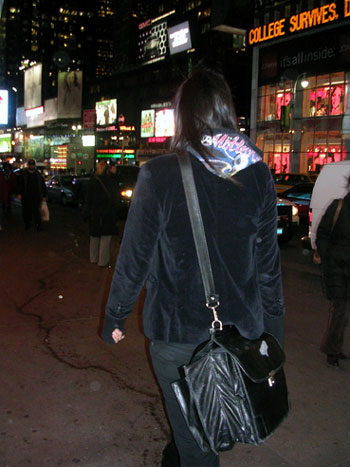
Then it’s out onto the streets. Times Square, just a few blocks away, glitters with its usual panache, choked by tourists and Midtown office workers. Kimy merges with the crowds, a full head taller than most, her gait regal, her expression blank. She saunters purposefully, though she doesn’t really have anywhere to go. The day stretches out, endless, nagging. Limitless, and at the same time, stagnant. Her hips, in the pinstriped pants and rhinestone belt she wears every day, swing from side to side, and the heels of her boots click, click, click on the pavement. But from whom to bum the first cigarette of the day?


Turning tricks

Transgender teens face the same problems as the larger transgender population, of whom a disproportionate number are homeless. Many are kicked out of their homes when their parents discover them cross-dressing.  Once out on the streets, it’s even tougher to gain and keep a job: Even if transgender people have identification, it often contradicts how they appear. One set of clothes quickly goes ragged, which doesn’t help either. If the kids don’t immediately fall victim to street violence — a looming danger, with society still largely intolerant of ambiguous gender or sexuality — they’re likely to turn to prostitution.

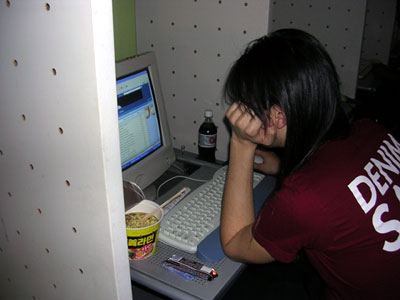
The Easy Internet Café in Times Square has become both a haven from the streets and a thriving social scene for homeless kids in Midtown. Like everything in this city, the scene is vast: The Empire State Coalition has estimated that there may be as many as 20,000 homeless kids in Manhattan alone. Nestled between Madame Tussaud’s and McDonald’s on 42nd Street, at three bucks an hour, the café provides an affordable way to pass the time.  Working in groups, the kids can easily bum a few dollars in change, and share the computer time between each other.  Plus, it’s warm inside.  Although the café’s food counter serves overpriced lattes and pastries, which the kids can’t afford, the smell of espresso and baking bread adds to the feeling of being somewhere “normal,” escaping the drafty chaos of the shelters.  

The café also provides a way to make money. Online prostitution doesn’t require an interview or nice clothes.

“The Internet café really has become an addiction for these kids,” says Kate. “It’s a dissociative, escapist thing.”  It’s gotten so bad that the counselors at Sylvia’s have started lecturing the kids about “café reduction,” reminding them that they have to go out in the world and get things done if they’re ever going to get out of the shelters. Kate worries about the prostitution she knows is negotiated in the cafés, and tries to encourage phone sex if they’re going to go that route — at least then, the kids are less likely to wind up with an STD, or get assaulted. “But these kids have limited choices,” says Kate, “and I have nothing else to offer as an alternative.”

Usually, Kimy spends several hours a day — however many she can buy — scouring the Internet for potential clients.  Back in the small Utah town where she grew up, Kimy made $10 for oral or sometimes anal sex when she first started turning tricks.  All that seems a long time ago.  Kimy’s parents, whom she describes as educated and intellectual, but “uncomfortable” with her sexual identity, know she’s homeless, but they don’t know she’s turning tricks. Kimy’s too proud to tell them: She doesn’t want to be tempted to take their money. Anyway, here in New York City, she can make more than she used to, because the clientele is often comprised of Manhattan businessmen with money to spare.  

But Kimy’s rates haven’t gone up by much. She says she recently made $50 for oral sex with a man in the back room of his office in the Empire State Building, her usual rate for blowjobs.  She’ll do full sex for $100, though many of her friends charge twice as much.  “It’s pathetic, I know, because everyone else is making hundreds of dollars for the same work,” she admits.  “It’s just really easy money.” Sometimes Kimy is selective about her work — not taking offers she feels aren’t worth it — but in times of desperation, she’ll take anything she can get.

Watching Kimy negotiate online tricks is like watching a mad scientist at work. She typically posts on several different forums, using carefully crafted language to attract clients, and has seven email accounts to handle the massive volume of mail she’ll receive within ten minutes of placing her ads.  

Substituting a dollar sign for the letter “S” signals prostitution, and certain words are triggers.  “Men like to hear words like soft, warm, young, tight,” Kimy advises.  This time, her post reads: “Tall $en$ual Beautiful Young Fre$h Tranny Need$ Financial Help.  Can and will do anything.  6’3, 160 pounds.  35, 28, 34 (ouch), slim warm body, long dark soft straight hair.  Can do ANYthing.  Meow!”

The screen is quickly littered with instant message pop-ups.  Kimy responds to each one while simultaneously refreshing her email accounts to read and reply to various offers.  She composes flirtatious responses, but her comments aloud — “I hate men,” “losers,” “I hope you all die; I hate you all” — reveal her true feelings.

Kimy says that even if lots of things about being transgender are hard, there’s an upside: It’s easy to find “straight guys” — otherwise known as “tranny chasers” — who’ll pay money to sleep with you. That’s why so many homeless transgender youth end up doing sex work, according to Pauline Park. “There’s a huge underground tranny chaser scene, made up mostly of professional white men,” she says. “Many are married but don’t view sex with a tranny as cheating on their wife because ‘it’s not a real woman.’ They want someone feminine but functional — a chick with a dick.”

Tranny chasers mean fast cash for kids like Kimy, who — while biologically male — puts up a demure, submissive front. And in a strange way, her customers also provide emotional reinforcement. “Male-to-female transsexuals tend to be particularly self-critical,” says Park. “What’s more validating than having a man pay for your femininity?”

But Kimy doesn’t like to talk about things like that, preferring to stick to business. Her bidders are filtered according to their financial prowess.  Those who won’t pay enough, she firmly disregards.  “This is where it becomes like a business transaction,” she says as she types furiously.  “Like trading stocks and bonds.”  She induces floods of offers by saying she’s got a “tight asshole” and that sex will hurt her, which isn’t untrue.  “They always have to poke around a lot,” she admits.  “I have no feelings when it happens.  No one can get inside of me. They try and try, but they can’t get in.”

Before Kimy can close any deals, her computer time runs out.  None of her friends are around today to bum a few more minutes online.  Yesterday, one of the guards kicked them out for being rowdy — the same guard who routinely pays her friends for sexual favors and harasses the group, Kimy says, because he knows they’re homeless.  She’s filed a complaint, but so far it hasn’t done any good.  Spotting him in the corner, she makes a quick exit before he sees her and makes a scene.



Dress up

All her life, Kimy has wanted to be a girl.  She remembers her older sister calling her “Alice” and dressing her in girl’s clothing.  At some point, she began wearing those clothes on her own, and she thinks her parents probably suspected she was gay as early as age 4.  By age 13, Kimy had abandoned cross-dressing and instead become obsessed with the idea of getting a sex change operation.  “I’ve always hated this thing between my legs, and wondered why I have it,” she says.  At one point, she was so frustrated that she almost took scissors to her penis and chopped it off.  

“Transgender kids who are poor or homeless have little realistic hope of accessing medical care, let alone hormones,” says Shannon Minter, Legal Director for the National Center For Lesbian Rights and board member of the Transgender Law Project. “Street hormones and black-market silicone injections are relatively accessible, but dangerous. But people are in pain, and they’re facing an overwhelming desire to physically transition, so they end up taking desperate measures.”

Even those who aren’t poor may fall into these traps.  Most health care plans won’t cover hormones or gender reassignment surgery.  Yet surgery — or the stated intent to have it — is one of the factors needed in many states to formally change the gender on one’s I.D.  That’s why so-called “pumping parties” — like Tupperware parties, only with silicone injections — have become so common.

Kimy, by the time she was 16, wanted the operation so badly that she started stealing to save up for it.  Things were getting worse with her parents, who she says, “just wanted me to be normal.”  At first, Kimy just took little things, but eventually she stole computers, cars, and even a cash register.  Finally, she got caught.

Kimy was sent to a juvenile detention center for a few months — a place where she says she had never seen “so many penises” in her whole life.  There were times when she was almost raped, but she was lucky enough to have some of the other inmates on her side to protect her.

Soon after she got out of jail, she got into a fight with her stepfather.  He told her that Utah wasn’t the place for someone like her, that he didn’t want her in the house anymore.

She had nowhere to go.  “I just kept thinking to myself if I were a girl, none of this would have ever happened,” recalls Kimy.  “I wouldn’t have had to steal things in the first place.”  

Kimy took off in a stolen car with a male friend who had fallen in love with her.  He told her he wanted to take her away, to take care of her, to never let anyone hurt her again.  “We were bouncing, heading east towards Oklahoma,” she says.  “He said he had family there that we could stay with.”  They got as far as New Mexico before they were both arrested for possession of drugs and car theft.  In the local jail, Kimy says, there was a lot of sexual activity going on.  An incident — she classifies it somewhere between rape and consensual sex — occurred.  Ever since that time, she has hated sex, and men.

When Kimy was released, people on the street told her to get out of their town.  She reads tarot cards, and the cards told her to go east.  So she began hitchhiking her way to New York City, exchanging sexual favors for rides.  

There was a lot of walking, and it was cold.  She hit the city in December and spent the first few nights on the streets, crashing on the stairs of the subway entrance where the warm air wafts upward.  “The whole time, a stubborn attitude was going through my head, that I could do this,” she says. “I didn’t sleep all night.”  Another night she was able to sleep inside Penn Station, where the cops are more lenient.  She had $40 in her pocket and a pack of cigarettes.  

Kimy decided that during the daytime hours, she should walk around the city and get used to it, get to know it.  She didn’t have anything else to do, and she needed to do something.  But the winter nights were getting brutal.

She found a phone book and looked up the names of shelters, beginning a phase of constant transition and instability, being bounced from bed to bed.  At St. Agnes, the boys flashed their penises at her.  At Covenant House, a group of kids beat up her straight friends for hanging out with her.  While younger generations on the whole are increasingly tolerant of gays and lesbians, many kids — like the rest of society — still think transsexualism is weird or freakish. The need for LGBT “safe” beds and places like Sylvia’s underscore the threat of violence.  Instead of the perpetrators being punished, Kimy and her friends were kicked out.  That’s when she came to Sylvia’s Place.  She had just turned 19.


A bored and broke tourist

Sometimes, Kimy walks for hours.  If she has an appointment to go to, or someone to meet, she’ll often circle the block to kill time.  When the weather is bad, she’ll ride the subways.  Better to keep moving than to sit still and have time to think.

“Being homeless sucks,” she says.  “It’s like being a really bored tourist with no money every single day.”  Central Park is a decent hangout, but “there’s a lot of really strange people there.”  Often, in the park or along 42nd Street, religious fanatics snarl comments at her, calling her either Jesus or Satan.  Wherever she goes, people notice her.  But Kimy just wants to remain unseen.  “Most days, I just try and hide.”

The New York Public Library is a good hiding place.  On cold days, Kimy often reads there for hours in a deserted wing.  Plus, the library has free Internet access, even though it’s cut off after half an hour and the connection is agonizingly slow.  Kimy heads there now, hoping to close one of her deals.  

A few months ago, Kimy had a real job selling newspapers.  But she got too much harassment being on the street.  One man approached her, saying he wanted her to work as a messenger.  It ended up that he just wanted her to be a stripper.  She had sex with him for money.  “It was disgusting,” she says, as she logs on to the library’s ancient computer with sticky keys.  “He wanted to touch my private parts and I hate that, but I had to let him do it.”  She lost the newspaper job soon after.  

It’s tough to get a job in this city, and even tougher without an I.D.  Kimy’s was stolen a few weeks ago by a boyfriend she thought she could trust, and she doesn’t have her birth certificate or proof of address to get a new one. He also took all of her art supplies, her CD player, and what few clothes she had.

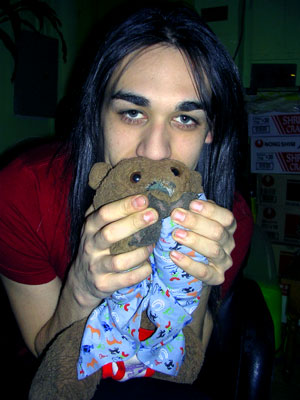
Kimy’s just grateful he didn’t take the one thing in the world that means the most to her: her teddy bear, Cubbins.  “I’ve had him since I was four years old.  He gives me a purpose for living,” she says.  “I take care of him.  I treat him as the child I’ll never have, even though he’s a stuffed animal.  He’s the reason I don’t commit suicide.”

Suddenly, Kimy gets an email offer from a guy who saw her leaving the Internet café.  He wants to meet her in ten minutes for a blowjob.  Kimy agrees.  Hastily, she finishes up the one personal conversation she’s been having — a boy she often talks to online, but has never met.  With time running out, she signs off with “I want you to hold me.”


Transformations

Kimy meets her potential trick, a tall man in a business suit, standing outside of the Easy Internet Café.  They talk for a while, but eventually Kimy tells him she doesn’t want to go through with the deal.  He’s offering her $50, and with the cost of the hotel room where they’d have to go at this hour, she’d only be making $25.  She doesn’t want to do the deed for that price.  “I would have felt terrible about myself afterward.”  With no prospect of Internet use and no money, she bums a smoke and heads to Virgin Records to zone out.

Music is Kimy’s sedative.  It is also her source of creative inspiration.  Kimy’s dream is to be a fashion designer and have her own studio, where she can create personalized designs for her clientele, who would come to her.  Then, she wouldn’t have to go out in public very much.  She could stay in her own little world.  

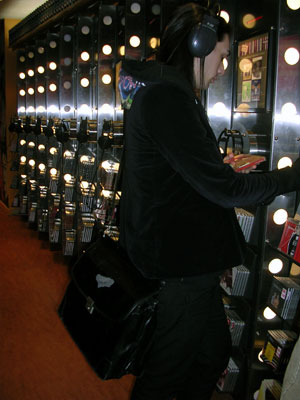
When Kimy listens to music, she sees models strutting down runways in her head.  She transposes these visions into a black sketchbook she carries with her everywhere.  Without her CD player, she now comes to Virgin and hangs out in the trance section.  She puts on the bulky black headphones and stands still, letting the sounds wash over her, like a tall, dark phantom, bothering nobody, hoping not to be noticed.  

Afterwards, the warm weather allows Kimy to head to Bryant Park to sketch the design she’s just conceived.  “I wish I could just videotape what’s in my head and show it to everyone,” she says as she neatly lays out her colored pencils on the small table.  She no longer has the luxury of her expensive acrylic paints and brushes, which were among the possessions taken by her boyfriend.  She thinks he probably just threw them away.

It’s lunchtime: a chocolate pudding cup and the rest of the crackers from this morning.  Kimy draws a black dress with a plunging open back connected by strings of diamonds.  The wind billows through her shoulder-length black hair, the afternoon light glinting on the auburn ends of a faded dye job.  “Oh yes, this will be really easy to make …” she murmurs.  For a moment, she’s somewhere else.

Late afternoon, done with her sketch, Kimy heads to the fashion district to look at fabrics and sewing supplies, things she dreams of buying one day.  It’s another one of her escapes.  She can spend hours in these stores, surrounded by cotton and silk, fingering the different textures, imagining how well this or that material would work for her latest designs.  

Kimy has been drawing for as long as she can remember. “I see things happening in my mind.  I want to transform things, and that’s why I’m always really quiet,” she says. “I want to make everything in my head happen in reality.”  But fabric isn’t cheap, and Kimy doesn’t have money anyway.  So she touches the fabrics delicately, lingering, as if trying to memorize how it feels to hold them in her hands.

Tomorrow, she says, she’s going to be productive.  She’s going to go get her food stamps, and maybe try to find a job.


Meat and potatoes

On a Sunday night a few weeks later around dinnertime, Sylvia’s place is quiet and empty. It’s warm and smells of cooking. Some of the kids are next door attending church services.  Others won’t arrive until the midnight curfew. Kate stands at the kitchen countertop elbow-deep in ground beef.  The kids sometimes help out with the cooking, but the duty mostly falls to Kate and the overnight counselors.  Flour dust coats her green housedress as she prepares the meat and sets it to bake in the oven. Then she scrubs a dozen potatoes and seasons them with salt and pepper.  

Meals here are usually simple. The kids are always hungry, and they’ll eat pretty much anything. Sometimes, Kate treats them to her special pot roast. One of the counselors, Frederick, is rumored to cook the best homemade macaroni and cheese in town. Even the gaunt, wiry Alicia, a transgender resident, says she’s put on 10 pounds by eating Frederick’s food. Usually, though, dinner comes courtesy of the food bank, and that means meat and potatoes.

A kid comes knocking at the gated entrance, begging to be let in. “It’s not opening time yet, Ron. You know that,” Kate reprimands. Ron says he’ll clean and do chores if she’ll let him in. It’s cold outside. Finally, Kate relents. “Oh, alright.  I don’t believe you, but alright,” she grumbles, unlocking the gate. Ron, a kid with bleached hair and tattoos, bounds inside like an overeager puppy, his wallet chains jingling loudly. He sits down next to the table where food is laid out for the weekly church social and starts picking at the Saran Wrap. “I’m just fixing it!” he explains when Kate tells him not to touch. But he stays there, staring at the food, as she washes the dishes.

Kate sees lots of turnover, but lots of kids end up coming back to Sylvia’s. Many youth create their own little families on the streets or in the shelters after being kicked out of their homes. “There is a huge amount of resilience among these kids, but they do end up adopting a homeless mentality,” says Kate. “All of their friends are homeless; their identity becomes homeless. They end up being lonely when they get housing.”

An hour later, church is out and the shelter is filled with people. They stand around socializing, holding plastic plates full of grapes and sponge cake and leaning against the file cabinets labeled with names where the kids keep their clothes and any belongings.

In a few hours, this space will be filled with metal cots, the blare of a large television, and kids passed out under piles of blankets, trying to sleep away the day. In the midst of the festivities, a quiet teenager in a too-large coat comes knocking at the door. Someone lets him in and finds Kate, who takes him aside and starts writing down his information. The shelter’s ten beds are full, but he doesn’t have anywhere else to go.

Teenagers like the new arrival gravitate towards Kate. They seem to know that she cares. A decade of work in the New York City shelter system has gained her a reputation among queer-identified homeless kids because those who welcome them are so rare. “Rape is pretty common among these kids,” says Kate. “So is post-traumatic stress disorder. There’s also the depression that results from being part of a marginalized community, a sense of limited opportunities. The only visible transgender people right now are either performers or prostitutes.”

For kids like these, Sylvia’s is a haven. Kate watches them move in and out of the iron gate and sees their sadness and pain. “There’s a concept in Judaism, Tikkun Olan,” she explains. “It’s as if there is a glass sphere, a globe, that has been dropped on the floor and shattered into a million pieces. We each pick up little pieces of glass, and slowly put the world back together.”

It’s nearly curfew, and the churchgoers have gone home. Kids lounge on the cots watching television, and Frederick is doing the dishes. Kate sits at a table doing paperwork.

Kimy steps outside for one last cigarette before bedtime. She’s wearing flannel pajama pants and clutching Cubbins. Her hair, wet from the shower, falls in its natural waves against her shoulders. She laughs, recalling a conversation she had earlier this evening with Kate, when they were discussing what it would be like if people had tails. They imagined some people would cut their tail-hair into fashionable styles, some might dye it odd colors, while others might let it grow long and bushy. It was a good moment and those are rare.

Kimy takes a drag on her cigarette and says, “I feel like I’m in a pit right now. I can’t get an I.D. because I can’t get my birth certificate. I can’t get a job.” To make matters worse, as she was walking down the street this afternoon, a man leaned out of his car window and yelled, “Whore!” at her. She tried to ignore him, but it hurt. She called her parents crying a couple of times, but was too proud to take the cash they offered.

It’s time to go in. “I feel stuffed,” Kimy says, putting out her cigarette. “Like someone has sewn me Victorian-style into this body, and I’m wearing a big coat, and I just want to shed it, and I can’t.” Tomorrow she’ll begin again. She’s heard of another modeling agency, one that might be interested in her look. She’s heard they don’t require pictures.


An update: Kimy finally got her birth certificate. She was hired at Banana Republic, and started interning for a fashion designer on the side. She saved up enough cash for a room in Harlem. But when she kept showing up for work late, she was fired. Unable to make rent, Kimy has started turning tricks again, crashing at Sylvia’s or in the apartments of the men who hire her. She’s trying to save up for a bus ticket to Montreal, where she thinks she might have friends.


American dreaming

Jason DeParle aims a critical eye at welfare reform during the Clinton administration.

Arkansas Governor Bill Clinton rode into office with the promise to “end welfare as we know it.” Now, a decade and a half later, the first complete, non-partisan review of his efforts — and those of opposing party leader Newt Gingrich, whose Contract with America offered his own party‘s version of welfare reform — has appeared in Jason DeParle’s American Dream: Three Women, Ten Kids, and a Nation’s Drive to End Welfare.

DeParle, a senior writer for The New York Times who reported extensively on welfare in the 1990s, takes readers on a whirlwind tour of the evolution of welfare at the federal level, beginning with President Franklin Roosevelt’s original initiative to provide benefits for poor (and, implicitly, white) widows to care for their children and racing up through the 1980s, when welfare was viewed as a national apology for the abysmal conditions of 1960s housing projects and the social maelstroms they had created. By 1996, when Clinton, himself a lower-income success story, and Gingrich were in power, public approbation for “ending welfare” (a phrase whose genealogy DeParle also traces) was at an all-time high, and Congress sought a solution that would empower states to cleanse their own rolls. While Clinton”s plan emphasized federal job creation as a way to cushion the transition from welfare to work, Gingrich’s placed the burden of planning on individual states to decide how they would reform their own programs.

In the end, the country ended up with an amalgam of the two plans and DeParle’s book follows three different women from Milwaukee who found themselves on the welfare rolls in the early 1990s. The choice of Wisconsin was not accidental; Republican Governor Tommy Thompson, a nearly unknown candidate for public office, emerged in the late 1980s using an anti-welfare platform to end decades of Democratic governance in the state, and was held up by Clinton as a leading light of welfare reform.

Wisconsin was the site of an early skirmish over welfare in the 1990s after a wave of Chicago recipients moved to Milwaukee, where the benefits (under the then-Democratic government) were better and the cost of living was lower. Three of those Chicagoans — Angie, Jewell, and Opal, all cousins — form the meat of DeParle’s narrative, and provide a narrow but useful portrait of the welfare system as it stood when Clinton took office. All of the women came from families who, within the space of a few generations, migrated north from sharecropping farms in the Mississippi Delta. DeParle wisely steers away from comparing the patronage system of Jim Crow farming and the mechanics of the welfare state, emphasizing instead the drive of Angie’s grandmother and her siblings to make a better life on Chicago’s South Side. It is that same spirit that drives Angie, Jewell, and Opal to Milwaukee, where they find a house with a forgetful landlord and, with their welfare checks, settle in with their children — until the state’s W-2 Welfare to Work plan disrupts their comfortable lives.

Or that’s how conservative critics might have pictured it. The most surprising finding of DeParle’s book is that, while the three women continued to draw welfare checks until the state directly cut them off, they were often employed part-time, if not full-time, on the side in order to make up the difference between their check and their family’s needs. When job-oriented counseling started to take the place of classical check calculations, recipients would often omit jobs from state-reported forms — but would continue to work instead of just relying on their benefits. Angie, for example, was enrolled by the state in the employment-search program JOBS (Job Opportunities and Basic Skills), where she diligently recorded businesses she called and job contacts she made, without divulging her temporary nursing work.

In Jewell’s case, only five months passed before the state “found her second job” (thanks to better software), but her enrollment in the JOBS program wouldn’t have provided a stable welfare check for long anyway; the specific classes she was required to take were continually cancelled, making it impossible for her to matriculate into an actual job with this state-mandated training hanging over her head. All three women rejected the “community service jobs” — wageless work designed by Wisconsin administrators to give welfare recipients the impression of working for their benefits as, not surprisingly, a waste of time better spent at a job with take-home pay.

The book’s last third describes the welfare bureaucracy in Milwaukee as it existed in the late 1990s, focusing on the for-profit administrator Maximus, whose financial malfeasance would later make headlines. These private agencies were responsible for the implementation of Wisconsins welfare reforms, for better or (usually) for worse. Maximus represented a triumph of bureaucracy over positive individual change: Opal, for example, was asked about her “employability plan,” not about whether she had a job. Case workers, who were often more adept at paperwork management software than at real-life advice, felt no pressure from the state to cut welfare rolls once they had already fallen some 90 percent, and would frequently cut their clients a check rather than pursue them individually to make sure they were following through on their job search objectives. Ironically, this is just the kind of abuse W-2 was designed to prevent. With five private welfare-implementation organizations in the metro Milwaukee area in the late 1990s, graft and mismanagement of funds were easy to hide even as case workers couldn’t get equipment and training for their clients.

Woven through the women’s stories are those of their boyfriends and husbands, whose instability often contributed to financial insecurity. Angie’s boyfriend was in jail awaiting trial when she moved to Chicago, and Jewell’s drug-dealing boyfriends were unwilling to commit to her except when serving short prison terms. In Opal’s case, her spiraling addiction to crack cocaine was aided and abetted by a sometime boyfriend and dealer. DeParle notes that while almost 75 percent of women leaving the welfare rolls worked at some point in the next year, by the end of the 1990s, only half of lower-income black men were similarly employed. The booming economy may have lifted Angie’s and Jewell’s boats but it left behind the men they loved, creating an ironic commentary on the original intention of welfare.

Yet just getting a job — the effect of “ending welfare as we know it” — didn’t necessarily change these womens lives as people might have expected. Gingrich conservatives who tout marriage as a social stabilizer would be disappointed to discover that of the three women, only Jewell saw getting married as a solution to her financial problems, and continued to manage alone when a nuptial opportunity never arose. And Opal, whose drug problems seemed evident to everyone except her case worker, drifted in and out of jobs, staying just long enough to make a little money and then disappearing on two- or three-day drug binges. Even Angie, a nursing assistant and the longest employed, didn’t see herself as a champion of the W-2 system. She might have seemed like “that American hero, a working-class stiff to proclaimers that welfare reform had worked” — Angie did leave the rolls, after all — but she tells DeParle, “I never think about shit like that! It means I be a broke motherfucker for the rest of my life!”’

DeParle makes it clear that welfare neither solved the women’s problems, nor exacerbated them with its absence. But the margin by which it improved the lives of Angie and Jewell is an important one for policymakers to take note. It’s hard to challenge DeParle’s math when he figures that, because of payroll taxes and food stamps, Angie only made $3,400 more off welfare than on, even though she was earning almost $10,000 more per year. And that measurement didn’t take into account work-related expenses like uniforms and transportation, or the loss of her health insurance (although her children were allowed to stay on Medicaid).

As Barbara Ehrenreich’s Nickel and Dimed exposed, the minimum wage in most states can’t realistically keep a single-income family above the poverty level. As a piece of social engineering, then, the minimum wage can be a great upward mobilizer; as a viable “minimum on which to live” it makes a mockery of women like Angie who, without their GEDs, can’t expect to get a higher-paying job. When Clinton said, “People who work shouldn’t be poor,”’ he made a promise that has yet to be fulfilled by state help.

American Dream is so crammed with history and narrative that DeParle leaves little space to offer a full prescription for remedying what welfare reform has wrought. But the federal and state systems of aid that have “replaced welfare have never lacked for prescribers” — only for a complete description of symptoms. In the end, policy wonks from both sides of the aisle should find in DeParle’s reportage lessons which may be applied to any aid implementation, from how to quell the furor over the new Medicare prescription plans to the joint federal and state efforts it will take to rebuild the Gulf Coast after last year’s hurricane season. “


If we leave our gods (part two)

Those were the good days when a man had friends in distant clans. Your generations does not know that. You stay at home, afraid of your next-door neighbor. Even a man’s motherland is strange to him nowada…

Those were the good days when a man had friends in distant clans. Your generations does not know that. You stay at home, afraid of your next-door neighbor. Even a man’s motherland is strange to him nowadays.

—Chinua Achebe, Things Fall Apart

On Wednesday I wrote about Chinua Achebe’s book Things Fall Apart, and its relevance to modern-day struggles between old and new — specifically, the recently renewed debate over evolution, which pits religious doctrine against scientific knowledge.

I should be clear about one thing: By humanizing deeply flawed men like Okonkwo, Achebe is not telling us that we should wax nostalgic about the old ways. It would be foolish to forget the cruelties of that past society. But it would be foolish, too, to forget why Okonkwo clings so desperately to his culture’s disappearing traditions — or, for that matter, why men and women of a similar mindset today persist in certain beliefs about the origins and history of life in spite of scientific evidence to the contrary.

When I used to cover religious issues as a reporter, I saw these reasons firsthand. The church is, above all, a community, and tradition is the bedrock of that community, the shared language, imagery, and philosophy that make communication, and communion, possible. It is not surprising that today’s most fervent defenders of the old doctrines — evangelical Christians in this country — have some of the most tightly knit communities of faith and the fastest-growing congregations. Especially in regions of the country (or world) that have yet to hear the good news of this new era of global markets, the good news of scripture adds real, undeniable value to people’s lives.

Perhaps the clash of cultures in Things Fall Apart could have turned out less tragically, and we may hope the same for the current battle over evolution. (There have been some recent attempts to reconcile faith with science — take, for example, the Dalai Lama’s recent book, The Universe in a Single Atom, which attempts a dialogue between Buddhism and modern science, especially physics and genetics.) That said, the lack of understanding on either side does not bode well. We see the terrible consequences of such ignorance in Achebe’s novel. The British overlords do not understand why the Igbo persist in their “primitive” customs, and their intransigence forces a confrontation that ends in death.

Particularly illuminating is the description of one zealous missionary, the Rev. James Smith, who insists there is no reason to compromise with or accommodate the heathens. “He saw the world as a battlefield in which the children of light were locked in mortal conflict with the sons of darkness,” Achebe writes. It is not hard to see a similar kind of combativeness on both sides in the recent debate over teaching evolution. On one side are those who disdain science; on the other are those who see the religiously devout as “primitives” of another sort. What lies between them is shared misunderstanding. When Okonkwo and his fellow villagers confront the missionary, one of the men offers an apt description of their predicament: “We say he is foolish because he does not know our ways, and perhaps he says we are foolish because we do not know his.”

Near the end of Things Fall Apart, Achebe gives us more clues of what the old ways mean to men like Okonkwo. Giving thanks before a feast at Okonkwo’s home, his uncle Uchendu prays to the ancestors for health and children. “We do not ask for wealth because he that has health and children will also have wealth. We do not pray to have more money but to have more kinsmen. We are better than animals because we have kinsmen. An animal rubs its itching flank against a tree, a man asks his kinsman to scratch him.”

With all our modern technology and sophistication, humanity still hungers for connection and kinship. The old ways die, the new ways take root, but what happens to the community? That is the tragedy of Achebe’s book, and the challenge we face now, on the precipice of another transformation.

Victor Tan Chen

Victor Tan Chen is In The Fray's editor in chief and the author of Cut Loose: Jobless and Hopeless in an Unfair Economy. Site: victortanchen.com | Facebook | Twitter: @victortanchen


Idol worship and travels with Phil

You have to be pretty much a deaf-blind hermit to have never heard of American Idol.  It’s become one of those TV phenomena that defies criticism because it really doesn’t matter what I or anyone else says about it, the public will still tune in and watch as pop star wannabees warble in front of crazed family, friends, and fans-a-million.  Further down the dial is another competition show that pits pairs of people who know each other in a race around the world.  The Amazing Race is every bit as engaging and fun, but while the stage-bound Idol is predictable and trite, the Race is unpredictable and fluid as the audience goes along on a fun and furious trek to exotic locales while discovering a little about the world and human nature.  

For all its plastic veneer, Idol isn’t just a talent show but a reflection upon the essence of what makes us American.  Oh, of course the show’s roots are British and the concept franchised in numerous countries around the globe, but that’s exactly why it is quintessentially American — Idol is the McDonald’s of television — full of idealism, hope, and the idea that with diligence and hard work, you can become successful.

It also represents the less attractive aspects of American culture — arrogance (see Simon), celebrity, obsession, and a disdain for those who may not fit our idea or image of success.  It’s also glitzy, processed, easily digested, and only satisfying to a point — much like a certain food product that sits on a sesame seed bun.  

What makes Idol popular is its adherence to classic theater, almost attune to the Roman arena. The intrigue isn’t just in the trenches but in the stands as the audience participates in the outcome of these singing gladiators who dodge the barbs of sometimes-harsh judges.   I must admit that I enjoy patronizing McIdol, but I’m also glad that it only lasts a few months because you can only take so much Ryan Seacrest in one season.

The Amazing Race is a different story.  At least for me, it is one of those shows that I can’t wait to watch each week and curse the TV when Phil Keoghan (the host) finally gives the bad news (most of the time) to the last players to arrive at the pit stop because it means it’s the end of the episode.  Race’s premise of not only pitting couples against other racers but against each other has helped the show win Emmy after Emmy, but it’s also the only show of its kind that ordinary Joes like you and me could realistically compete in and have fun at the same time — it is this empathetic probability of success that I believe is the reason people like watching Race.  There are physical and mental challenges along the way that can be quite scary, but they’re never over the top and many not-so-physically-fit racers over the years have proven that, when the adrenaline is pumping, you can do things you normally would never do, like bungee jumping or begging for money in a foreign land.

Like Idol, Amazing Race is theater but more like an off-Broadway play in a small Greenwich Village basement that holds twenty chairs.  You’re up close and personal as witness to the story of two individuals and how they keep from driving each other crazy. You have couples whom are married, dating, cohabitating, sisters, college buddies, father/daughter, etc.  They each bring baggage with them, and I don’t mean luggage, which, of course, makes the drama more interesting.  Though the reality of all these shows is somewhat tainted because the players are aware of the cameras and can’t help but play to them, the chaos and franticness of Race probably makes it the only show where it’s conceivable that the players actually forget that they’re being taped to be broadcast to millions of people.  You get a great sense that these folks are acting pretty much like they do during their everyday lives, and that’s refreshing.  My only advice to the producers is to put the Travelocity gnome to rest and find a less irritating tie-in sponsor, just not McDonald’s.  

Both American Idol and The Amazing Race are in the middle of their seasons, but it’s not too late to try them on for size.  You may feel guilty liking Idol, and the Race will find you pining for the overseas trip you’ve always dreamed of taking.  Oh, on the battle of the hosts, Phil Keoghan wins hands-down because anyone who can stand for hours next to some bizarre local representative waiting for racers to make it to the pit stop deserves praise and the paycheck that goes with it.

Rich Burlingham


California über alles

Way back in 1994, before I sadly left behind the Pacific Ocean for a grayer life on the Atlantic Coast, I lived in Los Angeles.  It seems hard to remember, but back then California had Republican governor Pete Wilson, memorialized in the Disposable Heroes cover of the classic Dead Kennedys song.

1992 had been the first year that California had gone Democratic since the 1964 Johnson landslide. Prior to that, it had been mostly a Republican state.  With the Republican dominance under threat, Wilson backed Proposition 187, an anti-immigrant political stunt that even the official state election guide described as a bad idea.  It won handily, as did Pete Wilson.

In doing so, though, the Republicans cemented their image as a reactionary and hateful party.  California flipped. It is now one of the safest Democratic states in the country.

The national Republicans seem like they are on the same course.  Cooler heads are trying to slow it down, but they still may pass an idiotic and cruel law.  At the very least, they are stepping up as the anti-immigrant party.  It may help them in the 2006 election.  Regardless, any law will almost certainly be ineffective, and the more vicious provisions will be struck down in the courts.  

If the Democrats play it right, which is always an iffy proposition, they have a chance to pull a California nationwide. With an anti-gay, anti-immigrant message, the Republicans place a whole number of close states at risk. Colorado, New Mexico, Florida, Ohio, and Nevada were battleground states in the 2004 election.  Have you been to these places?  Is bigotry really a good long-term strategy?

Keep your Alabamas, your Mississippis, your Idahos, and your Dakotas.  But watch out Texas, we’re coming for you.

Pete DeWan


Quote of note: House Republicans show concern for inmates

I say let the prisoners pick the fruits.—Rep. Dana Rohrabacher, Republican from California, …

I say let the prisoners pick the fruits.

—Rep. Dana Rohrabacher, Republican from California, criticizing a Senate bill that would provide an estimated 11 million undocumented immigrants the opportunity to become U.S. citizens. Rather than turning to immigrant farm workers, Rohrabacher said, the agricultural industry should instead rely upon the country’s homegrown inmate population, currently the world’s largest, at 2.1 million. Another House Republican, Rep. Steve King of Iowa, said that “anybody that votes for an amnesty bill deserves to be branded with a scarlet letter A&rdquo — reminding Americans of a kinder, gentler time in our nation’s history, when “witch hunt” was not yet a quaint figure of speech.

Victor Tan Chen is In The Fray's editor in chief and the author of Cut Loose: Jobless and Hopeless in an Unfair Economy. Site: victortanchen.com | Facebook | Twitter: @victortanchen


If we leave our gods

”If we leave our gods and follow your god,” asked another man, “who will protect us from the anger of our neglected gods and ancestors?”“Your gods are not alive and cannot do you any harm,” re…

”If we leave our gods and follow your god,” asked another man, “who will protect us from the anger of our neglected gods and ancestors?”

“Your gods are not alive and cannot do you any harm,” replied the white man. “They are pieces of wood and stone.”

When this was interpreted to the men of Mbanta they broke into derisive laughter.

—Chinua Achebe, Things Fall Apart

Continuing my occasional series, “Random Thoughts About Random Books,” I want to say a few things about Things Fall Apart, by Nigerian author Chinua Achebe, which I recently reread. This slim, sparely written book is so many things — a story of a family crushed under the weight of a father’s sins, a history of upheaval and subjugation in colonial Africa, a tragedy reminiscent of the Greek classics that speaks of the consequences of pride, a tale of violent conflict between sexes, classes, communities, and cultures. I can’t hope to do justice to its brilliance with the few words I have here. But I want to focus on one particular strand of Achebe’s masterpiece: what happens after new ways usurp the old, and those older traditions — and the communities they hold together — fall apart.

It’s a topic that’s been on my mind lately, now that this country’s perennial unease about change has found its way into the headlines yet again. This time, it has taken the form of theories of “intelligent design” and other efforts to salvage religious doctrine from the onslaught of Darwin’s theories. In Achebe’s novel it is the Christianity of the European masters that viciously clears away the vital undergrowth of indigenous tradition. Today it is science that is burning away dominant Christian beliefs — or, at very least, threatening to do so. (Fortunately for those who love doctrine, today’s defenders of the faith are much better organized than the villagers in Achebe’s novel.)

Things Fall Apart focuses on the story of Okonkwo, a determined and industrious man living in an Igbo community in what is now Nigeria. Bitter at the memory of his late father, who lacked ambition and died heavily in debt, Okonkwo has long dreamed of achieving wealth and status in his village and raising his sons to be strong, tradition-minded men. But Okonkwo’s hopes collide with the transformations that are taking place throughout Africa. Christian missionaries establish a presence in the village and turn young and old against the old ways. British imperial functionaries impose their own customs, beliefs, and laws, and brutally suppress dissent.

Part of the beauty of Achebe’s novel is that he does not come out on the side of the old or the new. While Things Fall Apart was written as a necessary corrective to simplistic, condescending depictions of Africans in European literature (it takes its title from the much-quoted poem by Irish poet William Butler Yeats that prophesized the destruction of Western European civilization by rising hordes of “uncivilized” peoples), Achebe does not depict the Christian missionaries, or the doctrines they preach, as evil. In fact, his portrait of Christianity is quite sympathetic at times. We see courageous Christians standing up to aspects of Igbo traditional life that are unjust and unethical. Twins are left to die in the forest because they are believed to be cursed. Men are taught to be stern, even cruel, with their (multiple) wives. The society’s lowest caste — the Igbo version of India’s “untouchables” — are kept at a distance from the so-called “free-born.” Those men and women who convert to Christianity in Okonkwo’s village choose to reject these unjust beliefs among their people, and Achebe acknowledges their bravery. He also spends much time in his novel depicting the plight of those harmed by the whim of superstition and custom — including, most tragically, one of Okonkwo’s adopted sons.

But Achebe also shows us how the death of tradition becomes the death of a community. The old ways were unjust, irrational, impractical — but they gave men like Okonkwo a sense of purpose, a bond of kinship, and a foundation on which to build their society. As the fabric of tradition unravels, so does the community. “I fear for you young people because you do not understand how strong is the bond of kinship,” one of the village elders says at one point in the book. “You do not know what it is to speak with one voice. And what is the result? An abominable religion has settled among you. A man can now leave his father and his brothers. He can curse the gods of his fathers and his ancestors, like a hunter’s dog that suddenly goes mad and turns on his master. I fear for you; I fear for the clan.”

I’ll continue this discussion of the book in my post on Saturday.

Victor Tan Chen

Victor Tan Chen is In The Fray's editor in chief and the author of Cut Loose: Jobless and Hopeless in an Unfair Economy. Site: victortanchen.com | Facebook | Twitter: @victortanchen


Free at last

Abdul Rahman, the Afghan Christian convert who was supposed to stand trial for apostasy — the penalty for which is death, according to Islamic Sharia law — has been freed on the basis that he is mentally unfit to stand trial. Rahman, a Christian for 16 years, converted in Pakistan while he was working as an aide worker and lived in Germany prior to returning to Afghanistan in 2002.

While he was deemed mentally unsound for trial, the Afghan authorities who arrested him two weeks ago would have struggled to put his case to trial under the glaring light of international scrutiny. Rahman may be mentally unsound, but the decision to declare him unfit for trial was probably the only way that the Afghan authorities could placate the international community while still maintaining its legitimacy.

A slew of nations expressed their revulsion and horror at the prospect of Rahman’s pending execution, with a glittering list of dignitaries pleading for his release, including Australian Prime Minister John Howard, U.S. Secretary of State Condoleezza Rice, Pope Benedict XVI, Canadian Prime Minister Stephen Harper, and Austrian Foreign Minister Ursula Plassnik.

While Rahman has escaped standing trial, it is likely that vigilante justice will now resolve the issue unless he successfully and immediately seeks asylum abroad. He was, after all, turned in to the authorities by his family, following a dispute. If the law refuses to execute Rahman, then the clerics will ensure that he gets his just dessert. Cleric Abdul Raoulf told his followers at  the Herati Mosque: “God’s way is the right way, and this man whose name is Abdul Rahman is an apostate.” According to Raoulf’s sermon, Rahman had “committed the greatest sin” in his conversion and ought to be executed.

The courts have effectively set a precedent, since this was possibly the first case of its kind in Afghanistan. While the legal decision that he is unfit to stand trial is interesting, what will be more interesting will be the reaction of the millions of ordinary Afghans. While Rahman has survived his first hurdle, the second — of religious conviction and vigilante justice — will certainly be harder to overcome.

Mimi Hanaoka


personal stories. global issues.