Two ebullient sisters

Twosisterssepia.jpgA photo of two great aunts serves as inspiration.

Twosisterssepia.jpg


repressed footnotes
on an archival page
resurrected by
genealogical research
and the discovery

of a sepia photo
that is no longer
portentously bound
the vignette
an uninhibited pose
of visceral youth

two ebullient sisters
that gaze out
with enigmatic smiles

and whisper yet the mosaic
of memories that
once defined their days


Footnotes

Freud steps off the printed page.

Allurement

Freud is at it again
probing what excites men.

It is not the size of the shoe
but the height of the heel

stilettos.

He watches the sophisticated pose
the way the wearer walks,

the sway of the hips
the shape of foot and leg.

Footnotes.


The martyrs are home

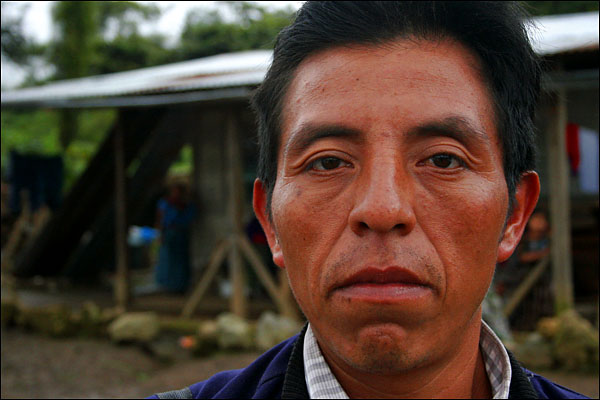
Martyrs01.jpgPost-war reparations in Guatemala.

Surrounded by coffins, ribbons, and three forensic anthropologists, families of victims from Guatemala’s 36-year internal conflict received their deceased relatives’ remains on January 25, 2007. The families fathered in a church in Xaxmoxan, Chajul, Quiché, Guatemala, finding closure more than two years after the National Coordination of Widows in Guatemala (CONAVIGUA) began compling witness testimonies from villages in the municipality of Chajul. During the internal conflict from 1960 to 1996, Quiché’s population suffered 263 massacres, according to the Recuperation of Historic Memory report, known as REMHI and entitled Guatemala: Never Again. In the words of one son who received his father’s remains: “This is a great moment. My father has arrived. The martyrs are home.”

[Click here to enter the visual essay.]


Flashbacks

Moving on. We all do at some point, often reluctantly. In this issue of InTheFray, we offer four perspectives on the timelessness of age, four flashbacks of a world that was and insights on the world that is.

ITF Travel Editor Michelle Caswell begins with advice on where not to spend your 30th birthday — unless, of course, you need A bad day in Cambodia to realize that aging isn’t half bad compared to living under the Khmer Rouge’s brutal regime. Speaking of getting older, ITF Contributing Writer Rhian Kohashi O’Rourke discovers that a woman with a head of white hair is not nearly as obsolete as young women fretting over that dreaded First gray hair seem to think.

We then turn to ITF Copy Chief Erin Marie Daly, who finds what has been lost in the world of digital music and, in the process, uncovers relics of the past in one of New York’s newest treasures, The Vintage DJ. And in Guatemala, James Rodriguez captures the pain and closure felt by families who lost relatives in the country’s 36-year internal conflict when they finally receive the deceased’s remains after a two-year wait.

Rounding out this month’s issue, Terry Lowenstein waxes poetic about the past and present while perusing a family photo album, observing fashion trends, and making the daily commute.

Coming next month: ITF’s take on the changing shape of language in the 21st century.

Laura Nathan
Editor
Buffalo, New York


A bad day in Cambodia

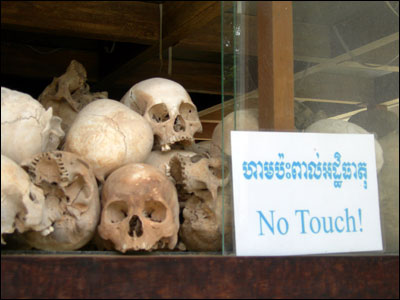
200703_ttlg2.jpgHow traveling puts turning 30 into perspective.

I had come to Cambodia to turn 30. My twenties were not nearly as fabulous as I had planned, and I needed a dose of perspective to shake the decade off. Nowhere is perspective so easily gained as in Cambodia, and nowhere is the Cambodian trifecta of poverty, corruption, and genocide more apparent than in the capital city of Phnom Penh.

After days of trekking around the exquisite temples of Angkor Wat in the northern countryside, Phnom Penh is a shock to my system. My husband and I see kids sniffing glue on the street, white men parading around with prostitutes, and legions of homeless people sleeping and bathing on the banks of the Ton Le Sap. Phnom Penh is a city of non-governmental organization workers, not tourists, and after two days, we are quickly running out of attractions to visit. Only two essential stops are left on our trip: S-21, the prison camp where many suspected spies were tortured by the Khmer Rouge, and the killing fields, where those same prisoners were executed and buried.

When the Khmer Rouge seized power, Phnom Penh was evacuated within two days. Khmer Rouge soldiers, some as young as 11, had the French colonial city at their disposal. They turned mansions into barracks, hospitals into weapon storehouses, and schools into torture centers. One such torture center was Toul Sleng prison, also known as S-21, a former primary school in what had been a quiet, tree-lined, upper middle-class suburb. Today, the S-21 complex is a museum. The surrounding neighborhood is full of barbed wire, stray dogs, and trash-littered gravel roads. It seems sketchy even for a city as lawless as Phnom Penh.

Our guide at S-21 is a quiet woman in her late thirties who lost most of her family during the reign of the Khmer Rouge. “First they killed my father,” she says, echoing the title of Luang Ung’s haunting memoir of growing up under the regime. The rest of her family was split up and sent to camps in rural areas at opposite ends of the country, she tells us. The guide and her mother were transferred to a camp near the Vietnamese border; they survived by walking to Vietnam in the middle of the night. The guide was nine at the time. She never saw her siblings again.

S-21 is a series of four four-story buildings, which, though worn and weather-stained, give no outward clues to the torture endured by 20,000 prisoners inside. One step into the first building, however, and we are immediately confronted with its grim history. The former classrooms have been divided up into cells, each with a rusty, sagging bed frame. Next to each bed lie cattle prods and other rusty instruments of torture. Fuzzy, blown-up black-and-white photographs reveal how each room looked when the Vietnamese army arrived to overthrow the Khmer Rouge: torched corpses chained to the bed frames, bodies unrecognizable. Wild pigs and rats had already eaten many of the bodies.

Our guide is surrounded by an aura of profound sorrow. She walks into each room, delivers a sentence or two about what happened there, and immediately turns and walks out into the open-air corridor to wait for us. It is as if she cannot handle an extra second inside the walls.

In one cell, the biggest moth I have ever seen flutters about. Its wingspan must be 12 inches, and its brown markings match the dust and rust inside S-21. The moth is eerily beautiful, the product of a warped ecosystem in which pigs scavenge for human flesh and children tote machine guns. I imagine the impossible: that this moth has been around for decades, flitting about this room, quietly watching the transformation from school to torture cell to tourist attraction. The moth reminds me that life goes on, even in the face of insanity.

Our guide leads us to the next building, where hundreds more black-and-white photos of prisoners are displayed. Like the Nazis, the Khmer Rouge kept meticulous records, photographing each prisoner with a numbered plaque upon arrival at S-21. Looking at these photos feels like staring into the eyes of ghosts, each staring back, aware of his or her rapidly approaching death. Out of the 20,000 people housed at S-21, only seven survived.

In the next building, we view an exhibit of present-day photographs of and interviews with former Khmer Rouge soldiers, most of whom are now middle-aged farmers, eking out an existence in the countryside. None of them express regret about their involvement with the Khmer Rouge. Many feel like victims themselves, having been recruited as child soldiers. No one, including these former soldiers, has ever been tried for the atrocities that took place under the regime.

When I ask my guide how she feels about the movement to bring former Khmer Rouge officers to justice, she looks at me with sad, scared eyes and says, “It’s very difficult to talk about politics in my country.” Apparently, more than two decades after the Khmer Rouge, the walls at S-21 still have ears.

Leaving S-21, we negotiate with a tuk-tuk driver to take us to one of the killing fields — former rice paddies where political prisoners were executed and buried in shallow mass graves. The killing fields are now a memorial, but active farms surround them on three sides. Barbed wire demarcates the farmland from the graves. Young boys stand behind the barbed wire, offering to pose as prisoners for the equivalent of $1. In Cambodia, where the average monthly salary is about $17, that is a tremendous sum of money. These kids — some as young as seven — are already master capitalists. Some tourists take them up on the offer, getting the perfect shot of Cambodian boys standing behind barbed wire.


The evolution of a pertinacious pedestrian walk

A simple commute brings unexpected pleasures.

A large tortoise meanders with a philosopher’s jaunt
as we and other vehicular traffic choose a path
that does not intrude on his scholarly dissertations.

On the tarmac that intersects academia
and commerce the chanced glimpse
of a bushy tail betrays the pilgrimage of a red fox.

In a moment he is gone, in fact his quick
flight is nearly missed by my two daughters.
For this day we are all fellow passengers
on the highway that unfolds before us.

Here too, are geese, unwelcome guests
who will not leave, with them, their offspring
no longer chicks, but rowdy adolescents
who swagger before stalled impatient drivers.

Further down the street a rambunctious rabbit
forgoes verdant sheltered paths to cross
the byway that dissects a neighborhood.

Later, in solitude on a pathway less frequented
by commuters, I chance upon a red tail hawk
and wonder at the width of its wing span.

Now, I wonder what else lies hidden?
What waits beyond the turn?
Or the rise in the hill?
Or just beyond my neighbor's fence?

More than expected sightings of possum
and raccoon, of this I am sure, for nature seems
to have evolved a pertinacious pedestrian walk
and claims the macadam as her own.


The Vintage DJ

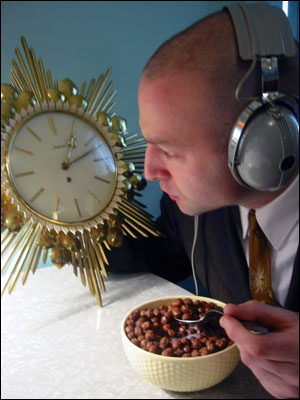
200703_vintage4.jpgSpinning the present into the past.


Click above to hear “Eleanor Rigby.”


If ever there was someone in need of a time machine, it’s Jonathan Jacobs.

Amid the buzz of bar talk and acid-tripping hipsters, Jacobs leans over two Audiotronics Classroom record players, circa 1950. His shaved head and crisp grey suit — and his bulky headphones — stand in stark contrast to the increasingly raucous crowd, which doesn’t quite seem to notice him as he moves, trance-like, over the magic machines. It’s a Valentine’s Day-themed bash in a drafty, multi-level Brooklyn warehouse, and people are warming themselves with $3 Pabst Blue Ribbon and pot brownies. A huddle of especially enthusiastic partygoers plays a pickup game of spin-the-bottle opposite from the corner where Jacobs intently filters through boxes and boxes of weathered albums.

Jacobs, for his part, doesn’t appear to notice the crowd either, the blurring eyes and spilling beers and occasional loss of footing. Not even the drag queen in a pink tutu and six-inch platforms or the girl so drunk she’s fallen head-first into the spin-the-bottle table can shake his focus. He’s utterly entranced by his records, and the world that he’s creating. Like many DJs, Jacobs loves what he does but supplements his income with a day job to make ends meet. He takes requests when he spins, because his goal is to understand the vibe of the crowd wherever he manages to line up gigs: bars, cocktail parties, weddings, benefit shows, and most recently, the warehouse rager. But unlike other DJs, Jacobs aims to transport listeners into a totally separate universe. If Jacobs had his way, the year would be 1963, not 2007.

Jacobs, AKA The Vintage DJ, spins an eclectic mix of tunes from the 1930’s, 40’s, 50’s, 60’s, and early 70’s, all from the original 78’s, 45’s, and 33’s. Sometimes he’s accompanied by his dance team, the The Salesmen — two male dancers (actor friends of Jacobs) wearing sharpie suits and carrying brown suitcases. Sometimes he projects montages of old films or live feed of the audience. His goal: to immerse listeners in a dreamlike world, an “audio time warp” that transports them to a prohibition era speakeasy, a roadside juke-joint, a mod London hotspot, or an explosive Afro-Cuban nightclub.

In other words, to take them away from here.

Not just a mac-and-cheese kind of comfort

So who is The Vintage DJ, and what makes him tick? Up until five years ago, even The Vintage DJ himself didn’t know. Like any other thirtysomething with a 9-to-5, the former theater major didn’t have much time to spend on his predilection for old jazz and AM radio stations.

Then he bought an old record player for his friend James as a birthday gift. The sound in a small room was so amazing that Jacobs began to wonder what would happen if you could have more of the same: preserving the song, but amplifying it. From thrift stores, he bought himself two record players, then four more. Not having any older, wiser Vintage DJs to act as muses or guides, Jacobs forged ahead into uncharted territory, creating The Vintage DJ persona as he went along.

He did know one thing: when he laid the needle to vinyl, “there was a weird nostalgia, and with the nostalgia came warmth, and with the warmth came an emotional response — not just a mac-and-cheese kind of comfort, but something more complete.”

Jacobs kicked off his career in 2003 by working a small benefit where he connected the headphone jack into the mixer and played directly off the records. The crowd responded, and The Vintage DJ was born. He hit the streets of New York City on the weekends, when he wasn’t working his day job, hunting down gigs. It was summertime, and that made for a lot of sweat, because Jacobs had decided that The Vintage DJ must be properly suited (and hatted, when out on the street). Plus, he had to lug around a record player and a suitcase full of albums. He made a list of the top ten most interesting bars in Manhattan — not because he liked the nightlife, but because that’s where DJs do their thing — and went to every single one looking for a chance to show his stuff. But not everyone opened their doors.

“When you create as an artist, you really have no clue how odd your work is,” Jacobs says. “People wanted to know if I had a following, which I didn’t at the time. It wasn’t only risky musically for them, but inconvenient because of all the special equipment and hookups.” While there aren’t that many technical logistics associated with his craft, Jacobs has had to figure out how to work with different systems. “When you hear a song on vinyl, you’re hearing it in a different way,” he says. “The sound quality, and the fact that you can see and hold the record jacket, it’s authentic, and it is a porthole to the past. I’m playing an object that is 40 years old and has a life. It’s a vestige and a relic. And a relic is something that will eventually be extinct, so I’m trying to keep this thing alive, to share it with people in a special way.”

The path to fame for The Vintage DJ isn’t always easy, although Jacobs is quick to point out that he makes more money as The Vintage DJ than at any of his day jobs. “I’m making a living following my passion, getting paid to be who I really am,” he says. This week, however, he’s being paid in pizza for a gig he put on for a pizza parlor-owning friend.


Dirty words

"This could be the beginning of a movement. I forgive those young people who do not know their history, and I blame myself and my generation for not preparing you. But today we are going to know our history. We are not going to refer to ourselves by anything negative, the way the slave master referred to black people, using the n-word."
—New York City councilman Albert Vann, referring to the ban of the racial slur in New York City, which won the unanimous backing of the city council on February 28th.

The ban, however, is symbolic, and use of the slur will not incur punishment.


Hair to dye for

200703_grayhair.jpg A quirky look at the first gray hair.

She was a wise woman.

Heads turned as she pushed her metal shopping cart down supermarket aisles. Strangers at stop lights turned to see if she was wearing a fake attachable halo like the ones children might don with their Halloween angel costumes. Even the kindergarteners she taught noticed — and gave her silent reverent bows as she walked by.

The wise woman’s mane of pure, majestic white hair was unsettling.

People rarely dared to speak openly about it.

Women over 30 were the only ones who blurted out their fears in little bursts of self-conscious comments.

“I wish my hair were striking white. Not this awful, lifeless ash,” they said mournfully, always lifting a portion of their own hair and letting it fall back to their scalps like washed-out pieces of dead seaweed.

“You’re so lucky. Once you dye your hair, you can’t stop. But I guess with hair like yours, you’ve never had to dye it, have you?”

The wise woman would shake her head silently. Never.

“I can’t believe that. I remember when I got my first gray hair, I was devastated.”

She knew that even if she tried to say something to help them acknowledge their inner light, they would not hear it.

So she stayed quiet, as the women, wrapped up in the tragedy of aging, prattled on about their fear of becoming obsolete, of losing their husbands to younger women with thick, vibrant, undyed hair that tumbled down their backs.

“Just like the ones in the Pantene Pro-V commercials — you know which ones I mean?”

They sputtered about feeling threatened by airbrushed TV goddesses, whose sexiness and confidence seemed to flow into their bouncy hair.

The women would eventually finish their monologues and drift away, muttering about models and the latest haircuts on “Grey’s Anatomy.”

Never once really seeing the woman of wisdom’s luminous white hair.

If they had looked a little longer, they might have glimpsed the icy tips of the highest mountains piercing crystal blue skies.

If they had stilled their minds for a moment, they’d catch a soft aura and glimpse Buddha sitting under the Bodhi tree and awakening.

They might feel the gentle warmth of a church candle between their palms. Or a pool of tranquility deep inside their bellies, like an untouched lake in a forgotten grove.

Instead, the women walked on without looking back.

Without even a silent kindergarten bow.

personal stories. global issues.