Odd American out in Prague

200708_interact1.jpg“Kafka was bug.”


A few years ago, I took a personality test. A hundred “yes” or “no” questions, such as Do you require structure (yes), Do you keep your thoughts to yourself (no), Would you like some level of fame (duh). The last question was fill-in-the-blank: Describe your self-image. I got stuck on that one. How can you sum it up in a single word? Writer, teacher, Democrat, Chicagoan, and on and on. How you fit all that into an inch-long fill-in-the-blank is beyond me.

But then I moved to the Czech Republic.

I teach in the fiction department at Columbia College in Chicago, and I am a faculty member in its study abroad program in Prague. I teach the works of Franz Kafka, drink wine in cafés, sit around being obnoxiously literary, and yes, it’s just as great as everyone says — so much so that in 2004, I decided to stay. I went on sabbatical for the fall semester, sold all my stuff, and stashed my car at Gramma’s. My boyfriend, Christopher, and I rented a furnished flat on Belgitzka in Namesti Miru, a primarily expatriate community. Our landlords were Yugoslav, a French couple lived on the second floor, and the only decent Mexican restaurant in the city was across the street. Had I, at that time, been asked to fill in my self-image, it would have been easy: I was an American.

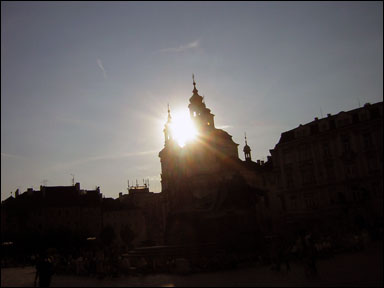
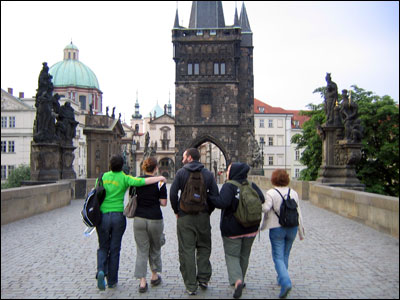
Prague is a true fairytale, all castles and churches and curving cobblestone streets—hands down the most beautiful place I’ve ever seen. But as you know, beauty attracts, and every summer, tourists overrun the city. Many are American, and they — ahem — we are easy to spot.

I’d be writing in a café, sitting next to a table of girls. I could tell they were American because of 1) the accent and 2) the pants. Great fuckin’ pants, those American girls, with their credit cards, full-on makeup, and loud voices: “Are you ser-ious?” They’d flip through entertainment guides, go to the Roxy later, and talk about Doug calling last night from Ohio. “He’s, like, coming to visit in November and I, like, cannot wait!” they’d say and then reapply their high-end lip gloss — always MAC or Chanel, those American girls!

I’ll pause to marvel at my own hypocrisy, sitting here in my Ralph Lauren. How am I different from those girls? Certainly I can answer that question, but what about the Czechs? To them, my image was the same as those girls: We were American.

“You are not American,” said my waitress at Cartouche, a restaurant where Christopher and I ate nearly every week.

I assured her I was.

“No, Americans — they talk like this,” she said, and then, in pitch-perfect Valley Girl: “What you mean I must eat potato! You know how much the carb in potato?”

Looking back on it, I should have been flattered that she didn’t think I sounded “American.” In the moment, though, I was drunk on Frankovka, and all I did was laugh.

“You eat here long time,” she said. “Why you in Czech Republic?”

I told her I was teaching Kafka, the writer whose picture happens to adorn every T-shirt and coffee mug in the city.

Io, Kafka. He was bug,” she said, referring to his story The Metamorphosis, where Gregor Samsa wakes up as a giant cockroach. “You smoke the water pipe? Tomorrow you come my house. We smoke water pipe. Okay? Bye bye.”

This was Marketa, our first Czech friend.

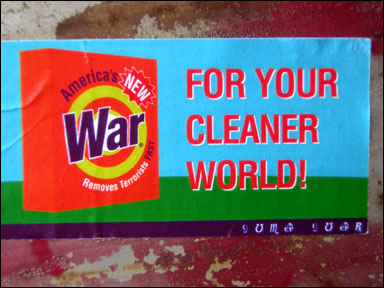
We needed one. The war in Iraq was going strong, and the campaign for the U.S. presidential election was well under way. Foreign anti-American sentiment was high, and some of my students had sewn Canadian patches onto their backpacks as a precaution. 

We met Marketa in her studio apartment. A mattress sat on the floor. The table was a piece of plywood laid across a crate. Candles were everywhere, and she pointed out the different countries where she’d bought them: Tunisia, Morocco, France, and Croatia.

“One time, I wait on your president,” she told us, pouring wine into teacups. “He was here for party, and I am catering. We must keep our arms like this,” she clasped her arms at her sides, “so his soldiers can see our hands.”  

“His soldiers?”           

“Secret Service,” Christopher said.           

“Yes, and he just sit there all night with look on his face.” She set her expression in a creepy joker-type grin. “He is really … what’s the word …

She flipped through the Czech-English dictionary. “No, here,” she said. “He is … ray-deck-oo-lush, no, LUS, ray-deck —”

“Ridiculous.”           

“Rideck … ah, my mouth does not do this word. Here, there are more.” She looked back at the dictionary. “Laughable. He is laughable, yes?”           

I wasn’t sure how to respond. Back in Chicago, among my liberal friends, I would’ve said the obvious: “Yes, he is laughable.” But sitting in Marketa’s living room so far from home, an unfamiliar confusion grew in the pit of my stomach. How could I feel both pride for my country and disdain for my president?

Marketa interrupted my thoughts. “There is election soon in your country,” she said. “For which do you vote?”

“Kerry,” I told her.

“Good,” she said. “Now we may be friends.”

Our friendship with Marketa had two main parts:

1) She took care of us. When Christopher and I got food poisoning, it was Marketa who explained to the pharmacist what we needed. We’d get text messages that read my Megane, tomorrow is state holiday so the stores they will be closed so shop today, please.

2) We dispelled her image of what “America” was.

“Chicago is dangerous,” Marketa said over beer and foosball. “There are gangsters.

“There are gangs,” Christopher told her. “They’re not like Al Capone.”

“What are gangs?” she asked.

This happened over and over, these words in the English language that I’ve never had to explain because I’ve always lived them. But, lived them how? What is a white, middle-class girl doing explaining Chicago gang culture?

Gang culture is a part of America. So are farming, and Republicans, and Xbox, and factory work, and millionaire CEOs, and all the things I can’t understand myself, let alone explain.

That really came to a head after the election. Our Czech friends would ask, “Why do the American people vote for this man?” It forced me to think outside my shock, anger, and political affiliations. I’d say, “There are some people in my country who feel differently,” and in trying to explain how “those other people” felt, I’d like to think I understood a little more about my country.

On the day after the election, Marketa sent us a text message: Oh no!  I would like to cry! Shit! I don’t understand people who want to have so bad president! Don’t be sad please, I am sorry about your bad president and I still like you.

While she still liked us, many others just saw us as Americans. On the day Bush asked the Czech government for soldiers to replace Americans in Iraq, Michael Moore’s Fahrenheit 9/11 came out in Eastern Europe. Christopher and I attended a post-screening discussion, and it became very clear what Czechs thought of our government. I felt more and more confused and disconnected: How could I be homesick for a place that was pissing me off so much?

Shortly before we returned to Chicago, Christopher and I were walking through Old Town Square, warm from the wine we had at dinner. It was a beautiful, cool night. Every A-frame and tower-top lit the sky like a theater set. In the center of the square was a huge crowd, at least 100 people, all of them singing “Another Day in Paradise.” In the middle of it all was one guy and a guitar, which he played badly, but it didn’t matter. What mattered was the song, a single, stupid song that every person — whatever their nationality — knows the words to, and in that moment we were all together, all of us singing (even me, and I hate Phil Collins!). There were little kids, and older people, and couples holding hands. The woman next to me was wearing a sari, and she smiled, and we sang, and I wasn’t confused or disconnected that night. I was part of something greater.

The day before we left, Marketa gave me one of her candles. “Don’t worry about being American,” she told me. “It is more important that you are my friend.”

If someone were to ask me now what my self-image is, I’d still say Writer. Teacher. Democrat. I’d also say American. What I’ve got to come to terms with is what that means for me. But if there’s room for only one word to fill in the blank, I’d put: friend.


Who’s that lady?

Do you know a woman who is super exceptional? Perhaps a brilliant go-getter? A devout do-gooder? Or even just an all-around great gal?

Glamour wants to know about her. Between now and August 19, the magazine is accepting nominations for everyday women — community leaders, friends, colleagues, teachers, even editors — who inspire you. To learn more about Glamour‘s search for the Woman Of Your Year, click here. Or, if you just can’t wait to nominate a certain someone, by all means, go for it.


Danica McKellar is my new hero

Winnie Cooper grew up, got hot, and more importantly, got even smarter. She has a new book out called Math Doesn’t Suck, aimed at young teenage girls who struggle with the subject and are constantly exposed to ditzy celebutantes.

       "When girls see the antics of Paris Hilton and Lindsay Lohan, they think that 
       being fun and glamorous also means being dumb and irresponsible," the 32-
       year-old McKellar told Newsweek for editions to hit newsstands Monday.  
       "But I want to show them that being smart is cool," she said. "Being good 
       at math is cool. And not only that, it can help them get what they want out
       of life."
 
I’m not the age demographic the book is aimed at, and unfortunately, incurably, I do suck at math. But I never tire of watching a great woman leave her mark on the world. I watched Kate Winslet and Jennifer Lopez make curves okay. I hope McKellar will be the first of many women to make intelligence fashionable. Hopefully someday, that’s the world my daughter will live in.  


Sweet 16ers aren’t so sweet

There are a lot of things wrong with today’s society. Thanks to my youthful naivety, I look to the future with optimism and hope. However, my buoyancy is conflicted as I am troubled by the next generation. Do today’s current teenagers have the foresight to correct the destruction left behind by the baby boomers?

My uneasiness is caused by many reasons, most of which, though, are clearly illustrated by the MTV series, My Super Sweet 16. Now, I don’t believe Sweet 16 is the root of youth’s corrupted spirit. But, the show’s premise is to showcase parents’ shameless display of extravagance while exposing their shortcomings. This failure in parenting has not only spawned a degenerate generation but revels in exploiting it for entertainment.

Sure, it’s easy to place blame on the parents. They’re responsible for instilling goodness and morality in today’s children, thus providing a strong foundation for tomorrow’s adults, right? That’s certainly easier said than done. I know it’s not entirely their fault that the prevalent parenting method is based in believing love is best demonstrated through gaudy status symbols. 

I can only hope all this materialism in place of parenting will provide fertile grounds for an eventual realization and rebellion. Finding this source of emptiness is what keeps therapists in business, no? More disconcerting than bad parenting, though, is the lack of role models to unearth this discontent.

In fact, Sweet 16 is a show about the inadequacy of current cultural role models. Using the Paris Hilton method of success, anyone with enough money can buy their way onto TV into the hearts and minds of impressionable young ones. And it’s the girls that are suffering the most from these disposable influences.

It used to be that a girl’s sixteenth birthday was a celebration for surviving the unforgiving journey from awkward adolescent to developed adult. But it seems to me that every character featured on Sweet 16 revels in acting and behaving like a spoiled child. In fact, most delight in dramatic tantrums and sinister bitchery for the television cameras.

Regardless of the legitimacy of the dramatics, the show illustrates an unsettling new level of bratty-girl behavior. Whereas boys use physicality and violence to bully, girls have always resorted to verbal attacks to belittle each other. This belittling was once done behind backs and with a slight sense of wrong-doing; today’s young girls are meaner than ever without any sense of remorse.

And this new level of bratty-girl behavior is not limited to extreme insults. Aggressiveness and domineering have surpassed catty putdowns to become the favored form of intimidation. Where did this perverted sense of female entitlement come from? Because I’m pretty sure Paris Hilton wouldn’t instigate, let alone win, a bitch fight with even the most "exhausted" Hollywood starlet.


Teen pregnancy in Texas

From Yahoo! News: "Texas leads U.S. in teen birth rate." When questioned about the state’s abstinence-based teachings versus comprehensive education, State Board of Education President Don McLeroy had this piece of wisdom: "The idea that just giving them a lot of information is going to solve it, I think, is kind of naive." Granted, informing hormonally-driven teenagers about condoms and such will not stop teen sex or pregnancy. But isn’t it more naive to tell these teenagers to not have sex at all, refusing to tell them even the basics about safe sex, knowing that teenagers have engaged in pre-marital sex since the beginning of mankind, and always will? 


Hypocrisy of “I’m not a plastic bag” bag

Recently handbag designer Anya Hindmarch decided to jump on the environmental bandwagon by releasing a limited-edition canvas shopping bag emblazoned with the words "I’m not a plastic bag." Because of its exclusiveness, people lined up around supermarkets in cities all over the world just to get their hands on it. The bag was/is a definite hit and sold out in hours only to appear on eBay later on for a mark-up equaling hundreds of dollars. But this message of creating a buzz around a canvas bag that should help the environment is wrong.

The people that bought the bag won’t use it in place of plastic bags
Most people aware of this bag are most likely into trendy items and not interested about the environment. This bag is the "it" bag of the moment, so just because it’s made out of canvas and its claim is that it’s not a plastic bag doesn’t automatically make the person who buys it "green." A lot of the people that bought the bags wanted to resell them on eBay for hundreds of dollars anyway, not use them for grocery shopping. Most of the people that bought the bag probably don’t even shop for groceries themselves. They send their housekeepers or personal chefs who most likely won’t get the bag lent to them for that purpose.

The bag designer is all about consumerism, not environmentalism
Anya Hindmarch is a bag designer. Her job is to create bags and encourage people to buy as many of them as possible so she can make a living. Encouraging mass consumerism is not good for the environment. And even though she pretends that her "I’m not a plastic bag" bags are good for the environment, London’s Evening Standard recently uncovered the unflattering fact that Ms. Hindmarch’s bag was manufactured in China using non-organic and non-free-trade materials.

Have yet to see regular people using the bag for groceries
A quick trip to some Manhattan grocery stores didn’t uncover anyone actually using the bag for its so-called intention. The grocery baggers  as usual  still used plenty of plastic bags. They were double bagging and barely filling these bags full. There was not an "I’m not a plastic bag" in sight. There was, however, a non-trendy, ratty, old Hughes Market canvas bag and Sierra Club canvas bag that were in use by me. But since they have been in use every week for years, no one wanted to rip them off my shoulder and offer me $200.

The people that waited in line and bought the bag are hypocrites
Here in the U.S. the bag was sold at Whole Foods stores for a mere $15. The day was rainy. So after the lucky people who were at the front of the line got their precious canvas bag, it got wrapped up in a plastic bag to keep it dry. How ironic is that?

keeping the earth ever green


Little boy blue

It’s hard to grow up in a world of aging baby boomers. They’re an iconic generation defined by flower power and free love. They had a view of the world and an idea of what it should be. Then they actually took action to make the necessary changes.

I am truly inspired and intrigued by my parents’ generation. And utterly annoyed and disgusted by my own.

Where are the rebellious 20-something heroes hell-bent on shouting society’s hypocrisies and injustice? Where are the forward-thinking intellectuals sharing philosophies leading the way to a better future? And why the hell is everyone so sad?

The Emo kid’s sad influence has seeped into all aspects of society. Clad in black skinny jeans, heavy eyeliner, and a permanent frown atop a skeletal frame, the Emo kid is easy to spot in a crowd. He’s the one quick to drain all fun from everyone around just by the sight of his razor-cut hair and defeated attitude. How can anyone be happy when the Emo kid sacrifices his spirit to illustrate the horrible world we live in?

But is that really why the Emo kid is sad? I’m quite certain he’s grown up in an affluent household. I’m sure he has been provided with all the amenities that make up a seemingly joyous and fulfilling life. Yet, he’s just so sad.

Maybe the Emo kid is sad because his social interactions are done solely through Facebook and AIM? With expressions and emotions narrowed to a few simple icons, there is no need for actual human contact. Maybe if there were a wider array of frowny-face emoticons, the Emo kid would brighten up.

Or maybe the Emo kid is just so self-absorbed that he has nothing better to do but sit and think about how sad he is?

But is this the best rebellion available today? Where past troublemakers wore leather jackets or grew long hair, today’s youth wear large headphones to drown out noise that would distract from their wallowing.

As past generation’s rebellion was fueled by anger at restrictions and rules, this generation has been granted access to every desire and demand. Is the Emo kid gloomy because he doesn’t believe he has lived up to his parents’ expectations?

Regardless of what makes the Emo kid so emotional, I really just don’t understand why, if he is truly sad, there is a need to draw attention to it? Why not do something about it? After all, movement is what made the baby-boomer generation so significant. Where are the writers/musicians/poets/artists channeling this angst into something tangible? It’s about time for someone of this generation to speak up.


UN Peacekeeping — more harm than good?

The UN Department of Peacekeeping has, over the years, become known for its foibles.  The department received considerable criticism for its handling of Kosovo, as well as the Rwandan genocide (captured in the film Hotel Rwanda).  Child prostitution in countries such as Cambodia and Bosnia rose after UN Peacekeepers moved in.

And now, the latest in a series of scandals involves Moroccan members of the UN Peacekeeping force accused of sexually abusing girls as young as thirteen in Bouake, Cote d’Ivoire, where 732 Moroccan UN members are stationed.

While all UN "Blue Helmets" are barred from having sex with locals (even those who are of age), it has become incredibly common, as young girls in many countries see them as a source of income, particularly given the size of the peacekeeping units (700 foreign men in one small city?).

According to one article I read, some of the older women in Bouake (okay, by older I mean 20s or 30s) blame the girls as much as the soldiers, saying that the girls approach the men, often hounding them for sex in exchange for what amounts to just a few U.S. dollars.

That may be so, but if you ask me, it is the responsibility of the men to just say no


Pedophiles in Texas

NBC’s successful (if criticized) Dateline series, To Catch a Predator, has helped officials in many states catch pedophiles. A volunteer poses as a child, pre-teen, or teenager online and then makes arrangements in chat rooms to meet with pedophiles, who are greeted at the door by NBC’s cameras. Many are prosecuted, as they should be. But a recent taping in Texas did not go as planned. An assistant prosecutor arrived with the intention of having sex with (raping, actually) a 13-year-old boy. After being exposed, he ran to his car and shot himself in the head before he could be arrested. Because of this, Texas law officials are refusing to prosecute any of the other men who showed up at the house. They’re even blaming NBC for the death of a wealthy, well-connected good ole boy.

In response to the incident, a Murphy, Texas, resident had this to say: "[NBC] can chase predators all they want, but they shouldn’t do it in a populated area with children…" Excuse me, ma’am, but isn’t that exactly where they should do it?

It gets better. The sister of the dead pedophile is suing NBC for the death of her brother. She wants $100 millon dollars, and her lawyer says, "NBC is responsible for his death."

Personally, if I found out my brother was a pedophile who cowardly shot himself rather than face the consequences (you know, the kind of consequences pedophiles face in prison), I’d have him tossed in unconsecrated ground and change my name. But then again, I’m not from Texas.

personal stories. global issues.