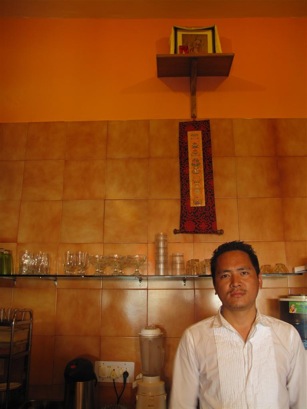
Sichoe runs his family’s coffee shop a minute’s walk from the Dalai Lama’s residence.

Dreaming Lhasa

Tibetan refugees build new lives while dreaming about their homeland.

Waiting customers, mostly westerners who come to sip coffee at his cafe a minute, walk from the Tsuglag Khang, the Dalai Lama’s main temple opposite the god-king’s exile residence in the Indian Himalayas. Jamphel Sichoe comes from an immigrant background and knows what it is like to grow up with multiple traditions, having “chinky” little eyes which most ethnic Indians consider being of Chinese origin. Sichoe, 24, born in exile, works each day from noon till night attending to customers at his café. He wears an Indian dress, but in his mind are thoughts of his unseen homeland, Tibet.

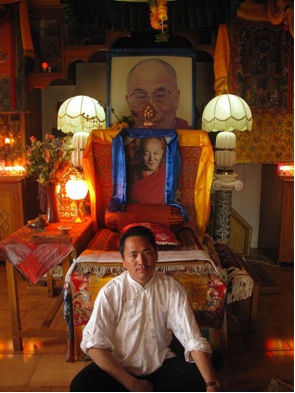
Like all Tibetan shops, his cafe has a Dalai Lama portrait hanging on the wall, featuring a khata, a traditional scarf, as a holy gesture. During his long shifts, he stands managing the café, at times on with social networking sites on his MacBook. Though with each day’s hard work he finds himself restless – helping his Dad with English translations every morning, participating in various non-governmental organizations and Tibet support groups, organizing various human rights protests.

As the sun sets his old friends – Tenzin Chemi, Dolkar and Kalsang – come to meet at the café to sit around talking about their daily activity. Chemi and Kalsang were born inside Tibet but fled into exile with their family when they were 10 years old, following massive unrest inside Tibet. Both come from areas far inside Tibet, where technology and modern living are just dreams. Chemi and Kalsang are from Amdo province inside Tibet, while Dolkar and Sichoe are from Shigaste and Lhasa, in Tibet’s mainland. They all come from far corners of the large autonomous region now under Chinese rule. Chemi and his family crossed the border with the help of a guide and trekked through the mountains for more than a month before reaching Nepal, where he was kept in a Tibetan refugee center before being sent to the one in Dharamsala, the de-facto capital of Tibetans in exile in India.

They are the young guns of the exiled Tibetan community, educated to understand world politics and keeping up traditions, customs and religion in the midst of modernity. They talk about ethnic conflicts within the society; about disputes between the People’s Republic of China and their spiritual leader, the Dalai Lama; about the unrest they hear about inside Tibet and its outlying areas. About solutions to the political divide between generations in exile. About the Free Tibet movement. About lives and grass root problems they face each day, living in a land that is not their own with many complicated factors – poverty, racism, political or oppression. About the brutal suppression their countrymen have faced throughout their lives. Solutions to Tibet’s problems seem hard to come by, and hope is fast receding with the 74-year-old Dalai Lama aging; Tibet’s problems almost too numerous to count. They debate in Tibetan, Hindi and broken English, at times speaking typical local dialects, as if they were Indians making fun of each other.

As they finish meeting, Sichoe thinks of the day’s most important work he needs to perform – working with Tibet support groups until late in the night. He’ll be organizing tomorrow’s event, and a lot of effort has gone into this organization. The date is March 10, and this year it will be the 51st anniversary of the failed Tibetan Uprising against the Chinese rule, marking 51 years of the Dalai Lama’s flight into exile with thousands of his followers, who left their homeland in search of freedom and the desire to live their lives as they see fit. They say they did so to avoid political oppression and religious persecution.

Closing the café at 9, Sichoe walks back home down the steep road lined with deodar. The sky is dark over the Himalayas, and there is a shiver of cold despite the fact that spring is almost here. At home his eldest brother’s family waits for dinner. His father is a highly religious person and is early to bed after the evening prayers. Sichoe rests a few minutes before watching news on the TV, news of security beefed up in Tibet’s capital Lhasa ahead of tomorrow’s celebration of the 51st anniversary. Chinese police have cordoned off the entire city. His niece Choezom, who is half his age, listens carefully to the family’s conversation. She studies in a convent school where most of the students are local Indians.


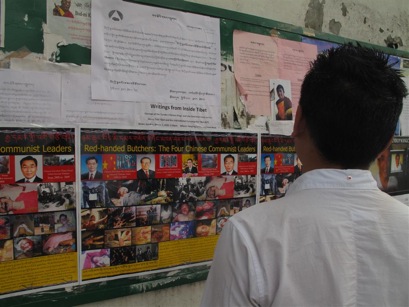
Soon Sichoe finishes his dinner with his family members, and with many things to do for tomorrow, he meets his friends who await him down the street from his residence, and from there they all go straight to the community hall. There is a meeting with fellow refugees to discuss tomorrow’s event. Some of them prepare by writing anti-China, Free Tibet and human rights slogans on cardboard for display at the tomorrow’s ceremony and during protest marches on the streets. Sichoe helps other refugees, mostly newcomers, to get excited about tomorrow’s event. He stays up until midnight helping his friends, and then he goes back home, hoping for a successful event tomorrow.

**********

The light comes up above the animated settlement on its little ridge overlooking the Kangra Valley, and chants from the temple carry on the morning breeze. A gong sounds as the sun comes up above the snowcaps. The day has come that every Tibetan awaits: March 10. The morning before he goes out to attend the ceremony, Sichoe prays at his family’s prayer hall. Like many other Tibetans, he does the kora – the holy walk around the Dalai Lama’s residence and temple.
Thousands of Tibetan exiles and their supporters, most of them dressed in traditional silk and wool robes, gather in the compound of a Buddhist temple to hear the Dalai Lama and other senior leaders of the Tibetan government-in-exile on the eve of the day marking 51 years of exile. The crowds include hundreds of Tibetan children dressed in school uniforms, Tibetan nuns and monks in orange and maroon robes, and other young Tibetans with “Free Tibet” and Tibet’s national flag painted on their faces.
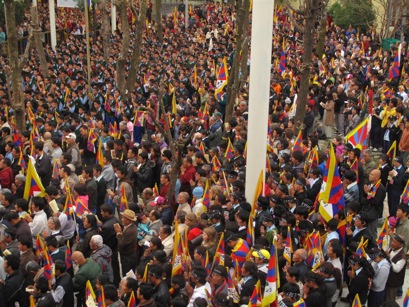
In the speech the Nobel Peace laureate blasted Chinese authorities, accusing them of trying to “annihilate Buddhism” in Tibet. His message has an impact in the refugee community that has made a visible effort to keep Tibetan culture alive – its language, crafts, and the practice of Tibetan Buddhism. Soon after the Dalai Lama’s speech thousands of Tibetan monks and youths march through the streets, shouting pro-Tibet slogans and praying for the Dalai Lama. The demonstrators, including those who followed the Dalai Lama when he fled Tibet and their children, all pledge support to their spiritual leader.
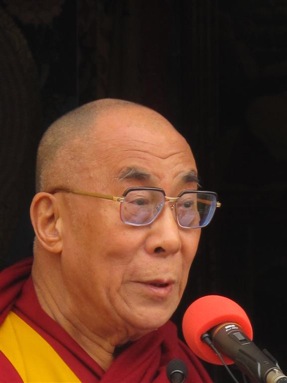
Indeed, new generations remain devoted to the cause. There have been no signs that Tibetans in exile here will give up their hope of returning to their homeland in freedom. And many are confident they will ultimately achieve their goal. An elderly Tibetan in the crowd says, “Don’t let anyone steal your dream. It’s our dream, not theirs. As long as there is no enemy within, enemies outside cannot hurt you.”
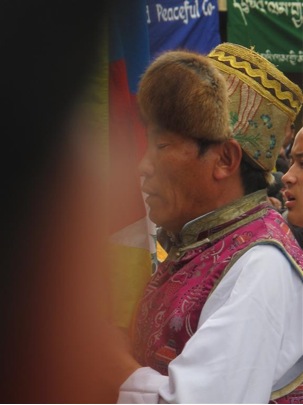
For the first generation immigrants, the image of the homeland remains quite vivid in the mind’s eye, despite planting firm roots in their new homes over successive generations. The images may gradually recede, but Tibetan people living in exile still hold firmly to the notion of freedom and rang btsan, or self-determination, hoping that their country will be given back to them some day. In fact, living in exile has only strengthened the resolve of Tibetans to regain their homeland.

Hundreds of Tibetans from different walks of life stage a massive protest rally, which starts from the main temple and culminates at a local bazaar. Huge presences of Tibetan protestors on the streets lead to traffic chaos. Since he has eagerly awaited this day, Sichoe joins the massive protest as well. Wearing the Tibetan flag over his back and marching down the steep roads from Mcleod Ganj down to the Indian bazaar in Dharamsala, he shouts slogans, appealing to world leaders to listen to their plight. The event climaxes in a candlelight vigil, with participants holding banners with slogans like “Stop torture in Tibet” and “China stole my land, my voice and my freedom.” Young radical groups shout anti-China slogans and call for rangzen, or full independence, for Tibet.

In the last 51 years, India has attracted many Tibetan refugees with its image of a slow pace of life and a peaceful lifestyle for refugees of all nationalities. This exiled community has created a new Tibet away from Tibet – a Tibet 2.0 — that aims to be more modern, more visible and more internationally connected than the real, existing Tibet over the border. There are over 12,000 exiles living in the valley; most reside in the suburb of Dharamsala known as Mcleod Ganj.

Sichoe’s father fled into exile in 1959 just after the Dalai Lama. Once in India, he lived with his family in Darjeeling and Mysore until 1981, and later in Madhya Pradesh in central India until 1990, quietly serving as a lama for the Tibetan community in exile throughout that time. Sichoe was born in Chattisgarh, an Indian state, but soon his family moved to Dharamsala to be closer to His Holiness, the Dalai Lama. He went to school at the Tibetan children’s village where all Tibetans get educated, mostly funded by support organizations. Sichoe believes he’s living in the world’s most successful refugee community, but this wasn’t his peoples’ aim. Many refugees feel they have no purpose and meaning in life. The pain of being an exile is that you do not belong where you stay, and you cannot return where you belong.

For Sichoe life in Dharamsala is a positive, multicultural, and diverse experience of everything from “shanty” to Bollywood, which he enjoys. Still, though, there is sadness. Sometimes he forgets he’s a refugee, but at the end of day he remembers. He believes that China thinks every Tibetan in exile is a criminal, and he wonders if he is.
The night after the candlelight vigil, Sichoe, drained of energy, returns home. The buzzing town is full of travelers and Tibetan shops remains closed all day to commemorate the event. At home his family prepares the special dinner when all members of the family will sit together, eating, before the short prayer. Tibetan dishes fill the evening after the day’s hard work, with soup bowls, mutton momos, tingmo, the Tibetan bread, rice noodles, chicken and thupka all served at the table in a small room and presented with Tibetan Thangkas.

After the special dinner, Sichoe helps his family clean the room while others collect the plates to wash. His niece Choezom enjoys time with Sichoe, sharing with him her day’s activities. Tired, Sichoe wishes all a good night and walks to the front of his room. As he enters his room he sees one of the cardboards he prepared the night before, on which he wrote “China: respect human rights in Tibet.”

*******

Sichoe wishes to return to his homeland as a Tibetan, not a Chinese. India is the best country for refugees, but it’s not the same as being a citizen of his homeland. Sichoe’s homeland Tibet is a plateau region in Asia. Often referred as “Roof of the World,” Tibet is the highest region on earth. During Tibet’s history, it has existed as a region of separate sovereign areas, a single independent entity that is now under Chinese sovereignty. Approximately 6 million people live across the Tibetan Plateau, and about 150,000 live in exile, who have fled from modern-day Tibet to India, Nepal, and other countries.

However, for Tibetan refugees, the picture is quite different. They left their homeland in search of freedom and escape from the Chinese dominance over the region. With 51 years in exile, most refugees and their children have been forced to resettle throughout the world. The Dalai Lama’s seeds of compassion are helping young refugees to settle and maintain their ethnic culture.

Tibet is extremely hard to reach, but China’s recent development has connected it to the world, despite it being hemmed in on the south by the Himalayas and on the north by the almost equally high Kunlun Mountains. The terrain is inhospitable, since the plateau itself is about 15,000 feet above sea level. The climate is harsh, with violent swings of temperature between night and day at all times of the year. It is well-known as the “Third Pole of the Globe.” The world’s highest summit-Himalayan, which strides across the boarder between China and Nepal, claims a height of 8,848 meters above sea level. Lhasa is the administrative capital of the Tibet Autonomous Region in the People’s Republic of China. It is located at the foot of Mount Gephel. The city is the seat of the Dalai Lama, the location of the Potala and Norbulingka palaces having names in World Heritage Sites, and the birthplace of Tibetan Buddhism. The Jokhang in Lhasa is regarded as the holiest center in Tibet.

All young Tibetan exiles are torn between these two views of Tibet – one magnificent, the other horrible. For Sichoe his homeland is far from sight. He was born in Chhattisgarh, a state in India. His father is the 9th Jestun Dhampa, the most religious figure in Mongolia after the Dalai Lama. Khalkha Jetsun Dampa is considered one of the most revered teachers of the Kalachakra Tantra, the Tara Tantra, and Maitreya, the future Buddha. His incarnation was recognized, at the age of four, by Reting Rinpoche, the Regent in Lhasa, as well as other high lamas and the state oracles. His identity was kept secret due to Stalin’s influence and oppression in Mongolia. At the age of 25, he gave back his monastic vows, and then went to stay at Ganden Phunstok Ling, established by his predecesor Taranatha, until the age of 29 when the Chinese invasion forced him into exile, along with hundreds of thousands of Tibetans.

Then, in 1991, with the dissolution of the Soviet Union and the newfound religious freedom in Mongolia, many Mongolian monasteries sent their abbots, lamas, and ministers to India to discuss with the Dalai Lama, in Dharamsala, the possible location of the Ninth Khalkha Jetsun Dampa. It was at that time, through the Religious Office of the Tibetan Government in Exile, that the Dalai Lama gave the official stamp of recognition and acknowledgement of the Ninth Khalkha Jetsun Dhampa, the spiritual head of Buddhism in Mongolia.

Sichoe is grateful for the teachings he’s gotten from his father. For him he feels 60 percent Tibetan, 20 percent Indian, and 20 percent American. His country will be wherever he’s make his living.
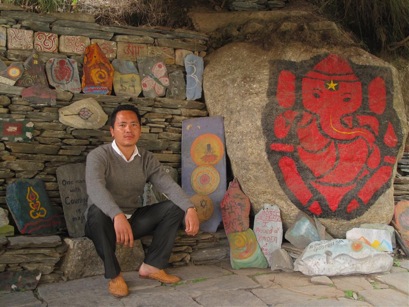
Thousands of mainly young Tibetans have escaped to the small hill town of Dharamsala, which has turned people from poor, rural Tibetan areas with little education, business and few career prospects in China into professionals whose horizons extend around the world.
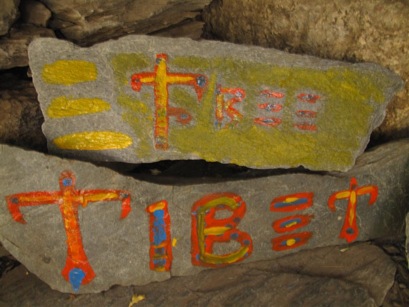
As home to the Dalai Lama, the Karamapa Lama, Tibet’s third highest spiritual figure, and other high-ranking lamas and monks, Dharamsala is the heart of Tibetan exile life, and its hills are adorned with Tibetan prayer flags. The town, where monks and nuns outnumber tourists, is also thronged with small cafes, bustling with activity as monks perform their daily routines and teach courses in Buddhism, while locals engage in community activities such as volunteering as teachers. The Tibetan equanimity is striking. The town is smaller than an average county town in China and possesses modest economic resources, yet there is a notable calm. Some of this may derive from the regular stream of new arrivals from Tibet. They have not risked their lives on tough journeys across the Himalayas to begin the next phase of their lives as refugees. Some want a better education, some want to become monks in monasteries, some just want a better life.

Recent Tibetan refugees even speak Chinese. A favorite pastime of the younger ones is spending time in Internet cafés, watching Chinese video-clips and chatting online. Tibetans making international calls to their relatives and friends on the other side of Himalayas often talk in Chinese. The young refugees are growing up defying easy definitions; the children of exile are slowly coming of age.

Sichoe knows time is running out, and even if he doesn’t go back, he’s ready to work and help his exile community. “I will work in the Tibetan government, may it be in exile or back inside Tibet, bringing more and more reforms is the need of the people,” Sichoe says. With a Bachelor of Arts degree from Delhi University, he’s talented, modern and has a Tibetan blood for struggle. He shares his thoughts about the life after the Dalai Lama, when Tibetans will have to struggle even more than they do today, but he’s ready as life moves on.

“Here, it’s like a confused cocktail of my citizenship – half Tibetan, half Indian and now with western culture rooting in us, it’s a blend,” he says. To go back to his homeland is his dream, like it is for many refugees. As each day dawns, Sichoe will walk the kora, and later he’ll help his father with English translations, then go back to the café at noon. For now, he sits on a stone overlooking the high mountains, dreaming of Lhasa.
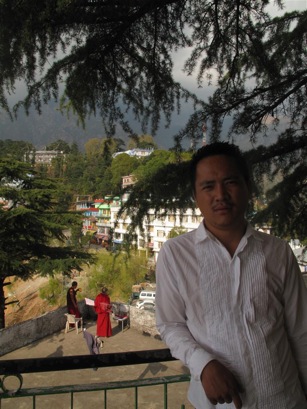
 

Ayan Hirsi Ali: A wasted voice

Ayan Hirsi Ali’s life story reads like a fast paced political thriller.Coming from a conservative Muslim family, Ali suffered gender discrimination and violence of worst kind-female genital mutilation. But she managed to stay strong and turned her life around.

 Quite a positive story. But unfurtunately, her powerful voice is going wasted. She is siding up with the neocons and has turned into a professional anti-Islam(not anti-radical Islam or anti-fundamentalist) talking head.

Her life story and its positive energy can be a powerful message against the radical and fundamentalists who abuse their faith and their fellow beings. Instead Ayan Hirsi Ali is now a neocon, anti-Islam, pro-war talking head.

What a tragedy!


Apocalypse now! Beck-Palin 2012

Glenn Beck and Sarah Palin  are the true peddlers of hate and lies. Beck accused President Obama of hating white culture and white people, while he was socking racial and religious fear among people.

Beck’s Islamophobia is out of control. He made it pretty clear that only Christians are real Americans and that a non Christian should not be allowed to be president. That is why he keeps on raising doubts about President Obama’s faith and background.

 Glenn Beck exploits people’s fear and reservations to gain political mileage. He is a hate monger.

And now, to make it worse, the Beck circus has found a new clown. The airhead from Alaska-Sarah Palin.

Palin’s depth and understanding of world issues is well documented. She is shallow and hollow enough to believe that "I can see Russia from my house" qualifies her to be a President. Now she is also into the Islamophobia brigade, furthering the radical Evangelical view of a Christian America.

If Beck-Palin 2012 becomes a reality, I guess entire towns and cities will migrate up to Canada to escape and wait for the apocalypse to play out.


Offbeat Brides

Let me begin by explaining that I don’t like weddings. Whatever gene most women carry for white dresses and flowers and big rings, I don’t have it. I’ve been to too many weddings, I’ve been bored by talk of tiaras and disgusted by both the chicken and the beef, and I see the billion dollar wedding industry as a scam.
That said, I will now count the ways in which Offbeatbride.com kicks ass.

I discovered it as a link on i09 (Gawker’s sci-fi web cousin) about a geeky wedding. The featured bride and groom had Star Wars cake toppers and had their guests chant "so say we all" during the museum reception, overlooked by a real dinosaur skeleton. I instantly thought of my future hubby (yes, I have found my life-mate. And no, I still don’t want a big wedding. And as long as KFC potato wedges are served, he’s fine with that). Offbeat Bride (OBB) was the source site, and a bottomless blog of original, non-traditional, just-a-party-yet-a-blast wedding profiles.

Ariel Meadow Stallings is the original OBB. While planning her own wedding years ago, she chafed at the ideas and offerings for the holy wedding trinity: "timeless," "elegant," "unforgettable." Her first book (and eventually, the blog) Offbeat Bride: Taffeta-Free Alternatives for Independent Brides was born out of her own wedding plans. She quickly gained a following by espousing lifelong commitment, gay marriage, organic rings sans-blood diamonds, no stress parties, on a budget. The OBBs who create profiles and share their stories and photos do not take out loans for a 12-hour get together. They do not cave in to their family’s wishes or insist that their bridesmaids wear the same unflattering dress.

Themes are the most popular types of weddings on OBB. Roaring 20s, renaissance, rockabilly, goth, ethnic fusion, gamer, geek, sci-fi, eco-friendly – it’s all there. An interracial couple got married on Loving Day, the anniversary of the Supreme Court’s 1967 ruling (see Loving vs. Virginia) that interracial marriage was legal. Another couple was the first to get married at the Jim Henson Co. lot with a muppet-themed wedding. They even had their own custom muppets made. (As someone who recently made a pilgrimage to see the touring muppet display, and begged to be allowed to take just one picture of the original Rolf, this just tickles me Mahna Mahna-pink!)

What impresses me most are the no-nonsense, independent attitudes of the blog contributors. Invitations that urge support of gay marriage (and the many gay-wedding profiles). Articles about dresses for wheelchair-bound brides (hey, wedding establishment – they exist!). A bride and groom married in a small, inexpensive library ceremony whose "family…just didn’t understand why we weren’t doing this huge, 200 guest shindig… We had to politely explain, again and again and AGAIN (people just didn’t get it) that this was OUR DAY."

My personal favorite is from Gael Girl. Not just because her wedding cost under $100, that they walked each other down "aisle" (path in the woods) in Irish tradition, or that it was in a cave at sunrise. It’s because she explains their desire to be married sooner rather than later because, "I’m disabled and Michael wanted to start taking care of me." That’s love.

I have always been immune to the myth implanted into our cultural psyche that "a diamond is forever." I don’t believe that an expression of love costs $4,470 ("the average spent on an engagement ring.") In fact, I’m confused and repulsed by that standard. We all know by now that a human being in Africa risked his life to dig that carbon-based nugget out of the ground, simply so you could display it on your finger. As you read this, another family’s home was foreclosed… if only they had $4,470 to spare. It lifted my hopes for my gender when I read of one bride’s diamond-less ring, "It cost $99. I love it." I’m going to frame this statement and teach it to my daughters: "when you talk exact carats, you’re getting into the dick-size game." Amen, girlfriend.

At the end of the wedding day, the perfect cake is digested. The perfect flowers will droop and die. You will have seen another elderly relative do the chicken dance. Again. You will go home with one person. That needs to make you happy. Not a song list, or matching jewelry, or a dress you will never wear again. I will let OBB Krista8029 sum it up for me:

I’ve realized that all the tulle, champagne and twinkle lights that were so important last time may make the "perfect" wedding, but it doesn’t make the perfect marriage. As much as I look forward to celebrating with family and friends, the thing I’m looking forward to the most is spending the rest of my life with my favorite person. And that’s what it’s all about. 


Iraq is not a safe foreign employment destination

Iraq is still a violent, war torn nation, as proven by steady stream of violence and insurgent attacks. United States is ending its combat mission in the country this month(August 2010). This will leave a huge security hole in the country. I am not advocating that US stay in the country indefinitely; but the least Nepali government can do is read the papers and make common sense decision.

After the US troops pull out,the insurgent activity is definately going to go up. In the long run the Iraqis themselves will take care of the situation, but that is not going to happen today, tomorrow or even next year.

 Until then lives of these hard working people should not be treated as spare goods. Nepal should reinstate its ban and keep its people from seeking employment in dangerous Iraq.


President Obama’s dipping poll numbers


  • Gulf oil tragedy: President Obama did not handle the oil spill and BP properly. He did give a great speech on the incident, but then the action did not match his words. Okay, I am not saying that he should have been in the Gulf water in a wet suit, but he could have done something closer to that.
  • The economy: How long is he going to blame Bush for the economy? He has to start making progress because blaming Bush and the Republicans isn’t going to work anymore.
  • The mosque controversy: Did he have to inject himself into this vile debate? The right wingers are abusing Ground Zero mosque concerns to spread hate against Muslims, and the President’s speech on the issue just gave them more fuel. He should have kept his mouth shut on this issue.

And now President Obama is going on a 10-day vacation to Martha’s Vineyard. Not the right time to relax. Get back to work, Mr. President!


On religious discrimination: The hidden and accepted kind


I am not saying that Lord Shiva’s devotees are irrational, but there are plenty who use and abuse God and religion. For example, during the month of Shrawan, large numbers of married Nepali women and young girls fast every Monday. Their desire? The married ones pray for their husbands’ long life and the single ones ask the lord for a good husband.

What on Earth? Is God a businessman or an egomaniac who is pleased by you not eating on a certain day and will grant your wishes? And, also, what is it about Hindu women fasting and praying for their husbands’ long life? In no other religion women are forced to beg for their partners’ long life, and yes, the husbands are completely absolved of this duty. It is the female who begs, not the man.

This is religion- and culture-sanctioned discrimination. Very much accepted and prevalent in Nepal and also in India. Drives me nuts.

Some will attack my observation because I am an atheist and supposedly bound to attack anything remotely connected to God or religion. Bonkers! I am criticizing this practice because this is just so ridiculous and stupid. In the 21st century, women are intellectually infantilized and reduced to begging in front of God.

When are we, Nepali women, going to grow up?


The question of poverty

Almost1 in 5 children in the United States grows up in poverty. This is in thewealthiest country in the world. A schoolteacher in Nepal once asked me ifthere were poor people in the USA. It was a difficult question to answer. SinceI’d arrived in Kathmandu, and Asia as a whole, I’d seen more people living inmore crushing poverty than I’d ever imagined. The homeless in India are in muchmore dire straits than the homeless in Los Angeles — those in India aremissing multiple limbs, missing eyes, emaciated, desperate, starving to deathin front of my eyes. Yet human suffering is human suffering. Does the Vietnamveteran who freezes to death in an alley on a particularly cold night deserveour sympathy any less than a leper, dying slowly in India?

Inthis month’s issue of InTheFray, we explore poverty. NatalieLefevre shares with usthe piece Europe’s most hated people, which takes a look at Roma living in Europe. Natalie Lefevre alsowrites about her experiences with HIV/AIDS patients in Thailand in Caringfor the rejected. Poet Lynn Strongin explores her poem TheWitnessing.

Soit is a difficult question to answer. Is there poverty in the United States?Well, look around. What do you see?

I am a writer/editor turned web developer. I've served as both Editor-in-chief and Technical Developer of In The Fray Magazine over the past 5 years. I am gainfully employed, writing, editing and developing on the web for a small private college in Duluth, MN. I enjoy both silence and heavy metal, John Milton and Stephen King, sunrise and sunset. Like all of us, I contain multitudes.

Each one of the children had their own character: Bam was really sweet but was easily upset.

Caring for the rejected

Volunteering for people living with HIV/AIDS in Thailand.

In the summer of 2006, I started a degree in international studies. I had a great time exchanging ideas with like-minded people. I was learning a lot of theory on how to change the world, but I was missing something. How could I avoid becoming a bureaucrat who didn’t know the people whose needs I was supposed to be championing? To prevent this, I decided to do grassroots volunteering over my winter break.

While Googling websites, I came across the Camillian Social Center in Rayong, Thailand. The website’s description stated: “The Camillian Social Center in Rayong is confronting AIDS in the 21st century through prevention, treatment and care. We believe that prevention, treatment and care go together to reduce the potential for the transmission of the virus.” I knew instantly this was where I was going. I had always been intrigued by marginalized and excluded groups in society. This was my chance to help. When I told my family and friends how I was planning to spend my break, they stared at me either in disbelief or in admiration, as if I was risking my life.

When I arrived in Bangkok, I was excited because of the adventure that awaited me but, I hate to admit, I was also a bit scared. I had done some traveling by myself before, but never in a country like Thailand. That’s why, after trying in vain to explain where I wanted to go to the doorman of my Bangkok hotel, I chickened out and instead of taking the bus like the locals, I rented a taxi to go straight to my destination. Disappointed with my unnerved self, I decided not to give in to my fear anymore during the rest of my stay in Thailand.

And so the adventure begins

I was both excited and nervous when we arrived at the center. We passed through a gate and entered a big courtyard with some trees and a pond in the middle. In front of the buildings, several people were enjoying the shade in silence. Some were in wheelchairs, others in hospital beds. Here and there a person was sweeping the courtyard. As soon as I got out of the car, the taxi driver took off. He obviously did not feel at ease around sick people.

A really tall woman named Cindy came to welcome me.  When she came closer, I realized Cindy hadn’t always been a woman. It was amazing how feminine she looked. At first, I felt a bit uncomfortable and was afraid of saying or doing something to insult her. But Cindy was quite open about her sexuality and she soon became the one I chatted with the most.

Cindy directed me to a building on the far end of the courtyard. Inside a big dining room, about twelve children of different ages and a few European men were having lunch. Cindy introduced me to Father Giovanni, the founder of the center.

Father Giovanni and his children

In 1995, Father Giovanni established the Camillian Social Center for the rejected: homeless people living with HIV or AIDS. Although he is a priest, he talks loudly, using lots of gestures and is not really a champion in subtleness; Father Giovanni is a rebel priest. Against the strict Catholic principles, he does not preach abstinence and heterosexual monogamy as the only way to prevent HIV. On the contrary, he kept joking about the homosexual orientation of some of the residents.

The children had just finished their lunch and were anxiously waiting to introduce themselves. Father Giovanni explained that most of the children from the center were at school but these  were not welcome in any school because they had visual signs of their HIV-positive status. 

Although HIV causes AIDS, a person can be HIV-positive for many years before experiencing any symptoms and developing AIDS. The HIV virus weakens the immune system until the serious damage results in the onset of AIDS. This is marked by the emergence of severe infections that would not develop in an individual with a healthy immune system. In theory, people don’t die from AIDS, but from one of the infections that were made possible by the absence of an immune system.

He called one of the girls over to him. “How old do you think she is?” he said. I guessed around four years old. “She is turning nine this year,” he responded.  Pim was brought to the center by social workers after her grandfather had died. She had been taking care of him for years. The only food she had during those years was instant noodles once a day. She had only arrived to the center quite recently and the medication made her sick.

Over the weeks I was there, Father Giovanni told me all the children’s stories and most of them were as sad as Pim’s story. Kaimuk was 15 but looked like a 7-year-old. Chom was blind and contracted HIV as a result of a visit by a Dutch tourist to a “massage saloon.” Because she was blind, Ed was bed-ridden before she came to the center; at the age of 4, she had never learned to walk. AIDS had made all of them orphans and left them HIV-positive.

My first Thai friend

In the mornings, I worked at the Palliative Care Unit, or PCU, from 6 a.m. to 12 p.m. Two patients were assigned to me, one of which was Pung. He was about my age at the time and I could tell he used to be quite good looking. He had these huge brown puppy eyes that spoke more than words ever could. They always looked so sad. His body was wasting away and seemed to belong to an 80-year-old instead of to a 23-year-old man. It was heartbreaking to look at him in this condition. Pung might have made some bad decisions in his young life, but it was not my task to judge him.

It wasn’t easy to understand Pung, obviously because I didn’t speak Thai but also because he couldn’t utter more than a few sounds. You just had to read his eyes to know what he was trying to say. Sometimes that worked out but it wasn’t always easy. The first time I helped him eat, he kept asking for nam. After running back and forth with almost everything I found in the fridge, one of the carers told me he wanted one of the milky drinks. When I finally gave him one, he smiled for the first time. It seemed as if he was saying,
“That was a good one, wasn’t it?” Ever since our milk adventure, he smiled at me every time I passed by. Even when we had to take him out of bed to change the sheets and he seemed to be in excruciating pain, he tried not to show it. I had just made my first Thai friend.

My first Thai heartbreak

Pung was the first person I checked up on in the morning when I started work and I usually dropped by after lunch when the children were napping. One afternoon, I wanted to cheer up one of the other patients who had been feeling very sick that morning. When I entered the PCU there was a screen hiding Pung’s bed from view. At first, I didn’t know what was happening. I went to sit with one of the other patients who spoke a little bit of English and then I realized that Pung was dying. From across the room I could hear him breathing and one of the carers was holding his hand.

When I’m on my deathbed and someone asks what I regret about my life, I will remember that I didn’t go to Pung to hold his hand while he was dying. I couldn’t do it. It was the first time I witnessed someone dying.

I knew when it was over; the heavy breathing stopped and the carer came from behind the screen. In my mind, he looked at me with accusing eyes: “Why didn’t you sit beside him? You were his carer for the last few weeks.”

I was advised not to get too close to the critical patients. When someone ended up in the PCU, chances were low they were leaving it again. I decided not to follow this advice. These people were rejected by their families, their friends, and their communities. No matter what they had done in a past life, they deserved to have someone care for them when they die. During the rest of my time there, I was next to several people when they died. Books cannot teach what this experience has taught me about life. It is hard to point out what it exactly has done to me, but volunteering with these people has undoubtedly changed my life for the better. It made me realize how lucky I am and inspires me to do everything I can to improve the lives of people who are not so lucky.

An 8-year-old woman

Among the children I also had my favorites and Pim was one of them. She had only arrived recently and was not adjusted to the medication yet. One afternoon, I was playing with the other kids when I noticed Pim in the toilets. Something was clearly wrong. When I went to check up on her, she was cleaning up her vomit. She was embarrassed when she noticed me. I offered to help her clean it up but she didn’t let me. I often had the feeling with her that I was the kid and she was the grown-up. After Pung died, it was Pim who comforted me. Now, when I wanted to take care of her, she didn’t let me. Not the fact that she was feeling sick saddened me, but that an 8-year-old girl was cleaning up her own puke. She should have someone to hold her hair while she was throwing up and tuck her into bed when she was sick. This was typical for all the kids there; although they still played like children, circumstances had forced them to be more mature than others at their age.

Love and hope in the time of AIDS

A lot of heartbreaking things happened at the center, but there was also hope. The oldest child, an 18-year-old, was one of the best students in her class and just got her first boyfriend. When she finishes school, she wants to go to university and come back to help at the center. A woman who had been close to dying in the PCU, miraculously got better and was working in the center now as a carer. A male carer, who used to be a violent gang member but was now one of the sweetest men ever, was married to an HIV-positive woman with whom he had a beautiful daughter. There was even a love story. Two of the residents had fallen in love and were caught together in bed. The gossip queens really enjoyed the story the next day!

Most of the residents in the center used to work as go-go dancers, masseuses, strippers, and escorts. They were some of the most fun people I have ever met. A male go-go dancer was constantly talking about his past adventures and liked to dress up extravagantly. A blind masseuse gave me Thai massages every afternoon, which were painfully relaxing. Although we couldn’t have a real conversation because of my lack of knowledge of the Thai language, we understood each other’s jokes and gestures. These people who knew the end of their lives would come sooner than others were making the most of what time they had. This attitude made them more fun to hang out with than most healthy people.

The ‘good-bye, I’ll be back as soon as I can’

I had become fond of all the people there: the dying, the children, the carers, and the other residents. Each one of them was unique. I also would never forget the ants in my room and the dogs outside. Every day I fought my own war against both. It was part of my morning ritual to kill the ants with a bucket of water, but they kept coming back. The dogs were worse. Every morning when I left and every evening when I returned, they were barking and running toward me. One of my housemates gave me an umbrella in case I had to defend myself against these monsters.
But in the end, I still absolutely hated saying goodbye; my last day was torture. I had promised to come back in six months, but I knew some of these great people were not going to be there anymore.

It took me another week after I got home to adjust to “normal” life. It annoyed me that people were complaining about minor problems, while these people who were so much worse off were making the best of each day. It’s a common problem for people returning from volunteering in developing countries. It takes a while before you can put the experience into perspective and start complaining yourself about the amount of work you have to do that week.

After this experience, I was more convinced than ever about the need for development policies and efforts to focus more on the most excluded and marginalized groups in society. A country cannot make true progress if it leaves some of its citizens behind in extreme misery.

Want to volunteer?

More information on donating or volunteering for the Camillian Social Centre in Rayong: http://www.camillian-rayong.org/

Volunteering opportunities in new Camillian center for children living with HIV/AIDS or a disability near Bangkok:
Contact: faisal1rcr@hotmail.com
http://www.camillianhomelatkrabang.org/


I witnessed it but I did not sing at first

Beauty and ugliness, freedom and restraint, found concomitantly.

The Witnessing 

I witnessed it but I did not sing at first.
I want to wheel you round, plant a kiss on your lips & see it bloom
into a garden.
Season after season
the language  of bees is haunting.
 

Amity lakes at first light were golden
translucent as negative film.
At noon they were stark as stones, as sin.
By evening, those selfsame hills were graven
like names in silver or stone:
the air took the carving as sky bears the riding and the
rising through worst storm.
 

Be good to your girl for the even dozen
days you have on vacation.
Tear each page from the book of getting well.
Then take a deep breath. Will you ever come this way again?
Tread these streets, roll the asphalt with the wheels at twelve years
of age exchanged  for legs.
They can shatter like duck eggs, spill & stain
cardboard or wood, rather than sustain.
 

Where nourishment comes from gladness, from bitterness, however
sharply imaged, births that scratching across the ribs, which is
starvation.
 

Today I wrote a baker’s dozen.
The day was laced with sounds of transportation
like pastels on paper with a grain.
Foghorns gave a fat tuba sound in morn
& they came two times:
once for ready, twice for the real thing.
 

Low flying planes at noon took the top of the head off
like skimming cream.
One ducked the way you bring coals to Newcastle.
That futile act was not witnessed:
but a tnightfall, the most lonesome sound in the world, the train
was given bent ear
to get the mind around motion
of the girl in asylum, of the child paralyzed
erasing the desire to reverse the life’s term
would be like seeing a death & walking away from blind
would be the unforgivable act: unwitnessing.
 

The hat has been found and shaped on a wooden head
Lambie, how can I tell you my body has no longer been a good place to live
to serve.
Though I touch the map of the invisible world, I torch the one I live in.
Flocks of sheep drift down on our nightgowns
let them not be shorn.
The priest wore a black robe turned twice.
The sky is empty
and my feet have swollen with the heat
I go out in slippers
“The cries of the disabled girl down the hall drew them running.”
Not to worry. No worries.
 

Old Blaze the roses were called in the Empress garden.
It ravages and savages one.
Climbing gold is another one
printed on the old-fashioned signs.
I woke with teeth on my work
to fold the hours over, one after one.
Scrubbing has a very soothing sound.
 

There is a raven-like flock of young men.
I might as well wait outside the circle.
Last night, the buildings whose brick
looked the color of watermelon
whose windows charcoal,
reflected, for me, the soul
battling a long life to get out of the body’s hole
torn one day, flown free.
But spiritually I was a lark, the edge bitter, the core light
outshining the dark withal.

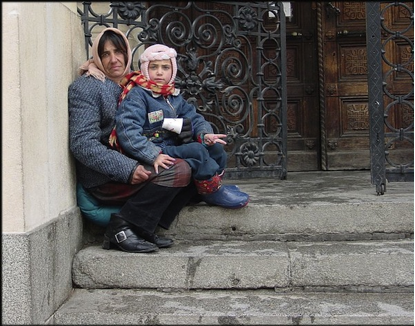
Roma mother and child begging. Photograph by Lori Scott.

Europe’s most hated people

The Roma

Every day on my way to work I passed by them. They were sleepingon the cold floor in a corner of the train station: a mother; a father; and twoyoung children in between them. They were still there when I finished work.While I was on my way to a warm apartment, a hot meal and a nice hot shower,these parents would spend another night with their children on a freezingfloor. There had been quite some solidarity lately with asylum-seekers who wereforced to sleep on the streets. Most of them had found a roof above their headsfor the harsh winter nights. But not this family; they could not ask for asylumand a bed to sleep in because they already are European citizens. They areRoma, often called Gypsies or nomads, and are associated with negativestereotypes such as theft, domestic violence, and being slum-dwellers.

My first experience with the Roma was about five years ago when Iwas living in Valencia, Spain. To go to the beach from my place, I had to walkthrough a dodgy-looking neighborhood that seemed rather to be located in a poorEastern European country than in a developed country such as Spain. There weremany dogs and half-naked children on the streets. The women were often yellingand the men looked at me in a threatening way. I wanted to get out of there asfast as possible. During my time in Spain, many people warned me of the gitanos, who werepickpockets and would threaten me with knives. They never did, however, and Ibecame intrigued by this European minority that seems to be excluded from“European integration,” lagging behind while their fellow countrymen aregradually joining European middle class.

It is widely known that many Jews died in the Nazi concentrationcamps, but less known is that also about half a million Roma were gassed.Unlike the Jews, the Roma continue to face serious threats and discriminationespecially in Eastern Europe but also in Western Europe. In 2008, young Italianmen set Roma camps in Milan, Naples and Sicily on fire with Molotov cocktails.In June 2009, 65 Roma living in Belfast were forced to return to Romania afterracist attacks on their houses. These are just the stories that have made it tothe news.

The only stories I read or hear about the Roma portray them aseither criminals or helpless victims. Why does no one wonder who these peopleare and why they are one of the most hated peoples in Europe?


“They prefer to be called Roma. That is how they refer tothemselves. There is not even a word in Romani, their language,  for gypsy or nomad. These names weremade up by others,” Biser Alekov of the European Roma Grassroots OrganizationsNetwork sighs. “Actually, only a very small minority of Roma are still nomads.Most Roma have settled down.” 

The Roma have their origins in South Asia, from where theymigrated to mainly Central and Eastern Europe during the Middle Ages. Theydeveloped a nomadic lifestyle as a means of survival, earning money throughseasonal agricultural work, repairing items, clairvoyance and door-to-doorselling. At the moment, they are the largest ethnic minority in the EuropeanUnion, with about 10 to 12 million members. There is no exact number availablebecause many of them live and work illegally in other European countries.

The Roma have never had an easy time in the countries that becametheir homes. During the Nazi years, many of them were gassed in theconcentration camps and in the communist era, Roma women were forcefullysterilized. But the worst was yet to come. At least during the communist years,the Roma were sometimes given land or social support. After the fall ofcommunism, unemployment and poverty prevailed in the Roma communities. “Youcan’t imagine what poverty engulfed the Roma in my village. After 1991, Irented the village pub and was the only employed Roma. Nobody else had a job.The people began wandering around, looking for work in the towns,” Akif, a Romacurrently living in Brussels, remembers. Many Roma decided to try their luck inWestern Europe.

Since the Central and Eastern European countries joined the EU,the economic situation of many of their citizens is gradually improving. TheRoma on the other hand continue to face discrimination in education, housing,employment, healthcare and other public services.

Although it has been ruled illegal in many Eastern Europeancountries, the practices of segregating Roma children in schools or havingseparate classes for children with special needs simply because they are Roma hascontinued. In these “special” schools, they receive poorer education and havevery limited opportunities for employment or further education. In Slovakia forexample, 80 percent of children in special schools are Roma.

When a group of Croatian Roma decided to fight the practice ofsegregating Roma pupils, they managed to convince the European Court of HumanRights that this was indeed discrimination. Besides urging the Croatiangovernment to respect the principle of equality, the Court also awarded theseRoma pupils with $4,500 each. Yet, many members of the local Roma community didnot share the euphoria over this victory. They feared that the situation couldget worse for them after the court ruling.

Because of the high degree of poverty in Roma communities inEastern Europe, many live in deplorable conditions. Some feel they do not haveanother choice than to stay in illegal settlements. Once every so often, theauthorities forcibly evict the residents from their makeshift dwellings withoutoffering them adequate alternative accommodations. This of course drives themback on the streets and new illegal settlements arise faster than thebulldozers can destroy them.

It is extremely hard for Roma to get out of this vicious circlewithout a steady job. Saliha, a Roma woman from Bulgaria who came to work inBelgium explains: “Even with higher education, employers prefer Bulgarianapplicants without investigating your qualities. When they understand that youare a Roma, they stop to trust you.” Akif’s childhood dream was to become apolice officer. But when he applied after finishing secondary education, he wasnot hired, unlike his Bulgarian classmates. He was never given an explanationwhy. Tunde Buzetzky, facilitator for Decade of Roma Inclusion, confirms thatthere is strong discrimination on the labor market: “If your skin is darker,the available job is immediately gone!”

The lack of opportunities in the East convinced many Roma to moveto Western Europe. But with the growing numbers of Roma, anti-gypsyism grew inWestern Europe as well. In particular, Italy stands out for its anti-Romaattitude. In 2007, the government adopted increased “security” measures againstthe “nomad emergency.” Police was allowed to “collect data,” includingfingerprinting, exclusively nomads. Forced evictions without prior consultationor proposing adequate alternatives became more frequent. The strong anti-Romarhetoric from politicians and vilification in the media further increased thestigmatization of the Romani people, which resulted in various violent attackson Roma throughout 2008 and 2009. But in other EU countries anti-gypsyism isalso growing. Eurobarometer, a public opinion survey, has shown that nearly aquarter of all Europeans would feel uncomfortable living next to a Roma. InItaly this is half of the population.

Meanwhile, the European Union is trying hard to integrate Romaissues in its activities and many non-governmental organizations have taken onthe advocacy of the Roma. Unfortunately, all these efforts have not resulted insufficient progress. Grassroots Roma organizations strongly believe that themain reason why these policies have failed is that they were developed withoutthe participation of the Roma.

They might be right. The Bulgarian municipality of Sliven has thehighest percentage of Roma residents in the country and one of the biggest Romaghettos with 20,000 inhabitants. It works actively together with Roma NGOs,Roma experts, volunteers and informal leaders on education, housing, health andemployment issues. “This place used to be a terrible ghetto, now it’s good tolive there thanks to the inclusion of Roma in policy-making,” Alekov adds.

“Another important obstacle is the continued stereotyping. Romanipeople have been hearing for a long time that they are worthless. They havestarted to believe this themselves. Good role models are essential to motivatethem to fight for a better future for themselves and their children,” explainsBiser Alekov. He claims that it is only a small percentage of Roma that arethieves, prostitutes or beggars. “There are many Roma all over Europe that areleading or trying to lead a successful life just like other Europeans.Unfortunately many of them hide their Romani background because of the stigma.”

Alekov believes that if Europeans knew more about these Roma, theywould realize that they just want to have a decent job, live in their own houseand send their children to school, just like everyone else. His fellow Romaadvocate Buzetzky agrees that “although it would be incorrect to say that thereare no beggars or petty thieves among the Roma migrants in Western Europeancountries, most of the Roma migrants get legal jobs, send their children toschool and have a decent life. There are groups living in illegal camps underdreadful conditions. Indeed in these groups, some people may be engaged inpetty crimes.”

George Soros, whose foundation helps to improve the situation ofthe Romani people, writes in an article for The Guardian: “The keyto success is the education of a new generation of Roma who do not seek toassimilate into the general population, but deliberately retain their identityas Roma. Educated, successful Roma will shatter the prevailing negativestereotypes by their very existence.”

Fikret and Sevinch are such successful Roma. They moved to Ghent,Belgium, in 1998. Twelve years later, they own a house in a Flemishneighborhood, and have their own retail shop and construction company. Theyconsider themselves successful immigrants but stress that they had to work veryhard to get where they are today. “When we arrived, I started to work forTurkish women, to clean for them and to serve them. My husband began work onconstruction sites. After five years, we received Belgian passports, but we continuedto do the same job. However, we enrolled in language courses, because you cando nothing if you do not speak the language. Later I finished a business coursewhere I learned how to set up my own company, how to manage the retail shop,and what documents were needed. That helped me a lot,” says Fikret.  She explains that the main hurdles tolead a successful life for less fortunate Roma are that they do not speak thelanguage and that they do not know the local rules and regulations of thecountry they are staying in. They also often do not have the right documents tofind a legal job.

Mladen and Saliha came to Belgium from Bulgaria in 2007 to offertheir son a better education. They are both working as cleaners at the momentbut they have many goals and plans for the future. Mladen wants to open a smallrestaurant offering Bulgarian dishes and Saliha is looking for a job as a labassistant in the food or chemical industry. They do however still feel it isbetter to hide their Roma identity for some people out of fear of losing theirjobs.

They are not alone in this. Many of their fellow Roma keep theirethnic background a secret. They go through life as Bulgarians, Romanians,Slovakians or Kosovars. The family of Assen, who has been living in Belgium for18 years, has not yet explained to the grandchildren that they are not justBulgarians, but also Roma.

A Roma background should be something to be proud of. The cultureis very rich and goes back a long time. Unfortunately, there are many misconceptions.Begging for instance is not part of the Roma culture.  Biser Alekov says that “it is a big business and the peoplebehind it are considered as criminals by the rest of the Roma community.”


It is also commonly believed that it is part of Roma culture toforce very young girls to marry older men. Historically, weddings didtraditionally occur at an early age, between 14 and 16 for girls, but this ischanging among most Roma. Biser Alekov even claims that it is discrimination ifauthorities do not take action against the criminal act of forcing minors tomarry adult men. He claims that in these cases, the argument of “it is part oftheir culture” reinforces the stigmatization and marginalization of the Roma.

In fact, the Romani wedding is full of remarkable culturaltraditions. If the parents have not formally agreed to a wedding, the boy“abducts” the girl for a couple of days. When they return, the wedding iscelebrated. For the finale of the wedding ceremony, the young couple retires totheir room to consummate the union while the guests wait for the result: theblood traces proving that the girl was a virgin. These bloody clothes weretraditionally hung on a high place, so everyone could see that the bride wasrespectable. Today in most cases, only a symbolic form of these traditions isstill practiced.

Family and community belonging are very important to the Roma. Yourarely see old people in retirement homes. Instead, they live with theirchildren and grandchildren. When someone dies, his family stays at his side forthree days and three nights.

Roma still do not have an easy life in Europe. They arestereotyped as beggars and thieves and are not given equal opportunitiesbecause they are “Gypsies.” Once they have succeeded in overcoming the obstacles,they feel forced to hide their true identity. However, there is no need to betoo pessimistic, as Assen says: “Many will find their way. They will have towork hard on non-prestigious jobs, but if the parents do this work today,tomorrow their children – who are studying and complete local schools – willhave more opportunities. That’s how it was with other migrants, and that willhappen with us too.”

I sometimes wonder what happened to that Roma family Isaw every day in the station. One day they were gone. Have they found their wayand has someone offered them a place to stay? Or did they return disappointedto their home country?


The truth about wolves

A few weeks ago, my husband and I took a day trip to the Lakota Wolf Preserve in Columbia, New Jersey. The preserve rests on Camp Taylor, just minutes from the Delaware Water Gap and the Pocono Mountains of Pennsylvania. It is owned by Dan and Pam Bacon and Jim Stein. They have three different types of wolves that include the Timber, Tundra, and Arctic wolves. They also have two adorable foxes and three bobcats. Each pack and group of animals has their own fenced-in space that is more generous and humane than any in any zoo. The wolves have plenty of space to run, play with each other, and act like wolves, while still being protected.

As we began the tour, we were given information and facts about the nature of the wolf. Since it is a hot East Coast summer, the wolves had shed their luscious coats, looking a little like skinny coyotes. However, they were a perfect weight and quite larger than a coyote, husky, or a malamute dog. I immediately noticed that they behaved just like dogs, as they were panting and excited to see us (actually, their caretaker/pack leader, Jim, who had treats for them). Jim told us that they feed the wolves roadkill from the area, mostly deer meat.

Jim informed us about his preservation efforts along with interesting insights, such as wolves actually want to stay away from humans, and there only being one incident in the United States of a wolf attacking a man. I asked Jim what his inside knowledge was about the hunting of wolves in Alaska, and he said that the horror stories we hear about aerial hunting of wolves and their baby pups are true and unfortunately quite active today because of their state policies. (Thank you, Sarah Palin.) The reason behind all this hunting of wolves in Alaska is that the wolves are supposedly killing all their caribou (moose, deer, etc.), which are desired for the decadent and profit-making sport of hunting for the state. The irony is that these hunters justify killing all this caribou because of their overpopulation, especially in industrialized areas. So if there is an overpopulation of moose, why not let the natural predator (the wolf) take care of this situation as a natural part of the ecosystem? Contrary to claims that there is an overpopulation of Alaskan wolves, wolves are actually an endangered species in the United States. To reiterate, wolves want to stay away from men, and they are a natural predator of caribou. But, where there is an overpopulation of caribou, there is an abundance of expensive hunting licenses granted, contributing to the state’s economy.

In all honesty, men do not want to stay away from wolves. We have a natural fascination toward them. They have a mystical reputation. How we love the stories of werewolves and vampires. All this has nothing to do with the true nature of the wolf. They are timid, loyal, and intelligent animals. Yes, they are powerful and can be ferocious toward their prey or threat. They are wild. But, when you look in their eyes, you see wisdom, strength, and gentleness all at the same time. As I looked into the eyes of a black wolf, his gaze penetrated into my soul. I had a feeling of healing as I saw his strength and wisdom. I also wanted to pet him, but that, I have to admit, would be dangerous. I am attracted to this bad boy. He is dangerous and unpredictable, yet gentle and sweet. Don’t we all love that?

Our tour ended with a symphony of howls from all four packs of wolves all at the same time. The sound reminded me of a Native American flute. It was peaceful, spiritual, and very soothing. We were told to howl along with them. I felt connected to them. We are connected to each other.


personal stories. global issues.