Taking flight

When escape spells courage.

I’ve always had a thing for wings. Dragonflies, birds, planes, butterflies — if it flaps or soars, I’m interested. But while flight represents freedom and forward motion to me, many others equate it with running away.

Americans are socialized to believe that fleeing a difficult situation is the coward’s way out. We view flight as an escape from something one should face head-on, as the weaker side of the natural “fight or flight” dichotomy. We are taught that winners never quit, and quitters never win.

But when is “flight” actually a form of “fight”?

Escape from slavery is the most illustrative example of “flight as fight.” For a slave walking out of the South into the unknown territory of the North, freedom was a mystery. Imagine what it was like to flee from the only home — albeit an oppressive one — that one has ever known. And toward what? Conventional wisdom of the day dictated that blacks belonged in slavery. Imagine summoning up the courage to flout the status quo and venture out alone.  

We do not view the slaves’ flight as cowardly, but it is difficult for us to comprehend the depth of courage it took to seek freedom. Two centuries of hindsight enable us to see the value of their choice. At the time, escape constituted a life-altering plunge into the profound and intangible unknown.

Society has similar responses toward survivors of domestic violence. A friend of mine once confided in me about problems with her husband, as their marriage of several years was nearing its end. From the outside looking in, I immediately recognized the signs of physical and emotional abuse and, as gently as I could, told her my impressions. Just as gently, she demurred, declaring their mutual love and commitment.

Weeks later, after a particularly troubling episode at home, she came to me again. We walked through a park together. I listened as she cried, and beyond my distress over her situation, I felt lucky that I had nothing to tie me down, that I had never relied on another person to keep my life in line.

For the longest time, she could not see how to leave him. How easy it seemed to accept her life as it was, even a life so fraught with pain and fears, because that pain and those fears were familiar. She was afraid of her husband — but more afraid of herself. She knew he would hurt her. But she did not know whether the world might further hurt her without him.

It’s impossible to explain freedom to someone who has never experienced it. Concepts of independence, self-direction, and discovery fell on a blank slate. I felt as if I were pushing buttons on a cash register, and no numbers were coming up. For my friend, embracing independence required a leap of faith the distance of which I could not fully comprehend. The day she decided to leave her husband, her eyes radiated fear. She trembled, her body suffused with a terror so strong she wept in my arms from the pain of it.

But then, she lifted her head, dried her eyes, and went on. She gritted her teeth, dug through the uncertainty, fear, and loneliness, until one day she said, “My life is my own. I made it that way, and no one can hurt me again.”

Socially, it has become easier for people to leave abusive partners. We now recognize that staying married for marriage’s sake is not always best. And with that shift in thinking, we’ve adopted the perception that walking away from abuse is the right thing, the logical thing to do.

What is our common reaction to abuse survivors? Pity, perhaps. We feel sorry for the difficult experiences that bring them to places so low. We look at them and see fragility and sorrow. But while we may see crumpled wings, we must also recognize the cocoon and the shape of something being built, something beautiful and stronger than before — a being with dreams and distance to travel. Strength exists in uprooting the status quo, in finding the courage to stand alone.

On my own personal level, the choice between “fight” and “flight” arose in a decision to change my career path and escape what I call the “professional treadmill.”  

American society glorifies law and medicine as the epitome of success, the end result of a long road of study and hard work. But we often forget how prescribed that journey can be for the person who, at age 16 or 17, decides how the rest of his or her life will play out, with little room for variation. Science classes in high school lead to science classes in college, which lead to med school, rotations, internship, residency, and ultimately, work as a physician. I deeply admire the dedication it takes to complete that path; our society admires it also. But for me to have stayed on that path would have been dedication without courage.

The day I chose to stop pre-med classes was one of my highest points of courage. I did not feel like a quitter as the world would have had me believe. I felt free. I was not walking away from a fight. Rather, I felt myself gearing up for the greatest struggles I expect to face in my life: learning who I am, deciding what I will be, and how to make my contribution to this world before my life runs out.

Few things are scarier than stepping off that treadmill onto the regular sidewalk, where you have to choose your own way and get there under your own power. It’s terrifying to step out of the known into the unknown, to lift your feet off the ground and hope your wings have what it takes to go the distance. At those moments, only faith and courage are with you.

And yet stepping off, for me, was to experience texture — the rocks and sand and grass beneath my feet. It meant traveling in my own direction, not in a straight line, and it has led me to places the nervous high school junior who marked “pre-medicine” on her college applications never could have predicted or imagined.

In big and small ways we each have the power to forge new paths for ourselves, and we mustn’t let others think us cowards for defying expectations. We do have to fight many internal — and external — battles to escape, to remove ourselves from negative equations, to cancel out the things that drag us down.

Changing trajectories when our current paths are failing us is not weakness. It is decisive action. Slaves who ran for freedom knew that somewhere in the unknown was a better place for them, despite the world telling them “stay in your place.” Abuse survivors who find the courage to discover their independence do so only by leaping into uncertainty. Such actions must be taken, for to exist solely within prescribed boundaries is to risk never knowing our truths and our potential. By leaping, we learn to fly.


The best of it

Every year she was forced into a new place.

I am up in my tree. The sky is spotted with stars — JD used to say stars are vanilla freckles on the darkest chocolate face. I look into that face for a sign of a smile. A night breeze moves the leaves.

The leaves in my tree are green-gold, but you can’t tell at night. Not unless you scrunch down so the streetlights shine through — the streetlights in front of our house — Mama’s and my house.

Mama says it’s not right for a girl like me to be out climbing trees — ‘specially at night, and me only nine years old. I can just see her standing there in her nylons on the scratchy grass in our perfect, tiny yard. Her hands would be on her hips, each one holding one of her grown-up-lady shoes from work. Her big sweet face looks up at me. It wrinkles itself into a get-outta-that-tree-right-now-Young-Miss look. Even though my name’s Antoinette, that’s what Mama calls me, “Young Miss.”

I would climb down and say “Sorry Ma’am.” Mama’s big on Ma’ams — it’s just the way she is.

Mama puts a big soft arm around me, and we head for the house. Can’t you just hear her say, “ooh, ouch,” in a squeaky voice as we walk over the scratchy grass? We would laugh and go inside and order next door for Chinese.

Here I am stuck on the top bunk. The ceiling is too close — all those little bumpy pointy things. They feel like dirty chalk. If Deandra hadn’t gone and broke her leg she’d be sleeping up here and I’d get the bottom bunk.

Up in my tree I can see the whole city. It sparkles out there, so far away ‘cause our place — Mama’s and my place — it’s up in the hills. We got a lot of land around us ‘cause that’s the way Mama likes it after a hard day at the office.

She says, “Who wants to be sleepin’ surrounded by a million folks they don’t know, in a million hotels and apartments, and that ratty old downtown shelter, too?”

Downtown’s full of nothing but people and you can’t even see the stars at night. I should know.

We got lots of stars at our place — Mama’s and my place. Every so often at night Mama comes and wakes me up. She stands there by my bed, all tall and spiky. The beads in her braids say click-click.  She takes my hand and says, “Come on out here, Netnet.” She calls me that sometimes.

We walk out in the yard in our lacy nightgowns. “Look at all them stars,” she says, and we just stand there and shiver together, Mama and me, knowing it’s nice and warm inside.

There’s a little river making its water-noises in back of the house, and all the frogs are croaking a nightsong, and there’s even a firefly out by the shed. Mama’s big on nature. That’s just how she is.  

Are Frances and Deandra gonna keep moving around all night? All those plastic crinkle sounds keep me up. I stay still as I can so I don’t make any plastic crinkles, myself. Most rules in this place are okay, but not the plastic sheet rule. Plastic sheets are for babies.

In my tree I look down at my watch. It’s on my left wrist. I told Mama I didn’t need a watch so nice, but she insisted. She said “Little Toni Girl” — that’s what she calls me, you know, it’s short for Antoinette. She said. “Little Toni Girl, anyone pretty as you ought to have a pretty watch.” Then she put that watch on her credit card. I don’t know which one. She’s got ‘em all: Visa. MasterCard, American Express — she’s what you call one of those golden customers.

I think about how I shouldn’t be climbing trees wearing my new watch and nice clothes. How I should climb down and go in the house. I should go to my room I don’t even have to share with anybody, and look through all the clothes in there for some tree-climbing clothes. I think I should, but I don’t. I just sit up here and study those vanilla freckles.

Maybe when I climb down tonight I’ll go inside and read. There’s books in our house — Mama’s and my house — whole big wooden bookcases like at the library, with those little numbers and everything. They’re all filled up with piles and piles of books, and me and Mama read ‘em all the time.

Mama’s so smart she’s always reading. Did I mention she’s got glasses? Mama loves books so much she’s got some of those gold-frame glasses. Mama says keeping her hair so short and wearing those gold glasses make her look dignified. I like that — having a dignified mama.

Sometimes Mama just sits in her big soft chair and reads all night. And so do I — right next to the fireplace — we got us a nice fireplace, you know. That’s where I read all those books, next to Mama’s big chair by the fireplace.

“Yeah?” I say.

It’s Deandra. I thought she was sleeping.

“Girl,” I say, “you shoulda gone pee before you went to bed.” I climb down and help her stand up. I hand her the crutches and she clumps on down the hall. I go back up the metal ladder and try to keep the crinkles quiet.

Frances is breathing soft and slow over in her bed. The toilet flushes down the hall. Deandra clumps in and leans her crutches against the ladder. She crinkles a lot when she gets in bed, but she’s got that big cast so I try not to get too mad at her.

JD used to say only little monkeys climb trees, but really he just knew he was too big. A man that big could never climb a tree, so he was just grouchy about it. If he hadn’t eaten all those pancakes every morning and bought himself double-triple french fries and left all that trash in the van maybe he would’ve got skinny enough to climb a tree. Then he wouldn’t have to go calling me a monkey.

But who wants to think about old JD? That was two placements ago. I’m up in my tree now, with its creaky noises when the wind blows like tonight. Right now I’m thinking about Mama and me coming out here to the garden where my tree’s lined up with a whole mess of other trees. We got bananas and pumpkins and kiwi fruits growing in our garden, and all that green grass all over the yard, and our pretty little house all warm and cozy.

Did I say how Mama bought this house here in this neighborhood back when I was born? That way I live here all my life and never have to change houses. All the other houses on the street are nice, but not so nice as ours — Mama’s and mine.

There’s a click-click sound and a whoosh when the front door opens. 11 o’clock. They’re changing shifts. I hear Suzanne whispering to whoever, telling all her little secrets about all of us and whatever happened today. Then she’ll go in the office and write a bunch of notes while whoever is getting settled in. Will it be Joanie Rae? I hope. Or maybe Elizabeth, or that substitute lady with the jingly bracelets?

Deandra is making a snuffly sleep noise and I can’t hear any of those secrets they’re talking about, but I think they’re in the kitchen now, cause somebody’s pouring a cup of coffee. That coffee gets poured a long time. Must be Joanie Rae.

After a few minutes she pops her head in our room. She’s got her favorite monster coffee mug. The hall light shines through her hair.

She walks over to Frances’ bed and looks down. Joanie Rae’s a big woman, but she walks like she’s made of cotton balls. The coffee smell follows her in. Then she turns and reaches out to touch Deandra’s crutches leaned up against my ladder. She shakes her head real slow.

Joanie Rae puts a hand on my bed and says, so quiet, “You still awake, Toni-girl?”

“Yes Ma’am,” I say.

“You know you don’t have to Ma’am me.” She pats my shoulder.

“I know.”

“You just get some sleep,” she says. “You just look out the window at your tree and get some sleep.”

“Yes Ma’am,” I say. “That’s what I’m doing.”

Joanie Rae’s all right.

Nobody else ever climbs up my tree. It’s all mine. Mama had this great idea — she built me a fence around my tree so nobody would come up and bother me. So I don’t have to fight off people like those boys that jump in front of you in line at lunch, or laugh at what you’re wearing. I don’t have to fight off people like Ted at the car wash, or old Mr. Hinkley at Eastside Shelter or Rita’s nasty brother.

Up here in my tree I wonder. I wonder about Joanie Rae. Where does she go when she’s not here? Suzanne talks about where she goes home. She says her man doesn’t treat her good. I wonder about Joanie Rae. I sure hope there’s somebody out there who treats her good.

This morning I am second in the bathroom. The rule is fifteen minutes each, but those older girls fog things up so bad you can’t even read the clock. I like getting done before they’re even up.

When I get back to the room, Deandra and Frances aren’t up yet. I fold my sleeping t-shirt on the bed and slip down the hall. Joanie Rae has the table all set for breakfast. The big bag of pancake mix is on the counter.

“Morning, Ma’am,” I say.

“Hey Toni-girl,” she says. She puts down the papers she’s reading and gives me a hug. I finish up, but she’s still hugging. I guess that’s okay. Joanie Rae’s all right. She smells like coffee and maple syrup.

When she lets go I see her eyes are all wet.

“They’re moving you,” she says. She waves some papers. “Again,” she says, then she throws them down on the table.

I pick up the papers and put them in a neat pile. One is all sticky from the syrup bottle.

“Saint Bernadette’s,” Joanie Rae says. “It’s on the Southside. I sub there, sometimes. The kids call it Bernie’s.”

I keep my eyes on the papers, all straightened up. I put them on the table, right on top of the tired yellow folder that says Antoinette Beeler Jones – that’s me.

Joanie Rae’s voice is high and funny. “I can’t believe it. Lost your mother so young, then the streets, the shelter, and a new placement every year since. Why can’t they let you be?”

I shrug.

Joanie Rae stands there cleaning up her face with a Scooby-Doo napkin, and I wonder if it would be okay to ask. I wonder if it would be okay to wish.

I take in a breath. “Do you think from my new room,” I say, “at Bernie’s? Do you think I can see any trees?”

“Oh God in heaven,” she says, then her face crumples all up and she hugs me again. “They have trees, yeah, they do,” she says in between sniffly cry noises, while she holds me up against her big soft chest.

I never knew Joanie Rae cried. She takes a long, messy breath, then says “You’ll be okay, Toni? You’ll settle in and stay awake half the night there instead of here. You’ll make the best of it, won’t you?” She asks.

I nod my head and say into her chest, “Yes ma’am,” but she just keeps on crying.


A long walk to work

New York City takes a transit strike in stride.

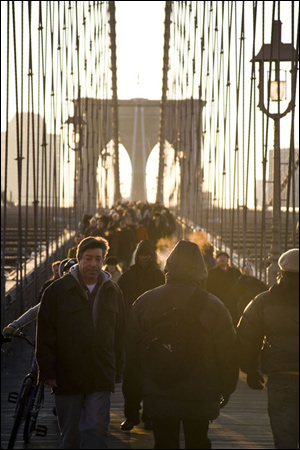
Commuters trek across the Brooklyn Bridge on the third day of the strike. Many New Yorkers were forced to find alternative ways to get to and from work.

In the early morning hours of December 20, 2005 in New York City, after marathon contract negotiations, the Transportation Workers Union (TWU) and the Metropolitan Transit Authority (MTA) were at an impasse to agreeing on wages and benefits.  The TWU decided enough was enough. It was time to make good on their threats to walk out from their positions as subway conductors, bus drivers, track maintenance workers, and other transit-related posts. They began what would become a three-day strike, leaving millions of commuters to fend for themselves seeking alternative methods for getting to work. New Yorkers bundled up and walked bridges, rode bikes and hitched cabs to get where they needed to be.

As could be expected, roadways were much more crowded than usual, with commutes taking upward of three hours for what was usually a 30-minute drive. Cab drivers and bicycle rickshaws saw a large increase in fares throughout the city. The Long Island Railroad (LIRR) and Metro North commuter rail lines were swamped with riders hoping to get into the city. News images showed lines in Jamaica, Queens stretching back and forth for blocks just to get a seat on the LIRR into Penn Station.

To make this photo essay, I took to the streets with my trusty bike and multiple layers of Gore-Tex to keep the cold out and the warm in. Beginning in Fort Greene, Brooklyn at 5:00 a.m., I rode the bridges, visited transportation hubs, and went to bus depots and subway stops to photograph the city under what became known as the 2005 New York Transit Strike. I first pedaled to the Manhattan Bridge, then over into Chinatown and downtown to the Manhattan side of the Brooklyn Bridge.  

Locking my bike, I walked up onto the Brooklyn Bridge. After photographing morning commuters for a couple of hours on the bridge, I got back on my bike and made my way up through Manhattan, stopping to shoot when something moved me. I ended up at the 57th St. Bus Depot and spent a short while talking to TWU strikers and making pictures as they picketed. Eventually, at the end of the day, I made my way to Penn Station to photograph the crowds commuting home.

Ever since September 11, 2001, New Yorkers have had an uncanny ability to remain calm under pressure. The transit strike was no different. For the most part, people did what they had to do under the circumstances and didn’t really complain too much about it. In fact, the only raised voices I heard throughout the entire strike came from commuters at Penn Station, as they were squished like cattle through police barricaded lines into narrow hallways.

I couldn’t help but think about the Blackout of 2003 when people had to improvise after 21 power plants in the Northeast and Midwest shut down in a span of three minutes, knocking out power for all of New York City.
People joined together to help those in need. Community members directed traffic. Stranded commuters stayed at friend’s houses in the city. People with cars gave rides home to strangers in need. And, during the transit strike, even with traffic backed up throughout the city, long lines, and long walks, everyone generally remained calm and worked together.

For the most part, New Yorkers empathized with the plight of the TWU workers, agreeing that their jobs were not the easiest and they deserved a fair contract. But as the strike went on, more and more people became frustrated. A number of my teacher friends, city workers who are also without a contract, grumbled that TWU workers generally make more money then they do. One teacher went on to complain that a TWU worker had never been nice to her when she needed help in the subway system, and that maybe the teachers should be the ones taking to the streets.

If the strike had gone on for more than three days, or the weather had been bad for the commuters, I have a feeling things would have made a turn for the worse. With the nice weather, albeit cold, people were able to get to work without extreme hassle and only had to do so for a short period.

All in all, the sentiment now is generally one of confusion. After lengthy negotiations with the MTA during the strike, the TWU agreed to go back to work after representatives reached agreement on a contract that met most of their demands. Unfortunately, things did not pan out as the negotiators hoped. As of the writing of this article, in a union-wide vote, the TWU rejected the contract worked out with the MTA.  Now, once again the TWU is without a contract. The future remains uncertain, and we are led to ask the question:  was the strike even necessary?

Click here to enter the photo essay.


The anti-pleasure principle

On the scorecard of sins, Lust usually gets top billing. But what about the others?

Perhaps the Grand Old Party (GOP) should change its name to the Party of Galatians (POG). After all, verses in that book of the Bible outline the crux of the modern day Republican ethos: “Walk in the Spirit, and ye shall not fulfill the lust of the flesh. For the flesh lusteth against the Spirit, and the Spirit against the flesh: and these are contrary the one to the other: so that ye cannot do the things that ye would” (Galatians 5:16-17).

The Christian Right, the Bush administration, and its acolytes have been trying to fight sins of the flesh for decades. Under Dubya, today’s Republicans have successfully defined morality solely in terms of sexual attitudes. As the movement continues to splinter over issues like uncontrolled spending and the legality of wiretapping Americans, one reliable bugaboo never fails to galvanize the right: Lust, defined as “unlawful craving for pleasures of the body.”

A controversial speaker at an event for Texas Governor Rick Perry caught the attention of The New York Times. Columbus, Ohio senior pastor and “Silent No More” author Rod Parsley said that Christians would not cave to requests for legalization of gay marriage because “we are not to sacrifice our children on the altar of sexual lust of a few.”

Similarly, Billy Graham’s son, Franklin, said that New Orleans — the City of Sin — was rightfully in the Lord’s crosshairs for a hurricane disaster because of its libertine mores. “This is one wicked city, okay? It’s known for Mardi Gras. It’s known for sex perversion,” Franklin Graham said. His rant also included references to the Big Easy’s “Satan worship” (aka Santeria) and laissez-faire attitude toward drug use.

Whether it’s the recent Senate porn hearings held by Kansas Republican Sam Brownback or the reliably loopy Senator Rick Santorum’s equating same-sex marriage with dog-shagging, calls to action taken under the aegis of Christian values have meant calls to thwart non-Church-sanctioned petits morts.

In pursuing sins of the flesh with such a vengeance, the modern GOP-Christian Right amalgam has taken on just one-seventh of the biblical battle against sin. Lust prevention occupies much of the Right’s time and efforts, often trumping niggling questions of health policy and common sense. Last year, conservatives stated their intention to block mandatory vaccinations of young girls against HPV, a sexually transmitted disease that can lead to the development of cervical cancer. Why? They feared that newly protected girls may (as a spokeswoman for the Family Research Council said) “see it as a license to engage in premarital sex.” For all the fervor surrounding Lust, the GOP seems downright lackadaisical when it comes to curtailing the remaining deadly sins: Avarice, Sloth, Gluttony, Envy, Wrath, and Pride.

As one of its calling cards, Republicans.org touts Proverbs 14:34: “Righteousness exalts a nation, but sin is a reproach to any people.” Perhaps it’s time to take a close look at the other six sins. Scattered throughout the book of Proverbs, the seven deadly sins have evolved into shorthand for the basic tenets of Christian thought. The big guns of Christian theology — Pope Gregory the Great, Thomas Aquinas, Milton, Dante — have referenced them for centuries. When he first cobbled together the sin scorecard, Gregory himself deemed Lust the least serious of the transgressions.

Avarice

Ranked as a sin more grave than Lust, Pope Gregory’s list named Avarice — the insatiable desire for wealth. The greedy have been called upon to answer for their lapses, thanks most recently to lobbyist Jack Abramoff. Christian Coalition founder and Georgia gubernatorial candidate Ralph Reed’s ambitions have been thwarted by his Abramoff ties, with a Christian Coalition member telling The Washington Post, “it became pretty obvious [Reed] was putting money before God.” Concurrently, the Securities and Exchange Commission’s probe into Senate Majority Leader Bill Frist’s stock sales, Tom DeLay’s charges of money laundering and conspiracy, or California Republican Representative Randy “Duke” Cunningham’s tearful apology for his long-running bribery scheme, demonstrate the need to tend to this particular sin. But while the investigations into these Republican Party members continue, so does a party-wide commission of what beliefnet.org’s Phyllis Tickle called “The Mother of All Sins.”

Quoting former Federal Reserve Chairman Alan Greenspan, Tickle said that to blame “infectious greed” for the rash of corporate scandals associated with Enron and Tyco “feels a bit like a betrayal. We’d been told all along that greed — well harnessed and regulated — was good, not only for corporations, but society as a whole, even the poor.” Indeed, the Bush administration takes that tack when promoting the elimination of the estate tax, higher standards for filing bankruptcy, and tax cuts for Americans in the top 1 percent income bracket. Nearly five months after Hurricane Katrina, Gordon Gekko’s Wall Street mantra “Greed is good” isn’t as popular as it once was.  

Sloth

Affected residents of the U.S. Gulf Coast were not just victims of great rains, but of another Republican sin — Sloth. This sin might appear to be the biggest anathema to today’s GOP members, who have long prided themselves on the “hand up, not hand out” meme and who extol the virtues of hard work and entrepreneurship. They seemed to follow the advice found in Romans: “Never flag in zeal, be aglow with the Spirit, serve the Lord.” Then came a certain former commissioner for the International Arabian Horse Association, and their sin was revealed.

Few would argue that saving the residents of New Orleans from the storm would qualify as God’s work, and Michael Brown’s less-than-zealous attitude toward his job as head of the Federal Emergency Management Agency (FEMA) became apparent within hours of the hurricane’s deadly landing in New Orleans, Mississippi, and Alabama.

Brown, a Bush crony with questionable emergency management qualifications when appointed to the post, penned some telling emails while the storm was at its height. According to CNN, some of those missives included, “Can I quit now? Can I come home?” the morning of the hurricane, as well as questions to his aide about what to wear when appearing on television. “Tie or not for tonight? Button-down blue shirt?” he asked. The reply was “Please roll up the sleeves of your shirt, all shirts. Even the president rolled his sleeves to just below the elbow. In this [crisis] and on TV you just need to look more hard-working.”

Gluttony

FEMA’s inability to get food and water to Katrina victims puts the Republicans at risk of committing yet another transgression — Gluttony. Withholding food from the needy, after all, is part and parcel of the sin, which refers specifically to overindulgence of food and drink, and, more generally, to consuming more than one needs. In the realm of resources — oil, money, and the like — modern Republicans are hoarders of the first order. In Congress, Alaska Republican Don Young showed himself a glutton for federal dollars (and punishment) when he insisted on using $200 million in federal spending on his “bridge to nowhere,” connecting two communities with a combined population of only about 14,550. Despite entreaties from his fellow Congress members, and even some of his own constituents, Young would not relent when asked to forgo his project in favor of allocating the funds to hurricane victims. Today’s economic policies (see Avarice above) seem geared to keeping resources concentrated within a small group of … Republicans.

Envy

A while back, some characterized the Republican hatred of former President Bill Clinton as stemming from an obsession with the 40th president’s lifestyle. With his supposed in-your-face sexuality, his recreational drugs, his rock and/or roll, Clinton exemplified the longhaired hipitude that the Republicans despised precisely because they wished they had his job. The result of this GOP envy was a two-year, $40 million investigation and a Starr-penned book that, one could argue, read like the same soft-core porn the Republicans were trying to eradicate (see Lust).

Wrath

The doggedness involved in toppling Clinton was part of a phenomenon that’s grown exponentially since the days of impeachment — Republican anger. One sees it in the face of the aforementioned O’Reilly whenever he’s confronted with Mexican undocumented immigrants, or Bob Novak when he’s about to be asked about his role in the Valerie Plame case. Fox News traffics in a type of anger that is both frightening and, if they weren’t being paid quite so much, quite hilarious.  

On the topic of trying to get at the root of Islamic terrorism, Ann Coulter famously wrote:

“They hate us? We hate them. Americans don’t want to make Islamic fanatics love us. We want to make them die. There’s nothing like horrendous physical pain to quell angry fanatics. So sorry they’re angry — wait until they see American anger.”

Her response probably wouldn’t have sat too well with the apostle James who advised that “everyone should be quick to listen, slow to speak and slow to become angry, for man’s anger does not bring about the righteous life that God desires.”

Pride

Listening is not chief among current Republican priorities. The president’s inability to hear any voice other than his own has contributed to his commission of the sin of Pride. Most recently, the New Yorker’s Seymour Hersh has documented that the president’s current policy in Iraq is being guided not by information from his generals on the sandy ground, but by the belief that in five or 10 or 20 years, his mission into the desert will be deemed an unparalleled success, catapulting him into the annals of history as one of the nation’s greatest commanders-in-chief. “Mission Accomplished” was a boast (also a no-no according to Corinthians) that, ultimately, could not be backed up. And yet, here is America in the middle of an intractable war, which originated with a deadly presidential sin.

So, is Lust (Gregory’s least concern) the sin which has gotten the Republicans and America into its current state of disarray, or do the six other transgressions really deserve a closer look? The fourth book of James hints at an answer:

“What causes wars, and what causes fighting among you? Is it not your passions that are at war in your members? You desire and do not have; so you kill. And you covet and cannot obtain; so you fight and wage war.”


Going to Plan B

The behemoth that is Wal-Mart is now being hauled to court by three women in Massachusetts; if Wal-Mart loses, it will be a victory for women and women’s health advocates.

At issue is Plan B, an emergency contraceptive pill that can prevent pregnancy if taken within 72 hours of sex. Pharmacies in Massachusetts are permitted to sell the pill, which is generally issued by prescription, over the counter, although none are required to do so. State law requires its pharmacies is to stock and provide “commonly prescribed medications in accordance with the usual needs of the community.” The three plaintiffs in Massachusetts are contending that Plan B falls within the usual needs of the community.  

Wal-Mart cites low demand for its refusal to stock the drug; however, the AP refers to a letter attributed to John Delaney, a Wal-Mart lawyer, stating that it was the company’s policy — and not a lack of demand or poor sales — to not stock emergency contraceptive pills. The only state in which Wal-Mart stocks Plan B is Illinois, where federal law mandates that it do so.

Should Wal-Mart lose this case, it will be a victory for women and women’s health advocates and a clear message to the corporate monstrosity that it cannot overrule the genuine needs of the community on the basis of its own political motives.

Mimi Hanaoka


Love Monkey is a nice frolic in the asphalt jungle

I generally like to give new TV series time to settle in before giving them the once over because it’s hard to judge from a single episode, especially a pilot.  Some potential series have killer first shows and then go down hill faster than Bode Miller.  Others are like fine wine and require time to breath before easing into big hits.  Then there are shows that fall somewhere in the middle like CBS’s new dramedy Love Monkey, starring Tom Cavanaugh, and which could have easily been called Ed In The City.  

Love Monkey is based on the best-selling book of the same name by Kyle Smith which was touted as an American version of Brit Nick Hornsby’s High Fidelity, which, in turn, was Americanized for the film version staring John Cusack and Jack Black.  Both book and TV show are about four thirty-something males living in New York, all at different stages of life, who hang out together and discuss the idiosyncrasies of their existence, which in most cases involves women.  The title stems from the idea that single guys in the jungle of the big city swing from relationship to relationship, looking for the right woman to settle down with.  The show veers from the book by changing the main ape, Tom Farrell, from a newspaper writer to a recording industry A&R man who gets fired from his cushy major label job because he cares more about the music than the bottom line.  He downgrades to a friend’s independent label where he can make more of a difference in helping undiscovered talent hone their craft and head towards stardom.  Tom’s trials and tribulations with musical artists are interspersed with his trials and tribulations with the opposite sex, which so far have only involved a few.  He breaks up with one romance at the start of the pilot, and after a few episodes, the embers are smoldering on another with one of his colleagues at work.  Along for the ride are three male buddies and a platonic girlfriend, who seem to act like the devil and angel on Tom’s shoulders, dispensing advice that may be well-intentioned but not always the best route to take.  It’s Tom finding his own path and his life revelations that make the show entertaining and meaningful.

Upon seeing the pilot, I was pleasantly surprised to find a show that doesn’t overtly try to make an audience like it.  It’s not a Desperate Housewives jumping up and down and waving in hopes of attracting your attention, but it’s also not dull pabulum for tired folks who want nothing but to sit and watch programs that hardly even use up one brain cell.  The characters are all interesting, likable, and flawed — which means that you want to find out what happens to them.  And that is what will make the show successful, if the writing stays fresh.  

Though, Tom Cavanaugh is the star, the show feels more like an ensemble piece, and if the rest of the cast is allowed to shine, I believe Love Monkey will turn into a big hit.  The writers need to take advantage of Judy Greer, who plays Tom’s platonic friend Brandy, a very astute actress who has great comic timing, charm, and a lot of chemistry with Cavanaugh.  One part of me wants them to build up the Brandy-Tom relationship, but another part wants there to be a good platonic relationship on TV that doesn’t involve one of the characters being gay.

Tom Cavanaugh takes his Ed character and fine tunes it, giving his screen Tom a little more edge and cynicism, which makes him not only more real than Ed but adds a lot more charisma, without losing the sweet charm that has been the actor’s appeal.  Jason Priestly (Beverly Hills, 90210) grows up to play the married buddy who is about to become a Dad and perhaps may not be grown up enough for the challenge.  Larenz Tate is Shooter, the rich playboy who works for the family business that allows him more time to entertain the ladies in the bedroom than attend meetings in the boardroom.  Christopher Wiehl is the not-so-enlightened ex-jock sports announcer who’s keeping his personal life secret for good reason.  There’s a lot of room for the characters to explore life in the big city much like their uptown counterparts who made it fashionable for ladies to talk about sex.  Perhaps Love Monkey will make it okay for men to talk about their emotions, though I can’t see Tom Cavanaugh ever appearing on the cover of GQ anytime soon. But you never know, he may one day become a Gap spokesman.

I recommend switching the channel over to CBS for Love Monkey after watching American Idol and House on Fox for a light but satisfying snack before bedtime.  It may not be issue-stretching material or shockingly thrilling, but with good writing and interesting characters, I think Love Monkey has the chance to become another Northern Exposure, quietly entertaining viewers for years to come.  You can catch Love Monkey Tuesdays on CBS, 10 p.m. ET/PT.

Rich Burlingham


Looking for moderates in the Muslim world

Josh Marshall of Talking Points Memo has a thoughtful post on the violent reaction to cartoons published of the prophet Mohammad. An excerpt…

Josh Marshall of Talking Points Memo has a thoughtful post on the violent reaction to cartoons published of the prophet Mohammad. An excerpt:

An open society, a secular society can’t exist if mob violence is the cost of giving offense. And that does seem like what’s on offer here. That’s the crux of this issue — that the response is threatened violence and more practical demands that such outrages must end. It’s back to the fatwa against Salman Rushdie and the Satanic Verses

The price of blasphemy is death. And among many in the Muslim world it is not sufficient that those rules apply in their countries. They should apply everywhere. Perhaps something so drastic isn’t called for — at least in the calmer moments or settled counsels. But at least European governments are supposed to clamp down on their presses to heal the breach.

In a sense how can such claims respect borders? The media, travel and electronic interconnections of the world make borders close to meaningless.

So liberal mores versus theocratic mores. Where’s the possible compromise? There isn’t any. On the face of it this gets portrayed as an issue of press freedom. But this is much more fundamental. ‘Press freedom’ is just one cog in the machinery of a society that doesn’t believe in or accept the idea of ‘blasphemy.’

I agree that there doesn’t seem to be any possibility of a long-term compromise in this case. In a diverse and increasingly interconnected world, the only hope for peace comes from accepting the right of individuals anywhere to criticize, even mock, anyone else’s beliefs. In the absence of such debate, we will eventually move back to a world of tribal, state-sponsored religions, with scientific inquiry halted or limited (which on some days seems to be the world that the Bush administration prefers).

That said, I’m not sure that all the clucking and finger-waving coming from opponents of Islam is going to get us to any solution either. Traditionalist, reactionary thinking always gains strength when there is meddling by foreigners identified with another faith. There is a tendency to close ranks when one’s people, culture, and fundamental beliefs are threatened.

Such was the case as far back as the early history of Christian Europe. If Muslim armies still had control of Spain in the 16th century, would there have been a Protestant Reformation in Germany and elsewhere? Dissent could take root in part because Europe’s Christians no longer felt as vulnerable to invasion from a foreign, infidel power; now they could simply turn on each other.

Muslims in the Middle East already have to deal with the presence of foreign troops on their soil, and foreign governments in their politics. The latest round of attacks on Islam from Europe and America has given extremist religious leaders all the more credibility among their followers.

With time and without meddling, the Islam that the West fears so much — the Islam that set the Danish and Norwegian embassies in Damascus on fire — can surely evolve, in much the same way that other faiths have evolved to blunt, and even expunge, traditions incompatible with liberal, capitalistic democracy. (We may forget, for instance, how far today’s mainstream Christian denominations have come from their traditional, once vehement, opposition to practices like usury and divorce.) After all, contrary to the views of some critics of Islam, not all Muslims think alike. In each of the countries now experiencing riots and upheaval over the Mohammad cartoons, there are growing numbers of highly educated professionals who want to see their societies move toward the protection of Western-style civil liberties. The problem is that these liberties are still seen as too “Western-style.”

If foreigners continue to intrude on domestic affairs in these countries, homegrown reformers will continue to have to counter charges that they are merely flunkies of the foreigners. And their voices of reason and moderation will continue to be drowned out in the strident, unnecessary conflict between East and West.

Victor Tan Chen

Victor Tan Chen is In The Fray's editor in chief and the author of Cut Loose: Jobless and Hopeless in an Unfair Economy. Site: victortanchen.com | Facebook | Twitter: @victortanchen


Sound of Ripeness

A sound, alert and dull,
of a fruit, ripping itself from the tree,
amid the speech-like tuning
of the deep silence of the woods …

translated from the Russian by Motýlí Voko

Звук осторожный и глухой
Плода, сорвавшегося с древа,
Среди немольчного напева
Глубокой тишины лесной …

~1908~

About the poem: In a famous essay, the Russian poet Marina Tsvetaeva makes a distinction between poets with history and poets without history. In poets with history, one can detect development over time—the voice matures, the idea grows. Poets without history, on the other hand, are complete from the first word they utter. To read Osip Mandelshtam’s earliest published poem, written when he was only seventeen, is to witness the birth of a timeless mind.

Jan Vihan is a contributing writer for In The Fray.

personal stories. global issues.