This Easter, bittersweet chocolate is best

This Easter, among overflowing baskets of mashmellow chickens, chocolate bunnies and Jelly Bellys, lay the bittersweet lamentations of the Pope. 

Speaking Sunday to tens of thousands of faithful at St. Peter’s Square, he cracked the eggshell of Easter’s sugary coating to discuss “how many wounds, how much suffering there is in the world.”

I am happy to say that, for a change, the Pope and I are on the same page.  While Christian holidays like Easter and Christmas often seem divorced from their principled roots and pious traditions  Easter marks the second biggest holiday for candy sales in the United States  the Pope kept the spirit of Christ’s resurrection central to his traditional “Urbi et Orbi” Easter address.  He spoke about terrorism, about kidnapping, and about the parts of the world that need political, economic, and social resurrection the most.

From Darfur to Afghanistan, Congo, and Somalia, the Pope’s call for reconciliation and peace, though idealistic, echoes the sense of hope growing in Northern Ireland.  On a holiday known for it’s pastel bunnies, egg hunts, and baskets of candy, I welcome his social conscience.  I only wish he had a few less conflicts to lament.

Read more about the Pope’s address here.


Growing pains

200704_hazleton1.jpg

Two city ordinances bring racial tensions to the surface in a small town that has seen a recent influx of Latino immigrants.


A catch in Amilcar Arroyo’s Spanish-accented voice conveyed his shock and hurt as much as his words. The slender, bright-eyed legal immigrant told a mix of Latinos and Anglos in the common room of a city church that, after 18 years of living in his adopted country, he recently felt as though he were an outsider once again. While covering a press conference at which Mayor Louis Barletta announced he would run for a third term, Arroyo, president of a Latino media company, found the silent animosity among his fellow U.S. citizens nearly palpable.

“I felt the atmosphere there. People there looked at me like a leper,” Arroyo said.

Arroyo would discover that feeling shunned was only the beginning. Asked if he would renew his support for Barletta, Arroyo said no. Arroyo had endorsed the mayor in a previous campaign but a pair of anti-illegal immigration ordinances Barletta spearheaded led Arroyo to withdraw his support. The day after the press conference Arroyo heard from a dozen callers criticizing his change of heart. Some said they had previously considered him an honest man and a respected community figure, but that his comments about the mayor had changed their views. Other calls were more ominous. “You’d better watch out. You’d better take care of yourself because you’re going to get hurt,” Arroyo said one caller warned.

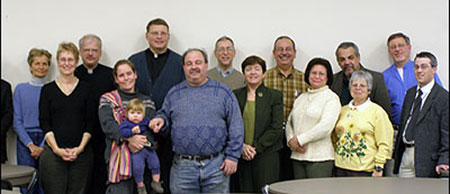
Arroyo spoke at a January 22 meeting convened in the common room of Faith United Church of Christ by the Greater Hazleton Ministerium, an interfaith clergy association. The Ministerium does not take an official position on the ordinance and is seeking common ground between those on both sides of the issue. Attendees included residents, clergy, city Latino leaders, a representative of the Pennsylvania Human Relations Commission and a Luzerne county commissioner. A big-eyed baby watched the discussions from an infant carrier slung over his mother’s shoulder.

One of the ordinances would have prohibited renting to undocumented immigrants and called for a $1,000 per day fine for landlords who did so. Of the 4,216 rental units in the city, 236 are Latino-occupied, according to the 2000 U.S. Census. Another ordinance would have revoked the business permits of establishments which employed illegal immigrants.

Legal challenges have prevented the ordinances from being enforced although their original versions were passed in July. In response to a lawsuit by advocacy organizations, landlords and residents, U.S. District Court Judge James Munley in October deemed the ordinances temporarily unenforceable and is slated to determine the long-term fate of the laws this month. If enforced, the laws could disrupt the education of child citizens who must leave the country with their deported parents, force a plaintiff who is a legal immigrant to be evicted because she is waiting for documentation of her status, and hurt the profits of business owners and landlords, Judge Munley stated in court papers explaining his decision.

Although the ordinances are intended to curb crime, city officials did not offer statistical evidence that increasing immigration has caused an increase in crime, Judge Munley said. The city has passed revised versions of the ordinances, which critics say have harmed the Latino community even though the laws are not in effect.

“It sort of became open season on a lot of Latinos, regardless of their status,” said Fabricio Rodriguez, executive director of Philadelphia Area Jobs With Justice, which organized a September rally opposing the ordinances. Racist graffiti, vandalism and fights in school are some of the problems local Latinos reported when Rodriguez surveyed them on the impact of the ordinances.

The ordinances address only illegal immigration, but xenophobic hecklers have taken them as a cue to publicly harass legal immigrants along with those who lack papers because it is impossible to differentiate the two groups based only on appearance, said Agapito Lopez, vice president of the Hazleton Area Latino Association and a member of the Governor’s Advisory Commission on Latino Affairs, in a telephone interview. Cultural differences make innocent Latinos seem suspect to their Anglo neighbors and the ordinances embolden residents to express their suspicion, Lopez said. Latinos frequently meet outdoors to share jokes and stories as they do in their native countries, Lopez said.

“When they see people gathering outside and speaking a different language, they think it’s a gang,” Lopez said. Far from being meetings of criminal cabals, the outside gatherings merely reflect how many Latinos’ sensibilities differ from those of many Anglos, Lopez said. “We don’t like to be inside because we come from tropical countries,” he said. Some Anglos’ misperceptions have led them to lash out at their Latino neighbors, Lopez said.

“There are people who are being called names in the street,” Lopez said.
 

Struggles to cross a racial divide

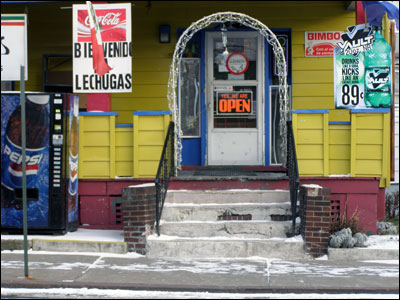
On a frigid January day shortly after the Ministerium meeting, people did not appear to linger in the street long enough to insult or be insulted. On Broad Street, the Roads End Pub and Club was dark inside and below the Blues Brothers statues on its facade a sign stated “All Legals Served.” A hat-snatching wind rushed down Wyoming Street, where well-kept older model cars lined the curbs. The vivid yellow clapboard walls of Lechuga’s market offered the eye a welcome change from the gray-stained gobs of old snow piled along the icy sidewalks. Latino grocery stores chock-a-block with sundries and tropical products, money transfer bureaus and travel agencies shared the street with employment agencies and Italian restaurants. A handful of stores stood empty; some had permits taped to their plate glass windows suggesting that new occupants were preparing to move in.

Those who work on Wyoming Street, noted for its concentration of Latino businesses, said that the consequences of the ordinances are economic as well as interpersonal. Owners of establishments that primarily serve Latinos have seen a drop in business which they trace to the ordinances. One grocery store employee said business had declined by about five percent since the ordinances passed because many immigrants have left town after raids by federal Immigration and Customs Enforcement agents.

“Immigration came down here and took people away,” said Julian Figueroa, an employee of Jazmin’s Grocery on Wyoming Street. Immigration officials did not target Jazmin’s, but did visit businesses on Wyoming Street, Figueroa said one recent afternoon after waiting on a young customer whom he advised about keeping track of her small bills. Other business owners also noticed a decline in customers.

“A lot of people just left town. You notice the drop at least as far as the money transfers that you do, calling card sales which is more of what the immigrant population buys,” said Chris Rubio, an employee of Isabel’s Gifts on Wyoming Street while staffing the counter at the shop one recent weekday. Some businesses have closed due to lack of customers. Rosa and Jose Luis Lechuga, plaintiffs in the lawsuit, closed their restaurant due to a decline in business, according to court papers. The restaurant served 45 to 130 customers before a previous version of the ordinances passed, but had only six or seven patrons daily afterward. The Lechugas’ Latino grocery store served 95 to130 customers a day before the ordinances passed, but had 20 to 23 patrons daily afterward. Jose Lechuga said by phone on January 30 that he was moving to Texas and had sold the store. The city does not keep statistics on business owners’ nationality so municipal employees do not know how many Latino-owned businesses have closed or how many new immigrant-owned establishments have opened since the ordinances passed.

City officials said the ordinances were intended to protect city residents from crime, not to harm Latinos socially or economically. Shootings committed by undocumented immigrants inspired the ordinances, said Joe Yannuzzi, council president, who supported the ordinances. Municipal law did not provide for punishing crimes committed by undocumented immigrants, Yannuzzi said by phone.

Shootings are rare occurrences in the city which had about 23,000 people as of the 2000 Census. Latino advocates have said that the population has increased by about 10,000 people since 2000. Mayor Barletta has said in published reports that the population had increased by at least 7,000 since the last census. “The only thing we could do is punish the people who are here legally,” Yannuzzi said. City officials began by exploring the appropriate response to several recent shootings, and later noticed a connection between the crimes and undocumented immigrants, Yannuzzi said.

“The violent crimes were being committed by illegal aliens,” Yannuzzi said. The ordinances allow the city to protect all residents, including Latinos, Yannuzzi said. “They live here the same as we do. They don’t want to see shootings either,” he said. Yannuzzi said that Latino residents’ departures should not cause concern that Hazleton’s population has nose-dived. Those who left were quickly replaced by other Latinos, he said. “The place is still booming and there’s a lot of Latinos still living here attending the schools and getting along with everybody,” Yannuzzi said.

A fellow council member echoed Yannuzzi’s concern with crime but had voted against the ordinances. “The rationale should have been to combat crime,” said councilman Bob Nilles in a telephone interview. Nilles opposes tying anti-crime ordinances to immigration issues because doing so creates legal problems for the city.

Those who attended the Ministerium meeting also expressed concern with violent crime and said that opposing it could be a common cause for those who might disagree about the immigration ordinances. “We know violence has gone up. We know that violence is connected to the drugs,” said the Rev. Tom Cvammen of Trinity Lutheran Church in West Hazleton, who facilitated the meeting.

With a calm voice and demeanor, the Rev. Cvammen appeared ready to help attendees stay focused on the goal of reconciliation should the conversation become overheated. Some who attended the Ministerium meeting said that focusing on crimes committed by illegal immigrants obscures a general increase in crime related to drug sales in the city. One attendee objected to the Mayor’s emphasis on illegal Latino immigrants when he endorsed the ordinances and touted them a means of stemming crime.

“He failed to mention that a non-Hispanic killed my cousin,” Anna Arias, president of the Hazleton Area Latino Association and a member of the Governor’s Advisory Commission on Latino Affairs, said sharply. Mayor Barletta did not return calls. Arias said that the person who killed her cousin had sold drugs and that he committed suicide after the crime. The room was silent.

Attendees defined reducing drug sales and other crimes as a primary goal of one of the three working groups that formed at the meeting. Members of each working group gathered around a folding table in the common room to brainstorm and develop action plans. The working groups included Latinos and Anglos who were Jews, Catholics, Protestants, Quakers and those who did not state a religious affiliation. Almost all appeared to be in their forties or older. Members of the working group on crime planned to invite David Wilkerson, founder of Teen Challenge, an international Christian-based drug rehabilitation and education program, to speak to members of church youth groups throughout the city. The crime working group also planned to invite members of Unidos, a diversity group at Hazleton Area High School, to the next Ministerium meeting on February 27.

Members of the working group dedicated to addressing public fears of Latinos said they sought to reduce fear by replacing it with the truth about people of whom others might be afraid. “A lot of the fear is based on untruth or exaggerations,” said the Rev. Jane Hess of Faith UCC. Group members considered creating a public forum in which immigrants would share their memories of becoming citizens. “At that moment, you have to put aside the country where you were born. You have to love this country a lot to do that,” Arroyo said.

To help community members get to know each other across ethnic divides, a third working group planned a series of cross-cultural activities. The working group planned to connect events for the May 3 National Day of Prayer to the Cinco de Mayo (Mexican Independence Day) celebrations and to dedicate the day to appreciating diversity. Working group members also planned to ask organizers to dedicate this year’s Fun Fest to celebrating diversity and to ask Wyoming Street merchants to hold a block party to coincide with the annual festival of music, food and crafts. The working group intended to start an inter-ethnic hiking and biking club for young people.

 

An age-old debate

Attendees have reason to hope for greater inter-cultural understanding, the Rev. Cvammen said. Catholics and Protestants once divided the city into sections along religious lines and used to attack each other on the streets of Hazleton but have long since ceased segregating themselves and brawling. Discrimination against Italians, Irish and Poles also used to be common in the city, Lopez and Arias said. “It’s something that was worked on before,” the Rev. Cvammen said.

The ebbing of historic inter-group tensions in Hazleton makes the city representative of a national trend. A century ago, public immigration debate centered on determining if Greeks and Poles could fit into U.S. society, said Randy Capps, senior research associate at the Center on Labor, Human Services and Population at the Urban Institute, a non-partisan research organization. Historic immigration debates have subsided nationwide only to be replaced by new ones.

“Now we’re debating whether or not immigrants from Mexico and Latin America are going to fit in,” Capps said. Attitudes of those participating in current debates are shaped by a different set of experiences than their early 20th century predecessors. Although the U.S. has historically been a nation of immigrants, many politicians now in office came of age during a 40-year period of relatively low immigration, Capps said. Immigration slowed between the 1920s and the 1960s due in part to ceilings on the number of people who could enter the U.S. from each country. The Great Depression also made the U.S. less attractive to immigrants seeking to escape poverty in their native lands. “We went through a period when we weren’t country of immigration, so it seems new and out of control,” Capps said.

The terrorist attacks of September 11, 2001 have also changed attitudes toward immigration. The hijackers who crashed airliners into the Pentagon, the World Trade Center and the Pennsylvania countryside were legal immigrants, but their actions have shaped attitudes toward those who enter the country with or without documents. Some U.S. citizens believe that cracking down on illegal immigration ensures national security.

“People feel they are acting against terrorism,” said Myriam Torres, director of the Arnold School of Public Health Consortium for Latino Immigration Studies at the University of South Carolina. Latino immigrants who enter the country intending to do harm are rare, Torres said. “The majority of immigrants from Latin America, they are not coming to commit crimes, they are coming to work,” Torres said. Immigrants who do not have enough money to qualify for visas often enter the country illegally to assist their families by taking jobs rejected by U.S. citizens, Torres said.

“They will do anything they are asked to do, because they know whatever they are earning here, even if it is a low wage, it is much higher than they would be earning at home,” Torres said. Policymakers seeking to control illegal immigration should address the human costs of a global economy in which developing countries fare poorly, Torres said. “I do think that there is a need to work with the countries who are sending people here,” Torres said.


Siddhartha Gautama, the Buddha

Your work is to discover your world and then with all your heart give yourself to it. —Siddhartha Gautama, the Buddha

Your work is to discover your world and then with all your heart give yourself to it. —Siddhartha Gautama, the Buddha

Victor Tan Chen is In The Fray's editor in chief and the author of Cut Loose: Jobless and Hopeless in an Unfair Economy. Site: victortanchen.com | Facebook | Twitter: @victortanchen


Books and guilt

This may be a familiar scenario to you (as it is to myself and all book lovers): you've started a classic novel/current bestseller/a friend's all-time favorite. You're mildly interested. Soon, you're just bored. You don't care who killed so and so, or how the multi-generational saga will unfold. But, this book has been hailed for decades as a masterpiece. Or, everyone is talking about this new book by Famous Author. Or, this book changed my boyfriend's life — I can't stop now. You tell yourself, I haven't read enough of it/I'm already half done/ I'm not as smart as others if I don't like it.

My (and Guy Dammann's) advice  step away from the book. First of all, no matter what anyone else thinks, you're entitled to your opinion. For instance, I hate Joyce Carol Oates's books. Yes, yes, I know  Columbia, Princeton, awards, prolific, etc. She's probably a lovely woman, others may be touched by her stories, but I'm not a fan. I don't apologize.

On the otherhand, my favorite book of all time is The Instance of the Fingerpost by Iain Pears. In my humble opinion, it's one of the greatest books ever written. But for my friends and co-workers, there was eye-rolling, groaning, "it was so boring." I play offended, but it's cool. (To those who don't like Christopher Moore, the genius of A Dirty Job and The Stupidest Angel, well, I can't be seen with you).

It has also been my experience that, if you hate a book, set it down and it may come back to you, somehow. I hated Poe as a teenager  not anymore. Ditto for Truman Capote, who is now a favorite (and may I add, Capote over Infamous). It took me a couple of years to get into Primary Colors, but in the end I loved it. The most memorable return to a book for me was The Ground Beneath Her Feet by Salman Rushdie. I started it when I was 18, when it was first released. I gave up before Vina even met Ormus. A few months ago, I devoured it. I'm still not over it. Since I've finished it, no other book can compare. Who knows why I felt nothing at 18 or why now it's a song that I want to hear again and again. It doesn't matter either way. There's always another book.

But I feel your pain, still. As zen as I may be about it now, it's instinct for a bibliophile to feel guilt over abandoning a book. Just yesterday I let go of Heyday by Kurt Anderson. I know I'll go back to it someday. But it's not the right time. I move on. 

Now, A Farewell to Arms. Did that suck or what? I actually finished it, too. Never again!

I could not put down Suite Française by Irène Némirovsky. The experience was a first for me: as I was finishing it, I felt sadness, and a little desperation. I knew the end was near, that this person had to leave me soon, and there was nothing I could do about it. I had never before felt as if I would miss a book, or it's author, as I would a friend going away for good. It must have been because of the book's background. I knew Némirovsky died at Auschwitz before she could finish it. I knew the last three intended parts of the novel died with her, unwritten. It's silly, really, wishing someone gone for six decades to somehow be saved because of her words. Suite Française will never be finished. The other precious 5,999,999 others were never saved either. Too much was lost. I feel it when I think of the last three missing parts of that novel.

The remaining words are all the world can ever have of a writer anyway. Suite Française was just our introduction to Némirovsky. Her previous novels are being translated and sold. And another, although much shorter, novel was found in her archives. Chaleur du Sang, or Fire in the Blood as we will know it, will be published in the fall, along with a biography of Némirovsky. What is left will have to be enough.


Fighting idiots with a closed mind

This week the University of Montana campus, where I am a student, has been seized by angry Christians. Specifically, it's a group from New York called Open Air Outreach, a group of men who  I can only assume  have been told by Jesus that it is appropriate for them to travel around the country being dicks in the name of God. (Go here to read the article.)

I know that it is an old cliché to reject the idea of the evangelical Christian with their sanctimonious ramblings, but I'm going to do it anyway. And mostly, it's because I'm annoyed with non-Christians.

The OAO is setting up everyday by the University Center (a student union building) for big "discussions" with the angry, vocal students around my campus who've yet to realize you should never fight an idiot. They can't see that it's useless to fight the men of the OAO  men with God on their side, don't ya know.

This is what I've had to deal with when I want to buy some orange juice or a bagel: endless shouts back and forth between diametrically opposed groups. And the students should know better. People traveling around America to stir up controversy should be ignored.

In this scenario of fervent opposition, neither side can win, and their disdain for the other has ruined any chance of having a real talk. The OAO has an excuse their beliefs are such that they have to be certain, but students are supposed to be open to new ideas and concepts. Or what would be the point of college at all?

My personal belief in the Almighty is not what I would call strong, but I do hold a small lingering spirituality from my childhood days spent in the Catholic Church. This is what I would call an Agnosticism that leans toward the notion that something caused that first cell, and I'm not sure what that was.

I'm setting those aside so I can approach the question of what it is that causes a person to grab a Bible and a bad attitude and hit the road in the name of God.

If you ask me, which you didn't, I think these guys would be doing the "I'm Right!" thing with whatever they believed in. That is to say, I think if these people were selling cars, they'd sell the best cars ever  you'd only have to ask them for confirmation.

In other words, I have no idea what causes this sort of feverish attitude. I can barely decide on pizza toppings for crying out loud.

So as Easter approaches, I am making a request to people of all spiritual persuasions to just stop the fight over who has it right. We're all flung together on this rock. I'm not sure why, and I've yet to meet a person who really does. Belief is a complicated concept, and it should never stand between two people.

That said, I can't wait for these guys to leave. I miss bagels.


Bored to tears

A few weeks ago I did a demonstration for my chemistry classes. They had begged me for days to do this particular experiment. So, one Monday morning, we assembled outside on the grass. A volunteer student set down a bottle of Diet Coke. He opened the bottle, dropped a stack of about six Mentos into it, and ran. The rest of us stood several feet back to observe. The fizzy pop shot up and out of the bottle very forcefully and traveled about fifteen feet in the air before coming back down. It was quite a sight. I was impressed. My students were not. I looked around and saw their bored faces. They looked at each other with expressions that said “That’s it?”

Failing to impress my students is not unusual. And in sharing with other teachers, I have found it is not unusual in any subject. On another day, I showed a video of the explosion that occurs when sodium mixes with water. My students refused to find it interesting unless I performed the reaction in class so they could see it first-hand. I tried that experiment in the classroom once, a few years ago, and some flying sodium hydroxide hit a kid in the ear. He was ok, but never again.

I read an article about a year ago that discussed the high-school drop-out rate. Apparently, nationwide, the rate is on the rise. The article suggested the reason for increasing dropouts is boredom. Apparently teenagers are so bored at school that they would rather drop out and find a job than continue. This insight astounded me. Is school really that bad? I remember taking some boring classes in high school, but I always looked forward to at least two or three subjects.

I try to make class interesting for my students, but as I explain to them, you can’t expect to be entertained all the time. Sometimes we all have to push through the boring stuff in life to get to something good. Having said that, I think that school can be too dull sometimes. The main issue, I believe, is relevance. Many high schools present a curriculum that has no relevance to their students’ lives. As teachers, we need to teach in a way that challenges students to think about their futures and that prepares them for careers. Actively engaging in developing their lives should not only prepare them for success, but also keep their interest.


Delivering hope

Sometimes, it takes looking from the inside to recognize greatness. From the outside of New York City, the media often presents us a picture of coarse New Yorkers, unconcerned with the fates of others, commuting back and forth through their busy lives. But on further inspection, the negligence and head-in-the clouds attitudes doesn’t touch all aspects of the city that never sleeps.

For a week, I was immersed in the New York culture. Like hundreds who live in the city, I took the subway to and from work each day, smashed in between strangers I didn't know, only to be deposited a 20-minute walk from work at Houston St. The subway system and its passengers became familiar to me, but the reality that became more true was that of the people who dedicate their lives to help others.

God's Love We Deliver isn't located in one of the magnificent buildings so typical of New York city, but in stature, it stands greater than all of them. The organization, located near Soho, is housed in a modest brick building, but more than 1,500 clients are served through its swinging doors daily.

God's Love We Deliver is changing the reality of people with HIV and AIDS, as well as other demonstrated medical needs daily by fufilling one of their most basic needs – nutrition. Meals are based on a diet for a person surviving with HIV and AIDS, so they are always over 2000 calories, and are handmade each day by volunteers and paid employees.

The kitchen is more than just a mere assembly line. During my week's stay, it wasn't uncommon to strike up a conversation with one of the regular volunteers, or to joke around with visitors from Harvard, or even catch one of the cooks singing a parody of Snow Patrol's "Chasing Cars." From helping, God's Love We Deliver does more than just deliver meals door-to-door it is rapidly creating a fellowship between people who care about other people.

What makes God's Love We Deliver so amazing isn't the numbers or the statistics we can view on paper  it's each individual person who suits up in a hairnet and rubber gloves to try to make a difference.

Derry Duncan, the volunteer specialist who walked us through training for the week we worked there, is one of the most charismatic individuals I have ever met. The woman is an enigma who didn't choose this work  it chose her. Yet her passion is palpable every time she speaks. In the entirety of a week, I never saw her without a smile on her face, and her gratitude for each and every volunteer was so visible.

To me, GLWD is Derry, and people like her, who don't think twice about whether or not they should become involved in helping others  they simply do, and through their enthusiasm and courage, inspire other people to come along.

According to the New York State Department of Health, more than 10,000 people in the city of New York alone live with HIV and AIDS. Though progress has been tremendous since it first prevailed many years ago, we have no scientific cure. But maybe, through feeding those who, perhaps without a little help, could not eat, we are actually helping to find a solution. So thank you to Derry and all others who give of themselves to do this work. It isn't just another volunteer assignment  really helping is a lifetime task.


Beauty as beast


"Whatever is in any way beautiful hath its source of beauty in itself, and is complete in itself; praise forms no part of it. So it is none the worse nor the better for being praised."

Marcus Aurelius Antoninus, 121-180 A.D.

What but the hope of praise could cause a person to submit herself to the latest cosmetic procedure, the eyelash transplant?  Yes, you read correctly, for about $3,000 per eyelid, you too can have hair removed from the back of your head and sewn onto your eyelids. Originally designed to allow burn or cancer victims to recover their lost lashes, eyelash transplantation has now entered the elective surgery market.  Today Show correspondent Janice Lieberman reports that there has been a 300% increase in its use for cosmetic purposes this year alone. Due to the origins of the hair, transplanted eyelashes require regular trimming and perhaps a bit of dye, as they and you age. In the spirit of beauty, pain is just part of the game.              

In her book, Beauty Junkies: Inside Our $15 Billion Obsession with Cosmetic Surgery, Alex Kuczynski outlines America's worship of the mirror. From women traveling to third-world countries for vacation surgeries to the reality of heavy, sagging skin from massive weight loss, Kuczynski emphasizes what has become a common theme: nothing is free. In a chapter entitled, "What Is Beautiful?" we learn that there could be a mathematical formula for beauty. In an interview with Dr. Stephen J. Marquardt, Kuczynski questions Dr. Marquardt's idea that beauty can be captured in a computer program. Beauty in the form of mathematical proportions loses its mystery of "you know it when you see it" to become a quantifiable commodity. The allure of equal beauty for all, those with enough cash that is, has women and increasing numbers of men, racing to the cosmetic surgeons. In our information age, there is no shortage of knowledge on the topic; type cosmetic surgery and books into a search engine and voila, the titles fill the screen.  From the nitty-gritty how-to books, to the more academically inclined Making the Body Beautiful: A Cultural History of Aesthetic Surgery, beauty is big business.

If Antonius is to be believed, beauty is, in and of itself, beautiful, regardless of the consideration of others. In reality, beginning in childhood with the queen's magic mirror zeroing in on Snow White, the ruthlessness of beauty as competitor is revealed. 

To be human is to want to belong.  The praise that Antonius spoke of pulls us into its orbit, and as we fill the space, it becomes crowded, bodies bumping into each other. From the desire of praise, competition is born. 

So are we surprised that strident on the front page of Sunday's New York Times, is the headline "For Girls, It's Be Yourself, and Be Perfect, Too"?  The bottom line for girls, and increasingly boys, is that good is never enough. The young women chronicled here engage in what has become the typical upper-middle-class college path. Days filled with Advanced Placement courses, extracurriculars and, in some cases, jobs, yet one young woman worries that her resume will be overlooked due to her lack of athletic ability. A father comparing his less structured childhood faults himself, 2006 America, and the Northeast for the incessant activities.  An outgrowth of the competitive nature of America, laying blame is much less frightening than jumping ship.  S.A.T. prep courses, community service, athletics, employment, each a necessary building block in the pursuit of success; dare you take a chance that one less will still get you your heart's desire?

Competition by its very nature, is honed towards survival.  Love it, hate it, none of us are immune to its charms. Women seeking beauty in surgery and girls on the verge of womanhood learning it is not enough to be smartyou have to be "hot" as well.  The prizes are significant, an income large enough to give your children as good as you got, satisfying work, partnership with someone you desire. Remember that old cliché, "beauty is as beauty does?" Meant to comfort, it fools no one. Beauty does quite well, thank you very much. It continues, alive and well, one eyelash at a time.       


A bucketful of hope

With conflict in the Middle East burning as hot as a California wildfire in spring and strife in Chechnya hardly close to a conclusion, a bucketful of hope seems ready to put out the coals of one long-painful blaze for good.

The devastating conflict between Protestants and Catholics over control of Northern Ireland looks close to peace. On March 26, prominent Protestant politician Ian Paisley sat down with Gerry Adams, a Catholic and leader of Sinn Fein, a political party originally formed as the political wing of the Irish Republican Army, in an unprecedented display of compromise and hope.

With so many reasons to lose hope for peace around the world, the meeting stands as a beacon of promise for a better future in Northern Ireland and countries like Chechnya and Israel, where historical territorial conflicts and irredentism have long blocked cease-fires and reconciliations.

As Paisley put it in remarks given at the meeting, “We must not allow our justified loathing of the horrors and tragedies of the past to become a barrier to creating a better and more stable future.”

I agree. I only wish more world leaders came to recognize that constantly using the past to justify present atrocities and violence only perpetuates hatred and misunderstanding among races, religions, nations, and states.

We don’t have to forget the past to bring a happier future; we need to be willing to move past it. Otherwise the fires will keep on raging.


Angela Davis, a case of acquired activism

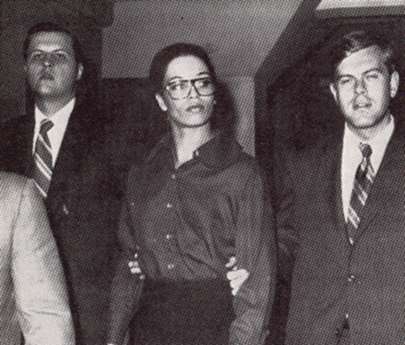
Angela Davis, activist, organizer, and philosopher once associated with the Black Panther Party as well as the Communist Party of the United States of America, is still an activist; she now works for racial and gender equality and for prison abolition.

davis_a.jpg


Born: January 26, 1944, Birmingham, Alabama, Davis received a B.A. from Brandeis University in 1965. She later studied as a doctoral candidate at the University of California-San Diego, under the Marxist professor and "One-Dimensional Man" (1964) author Herbert Marcuse.

She joined the Communist Party in 1968, and like many American Blacks during the late 1960s, suffered discrimination for her personal political beliefs and commitment to revolutionary ideals. But it was not until 1969 that she came to national attention after being removed from her teaching position in the philosophy department at UCLA by the California Board of Regents, under then California Governor Ronald Reagan's administration.

Davis had worked to free the Soledad (Prison) Brothers, African-American prisoners held in California during the late 1960s. She befriended George Jackson, one of the prisoners accused in an August 7, 1970 abortive escape attempt from Marin County's Hall of Justice; the trial judge and three people were killed, including George Jackson's brother Jonathan. Davis was implicated when police claimed that the guns used had been registered in her name.

Davis fled and was subsequently listed on the FBI's Top 10 Most Wanted list, sparking one of the most intensive manhunts in American history. That August, Davis was captured and imprisoned in New York City but freed by an all-white jury eighteen months later, cleared of all charges.

Today Davis is a professor of history of consciousness at the University of California-Santa Cruz. Davis is known internationally for her ongoing work to combat all forms of oppression in the United States and abroad.

Davis remains an advocate of prison abolition and has developed a powerful critique of racism in the criminal justice system. She is a member of the advisory board of the Prison Activist Resource Center and is currently working on a comparative study of women's imprisonment in the United States, the Netherlands, and Cuba.

During the last 25 years, Davis has lectured around the world. Her articles and essays have appeared in numerous journals and anthologies, and she is the author of five books, including Angela Davis: An Autobiography; Women, Race, and Class (Vintage, 1983), Blues Legacies and Black Feminism: Gertrude "Ma" Rainey, Bessie Smith, and Billie Holiday (Vintage, 1999), and The Angela Y. Davis Reader (Blackwell Publishing Limited, 1998).

Davis video segment


Wandering

With the sun out and the flowers in bloom, our eyes often seem to be wide open. But spring is the season for letting our minds wander.

In this issue of InTheFray, we take a look at some of the places to which our wits venture. We begin with our trip to A desert of dreams, where ITF Contributing Writer Penny Newbury learns about the Burning Man festival and the ups and downs of an anarchist tradition in her review of Brian Doherty’s This is Burning Man. We then turn to Happy little poem, Miles J. Bell’s take on a factory worker’s longing for “a long lie down.”

Finally, if you haven’t done so lately, we invite you to check out our blogs, which are now in full bloom.

Thanks for reading!

Laura Nathan
Editor
InTheFray

personal stories. global issues.