Lights, camera, action

For youth involved in Global Action Project, filmmaking is just the beginning.

“Okay, here are the rules:
Number 1 — No cell phones.
Number 2 — ENERGY!
Number 3 — There is one mic, so only one person speaks at a time.
Number 4 — Step up, step back. After you made your point, step back to give other people a chance to say something.”

This was how a community workshop — part of New York City’s Immigrant History Week — began. What made this meeting different from dozens of other events that week was who was running it: High school students were leading the gathering for other high school and college students. The meeting coordinators were part of the Immigrant and Refugee Media Project, one of several programs run by Global Action Project, or G.A.P. — a youth media and leadership organization for New York City high school students. Over the next hour and a half, they discussed how national policies on immigration affect people’s lives, the power of the media, and how to effectively work with other organizations to pool resources and use technology to spread their messages to a wider audience.

G.A.P. started in 1991 as a video-letters project with the goal of initiating exchanges between young people in different countries to help them learn about each other and discover similar issues each group faced in its communities. Susan Siegel, who had a background in art and youth education, came up with the original idea for what would become G.A.P. She met cofounder Diana Coryat in 1989. Their experiences in community media and youth-focused arts, education, and filmmaking led them to believe that media could be a transformative education and communication tool for students.

Susan facilitated the first video-letter project in Kopeyia, a rural village in Ghana. The youth chose to create a fictional film based on a schoolmate who had recently died of malaria. When the video was screened in New York City public schools, students were so moved that they made and sent a manual of home remedies from their cultures and a video-letter back to the youth. The film also sparked dialogue among the New York students about health issues they faced in their own communities. A second international video-letter was produced in 1993 in Livingston, Guatemala. Shortly afterwards, Susan and Diana began establishing New York City–based programs.

The seeds of change

The first activity at the workshop on immigration was the Mambo Mixer, an ice-breaking activity set to hip hop that introduced the students to each other and let them know that this would be a participatory event. They then screened “twisted truth,” a 12-minute film G.A.P. youth made in 2006 to address the U.S. government’s proposal to criminalize undocumented immigrants, and to highlight the role of globalization in the issue. The opening scene shows President Bush speaking from the Oval Office on the need for immigration reform. A clip from a pro-immigration rally then appears, with dialogue in English and Spanish, before the words “twisted truth” appear in white on a black screen. Students sit at a table discussing the impact of the developed world’s economic policies on so-called Third World countries. We are asked to consider what conditions would make people leave their own countries to come to America, and random New Yorkers are asked for their views on immigration. The film is rich with political cartoons, text to highlight key points, shots of misspelled graffiti, and dramatized scenes of people cleaning toilets to show the menial jobs that immigrants often have to take. The credits roll to “Dead Prez Beat” by M.I.A.

Next on the agenda: “Aliens vs. Predators,” a three-minute mock trailer that portrays the difficulties faced by undocumented immigrants trying to afford college, and the way that the U.S. military is targeting this group as potential recruits. They dangle citizenship, free college tuition, and employment opportunities to try to get these immigrants to enlist. The haunting chorus from Orff’s “Carmina Burana” plays in the background.

The students then engaged in a discussion about the videos they had just watched. One student asked, “Why do people have to kill in order to become a citizen?” while another related the story of his cousin’s experience and warned, “It’s easy to enroll, but hard to get out.” Asmaou, a 16-year-old, added, “Mainstream media only narrows your mind, since they want you to think like them.”

Next, Dan and Pilar, two G.A.P. staff members serving as facilitators for the meeting, divided the students into smaller groups in order to get them to think about ways they can collaborate in the future. The students suggested various alternative media outlets to use, offered to share equipment, and planned events. I got the feeling that I had witnessed the beginning of the slow process of change.

No sugarcoating here

G.A.P. turns the prevailing notion that youth have nothing to contribute and no opinions to share on its head by teaching students that their voices count. Dare Dukes, G.A.P.’s development director, explains that one of the organization’s core philosophies is that “people should share in their own knowledge-building as opposed to sitting and listening to an expert.”

Each project produces two films during the school year. Students come after school and on weekends to G.A.P.’s office in midtown New York. Working with the facilitators who have backgrounds in film and education, the participants decide what issue they want to take on, how they want to portray it on film, and how to write the script and storyboard the shots. They are then taught how to use the equipment and will shoot, act in, and edit the film.

The youth select issues that they deal with on a daily basis. At a script meeting I attended, the students were creating the dialogue and shots for a film on street harassment. They had come up with the idea of using a split screen to be able to show the same scene from the male and female perspectives. Shreya, a G.A.P. facilitator, asked Jessica, who would be playing the girl who gets harassed in the film, if the language was too strong. Seventeen-year-old Jessica reassured her, “I don’t want to sugarcoat any of this. I take the blows every day of my life, I can take it.”

While each project is centered on learning how to produce media, the students also acquire media literacy skills that help them deal with such issues as how minorities are represented in the media, the concentration of media ownership, and what images mean and how to use them to express their points of view. Additionally, the film is not the end result. Part of G.A.P.’s mission is to be a catalyst for change. With guidance from G.A.P.’s Community Outreach Director Binh Ly, the youths who make each film devise an outreach plan by researching organizations that might be interested in a screening, figuring out answers to potential audience questions, and developing workshops on the issues that the video addressed.

Cofounder Diana Coryat describes the impact of the work on the youth: “They were excited about having the opportunity to direct their own learning process, to get their voices heard, and take positive action in ways they hadn’t believed to be possible for young people. When the work was shown, reflected back at them were images and stories that accurately represented their lives, but were rarely articulated in other media. Their audiences, too, were affected because it gave them a fresh way to see these young people as smart, articulate, and vital members of the community.”

G.A.P.’s programs have produced videos on issues as varied and complex as teenage prostitution, workfare, the lives of refugee youth in New York City, teen pregnancy, human rights, the truths and lies of gangs, and how the educational system can push students to drop out of school. Over 1,100 students have participated in the program. And every year, more than 100,000 people see the videos at conferences and festivals, and on YouTube and cable broadcasts.

Over the years, G.A.P. students have continued to exchange video-letters with youth in other regions. After the events of Sept. 11, they engaged students in Dubai in a video project that explored misconceptions about Muslims and Americans. They have also exchanged video-letters with students in the Dominican Republic, Northern Ireland, Puerto Rico, Venezuela, and refugee youth living in camps in West Africa and Croatia.

G.A.P. will be holding its free end-of-year screening in New York City this June 14 from 6:00 to 9:00 p.m. at HBO (1100 Avenue of the Americas, 15th floor). The students will be presenting at the Allied Media Conference in Detroit from June 22-24, and leading three workshops at the U.S. Social Forum in Atlanta from June 27-July 1.

“Our job as media makers is to reveal the truth,” Asmaou declares. “People should know it.”


My house is fat

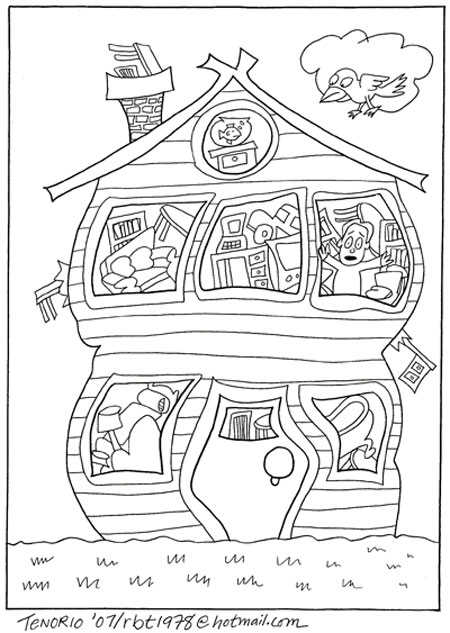
200706_house.jpgAttack of the junk bulge.


My house is fat. I still love it as I did when my husband and I bought it with dreams of a future in which the house was to be slender and beautiful.

But I have to say, the physical attraction is waning.

Once upon a time we lived in a tiny 1930s house, the kind where you could grab the toothbrush off the sink and get your shower running while sitting on the toilet. Not that I’ve done that. Back then, Dave and I vowed not to let our house turn into the cluttered mess we knew most American houses become. No exploding closets, no cars in the driveway because the garage is filled with Christmas decorations, no favorite clothes kept around just in case they come back into style.

Use it or lose it was the motto. And for a while, it worked.

Then we moved into a bigger house. Not a McMansion by any stretch of the imagination — we live in the San Francisco Bay Area, where a cardboard box costs $400,000 — but a decent, three-bedroom home with closets, cupboards, and a two-car garage. We needed to buy a few things to fill it out. And then, in replacing some of the old drab stuff, we bought new items and put the old ones — an old couch, chair, and tables — in the garage. Temporarily, of course.

And then we had a baby. Suddenly, there was no time to sift through our belongings and take trips to Goodwill. As baby products consumed every room, we shoved mattresses, cookbooks, and our daughter’s impressive wardrobe into every nook and cranny. And that old couch in the garage? You never know if a sibling or friend might need furniture. At least that’s what we tell ourselves.
 
As the house’s waistline grows, I know we should watch our intake, but I can’t seem to help myself.

I like stuff. I want stuff. Stuff makes me feel good.

I rarely walk into a baby store without buying an outfit for Sarah, even though her grandparents do a marvelous job of keeping her in high style. She has 18,000 toys, all of which she eats. We, the adults, have a mammoth television, Christmas plates, and half a closet dedicated to gift wrap. Recently, while reorganizing, I came upon a forgotten heart-shaped casserole dish. And still, as I perused Crate and Barrel for a media stand to hold our new TV, I wanted more. It got me thinking: Could I ever expect to have one of the thin, beautiful homes we see in the catalogs that rain down on us every week? Or is that dream as unrealistic as waking up to find I look like a supermodel?

Pottery Barn is one of these beauty magazine offenders. About every four hours we get a new catalog from them, and each one shows myriad, perfect rooms with a throw blanket and a pair of slippers at the foot of the couch. There’s no pile of bills, no overflowing laundry basket, and you certainly don’t find last season’s Pottery Barn décor shoved under the stairs. It’s perfectly sparse. It’s the skinny model I always wanted my house to be.

Instead, I open my kitchen cabinets and Tupperware tumbles out like rolls of fat over too-tight jeans.

Rather than purge belongings, a lot of people become manic about organization. Places like The Container Store have been established to satisfy this need. There are nearly 40 across the United States, and like gyms we go to for a week each January, they pretty much exist to make us feel like we’re getting our acts together.

I am guilty of this. I buy color-coded boxes, plastic bins, and shelf dividers, and bring them home to clear out the garage with the aim of driving my car into it. Ultimately, I just have too much stuff in nice bins.

You’d think Americans would catch on. We buy things in an attempt to improve our lives. Next, we believe that if we could just get our stuff organized, everything would be okay. Unfortunately, The Container Store can’t match the army of Pottery Barn locations in the United States, so our consumption is likely to far outweigh our efforts to get in shape.

Our society definitely makes it hard to live a lean lifestyle, but outlets exist to get our homes in fighting condition. On Earth Day, we dumped a TV and yards of extra cords at an e-waste recycling center. There are numerous places to donate clothing, furniture, and appliances to the less fortunate. And if we are really determined, we could just say “no” to buying things.

For our house, that’s not going to happen — at least not for a while. I’m resigned to it being on the chubby side, junk and all.


Knocking the weight

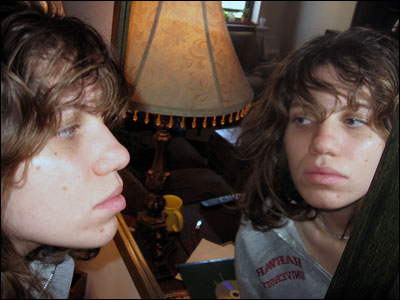
200706_interact.jpgSudden weight loss doesn’t make life as a woman any less heavy.

Halfway through my senior year in college, I came down with the flu twice along with pneumonia. For several weeks, I swallowed only Thai chicken soup and soy smoothies that were brought to me while I lay on my dorm room bed, coughing my lungs out. When the illness left, it had done what no amount of dieting or exercising had ever accomplished. I had lost every pound I’d gained since high school — not just the fabled “freshman 15” (okay, more like seven), but also the “sophomore four,” the “study abroad six,” and the “new boyfriend three.”

My lack of waif-like features had been an anomaly at my perfectionist Ivy school, but I coped. A proud feminist, I made a point of carrying my extra weight confidently. I felt as though my dress size separated me from the girls who played into sexist ideals and mournfully poured vinegar over their dinner carrots. Of course, negative body image drove me to distraction in private, but I could never wholeheartedly tackle the gargantuan — and in my mind, hypocritical — task of getting more than a few pounds skinnier.
 
And now I was sure I’d never have to. Back home for the holidays, I tried on my old clothes. My red dress from “sweet 16” parties fit perfectly. My embroidered cowgirl jeans fit, with room to spare. It didn’t matter that I would never have occasion to wear these ridiculous things again.
   
I was infinitely relieved. A chapter of my life spent feeling fat — and then feeling guilty for caring about my jean size when there was so much else to worry about — had melted away.

But it was naïve to think that all the emotional weight had left with the pounds. In our society, particularly in hypercompetitive niches like my college, size is crucial to our identities, reaching nearly as important a status as race and gender.

You can’t just sneak from fat to thin, or thin to fat.

The first comment I got after my recovery was from a friend whom I bumped into at a late-night campus joint. I was wearing a bulky ski parka, but this girl, who was particularly diet-conscious, saw right through my winter layers. “Oh my god,” she said accusingly from across the restaurant. “You got so ridiculously skinny. You must have lost 10 pounds in a week. Or was it 15?”

I was shocked. When I had been on the chubbier side, people didn’t comment on my body in front of others like that. An unspoken rule says that small bodies of various degrees are okay to moan over (“I’m so fat!”) and compliment (“You’re so not!”). But people who aren’t diminutive face a damning public silence. I was flummoxed. To revel in my friend’s scrutiny would have been impossible: “Thanks, girlfriend. That mucus in my chest really helped create a new me!” But I had been psyched to fit back into that red dress. I felt unusually speechless.

The attention came in a steady parade — some positive, some envious, some suspicious. “You look emaciated,” a close friend told me at a party that spring with a disapproving tone that was sounding like a familiar refrain. Again, my body — not my improving health — was being parsed in a critical way.

While once I was concerned about girth, I was now paranoid about girlfriends. I feared that my new size had thrown some secret pecking order off balance — that my friends had counted on my fuller figure and my feigned comfort with it to make them feel better.  Despite my idealistic aspiration toward a “we are all sisters” kind of feminism, my inner voice warned that I might have to get more stupid now that I was thin, or at least act more self-deprecating. I felt like a walking, talking threat to all the women I knew.

Back when other women had championed the South Beach Diet last year, I had scorned their agonizingly achieved slimness. Now their pissy attitudes about my change in size were forcing me to see that our bodies are always battlegrounds.

So I celebrated the “new me” by joining in a chorus of self-effacing comments. I would never have called attention to myself by stuffing a doughnut in my mouth and saying, “I suck,” when I was 15 pounds heavier. Now I could do exactly that, and I felt like I was joining a heretofore members-only club. And yes, I felt guilty about it.

But whether my self-criticism was silent or tellingly open, it was still there. Unlike the success stories trumped by women’s magazines, we women on all parts of the body-size spectrum still don’t think we’re good enough. And instead of turning against the society that makes us feel this way, we often turn against the woman who eats an extra slice of pizza or refuses dessert, shops one size up, or is a slave to the treadmill.

Engaging in this perverse group exercise of wailing about our waist sizes doesn’t do us any favors. Until we women stop being complicit in our obsession with weight, our relationships will be strained by the relentless need to measure ourselves, literally, against each other.


Why bugs like global warming

Today I was lying on the beach and trying to bring some color to my academic's cadaverous complexion. It was a little muggy, and there were sand fleas hopping about, which made me think: What would it be like to live in a climate where heat and bugs weren't just summertime annoyances, but a way of life?

Today I was lying on the beach and trying to bring some color to my academic's cadaverous complexion. It was a little muggy, and there were sand fleas hopping about, which made me think: What would it be like to live in a climate where heat and bugs weren't just summertime annoyances, but a way of life?

I've been reading The Wealth and Poverty of Nations, by historian David S. Landes, and he says some interesting things about how a tropical climate has made it much harder for countries to prosper. (This is a topic that economists such as Jeffrey Sachs have studied as well.) Climate is just one of the factors that shapes a country's development, but it is an important one. In cold weather, you can put on additional clothing or build shelter or start a fire. But hot temperatures make it much harder to work, and there's little to be done about it. This is part of the reason that some societies in tropical climates turned to slavery to solve their labor shortages, Landes says (if you don't want to work, force someone else to do it for you — and while you're at it, get a few servants to fan you with fronds). The American South achieved prosperity only after air conditioning became widespread in the period following World War II. In much of the tropics today, air conditioning is simply unaffordable for most people, who don't have sufficient electricity or consistent access to it.

Then there's the matter of bugs. Winters, for all the inconveniences they cause in temperate climates of unshoveled driveways, turtleneck sweaters, and bad poetry, also perform a crucial service by killing the resident population of critters and halting their spread. In earlier centuries, the fiercely multiplying masses of insects in winterless tropical countries made agriculture almost impossible, killing off workers or making them too sick to toil in the fields. Advances in tropical medicine have saved lives, but the toll of insect-borne diseases still handicaps many societies and their economies. Malaria kills thousands every day.

So there's another side to climate change besides rising sea levels and lands transformed into deserts. There's also the fact that rising temperatures will grow the various populations of insects, parasites, and pests that already cause so much death and illness in tropical countries. These critters will also become more common in temperate climates, too. If you hate bugs as much as I do, you might have another reason to jump on the environmental bandwagon.

Victor Tan Chen is In The Fray's editor in chief and the author of Cut Loose: Jobless and Hopeless in an Unfair Economy. Site: victortanchen.com | Facebook | Twitter: @victortanchen


The Global Peace Index

The Global Peace Index, which ranks 120 nations according to their relative peacefulness, has just released the 2007 rankings. The index is put out by Vision of Humanity, a website that was just launched in support of the index.

Unsurprisingly and unfortunately, many of the lowest-ranking countries are from MENA (Middle East and North Africa). Iraq, of course, falls into last place (121), while Israel, Lebanon, Algeria, and Iran are all pretty low (although Iran practically tied with the United States they are ranked in the 96th and 97th places).

Morocco (48), on the other hand, was in the top 50, along with MENA friends Kuwait (46), UAE (38), and Qatar (30). Oman was the highest-ranking MENA country, falling into 22nd place.

Indicators used in the index include the number of internal and external wars fought, relations with neighboring countries, political instability, level of distrust of fellow citizens, and the number of arms per 100,000 people, among other things.


No whites allowed

Meet Matthew Jezierski: "[He] started a club in honor of a group he considers to be oppressed and undervalued: the white male. The Caucasian American Men of ASU grabbed attention thanks to the club's name, but Jezierski insisted it wasn't a white pride organization. Jezierski, who is fluent in Polish (he was born in the United States), said he only wanted to promote cultural awareness. He didn't understand why being of European descent is anything to be ashamed of."

Dude?

But that's not the whole story. The whiny-white-boy club is now over, and Jerzierski is too embarrassed to talk about it. Especially because he was someone else's bitch at the time: a younger Ann Coulter named Emily Mitchell. Mitchell was also ruled by a guiding hand, that of the ultra-conservative Leadership Institute, who pays people like Mitchell to recruit virgins, racists, pro-lifers, conservatives, and generally repressed Republicans on college campuses. Thankfully, as swayed as one can be in college, eventually they grow up and get minds of their own. If not, consider this scenario:

"Hi mom, I joined a club for white men only."
"Son, we've stopped the tuition check and changed the will."

Until then, however, Mitchell and her ilk can still find plenty of easily influenced minions. There are still plenty of college boys who have never:
•been stared at or threatened for dating someone of a different race.
•been stared at for walking into an establishment with the gall of being adifferent race.
•been followed by a security guard for shopping while black.
•been pulled over by cops for driving while black.
•been afraid to walk alone at night or had his "no" ignored.
•had ancesters who were chained in ships to be sold or held in death camps to be exterminated.
•experienced or felt a single negative thing in life because of their gender, religion, or skin color (aparently Polish jokes have just rolled right off Jezierski, but maybe that's because he is one all on his own).

Yet these nice boys still buy a load like this from a pretty blond: "It's about balance. The African American men…their name is equally divisive. They're excluding Caucasian men. The Caucasian population is declining by percentages making it a growing minority," Mitchell says. "He [Jezierski] speaks fluent Polish and was offended. There's a separate Latino studies or Chicano studies but nothing for people who are white in color. They don't have anything to represent Slavic or German studies. Why aren't European cultures considered diverse?"

First of all, Heidi, there are European studies programs at colleges and universities (literatrue, history, language, and clubs like the German Devils Deutsch Club, which Jezierski settled for). Outside of that, programs like women's studies and Chicano studies exist not to exclude contemporary white men, but because white men of the past two millenia have excluded them. From everything. And now in the somewhat enlightened 20th and 21st centuries, minorities are telling their side about existing on the same planet, past and present. It's only a problem for the whites like Mitchell who don't like it.

People like Mitchell also need to remember this: America does have a white-men only club  it's called the White House. 


Harry Potter and the Georgia housewife

Laura Mallory has spent the last couple of years, legal fees, and too many people's time trying to get the Harry Potter series removed from the shelves of the school libraries in Georgia. I don't really have to explain why, do I — witchcraft, children, bad, etc. The local school board shot her down, as did the state board, and now a superior court judge. Next stop — federal court.

Here's the best part — Mallory hasn't even read the books. She says she doesn't have time, what with not working and dropping kids off at school. But she does have time for an obsession with a harmless, fictional children's book that even Christian groups across the country have hailed as teaching good against evil.

"At Tuesday's hearing, Mallory argued in part that witchcraft is a religion practiced by some people and, therefore, the books should be banned because reading them in school violates the constitutional separation of church and state."

Let's start with this — witchcraft is not a religion. More specifically, Wicca and variations are practiced by people, have been recognized as a religion since 1974, and were recently allowed to display their religious symbols on soldiers' graves and remembrance walls. The "witchcraft" of Harry Potter, however, is not real at all. If there is someone out there who can wave a wand, say something in Latin, and suddenly a child sprouts a tail, I'd like to meet that person. Until then, what goes in a Harry Potter book has never and will never be considered a religion.

Next, Mallory argues the books violate the separation of church and state. For argument's sake, fine. But Mallory also says, "I have a dream that God will be welcomed back in our schools again." So, Harry Potter is not welcome due to violating church/state, but Mallory's Christian God should be? And here's what it's obviously about — a Christian stamping her feet about not having control over what other people's children believe (or don't). Georgia residents — pray for your tax dollars.


The Pope backtracks

“The change highlights the importance of inter-religious dialogue.”

Cardinal Tarcisio Bertone, Vatican Secretary of State, stating to the Italian newspaper La Stampa that the Vatican would rescind its previous decision and will restore the Pontifical Council for Inter-Religious Dialogue as its own department.

Pope Benedict XVI downgraded the council, which addresses the Islamic world, in March 2006 and sent its president, Archbishop Michael Fitzgerald, to Cairo as a Papal Nuncio (diplomatic representative) to Egypt and to serve as the Vatican's representative at the Arab League in Cairo. By reversing his previous decision to merge the council with the Vatican's culture ministry, the Pope is clearly acknowledging the need to directly engage with the Islamic world, but it has not been announced whether he will also reinstate Archbishop Fitzgerald — a seasoned veteran in his former post — as head of the Pontifical Council for Inter-Religious Dialogue.


Just another three-day weekend

Summer has arrived, and along with what has become the standard increase in gasoline prices, the greasy scents of funnel cake and hot dogs permeate the air. Today, I am celebrating the "official" start of summer, Memorial Day weekend, at a local water park. The weather is perfect — mid 80s, low humidity with a gentle breeze. From the look of the small crowd, it appears that the traffic person on the local news was correct in his prediction that most folks would be hitting the beaches instead.

Thinking about the crowds that have headed towards the Jersey Shore reminds me of another beach, one named Omaha. Why a landlocked midwestern city was selected as the code name of one of the five landing points during the Normandy invasion of World War II was something never discussed in my American history classes. As a matter of fact, what little I know about the United States' most expensive and possibly most supported war was learned from my father or on after-school specials.

It was from television that I learned about the internment of U.S.-born Japanese Americans in response to Pearl Harbor and America's formal entrance into the war. I can still feel the shock that assaulted my childish senses when I realized that my beloved country was capable of such an act. This betrayal was further intensified when taken in the context of the unity presented during the war. My father often spoke of the rationing, how children saved every bit of scrap metal they could find. Our recycling efforts now must seem so, well, tame by comparison. That is why a headline like "War Costs Money. Why Can't Politicians Say So?" in last week's Washington Post's Weekly Edition reminds me once again of how far from the reality of war that most of us reside.

While we could lay the blame on a president and political leaders who have chosen to pay for a war without raising taxes or requiring Americans to tighten the purse strings in other ways, the bottom line is that as a whole we have found it easier to follow the leader rather than strike out on our own. Common sense tells us that eventually we will have to pay for a war financed through loans. A huge deficit stares us full in the face and yet the party continues.

There was a lot I didn't learn in high school or at my parents' knee, such as how to truly participate in the political process, that one voice can indeed make a difference, and why truth is the basis for accountability. I try not to make the same mistakes with my own children. Errands are run based on location to avoid duplicate journeys, replacing a broken washer becomes a lesson on energy efficiency, walking is strongly encouraged. So when my son points out the fuel consumption of a Humvee, though hopeful, my heart doesn't race like it used to when my dad told of neighborhood ladies saving sugar coupons to make a birthday cake or the bravery of his uncle, who when separated from his fellow soldiers, endured days of freezing solitude broken only by the German voices that surrounded him. I guess it should be no surprise that sacrifices to support this war are not high on the agenda; after all, for many of us, working for the common good has never been considered as important as honoring the individual.

Here at the water park, the water is warm, the lemonade is fresh, and the sunscreen is plentiful. Another Memorial Day weekend, fun in the sun, the cashiers ringing up the orders. As I watch my two sons frolic in the waves, I remember something else they never taught us in high school exactly how did the Roman Empire fall? I think a little research is in order.          


Al Gore

Let me explain. Nothing would make me happier about the future of this country or the world than if Al Gore were to become president. I voted for him in 2000, and I would again in a second. But, as the Time article suggests, a transformation would have to take place. Gore would have to become a politician again. He couldn't be the passionate geek who has earned the respect of the world with what began as a slide show in 1989. He would have advisors, speech writers, analysts, PR people, Naomi friggin' Wolf telling him what colors to wear. He couldn't speak or move freely. He would have stop being Al Gore and start being president. And I like the man who can call our president a drug addict and dilettante without having a crowd of people running to do damage control. I like the unapologetic intellectual who has influence in every country to save our planet.
If Gore were president, he would have to deal with Iraq, and he would fail, at least to a point. It doesn't matter who is elected next, Iraq will damage him or her. At this point, I don't even think God himself could fix it and keep everyone happy. 

If Gore were president, he couldn't focus on global warming. And we need him to focus on that. It's what he does best, and he devotes his entire self to it. No one else, at least no one with the convincing energy and exposure, has or could do that. A president is pulled in every direction by every need — war, health care, poverty, the party, both Houses, the polls, economies, staff, other presidents and prime ministers, allies, and enemies. I have no doubt that Gore could do it, and well. I just think that someone else — Obama, Hilary, Edwards — could also do it well. But no one can do what Al Gore is doing now.
If you disagree, you're not alone, and there are two websites you can visit. DraftGore.com and AlGore.org have petitions to sign to get him to run and much more. If successful in convincing him, you all and Gore have my full support.

personal stories. global issues.