- Follow us on Twitter: @inthefray
- Comment on stories or like us on Facebook
- Subscribe to our free email newsletter
- Send us your writing, photography, or artwork
- Republish our Creative Commons-licensed content
"We have to be clear what is at stake here…When each and every person's unqualified opinion is considered a fatwa, we lost a tool that is of the utmost importance to rein in extremism and preserve the flexibility and balance of Islamic law."
— Sheikh Ali Gomaa, Egypt's Grand Mufti (or Muslim cleric holding the highest official post for Islamic law) quoted in today’s New York Times article about the problems arising from the proliferation of fatwas, or non-binding legal opinions.
The article highlights two highly publicized and amusingly embarrassing fatwas about urine drinking and breast feeding, but it does point to a significant issue: the decentralized nature of authority in Islamic law and a proliferation — helped by technology such as the Internet, phones, and satellite television — of fatwas, many of which typically concern mundane questions that arise in quotidian life about what is appropriate and in accordance with Islamic law. What the article neglects to sufficiently underscore, however, is the fact that there has always been a wealth of legal opinions in the field of Islamic law — the quantity of fatwas should not, in themselves, be alarming. Rather, what is newer and more relevant is the proliferation of new religious authorities in societies where, as the proportion of individuals receiving a traditional religious education declines, the criteria by which to judge a religious authority can be blurred, unclear, or insufficiently scrutinized.
Jessica Cutler has filed for bankruptcy. This is what happens when your awful, never-should-have-been-published book doesn't sell, you have no other purpose or skill in life other than having sex for money, and the legal fees pile up when a former john sues you for kissing and telling. This made me smile.
Then God, in her infinite wisdom, smiled on my world some more, and put Paris Hilton in jail. This is what happens, ladies, when, again, you serve no purpose on this earth and defy the law. This made me do a happy dance.
My goodness, there's more! Joe Francis is still in jail. And even if he gets out, there's another charge, in another state, waiting for him. In fact, those other charges are why he is hiding in his current cell. He's just not man enough to take it like the intoxicated, unconscious, underage girls in his videos. These may only be tax charges, but if it was enough to keep Capone in jail, it's enough for Francis. This gave me hope.
Alas, God must have gotten distracted by that pesky genocide in the Sudan or something. Dina Lohan has been given her own reality TV show in which she ruins the lives of her other two children in her own selfish search for fame. I guess living vicariously through Li-Lo isn't much fun during her second tour of rehab. So I asked God, why? Why do my fellow humans perpetually harrass anonymous, hard-working, loving mothers everywhere for simply getting a day job, while Di-Lo is rewarded for mothering skills that would make Medea say, "Have you no shame, woman?"
For this, I thanked God for giving me a mother who saved my life instead of ruined it and for teaching me to respect, not exploit, myself and others.
It’s not uncommon to speak of the way a pregnant woman glows or of the beauty of a work of art depicting a pregnant body. But those are the takes of outsiders. For pregnant women themselves, carrying a child in the womb can make one feel fat, ugly even. In this visual essay, Karen Walasek uses poetry and paintings to debate these two takes on pregnancy. The conclusion, of course, is in the eye of the viewer.
[Click here to enter the visual essay.]
Thinking globally in the kitchen.
Don’t get too comfortable, guests.
When battling obesity means fighting the body you’re born with.

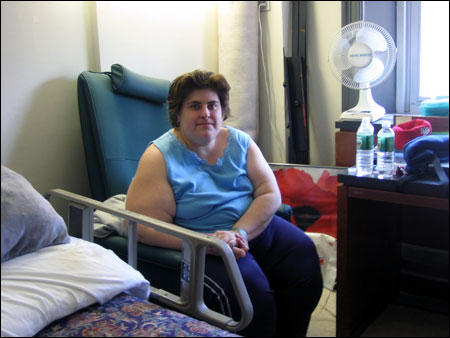
At age 12, Stacey Eddy weighed over 300 pounds. Her fellow sixth graders’ daily ridicule began on her journey to school. “People wouldn’t let me sit down on the bus because they were afraid I might squash them,” she recalls. In eighth grade, the bus driver assigned her a seat at the front of the bus so that she would at least have a place to sit, but that only made the teasing and taunting worse.
For the last seven months, Eddy, now 33, has made the 10th floor of Columbia-Presbyterian Hospital in New York City’s upper Manhattan her home and losing weight her full-time job. She has come from Long Island, New York to participate in a study on why people have to struggle to keep weight off. At 5 feet 4 inches tall, Eddy currently weighs 308 pounds, a monumental improvement from the 420 pounds she weighed two years ago.
Her hospital room is filled with dozens of Poland Spring water bottles, seltzers, diet sodas, and a small refrigerator containing a carefully portioned liquid diet that, according to Stacey, is “as appetizing as baby food.” With her easy smile and chatty disposition, Stacey speaks candidly about her lifelong obesity. Over 20 years after sixth grade, her bus rides aren’t much different, except that her schoolmates have been replaced by strangers who volunteer such unsolicited advice as, “You should look into gastric bypass surgery.” These daily slights are status quo for the obese. Dealing with them requires a strong mind and a will to persevere in spite of other people’s ignorance — qualities that stand out in Eddy. She, and others like her, are engaged in a war on two fronts. The first is a battle against their own bodies; the second is against those who don’t believe the first battle exists.
The stigma against the overweight and obese looms large in our society; fat people are seen as lazier, less intelligent, and weaker-willed than the average person. The obesity stigma is so severe that it can even spread to others who are not overweight. A recent study at Rice University showed that sitting next to or associating with an obese person decreases your own attractiveness and leaves a negative impression in the eyes of others. The study showed that prospective employers gave lower ratings to a male applicant whose photograph showed him seated next to a heavy woman. When the same applicant — with exactly the same resume and qualifications — was seen seated next to an average-weight woman, he received higher ratings.
This hiring prejudice is just one of many inequities that the obese face; they must also deal with a decreased likelihood of promotion, higher insurance premiums, and with earning about 12 percent less than the non-obese. These persistent biases arise from the assumption that obesity reflects personal choice or a lack of self-discipline. They suggest that the world’s latest health epidemic is a man-made predicament, and that those to blame are the fast food industry and the people who lack the moral resolve to refuse a second serving. According to the Centers for Disease Control, the prevalence of obesity among adults in the United States has reached an astounding 33 percent, affecting 65 million Americans. If obesity is really the result of poor choices and moral failing, then the United States has much more than a health problem on its hands. With so much extra fat on America’s waistlines, scientists are reexamining a central question: Is obesity simply a lifestyle choice, or is it preordained in one’s genes?
It’s all in the family
Lamont Daye is a gregarious 44-year-old with dark sunglasses and an infectious smile; he’s about 5 foot 6 inches tall and weighs 270 pounds. His wife Traci is 34 and weighs about 280 pounds. Sipping coffee at a Manhattan cafe, they relate their lifelong struggles with weight. Both of them have been on diets and 12-step programs like Overeaters Anonymous with limited success. Exasperated at the apparent unfairness of nature, Lamont describes his cousin Tony, who just can’t seem to gain weight because of his fast metabolism. “Tony will eat all the stuff in sight and won’t gain an ounce. If I eat one slice, it’s like — boom!” Lamont motions to his stomach. Traci, who has been more reserved, perks up, “I have friends that complain that they can’t gain weight, and I just want to choke them!” She says this without maliciousness, but with a tinge of frustration. Lamont and Traci’s struggles mirror those of Stacey Eddy; all three of them are trying to lose weight, but their bodies are fighting back. And they all recognize that their bodies are fundamentally different from others who can indulge in food without a second thought.
Science has confirmed this perception. Despite the societal conviction that weight is a choice, whether or not someone becomes fat is largely in the genes. The heritability of obesity is comparable to that of stature. While it’s commonly accepted that one can’t do anything to become taller or shorter, the variability in weight poses more of a conundrum. A 1986 study of adopted children and a 1990 study of twins, both performed by Dr. Albert Stunkard of the University of Pennsylvania, indicated that 70 to 80 percent of our weight can be accounted for by our genes. This means that the environment in which adopted children and separated twins are raised counts for much less than most people think.
Quite simply, obesity runs in families. Traci’s parents are both obese, as are Lamont’s. In addition, high blood pressure and diabetes are common in both of their families. That family history doesn’t bode well for their four young children despite Traci’s hopes that they don’t also become heavy. “I wouldn’t wish this on anyone,” she says.
Back in Eddy’s hospital room, she talks about her overweight mother who chose to have gastric bypass surgery 20 years ago — something that Eddy would never consider doing herself because her mother is often sick and frequently vomits. Eddy wants to lose the weight naturally, by using her mind to battle the genes she was born with.
It is common for Paraguayan women to greet one another with "Nde kyrapona!," which roughly translates to "You are so good and fat!" It is a compliment my American wife would have a hard time responding enthusiastically to.
Living in a small village in rural Paraguay for a two-year Peace Corps assignment, we were constantly confronted by a number of cultural differences, not the least of which was the appreciation for being fat. Being fat essentially meant that you are well off, not necessarily able to afford glass in your windows — there were only two households in our village that could afford that symbol of wealth — but wealthy to the point of having enough food to grow corpulent.
In an agricultural society such as Paraguay, there is an undeniable social prestige that comes with corpulence. Being fat means you own land and your crops are doing well. It means you probably aren't the one in the fields hoeing lines, but certainly the one consuming the benefits. In an agricultural society, being fat is being healthy. A fat pig is a healthy pig. A fat cob of corn is one to save because its genetic progeny will be equally fat.
Being called fat to your face is flattering.
On the other end of the village economic scale are the workers hoeing the crop lines. They are thin, many are gaunt, and their bellies round — because of intestinal parasites.
Because they tend to work in the fields, the poorer villagers may be in slightly better health than the more affluent villagers. But everybody, to a degree, is malnourished. Vegetables are practically nonexistent in our village, and fruit is seasonal and scarce. Meat is expensive. Meals are created almost entirely from a larder of corn meal, manioc, beans, or fried dough. The best thing in life one eats is chicharon — scraps of fried pig fat — and even the richer denizens get that treat at most four times a year.
Needless to say, the lack of options does not lend to a healthy diet, and high blood pressure ("presion alta") and adult-onset diabetes are rampant among the older members of the village.
Although my wife and other female Peace Corps volunteers would be horrified if greeted with an approving, "My, how fat you are" comment, none would consider it better to starve than to glut, be hungry than satiated. In a place where starvation is likelier than a healthy diet and "exercise" consists of hard work in the sugarcane fields, it is understandable that most aspire to be fat. For the rural Paraguayans, carrying one's fat proudly is the surest sign of worldly success.
My dog is overweight, the vet tells me. I need to put him on a diet. I alternate between feeling guilty and asking myself how this happened. I know the answer, of course: I cannot say no. More treats equal a happier dog. Who wouldn’t want that?
As the contributors to this big fat issue of InTheFray reveal, my dog and I are not alone in our struggle to cut the flab. This month we get the skinny on our culture’s problems with fat, in its many manifestations. We begin with Eric Chang’s look at how our big fat stupid genes — The invisible enemy — influence body type and hinder us from willing to be skinnier. Sometimes, extra weight comes from pregnancy, which leaves some people asking, “Is pregnant fat?” as Karen Walasek’s visual essay does.
Of course, as Sarah M. Seltzer points out in Knocking the weight, sometimes neither genes not willpower nor reproduction determine the shape our bodies take — or other people’s perceptions of our physiques. Other times, as Katherine Roff suggests in her review of Wally Lamb’s novel She’s Come Undone, shouldering The weight of the world can make eating seem like our only means of survival. But often, as Pris Campbell suggests in her poem Runway, few things are as seductive as the possibility of emaciation.
Our bodies aren’t the only things many of us wish were skinnier. Summer Batte dreams of slimming down her home but finds her love of “stuff” keeps getting in the way. And, in Cutting down to size, David A. Zimmerman struggles with the allure of being larger than life and the egotistical behaviors it manifests.
Rounding out this month’s stories is Lights, camera, action, ITF Board member Randy Klein’s profile of the Global Action Project, a youth media and leadership organization for New York City teens.
Thanks for reading. We hope you enjoy devouring this month’s issue as much as we indulged in putting it together!
Laura Nathan
Editor
It’s swimsuit season, which means it’s time to start obsessing over weight and body image. Of course, weight and body image are as American as deep-fried Twinkies and apple pie a la mode. Obsessed over by both the government and the news media, weight is not solely about obesity, but a continuum:
Dangerously Thin |———————| Normal Body Type |———————| Morbidly Obese
Nobody wants to be dangerously thin or morbidly obese. Most of us content ourselves with falling somewhere in between, and take comfort in being “normal body types.” But there are folks who are not “dangerously thin” or “morbidly obese” or anywhere near “normal.”
They’re larger than life.
The first time I recall meeting someone larger than life was at a social gathering, one of those things where friends of friends finally meet one another. My friend was the party’s host, and she sang at my very large church. I recognized at the party several of her singing friends. I knew these folks only from the JumboTron; I’d never encountered them up close and personal. A few of them brought my celluloid imaginations of them down to proper size, but one commanded the room with her presence as she did from the screen. I wasn’t attracted to her, but I was struck by her. She filled the room, yet remained unapproachable — to me at least.
She was larger than life.
I met another such person recently. I’ll call him Thor, the Lutheran pastor. Thor, of course, is the Norse god of thunder and a founding member of Earth’s mightiest heroes, the Avengers. And it was on a Thursday — “Thor’s Day” — that Thor the Lutheran pastor was in a church telling me how to take care of people. Funny, engaging, and nice, he held the attention of everyone in the room, whether he was saying something silly, offensive, or absurd.
He wasn’t dangerously thin or morbidly obese. He was large and in charge.
And to say I “met” him would be an overstatement. I didn’t introduce myself, because there was no point. He wouldn’t remember me and shouldn’t be bothered by me.
Do you know anyone like that? I can count one or two such larger-than-life types as close friends, but they’re always referred to by both their given names and their surnames, as though one name isn’t enough. They’re good people, doing their best in the world, not going out of their way to draw attention to themselves. But they don’t have to. They were made for the stage and the big screen. There’s a kind of unbridgeable gulf between them — and us.
We find ourselves in awe of such people, especially when they do merely human things. Us magazine has a regular section called “Stars: They’re Just Like Us!” with photographs of celebrities tapping melons and buying gum and scooping their dogs’ poop.
We are awestruck. There they are, living their larger-than-lives. Just like us.
I’ll admit there are days when I wish I were larger than life. I got my chance when I stopped attending a very large church in favor of a very small church. I was 25 years younger than the average congregant. I was well-skilled in the art of very large churching: I was gregarious and magnanimous. I was a handshaker and a backslapper. I was as large-as-life as I can get.
I joined the church’s drama troupe and got to wow the congregation with my grand theatrics. I joined committees and wrote for the church newsletter, which showcased my wit and vocabulary. I released my first book, made a community-outreach video, and became an elder, impressing everyone with my commitment and accomplishments.
And then the day came for the dress rehearsal for our large-scale Easter production. I was the star in two scenes, where I sang a solo and entertained the hoi polloi with my backstage antics. At one point, the pit musicians dropped a cue. Being the consummate acting professional, I waited briefly and then, with great irritation, began my solo. After the rehearsal, I boomed in my larger-than-life voice, in front of the whole cast and crew, “Am I going to get accompaniment for that song or what?”
The next day I magnanimously approached the piano player to make sure we were on the same page after the previous night’s fiasco. She had prepared a statement:
“You know the Bible a lot better than I do.” True, I affirmed, thinking, you hardly know the Holy Scriptures at all, while I know them backward and forward, thank you very much.
“But I’m pretty sure it says something in there about settling disputes privately — not in front of everybody.”
Okay, sure, it does say something like that.
There are times when I like to think that I’m larger than life, but I’m not. It’s all in my big, fat head. In reality, my frame can’t support such an oversized cranium, so sooner or later I’m going to collapse under the weight of my self-regard.
I'm reminded of King Saul, the unwilling first king of Israel, who stood taller than his peers and drew attention to himself without effort. Even when he hid during his coronation, the people sought him out. In making him king, the Israelites were sending a message to the surrounding communities: This is our king. He’s important, powerful, awe-inspiring, and larger than life — just like us.
Soon enough, Saul started playing the part and got himself in over his big, fat head. Meanwhile, his actions got smaller, pettier, and hurtful. Eventually, a larger-than-life Goliath would take his place, and an easily overlooked shepherd boy, David, would bring that giant down. David’s legacy in the Bible is not as a larger-than-life being, but as a down-to-earth, flawed human being — just like the rest of us.
So this summer, while I’m fretting over my figure and watching my weight, I’m going to keep one eye on my big, fat head. It’s the least I can do.
Of course, I’ll keep an eye on all the little people as well. I don’t want to step on their toes as I make my way.
Food’s so mundane when compared to the adoration of emaciation ...
Sara chops her lunch into equal sized bites,
moves it around on her plate
leaves white spaces
pretends to chew when anyone looks her way,
slides food into her lap.
Sara thinks her belly is as big
as the rising moon, that her thighs rival
those giant Doric pillars on the Parthenon.
Ten pounds down and she could be a runway
model like Anna Reston once was
or Barbara Di Criddo, strut flat-eyed
and loved,
a human hanger for size zero dresses.
She doesn’t know her runway is fated
to be a dark graveyard row, her trophy
a bouquet of dead roses.
Sara dreams the mirror tells her she’s beautiful.
She bows to her make-believe audience
holds frail arms out like angel wings for a curtsy,
smiles as her flesh melts down from bone
to fairy dust
to ground.
Wally Lamb’s She’s Come Undone explores the dark corners of obesity.
To write what you know, as the old maxim says, is good. But to write successfully about something you cannot possibly know is brilliant. And that’s exactly what Wally Lamb has done in his first novel, the New York Times bestseller, She’s Come Undone.
Lamb’s stunning 1992 entry into the literary spotlight deals with a broad range of issues with depth and without judgment, exposing the corners of the human soul as it deals with abandonment, rape, guilt, rites of passage, obesity, death, forgiveness, and finally, hope through the delicate perspective of a female character.
She’s Come Undone, which also made it to Oprah’s Book Club list, follows the life of Dolores Price, from her early childhood memories of her family’s first television to her mid-30s’ desperation for children, weaving you down, up, over, around, and through the tragedies and triumphs of her life. Dolores’ life contains one trial after another, sometimes leaving the reader struggling to see a way out for the imperfect heroine. It is only as we journey deeper into the novel that we begin to realize the full weight of Dolores’ initial warning, “Mine is a story of craving: an unreliable account of lusts and troubles that began, somehow, in 1956 on the day our free television was delivered.”
Beginning with her parents’ separation and being raped at 13, Dolores embarks on a downward spiral through her teenage years, eating away her guilt and entering adulthood at 257 pounds. At the end of high school, horrifically overweight and already withdrawn from society, Dolores is then confronted with her mother’s death in a freak accident.
This is just the beginning of Dolores’ troubles, their effects unraveling throughout the remainder of the story. Indeed, this novel is not for the faint-hearted or weak-minded. At times, it’s difficult not to flick forward pages in search of a glimmer of hope for the main character. Nevertheless, Lamb manages to weave some semblance of strength into Dolores’ character, saving us from feeling completely distraught over the poor girl’s fate.
Lamb’s close connection with his characters is evident in the voice he gives each one. In an interview with The Book Report’s Judy Handschuh, Lamb admitted that he doesn’t control his characters — in fact, quite the opposite. “People always say, ‘But you’re in control of what happens.’ That’s not true,” he explained. “I start with a character’s voice, and that voice leads me into the story. I never know where I’m going, and getting into the character leads me into realizing the story. Sometimes I try to put them on safer paths or have them make better choices. But whenever I do that, my writing becomes hollow. So I’ve learned to let them go their own way, and just wait to see what happens.”
Lamb has an uncanny knack for accurately depicting the tumultuous experience of obesity, which lends a genuine depth to his novel. Dolores’ early depression and attempts to eat her way out of sorrow result in a vicious cycle of gluttony and despair lasting well into her 20s. The ridicule she suffers, particularly once she enters a university, serves as sharp criticism of people’s insensitivity to overweight people. Dolores endures constant taunts and blatant mockery from her peers, and even her so-called “friends.”
Even though Lamb’s novel is 15 years old, the issue of the social ridicule and alienation of the overweight still resonates strongly today. According to a 2003-2004 survey by the United States Department of Health and Human Services, 32.9 percent of North Americans were classified as suffering from obesity — more than double the 1980 record of 15 percent. She’s Come Undone deals with the extreme nature of obesity from a personal perspective, allowing the reader a glimpse at the often forgotten and overlooked psychological difficulties involved.