Back to Basics

Best of In The Fray 2007. Why newspapers need to embrace narrative.

In its purest form, the newspaper was to serve as a city guardian. This was because the paper broke news. It informed and protected its constituency by imparting necessary fact.

Of course this isn’t print’s role any longer. Only the Internet and 24-hour broadcast news really break news now, faster and more cheaply. But newspapers have yet to adjust their role or articulate this shift. They continue to assume the obstinately objective, dispassionate voice of news breaker and to report facts that have already been reported elsewhere.

The combined effect of print’s inability to keep pace with today’s hard news cycle and its reluctance to abandon its official tone — even though it rarely delivers the latest word — has meant disaster for subscription dailies’ revenues. But — more importantly — in clinging to the old form, print journalists forego the chance to take up, at last, the greater journalistic tradition: the tradition of narrative news.

Narrative news is the retelling of real events with the intent to marry information to story, story being the artful rendering of events and the people who are part of them. Narrative is deliberate. Its structure, style, and voice are employed to reflect levels of meaning — social, psychological, historical — and to impart a sense of the greater significance of the action.

Narrative is a salable product for the simple fact that we live by it. We’re all always making sense of experience according to a story’s essential elements: continuity, character, and concept. H. Porter Abbott, a scholar of narrative, writes that narrative is “the principal way in which our species organizes its understanding of time”; that narrative gives us a sense of the shape of time, of our place in infinite space. In this respect, narrative is the essential element of human existence: It gives our lives meaning.

As such, it’s our inherent mode of comprehension and expression. Well-crafted narrative journalism demands the reader’s engagement; its structure and voice work to invest the reader in the page. Traditional methods of journalism preach the virtue of information and the plain language that delivers it: the maintenance of distance between journalist and reader, the antinarrative. But in attempting to distance themselves from their audience, journalists have only distanced the audience from their product.

This realization is not new, nor is the notion of including narrative in daily news. Many papers feature long-form news reports that editors habitually refer to as narrative. But to dress up any ordinary bit of journalism with superficial literary techniques — arbitrary metaphor, description, or wordplay — is not narrative. Nor is the insertion of a descriptive scene into an otherwise ordinary news piece. These are merely fast and facile attempts to disguise dull writing. But gussied-up inverted pyramids are only barely more appealing than un-gussied ones.

Were newspapers to attempt real narrative, the shift would require an investment in time. Such an investment is best suited to a newspaper, which can thrive on taking the time — a luxury that neither online nor broadcast news can afford. Because of its requisite slow carefulness, written narrative seems ill-suited to the web (read: print’s key competitor), which is fast-paced to a fault. And because the great appeal of the Web is its ability to display fragments of information and to deliver text in no predetermined sequence, that medium seems ill-suited to long-form story. The very concept of the nonlinear network conflicts with the nature of narrative, the basis of which is structured continuity. Story unfolds with deliberate intent, not in flashes.

Print journalists and publishers should take advantage of this media dissonance. Because straight information is base metal to narrative’s gem, it has evolved into a communal property, for which the public is ever less willing to pay. It will grow less salable over time, not only because its availability increases exponentially with the influx of new technology, but also because, as writing, it does little to engage its reader.

By contrast, narrative moves readers precisely because it embraces the communicative properties common to everyday conversation. Like conversational language, the language of narrative operates under established patterns: for example, the chronological structure of a story that is simply told. It draws upon common ideas and objects to evoke greater and yet-unseen ideas. And maybe most importantly, narrative, like spoken language, conveys something between people. It specifies its message to an audience through its tone, diction, frame of reference, and use of rich language.

People respond positively to these properties and are willing to pay for work that incorporates them because the writing feels real. Narrative is humanizing. It makes sense of our world. It echoes the ways we speak our own stories and the ways we relate to one another. It’s an ideal form through which to learn about our society.


No rest for the Good Samaritan

200712_activists.jpgActivist Lupe Anguiano reflects on a life spent fighting for equality.
 

Lupe Anguiano is a former nun who offers a religious framework that counters Christian conservatism. She was a pioneer in welfare activism and the women’s rights movement, and reframed religious debates to include issues of social justice. At the opening of the Lupe Anguiano archive at UCLA earlier this year, she was called, “truly an unsung heroine of the American civil rights movement.”

Below, Anguiano discusses the perils of large, rich institutions, and recounts a time when the church actually leaned left.  

Interviewer: Anja Tranovich
Interviewee: Lupe Anguiano

How have your religious beliefs influenced your activism?

I was always raised knowing we were made in the image and likeness of God. Fighting for equality has always been part of my upbringing. I was always brought up with the dignity of people.

Equality is something I have always struggled with. My dad was from an Indian background, and my mom was a Spaniard. My dad’s mom was the housekeeper to my mother’s parents. There was struggle from both of my grandparents’ sides. There were a lot of equalities issues.

To tell you the truth, the whole issue of standing up for your rights, I didn’t feel the need or strength of that until the ’60s.

You went into the convent when you were young, but got reprimanded because of your activism during the ’60s, especially on civil rights issues. What were you doing then?

I was a missionary sister, and the whole training is to respect others’ languages and cultures and not to impose your own ideas, and to be respectful of people, particularly of the poor. If people are poor, it shows the need for education; it’s not an issue of intelligence.

I feel very strongly about the issue of equality because I am Latina — Mexican American — and I had experienced problems of inequality among our people and black people. Some of the training I had as a missionary sister was to observe, judge, act — you observe, you judge, you act. You, as a citizen, have responsibility to stand up and do your part to make things equal for everyone. I was working with agricultural workers, with Latinos and black people as a missionary sister, and I saw some [of] the discrepancies and discrimination in how they were treated, especially with red lining. I thought that the church needed to stand up for these people.

One of my big confrontations, or rather challenges, with the church was with red lining, when blacks and Mexican Americans were not allowed to buy homes in certain areas of Los Angeles. I started to work for open housing. So did other nuns and priests, and many people were reprimanded.

I eventually left the missionary sisters because of that issue. The cardinal in Los Angeles then, Cardinal McIntyre, really forbade the sisters and priests from getting involved. The cardinal had local ties with developers, so he didn’t want to offend them. Some of us felt that it’s not an issue of not wanting to offend, but an issue of educating the Catholic community, that this is what the church stands for: equality.

That’s when you really saw the first exodus, not only myself, but also many others.

Pope John XXIII called for us to get involved with social issues. The pope called a Vatican Council and said that the church needed to be more involved and, like Christ, go out and work with people instead of just working in the convent.
So from the pope’s standpoint, and really knowing the doctrines of [the] church, we had to speak out and oppose on the local level.

The church used to have more involvement in these types of social issues. If you look at New York when unions were first founded, when the worker was exploited, the church stood up in support of the worker. And as a result of the church’s support, the unions were able to form.

Now you don’t see that kind of activism from the church.

You are right. Some of the very conservative churches have used the name of God and Christ to discriminate, particularly against women. It’s very confusing right now. You see the evangelical churches really coming down very hard on the equality of women and immigration, and supporting unjust things like the war. In those days [in the ’60s], the churches would be up in arms against the war. Today you just don’t have that.

Why is that?

[In] my honest opinion, I think it’s because of wealth and institutionalization of religion. Many times, ministers and priests and cardinals and bishops are more concerned about supporting the buildings and institutions instead of the message of Christ.

When Christ started the church, he lived his example — compassion, love, equality, peace, and justice. The church has become more concerned with sustaining the institution instead of Jesus’ message.

You see that in government as well. There is a general trend toward protecting the institution for the institution’s sake.
My feeling is that we’ve come to the point where people have to act. They have to look at their communities and voice their concern.

I was really delighted with the change in Congress, but there are still so many issues. Oil companies are really raiding the pocketbook[s] of the American people; it’s the height of injustice to Americans and all people. Bush doesn’t do anything about it, the church doesn’t say anything about it, and neither does the government.
I thank God we are in a free country; there is always the opportunity for change. I am 78 and I rely a lot on young people.

You did a lot of work for women in the ’70s alongside Gloria Steinem and Bella Abzug, forming the National Women’s Political Caucus and advocating for policies like the Equal Rights Amendment, which still hasn’t passed. In the ’70s, did you think that movement would have made more gains than it has?

Yes, because you know we were like on a roll; the Equal Rights Amendment was almost certified. I did a lot of work to bring church support to the Equal Rights Amendment.

You are often credited with changing the religious debate on this issue.

I was disappointed that it didn’t pass.

There were internal struggles within the movement as well. When I was fighting to change welfare so that it promoted education and training to help women go to work, some feminists decried having Latina women out of the house and working. Well, they were already working! Even the women at the Women’s Conference felt that we might be dismantling the safety net of Latina women by helping them work. How would we be dismantling their safety net by giving them the right to work? Not to do so would be condemning them to live in poverty. “Protect the minority women.” What is this?

Here we are, and women still earn 70 cents on every dollar earned by men. Talk about inequality! We still have it right now.

Gloria, Bella, and I thought, if you are going to talk about equality, we have to talk about equality across the board. They were very supportive.

I think we need the Equal Rights Amendment and its clear interpretation of equality for all. We need to really see equal rights from a total perspective of all people.

What I would like to see is young people really looking at equality from a local, state, and national perspective, and using their global eyes to really look at the world. You guys have a big job to do. I really believe in young people.

I sometimes feel that those concerned and active in younger generations are in the minority.

That’s always the case. Revolutions are started in groups of 10 or 12. If you can educate people to the issues and provide information, people will start to come out.

What are you working on now?

We are fighting the oil companies here in Ventura County, California. 
The Houston-based Northern Star natural gas company is trying to bring liquid natural gas into the area. For two years we’ve been fighting against them. All the independent studies commissioned on the topic show that the need for natural gas is flat. It’s questionable whether or not we really need it, and it will do great harm to the coastal environment.

California is very resourceful. We have a lot of innovators, companies creating wind and solar solutions. Investing in liquid natural gas will prevent us from investing in clean energy. The lieutenant governor [of California] has been really fighting with us.

We are also really dealing with the legacy of Enron. We’ve heard the tapes, how Enron manipulated the California energy market, manipulating the need. This seems like such a clear parallel, and we are very conscious of that. 

You’ve been involved in so many different campaigns: workers’ rights, unions, women’s rights, welfare reform, and environmental activism. What draws you to a particular subject or campaign?

Well, I am going to share with you a big secret. In reality, what I think happens to me is that our Lord just places me at the right place at the right time.

I do not enjoy confrontation. I would like to go to the hermitage and get away from all this stuff.

But I am placed in a situation, and I say, in my [conscience], I say: this is wrong. And I start becoming involved with people who are really doing something about it. I come in and support that work.

Recently I’ve been working with the Environmental Defense Center and Susan Jordan. She’s been an environmentalist all her life. She’s come up with some concise documents pinpointing some of the inequalities with the liquid natural gas issue. You have to be really dumb not to see it.

I’ll tell you what got me really ignited: when President Bush and the Congress signed the energy bill. It was more than I could handle. I just saw the exploitation [by] oil and gas companies. You’d have to be very callous and not very alert to see that. That [becoming angry] happens to me, and I guess it should really happen to a lot of people.

It’s a challenge. I would like to have young people take over so I can just rest.

What advice do you have for those young people?

To be strong.

We have a [conscience], and we know what’s right and wrong. We need to listen to our intelligence and come together.
And not to lose hope.

We can’t allow ourselves to get into a situation where we are ruled by the institutions around us.


May good things not become a stranger to you

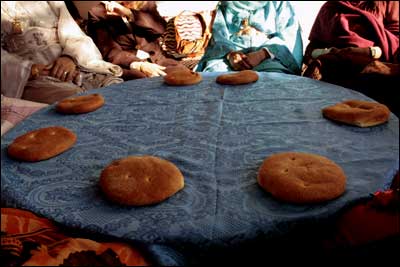
An American learns how to visit in Morocco.200712_ttlg2.jpg 

So much of life in Morocco is about visiting. Although it’s true that cell phones are prevalent here, they are rarely used for those long, haven’t-heard-from-you-in-a-while talks people have in the United States. That is still just too expensive an option for the average Moroccan to even consider.

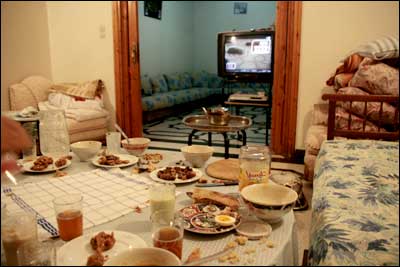
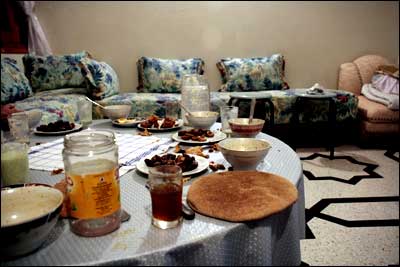
Instead, people here visit. The culture of visiting penetrates the rituals and day-to-day life of Moroccans. Most houses have decorated guest rooms that go unused until there is a knock on the door. Then the house goes into “guest mode.” Sweets and nuts are pulled out of cabinets and placed on the best china. Water is immediately put on the stove to boil for tea. If ever it seems your visit has caught your hosts off guard, perhaps they are simply out of mint leaves. Don’t worry, they will quickly send someone out to one of the neighborhood grocers to bring back what is needed. 

Make sure NOT to call before you come by

If you should unexpectedly stop by a friend or neighbor’s house in Morocco, don’t feel as though you have inconvenienced anyone; visits here are rarely planned. They are impromptu social calls that say “I was thinking about you” or “I was in the neighborhood.” Moroccans actually feel honored by the idea that you feel close enough to them to just stop by unannounced.

I have had more than one person here stress to me that I need not call before I come over. 

“Even if it was at meal time, you would just eat whatever we have that day. You’d just be like one of the household,” one friend said.  

When I told another acquaintance that I still hesitate before knocking unexpectedly on someone’s door because of my American conditioning to call first and ask permission, she burst into laughter. It was probably the funniest thing she had heard all day.

A few weeks ago, I spontaneously visited a friend and her mother who live in the old city of Fes. As we were sitting around, drinking coffee with milk and eating homemade pastry, my friend’s mother told me how she was about to get on her way to visit her brother just before I came, but changed her plans because she’d had the strong premonition that some guest was headed her way. 

“And it was you,” she marveled. I tried to share in her astonishment, but in a country where everybody visits, the odds were good that somebody would stop by.

In some situations, visiting becomes an obligation. You run into someone on the street or call to say “salaam” to an acquaintance, and they say, “You’ve become a stranger! You don’t come by.”

This scenario played out a few days ago with a family in my neighborhood. They had told me to stop by weeks earlier, but I had not gotten around to it. When I finally showed up, the first thing they said to me was that they had just been talking about how I hadn’t called or come by.

On an obligatory visit, make sure to go at an appropriate time, meaning not after 11:30-ish, because you will be “taken” for lunch. The midday meal is the big one in Morocco, and if you show up too close to it’s time, it is as if you are inviting yourself to be taken in for lunch. Moroccans use the expression “I was taken” to describe being kept at someone’s house unexpectedly or talked into joining someone for a meal after having run into him or her on the street.

Hold your water

It is inconceivable that anyone should visit a Moroccan house and leave without having eaten or drunk something. And if you dare try, you will be shamed into either staying until the food is prepared, or eating something from what is immediately available.

Sometimes I have fit a visit into my day when I really didn’t have the time or when I had prior commitments. I have always managed to untangle myself from an extended layover with what I call the “water and a promise” strategy: I ask for a cup of water, then drink it in such a way as to show how refreshed I feel. This means holding the glass as if it contains a precious life-saving liquid, then taking slow, serious gulps while maintaining eye contact with my host. This is followed by the kind of “ahhh” you see in cola commercials, quickly followed by a deep, sincere “praise God” as I put the glass down definitively on the tray, making sure to make a noise. Then I promise to return later for tea or couscous.

Day dreaming

If you are actually invited for lunch, it is likely that after the meal you will be offered the chance to take a nap on one of the lovely couches in the guest room. Just last week, after a hearty lunch of couscous with chicken and seven vegetables, followed by a dessert of bananas, apples, and tangerines, my host handed me a warm blanket and a pillow, and showed me a couch upon which I could recline. Even if it feels a bit strange, don’t fight it. Just about everybody in the house will probably conk out for an hour or so, and then wake up and have some tea.

The most common time to visit, which happens to be the time I prefer, is right after the late afternoon prayer, which is generally around three o’clock in the afternoon. During your visit, you will be served a light snack, such as some sort of pastry or homemade bread with an accompaniment of cheese, jam, or olives, and either mint tea or coffee with milk.

The great thing about the late afternoon prayer visit is that the sundown prayer is close enough to give you an excuse if you should need one to end your visit. In most parts of Morocco, sunset generally marks the end of the day in terms of outside life; people go home when night comes.

The only danger you might face if sunset finds you in a Moroccan home is being roped into spending the night. No, this is not the third grade — people here actually want you to spend the night at their place! And not having brought your toothbrush is no excuse. If your host is of a persistent nature, there is actually no excuse good enough to get you out of spending the night, except for having a major medical operation scheduled early the next morning.

You would be surprised how easily a lunch invitation turns into a sleepover request. And should you end up spending the night, don’t think you’re getting out of the house as soon as the sun rises. Eat breakfast, relax, and pray you’ll be able to escape before lunch. Pray hard.

Don’t go empty handed

What to take as a gift when you go visiting is another issue. It varies depending on the length of time since you last saw the person, on the occasion, and on the financial situations of you and your host. 

If you are a foreigner — especially one from Europe or the United States — your resources are assumed to be great. And they just well might be, but there’s no need to blow everyone else out of the water! Simple food items will do as a gift. The idea is to augment what you are about to consume.

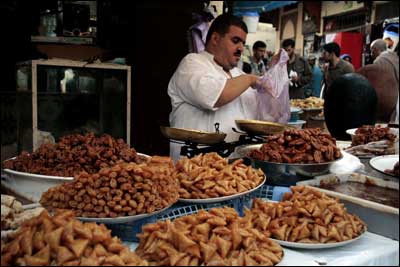
Typical things Moroccans bring each other on casual visits include cartons of milk, sugar (sometimes in the shape of huge bells), a few kilos of whatever fruit is in season, or mint leaves. The more special the visit, the more special the foodstuff: pure raw honey, for instance; pastries; fresh buttermilk (very much appreciated by Moroccans, as it goes well with couscous); or a live chicken — yes a <i>live</i> chicken — which your hosts themselves will have the honor of killing.

Of course, it is a part of the culture of visiting that your hosts should say, “Oh you shouldn’t have,” and perhaps even refuse your gift initially. They might pretend offense, saying that the gift is making the relationship too formal, and that they thought you were like sisters, brothers, or cousins. Just insist, push the gift into their arms, and say you refuse to enter their house with your hands empty. I find this is usually enough for them to accept the gift and allow the visit to proceed.

 I don’t know why you say good-bye, when I say …

Visiting in Morocco does follow a rigorous protocol, and sometimes it is hard to distinguish true hospitality from custom. But when you’ve finally sunk down into the Moroccan cushions, and you’re sipping your hot beverage and laughing with friends, you will be so glad you stopped by.

When at last you finally make it to the front door (which will not happen on your first try — three is usually the charm), someone is bound to leave you with the parting phrase, “Don’t become a stranger.”

At this point, you respond, as it is custom to do in Morocco, by saying, “May good things not become a stranger to you.”

personal stories. global issues.