- Follow us on Twitter: @inthefray
- Comment on stories or like us on Facebook
- Subscribe to our free email newsletter
- Send us your writing, photography, or artwork
- Republish our Creative Commons-licensed content
Cokie Roberts does NOT speak for me.
The Bible is America’s favorite book, followed by The Da Vinci Code and Angels and Demons. My head hurts. I suppose it could be worse. America’s favorite book could be Mein Kampf or something written by Danielle Steel.
First Lori Gottlieb got a book deal to expand on her article advising women to settle for whichever men they can. Now that book will be turned into a movie. I can actually understand this, too. The more outrageous your idea is, the more attention it gets. The more attention, the more views and hits. Then the more ad revenue, the more profit. This is a cash cow — of course they’re going to milk it. If any man or woman will take advice on something like whom they will vow to spend their lives with and create children with from a spoiled Beverly Hills dabbler, that’s their problem. Adults make even worse decisions than that everyday. But I wonder how Gottlieb, or anyone, would feel after finding out after a time that they had been the settled for — the person his or her spouse looks at and thinks, "Well, she’s all right enough, I guess."
Single people are being blamed for the bad environment. Because they cohabitate separately, they use more electricity than if they were in a single household. That’s the new theory, anyway. It wouldn’t have anything to do with the fact that families now live in McMansions full of electrical appliances. Or that most households have more than one TV, including one per child’s room. Not to mention more than one computer, cell phones and iPods charging, outdoor lights lining the walkway, etc. It also wouldn’t have to do with the fact that there are now SIX BILLION PEOPLE in the world!
Six teenage girls and two teenage boys in Florida will be charged as adults after videotaping themselves beating a 16-year-old girl unconscious for insulting them online. Oh honey, you should see what they do to you in prison.
Cyber bullying is one thing, a whole other post, a separate crime on its own. But this was a single girl writing things online. As the police chief said, writing childish insults on MySpace does not justify being beaten unconscious, beaten again when you come to, permanently losing hearing and sight on one side, and having it all filmed for the entertainment of others.
I can actually understand the mothers who defend their criminal offspring. Think about it. They’re not defending their children — they’re defending themselves as parents. They’ve created the monster, much like Bush created the war; now they can’t admit that they’ve failed.
Consider the first thing the mother said in the Today Show interview, clarifying that she does have custody of her daughter. She wanted to clear up her own reputation first: she is not an unfit mother who has lost custody or would give up her daughter. She wants you to know that she alone raised one of these girls.
As for their kids, these parents cling to tiny details about the attack because they need to somehow justify having raised a pack animal, an adult-in-training, who plans, carries out, and participates in these uncivilized, illegal acts. That involves cruelty, apathy, a lack of self-control, and ignoring right from wrong. At the very least, you’ve raised a coward who would stand by and watch a girl get beaten unconscious.
Every parent involved will have an excuse: "My child didn’t hit. My child warned her not to come in the house. My child was insulted online. My son didn’t know what was happening behind the door he was guarding." Because to admit that your child did this, you admit that you failed as a parent. They can’t admit that to the world; more importantly, they can’t admit it to themselves. And if the parents cannot own up to their own mistakes, their kids never will.
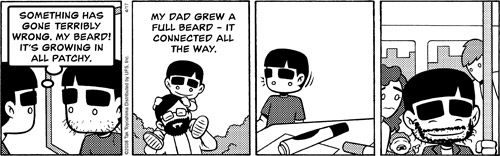
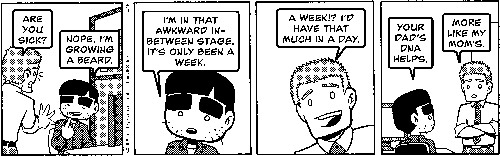
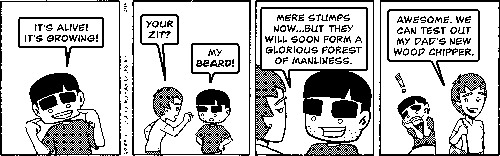
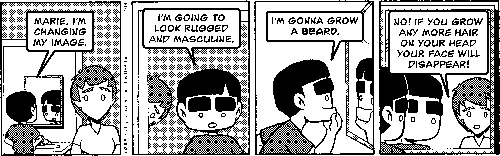
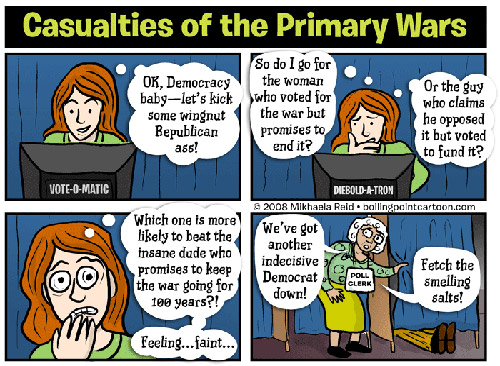
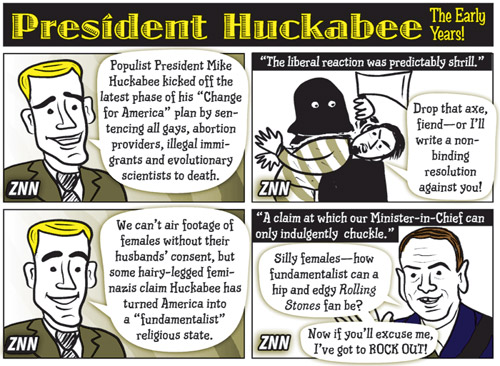
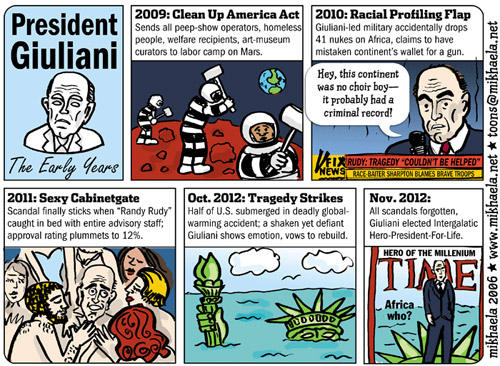
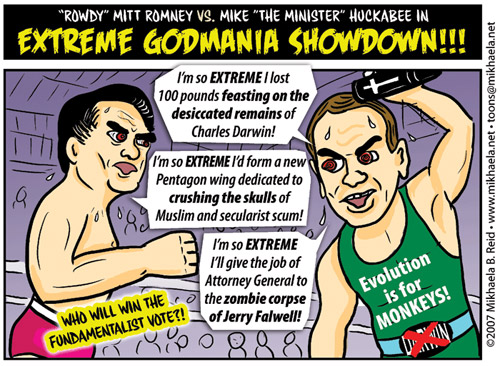
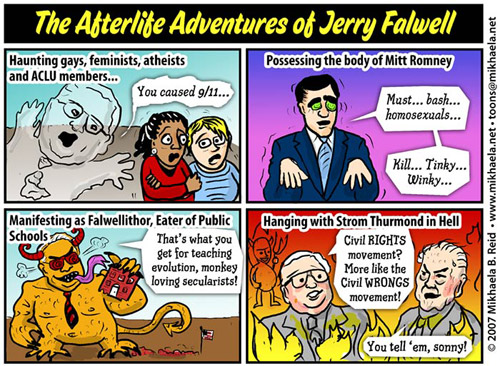
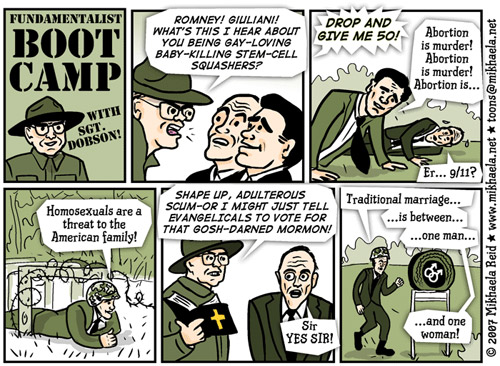
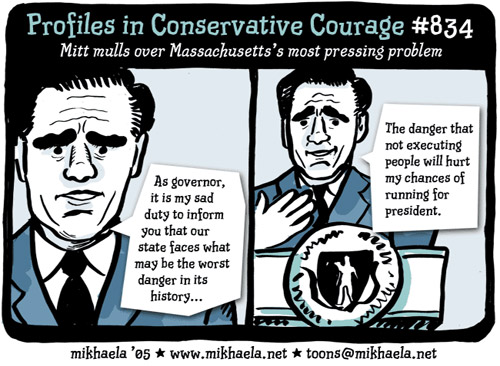
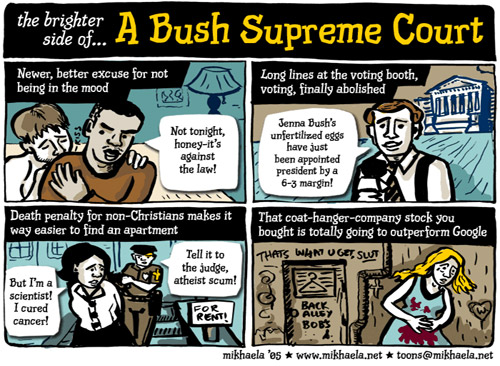
Here is a showcase of some of Mikhaela’s recent cartoons having to do with religion and politics. Click on the links to the left to view a cartoon. Enjoy!
—The Editors
{mospagebreak title=Casualties of the Primary Wars}
{mospagebreak title=President Huckabee, the early years}
{mospagebreak title=President Giuliani, the early years}
{mospagebreak title=Extreme Godmania Showdown}
{mospagebreak title=The afterlife adventures of Jerry Falwell}
{mospagebreak title=Fundamentalist Boot Camp}
{mospagebreak title=Profiles in Conservative Courage #834}
{mospagebreak title=The brighter side of … a Bush Supreme Court}

In this special edition of InTheFray, we focus on the interplay between religion and politics, especially during the singular and sometimes downright peculiar events of Campaign 2008, but we also go beyond U.S. presidential politics.
The complete line-up is to your right. Some stories offer a history of church/state issues in the United States. Others explain the consequences of recent developments, such as the look at the unhappy track record of President George W. Bush’s faith-based initiatives in Spreading the faith — and the funds. Some of this month’s articles report on conflicts between religion and politics abroad in places like Afghanistan. Others look inward, such as ITF senior editor Anja Tranovich’s interview with gay evangelical Rev. Mel White and Dr. Farnad Darnell’s personal essay on being Muslim/Mormon.
The question that inspired this edition — “Is there a ‘religious test’ in politics?” — was addressed two centuries ago in the U.S. Constitution, which specifically bans such a test “as a qualification to any office or public trust under the United States.” But in a broader sense, Americans have been struggling all along with this question in many ways. (See ITF Executive Director Victor Tan Chen’s time line highlighting more than 300 years of battles between "church and state")
Has religious conviction become a de facto requirement for presidential candidates in the half-century since the election of John F. Kennedy as the nation’s first (and so far only) Catholic president?
“I believe in an America where religious intolerance will someday end,” Kennedy said in his famous speech on religion in 1960, “… where every man has the same right to attend or not to attend the church of his choice, where there is no Catholic vote, no anti-Catholic vote, no bloc voting of any kind …”
Kennedy delivered that speech out of fear that his religion would deter many Americans from voting for him. In 2008, another presidential candidate, Mitt Romney, delivered a speech about religion and politics that consciously evoked the JFK address. Like Kennedy, Romney feared that Americans would not vote for him because of his religion, which in Romney’s case is Mormon. But some critics suggested the core of Romney’s argument was the exact opposite of Kennedy’s — intolerance of the irreligious rather than religious tolerance. “Freedom requires religion,” Romney said, “just as religion requires freedom.” (See more on Romney — including a fascinating contrast with his father George — in our interview with Randall Balmer, author of God In The White House.)
But the speech that has earned more comparisons with Kennedy’s during this campaign season was delivered by Barack Obama. Though Obama’s speech focused on race, it was brought about by religion: The speech was Obama’s response to attacks on his former pastor’s sermons. (Mark Winston Griffith comments on Obama’s speech in the context of politics and the black church in “The black church arrives on America’s doorstep.”)
For all this attention, Campaign 2008 does not seem to have clarified the issue of the role of religion in politics — or that of politics in religion.
“This political season has only heightened the confusion over the future of religion in the nation’s culture and politics,” Walter Russell Mead wrote in the March 2008 edition of the Atlantic Monthly, one of several publications to devote recent editions to the subject of religion.
Now InTheFray enters … into the fray. And so can you — add your answer to our round-up of views on whether there is a religious test in politics. Then take OUR religious test in politics, our quiz, and see if you know which 2008 presidential candidate said, “When discussing faith and politics, we should honor the ‘candid’ in candidate — I have much more respect for an honest atheist than a disingenuous believer.”
The answer — along with much in this edition — may surprise you.
Jonathan Mandell
Guest Editor
New York