Blog


The politics of Pringles

I was hungry the other day at the pharmacy (never a good idea), and so I bought a can — okay, two cans — of Pringles. Then I read today that the makers of Pringles successfully argued before a British tax court that the Pringle is not a potato chip.


I was hungry the other day at the pharmacy (never a good idea), and so I bought a can — okay, two cans — of Pringles. I know they're horrible for you. A telltale sign of poor nutritional value is a perfect, recurring shape not found anywhere in nature, and the Euclidean geometry of a Pringles chip is rightly described as supernatural. But, in my lightheaded state of hunger in that store aisle, I reasoned that any sane person, if posed with the choice between a Twinkie and a Pringle, would choose the chip, which in its defense has a color resembling potato, and not the unholy yellow gleam of a Hostess sponge cake.

Then I read today that the makers of Pringles successfully argued before a British tax court that the Pringle is not a potato chip. It has a potato content of 42 percent. The rest is corn flour, wheat starch, rice flour, and a host of other substances concocted by modern-day alchemists probably working out of a lab in New Jersey.

Procter & Gamble, the maker of Pringles, made an eloquent case on behalf of their product's unwholesomeness. (The corporation petitioned the court to get out of paying a British sales tax levied on food products.) The Pringle, said one lawyer, does not taste like — or "behave like" — a crisp (the British word for chip). "It has none of the irregularity and variety of shape that is always present in crisps. It has a shape not found in nature, being designed and manufactured for stacking, and giving a pleasing and regular undulating appearance which permits comfortable eating."

It is never a good sign when your food is in the same sentence as the word "manufactured." The word "undulating" should also raise hairs on the back of your head.

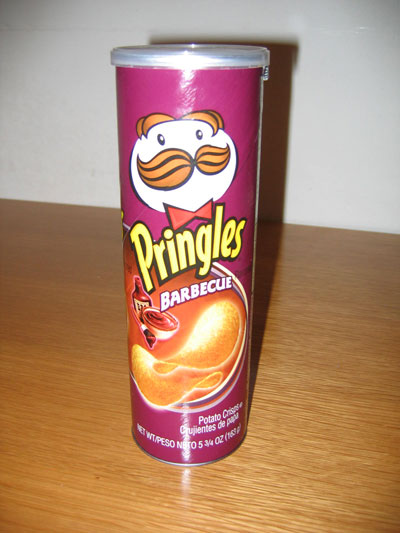
The lawyers for the non-chip chip went so far as to suggest in court that most shoppers didn't think of the Pringle as a potato chip (in spite of the fact that, at least in the U.S., the can clearly says "potato crisps" — as you can see in the photo above). This begs the question, "What on God's earth do they think it is?"

Perhaps the Pringle is an example of what Michael Pollan calls "edible foodlike substances." A Pringle is not real food, but an amalgam of food and various artificial dyes, flavors, and preservatives. It's unclear what some of these synthetic substances do to the body in the long term. Recently, a watchdog group called for the banning of artificial food dyes because of research that suggests they contribute to attention and hyperactivity problems in children.

Pollen advises people to buy food from the edges of the supermarket — from the aisles with refrigerated meats and dairy and unprocessed fruits and vegetables — since everything in the middle is not perishable, and therefore laced with preservatives. The pharmacy where I bought my Pringles probably counts as such a dead zone.

Maybe the makers of Pringles should have just taken the sales-tax hit and left us chip eaters in blissful ignorance. What will we as a society do, without our edible foodlike substances?

I think I'll go have some undulating chips now.

Victor Tan Chen is In The Fray's editor in chief and the author of Cut Loose: Jobless and Hopeless in an Unfair Economy. Site: victortanchen.com | Facebook | Twitter: @victortanchen


The art of conservation

    Oil may be the foundation of our economy, but water is the foundation of our lives. The average human can go weeks without food, but just a few days without water can mean death. Yet, like oil, our water resources are shrinking. One in six people today lack access to clean drinking water. While hotels in Las Vegas build fountains in the desert, a child dies of a water-related illness every 15 seconds.
    And things are getting worse, not better. The world’s population grows, living standards rise, and global water usage skyrockets. Middle classes expand, but carbon emissions increase, the earth warms and deserts spread, as the Sahara has over northern Africa. The wars of today may be fought over oil, but the wars of tomorrow will be fought over water.
    As with all of our resource shortages, the solutions to any impending water crisis lie in both conservation and innovation. We must seek to both reduce our consumption and develop technologies to allow fewer resources to serve more people. As is often the case, it makes sense to combine both the conservative approach of saving water or energy with a liberal approach of spending money on technological development. The devil, of course, is in the details. 
    In The Coney Island of Gregory Kiss’s mind, Michael Thomas Tedder writes of how one such innovative technology, photovoltaic glass, is being used at the new Stillwell Avenue Subway Terminal at Coney Island in New York. The architect, Gregory Kiss, uses the project to demonstrate that solar power can be both environmentally and fiscally sound, disproving not only political conservatives, but also traditional progressives, who are also inclined to think of solar power as expensive.
    Conventional wisdom holds that the Democratic Party has a lock on the African American voting bloc. Because of this, both parties write off the group’s vote and consequently ignore African American issues. Keli Goff’s Party Crashing: How the Hip-Hop Generation Declared Political Independence, reviewed by our book editor Amy Brozio-Andrews, explores how conventional wisdom might be wrong.
    A disenfranchised electorate can speak to the frustration inherent in politics. Emma Kat Richardson tells of her frustration in attempting to visit the heart of American politics, Washington, D.C., in her essay District of despair. A self-described "political junkie," Richardson’s love of the political process is palpable in her impassioned account.
    Pris Campbell explores how love is a self-conserving force, staying with us in fragments and images long after a relationship has died, in her series of poems entitled Romance and reminiscence. Her poetry is accompanied by artwork by Mary Hillier. 
    In Streethaiku, An Xiao uses the poetic form to inspire a photo essay that, like its namesake, uses a small part to suggest a larger whole. The images discard what is not necessary and capture the essence of their subject, and nothing more.
    Just as an old love can burn brightly for decades or a political voting bloc can be taken for granted for a generation, the power of conservation can dominate our lives in both positive and negative ways. Conservation can mean preserving something valuable, like oil, water, culture, or tradition, or it can mean clinging to old ideas for no more reason than they are what our parents and grandparents believed. The art of conservation is in determining how to strike a balance that maintains the good aspects of conservation while avoiding the bad.
    We hope that you enjoy this month’s issue. Thanks for reading!

I am a writer/editor turned web developer. I've served as both Editor-in-chief and Technical Developer of In The Fray Magazine over the past 5 years. I am gainfully employed, writing, editing and developing on the web for a small private college in Duluth, MN. I enjoy both silence and heavy metal, John Milton and Stephen King, sunrise and sunset. Like all of us, I contain multitudes.


Movie analysis: Spielberg’s A.I., a fable about life’s loss

Watching Artificial Intelligence A.I. recently made me think about what this flawed, profound film has to say about the meaning of loss and our own future as a species.


Here’s another in an occasional series of posts on films. I call it "analysis" rather than "review" because I look at the whole film, so there are almost always spoilers (you have been warned). You read reviews before watching a film; you read analysis afterward. I call it "movie analysis" rather than "film analysis" because I’m not a film scholar and I’m not interested in the craft of films, but rather their ideas.

Stanley Kubrick came up with the idea for Artificial Intelligence A.I., and he worked with Steven Spielberg to develop the film, which Spielberg ended up directing after Kubrick’s death. This may account for the peculiar mix of light and dark in the film’s themes, though Spielberg says it was he who brought a more somber note to Kubrick’s original script.

The film received mixed reviews, and there are certainly some conspicuous flaws in its plodding ending and the tin-ear direction of some of its scenes. But that said, A.I. is a vehicle for some powerful, profound ideas.

It is at heart a film about loss. Most obviously it is about a child rejected by his mother, but the robot boy David would have lost his mother even if she had not abandoned him. "Fifty years," the mother Monica tells her adopted son, is all she can be expected to live; and that is just a single sunrise and sunset to an immortal being. His journey in the film is a quest to find eternal love, which implies eternal life. The darkness at the core of A.I. is not the pain of abandonment but the knowledge that all things shall pass.

A.I. is also a film about the loss of the human race. "Death by global warming" is a scenario common to many futuristic films, in which a Noah-like deluge drowns a greedy, unrepentant, politically incorrect world. Politics and jeremiads aside, however, the end of human life (or all life) appears inevitable regardless of climate change, given that our sun (and all suns in this universe), the ultimate source of the energy that nurtures life, will one day burn out. (Isaac Asimov wrote a fascinating short story on this very topic.) What happens when the sun "breaks down," and "death shall have no dominion" — because life is no more? The great, unthinkable tragedy is not the loss of one life, but all life, and with it all that humanity has labored, fought, and loved.

The ending of A.I., in which David is given the chance to spend a single day with a reincarnation of his long-dead mother, is an explicit (albeit contrived) insertion of elements of the fable into science fiction. It is fantastical because the science of cloning (by replicating the DNA in a hair, in this case) can produce only a twin of ourselves, and never our true selves — our physical selves included — shaped as they have been by experiences unique in time. The popular fascination with cloning is itself driven by modern-day fairy tales of conquering death, with little basis in science. But the film depicts another, more essential fantasy: this dream that we can salvage our experiences somehow from the spacetime continuum, as the futuristic mecha do in the film when resurrecting Monica. The hope implicit in this fable is that the past is not lost to us; all that has happened has left a mark somewhere, like fossils in the earth, and perhaps one day we will find a way to recover them.

It is this reality that our civilization’s fables seek to overthrow with all their magic. We do not know whether what we do matters, because if it matters there must be some eternal memory of it. We have children, in part, to live beyond death; we seek fame and fortune, in part, to leave something for the ages. But even this, too, shall pass.

Victor Tan Chen is In The Fray's editor in chief and the author of Cut Loose: Jobless and Hopeless in an Unfair Economy. Site: victortanchen.com | Facebook | Twitter: @victortanchen


The environmental hazards of fireworks

On this July 4th as many are celebrating the nation’s independence by watching traditional fireworks displays, revelers should take note that these customary shows are an environmental detriment.

Gunpowder is the usual explosive device that launches the fireworks cartridge in the air. It consists of the chemicals potassium nitrate, charcoal (carbon) and sulfur powder, that when ignited, release large amounts of black smoke into the air. The familiar sulfur (rotten egg smell) and burnt smell that one associates with fireworks are concentrated amounts of pollution created directly from the ignited gunpowder.

Some solutions to the gunpowder-launching problem have actually come from Disney (which has a fireworks display every night over their fairytale theme parks). Disney has developed an air-launch technology that they have openly shown to the pyrotechnics industry.

The fireworks themselves are encased in plastic tubing, which litter the ground or bodies of water they fall into. The plastic can cause problems when their chemical makeup leaches out into the water or ground. Some now are encased in cardboard or paper maché which disintegrate in water.

The fireworks are made with many different chemicals and heavy metals that cause air pollution and can be hazardous to water sources. E Magazine writes that:

Depending on the effect sought, fireworks produce smoke and dust that contain various heavy metals, sulfur-coal compounds and other noxious chemicals. Barium, for instance, is used to produce brilliant green colors in fireworks displays, despite being poisonous and radioactive. Copper compounds are used to produce blue colors, even though they contain dioxin, which has been linked to cancer. Cadmium, lithium, antimony, rubidium, strontium, lead and potassium nitrate are also commonly used to produce different effects, even though they can cause a host of respiratory and other health problems.

Perchlorate, one of the chemicals used in fireworks, is of even greater health and environmental concern. Studies about its effects have been made by scientists from the Environmental Protection Agency (EPA). Dr Richard Wilkin of the EPA and fellow scientists studied an Oklahoma lake before and after fireworks displays from 2004-06.

Within 14 hours after the fireworks, perchlorate levels rose 24 to 1,028 times above background levels. Levels peaked about 24 hours after the display, and then decreased to the pre-fireworks background within 20- to 80 days.

EPA studies have shown the chemical to affect the thyroid’s intake of iodide.

In lieu of fireworks viewing to celebrate the holiday, environmental magazine Plenty suggests banging on pots and/or singing instead.

Happy July 4th.

keeping the earth ever green


So easy. You just smile, okay?

I’ll admit I’m getting a bit worried. The homeless man who hangs out at Grand Army Plaza every morning hasn’t shown up for about a week now.

He has been there for years without fail, save one brief period, occupying a seat on the platform during the morning commute, and gone in the evening. When a homeless person doesn’t make his appointed stops, there’s a reason. We all have our routines.

There’s something about this guy that’s a little bit different. Something about him I like. He’s Burmese (as I overheard him tell another woman one day) with stringy gray hair down the middle of his back, but so sparse on top his scalp is visible. He pushes a shopping cart that’s been rigged like this: the front end has been sawed off so that only the handle and back wheels are in tact, and in place of the missing basket is a granny cart held on by bungee cords.

Despite the fact that all of his earthly possessions fit inside a shopping cart (or perhaps because of it) he seems, to me, to be a genuinely happy guy. He works on the sudoku puzzle in one of the free morning newspapers. He eats bagged salad with chopsticks and washes it down with Coke swigged from the bottle. He watches the comings and goings of the trains like a Buddha. He laughs a lot. I don’t know if it’s with us frantic commuters or at us.

Maybe he moved on to greener pastures like Union Square, suddenly deciding that Grand Army Plaza was no longer appealing. The last time he disappeared for several days, he returned with this latest cart incarnation. Of course the cynical side of me assumes that the old one had been cart-jacked during some sort of scuffle, but he might have just figured he needed new wheels.

I know one other Burmese man who goes by the name So. So works in my building as a greeter. (Though knowing my company, his official title is probably something along the lines of Executive Salutation Assistant.) This is the happiest man alive. He is relentlessly cheerful. He says hello to everyone who appears from the elevator bank in a grand sing-songy voice. There is something about So’s energy that is so peaceful and calm, your spirits are lifted immediately. Even the normally grumpy bike messengers offer a handshake and a wave when they see him. Now he’s trying to expand his English by watching television and picking up bits and pieces from his co-workers.

“Hello! It crazy, sick cold outside, yes?” (Laugh) “My bum about to sweat off.” (Another laugh) “You got one package waiting here for you, okay?”

I’ve been teaching him a few words in Italian because he wanted to know. Now he also says things like, “Ciao! Buon giorno!” as he walks the halls for his hourly rounds. In exchange he tells me things about his country. “We like food things hot, hot, hot. Too hot for you, yes. But a-okay for me!” (Smile and laugh)

I don’t know much about So’s life in Burma (now Myanmar), but I suspect it wasn’t cushy, probably much like my friend on the train platform. Yet they both give off a serenity and happiness that can’t be faked. Is it because they have learned to be truly grateful for what little they may already have rather than deciding to be happy only when they acquire a laundry list of things? Maybe it’s as So succinctly put it one day, “It so easy. You just smile. Okay?”

I hope I see the guy on the Grand Army platform again soon. I’ll give him a big smile and the sudoku puzzle book I’ve taken to carrying around with me. Just in case.


Things I don’t understand part II

Pfft diamonds.

There was a silly little girl in line behind me at Victoria’s Secret a while back who said to a girlfriend, "You know, it’s not even about him. I just want that ring on my finger." Ah, the basis for a long-lasting marriage.

Aesthetically, diamonds are dull. Clear, sparkly, round, blah, blah, blah. Historically, they were rare. But even before I read the 1982 Atlantic Monthly article, I suspected that if nearly everyone had a diamond in some form or another (not to mention the vaults full of them all over the world), they were not rare, not valuable, not special.

In 1870, however, huge diamond mines were discovered near the Orange River, in South Africa, where diamonds were soon being scooped out by the ton. Suddenly, the market was deluged with diamonds. The British financiers who had organized the South African mines quickly realized that their investment was endangered; diamonds had little intrinsic value and their price depended almost entirely on their scarcity. The financiers feared that when new mines were developed in South Africa, diamonds would become at best only semiprecious gems.

Oh no you have a supply of junk but want the cash to keep rolling in? Well, just form a company and get a slogan.

The diamond invention is far more than a monopoly for fixing diamond prices; it is a mechanism for converting tiny crystals of carbon into universally recognized tokens of wealth, power, and romance. To achieve this goal, De Beers had to control demand as well as supply. Both women and men had to be made to perceive diamonds not as marketable precious stones but as an inseparable part of courtship and married life. To stabilize the market, De Beers had to endow these stones with a sentiment that would inhibit the public from ever reselling them. The illusion had to be created that diamonds were forever "forever" in the sense that they should never be resold.


But, how, oh how to convince gullible people to buy something they don’t need. Why, you need advertising professionals!

In its 1947 strategy plan, the advertising agency strongly emphasized a psychological approach. "We are dealing with a problem in mass psychology. We seek to … strengthen the tradition of the diamond engagement ring to make it a psychological necessity capable of competing successfully at the retail level with utility goods and services…"

Now, aim below the belt. Aw hell, just aim to unlock the chastity belt.

N. W. Ayer outlined a subtle program that included arranging for lecturers to visit high schools across the country. "All of these lectures revolve around the diamond engagement ring and are reaching thousands of girls in their assemblies, classes and informal meetings in our leading educational institutions," the agency explained in a memorandum to De Beers.

Too bad that thing on your finger is completely worthless.

The appraisers at Empire Diamonds examine thousands of diamonds a month but rarely turn up a diamond of extraordinary quality. Almost all the diamonds they find are slightly flawed, off-color, commercial-grade diamonds. The chief appraiser says, "When most of these diamonds were purchased, American women were concerned with the size of the diamond, not its intrinsic quality." He points out that the setting frequently conceals flaws and adds, "The sort of flawless, investment-grade diamond one reads about is almost never found in jewelry."

But who cares the masses have been convinced. Now, about those teeny tiny rocks dug up in the Soviet Union that are hitting the market: lather, rinse, repeat.

The diamond market had to be further restructured in the mid-1960s to accomodate a surfeit of minute diamonds, which De Beers undertook to market for the Soviets. They had discovered diamond mines in Siberia, after intensive exploration, in the late 1950s: De Beers and its allies no longer controlled the diamond supply, and realized that open competition with the Soviets would inevitably lead, as Harry Oppenheimer gingerly put it, to "price fluctuations,"which would weaken the carefully cultivated confidence of the public in the value of diamonds.

… De Beers devised the "eternity ring," made up of as many as twenty-five tiny Soviet diamonds, which could be sold to an entirely new market of older married women. The advertising campaign was based on the theme of recaptured love. Again, sentiments were born out of necessity: older American women received a ring of miniature diamonds because of the needs of a South African corporation to accommodate the Soviet Union.


Imagine all this time you’ve been concerned about heroin and gas supporting terrorism. You never even thought that the "symbol" on your finger once funded those dirty commies!

Some hundred-million women wear diamonds, while millions of others keep them in safe-deposit boxes or strongboxes as family heirlooms. It is conservatively estimated that the public holds more than 500 million carats of gem diamonds, which is more than fifty times the number of gem diamonds produced by the diamond cartel in any given year.

So, let’s review:

  • Diamonds are not rare. Keep in mind, this article was written 25 years ago – there are probably billions of diamonds out there by now.

  • Diamonds are not forever after all, more than half of all marriages end in divorce.

  • Diamonds do not equal love. They equal retail sales = stock points = corporate salaries.

Diamonds are not special with enough years of savvy marketing, a few suits can convince us to buy anything. So the next time a girl sticks out her hand and squeals, laugh at her. The next time a woman shows off her "right-hand-independent-woman-band," roll your eyes. The next time you’re in a mall and you’re drawn to the window of [correction – average mall jewelry store], oggling the (literally) piece of dirt set in something gold-plated, displayed in a cheap velvet box, priced at $99, that millions of other suckers will buy to appease some chick, just walk away. Listen to Ken Mondschein over at Nerve:

In short, diamonds not only aren’t a girl’s best friend, they’re also bad for human rights and the environment. Worse, they’re a symbol of the same conspicuous-consumption consumer culture that reduces human relationships to a bank balance. With a thousand and one creative ways to show your love for each other claddagh rings, pornographic medieval badges a diamond-free engagement band shows love for the rest of the world.