- Follow us on Twitter: @inthefray
- Comment on stories or like us on Facebook
- Subscribe to our free email newsletter
- Send us your writing, photography, or artwork
- Republish our Creative Commons-licensed content
Everyone (even the president) talks about America's "addiction to oil," and this recent debate over offshore drilling has made me think that the addiction analogy is a useful way to think through the issues.
Everyone (even the president) talks about America’s "addiction to oil," and this recent debate over offshore drilling has made me think that the addiction analogy is a useful way to think through the issues.
Republicans want to drill offshore and in other new areas (such as Alaska) because they think it’s a quick and easy way to reduce gas prices. I’m somewhat sympathetic to this view: More supply will lower prices, and it is clear that many Americans are hurting terribly because of the higher costs of not only gas but all the goods and services that come from the burning of fossil fuels in our economy — basically, everything else. Yes, the higher price of gas is reducing consumption, just like a gas tax (remember the discussion of that in 2004?), which means less carbon emissions and less global warming, but the pacing is the problem: Everything is happening way too suddenly. The sharp rise in prices has blindsided Americans, especially those of fewer means, and these are households that are teetering on the edge to begin with, and can’t absorb the one-two punch of higher gas and food costs.
Democrats argue that drilling offshore will cause serious, irreparable harm to the environment, and may not even help lower gas prices that much, if at all, given what a small amount of oil can feasibly be pumped from the bottom of the sea, relative to Middle Eastern sources. All offshore drilling leads to oil waste being pumped into the sea, not to mention a risk of disastrous oil spills during transport, and so the damage that this kind of drilling can cause to oceans and seashores (and, more pragmatically, to the tourism industry) is very real.
But the most persuasive argument to me is that more drilling simply delays the solution to the problem. The solution is clear to everyone, I think: We need to develop non-polluting, renewable sources of energy. By drilling, we divert limited economic and political resources toward propping up an industry that eventually must be phased out. Every investment dollar that goes into the oil industry is a dollar not going to green energy.
It’s like a drug addict, who knows she has to quit, but keeps finding new reasons to shoot up. The solution is to stop using. The effects of using are clearly bad, and every time she gives into temptation, she makes the situation worse, and the addiction harder to break. Likewise, by continuing to give into our oil addiction, we’re making global warming and our Middle Eastern dependency worse, and moving further away from our goal of abstinence.
It’s a bit ironic that the Democrats are the ones who advocate quitting cold turkey this time, while the Republicans want "just one more taste."
If we really do need just "one more taste" to tide over our struggling families, then we might as well use the oil sources that have already been tapped — diverting some of the Strategic Petroleum Reserve, and recycling existing oilfields. It’s sort of like using the drugs stashed under your mattress rather than heading into the city to re-up. (Not that I have any experience in these things.) It’s still bad behavior, but at least you don’t have to go too far.
Victor Tan Chen Victor Tan Chen is In The Fray's editor in chief and the author of Cut Loose: Jobless and Hopeless in an Unfair Economy. Site: victortanchen.com | Facebook | Twitter: @victortanchen
Type "green cleaners" into any online search engine and you’ll get links to sites giving you "recipes" for do-it-yourself cleaners to brand-name environmentally-friendly cleaners.
Although buying Earth-friendly brands like Simple Green are fine for the environment and maybe a more familiar buying process, they can be much pricier than chemical cleaners.
On the other hand, making your own green cleaners is cheap and just as, or even more effective than, using harsh chemicals — and much better for your own health, too.
There are usually the same natural ingredients listed on most of the do-it-yourself sites:
1) white vinegar
2) hydrogen peroxide
3) baking soda
4) castile soap
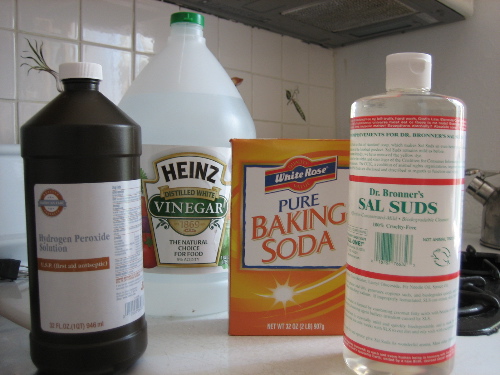
White vinegar has many different uses. Combine it in a spray bottle with water and it’s a glass cleaner. It kills bacteria, so it can also be combined with the castile soap to clean countertops, floors, and toilets or to rinse dishes.
Hydrogen peroxide is a bleach alternative and non-toxic to the environment. Anything that usually takes bleach can be substituted with HP instead. HP is also an antiseptic that can clean superficial skin wounds, be used as an oral rinse to whiten your teeth, and work as a hair lightener. Combine it with baking soda and castile soap to clean and whiten the bathtub and sinks.
Baking soda is a gritty powder that can be used in places that need scrubbing. A very effective way to unclog drains is to combine one cup of baking soda and one cup of white vinegar to a pot of boiled water. It will fizz up when the ingredients are added, and that’s what will purge your drains of clogs. Pour it down the plugged drain, flush with water, and voila — the drain will be miraculously unplugged. I actually used this as a last-ditch effort on a slow drain that has been backing-up for years. I had been using a chemical unclogger because it seemed so stubborn that only chemicals would unplug it.
Castile soap is a vegetable-oil-based natural soap. You can go one step further and actually make it yourself (there are lots of recipes online), but it’s usually reasonably priced. Dr. Bronner’s is a good brand that can be found online or at places like Trader Joe’s. This soap is used in place of other soaps, like dishwashing detergent, bathroom cleaner, laundry soap, and shower gel. I’ve read online accounts of people even brushing their teeth with the soap.
Some other green cleaning ingredients (that I haven’t tried but are also popular) are lemons and borax.
If you have chemical cleansers in the house, it’s best to use them up before you go green — because if you throw them out, it’s just as bad for the environment as using them.
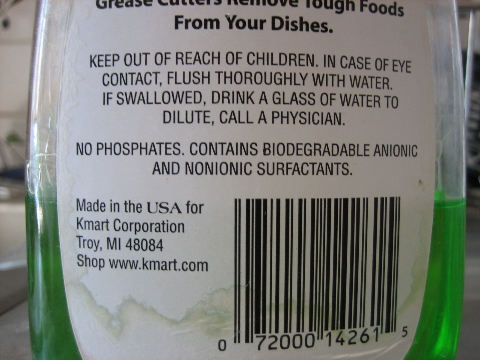
And not all your old standby cleansers are necessarily bad for the environment. Ivory Soap is pretty much natural and not bad for the Earth. Also look for words like biodegradable surfactants — and anionic and nonionic on dish and laundry soap labels.
keeping the earth ever green
I didn’t really listen to what they were saying exactly, but my ears perked up when I heard one of the boys calling the other the N-word. To my knowledge, the context in which the often-offending word was said was not a negative one, but rather in reference to his friend. All the same however, I couldn’t help but take note of it and the black man standing by the education-prep books couldn’t help but glance either.
His cursory glance obviously made me think. Was he irritated by the boy’s obvious disregard for using such a contentious word, especially for someone who isn’t black, or did he merely peer at the relatively loud outburst amidst the quiet readers?
Despite my strong distaste for most politically correct terminology, I can’t help but find something wrong with the N-word. Maybe it’s because I’m a sensitive minority or I’ve been unconsciously brainwashed by society to feel that this word is an especially ugly one and should never be uttered by society (even though I have never been one to object to a substantial sprinkling of the word “fuck” in my daily vocabulary).
When I bring it up to my black friends, they generally respond with indifference when a black person chooses to include the term, but if a suburban, fourteen-year-old white kid utters it, then it’s clearly a problem. Or is it only a problem when a so-called dumb white kid samples it for their liking, but it’s tolerable if New York City “urban” Hispanic kids consider it worthy of their sentences? Frankly, I wouldn’t blame black people for being annoyed. I liken the N-word to the Fubu of the English language; you know, “For us by us.” In a sense, I get it. Black people drummed up a unique word solely for their culture, and they certainly don’t want anyone stripping it from them.
In another sense, I’m just confused. How could a word have created such controversy? I, myself, have never said it and never plan on saying it; not because I think it’s taboo, but rather out of respect for black history. However, plenty of my non-black friends randomly pepper their daily conversation with it.
Honestly though, does it even matter? It’s just one word lost among the millions of other problematic phrases in our society. Or is this issue with the N-word actually a much larger problem we face in today’s environment because it further segregates what is supposedly black and what is supposedly part of the other? Isn’t the point of diversity and globalization and living in 2008 to view the inhabitants of this planet as people, not as parallels established via color?
Either way, every time I’m presented with this argument, I rarely find a reasonable explanation concerning this vocable perplexity. In a perfect world, we all would just ridicule those who quantify and categorize every example concerning color or ethnicity. But until then, we’ll just have to settle for semi-inane blogs posted by curious rabble-rousers.
Actually, the study claims to show a relationship between abstinence from alcohol drinking and depression, but what about those poor mice?
Medical research owes much to the mouse, that wee rodent that is more guinea pig than guinea pig, standing in selflessly (if unwillingly) on behalf of human beings in countless lab experiments that palpitate, penetrate, irradiate, and incinerate it in the name of science. Apparently, the mouse is an excellent surrogate for us humans across a wide variety of physiological measures.
All this said, this study, which examines the effect of ending alcohol consumption in mice, made me laugh. The study authors argue that their research shows a "causal link between abstinence from alcohol drinking and depression." I'm sure a good deal of the theoretical complexity behind this research got lost in the write-up, but I found it hilarious that we can infer this "causal link" in human beings by seeing whether mice who stop drinking can swim in a beaker of water. (It's called the Porsolt Swim Test.) Those mice who just float without swimming are deemed depressed. No word on whether they subsequently get therapy or AA.
I also love the name of the center responsible for this study, the "Bowles Center for Alcohol Studies." It sounds like a fun place to work: beer pong every Friday?
Victor Tan Chen Victor Tan Chen is In The Fray's editor in chief and the author of Cut Loose: Jobless and Hopeless in an Unfair Economy. Site: victortanchen.com | Facebook | Twitter: @victortanchen
I was disturbed by this report that a former Baptist, now atheist, soldier is alleging discrimination in the Army because of his beliefs. He served two tours of duty in Iraq, but he claims he was ostracized and even threatened after he refused to pray with other soldiers.
After decades of virulent racial segregation, the U.S. military has won an admirable reputation for creating esprit de corps across ethnic and racial lines, and has made recent strides in extending equality to women servicemembers (its intolerance of gays and lesbians in uniform, of course, is a different matter). In any case, you'd think the military would know better not to discriminate based on religion, if only to avoid the public perception, particularly in the Middle East, that America is a Christian nation waging a war against Islam. It doesn't help that a group like the Officers' Christian Fellowship, which has representatives "on nearly all military bases worldwide," has made it their mission to "raise up a godly military," whatever that means.
When I was watching that series Carrier, I found the segment on religion particularly interesting, because evangelical Christians clearly dominated (well, there was a Wiccan group) and I got the sense that sometimes officers led prayers that everyone was expected to follow. It made me wonder how atheist soldiers got along with the rest of the crew. (Of course, the discrimination that believers face in many secular settings is worrisome, too. But hopefully there are fewer guns and bombs involved.)
Religiously inclined soldiers can take solace in their faith after going through the hell of armed combat, and surely that's why there are so many chaplains in the ranks of the military. Yet, if I were a man of the cloth (for the sake of argument), I wonder what would be going through my head as I blessed soldiers going off to kill the enemy. That "Thou shalt not kill" business in the Bible seems rather clear. When asking for God's help, it's probably best not to ask for things He doesn't much care for, like killing. And you know the other side is praying hard, too; asking God to take sides in a fight is like asking a parent to choose between her kids.
It reminds me of what Lincoln said during the Civil War when he was asked by a group of leaders to join them in prayer that God be on the Union's side. He answered, "Sir, my concern is not whether God is on our side; my greatest concern is to be on God's side, for God is always right."
Victor Tan Chen Victor Tan Chen is In The Fray's editor in chief and the author of Cut Loose: Jobless and Hopeless in an Unfair Economy. Site: victortanchen.com | Facebook | Twitter: @victortanchen