Blog


‘A Merry Christmas to all, and to Bill O’Reilly, Happy Holidays’

Congressman John Dingell, a Michigan Democrat, recited a poem parody of “The Night Before Christmas” on the House floor last nigh…

Congressman John Dingell, a Michigan Democrat, recited a poem parody of “The Night Before Christmas” on the House floor last night, in response to a resolution proposed by Republicans to “protect” the “symbols and traditions of Christmas.” Demagogue has the text, and Crooks & Liars has the video.

I hope this War on Christmas ends sometime during my lifetime. Christmas just isn’t any fun anymore with all the elves locked up in Abu Ghraib and St. Nick stuck in a spider hole. I say we launch a preemptive strike on Hanukkah and Kwanzaa and take them out. Let’s not wait until Dec. 25 for that mushroom cloud over Macy’s.

Free the reindeer!

Victor Tan Chen

Victor Tan Chen is In The Fray's editor in chief and the author of Cut Loose: Jobless and Hopeless in an Unfair Economy. Site: victortanchen.com | Facebook | Twitter: @victortanchen


The Boiling Point

Bill O’Reilly and his Elves of Fury in “A Christmas Battle!”
 

Quote of note

“I put to you that the United States is without doubt the greatest show on the road… Brutal, indifferent, scornful and ruthless it may be, but it is also very clever. As a salesman it is out on its own and its most saleable commodity is self-love… The crimes of the United States have been systematic, constant, vicious, remorseless, but very few people have actually talked about them… You have to hand it to America. It has exercised a quite clinical manipulation of power worldwide while masquerading as a force for universal good. It’s a brilliant, even witty, highly successful act of hypnosis.”

Harold Pinter, accepting his Nobel Prize for literature last week. The playwright, 75, in a wheelchair and ailing from cancer of the esophagus, delivered his acceptance speech by video, during which he lambasted American foreign policy.  

Mimi Hanaoka


Defeating intelligent design

Kansas, and largely its state board of education, has been waging something of a bureaucratic crusade in the name of intelligent design, and this week a professor became one the first physical victims in the state squabble over the theory.

Intelligent design, in its simplest terms, is a theory that questions the legitimacy of evolution and suggests the universe has been formulated, in all its complexity, by a higher power.  Last month the Kansas Board of Education voted 6-4 in favor of new educational standards in state schools that challenge the legitimacy of evolution; teachers will now be obligated to adhere to these criticisms in science classes.  The board’s chairman, Steve Abrams, gloated, “This is a great day for education.” While Pennsylvania’s Board of Education recently voted to approve similar changes, outraged Pennsylvania voters replaced all of the board members who endorsed the changes.

As a retort to the recent challenges to evolution in the name of intelligent design, University of Kansas religious studies professor Paul Mirecki proposed to offer a new course this coming spring, titled “Special Topics in Religion: Intelligent Design, Creationism and other Religious Mythologies.”

It seems that Mirecki is not, unfortunately, a tactful man.  He allegedly sent an email to a student organization on the university’s campus in which he disparaged religious conservatives as “fundies” and asserted that categorizing intelligent design as mythology in his upcoming course would serve as a “nice slap in their big fat face.”

Mirecki is doubtless undiplomatic, but his beating, apparently a result of his proposed course and the email, is a lamentable throwback to outright primitivism.  Battered by two men who he says referred to his proposed course during their attack, Mirecki has since driven himself to the hospital, withdrawn his proposal to teach his course, and apologized for the scornful email.  

The challenge for both Mirecki and his assailants is now to haul the debate about intelligent design out of the ring of tactless mudslinging and vigilante justice and back into the at least civil, and ideally academic, sphere.  

Mimi Hanaoka


King Kong is alive and very well, thank you

I was privy to a screening of Peter Jackson’s reincarnation of King Kong and was utterly taken by not only the amazing visual effects but with the emotional story that makes you believe that a very large gorilla could actually fall for a cute blonde in a size-four dress.  In terms of cost, spectacle, and great buzz, King Kong is in a league occupied by very few films — the likes of Titanic, Star Wars, Jaws, and Gone with the Wind.  I’m not sure if a “monster film” will be able to beat out the box office that a certain sinking ship was able to do a few years ago, but the magical symbiosis of state-of-the-art effects and a masterly crafted story should put a lot of fannies in seats for weeks to come.

There are numerous reasons why people go to the movies — with escapism being one of the more popular — and Jackson and his thousands of associates have created a perfect escapist film that takes you back to New York circa 1933 (the same period the original film took place), all created either on New Zealand back lots or via the wizardry of miniature photography and computer graphics.  I happened to be in a large theater filled to the gills with visual effects professionals, and even those who create similar wonders used in King Kong were awed by how those images were used within the context of the story and how they successfully make the audience believe what’s on the screen is real — the prime objective of a film of this magnitude.

As with the original Kong, the visual effects in this version will be thought to be archaic in fifty years or less, and so it will be the telling of the story if it will be remembered by our grandkids’ children.  As with Titanic but more so, the actors need to match the larger-than-life marvels created by geeks in cubicles.  I am happy to say that this cast successfully moves the digital magic aside, elevating the human element that lifts this Kong to new heights.  Kudos to the casting of Jack Black as film director Carl Denham whose infectious performance allows you to root for his shameless obsessive showman who ultimately is the true slayer of Kong.  The rest of the male cast brings in admirable performances, yet it is the charm and emotional truism from Naomi Watts as Ann Darrow that is the thematic center of the film.  The believable relationship she creates with Kong is both primal and emotionally complex.  You come away from this movie very much like you do from one of those weepy romance stories, such as The Way We Were or Love Story, where a tear is always shed at the sad but predictable ending.  

I can’t say that King Kong was all sheer astonishment.  The film is long (over three hours), and there are scenes that seem as though they were put in for visual showmanship without moving the story along.  There are certain areas where the effects are not up to par with many of the more compelling sequences, such as the inspiring fight between Kong and the T-Rexes.  There are moments when your disbelief is suspended because of matching problems between live actors and the computer-generated images, but for most viewers, these will go unnoticed.  Though the recreation of New York is far beyond compare, a little less would go a lot further, especially during the final Kong on the Empire State Building sequence.  When comparing this version with the original, the visuals are what stand out as far superior, but even more important is the significantly better portrayal of the core love story between beauty and the beast.  Watts has to win an award for the best acting performance to a green screen this year and for the ability to run barefoot through a jungle and over rocky terrain without even a blister to show for it.  

King Kong is the movie to beat this year as it opens at the same time as Jackson’s previous record-setting ventures, the three Lord of the Rings films.  I don’t see it bringing another gold statuette to the New Zealander, but if packing ‘em in at the theater is more a stamp of approval, then he will be heralded again as a cinematic genius.

King Kong opens December 14 worldwide.  ‘Tis the season to remember that movie tickets make great stocking stuffers or Hanukkah and Kwanzaa gifts.

Rich Burlingham


Long River

Editor’s note: Starting this Friday, we will publish translations of poetry and prose culled from literatures in various languages and translated into English by Motýlí Voko, our newest contributor. The translations, and other musings by Voko, will appear in the blog every Friday.


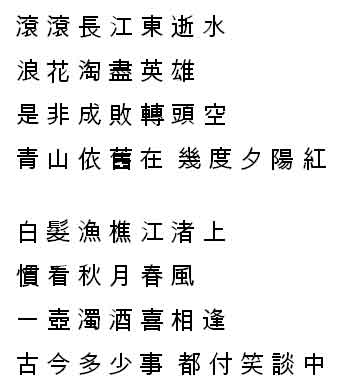
Gun-gun, thunders the Long River. To the east the waters pass,
the foam of breaking waves rinsing life out of heroes.

Right and wrong, success and defeat, turn your head and they are hollow.
The dark green mountain stands always as before,
the evening sun reddens ever once more.

The old man, fishing in the river, gathering wood on the isle,
knows the gaze of the autumn moon, the feel of the April breeze.

Over a jug of cheap, murky wine, friends happily drink to each other.
Of then and now, of how many things,
they tell with a smile.

translated from the Chinese by Motýlí Voko

Long River Chinese poem

About the poem: Originally written by Yang Shen (1488-1559) as lyrics to a set tune, this poem was later appended as a preface to the immensely popular novel Romance of the Three Kingdoms (San-kuo yen-yi, first printed in 1494), which is how most Chinese readers know it today.

Jan Vihan is a contributing writer for In The Fray.


Brokeback Boondocks

Cartoonist Aaron McGruder has a good riff going this week at The Boondocks, with Granddad Freeman intent on seeing a “manly” movie. …

Cartoonist Aaron McGruder has a good riff going this week at The Boondocks, with Granddad Freeman intent on seeing a “manly” movie. Here’s an example:

Grandad Freeman: I feel like seeing a movie! What’s out?

Huey: 50 Cent, “Harry Potter,” “Syriana” …

Grandad: Naw … I want to see a man’s movie. How ’bout this “Brokeback Mountain”? What’s that about?

Huey: Um …

Grandad (reading newspaper): Let’s see here … Oh, it’s about cowboys! Well, that sounds very manly! Let’s go!

Things go quickly downhill from there.

Do your slightly homophobic granddad a favor and take him to see the film adaptation of Annie Proulx’s short story “Brokeback Mountain” this weekend. It’s directed by Ang Lee, stars Jake Gyllenhaal and Heath Ledger as our gay cowboy heroes, and boasts an 80 percent “fresh” rating on Rotten Tomatoes so far. Granddad Freeman would approve.

Victor Tan Chen

P.S. I had a Granddad Freeman moment last week, when my dad spotted us watching the film Saving Face. “Oh, a Chinese movie!” he exclaimed, his immigrant interest piqued, just minutes before the racy lesbian love scene … (fortunately for all involved, he fell asleep).

Victor Tan Chen is In The Fray's editor in chief and the author of Cut Loose: Jobless and Hopeless in an Unfair Economy. Site: victortanchen.com | Facebook | Twitter: @victortanchen


Quote of note

“If you want our money, you have to let our recruiters on campus”

The Supreme Court heard arguments yesterday from law schools who wish to bar — or at least limit — recruiting by employers who discriminate against gays and lesbians. This means the military, one of the last bastions of open discrimination on the basis of sexual orientation. The Solomon Amendment, which ties federal funds for education  to military recruiting access, has thus far curtailed the extent to which schools of any nature may obstruct military access. It seems unlikely, given the tenor of the justices’ responses, that the court will act to overturn the amendment, or previous court decisions regarding the military in schools.

Laura Louison


50 issues later …

ITF Post-It

The original Post-It note of ideas for naming the website that would become InTheFray.

This is InTheFray’s 50th issue. As the co-founder of the magazine and its first editor, I have seen the magazine grow over the last four years, with highs and lows along the way. Many times I asked myself why I continued to volunteer for this project — or why anyone else would.

As I see it, InTheFray has never been about selling products, spreading a brand, winning awards, amassing influence, or bringing any politician to power. We haven’t made any money off the Internet. The staff is all-volunteer. I’m sure we could find more entertaining ways to spend our weekends than proofreading articles, writing photo captions, and collating grant proposals. And yet we continue to do it. Many of us have even dipped into our own pockets to keep this project afloat.

For the scores of writers, photographers, artists, editors, and businesspeople who have worked on this project since we started publishing in April 2001, InTheFray has truly been a labor of love.

To be honest, at times it has felt more like labor than love for me. You could call it a kind of perpetual pregnancy (if I can venture to imagine such a thing), necessitating frequent back massages and pints of Ben & Jerry’s from an angelic spouse, culminating in our monthly bundle of journalistic joy, who looks like perfection in my eyes until I notice that little typo under her chin or that extra bill hidden in her crib …

But whenever I get frustrated with my work, there are two things that bring me back, again and again, to this magazine. One is my belief in InTheFray’s mission. The breadth and the ambition of our efforts have grown over the years (as you can see this month’s anthology of greatest ITF articles), but the objective has remained the same: to help people better understand one another.

Today, in these precarious times — with war and disaster ever in the headlines, and poverty and inequality ever in the shadows — that mission is arguably more important than when we started this magazine. It may, in fact, become the defining struggle of our generation: how to live in peace in a world of fewer borders and greater risks, growing freedom and thornier ethics, expanding cultures and shrinking resources.

I hope that InTheFray has contributed something to this important debate. I hope that we have touched readers with our words and images, challenged their prejudices and assumptions, and made them think hard about the way they live their lives. I hope that we will continue to enlighten, provoke, and inspire people in the years to come.

The other thing about InTheFray that continues to inspire me is its people. I co-founded this magazine four years ago with the help of many friends, and along the way I have met many more. I want to thank all the staff members who have given so generously of their time and talents, especially the veterans who have stood behind the magazine from the beginning. I have never met a group more curious about the world or less egotistical about their work. They are truly the embodiment of the principles our magazine stands for, and I feel blessed to know them.

The lesson I have learned after four years and 50 issues is that these small things in life matter. How we treat each other — on the street, at home, in cyberspace, on a volunteer staff — matters. The respect we show, the kindness we express, matters. We each have the power to overcome ignorance. We each have the strength to stand against injustice, to teach compassion, to reach out to another human being. InTheFray is just a vessel for this message. What we do in our ordinary, everyday lives — this makes all the difference.

Victor Tan Chen
Co-Founder and President
New York

THE BEST OF InTheFray (SO FAR)

To commemorate ITF’s 50th issue, we’ve republished many old favorites, like ITF Editor Laura Nathan’s interview with director Shola Lynch, my interview with Vandana Shiva, PULSE Columnist Laura Louison’s interview with Pulitzer Prize-winning investigative journalist David Shipler, and some of ITF’s best columns and cartoons to-date, all of which our readers and editors selected as the &lrdquo;Best of ITF … so far.”

We also asked the writers of your favorite stories from each channel to reflect back on what inspired them and have included their personal musings, along with a link to their winning pieces. Here are the winners:

  • Richard Martin for his poem “Gay Lit,” which won hearts by taking on the perspective of a gay prison inmate.
  • Rhian Kohashi O’Rourke for her remembrance of her grandfather in “Tofu and Toast.”
  • Russell Cobb for investigating the dirty work left to immigrants on Mississippi chicken farms in “The chicken hangers.”
  • Laura Nathan for exploring Jewish heritage in her review “Strangers in a strange land.”
  • Andrew Blackwell for following love to Colombia in “Fear(less) in Bogotá.”
  • and John Kaplan for his photo essay “Life after torture.”

    As we prepare to embark on a new year — one we hope will be far less tumultuous than the last — we also bring you a few new stories, including Gergana Koleva’s story of her own kidnapping in Haiti, Erin Cassin’s exploration of how Hurricane Wilma brought her closer to her Cancún neighbors, and Annette Marie Hyder’s prose poem inspired by Pakistani woman Mukhtar Mai’s battle against her village’s tradition of retributive rape. On Monday, December 12, we will feature part three of Pulitzer Prize-winning photographer John Kaplan’s “Vanishing heritage.”

    We also bring you three new book reviews: Michelle Caswell on Bakari Kitwana’s non-fiction book Why White Kids Love Hip-Hop, David Holtzman on Ernesto Quiñonez’s novel, Chango’s Fire, and Nicole Pezold on Zadie Smith’s On Beauty.

    Thanks for reading — and sticking with us through the ups and downs of the first 50 issues!

    Coming next month: The Best of ITF 2005. Please help us select the winning stories by taking two minutes to vote for your favorite stories of 2005!

  • Victor Tan Chen is In The Fray's editor in chief and the author of Cut Loose: Jobless and Hopeless in an Unfair Economy. Site: victortanchen.com | Facebook | Twitter: @victortanchen


    High time for sexing up the disabled

    I don’t mind adding to the praise parade that has rained down upon Murderball because it’s one of the best documentaries I’ve ever seen.  Murderball (which chronicles the lives of members of the U.S. Paralympic Rugby team) enlightens those not disabled by shattering the accumulated patronization of  the disabled in film.  Most importantly, Murderball presents us with a sweaty, sinewy pack of athletes that one can’t help but sexualize, especially when they’re talking about masturbation and their preferred penetration positions.  These guys embody defiantly aggro masculinity in all of its gladiator glory.   The disabled have long been emotionally eviscerated by pity on film, forced into egregiously noble roles where they’re allowed to create epiphanies for people who aren’t disabled.  Wow, our lives don’t suck, thank you for dispensing wisdom in a harmlessly non-erotic way, like a child or a kindly old person.  But the fact remains that if any of us happened to end up a quadriplegic tomorrow, would we want people to cradle us with sorrowful Bambi-eyes or would we want them to straddle our chairs?  Murderball helped me to realize that part of achieving social justice for the disabled involves getting over the tragically narrow categories of “hotness” and giving them lewd stares whenever appropriate.  I plan on starting tomorrow.

    But Murderball’s humanization process proceeds at many levels.  Some of the people in the documentary seem like unrepentant dick wads.  As a gay man, I know how nervous I get when gay people get depicted as murderers, trashy whores, or generic bogeymen for free-floating heterosexual fears about the destruction of their always-imperiled families.  But the fact is that some gay people do murder and slut around, but only heterosexual white men have the luxury of individuality.  No matter how many of them rape and kill, they will never have to watch the news and then endure questions about what intrinsic aspects of their “culture” make them such pathological humans.  

    Part of the process of having that kind of power comes from not having to be exemplary minorities.  The disabled have been given a heavy cultural burden symbolically, shoehorned into portrayals like the hunchback of Notre Dame who saves a woman’s life repeatedly, only to have her hook up with another man because the standard narrative for the disabled person is to provide wholesome illumination of how precious life is, a not-so-subtle stab in the back which implies that disabled life isn’t equally as precious.  Murderball gets ugly, with some of the men displaying petty, angry, infantile outbursts in the course of the competition, just as it should be.  It sounds contradictory, but I felt liberated from ignorance in that first moment when I realized that I totally loathed one of the central characters, but loathed him as a whole person.  I stopped seeing the chair and saw straight through to the asshole inside.

    —Terry Sawyer


    Partnership and divorce

    “Civil partnership” may sound more bureaucratically clinical than “marriage,” but for homosexual couples in Britain this month, it will amount to almost the same thing, complete with divorces as well as unions.

    Although Britain lags behind Belgium, the Netherlands, Spain, and Canada in actually permitting gay marriages, the Civil Partnerships Act (which will come into effect in Northern Ireland on December 19th, in Scotland on the 20th,  and England and Wales on the 21th) will confer essentially the same legal rights as marriage. Under the act, gay partners will be each other’s financial beneficiaries without a will and will be permitted to inherit, be exempt from inheritance tax, benefit from their partner’s national insurance payments, enjoy the same pension privileges as their married counterparts, be considered married in terms of immigration, and be obligated to financially support each other.  The British government expects up to 22,000 such unions by 2010.

    Like married couples, gay couples will now have the legal privilege of the agony of divorce, complete with the same financial wrangling.  Like married couples, those in civil partnerships will have to wait one year before filing for the dissolution of their partnerships.  

    Mimi Hanaoka
