Blog


Fighting idiots with a closed mind

This week the University of Montana campus, where I am a student, has been seized by angry Christians. Specifically, it's a group from New York called Open Air Outreach, a group of men who  I can only assume  have been told by Jesus that it is appropriate for them to travel around the country being dicks in the name of God. (Go here to read the article.)

I know that it is an old cliché to reject the idea of the evangelical Christian with their sanctimonious ramblings, but I'm going to do it anyway. And mostly, it's because I'm annoyed with non-Christians.

The OAO is setting up everyday by the University Center (a student union building) for big "discussions" with the angry, vocal students around my campus who've yet to realize you should never fight an idiot. They can't see that it's useless to fight the men of the OAO  men with God on their side, don't ya know.

This is what I've had to deal with when I want to buy some orange juice or a bagel: endless shouts back and forth between diametrically opposed groups. And the students should know better. People traveling around America to stir up controversy should be ignored.

In this scenario of fervent opposition, neither side can win, and their disdain for the other has ruined any chance of having a real talk. The OAO has an excuse their beliefs are such that they have to be certain, but students are supposed to be open to new ideas and concepts. Or what would be the point of college at all?

My personal belief in the Almighty is not what I would call strong, but I do hold a small lingering spirituality from my childhood days spent in the Catholic Church. This is what I would call an Agnosticism that leans toward the notion that something caused that first cell, and I'm not sure what that was.

I'm setting those aside so I can approach the question of what it is that causes a person to grab a Bible and a bad attitude and hit the road in the name of God.

If you ask me, which you didn't, I think these guys would be doing the "I'm Right!" thing with whatever they believed in. That is to say, I think if these people were selling cars, they'd sell the best cars ever  you'd only have to ask them for confirmation.

In other words, I have no idea what causes this sort of feverish attitude. I can barely decide on pizza toppings for crying out loud.

So as Easter approaches, I am making a request to people of all spiritual persuasions to just stop the fight over who has it right. We're all flung together on this rock. I'm not sure why, and I've yet to meet a person who really does. Belief is a complicated concept, and it should never stand between two people.

That said, I can't wait for these guys to leave. I miss bagels.


Bored to tears

A few weeks ago I did a demonstration for my chemistry classes. They had begged me for days to do this particular experiment. So, one Monday morning, we assembled outside on the grass. A volunteer student set down a bottle of Diet Coke. He opened the bottle, dropped a stack of about six Mentos into it, and ran. The rest of us stood several feet back to observe. The fizzy pop shot up and out of the bottle very forcefully and traveled about fifteen feet in the air before coming back down. It was quite a sight. I was impressed. My students were not. I looked around and saw their bored faces. They looked at each other with expressions that said “That’s it?”

Failing to impress my students is not unusual. And in sharing with other teachers, I have found it is not unusual in any subject. On another day, I showed a video of the explosion that occurs when sodium mixes with water. My students refused to find it interesting unless I performed the reaction in class so they could see it first-hand. I tried that experiment in the classroom once, a few years ago, and some flying sodium hydroxide hit a kid in the ear. He was ok, but never again.

I read an article about a year ago that discussed the high-school drop-out rate. Apparently, nationwide, the rate is on the rise. The article suggested the reason for increasing dropouts is boredom. Apparently teenagers are so bored at school that they would rather drop out and find a job than continue. This insight astounded me. Is school really that bad? I remember taking some boring classes in high school, but I always looked forward to at least two or three subjects.

I try to make class interesting for my students, but as I explain to them, you can’t expect to be entertained all the time. Sometimes we all have to push through the boring stuff in life to get to something good. Having said that, I think that school can be too dull sometimes. The main issue, I believe, is relevance. Many high schools present a curriculum that has no relevance to their students’ lives. As teachers, we need to teach in a way that challenges students to think about their futures and that prepares them for careers. Actively engaging in developing their lives should not only prepare them for success, but also keep their interest.


Delivering hope

Sometimes, it takes looking from the inside to recognize greatness. From the outside of New York City, the media often presents us a picture of coarse New Yorkers, unconcerned with the fates of others, commuting back and forth through their busy lives. But on further inspection, the negligence and head-in-the clouds attitudes doesn’t touch all aspects of the city that never sleeps.

For a week, I was immersed in the New York culture. Like hundreds who live in the city, I took the subway to and from work each day, smashed in between strangers I didn't know, only to be deposited a 20-minute walk from work at Houston St. The subway system and its passengers became familiar to me, but the reality that became more true was that of the people who dedicate their lives to help others.

God's Love We Deliver isn't located in one of the magnificent buildings so typical of New York city, but in stature, it stands greater than all of them. The organization, located near Soho, is housed in a modest brick building, but more than 1,500 clients are served through its swinging doors daily.

God's Love We Deliver is changing the reality of people with HIV and AIDS, as well as other demonstrated medical needs daily by fufilling one of their most basic needs – nutrition. Meals are based on a diet for a person surviving with HIV and AIDS, so they are always over 2000 calories, and are handmade each day by volunteers and paid employees.

The kitchen is more than just a mere assembly line. During my week's stay, it wasn't uncommon to strike up a conversation with one of the regular volunteers, or to joke around with visitors from Harvard, or even catch one of the cooks singing a parody of Snow Patrol's "Chasing Cars." From helping, God's Love We Deliver does more than just deliver meals door-to-door it is rapidly creating a fellowship between people who care about other people.

What makes God's Love We Deliver so amazing isn't the numbers or the statistics we can view on paper  it's each individual person who suits up in a hairnet and rubber gloves to try to make a difference.

Derry Duncan, the volunteer specialist who walked us through training for the week we worked there, is one of the most charismatic individuals I have ever met. The woman is an enigma who didn't choose this work  it chose her. Yet her passion is palpable every time she speaks. In the entirety of a week, I never saw her without a smile on her face, and her gratitude for each and every volunteer was so visible.

To me, GLWD is Derry, and people like her, who don't think twice about whether or not they should become involved in helping others  they simply do, and through their enthusiasm and courage, inspire other people to come along.

According to the New York State Department of Health, more than 10,000 people in the city of New York alone live with HIV and AIDS. Though progress has been tremendous since it first prevailed many years ago, we have no scientific cure. But maybe, through feeding those who, perhaps without a little help, could not eat, we are actually helping to find a solution. So thank you to Derry and all others who give of themselves to do this work. It isn't just another volunteer assignment  really helping is a lifetime task.


Beauty as beast


"Whatever is in any way beautiful hath its source of beauty in itself, and is complete in itself; praise forms no part of it. So it is none the worse nor the better for being praised."

Marcus Aurelius Antoninus, 121-180 A.D.

What but the hope of praise could cause a person to submit herself to the latest cosmetic procedure, the eyelash transplant?  Yes, you read correctly, for about $3,000 per eyelid, you too can have hair removed from the back of your head and sewn onto your eyelids. Originally designed to allow burn or cancer victims to recover their lost lashes, eyelash transplantation has now entered the elective surgery market.  Today Show correspondent Janice Lieberman reports that there has been a 300% increase in its use for cosmetic purposes this year alone. Due to the origins of the hair, transplanted eyelashes require regular trimming and perhaps a bit of dye, as they and you age. In the spirit of beauty, pain is just part of the game.              

In her book, Beauty Junkies: Inside Our $15 Billion Obsession with Cosmetic Surgery, Alex Kuczynski outlines America's worship of the mirror. From women traveling to third-world countries for vacation surgeries to the reality of heavy, sagging skin from massive weight loss, Kuczynski emphasizes what has become a common theme: nothing is free. In a chapter entitled, "What Is Beautiful?" we learn that there could be a mathematical formula for beauty. In an interview with Dr. Stephen J. Marquardt, Kuczynski questions Dr. Marquardt's idea that beauty can be captured in a computer program. Beauty in the form of mathematical proportions loses its mystery of "you know it when you see it" to become a quantifiable commodity. The allure of equal beauty for all, those with enough cash that is, has women and increasing numbers of men, racing to the cosmetic surgeons. In our information age, there is no shortage of knowledge on the topic; type cosmetic surgery and books into a search engine and voila, the titles fill the screen.  From the nitty-gritty how-to books, to the more academically inclined Making the Body Beautiful: A Cultural History of Aesthetic Surgery, beauty is big business.

If Antonius is to be believed, beauty is, in and of itself, beautiful, regardless of the consideration of others. In reality, beginning in childhood with the queen's magic mirror zeroing in on Snow White, the ruthlessness of beauty as competitor is revealed. 

To be human is to want to belong.  The praise that Antonius spoke of pulls us into its orbit, and as we fill the space, it becomes crowded, bodies bumping into each other. From the desire of praise, competition is born. 

So are we surprised that strident on the front page of Sunday's New York Times, is the headline "For Girls, It's Be Yourself, and Be Perfect, Too"?  The bottom line for girls, and increasingly boys, is that good is never enough. The young women chronicled here engage in what has become the typical upper-middle-class college path. Days filled with Advanced Placement courses, extracurriculars and, in some cases, jobs, yet one young woman worries that her resume will be overlooked due to her lack of athletic ability. A father comparing his less structured childhood faults himself, 2006 America, and the Northeast for the incessant activities.  An outgrowth of the competitive nature of America, laying blame is much less frightening than jumping ship.  S.A.T. prep courses, community service, athletics, employment, each a necessary building block in the pursuit of success; dare you take a chance that one less will still get you your heart's desire?

Competition by its very nature, is honed towards survival.  Love it, hate it, none of us are immune to its charms. Women seeking beauty in surgery and girls on the verge of womanhood learning it is not enough to be smartyou have to be "hot" as well.  The prizes are significant, an income large enough to give your children as good as you got, satisfying work, partnership with someone you desire. Remember that old cliché, "beauty is as beauty does?" Meant to comfort, it fools no one. Beauty does quite well, thank you very much. It continues, alive and well, one eyelash at a time.       


A bucketful of hope

With conflict in the Middle East burning as hot as a California wildfire in spring and strife in Chechnya hardly close to a conclusion, a bucketful of hope seems ready to put out the coals of one long-painful blaze for good.

The devastating conflict between Protestants and Catholics over control of Northern Ireland looks close to peace. On March 26, prominent Protestant politician Ian Paisley sat down with Gerry Adams, a Catholic and leader of Sinn Fein, a political party originally formed as the political wing of the Irish Republican Army, in an unprecedented display of compromise and hope.

With so many reasons to lose hope for peace around the world, the meeting stands as a beacon of promise for a better future in Northern Ireland and countries like Chechnya and Israel, where historical territorial conflicts and irredentism have long blocked cease-fires and reconciliations.

As Paisley put it in remarks given at the meeting, “We must not allow our justified loathing of the horrors and tragedies of the past to become a barrier to creating a better and more stable future.”

I agree. I only wish more world leaders came to recognize that constantly using the past to justify present atrocities and violence only perpetuates hatred and misunderstanding among races, religions, nations, and states.

We don’t have to forget the past to bring a happier future; we need to be willing to move past it. Otherwise the fires will keep on raging.


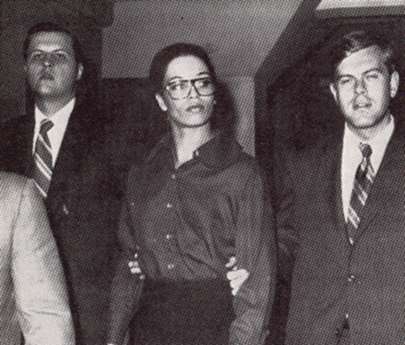
Angela Davis, a case of acquired activism

Angela Davis, activist, organizer, and philosopher once associated with the Black Panther Party as well as the Communist Party of the United States of America, is still an activist; she now works for racial and gender equality and for prison abolition.

davis_a.jpg


Born: January 26, 1944, Birmingham, Alabama, Davis received a B.A. from Brandeis University in 1965. She later studied as a doctoral candidate at the University of California-San Diego, under the Marxist professor and "One-Dimensional Man" (1964) author Herbert Marcuse.

She joined the Communist Party in 1968, and like many American Blacks during the late 1960s, suffered discrimination for her personal political beliefs and commitment to revolutionary ideals. But it was not until 1969 that she came to national attention after being removed from her teaching position in the philosophy department at UCLA by the California Board of Regents, under then California Governor Ronald Reagan's administration.

Davis had worked to free the Soledad (Prison) Brothers, African-American prisoners held in California during the late 1960s. She befriended George Jackson, one of the prisoners accused in an August 7, 1970 abortive escape attempt from Marin County's Hall of Justice; the trial judge and three people were killed, including George Jackson's brother Jonathan. Davis was implicated when police claimed that the guns used had been registered in her name.

Davis fled and was subsequently listed on the FBI's Top 10 Most Wanted list, sparking one of the most intensive manhunts in American history. That August, Davis was captured and imprisoned in New York City but freed by an all-white jury eighteen months later, cleared of all charges.

Today Davis is a professor of history of consciousness at the University of California-Santa Cruz. Davis is known internationally for her ongoing work to combat all forms of oppression in the United States and abroad.

Davis remains an advocate of prison abolition and has developed a powerful critique of racism in the criminal justice system. She is a member of the advisory board of the Prison Activist Resource Center and is currently working on a comparative study of women's imprisonment in the United States, the Netherlands, and Cuba.

During the last 25 years, Davis has lectured around the world. Her articles and essays have appeared in numerous journals and anthologies, and she is the author of five books, including Angela Davis: An Autobiography; Women, Race, and Class (Vintage, 1983), Blues Legacies and Black Feminism: Gertrude "Ma" Rainey, Bessie Smith, and Billie Holiday (Vintage, 1999), and The Angela Y. Davis Reader (Blackwell Publishing Limited, 1998).

Davis video segment


Wandering

With the sun out and the flowers in bloom, our eyes often seem to be wide open. But spring is the season for letting our minds wander.

In this issue of InTheFray, we take a look at some of the places to which our wits venture. We begin with our trip to A desert of dreams, where ITF Contributing Writer Penny Newbury learns about the Burning Man festival and the ups and downs of an anarchist tradition in her review of Brian Doherty’s This is Burning Man. We then turn to Happy little poem, Miles J. Bell’s take on a factory worker’s longing for “a long lie down.”

Finally, if you haven’t done so lately, we invite you to check out our blogs, which are now in full bloom.

Thanks for reading!

Laura Nathan
Editor
InTheFray


Translating for God

“I decided it either has to have a different meaning, or I can’t keep translating…I couldn’t believe that God would sanction harming another human being except in war.”
— Laleh Bakhtiar, speaking about Chapter 4, Verse 34 of the Muslim holy text the Qur’an, which concerns the appropriate treatment for a rebellious woman. The appropriate meaning and translation of the verse has been debated, and Laleh Bakhtiar plans next month to add her new translation to the 20-odd extant translations of the Qur’an. Among the interpretations of the verse is the understanding that it advocates a three-fold measure in which the woman is first reprimanded, then abandoned in bed, and then beaten, which is one meaning of the verb “daraba.” Laleh Bakhtiar has, to significant controversy, translated the instruction as “go away from them.”


Welcome to the jungle—tales from suburbia’s darkside


Sighing, I said, “Who knows? We must have some seriously bad karma.”

Over the years, we have had numerous conversations about our predilection for attracting neighborhood stalkers. You know, the kind of neighbor that stops whatever he or she is doing in their backyard to listen intently to round two of our “Where did we go wrong?” argument about our oldest son or round 9,999 of “Your mother said that? What was she thinking?”

Our neighbor is such a stalker. His life must be colossally boring because he is endlessly fascinated by ours. My poor husband, Mike, tries to mow the lawn when the guy is at work so he can avoid any contact.

The man, Sam, is like fly paper. Once he comes over, he sticks around until you ask him to leave. One Saturday afternoon, Sam invited himself over. The idiot actually told Mike and me that he planned on killing his wife. My husband’s eyes just about turned into marbles and rolled out of his head right onto our driveway. My response went something like this:

“Sam, I hope you realize that you just made Mike and I accessories to first-degree murder. If anything happens to your wife, I’ll be singing like a canary.” I was eyeball to eyeball with him as I said this, and I’m ashamed to admit that I sort of grabbed the collar of his shirt.

I guess I must have been having some sort of prison flash-back. I guess the implied threat worked because he scuttled away and we didn’t see him for months. We seriously considered becoming hermits, thereby curtailing our neighborhood interaction to a minimum, but that can only last for so long. We do have to eat.

Unfortunately this appears to be a recurring pattern in our lives. Recently, I offered to give my son Anthony’s friend a ride home after school. For some reason, the boy’s mother saw it as carte blanche to use me as her daycare provider of choice and resident therapist. I really do like my son’s friend, so I put up with this. However, I find it odd that absolute strangers feel comfortable in providing me with the intimate details of their lives on very short acquaintance.

With every fiber of my being, I know that I am not the slightest bit interested in hearing about her love life, impending divorce, or her adult-novelty business where she gives “pleasure parties” (I kid you not). At times, I am sorely tempted to ask, “Do you want some cheese with that whine?”

She is in a self-imposed rut and foolishly picks the same man each and every time. I mean they have different faces, but inside THEY ARE THE SAME MAN.

I wish that I had the gumption to just say, “Look honey, maybe this marriage thing isn’t for you and, until you work this out, maybe birth control might be a good idea.”

Cruel, yes. Judgmental, yes. Unfair? I don’t think so. I’m a firm believer in the “you pays your money, you takes your choice” rule of life. Sooner or later, we all have to pay the piper for our foolish mistakes. Your luck is going to run out and your karma bill will come due. But I remain silent because I love my son, and I really do like his little friend.

It seems to me that today people mistake common courtesy for overtures of friendship. As I consider friendship a gift that should be nurtured and cherished, it is not something I offer lightly or casually. This attitude might be antiquated and hopelessly old-fashioned, but my husband and I have followed this creed since the dawn of time. I am no longer that fiery first grader chattering away about my new best friend (back then I changed friends about as often as I changed my underpants). Our generation is the generation that stays (remains constant) and this has filtered into the way we relate to others.

My companions are women that I can have real conversations with on a variety of different topics. If they need me, I’ll be there in a flash as they have often been there for me. There is true history here. We are allies who have weathered both tragedy and beauty. We act as both cheerleaders and consciences. Because there is true love and affection in these tangled webs, we do not take advantage of our good natures or muddy the waters with ulterior motives. In essence, we are a support group (without the bad coffee). To put it in admittedly bluntly obsolete terms: they are my kindred spirits, and I am blessed to have them in my life. And, thankfully, none of them gives pleasure parties.