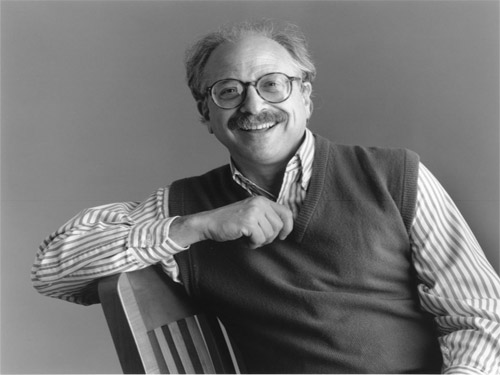
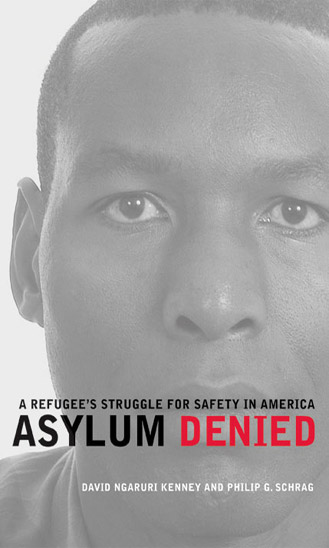
David Ngaruri Kenney, a farmer in Kenya, was imprisoned in a water-filled cell for organizing a protest. He applied for asylum in the United States and Philip Schrag, director of the Georgetown Center for Applied Legal Studies, worked on his case. They jointly wrote the recently published Asylum Denied: A Refugee’s Struggle for Safety in America, which recounts Kenney’s improbable trajectory from Kenyan farmer to U.S. college basketball player, and now, American lawyer.
Interviewer: Scott Kuhagen
Interviewee: Philip Schrag
What is the objective of the book and how did you get involved in Mr. Kenney’s case?
David Kenney was a political activist in his native Kenya in the early 1990s. He didn’t choose to become a political activist; he was a peasant farmer trying to grow tea and making a living. By doing so he discovered he couldn’t make a living growing tea because the price the government was paying was so low that it was causing him to lose money to grow tea. And yet the contract he had signed with the government monopoly prevented him from growing any other crops on his land.
So he organized a farmers’ boycott and protest to try to get the government to justify its policy or change it. And as a result, he was put in jail [and] nearly executed at gunpoint in a forest. He was saved at the last minute because the security forces of Kenya thought he could be more useful to the regime alive than dead. So they tortured him for a week, putting him in a water-filled cell in which he was in constant threat of being killed by drowning, and eventually put in solitary confinement for eight months.
When he was released from solitary confinement, his bank account was frozen and he was prohibited from meeting with more than three other Kenyans at the same time, so his life was effectively over. He had no commercial or social life, and could not even continue his education. He had an incredible piece of luck in that he met some American Peace Corps volunteers who had been assigned to his region, and they had the idea — since he was 7 feet tall — of getting him a basketball scholarship to the United States. This was pretty amazing because he had never seen a basketball! So this was a pretty far-out idea.
Nevertheless, they pursued it. They persuaded an American basketball coach to come from Colorado to Kenya to see him play basketball, and meanwhile frantically taught him how to play basketball.
He ended up coming to the United States on a basketball scholarship. He got a U.S. college degree, and when his education was over, Daniel arap Moi, who was in charge of Kenya when he was jailed and tortured, was still in power. So he applied for asylum. The book tells the story of his four-year struggle with our immigration services, in which he was constantly denied asylum by one bureaucracy after another, and eventually forced to go back to Africa, where he was nearly killed once again.
For those who might be unfamiliar with asylum, can you talk very generally about what an applicant would have to show [to win asylum]?
A person can apply for asylum if he has come to the United States either legally or without permission, and says that he is afraid to go back to his home country because of a fear of persecution on account of his race, religion, nationality, political opinion, or membership in a particular social group. Kenney of course was afraid to go back on account of persecution as a result of his political opinion.
If you apply for asylum, you get fingerprinted and photographed. Your identity is checked to make sure you’re not a terrorist. But more important than that, you are required to file hundreds of pages of corroborating evidence if you want to have a good chance of winning your case. It’s very difficult to obtain this corroborating evidence if you don’t have a lawyer working for you and if your friends and relatives back home are afraid that if they cooperate with you they themselves would get in trouble with the regime. This is a very challenging process for any asylum applicant, and most people who apply for it do not win asylum.
Is his experience with the system typical of the challenges that asylum seekers face?
Well, every case is different, of course.
Mr. Kenney, for example, was denied [asylum] by an immigration judge even though she believed that everything he said was true and he had a lot of documentation.
When he was halfway through his college education in 1997, he got a letter saying that his younger brother, a boy he had brought up as his own son after his father died, had been arrested and was being tortured in a Kenyan prison. And he knew very well what that meant.
So Mr. Kenney dropped everything, flew to Kenya, hired a lawyer, got his brother out of jail, and immediately returned to California to resume his studies. But because of this trip to rescue his brother, the immigration judge ruled that he had forfeited his status as refugee — that he was a legitimate refugee but he had returned home, proving that he was not eligible to be a refugee anymore.
His case went even further than that, correct?
Yes. He was represented at the initial stages of the case at the immigration court by students of mine at the clinic I run here at Georgetown Law School. It’s called the Center for Applied Legal Studies. The Center and clinics like it throughout the country have students who do all the work that lawyers would do, for academic credit, under the supervision of professors who are experienced lawyers.
And these students did a fabulous job of representing Mr. Kenney. One of them even made an impassioned closing statement at the trial, comparing his [Mr. Kenney’s] tea boycott with the Boston Tea Party of 1775, which did impress the judge despite the fact that she denied asylum. So they did a great job, but he lost there, he lost at the Board, and I took his case to the United States Court of Appeals.
Recently there have been some press reports, especially an article in the Washington Post that quotes the dean of Georgetown Law School, saying that interest in immigration law and immigration law clinics in general has really increased. As a clinical instructor yourself, what really excites you about this increasing interest in immigration law, and what are the hopes that you have for this new group of students moving into the field?
This field has just burgeoned in the last 20 years. In the early 1980s, there were virtually no courses in immigration law at most American law schools. It was a real backwater of legal education. Thanks to a small group of people who started popularizing this field long before I got into it, it is expanded, and now there are immigration law courses at most American law schools, and there are clinics in which students represent immigrants in real cases, as my students did in Kenney’s case.
Students find this area of law extremely exciting and interesting for several reasons. One is that they are little death penalty cases: there is a lot at stake! If a person wins asylum, they can apply for a green card after a year, and then start on the road to American citizenship. If they lose, they are ordered deported. If they are deported to their own country, which is the usual case, they may face imprisonment, torture, or death.
I was curious if you had any surprising or noteworthy examples where you’ve learned of how one of your clients who has received word that they can stay indefinitely in the United States has embraced their new country of the United States?
I think that the most dramatic instance of that occurred today! We recently won asylum for a young woman who had escaped from Zimbabwe — a political activist who had escaped from Zimbabwe — where you know that the human rights record, especially during the last election, has been very bad. She not only won asylum, but because she won asylum, she is able to bring her husband and children over to the United States, and everybody will be safe from retaliation and persecution. Well, she called our offices today and offered her services to volunteer to help other people in the clinic because she was so impressed with what the students had done to help her win her case.
Do you think that we are a generous and welcoming country, or do you have concerns in that area?
Our refugee law isn’t perfect. There are many blemishes and problems with it. But we’ve really come a long way since the 1920s and 1930s. Perhaps the most terrible incidence in American immigration history was when Hitler allowed 939 Jews to leave Germany in 1939. They thought that they could go to Cuba, but the Cuban president refused to let them in. The Christian captain of the ship then sailed the ship toward the United States, and off the coast of Florida radioed President Roosevelt and asked for permission to land his passengers in safety in the United States. And Roosevelt refused to let them land.
The ship went back to Europe, where nearly half the passengers, a little over half the passengers, were killed in the Holocaust.
We’ve come a very long way since then. In 1980, we passed a Refugee Act, and now we’re one of the most welcoming countries in the world at a time when other countries are again turning away refugees. We resettle a lot of people who are in need. Refugees are about 10 percent, maybe 15 percent if you include asylum winners, of all U.S. immigration. In 2006, we resettled about 40,000 refugees from United Nations camps around the world, and granted asylum to another 30,000 or so additional refugees. So that’s a pretty large number.
On the other hand, there are a lot of things we could do to make our system more fair. Perhaps the principal one, one of the first things that we should do is that we should enable people to get fair representation in asylum proceedings when they are indigent. The chance of winning asylum without a lawyer or a representative is 16 percent in immigration court.
With a lawyer — all lawyers combined — it’s about 41 percent. With a lawyer from a law school clinic or a nongovernmental organization [NGO] such as the Hebrew Immigrant Aid Society or Lutheran Immigration and Refugee Service, or a pro bono lawyer from one of the large law firms, the chance of winning asylum in immigration court is about 90 percent. Not because these organizations select the cases more carefully than others, and not because they’re more brilliant than the other lawyers who represent asylum seekers, but because lawyers from big law firms and NGOs limit their caseloads and devote enormous amounts of resources to investigating the facts of each case, getting all that documentation to prove the case so that the judge doesn’t just have to accept the asylum applicant’s word for it.
Unfortunately, there aren’t enough such lawyers to go around, so providing free legal representation to indigent asylum seekers is essential for fairness in our system.
[Without giving away the ending] what is the outcome of the case and your relationship with Mr. Kenney?
Mr. Kenney, despite being nearly killed three times in his life, is currently back in the United States. He is a lawful permanent resident and has applied for American citizenship. He has graduated from an American law school, Catholic University Law School, and is working in the district attorney’s office of Montgomery County, Maryland. So it’s been an extraordinary odyssey for him from being a peasant farmer, to being a political prisoner, to being a student at an American college, to being ordered deported and leaving the United States and being nearly killed in Africa again, to coming back to the United States and graduating from law school here. During that period, I have been fortunate enough to become his friend and his co-author.
Scott Kuhagen
Dear Reader,
In The Fray is a nonprofit staffed by volunteers. If you liked this piece, could you
please donate $10? If you want to help, you can also:


 Silly simon.




 VP Contenders.