Republican bailout

Is there blood coming out of my eyes?

I don't like the auto bailout plan any more than the next person. I don't for one second believe that this will save the jobs of auto workers, the plants they work in, or the towns they live in. I do believe that CEOs will continue to earn fat bonuses and fly privately. It also galls me that wealthy Americans have sneered about welfare queens and irresponsible behavior (No investment portfolio? Madness!). It's just plain different when old white millionaires have their hands out who cares that they've driven these gigantic companies into the ground? (For the love of Pete whoever that is are ya gonna stop making $#%@*& Hummers already?) Republicans and moneyed conservatives also rail against government interference deregulate! Drill baby drill! Unless we're talking about your private sex life or begging Congress for billions. But the world markets crashed overnight on news of the Senate not passing the deal, and I was certain our market would follow today. Eventually, it will. What is an American citizen to think?

Yesterday I read that Democrats quietly slipped into the deal a pay raise for federal judges. "District judges and lawmakers now earn $169,300 a year… There is concern among many policymakers that judges are not paid enough relative to the importance of their offices…" That's tough. Teachers and nurses everywhere feel your pain.

This morning I learned that the deal fell apart in the Senate because Republicans wanted auto workers to have their wages cut significantly. Now now, auto workers think of the poor, disadvantaged judges.

Now I'm reading in Salon about Republican politicians who voted against the deal and benefit from having foreign auto plants in their states.

I ask you again is there blood coming out of my eyes?

There's a special place in hell for Republican senator Bob Corker, whose area does have one domestic plant…which will soon close (they need to make room for the Volkswagen plant coming to his Tennessee town). It was Corker vs. the auto-workers union:

             …Mr. Corker admitted to the union's representatives that
             discussions over wages were "largely about politics in the
             G.O.P. caucus."

             Mr. Corker said he proposed that wages and benefits of 
             U.A.W. members be competitive with lower rates at American
             plants run by foreign rivals…Without that agreement, Mr.
             Corker said he could not sell a compromise to other Republicans.

Apparently, this is how it works now: Republicans so badly want to screw over American workers that they will bring financial disaster to foreign markets. 

Republicans made in America!


The future of the Republican Party

From CNN: Huckabee, Palin Top List of 2012 GOP Contenders, Polls Says.

Well, isn’t that special? A lying moron and a white-supremacist evangelical. You stay classy, Republicans!


On the shoulders of giants

Tramping in New Zealand.

There are moments, like long stretches of New Zealand’s Whanganui River, when time flattens out and one need do nothing but simply exist, floating along the surface and enjoying the fine day. My wife and I spent three such days on the Whanganui River Journey, one of New Zealand’s famous Great Walks. To dip your paddle into the river is to dip into a perfect reflection of the deep, wild valleys and the clear blue sky. At times the river is so peaceful that these moments can stretch into infinity, and time, a construct for lesser beings, vanishes.
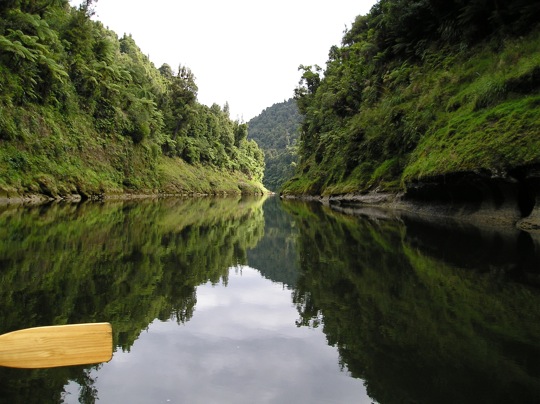


There are other moments, both in life and on the river, that demand action. A canoe can be an unforgiving method of travel on rapids, all too apt to turn sideways and capsize, dumping its occupants into the roiling current. When the front of your canoe enters a rapid, the water beneath it begins to move faster, until the boat and the river are moving at the same speed. It is critical at this point to maintain the boat’s momentum, and so you paddle as hard as you can, reaching and pulling at the churning water while wrenching at the river with your paddle, maneuvering your canoe around rocks and keeping yourself upright and inside the boat. It is a rush, a blur of action independent from conscious thought, and it is even fun when you spill into the river. If you do find yourself in the river, you just wring yourself out, collect your belongings, and continue on your way. The sun is warm and the water soon calms.

And if your way should include your rental car grazing a guardrail, you should laugh and try to forget about it, and remember that Kiwis are nice people. I learned this at a panel beater in the small town of Renwick, in the heart of the Marlborough Valley, New Zealand’s wine country. The owner of the local shop looked at the scratch, squinted, and said, "I think we can get that out." While he worked on the car, we told him our story. In a few minutes, the scratch was gone and we were on our way. "Just tell everyone that Kiwis are nice people," he said, refusing our money. Consider yourself told.
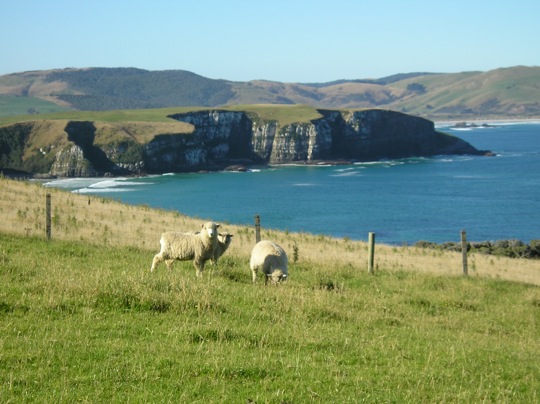


There are more than 20 vineyards within a few miles of Renwick. The spectacular countryside and density of the vineyards makes the bicycle an ideal mode of transportation for a wine tour. The wineries in the region offer free or low-cost tastings and sell their wines in their "cellar door" shops. The regional specialty is Sauvignon Blanc, but slight climactic variations means that each vineyard grows slightly different grapes, producing distinct wines. You learn quickly that the bartender is the gatekeeper to each winery’s finest vintages, and it is in your interest to make friends with this person, since he or she decides if you are good enough for the good stuff. It pays to speak the language: You may refer to a Sauvignon Blanc as reminiscent of an unoaked California Chardonnay, or comment on how the Pinot Noir of the region is spicier and less dusky than French or Italian varieties. We tasted many inferior vintages, but we were finally rewarded with a taste of a fine, single cask Pinot Noir at the Nautilus Vineyard, where an ex-pat American cracked open the vineyard’s Special Reserve for us. It was brisk and unique, inviting and beguiling, much like the rest of New Zealand.

Queenstown is the adventure capital of New Zealand, a country famous for its adventurers. We were ready for an adventure; it is what we came to New Zealand for. Some people like bungee jumping. Some enjoy parasailing. Others are more into skiing, snowboarding, mountain-climbing, hang gliding, or jet-boating, all of which is available in or around Queenstown. Not us. We prefer trekking up a steep hill and back down the other side, preferably across streams and other difficult terrain. We settled on the Rees-Dart track, a four-day jaunt into the Southern Alps.
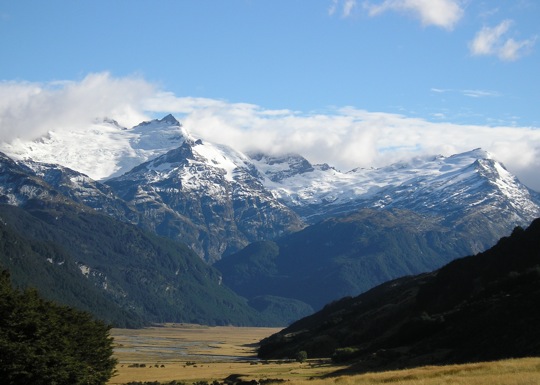


It was great. We slept in DOC huts and walked through open alpine tundra, above the tree line, rocks and hardy plants clinging to the hills around us. When a heavy fog rolled in and enveloped us in its thick, misty embrace, it felt as if we were walking across the surface of Venus. The atmosphere was ghostly; people drifted in and out of view, and the moisture in the air absorbed sound like a wet sponge, enforcing an eerie silence that hung over the trail.

But when the sun finally broke through, peeling the gloomy mist away, it felt glorious. The warm rays slanted down, carving thick slices through the mist and awakening us from our slumber. The wet landscape glistened in the bright light, and the mountains’ snow-topped peaks winked and sparkled at us. I smiled as we clambered over boulders and across small streams, tramping through the New Zealand countryside in a local tradition as old as human settlement in the region.
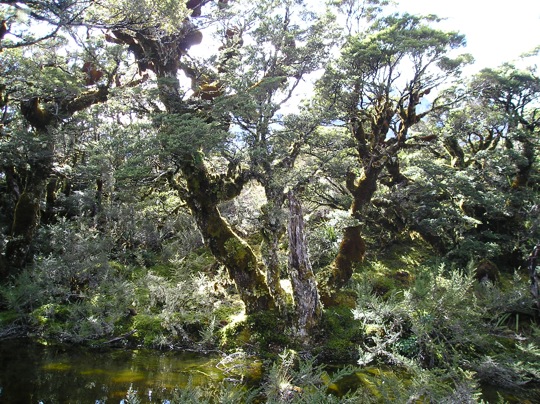


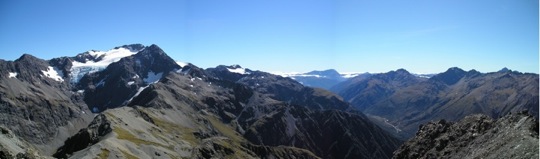
After our hike, we continued north from Queenstown, and climbed Avalanche Peak, near Albert’s Pass, our final exploration of New Zealand’s astounding natural beauty. The peak overlooks a valley in the middle of the South Island. A highway and a railroad snake past the small town at the pass. As I stood there at the crest, a frozen instant in time, I felt as if I were on the shoulders of giants, with snowy peaks soaring to the sky all around me. I was born in the flat, featureless Midwest, but my grandfather is from Colorado. It is from him that I get my love of the mountains. They are breathtaking in their sheer size, and the blue-white snow that clings to the tops looks so majestic — a powerful reminder of my relative size and place in the world. I do my best to remember this and stay respectful. It is all any of us can do.


I am a writer/editor turned web developer. I've served as both Editor-in-chief and Technical Developer of In The Fray Magazine over the past 5 years. I am gainfully employed, writing, editing and developing on the web for a small private college in Duluth, MN. I enjoy both silence and heavy metal, John Milton and Stephen King, sunrise and sunset. Like all of us, I contain multitudes.


Happiness

With the global economy in crisis, terrorist gunmen spraying bullets into crowds of innocent civilians, and political and religious unrest around the world, it can be easy to focus on sadness and despair and miss the joy in the world around us. We have all experienced the sensation of joy, but what is the source of that happiness? In those who have been diagnosed with depression, their malaise is attributed to a chemical imbalance in their brains. Is happiness a neurotransmitter? Is it serotonin and dopamine levels? Or is it something more profound than that?

In Suicide in paradise, Maura O’Connor investigates why Sri Lankans have one of the highest suicide rates in the world, despite having gross national happiness (GNH) measures higher than India and Russia. Elsie Sze takes us to Bhutan in her piece Happiness in Bhutan. The Himalayan kingdom is famous for its high GNH rankings despite widespread poverty and a lack of first-world luxuries. Jon Hall recently attended a conference in Bhutan exploring the reasons for this and shares some of his insights in a Dispatch for the 4th International Conference on Gross National Happiness.

What the Bhutanese provide a demonstration of is that happiness comes from within, not from the comforts of the external world. In A boy grows in Brooklyn, Claire Houston documents the simple, pure joy a child brings to her neighbors, a lesbian couple who have been trying to have a baby for years. Emma Kat Richardson explores the joy of David Sedaris’ humor in From the stage to the page. Of course, happiness is often inextricably intertwined with other, darker emotions. Roman Skaskiw writes of the mixed joys that love can bring in his short story The goblins’ drum. In Riding (uphill) to prosperity, Debra Borchardt investigates how bicycle tourism brings both economic success and controversy to a rural Pennsylvania town. Finally, in On the shoulders of giants, I explore the delight to be found in the the natural beauty of New Zealand.

As with all emotions, happiness is fleeting and difficult to quantify. What is clear, however, is that the source of happiness is inside the human heart and soul, rather than in the outside world. We must each find joy in our own lives and in our own ways, cherishing it when we find it and accepting its departure with the knowledge that this too, like all things, must pass.


If you enjoy reading InTheFray Magazine, help us keep publishing by visiting inthefray.org/donate and giving what you can. The vast majority of our funding comes from you, our loyal readers, making us truly independent media. Thanks for reading and thanks for your support!

I am a writer/editor turned web developer. I've served as both Editor-in-chief and Technical Developer of In The Fray Magazine over the past 5 years. I am gainfully employed, writing, editing and developing on the web for a small private college in Duluth, MN. I enjoy both silence and heavy metal, John Milton and Stephen King, sunrise and sunset. Like all of us, I contain multitudes.


A boy grows in Brooklyn

After years of wanting a baby and undertaking 11 rounds of artificial insemination, Lynn finally became pregnant.

Nine months later, she and her partner, Lori, welcomed Jack into their Brooklyn home. Photographer and neighbor Claire Houston documents the couple’s first months of motherhood.


[ Click here to view the visual essay ]


The Missing Class now out in paperback

My book, The Missing Class: Portraits of the Near Poor in America, has been released in paperback. You can find it at your bookstore, or order it on Amazon or Powells.com. (Use these links and a portion of the sale price goes to InTheFray.)

My book, The Missing Class: Portraits of the Near Poor in America, has been released in paperback. You can find it at your bookstore, or order it on Amazon or Powells.com. (Use these links and a portion of the sale price goes to InTheFray.)

Victor Tan Chen is In The Fray's editor in chief and the author of Cut Loose: Jobless and Hopeless in an Unfair Economy. Site: victortanchen.com | Facebook | Twitter: @victortanchen

personal stories. global issues.