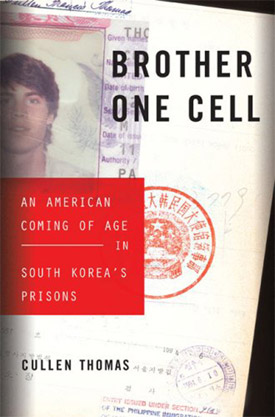
Brother One Cell

A look at life behind the bars of a South Korean prison.


Every expatriate in Asia has known this guy. He is the one that cultivates a patch of marijuana in the hills near Lake Biwa. He smuggles condom-wrapped ecstasy tablets up his ass from Ko Samui. He buys magic mushrooms in a Cambodian bar for resale in Singapore, or horse-trades cheap methamphetamine in a Seoul nightclub. And now and then you hear of these guys getting busted, and later you wonder what ever happened to them.

While teaching English in Seoul in 1994, Cullen Thomas made a plan to visit a remote mountain village in Luzon, buy bricks of hash on the cheap, mail them to himself in Seoul, and to sell them to the expat crowd. The first brick arrived safely, and he was a 23-year-old cosmopolitan outlaw: “Like many of the other foreigners, I fooled myself into thinking that I could operate alongside Korean society and yet not have to answer to it.”  He signed for the second brick poste restante, and was quickly surrounded by drug agents. 

Brother One Cell: An American Coming of Age in South Korea’s Prisons (Viking) is his memoir of prison life and his journey from youth into manhood. The early chapters are a cautionary tale for any foreigner sucked into the South Korean criminal justice system. In a Kafkaesque scenario, he deals with a con artist Korean lawyer, bratty and bungling translators, and a prosecutor that uses him to practice his English.

South Korean police work often depends on forced confessions rather than investigative work to make a case. He recalls a “short, fat man who still has the grease of lunch on his face and the smell of liquor on his breath” approaching him with a cattle prod-like device:  “All I can think is What the hell? before he casually presses it against my upper right thigh and triggers it again with a smile. A painful blast of electric current shoots through me, shoots me right out of my chair into the middle of the room.”

Thomas was sentenced for three and a half years with no appeal. During that period he served his time in three different prisons, and his compatriots were Pakistani killers, Peruvian thieves, an American child murderer, smugglers, and Korean draft dodgers. Inside his cell and inside his head, he rages at his shame and predicament, he worries for a girl he left behind, and he gains wisdom into his own nature and human nature.

He adapts with a monk-like acceptance and finds work in the prison’s shoe factory to pass the time. In the prison yard, he becomes a basketball hero and earns some respect in no-rules dirt court games organized by gangsters. Back in his cell, he bides his time by keeping a surreptitious diary with a stolen pen. He learns of friends that are denied visits and of confiscated care packages from family members. He is not allowed to write about the prison, so he learns to write letters in a roundabout narrative to avoid the censors.

Some of his observations of Korean society are so accurate they could be equally applied to life in Korea outside the prison walls: He describes an unappetizing diet that is not much different than what most Korean day laborers eat everyday. The drab, cold cement walls in unheated buildings could be any rural Korean elementary school. The petty prison bureaucrats are equally contemptible as those at city hall, and throughout his story, Thomas describes the inane pissing contests of Confucian hierarchies.

It is important to note that Thomas harbors no animosity for Korea from his hardening prison experience. Back home in New York, he eats bibimbap and is asked by Korean acquaintances if he will ever return. He writes, “I had a lot of love and appreciation left in me for Korea. She had taken me to the edge and let me look over, but she never let me go and didn’t leave me there too long. She didn’t feel the same about me. I don’t know if I can ever go back.”


The luster of pearl and pico rat traps

Five poems exploring themes of imprisonment.

Luster of pearl

the bamboo mirage in the gravel garden
faints dead away

at the howls in the dining room
springing up at the fairway moon

Observation pit

and the western horse shall lie down with the ground sloth
and the dire wolf
the western camel
the mastodon
all for a space of thirty millennia
the saber-toothed cat
the ancient bison
and their bones be roofed charmingly
while the decades of fashion go right by
one after another
and the ground shake
and the precipice of history
at the Los Angeles County Museum of Art
 
a figure of Orpheus left outside in the back where smokers go
and the Burgher with the key
and the other backward-looking with despair
and Eve
The Shade
all wrapped in plastic on pallets
Bourdelle’s archer
Balzac

Pico

in the city
no longer a city
college
across the street
an agreeable old motel
blue as the Pacific Ocean
now a rat trap

marron glacé

he talks about the weather
of this crisis and that

a nincompoop
a poltroon
they say

but he strikes back
outlawing the light bulb

Wilshire Boulevard

we had to sit right in the by
your leave temple while the sit
right there leave nothing behind
temple went down and then we said
all of us we said to ourselves
they can’t we think again

but ourselves think little and that
with a certain sort of greed
that came of plastics and regurgitated music
so they said and took it up
the proverbial flagpole and sang the pledge of allegiance to it

all night long we hear the singing
night that is violet with stars and planes
and the golden sunrise you see
in California Impressionists


Those who suffer

I’ve been acting silly lately. I’ve spent my time thinking about the people out there who have lost their jobs, their homes, their healthcare, even their health. I’ve thought about those who sleep in their cars, on relatives’ couches, or on park benches. I should’ve been thinking about the people in this country who are truly suffering: bankers’ girlfriends and Brown University students.

I’m always a bit late to the game, so I just discovered Dating a Banker Anonymous, a blog written by the wives and girlfriends of Wall Street’s finest (the financial rats who, in the absence of the regulation cat, destroyed our economy) who are learning to go without the necessities. That is, go without jewelry, opera tickets, facials, weekend trips to Europe, decent sex, and large allowances. These women thought they had attained their goal you know, relationships based on the exchange of sex for money. If they can’t be distracted by shiny things, they might have to face the fact that they serve no real purpose in life.

Initially, I thought, like many others, that this was a joke. As the days go by, it appears that these women are very real and very serious. A beauty writer (Seriously? Beauty writer? Could you be more useless?) in New York told The New York Times: "One of his best friends told me that my job is now to keep him calm and keep him from dying at the age of 35," Ms. [Dawn Spinner] Davis said. "It’s not what I signed up for."

That whole sickness-health/richer-poorer thing…who knew you were supposed to mean it?

The media has mentioned a "feminist backlash," but I have no doubt that behind every foot-stamping girlfriend is a pouting, empty-handed banker.

The suffering is not limited to Wall Street. It extends all the way to Thayer Street…in Providence, Rhode Island, home to Brown University. Brown students are best known to my fellow locals for blindly walking straight into oncoming traffic on a daily basis. I guess a high SAT score means never having to look both ways before crossing the street. Anyway, Thayer Street is the trendy, crowded shopping center of the college hill universe. Vintage clothing stores, an art house movie theatre, and, of course, a Starbucks line the busy one-way road. All was right in the Brown world…until two pizza joints opened too close to each other. And now, like, ohmygod, the young are lost. A freshman writer in the Brown Daily Herald student newspaper complains,

The war between Antonio’s and Nice Slice is affecting thousands of Brown students…the central location of Antonio’s and Nice Slice on Thayer and their close proximity to one another makes choosing one pizzeria over the other particularly grueling.

The unemployment rate in Rhode Island has reached ten percent. A few weeks ago, a homeless man froze to death while sleeping under a bridge. But…too many pizza options…what’s a boy to do? Surely not volunteer, or fundraise, or even be aware of the world around you. When the tough gets going, take to the blog! Take the student newspaper’s editorial page! You’re spoiled as hell, and you’re not gonna take it anymore!

personal stories. global issues.