Tourism vs. Backpacking

Discovering the difference in India.


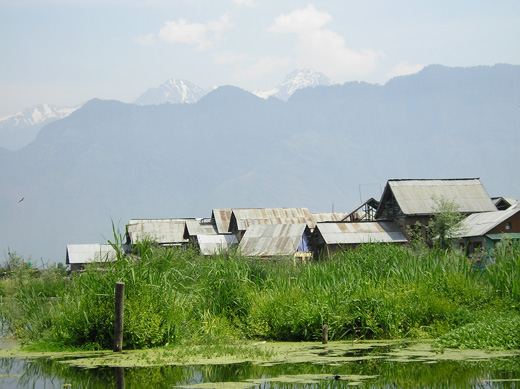
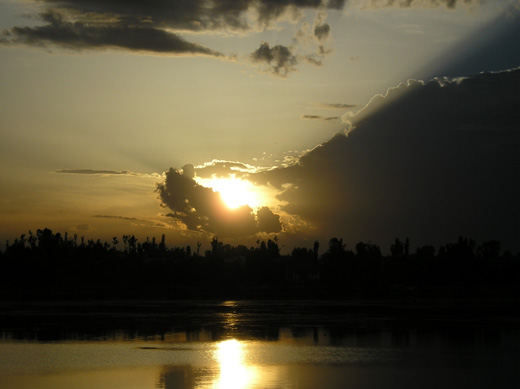
It’s hard to know exactly where to begin with India. India is a contradiction. India is an ancient enigma. India is both a temptress and thief, modern and ancient, new and old, alive and dead. India will pay for the tuk-tuk to take you away from the train station just to sell you an expensive trip to Kashmir. India will take your picture and demand to be paid when you take hers. India will promise to not sell you anything and sell you something anyway. India will leave you to sit on the roof of the houseboat floating on a lake of shit, to watch the sun set and listen to the prayer calls. India will insist that there is no problem when it is clear that there is a problem. India will tear at your heart and she will restore your hope in humanity.

See what I mean? Where do you begin with that?

So forgive me if I start with something of which I am certain: I do not like airports. There are too many people asking too many vaguely accusatory questions, too many security checks, too many regulations, too many assault weapons, and too much waiting. I get uneasy, nervous, anxious, and I’m unable to relax. The domestic terminal of the Delhi airport, where my wife and I are waiting for a flight to Srinagar, in Indian Kashmir, does nothing to relax me. I am sitting in a thick knot of humanity, the scent of which hangs in the air around me. It wafts out from the strange and frightening toilets and floats through the lobby of impatient travelers. My anxiety is not eased when I have to identify my bags on the tarmac before they will be loaded on the plane. It is a jarring reminder that Kashmir is a disputed territory and terrorism is a very real threat.

I’m not sure what has brought us to India. I had a vague, idealized notion of a romantic India: a place of magic and wonder, where a young prince meets death, illness and old age becomes an enlightened ascetic. The United States refers to itself as the melting pot, but it is India where Hindus, Muslims, Sikhs, and Christians all swirl together, mixing in a thick stew of 22 constitutionally recognized languages. Kashmir represented the crown jewel of this mystery and mysticism, a paradise on Earth, fought over by nuclear powers.

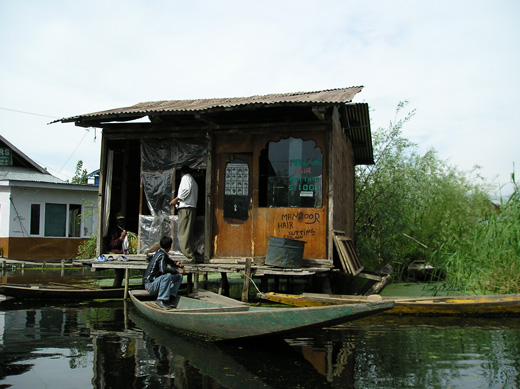
Srinagar, in the heart of the Kashmir valley, is famous for its lakes; there are sections of town with streets of water, and shikara boats ply the channels like gondolas in an Indian Venice. The interconnected lakes, Nagin and Dal, are ringed with houseboats and filled with floating vegetable and flower gardens. For centuries the town was a major tourist destination, but visitors to Kashmir have declined due to terrorism. Though tensions between India and Pakistan have eased in recent years, violence occasionally flares up. All of Kashmir is heavily militarized. Each intersection has two or three soldiers posted, assault rifles ready, and there are frequent barricades in the road made of barbed wire and sandbags. The devastating violence has left the people war-weary, ready for peace.

Lonely Planet India (LP) advises a traveler to not under any circumstances book one’s accommodations in Srinagar before leaving Delhi, because you will overpay for a houseboat that has been over-promised. LP warns travelers to not believe anyone who tells you that the tourist office is closed, that it’s somewhere else, or has burned down. My wife and I, with our week’s worth of experience in India, are certain we know much more than our guidebook. We follow the advice of a very kind tout who found us wandering around in the Delhi train station, confused and lost. He is nice enough to put us in a tuktuk and bring us to his friend’s travel agency.
"This tourist office is closed today," he says. "I will show you."

He knows a guy who can get us a “great price.” He is doing us a favor. At the travel agency we are shown photos of a beautiful, ornate houseboat floating on a pristine lake surrounded by the snow-capped peaks of the Himalayas. It looks like paradise. It is paradise, our travel agent assures us, and he will give us a bargain price. Just because he likes us. We pay up front.

We think we are clever, because this means we’ll have a ride waiting for us at the Srinagar airport. This is what you do when traveling as a Tourist. Your transportation is arranged for you, you have an itinerary, and everything is planned out ahead of time. There is a comfort in these certainties, because you do not have to worry about where you will stay, how you will get there, what it will cost, and whether you are getting a good deal. As a Tourist, your needs are catered to by someone who has done this before.

Mustaq is a tall, bronzed man with a loping gait and a quick, wide smile. He is easygoing and instantly likable. We chat about ourselves and about Kashmir as we drive to the houseboat, where we meet Hamid, the manager of the boat.

My wife and I envisioned ourselves exploring the streets of Srinagar by ourselves, stumbling across mysterious ancient ruins or maybe the Tomb of Jesus, or visiting a mosque. It is Hamid who tells us how it will be. We may have paid for our lodging, but we hadn’t paid for anything else. Because Kashmir is a disputed territory, Hamid tells us, we are required to have a guide with us at all times. Any tours we want to go on will have to be arranged through him. For a fee. Hamid sees our blue American passports and determines that we are like washrags filled with money that he must wring out.

"Americans and Saudi Arabians have all the money," he repeats several times as we discuss our itinerary, wringing, twisting. "They can afford anything."
But once we are through negotiating with Hamid, he and Mustaq make it clear that we are their guests, and Mustaq proceeds to treat us with the utmost of respect and care, attending to our every need.

Despite the heavy militarization of the area, and despite giving us the hard sell at every opportunity, Kashmiris are extremely friendly, always quick to offer a cup of their milky, cardamom-flavored tea. Pakistan and India may both lay claim to Kashmir, but the Kashmiri soul is fiercely independent. The Kashmiris we meet are a proud and happy people. When we meet someone, they invariably ask, "How are you?"; "Where are you from?"; "How do you like Kashmir?", in that order.

Kashmiris often say that they live in the most beautiful place on earth, and it breaks my heart a little bit every time I hear this. In addition to the smog that hangs over the mountains, the lakes and channels are clogged with pollution. Toilets in the houseboats flush directly into the lakes, filling them with thick, nasty sludge. The streets are thick with litter. The buildings are decrepit and decaying, like broken teeth. Despite all this, you can sometimes still see Kashmir’s beauty. The Mughal Gardens burst forth with fountains and flowers, the lakes shine like jewels when the sun strikes them, and the pride of the people who live there is humbling. It is painful to see this evident beauty diminished by a lack of resources to provide adequate sanitation.
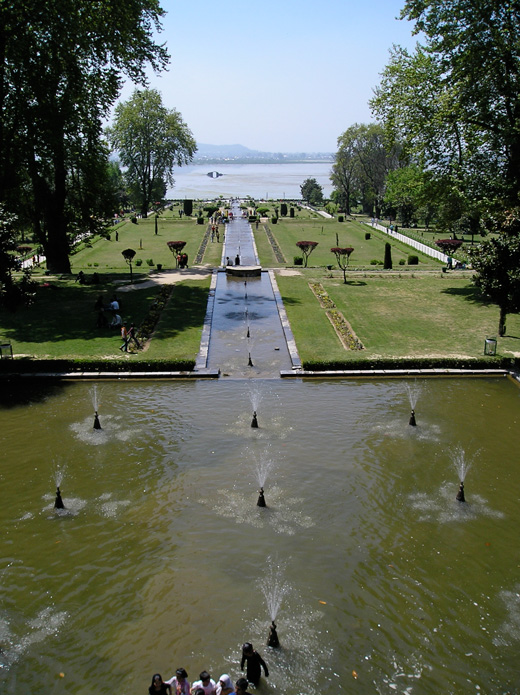
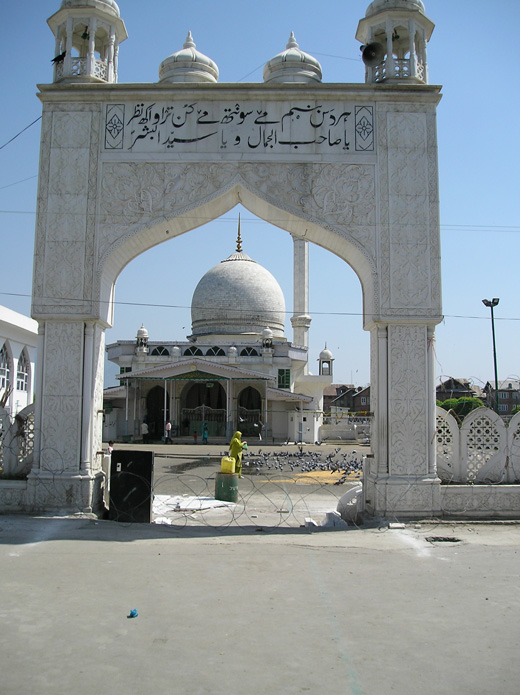
We experience Kashmir as Tourists, riding from the Hazratbal Mosque to a trek in the Himalayas in a large, white SUV, like VIPs blasting through the streets of Baghdad. We are supervised every moment we are awake by either Mustaq, Hamid, or another guide. The few moments that we are free we spend on the roof of the houseboat, playing cards and watching the sun set over Lake Nagin.

As the week wears on Mustaq becomes more relaxed with us and we get brief glimpses of the real Srinagar, the one we came to see, not the sanitized Tourist version. He takes me to get my glasses repaired on the back of his moped. My wife and I take a tuk-tuk to the bank, and when we take too long, the driver takes a detour to pick up his two kids from school, who cram into the back next to us. I am waiting for my wife outside the restroom on an unescorted trip to Chakreshwari Temple when I’m surrounded by a group of giggling young girls, who ask if I’m married, and claim me as their boyfriend. They run away with peals of laughter when my wife returns. These glimpses are enough to leave us frustrated when we deal with Hamid, who insists that we are required by law to have a guide at all times, though it is now clear that we aren’t.

When we leave Kashmir on a public bus, we cease to be Tourists. Tourists do not sit on bumpy public buses filled with bags of mail and a few other Kashmiri travelers who blow smoke at the “No Smoking” signs and stare at my wife. Tourists do not eat in cheap roadside restaurants with the locals. Tourists do not arrive at the Jammu bus station as the sun is setting with nowhere to stay and nowhere to go. We are now Backpackers.

The road between Jammu and Kashmir is narrow, and it twists around hairpin turns, dives through interminable black tunnels, and climbs over mountain passes. As we bounce around bends, I look over the edge of the roadway and down, down, down, to the Chenab River which carved the valley we are riding through. I can see the burned-out shell of a bus much like the one we are riding in at the bottom — or is that a rock? My imagination is certain, but my mind is doubtful. The bus stops several times along the road. The winding mountain track is susceptible to landslides, and a recent landslide has blocked a portion of the road; until it is cleared, traffic can only go in one direction at a time. It is eight hours before we arrive in Jammu. We spend six hours there before boarding an overnight bus to Dharamsala, home-in-exile of the Dalai Lama.

Except it isn’t exactly an overnight bus to Dharamsala. It is an overnight bus to Mandi that stops at a junction near Dharamsala. At three in the morning. The bus disgorges us and we stand on the side of the road, wondering what to do next. It is at this point that we wish we were Tourists and not Backpackers. Tourists do not stand on the side of the road in the middle of the night. Backpackers must figure things out for themselves.

There are seven of us: two Irishmen, three Englishmen, and two Americans. We stand in a rough circle and eye each other. There is one small taxi with two drivers, one of the ubiquitous silver Tata sedans, with room for maybe three of us, with gear. A few minutes of conversation reveals that we all had found ourselves on the side of the road in the middle of the night in northern India in much the same way: We’d been talked into staying on a deluxe houseboat that had perhaps once been deluxe but no longer was. We’d been swindled on carpets, cheap trinkets, textiles, saffron, and everything else we’d bought that was supposed to be real but wasn’t. My wife and I had felt like fools for the times we’d been suckered like this, and it was nice to hear that we weren’t alone.

The taxi driver wants 500 rupees each to take us into Dharamsala, which we reject as unreasonable. This is how negotiation here works: One party begins with an unreasonable offer, the other party counters with an equally unreasonable offer at the opposite end of the pricing spectrum. We offer him 50 rupees each, expecting a capitulation, but he doesn’t budge. He has us over a barrel. If he doesn’t give us a ride into town, we’ll have to walk, which at three in the morning isn’t something we want to do.
"Let’s just pay him," someone says, and the driver’s eyes light up.

"I think a bus will be along soon," says one of the Brits, James.

We continue talking about our experiences. Someone lights a cigarette and passes it around. A truck rumbles by, and the driver ignores our attempts to flag him down.

"What should we do?" someone asks.

"I think a bus will be along soon," says James.

"You said that before. Why do you think a bus will come by?"

James shrugs. "I don’t know. I heard that they have buses that run into Dharamsala from here. One will be along soon enough."

"We might be here until morning."

James shrugs again. "I think a bus will be along soon."

The taxi driver decides he’s wasting his time. He starts his car and scolds us in Hindi through his open window as he drives away. The seven of us watch with forlorn resignation as the taxi’s red taillights fade in the distance. I set my pack on the ground and sit on it. No sense standing here if we are just going to be waiting around. The two Irishmen have the same idea, but the opposite reaction. They hoist their packs and head down the road toward Dharamsala, disappearing into the dark after a few moments.

"I think a bus will be along soon."

Out of the darkness two yellow eyes gleam, growing, with a dull roar, into the headlights of a vehicle. A bus! It rolls to a stop in the intersection in front of us and the door opens. James shrugs and smiles, and we all board the bus, paying the eight rupees fare to Dharamsala.

Once we reach Dharamsala, we still aren’t at our final destination. Dharamsala is at the base of an enormous hill, one of the many foothills of the Himalayas, and above us is McCleod Ganj, home-in-exile of His Holiness, the 14th Dalai Lama of Tibet. We find the taxi drivers in Dharamsala to be much more reasonable, and soon are whipping up the steep, curving streets toward McCleod Ganj in a rusty, dented minivan.

Just shy of the crest of the hill, the taxi begins to slow. The driver stomps on the gas and the engine roars, but the van keeps slowing, rolling to a momentary stop before reversing direction and beginning to roll back down the hill. The driver steps on the brakes and kills the engine before turning to us. "The taxi is no more. It will not go."
"This way?" asks James, pointing up the hill. We are no longer surprised when vehicles refuse to work, when the power goes out, when things aren’t what they seemed to be. We have come to expect such things.

"Yes. Not much farther," the cabbie replies, nodding his head.

Of course, once we reach McCleod Ganj, it is still four in the morning, pitch dark, and all of the shops and hotels are locked up tight. Stainless steel doors have been lowered and secured with padlocks. We walk up and down the empty streets, banging on hotel doors occasionally, trying to rouse someone with no success. I am starting to get discouraged when a voice calls out to us.

"Hey, over here. I have a place you can stay!"

We’d been in India long enough to be skeptical. What is this guy doing out wandering around at four in the morning? What is he up to?

Nothing, it turns out. He had heard us making noise, and came out to help. He is a Tibetan refugee and works at the International Buddhist Hostel. He offers us warm, clean beds for a fair price. He knew what it was like to be new in town, and he wanted to give us a hand. It was beautiful gesture. It was moments like these that have brought us to India.

The sun is beginning to rise as I pull the thin white sheet to my chin and drift off to sleep, but I feel exhilarated, as if a great weight had been lifted from my shoulders. We are safe, we have arrived, and we made our own way across the Indian countryside. It has forced us to interact with the population instead of observing them from behind glass. Outside our hotel room, India looms large, waiting for us. We have seen much since we left Srinagar that morning, and much more since we’d arrived in Delhi two weeks earlier, but I know, with certainty, that India still has innumerable surprises waiting for us.
I am a writer/editor turned web developer. I've served as both Editor-in-chief and Technical Developer of In The Fray Magazine over the past 5 years. I am gainfully employed, writing, editing and developing on the web for a small private college in Duluth, MN. I enjoy both silence and heavy metal, John Milton and Stephen King, sunrise and sunset. Like all of us, I contain multitudes.


The delicate art of Facebook snooping

Or, how to find out who married your college boyfriend, whether your gorgeous neighbor is available, or if bad things befell the mean girls from high school.

Click. Laura Norton scans a stranger’s photo album. Click. Santhoshi Doshi reads that one of her friends has changed jobs. Click. Ana Robic discovers that the classmates who annoyed her at school still hang out with one other.

The three women are peeping into Facebook pages of friends and strangers. They are Facebook snoops.

There’s nothing wrong with it — after all, those who post know that information is out there for all the world to see.

But checking out people online has a deliciously furtive feel.

“Snooping” means browsing the messages, pictures, and videos of people who don’t restrict their Facebook pages.

Just click and enjoy.


It’s easy to be nosy

“Snooping on Facebook is a result of the way the information is presented to us, the ease of access and the visual aspects of information,” said Jeff Ginger, a sociologist working on a study called “The Facebook Project.”

Anonymity, in other words, abets.

“It’s gossiping, but without any blame,” admitted snooper Santhoshi Doshi, a business intelligence expert in Mountain View, California, who likes to look at people’s wedding albums on Facebook. “You’re free to look at stuff that you generally might not look at.”

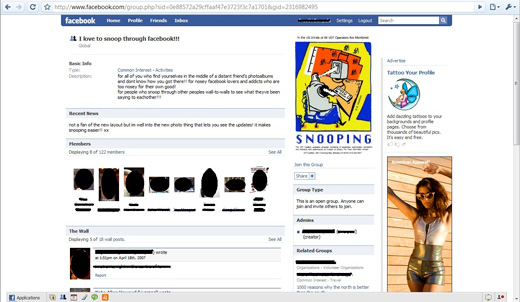
Snooping is so popular that there are more than 150 Facebook groups with names such as “I am a proud Facebook snooper,” “People who snoop on other people through Facebook,” and “I’m a Facebook snoop and not afraid to admit it!”

“Why did he friend his ex?”

Since people voluntarily upload their pictures, videos, and information, realizing that anyone can see, why does rolling through strangers’ pages seem slightly sleazy?

Sociologist Ginger says it’s because one can get information impossible or uncomfortable to get in person.

“If you ask someone if they’re dating in person, you unleash a whole barrage of implications. But if you look at this on Facebook, you answer your question without all of the fallout.”

And so, when Courtney Jones, a waitress from Norman, Oklahoma, is interested in a boy, her first step is to review his Facebook page.

“When I look at a page, I read into what is on there. Like if a guy is in a picture that alludes to something sexual with a girl, I assume that if they’re willing to be that open with their sexual life in front of the camera, I’m sure they’re willing to do more behind the camera,” she says.

Jones also snoops on behalf of her friends, especially when they start dating new people.

“I’ll go through his Facebook word for word, and see if he has anything I wouldn’t approve of. Pictures, wall-to-wall, everything. I gotta have my girls’ backs!”

Mirror, mirror on a Facebook wall

While it does seem that we snoop because we’re curious about those around us, it has more to do with our need to know ourselves, suggested Shanyang Zhao, a sociology professor at Temple University.

“Getting to know others is important for the purpose of getting to know ourselves, for others serve as a looking glass in which we see ourselves,” said Zhao, who specializes in Internet and human interaction.

Maybe this explains why Ana Robic, a foreign language student from Brussels, snoops on classmates who were mean to her in high school. Robic belongs to a 108-member Facebook group called “Facebook helps me spy on people I don’t like.” Said Robic: “I look for something that shows me that I have a better life, so that I can say, ‘I don’t like you and look, I’m better than you are!’”

Zeeshahn Zafar, a public relations manager from Dubai, United Arab Emirates, snoops to gauge her popularity — or lack thereof.
“I read messages that other people have posted on that person’s wall. If a person has not replied to my messages, I check to see whether he or she has replied to other people’s messages.”

If you’re ignoring someone on Facebook, then you’d better have a good excuse.


“You look familiar”

Zhao argued that Facebook snooping will make communication more subtle, sophisticated, stylish, and “further differentiated based on personality, age, education, class, among other things.” But he also acknowledged that it keeps people from talking — or gossiping — with each other as much.

“I don’t talk on the phone as much as I used to with my friends,” Norton agreed. “And even when we do talk, I might say something and my friend will talk about how she knew about it through Facebook. It’s pretty ridiculous.”

There’s also such a thing as too much information.

“I sometimes meet new people at a party, maybe friends of a friend, and they seem familiar,” Doshi said. “And then I realize that I’d snooped on them through a friend’s Facebook page. I have to bite my tongue to keep myself from blurting that out.”


Lean Over: There Is Something I Must Tell You

Best of In The Fray 2009. Four poems by a contemporary American poet.

Undercurrent

Lean over: there is something I must tell you.

To the current there is a hook, an undercurrent of darkness braided with light.

The bustle you are, somber & vivid.

The little receipt which is old fashioned like the tall laced boot of our town.

The name sticker “Margaret N. Cutt” to whom the used book belonged.

Your language, “O dear,” and “quite the town,”

Vivid lipstick out of the forties.

The overwrought city, the muscled imagination.

The bustle in a dress. Free-floating angst in ceiling chandeliers, & the purple sweater I have taken to sleeping in with wool circles like those a child draws on a blackboard, a child of ten:

Filmed

Marcella Goldsmith would understand.

Preparing for the stone city of age, myself I am slowing, never leveling

See in dream

Steps washed over by water,

The thin air of antiquity’s room

I reach for every twig for the nest

The storyteller with leukemia habits our planet still
unlike the poet who grieved his wife’s death it was years before he habited his own skin.

Landscape tonight fades into Federal gray as I turn out lamps on reading

Knowing I can never have you,

Knowing John Donne’s words, “If I dream I have you, I have you,”

Are true & untrue like a bird flying with one wing.

Not bogged down in sateen daughter

Chylde

Sister

But rising

To surge above the plains of rainy Tuesday.

Now will become later         like after the anguish of an infusion

Meantime Lindt Fioretto assorted chocolates

Stand in a round hatbox on my desk

& I start trying chocolate, moka doll hats on

With plumes

The plumes are “chocolat croquant” Caramel & hazelnut
we are two long-legged children in the attic on a dark day

Making lights

Revolve like at the planetarium:

A peacock & his hen:

I am the little drab one

Bringing up the rear

Bustle rustling

Am I the dark one serving the blonde one or are you the dark one serving me?

Roxbury Hall, Mass this would bow me to sateens:

Lady  Robe

I do not often rove but rove now

For whom I leave / for whom I love.

Duvet sale

A four season 550 loft power goosedown

Blowout                        Price-Slasher

“Sweet Dreams”

Dare I imagine us under it? How do I write? I open a vein.

Ink barely dry on the death certificate

Sharp as a tack if I’d sat on you in life I’d have bled:

This way it’s an uproar, an otherworldly bed:

Dream up a pillow fight, Paul Bunyan daughter

Feathers aglow an albino snow blown in a fan: I’m yours. You’re down:

Four posts, gold maple bedsteads:

Cold polishes lenses & silver pen nib

From swan.

No swan, tall woman, yet egret feathers would look good upon

A hat you wore tearing at drabness like a lion with roar:

Cape

Flung over shoulder with that bravado of a very large woman.

Just a touch of mascara

Diminishing such mirth would be

Like cutting off the hands with a blowtorch.

That touch

Is over the top

Too little

& too much

The way Sappho’s odes

Were unbearable

Yet not enough.

My shower restores me

Between bouts of loneliness

(Which strike now I am laid off work with a broken ankle)

Its colours sepia, silver salts, gelatins like an old photograph turned liquid

But its script is virginity: non stop

Vocal chords closing down.

Only two globes back

(Two “Globe & Mails” that is)

I received accolades:

Now, although I trace the alphabet faithfully with my wounded foot as the doctor tells me to, there is no full telling this thing, this loss.

Now in this gray convening

I pleaded with the covenanters

To move be in a New York moment

So I can be held with the wild language again.

The Lord of Diminuendo

Has come

Those small footsteps

Insistent

As the rain

Colours sweet

But so saturated

With the approach of spring

Like Leonardo’s Adam & God almost touching hands.


Aliens

“On with you, go on, go on,” he said.

Usually when one leaves a city for another, sheds a life and a skin for another, one turns one’s attention to what one must take along, rather than understanding what one must not leave behind. Father and I came to this city quietly, naked to the bone, to the recesses of our souls, though we didn’t know it. The aircraft that carried us landed lightly upon a long dark runway, and stopped. We were empty, vessels within a vessel. As we disembarked, set our feet firmly upon the dusty soil of this city, I remember thinking: This city is strange. I don’t belong here. I was seven at the time, and, without a doubt, was given to reason with that characteristically complex though effortless ease — the city was unfamiliar, strange, and I thought each step of mine an intrusion.

I now believe there were several reasons I felt the way I did. New Delhi summers are hot, and we arrived in the middle of June from wherever it was that we came. I was a child of winter, and in nail-biting cold, felt alive. I loved to resist winter’s icy offensive, its assault upon my being. I’d fight the cold because I could and because it made me feel brave, understood, even relevant. But now, the summer wind that accosted us as we hurried away from the craft was this strange city’s restraint, its displeasure; the harsh gust expected resignation, not a fight. New Delhi didn’t want us. We were flayed, the sun glared contemptuously and cracked open giant eggs of sweat upon our heads. I felt unwelcome, wanted to return to the craft, but Father gently pushed me into the departure terminal, mopping his forehead with a small, insufficient handkerchief. “On with you,” he said, “Go on, go on.”

On we went, till we stood before a conveyor belt that slowly whirred past while a bunch of us stood in a huddle, waiting. Father, too, at the time, contributed to my (our) situation. “On with you,” he’d said, while he reeked of that alcohol that so reminded me of wherever it was from which we came. Every inch of his body, more correctly his being, seemed to be absent, left behind at the place which was the very source of us. Our presence at that airport seemed to be so steeped in absence that we must’ve been invisible — someone lunged for their luggage, and I was thrown aside. Father didn’t notice.

“Why do people rush? It’s not like the luggage is going anywhere,” I said, mildly bruised.

Father continued to stare at the belt, through the belt, at something distinct and imperceptible. I repeated myself, and he finally looked at me, through me, and spoke.
“One place to the next, that’s the way it is.”

As the wait prolonged (there was a problem with one of the luggage transportation carts), I thought Father might turn into stone. He stood so very, very still, his glance unwavering, like a statue erected in fond memory of himself — my father who once was, and now, strangely, wasn’t.

I gave in, as I often did, to reminiscing. I felt there was a library where memories went and were classified, and when one summoned, an appropriate one was sent along. Perhaps a stern librarian sat behind some giant wooden desk trembling beneath piles of memory retrieval applications. As luck would have it, that particular day, standing by the conveyor belt, I was not fortunate (the librarian must’ve been overworked). In a jolt, a flash, I was back where I came from, back on the streets of a lost city that was cold and lightless, my home. I was walking back from school, whistling to myself as it were, and upon turning a corner found myself surrounded by a horde of hooligans.

“Take off your clothes,” one of them said. He was large and filthy, looked singularly mad.

“Why?” I asked. “It is cold.”

“We’re feeling cold too,” he sang, and smiling, punched me in the face. I fell to the ground; my nose broke upon the pavement. A narrow stream of blood found its way down my face, and soon, a patch of ice on the street turned a pinkish red. No one moved for a few moments. It was as if we were all waiting to measure how much I’d bleed, how much blood, how much warmth, I had in me to lose.

Then I rose. “All right,” I said, removing my cap. As I peeled off my clothes, the hooligans claimed them and scattered, shouting, hooting, even whistling the tune I’d been whistling a few moments past.

I sat down on the bloody ice. I was naked and much too cold to move. Too cold even to cry.

The memory passed, and I found I was breathing harder. I turned my attention, once again, to the conveyor belt as it whirred and chugged on by. I hadn’t cried since that day, as though the cold of that nightmarish nakedness had then and for all time thereafter frozen the pools from where tears drop. Had my blood been turned to ice?

“I like the cold,” I told Father. “Delhi is too hot.”

He looked at me (through me) once again.

“Don’t worry, beta,” he said. “Delhi has its winter months too, around four in a year.”

I looked away. Maybe adults didn’t understand anything. No, they didn’t. Who was to decide who understood what? I was troubled by this question, confused, afraid to attempt to understand anything for I might misunderstand. That day was instilled in me a fear of comprehension.

“You’re seven,” said Father, when I spoke to him of this fear.

Our luggage arrived and we lunged for it with controlled hurry.

Soon we were in a cab (a black and yellow taxi), speeding away from the airport. Father sat beside me in the backseat, and stared out of the window as the city underwent an unending metamorphosis occasioned by our passage. I took to appraising him and I am now thankful for that decision — the vision of my father that day as he sat and surveyed this city is the memory of him I carry most distinctly, most clearly, even today. His shoulders were hunched, his handsome face only just beginning to show the signs of weariness. His large brown eyes were concealed behind thick, horn-rimmed spectacles, and his wide intelligent wrinkled forehead was lined with sweat. It was as if he was a glacier, beginning to melt, just then — a slow meltdown of age and heat and disorientation, and with each successive kilometer of our descent into this new world, he seemed to bite his lip harder, though he was never going to cry. Past him, I saw through the window odd bungalows and multiplexes and dust rising in spirals upon hordes of people. At red lights, beggars came and beat their fists, clanged their bangles, blessed and cursed us.

“Where are we going?” I asked him, desperate for some distinct emotion, as the biting of the lip I didn’t understand.

“To our new home.”

“Is it big?” Our earlier apartment had been big. It had grown bigger once my mother died.

“It’s big enough, yes.”

Settling in was not difficult — we barely had any luggage. It was true that the apartment was big enough, but it would be truer to say that our existences were unquestionably small, compact. The apartment was on the second floor of someone’s home, and had a bedroom with an attached bathroom, plus a drawing-dining-kitchen and no balcony. It took us about an hour to empty our suitcases.

Then, we slept, and in that sleeping waking dream, three years passed: I found myself enrolled at a school and found that I had friends. I saw myself smiling when I looked at my reflection, and soon, I began to find that summer was an added joy, and so was monsoon, so was spring, so was autumn. Soon I forgot that I ever was born in another city, that I ever had a mother. I forgot what she looked like, whether she smoked and drank the same alcohol as Father, whether she smelled nice. I found that I had cousins and aunts and uncles here, I felt as though I’d always lived here. I was wrapped and swept away in a tide of wanting to belong and then actually belonging and I unearthed, in some illusory, childish sense, a sort of happiness. All this while, Father walked beside me, behind me, in front of me, always a shadow that stretched around me, now grew, now collapsed toward me. When the thought of his loneliness hit home, I stopped to look at him. He was still the man he was in the black and yellow taxi, but further away from me, veiled in a darkness that was perhaps my happiness. But then I thought: Can one ever shed light upon a shadow?

The day after my 10th birthday, he moved me into my aunt’s home, and then disappeared.

I never saw him again.

Till this day, more than a few decades after the events I have just described, people speak to me of desertion, abandonment — a big word, an unforgivable act. I am asked: “Did you feel abandoned at the time?” I tire of telling people that it doesn’t matter what I felt at the time, for my feeling at the time cannot qualify his act — he left when I was 10. The act was neither wrong nor right, couldn’t be either. It was a fact — he left when I was 10, when I grew comfortable in my own shoes, when I forged a bond with this city. He did what he thought was best, and the act was neither right nor wrong. He couldn’t have known whether it would be either, because a man, at the end of what he supposes is his life, at the time of crisis, if he is moral, does what he thinks is best.

I like to think he didn’t abandon me, but abandoned instead a memory of another land, another time, which instead was his imprisonment — the memory of his wife, my mother, our home. I like to think he abandoned his imprisonment.

I like to think he returned to the part of his self that he left behind. I like to think he returned to that memory, to live in it as if it were not yet a memory but the actual content, the substance of his reminiscing. I like to think he now lives once again in the lost city that we so hurriedly left, no longer a prisoner of its memory, but a free man; he is at the beginning of something, thinking of me (as I am of him at the moment), snuggled in a blanket, warm in the cold, his glasses patient upon the bridge of his nose, his eyes alert, his hair grey, and his forehead less creased.

He’s reading a newspaper.

He’s home.


Spring is in the air

With the onset of spring comes a lighter feeling, the desire to shed the things that have been weighing you down all winter physically, emotionally, and spiritually.  No one, young or old, is immune. It's hard for folks who live in climes where the trees remain green all year to understand fully the newfound energy and yearning to take a walk on the wild side when the buds appear after a long frostbitten winter. So when New York had its first balmy day this week with high temperatures near 60, I knew it was only a matter of time before something crazy happened. What I didn't expect was that it would involve a four-year-old girl and the 1 train.

Each morning I transfer from the 2 express at Chambers to the 1 local. On this day, the 1 train was fairly empty anyone who wanted a seat had one. Across from me was a father taking his young daughter to daycare or pre-pre-pre-school, which it seems children must be enrolled in while still in the womb or be destined for a life of desperation and depravity. The father was deep in conversation with the friend seated next to him about the political candidates.

The little girl, unencumbered from her usual bundle of down coat, scarf, hat, and mittens, wanted to dance. She wanted to twist and shout and boogie on down. So she wiggled off her father's lap and showed off her moves that would rival some of the competitors on Dancing with the Stars.

Her father was wary and held on to her hand in case the train stopped short. But that wouldn't do. She wanted to be free from all restraints. She pulled from her father's grasp and shook what her momma gave her to a tune that was only in her mind. As we approached Franklin Street, her father stopped talking to his friend long enough to tell the girl to hold on to the pole. She grasped the silver pole in the middle of the car still dancing. (Let me pause for a moment to say that in no way am I guessing at or alluding to this girl's future career choice.)

The doors closed and we were on our way. The girl started a Flashdance-like stutter step and twirled around the pole. Her sheer abandon was infectious. I wanted to be four again, doing whatever the moment begot, hearing some kind of Orpheus-inspired melody in my mind, not letting my ego tell me it was embarrassing to do such a thing.

And then this sweet little girl did a thing so vile, everyone around her, including her own father, cringed involuntarily. Swept up by what can only be attributed to spring fever, she stuck out her tongue and licked the pole.

For you subway riders, no further explanation is necessary. In case you car commuters are wondering what the fuss is about and lest you think I'm a germophobic nut, I'll just say this pole, that most assuredly has never been cleaned since the train was commissioned during the Ford administration, has been held by hundreds of thousands of hands. Hands that have been sneezed on and coughed into. Hands that have gone to unmentionable places. Hands that picked noses only moments before. Who knows where else these hands have been?

I wouldn't be surprised if, in the coming months, a report was issued showing your house's dish sponge contains more germ-toting bacteria than the average subway pole. But I'm not taking any chances. Someone hand me some antibacterial lotion.


Vagina warriors part two and vegetable curry

I'm still licking my lips from a beautiful vegetable curry I made today, along with an afternoon of inspirational theatre…

Theatre is a lot like cooking: all the elements need to infuse together to make a delicious meal. I was worried my broccoli and cauliflower had seen better days. I have a tendency to make my curries a little too spicy, and I didn't seem to have enough coconut milk to cover my colorful potpourri of veggies. I had just experienced the best biryani I had ever had this past week at a new vegetarian Indian joint in my neighborhood which actually had cashews in it. I figured I'd try to do the same and add cashews to my concoction. Sometimes being a copy cat works out, and sometimes it doesn't. I find the theatre to be the same. Either it is so boringly over the top, with everything included but the kitchen sink; or it is something that has been done way too many times before in too many formulaic ways.

I was pleasantly surprised to find that this was not the case with my curry/biryani or the theatre I experienced today. The play I saw was a compilation of monologues put together by Eve Ensler and Mollie Doyle called A Memory, A Monologue, A Rant and A Prayer: Writings To Stop Violence Against Women and Girls. The play was produced by Lillian Ribeiro (a true vagina warrior princess) and directed by Rose Ginsberg in a deliciously funky artist building that houses Art House Productions in eclectic downtown Jersey City, New Jersey.

As a V-Day veteran, I was once again encountered with a warm atmosphere of art for and about women when I entered the theatre space. This art included touching photographs with women's faces and booths with V-Day memorabilia and literature about domestic violence (with lovely volunteers from _gaia and Women Rising). Of course, I was greeted by the vagina warrior princess producer-host, Lilly Lips, who had on a bright orange bob wig and 1940s-looking navy blue suit, a combination that unexpectedly made her electric blue eyes shine exquisitely with love.

The actors were dressed in red and black. When the play began in a medley of powerful words about violence, I was pleasantly surprised to see male actors in the cast, which was something I missed in the original Vagina Monologues.

Each monologue was about a different occurrence of violence, some of which included a woman being tortured in Darfur, an urban woman being beat up by her boyfriend, and a college girl getting gang raped at a party. The audience was fully engaged and silent. All we could hear were these terribly sad stories, with the accompaniment of the screeching wind outside the building which was better than any sound effects any director could have planned. It was like the wind was involved in this theatrical event, or perhaps it was the screams of all the suffering souls who had lost their lives due to violencehaunting us to never forget them. This reminded me of the poems written by Marjorie Agosin in her book, Secrets in the Sand: The Young Women of Juarez, where she describes still hearing the cries of the women who were so brutally raped and murdered in the deserts of Mexico, where their unknown bones are still buried today.

 So, the stars were all lined up. The wind was involved, the actors and director gave justice to all the great playwrights that contributed to this work, and my cashews tasted great with my not-too-spicy vegetable curry. It was an afternoon of delicious, life-giving nutrition for the body, mind, and soul. Aristotle would be proud, or should I say Sappho?

I dedicate this story to all living beings who have suffered at the hand of violence. May we continue to hear your voices until there is peace on Earth.     


To the MPAA — your biases are showing

Bruno is meant to "expose the rampant homophobia across the United States." The title character, a gay Austrian fashion reporter, "appears to have anal sex with a man on camera." The MPAA had a hissy fit over the dude-on-dude scene and handed down the harshest rating a non-porn film can earn.

Yet last month, The Last House on the Left was released with an R rating, and critics and audiences alike shunned it over the detailed, graphic, violent rape scene. One critic called it "stomach-churningly anti-human." The MPAA shrugged and gave it an R rating.

A teenage girl is brutally assaulted yawn. Two adult men engaging in non-violent consensual intercourse madness! In a review of the documentary, This Film is Not Yet Rated (which exposes the biases of the board members and the board members themselves), Kirk Honeycutt of The Hollywood Reporter noted:

Board decisions in recent years reveal a strong middle-class, male, heterosexual bias. The board has declared that female orgasms in certain films go on "too long," and it comes down hard on shots of female pubic hair. Gay sex receives harsher treatment than straight sex. Graphic violence, even against women, skates free of the dreaded NC-17 rating.

The MPAA's answer to the anti-gay accusation: "We don't try to set standards, we just try to reflect them." Translation: "White, middle-class America hates the gays, so we do, too."


B/O on the 2/3

The train was already in the station at Grand Army Plaza when I swiped my Metrocard. I double-timed it down the stairs.  The automated voice on the newer trains announced to stand clear of the closing doors. I flew through the nearest open door moments before it shut. I watched the platform slip away as I congratulated myself on my agility and speed and on the fact that I would now only be 10 minutes late to work instead of 15 had I been forced to wait for the next train.

Then I turned around.

I was alone in the car.

It takes a moment to process why one would be alone in a train car during the height of rush hour. Was this train out of service? Maybe we were headed straight for the bowels of the city, some Dante-esque place where the trains are destined for an eternity of riding on a circular track, never reaching a terminus. But through the window to the next car I could see plenty of people. In fact they looked like they were wedged in tighter than a toothpick between two molars.

And then I understood. The realization came to me slowly as if riding on a wave of air molecules. The entire car had been compromised by one extremely rank homeless guy.

I've smelled plenty of foul stuff before. One particularly horrific stink involved a county fair ride called the Gravitron. It was an enclosed ride shaped like a spaceship. You entered into complete darkness (except for strobe lights) and then the spaceship spun around gathering enough centrifugal force that you'd "stick" to the walls. After a month at the fair servicing thousands of funnel-cake-eating, pot-smoking teenagers, I imagine they had no choice but to burn the ride to the ground to eliminate the smell.

But this. This was extraterrestrial stink. I know I'm failing you as your faithful subway commuter, but I honestly can't describe the smell. It was layers and layers and months and months of egregious filth so powerful that it cleared an entire subway car. This was the kind of smell that stays with you. It permeates the fibers of your coat and your hair. Your eyes water. Even breathing through your mouth doesn't stop the funk from going undetected. Somehow, despite years of commuting under my belt, I'd boarded this car anyway. Rookie mistake.

There are not many things that would cause a New Yorker to forgo an opportunity to sit and instead pack himself into a car for the next 30 minutes. I've remained in cars next to people eating chicken wings, in complete darkness, with a mariachi band working the crowd, but this was unbearable. Damn the MTA for locking the doors between the cars.

The ride to Bergen Street when I could move to the next car was interminable. I was poised as we pulled into the station. As soon as the doors opened, I burst out of the car coughing like someone who had been stuck in a gas chamber then suddenly set free. I squeezed my way into the next car. People around me wrinkled their noses and issued sidelong glances at the new girl who stank to high heaven.


Pakistan: signs of fracture

The attack on a police academy which killed nine comes just weeks after a visiting Sri Lankan cricket team was attacked. Lahore, Punjab province's largest city, has experienced two high-profile terrorist attack in a very short time span, proving that militants are not limited to the lawless Northwest Frontier Province (NWFP).

In an earlier post, "Pakistan dilemma," I discussed Pakistani government's decision to enter into a peace agreement with Taliban militants based in Swat Valley. The militants have established a Sharia court there and govern in the same authoritarian way as they did back in Afghanistan.

The decision to allow the militants to flourish in Swat Valley has hurt Pakistan's chances of defeating terrorism and getting rid of the Taliban and their al Qaeda friends. Why will the militants fear the government or the security forces when they see that, with enough pressure, the government is ready to agree to their demands?

President Obama has promised to overhaul America's policy on Pakistan and Afghanistan. He needs to stop pouring billions into Pakistan when the country's government is caving under the terrorists' demands. Terrorism in Pakistan can be defeated only when the country's government grows a spine.


Environmental initiatives in Bangladesh

I recently visited Bangladesh and was very impressed by several of the environmental initiatives this small, poor, and overcrowded nation of a growing 150 million has achieved.

Bangladesh has already managed to completely ban polythene plastic bags in 2002, is successfully using a much cleaner alternative vehicle fuel of compressed natural gas (CNG), is reducing greenhouse gas by keeping vast amounts of waste out of landfills, and uses cycle-rickshaws, probably the most-green urban transportation around, which are abundant all over the cities.

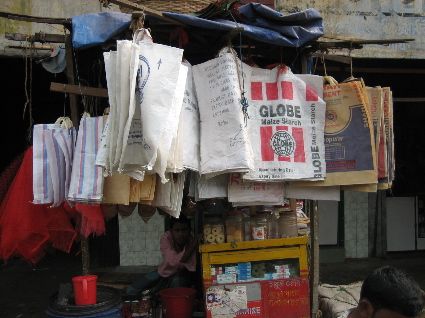
Bangladesh has banned thin polythene bags since 2002; instead people bring their own reusable bag or must purchase a bag like these ones made from recycled materials.
 
Bangladesh is a relatively new country, becoming independent only in 1971; before this it was known as East Pakistan after the partition from India along with West Pakistan (now just known as Pakistan) in 1947.

This nation, wedged between India on the west and north and Myanmar on the east, is one of the poorest and most crowded places in the world; it’s also going to be most affected by global warming. Most of the time when you hear about this country in the news it’s for some kind of natural disaster like Cyclone Sidr in November 2007 or about a lot of its land disappearing if all the glaciers of the Himalayas melt and raise the sea levels.

So maybe because of this or despite it, Bangladesh has the environment in mind.

Bangladesh has thousands of cycle-rickshaws, which are by far the cleanest form of urban transportation.


One major problem is air pollution. The government has addressed this with the alternative fuel of compressed natural gas (CNG), which is less polluting than gas and diesel fuels. But industries such as brick factories are another major concern that several international agencies are addressing.

Compressed natural gas was implemented to clean the air and is now mandatory in all auto-rickshaws, which are now painted green and simply referred to as CNGs.


The Kyoto Protocol’s Clean Development Model (CDM) allows developed nations who signed the treaty to invest in clean technologies in developing nations. Bangladesh is a place that CDM is designed for and several CDM projects are operating successfully. One project is by an NGO named Waste Concern, which takes organic trash, turns it into salable compost, and sells the carbon credits in the overseas market. They keep the trash out of the waste stream and reduce greenhouse gases. In addition Waste Concern has created jobs for the poor and cleaned up the cities.

Tons of organic waste accumulates every day in city markets like this one, the Karwan Bazar in the capital Dhaka. Waste Concern takes the waste, makes compost, reduces greenhouse gas, sells carbon-credits, and has created jobs.


Making cleaner brick factories is the latest CDM project for a company that already has helped bring compressed natural gas to the country. Iftikhar “Sabu” Hussain, CEO of CNG Distribution Company, took me on a tour of the pilot clean-brick kiln on the outskirts of the capital city Dhaka.

Brick factories near Dhaka spew out smoke and pollute nearby farmlands.


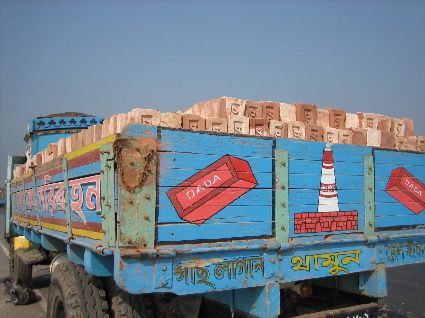
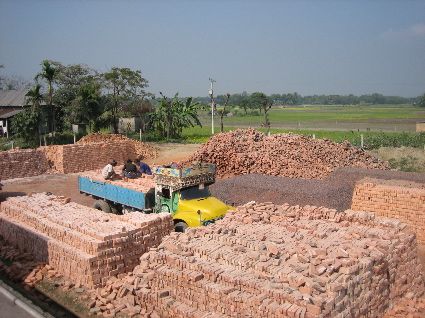
The countryside adjacent to Dhaka is emerald green farmlands starkly contrasted with dirty white brick-kiln smokestacks belching black smoke. Bricks are essential building materials here; everything is built with bricks and the industry is in demand.

Bricks are essential building materials in Bangladesh; everything is built with them.


These seasonal factories spring up in the dry season and are unregulated and abusive to workers, says Hussain. They burn coal inefficiently and the smoke and soot fills the air and falls onto the nearby crops.

Workers at the pilot clean-brick kiln organize the bricks.


Mr. Hussain’s brick kiln uses technology from China that infuses coal into the actual bricks themselves. When fired, the embedded coal hardens the brick and combusts, therefore using less external coal and releasing much less smoke.


This pilot clean-brick kiln releases less smoke than traditional ones.


This factory seemed to release less smoke when I visited, but it wasn’t perfect. Some smoke still escaped, but as Hussain says, it’s still in the experimental stage.

The clean-brick kiln sits adjacent to farmlands outside of Dhaka.


keeping the earth ever green


The whole story

Ron Howard is considering working on "an adaptation of The Strange Adventures of H.P. Lovecraft which is a graphic novel from Mac Carter and Jeff Blitz that takes elements of Lovecraft's struggles in real life and combines them with a fantastical element that includes transforming all of his darkest nightmares into reality"

You want to know Lovecraft's darkest nightmare? Barack Obama as president.
Artists, Lovecraft readers, and gothic/emo students everywhere have also chosen to ignore Lovecraft's larger-than-life racism and how intertwined his hatred was with his work. It's not enough that a bunch of "fans" gather at his grave in Providence every year to "celebrate" the man. A fan-created Lovecraft website contains a page explaining the misconceptions about the author. They don't even touch racism. They don't even try to justify any of the following:

The mass of contemporary Jews are hopeless as far as America is concerned. They are the product of alien blood, & inherit alien ideals, impulses, & emotions which forever preclude the possibility of wholesale assimilation…

The primal savage or ape merely looks about his native forest to find a mate; the exalted Aryan should lift his eyes to the worlds of space and consider his relation to infinity!!!!

Let's not be bothered by things like truth, reality, and history. Let's all go to the movies!


May 2009: Mothers and Fathers

May 2009: Mothers and Fathers Alarge majority of an individual’s brain development occurs betweenbirth and age 5. The most direct and constant influence during theseyears are mothers and fathers, or those that serve in such a role.Children unable to form strong attachment with their parents duringthis time frequently have difficulty forming solid, long-termrelationships throughout the … Continue reading May 2009: Mothers and Fathers

May 2009: Mothers and Fathers
Alarge majority of an individual’s brain development occurs betweenbirth and age 5. The most direct and constant influence during theseyears are mothers and fathers, or those that serve in such a role.Children unable to form strong attachment with their parents duringthis time frequently have difficulty forming solid, long-termrelationships throughout the rest of their lives. Caring, nurturingmothers and fathers are critical in ensuring proper early childhooddevelopment, and encouraging continuing growth throughout childhood,adolescence, and into adulthood.
In our May issue, InTheFray Magazine wouldlike to explore mothers and fathers. Think about your own parents andthe role they’ve played in your life. Think about your role as a motheror father and how you contribute to your own child’s well-being. We’dalso like you to explore the more metaphorical applications of theterms. People often refer to their country, their planet, or their Godas a mother or a father. What do we mean when we say this? We encourageyou to explore this concept thoroughly, in all of its differentmeanings.
Contributors interested inpitching relevant news features, poetry/fiction, cultural criticism,commentary pieces, personal essays, visual essays, travel stories, orbook reviews should e-mail us at mothersandfathers-at-inthefray-dot-org.Send us a well-developed, one-paragraph pitch for your proposed piece NO LATER THAN APRIL 13, 2009.  First-time contributors are urged to review our submissions guidelines at http://inthefray.org/submit and review recent pieces published in InTheFray Magazine at http://inthefray.org.

I am a writer/editor turned web developer. I've served as both Editor-in-chief and Technical Developer of In The Fray Magazine over the past 5 years. I am gainfully employed, writing, editing and developing on the web for a small private college in Duluth, MN. I enjoy both silence and heavy metal, John Milton and Stephen King, sunrise and sunset. Like all of us, I contain multitudes.

personal stories. global issues.