Bailout

A look at its past, present, and future.

It seems everyone is talking about bailouts these days. Like a giant sinkhole, companies and financial institutions that once seemed solid are crumbling into the ground: GM, Chrysler, AIG, Bank of America, Citigroup — the list goes on. Even the porn industry asked Congress for $5 billion, on account of the “soft” economy. Congress and President Obama approved over $700 billion for a stimulus bill that, when added to the $400 billion bailout of mortgage giants Fannie and Freddie Mac (already semiprivate institutions subsidized by the federal government), brings the total bailout to more than $1.1 trillion.

Why? Well, unless you are really, really poor or just can’t remember how many houses you own, you might have noticed the economy is sputtering. To justify such a sum, members of Congress, President Obama, and talking heads have been characterizing this latest downturn in some pretty stark ways. If you were to put the phrase “worst economic crisis since the great depression” into Google, it would return 136,000 hits. Obama used this phrase many times during the 2008 presidential campaign. Peter R. Orszag, Obama’s director of the Office of Management and Budget, is using it. The International Monetary Fund has said as much. Heck, even the Socialist Worker is using the phrase, hoping (still) that “revolt is in the air.” In a related but somewhat different spin on this, many of those who support aid to corporations and who are for an economic stimulus have argued that not doing so will result in another “Great Depression.”

Of course all of this is plain political hyperbole. But this is not to say that we shouldn’t act. The economy is weak and these financial firms and auto companies are in trouble. Beyond the hyperbole is the real issue, a revived debate about industrial policy: to what degree (if any) the government should intervene in supporting sectors of the economy. While there is no formal industrial policy in the United States, there is a de facto one that has existed since the early days of the republic. Despite the rhetoric that the United States is becoming a socialist nation, today’s bailouts should be seen as part of a long history of government involvement in the economy here and abroad.

First, let’s be clear. While things are bad, this is not the Great Depression. National unemployment during the 1930s never fell below 15 percent. The worst came in 1932, when unemployment averaged about 25 percent. Some local rates were even higher. Chicago and Cleveland had 50 percent unemployment, while Toledo measured 80 percent. The gross national product fell by 25 percent from 1929 to 1932, and prices dropped by some 40 percent. Nine thousand banks went bankrupt or closed to avoid bankruptcy between 1930 and 1933.

Nor are today’s problems the worst economic crisis since the 1930s. Unemployment hit 8.9 percent in April 2009, but it was nearly 11 percent during the 1980-1982 recession. Luckily we have not had high inflation rates; the rate reached 5.6 percent in July 2008, but was 13.3 percent in 1979. Bank and thrift failures were in the several hundreds per year at the height of the savings and loans debacle of the 1980s. This year, 21 banks have failed so far. It is true that the amount of money at stake is higher today, and the international links among financial institutions are much greater. The potential of failure and the consequences seem high. But as painful as it is, we have seen worse.

Now, the more important issue is the relationship between the government and the economy. While die-hard conservatives like the late Milton Friedman dream of a purely free market, the truth is that, historically, government at all levels has intervened in direct and indirect ways. Let’s look at a few of the many examples of how the government is and has been involved in economy, bailouts, and otherwise.

One of the key areas in which governments regularly intervene is transportation. In the early part of the 19th century, the federal government took an active interest in promoting canals and the creation of the National Road. These would better link east and west, promote settlement and trade, and ensure greater federal control over westward expansion. State governments also supported these efforts. Later, federal subsidies, including land grants (along with a continued active military campaign against Native Americans), helped railroads expand west and transform the United States. In the same era, the federal government maintained high tariff rates on imported goods as a way to spur domestic manufacturing. The emergence of automobiles and highways in the 20th century also depended upon federal (as well as local and state) largesse. And now the federal government is using its muscle to promote research and development of electric drive vehicles and passenger rail through such legislation as the 2007 Energy Independence and Security Act and programs in the $700 billion stimulus package.

Today, the agricultural sector is by far the largest beneficiary of federal subsidies. If we take this back to the 19th century, for example, we see railroad subsidies going hand in hand with those for purchase of land to support western settlement. The U.S. military aided this with its campaign to wipe out Native Americans. After the Civil War, farmer organizations became more politically active. As they gained more influence, railroads began to control shipping and favored larger, wealthier clients over small farmers. At the same time, larger financial institutions, like that of J.P. Morgan, began to exert more influence over credit. Both big business and big finance infiltrated political circles, and farmers were among the most vocal in identifying this threat to democracy and organizing to do something about it. The Grange, the Farmers’ Alliances, and then the Populists pushed for, among other things, greater transparency in commercial transactions as well as stricter controls over big business. They also wanted government protection in terms of higher prices and access to fair credit.

When the Dust Bowl hit in the 1930s and New Dealers worried about poverty in the rural South, the federal government moved aggressively to aid the farming sector. These federal subsidies have continued even as the rural population declined and as more and more farms became corporate entities as opposed to family owned businesses. Today, with farm employment less than 2 percent of total employment, the roughly $21 billion a year spent by the Department of Agriculture does not necessarily help the small farmer, but rather giant agribusinesses like Archer Daniels Midland (ADM).

A third and more familiar area involving government working closely with corporate entities is what Dwight Eisenhower warned of when he left office in 1961: the “military industrial complex.” While the connection between the federal government and industries supporting the military developed long before Ike, the Cold War certainly altered the scale and scope of the mutual dependence. After all, about $15 trillion in today’s dollars went into the Cold War between 1948 and 1990, helping to keep the defense industry, including major companies like General Electric and IBM, humming along. And while overall military spending has dipped some, its connection to the private sector has continued unabated. Under George W. Bush, we’ve even seen the acceleration of privatizing many of the functions usually handled by the military itself. Along with industries and companies, towns, cities, and regions came to depend on war for their survival. The so-called “Gun belt” from the Mid-Atlantic coast through the Gulf Coast and over to the West thrived on the military. During World War II, the region became home to military bases, training facilities, and a host of related entities. These connections only spread and deepened during the Cold War.

At the other end of the economic spectrum, the federal government continues to aid regions and communities suffering from high levels of poverty and unemployment. In the 1960s, the Area Redevelopment Administration offered various incentives to lure business into such places. It was followed by the Economic Development Administration. Appalachia has its own federal-state agency, the Appalachian Regional Commission. In 1975, New York City received $2.3 billion in loans to stave off a financial crisis.

These federal bailouts to places came largely from a real concern with alleviating poverty. And things have improved somewhat in Appalachia and other communities hit hard with poverty. But they still lag behind, leaving unresolved the issue of geographic inequality. More serious methods of redevelopment and transferring money to regions in need would have to be considered if alleviating poverty is truly a goal.

The poverty rate has fluctuated over time and varies according to social factors such as age, sex, and race. The federal government did not measure poverty until the 1960s. Looking back, the overall rate was about 22 percent in 1960, dropped to 11.1 percent in 1973, rose again to 15.2 percent in 1983, and dropped and rose again to about 15 percent in 1993. It fell again to 11.3 percent in 2000, but has risen to reach 12.5 percent in 2007. Rates among female-headed households and minorities are higher than these rates: 30.7 percent and 24.5 percent respectively. The poverty rate for whites is lower: 10.5 percent.

The federal government and state governments also use various tax policies and labor laws to help corporations. For example, companies usually get tax abatements and assorted credits from state and local governments. True, government does regulate businesses as well. So while it is too much to argue that government is in the hands of business, it is fair to say that the state has played and continues to play a significant role in promoting and protecting corporations.

Along side the subsidization of corporations, direct bailouts to corporations have happened before. A few examples from the last 30 years or so show that today’s plans are more expensive, but not new. In 1970, the Penn Central Railroad declared bankruptcy — the largest corporation to do so up to that time. It sent shock waves through credit markets. The federal government stepped in with loan guarantees to banks, and eventually the government consolidated the Penn Central and other railroads into Conrail. The railroads were deregulated (as were the airline and trucking industries) and Conrail turned a profit in 1981. The government kept running it until 1987, when it was sold. The Penn Central bailout cost some $3.2 billion. In 1971, Lockheed, a major defense contractor with deep ties in Southern California, was the first recipient of money from the Emergency Loan Guarantee Act, which could provide funds to any major business enterprise in crisis. Lockheed paid off its $1.4 billion in loans by 1977 and government earned about $112 million. The government bailed out Chrysler in 1980, and by 1983 it had paid back its loans, giving the government a profit of $660 million.

When deregulation came to the savings and loan industry in the early 1980s (government removing its hand), it led to a serious crisis. To prevent billions in losses, the federal government then stepped in with the Financial Institutions Reform Recovery and Enforcement Act. In the end, the cost exceeded $220 billion. After the attacks of 9/11, the already weak airline industry hit crisis mode. To stave off the failure of major airlines, in 2001 the federal government created the Air Transportation Safety and Stabilization Act, which provided some $18 billion in assistance. In the end, the government recouped this money and made a profit between $150 and $300 million.

While the government has been busy aiding corporate America, there are a number of programs designed to bail out people. But these consume far less than other parts of the federal budget, and the social safety net that does exist is fairly weak. For example, the 2008 budget allocated about $271 billion for welfare (about 1.9 percent of the gross domestic product [GDP]) and about $739 billion for defense (about 5 percent of the GDP). Just recently, trustees for both Medicare and Social Security announced that these programs, the foundations of the welfare state, will be insolvent sooner than expected. Medicare is already paying out more than it is taking in.

Social Security is perhaps the best known and serves as the foundation of what exists in terms of social welfare in the United States. This tax on employers and employees was a 1935 compromise among those wanting a more generous social welfare safety net and conservatives who fought against any net whatsoever. A mix of federal and state control meant that originally, eligibility and payments under Social Security varied enormously; it also excluded domestic and agricultural workers, meaning large numbers of African Americans and women were left out. Over the years, reforms meant that the program, however poorly designed in terms of its funding, has been responsible for lowering poverty among the elderly, once the poorest segment of the population.

The program that came to define “welfare” was Aid to Families with Dependent Children (AFDC). This was a bailout to the poor as part of the New Deal, and it became the center of political debate when it expanded (and began to aid more blacks) during the 1960s and 1970s. AFDC ended under Bill Clinton, who promised to “end welfare as we know it,” replacing it with grants to states, with strict limits on how long recipients could receive aid. Today, about 2 percent of Americans are on direct public assistance, the lowest since 1964.

The debate is still on about the merits of this significant change; welfare rolls plummeted during the 1990s boom, and many were helped by the expansion of other assistance measures, including the Earned Income Tax Credit. But the percentage of children in poverty has gone up since 2000 from 16.2 percent to 18 percent, and some studies show that most families remain in or near poverty after leaving welfare.

In addition to these, other programs making the welfare state include Medicaid, veterans’ benefits, federal employee and military retirement plans, unemployment compensation, and food stamps. Federal assistance accounts for half the federal budget. Perhaps these are not bailouts in a strict sense of the term. But the social safety net — as weak as it is — provides security for millions of people, perhaps preventing them from needing emergency help. For example, some 51 million people will receive money from Social Security this year; about 50 million receive Medicaid; over 45 million receive Medicare.

With such a weak safety net in place, and a long history of aid to corporate America, should the government help the auto industry, banks, and financial institutions? The short answer is, yes. In terms of the auto industry, the bailout needs to focus on the workers, no matter what. As others such as Paul Krugman have pointed out, the credit market is so dried up that should these companies be forced into bankruptcy, they would be forced to liquidate as opposed to simply reorganize. This would mean millions more unemployed and more or less the end of the Big Three and the United Autoworkers. Reports are now surfacing that GM, Chrysler, and Ford may use taxpayer dollars to cut thousands of jobs here in the United States while maintaining or expanding their overseas operations. Without significant assistance, former auto workers and those depending on this industry will be left with nothing.

Regarding the financial institutions, the plan so far has been to inject money from the $700 billion allocated under the Emergency Economic Stabilization Act of 2008 directly into banks to free up credit. It has not helped. Credit remains a problem because banks are sitting on the money and the housing sector (remember, this is where it all started) is still a mess. Many, including the Government Accountability Office, have shown that the program lacks oversight, making it impossible to control how these financial institutions use the money.

What has become obvious is that deregulation and lack of oversight created a dangerous situation. Income inequality has increased in the United States. Among countries in the Organization for Economic Cooperation and Development (OECD), only Mexico, Poland, and Portugal are worse. In 1979, the post-tax income of the richest 1 percent of households was eight times higher than that of the middle class, and 23 times that of the lowest fifth. As of 2005, it became 21 percent between the top and middle, and 70 percent between top and bottom fifth. After accounting for inflation, most families are still making less than they were in 2000.

The need to salvage the assets of these institutions is real; remember, those Americans with retirement savings have had to put their money into stocks and bonds using vehicles such as mutual funds. Banks and other entities played fast and loose with people’s lives, and now these mostly middle class people (through tax money) are paying to rescue the banks and their corporate leaders. Wall Street pays out bonuses while Main Street foots the bill and staggers along. What is needed is a set of policies to reorganize the financial system. As William Greider has argued, what might be needed is to give the Federal Reserve power to regulate the financial sector that exists outside of banks (the “shadow banking system”). The Federal Reserve has power over commercial banks, but it only holds 24 percent of all financial assets. It is also likely that the federal government might need to take into receivership some of the largest troubled banks.

We’ll see what happens next from the Obama administration. Economically, it is not the Great Depression, but this is perhaps a political moment as malleable as 1933, when FDR came to office. He ushered in the New Deal, which was not perfect, but which served as a basis for an expansion of economic security that has been undermined in the last 30 years. Obama needs to focus on rebuilding the economy for all Americans, not just bailing out Wall Street.


These are difficult times

In any economic crisis, it is always the poorest that feel the effects the earliest, suffer the most, and begin to recover last. It is also true that in any economic crisis, it is always those who make the most noise who receive the most aid. The voices of those in abject poverty have long ago been silenced, and so it follows that the United States government hands hundreds of billions of dollars to bankers and other wealthy men, while food shelf stocks shrink, unemployment aid is exhausted, and welfare recipients are denigrated as deadbeats regularly on national television and radio networks.

I was in rural Nepal when a schoolteacher asked me, "Is it true that there is no poverty in America?" As he explained to me how he and the majority of his countrymen lived on less than $1,500 per year, how many lived on far less than that, how could I explain that poverty does exist in the United States? "But you are so rich," he said. "How can there be anyone who is poor in America?" Yet poverty exists. It is as grinding, as crushing, and as punishing in the United States as anywhere else in the world. Today, in the midst of this economic turbulence, tent cities are popping up just down the road from the McMansions. The voice of the poor may be a quiet one, but it is growing in numbers.

In this issue, we share stories of these difficult times. Gregory Wilson provides the historical context of government involvement in economic development in his piece Bailout. Iceland’s financial crisis has been far more severe than much of the rest of the world, and newly-elected MP Birgitta Jonsdottir shares a mini-documentary called Icelandic financial crisis, about how and why everything fell apart. In Day laborers, Gayathri Vaidyanathan looks at how the crisis has affected undocumented immigrant workers in New York, and in ”Where’s my bailout?”, Dean Stattmann shows us how the crisis has affected graffiti in SoHo. In Mexico, where a war rages over the trafficking of drugs, violence is increasing. Patrick Corcoran documents the challenges of reporting on the violence without getting killed in Reports of violence.

The economic crisis, of course, has inspired some to greater things. In Today, finance and trade bailouts are too often in the headlines, Terry Lowenstein shares two poems drawn from the headlines. Others, such as Nathan Bahls, view the crisis as an opportunity to take a risk. He shares the details in Six short hours.

It may be a few brief months, or it may be a few long years, but eventually, like all things, this crisis, too, will pass. The question is, when it does, will we go back to our old, profligate ways, or will we learn a lasting lesson. Will we remember what it is like to be without, and share what we can with the women and men around us who are still struggling? Or will we turn our backs, return to the table, and continue to gorge ourselves on the excesses of a civilization?

I am a writer/editor turned web developer. I've served as both Editor-in-chief and Technical Developer of In The Fray Magazine over the past 5 years. I am gainfully employed, writing, editing and developing on the web for a small private college in Duluth, MN. I enjoy both silence and heavy metal, John Milton and Stephen King, sunrise and sunset. Like all of us, I contain multitudes.


When the dairy runs dry

Tough times for an independent dairy farmer.

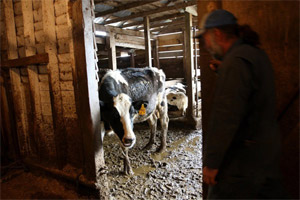
Running a dairy farm has never been an easy job for farmers in Maine. The extreme weather conditions alone make the task of raising, breeding, and milking cows a challenge. Mother Nature aside, it is a serious struggle for dairies to stay afloat in today’s world of economic unrest and the push and pull of supply and demand. Without bailout from the dwindling fund of state subsidies, small dairy farms may not be able to keep up with their larger, commercial competitors.

Kate Hassett documents the independent Cunningham Farm, in Waldoboro, Maine.

[Click here to view the slideshow.]


Six short hours

Reboot; rekindle; renew.

You can dream a little dream
Or you can live a little dream
I’d rather live it
Cuz dreamers always chase
But never get it

— Aesop Rock

Six hours from now, my alarm will go off. I’ll fumble around in the dark for my bed stand, slapping for the snooze, likely spilling water and/or knocking something valuable to the floor. Twenty minutes later, wiping sleep from my eyes and squinting in the morning sun, I’ll get on my bike and fly toward work. An hour from then, breakfast will be served up in bar form. Spreadsheets filled with millions of dollars of assets, line items representing pieces of reality, will take over my brain. Coffee will be brewed and ingested, meetings attended, and documentation laid out. A blitzkrieg of acronyms will require unraveling. A spread of accounting procedures from around the world will require translating. Mismanaged orders from foreign divisions will need corrections. Phone calls will be placed and answered, labs will be scoured for missing gear. I’ll check and recheck my email. Routine will continue in an organized frenzy, carrying me toward that final hour on the clock.…

Six hours from now, sleep-shy and carrying an overabundance of familiarity with my same daily pattern, I’ll start all over again. Six hours from now, I’ll clock in to a routine that many of us follow: wake, work, play (briefly), and sleep. Six hours from now, I’ll fumble in the dark for my alarm and step into my routine, one last time.

Six hours from now I’ll take the seed of an idea and attempt to turn it into a new reality. Six hours from now I start the process of something different.

_____

I had worn the shirt again. It was what prompted his question. The shirt itself was nothing special — black with long sleeves, normally not worth noticing, save a small, embroidered inscription on the chest. It was the inscription, though, that prompted him to ask me about the South Pole — if I had been there, what it was like, if I had seen penguins. Standing there, getting coffee, I offer him the story of the Antarctic life in brief, the hows and the whys of it. Encouraged by his curiosity, I explain to him how to find work on the seventh continent, the benefits and sacrifices of doing so, and a little of the personalities that find their way there.

His eyes hold the sparkle of an idea — on his face he’s forming the beginnings of a daydream of standing on a polar plateau. His questions bear the excitement of the daydream building in his system. He smiles wide as I lay out the details by which he can pursue the dream on his own. Then, in an all-too-familiar fashion, darkness hurriedly falls over his cheeks, like a mountain-weather storm front. It seeps into his voice and dampens his animated pitch to a lower range.

“I wish I could do that,” he says, defeat creeping into his hushed tone.

I want to grab him by his shoulders, wrest away the defeat and yell emphatically, “You can!” I want to lay out (again) the steps of how I made it happen for me, of how thousands of others did as well. I want to beg him to show me an idea, a dream that he is currently chasing. I want to not feel the loss in his words, the loss that so many become lost in. I want to stop another unfulfilled dream from crashing upon the shore of our modern world.

I want to do all of these things, but I don’t. I walk away, pondering the fear that can be found in the space between dream and the pragmatic call of day-to-day life. Pondering how not to fall victim to the same trap.

_____

Modern science tells us that our brains are elastic, stretching and expanding while young, hardening and growing more brittle as we age. A recent British study published in the International Journal of Geriatric Psychiatry posited that for each year worked past retirement, the onset of Alzheimer’s disease could be delayed by an average of 18 months. Even as young as our early 20s, the areas of our brain that assess risk solidify, increasing our aversion to activities we would have leapt after only years before.

The routines that we build around our lives become forms, massive structures surrounding an ever-hardening self. Fail to stir the mix or alter the aggregate, and when the forms are removed, the routine taken away, we can no longer adapt to the new surroundings. Routine can fast become a form of risk-aversion, an avoidance of all things uncomfortable, an excuse to steer clear of the unknown. We can keep speculated negative outcomes at bay, but at the loss of growing through challenge. By following routine as mantra, we shortchange one of the greatest strengths of human kind — the pursuit of beauty and good in the face of adversity.

What does it take, then, to stretch our hardening minds? Do we carry the strength to choose a different routine? The strength to choose no routine? Do we have the strength to carry on when forces outside our control break our mold? In the midst of economic meltdown, large-scale job losses, mounting medical expenses, and the multitude of hardships, can we find the opportunity for a new perspective? Can we bail out of a life as habit and into a life of challenge and purpose?

_____

Frustrated by the statements of “I wish I could do that” heard throughout my life, I consistently aim to not say the same myself. It’s a challenge that I have often failed to meet, but an ideal to strive for. By seeking what I want instead of only dreaming about it, I have lived in Antarctica; in the heart of ancient forests; on the edge of oceans and of deserts; in expansive cities and quiet mountain towns. I have experienced work as a cook, trail builder, youth leader, crew leader, alternative teacher, project manager, emergency response coordinator, wilderness first responder, graphic designer, systems administrator, logistics coordinator, inventory controller, political organizer, and as a writer. I know what it is like to work for private industry, for nonprofits, for the government, and for myself. I have known love. It has been my good fortune to learn and to try a great many things.

My attempts and triumphs, however, have not been clear of failure.

I have known long periods of unemployment and depression, loneliness and confusion of direction. Debt weighed down my neck for years. Many I have loved have passed on or moved on. More often than not, the dreams that I have sought came about not from the first path or first attempt, but from the second, third, or fourth. Often the route to a goal changed, sometimes so much so that the goal itself was transformed. I find courage and perseverance in the stories of others — in veterans and immigrants, in the day-to-day struggle of family, and in the perspective of a grandfather who refuses to look at life without a smirk for all of its absurdity.

I have learned, with my own blood, sweat, dollars, and tears, that the risk is worth the reward. We are far better served by challenging the status quo than by upholding it.

_____

Four years ago, while biking on the Otago Rail Trail in New Zealand, an idea formed in my head. It has since stayed with me through two major attempts at creating routine in my life, at settling down in a nature alien to my personality. Now, on the edge of a layoff from my current employer, I have another opportunity to jump away from routine. I have an opportunity to tear an idea from the fog of a dream and to make it my reality.

In six short hours I’ll be wrapping up the final pieces of a life in Colorado to go back home to Minnesota. I’ll be packing up everything into storage, save 50 pounds of gear in a trailer, my bicycle, and myself. For an entire summer I’ll seek out a cross-section of Minnesota in the random folk that I meet. I’m out to see if I can listen well enough to hear their stories, to hear how they challenge routine, perhaps to encourage someone to push their boundaries, perhaps to find that I still need to push against my own. The weather will find me, as it often does, with no more shelter than a tent. I want to see Minnesota (rural and urban) without the veil of cynicism that has crept into my postmodern life. In six hours, I’ll set out to understand the land I came from, so that I might better understand the lands I have yet to travel to.

_____

“I wish I could do that,” he says. 

Turns out, you can. Sometimes all you need is to try.


Day laborers

Money no longer flows in the mecca for undocumented workers.

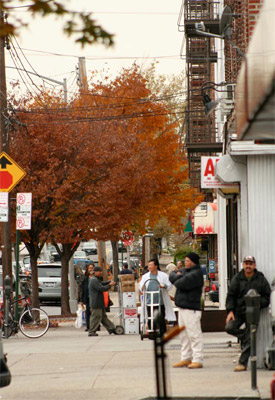
It is 6 a.m. Monday. The winter sun has not yet risen, but slowly, shadows of men flit through the dark. They gather against the bare rock walls of Pare de Sufrir Church in Woodside.

And in the morning emptiness, the laborers of Roosevelt Avenue begin their daylong vigil for temporary work.

A giant white cross hangs on the corner of the church, obscured by the elevated tracks of the No. 7 line that runs along Roosevelt. At 8:30 a.m., more than 50 Latino men, mostly from Ecuador, gather on all four corners of the intersection and wait.

For day laborers, New York City has long been a mecca where pay was good and work plentiful, according to Oscar Parades-Morales, executive director of the Latin American Workers Project in Jackson Heights. As the rest of the nation went through the subprime mortgage crisis, workers from as far off as California converged on the city looking for work, says Parades-Morales.

But in recent months, the construction industry has entered a slump. New York state has lost 2,000 jobs in construction since September 2007, according to the Department of Labor. A report released by the New York Building Congress, which represents the construction industry, expects 30,000 jobs to be lost in the city by 2010.

On Roosevelt, the workers are already facing difficult times. Last October, police arrested 10 laborers for obstructing the sidewalk at 37th Avenue and Broadway, three blocks east of the intersection. The incident was unusual, but has left the men apprehensive.

Below the white cross is a short, middle-aged, undocumented man who refused to reveal his name. “Jose” crossed into the United States from Ecuador seven years ago with his family.

“Running. Running [through] El Salvador, Guatemala, Mexico,” he says. “Maybe all day here.”

Jose is desperate for work. He needs money for child support payments to maintain visitation rights to his daughter and son.

Jose’s friend, “Jorges,” who also declined to identify himself, has his family in Ecuador. He came to New York City in 1986 when Ronald Reagan was president. He is taller than the others and is dressed in a brown leather jacket and a navy blue “NY” cap turned backward on his head.

“My baby,” he says of his nine-year-old son as he pulls out a passport-size photo of a black-haired, chubby boy from his wallet. “My wife.” He displays a photo of an unsmiling woman.

“No job yesterday. This year, no job,” he says. He has filled out an application for work in Manhattan, but no one calls him. So he ends up with the uncertainty of Roosevelt, waiting for contractors who pay less than minimum wage and hire one person for jobs that require at least two workers.

The men wait at a street corner until a contractor pulls up looking for day laborers. The men come cheap and one will do the work of many Americans. They are uniformly dressed in caps, sweatshirts, and blue jeans, and tote black knapsacks. There are a disproportionate number of mustaches in the crowd, a sign of manhood in Latin American nations.

At 9 a.m., the men stand around, doing nothing. Some sit on the litter-strewn sidewalk in their baggy jeans. Concrete is a natural conductor; it sucks the warmth of the human body. The younger men choose to be in the sunlight farther down 69th Street, but the older men stay under the cold shadow of the El. When a car pulls up, the extra seconds it takes to hurry back to Roosevelt can cost them the day’s job.

Some talk. Others don’t. Women walk by without sparing them a glance. The day laborers do not seem to notice. They are transfixed by the flow of traffic. When innocuous vans pause on the street, the men stare and wait for them to pull to the curb. A car honks on Roosevelt. Every man turns his head toward the car, but it doesn’t stop.

A green sedan pulls up to the curb. Three men race up to the car, hopeful. The lady asks for directions; the men help her out.

Every time I talk to Jose and Jorges, men dart across Roosevelt, thinking I’m hiring for a job. “You want worker?” they ask.

“They are like bee. Everybody will sting the car. They are like, grab the person,” says Pamela Plum, the owner of Color and Cut, a salon on 69th and Roosevelt, outside which the laborers wait.

The men switch positions and move from the wall of the church to the edge of the sidewalk. One man in a denim shirt is barely as tall as the mailbox he leans against.
At 9:37 a.m., a gray car pulls up. Three laborers go up to it and stand at attention. The driver gets out and talks on the phone, gesturing furiously. He then haggles with the laborers. The three get hired.

The going price for labor is cheap. It used to be $120; now they are lucky if they get $80 for a whole day’s work.

George Memdoza, 25, has blue-green eyes, fair skin, and a protruding belly. He came from Ecuador 10 years ago and lives with his mother.

He got a job moving furniture Sunday at 9 p.m. He finished work at 5 a.m. For eight hours of work, he was paid $80.

“No job is easy,” he says. “There was only me. Moving everything. Bed, cabinet, chair. Right now, my eyes very sleepy.” He came directly to Roosevelt after that job. “No go back to house,” he says.

Memdoza is harsh on the police. “Police come to intersection, ask if we have coke, marijuana. I’m no <i>narco</i>. Police <i>no comprende</i>,” he says.

This erratic work is the only source of income for these men. They are undocumented and unskilled, and the economic recession has snatched away too many jobs.

“The economic crisis is horrible,” says Parades-Morales at the Latin American Workers Project. “I have workers on the street who don’t find jobs for three, four months.” Parades-Morales tells of a man who got seven hours of work one week, and then two hours of work the next.

Many fall prey to unscrupulous contractors who do not pay at the end of the day, according to Parades-Morales. The men have no Occupational Safety and Health Administration training, a fact illustrated by the fake Nikes the men wear. Too few are in heavy-duty construction boots. In 2008, 21 men were killed in construction-related accidents in New York City; 17 of them were Latinos, according to Parades-Morales.

At 10:30 a.m., a plain white van pulls up. Men dart into traffic to get to the other side of the intersection, Jorges among them. About 20 cluster around the van.

“This guy, everyday he come here, take four, five people for delivery,” explains Jose, Jorges’ friend.

Jorges is not hired. The younger men are cooler, the older ones more jittery. They have greater family obligations. They have kids and must send money home. Jorges unfolds a yellow Western Union receipt and displays a $30 deposit to Ecuador proudly. He says that he needs a job today to pay his $100-per-week rent.

The small man leaning against the mailbox is at the edge of the sidewalk, anxiously scanning traffic.

By 10:37 a.m., most conversation has ceased. The El thunders by constantly. Many younger men give up and leave. The older men hang on.

At 11:30 a.m., in a Starbucks 10 blocks down the road, two elderly white men discuss the day laborers. “I remember postcards where the authorities fight the illegal immigrants [from Latin America] off because once they land, they start sucking off the public welfare system. … They come here and find heaven.”

At 2:30 p.m., there are two men outside Pare de Sufrir. Everyone else has left. Jose and Jorges waited for five hours but they finally gave up.

One week later in November, the men complain about the residents of 69th Street. Some men had drunk beer and created a racket overnight on 69th and Broadway, for which the day laborers had been blamed.

“What we do? We trying to live,” said Jose.

As night falls, the brothels along Roosevelt traditionally come alive as day laborers seek female company away from home and family. But these days, no one goes, according to Gustavo Gomez, a day laborer with family in Ecuador. Money no longer flows along Roosevelt.


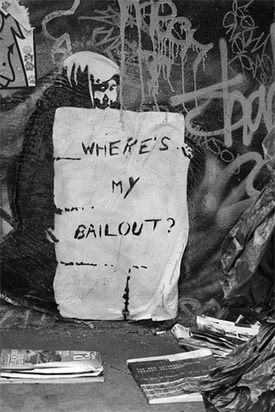
“Where’s my bailout?”

And other rude questions scrawled in angry graffiti around one of New York’s wealthiest neighborhoods.

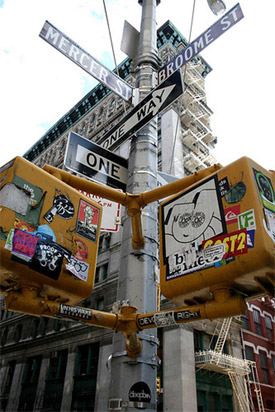
The sardonic graffiti appearing around New York’s SoHo lately seems incongruous, since this is one of the city’s wealthiest neighborhoods.

“Where’s my bailout?” a homeless woman asks in one stencil.

Another, in a pink makeshift frame with the words “The greatest depression” scribbled on it, shows a man being silenced by a United States of Debt dollar bill.

Graffiti has always adorned the buildings of SoHo, the formerly industrial Manhattan neighborhood that attracted artists with its spacious lofts in the ’70s, and today is home to top boutiques, restaurants, and galleries.

But the new wave of recession-themed graffiti feels like a throwback, or at least a vibrant collage of frustration and parody.

“It’s a free outlet for people to express themselves to a large audience,” said Timothy Kephart, creator of Graffiti Tracker, a web program that interprets graffiti. “Ironically, to express their displeasure with the economy, you could argue that the vandalism has a negative economic impact both in the monetary loss and in the quality of life loss.”

But some welcome the fresh dose of color.

“It’s awesome,” said Julian Kouyoumjian, a salesman at Kid Robot, a counterculture store on Spring Street that draws much of its essence from the graffiti scene. “We actually collaborate with a lot of street artists,” Kouyoumjian said. “It’s really popular and goes hand in hand with the stuff you see in here.”

And with new works appearing daily outside their doors, even some galleries can’t resist grafitti’s guerrilla appeal.

“It gives the neighborhood character,” said Alexandra Tayne, director of Lumas Editions Gallery on Wooster Street.

A poster depicting a man with “F___ the stock market, buy art” tagged along his sunglass lenses got Tayne thinking about the economy’s impact on the art industry.

Many SoHo gallery art buyers tend to work in the financial sector, she said, so times are also tough for galleries that rely on one big sale per month. “Luckily for us, we deal entirely with photography,” she explained. “So if we need to adjust prices, we can just make more prints. There will still be a limited number, and just a few are signed. Art has never been stopped by a recession.”

The community board that serves as the neighborhood’s main local voice doesn’t share the enthusiasm for street art.

“SoHo, like much of CB2, is landmarked,” said district manager Bob Gormley. “If graffiti is defined as any sort of tagging, writing, or painting on property owned by someone else, and doing so without the owner’s permission, it is always illegal. If a graffiti artist has the owner’s permission, that is a different matter. However, any such work would have to be in compliance with the city’s landmark laws.”

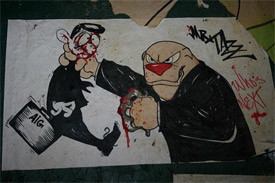
Certain pieces — like an illustration of an AIG employee being pummeled in the face by a pair of brass knuckles — seemed unlikely to win approval, anyway.

Resident complaints have waned considerably, though. Everyblock.com, a website that uses the mayor’s Community Affairs Unit database to compile data graffiti cleanup requests, indicated that complaints dropped significantly after the recession.

From January 2008 to April 2009, 101 graffiti cleanup requests were filed in SoHo, 70 by August 2008. But from September 2008 (when the investment bank Lehman Brothers collapsed, an event linked to the beginning of the recession) to March 2009, a mere 31 requests were filed.

Maybe SoHo residents are discovering an appreciation for graffiti. Or maybe they have bigger things to worry about nowadays.

“My apartment has been hit with graffiti, and it feels terrible,” said New York University student Louis Formica. “I didn’t ask for it to be tagged. It’s a strange feeling to know someone stood outside your house and vandalized it.”

If only bad news graffiti could always be on someone else’s property.


SoHo graffiti turns topical. 


Reports of violence

On the Mexican crime beat.


Perhaps the most consequential single episode in the recent history of the northern Mexican city known as the Laguna occurred on May 13, 2007. On that sunny Sunday afternoon, local political heavyweight and underworld boss Don Carlos Herrera and his wife were on their way back from a trip to the local Sam’s Club when their armored car was intercepted by an armed unit. The assailants riddled the car with more than 100 rounds.

Like hurricanes, armored cars are measured on a scale from one to five, with level-five armor offering the greatest capacity to repel projectiles. Herrera’s Cadillac Escalade was a level four, but the bullets, which had never before been seen in the Laguna, blew right through it.

Both Herrera and his wife suffered bullet wounds, and they were raced to a nearby hospital. Scores of local police maintained a one-block perimeter around the area, with no unauthorized person allowed to come any closer. Herrera and his wife survived, but Herrera’s longstanding control over the local drug trade was no longer undisputed. The battle for the Laguna had begun.
 
Carlos Castañeda is a stocky man in his late 20s, with a shaved head and a wide, welcoming face. He’s worked as a reporter in the Laguna since he graduated from college in early 2000, which he says was the fulfillment of a long-held dream.

“I always wanted to work for a media outlet. As far back as I remember, that’s what I wanted to do. It seemed like the most interesting career. My family wanted me to study some other major, engineering, something that paid a little better. But no, it wasn’t what caught my interest.”

The city where Castañeda works is actually made up of several cities: the Laguna is the colloquial name given to the neighboring municipalities of Torreón, Matamoros, Gómez Palacio, and Lerdo. With more than a million inhabitants, it is the ninth-largest metro area in the nation. Its economy (based largely on exports), quality of life (relatively high), and weather (hot as can be for 10 months of the year, bone chilling for two) make it a typical northern Mexican metropolis.

When I first moved here in 2005, the tranquility of the city and the trustworthiness of its inhabitants were among its foremost traits. While neighboring regions suffered under the weight of surging drug-related violence, the Laguna was an oasis of calm, an unlikely “Pleasantville” just south of the border region. You could walk around late at night undisturbed. Physical violence didn’t go beyond bar fights. Sightings of machine gun–toting federal police and army troops were limited to the television.

In May 2007, Castañeda was a relatively new reporter to the crime beat at La I, a local tabloid newspaper with a penchant for splashy photos and direct, pithy headlines. At that point, Castañeda’s reports revolved mostly around drunk driving accidents. As luck (or more precisely, his schedule) would have it, Castañeda was not working the day Herrera was attacked. But an event of such significance prompted a phone call from his editor, and when he went to work on Monday, he began following the story. This meant little more than the mundane task of tracking Herrera’s physical improvement in the hospital, but the broader significance of the event would soon be known.

The attempted assassination of Herrera was the opening shot in what has turned out to be a very long battle for control of the city. The drug gang known as the Zetas — founded by ex-military officers and linked to traffickers in the Gulf state of Tamaulipas — had moved into town and was determined to rip control of the Laguna from Herrera and his backers in the Pacific state of Sinaloa. At stake were both valuable smuggling routes (Torreón is just six and eight hours, respectively, from key border crossings in Nuevo Laredo and Juárez) as well as the growing local drug market.

What followed was a string of recriminations, kidnappings, threats, grenade attacks, and killings that carry on to this day. In the days following the attack on Herrera, the leader of the region’s anti-kidnapping unit, Enrique Ruiz, was himself kidnapped; his captors videotaped their blindfolded victim identifying local businessmen as being in a league with Herrera.

As Ricardo Ravelo narrates in his book Chronicles of Blood, the Zetas then arranged for the video to be shown before a reunion of a local business group, many of whose members were implicated by Ruiz. A letter was read to the gathering, which warned, “The person who has illicit business outside of our organization will be bothered … be informed that any disobedience before our petition will bring irreversible consequences for yourself and your business partners.” According to Ravelo, 25 private aircraft left the area for the United States the following day.

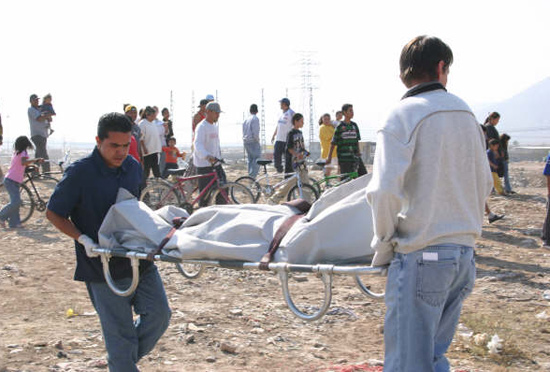
Today, more than two years later, incidents worthy of an action film are regular occurrences. The city awakens to the sight of executed bodies on a near daily basis.

Last summer, an armed group attacked the police station in Lerdo in broad daylight, killing four officers and beating up female employees before fleeing. (The chief resigned shortly thereafter.)

In September of 2008, Torreón received national news coverage when the army arrested several dozen of its local police for working for the Zetas. Torreón celebrated Christmas Eve with a gun fight in the midst of a downtown shopping rush, and rang in the new year with a nationally televised, four-hour firefight that caused the evacuation of the city’s toniest neighborhood. Schools around the region closed days early, ahead of the 2008 Christmas holidays, due to rumors that armed groups were planning to force their way into the schools to rob all the teachers of their Christmas bonuses (worth two weeks of salary). It’s as if the various cities making up the Laguna are competing for the most sensational headline. 
For Castañeda, all this has meant navigating a city that was far different than the Laguna in which he had grown up. A common trope about the drug wars in Mexico is that the drug gangs only kill each other. There’s an element of truth to that, but the underworld fighting invaded the daily routines of the Laguna as a whole. The Zetas created a climate of fear that extended well beyond those who make their living smuggling cocaine, marijuana, and the like northward. They supplemented their trafficking income with car theft, kidnapping, and extortion, all of these crimes much more of a public menace than the peaceful passage of drugs. Other criminal groups, dedicated to many of the same activities, took advantage of the chaotic backdrop to establish a toehold in the Laguna underworld.

The press was among the casualties. Castañeda talks about a local press corps that was threatened and bullied. Various newspapers and television stations were threatened as well. One reporter in Gómez Palacio was kidnapped and beaten up in response to something he wrote, but Castañeda said the threat to the local press went far beyond one mere incident.

“More than a direct threat against any reporter in particular, what you see is a change in the climate in which the reporters work,” Castañeda says. “The editorial chiefs say to be careful, to not investigate too much.”

“[You write] what the authority tells you, no more. Don’t search for more, don’t ask, don’t investigate, period. This is the problem, the self-censorship that has taken hold in the media outlets, which definitely goes hand in hand with the fact that it has gotten more dangerous. That’s how the reporters see it.”

Reporters in the Laguna have reason to be concerned. Mexico is one of the most dangerous places on the planet for a reporter, with more than two dozen journalists killed since 2000, and a handful more who have disappeared. Both Reporters Without Borders and the Committee to Protect Journalists rank Mexico as the most dangerous country in the Western Hemisphere to work as a reporter. From the federal government down, official efforts to address the problem have been slow and ineffectual.

Castañeda says the impact of the threats is palpable. “These threats, whether they are real or not, have modified the way the coverage is carried out.” In response, some newspapers also removed authors’ bylines from crime stories and had local police stationed at the entries to the offices throughout the workday. Media outlets also coordinated their coverage, so that no one newspaper or TV station stood out too much.

Castañeda adds: “Between the media outlets, there’s a discussion among the editorial bosses, the directors, when there’s a story about a murder, and execution — any of that — it’s treated with official information, with information sent by the procuduría, and since then, nothing has been investigated. Nothing is published beyond that which is official information. Information that the authorities provide. There’s no way to balance this information. So as to not get us in trouble, to not investigate too much, to not receive threats, to not be singled out, to not provoke these powers — the drug traffickers — we’re going to go with official information.”

At the same time, the basic obligations of the job hadn’t changed, which left people like Castañeda walking an increasingly fine line. “The reporters have to be playing two games — with the company for whom they work, and with the authority. And with the organized crime, too.”

“Now the officials are so scared, that they say, ‘Don’t put me in the news. Don’t interview me, please.’ It’s really tricky, the situation now. Before, the same functionaries would call you and tell you, ‘I have a detainee here, it’s interesting’ … The authorities themselves feel threatened.”

The vacuum that the threatened media left behind ceded space for the dissemination of news through other, less formal means. Alarming, and often brutally graphic, email chains spread news of assassinations, as well as warnings of upcoming violence.

Incidents like those described above were accompanied by the daily dissemination of fear-mongering email chains. Most, written by a concerned citizen or someone pretending to be one, warned against imminent bloodbaths at some bar or another: “So I ask you to please listen it’s for your good don’t go out to bars in the night and if you see trucks without plates report them. In Lerdo be careful in San Isidro and Back Stage. Gómez: In Flamingo’s and Tonic. Torreón: K-pital and La Quinta bar.”

Other emails claimed to be the voice of one trafficking group or another, and tried to justify their presence while condemning their competitors: “[W]e DON’T KIDNAP, NOR ROB, NOR DO WE HARM INNOCENT PEOPLE, we ask that you don’t get scared with big-talking assholes that act with impunity because they are protected …”

Still others served no communicative purpose other than to terrorize. I once received an email that was just a series of snapshots of severed heads in a convenience store, all with a bloody “Z” carved below the hairline.

The impact of the rising tide of drug-related violence in Mexico has extended far beyond one mayoral administration or a small coterie of business big shots. The Laguna has seen the organic weakening of society, from top to bottom. Mexico City columnist Ricardo Raphael captured the prevailing sense of chaos during an August 2008 column:

“Until a little while ago, the Mexicans from the Laguna were famous for being big spenders and big partyers … Now, nevertheless, the streets of the Laguna empty out at eight o’clock at night and consumption has plummeted. The war against drug trafficking has dramatically affected the lives of these residents. As in Tijuana, Juárez, or Culiacán, here also fear has gained ground.”

The same day that Raphael’s column ran, a heavily armed military convoy — totaling 350 ski-masked soldiers and more than 50 Hummers and troop transports — drew stares while proceeding down Torreón’s main drag. A dozen police patrol trucks accompanied the soldiers, a handful of jackals escorting a pack of lions. The soldiers reassured the inhabitants that there was an official authority more powerful than any drug gang, but violence didn’t drop. Indeed, it continued to rise.
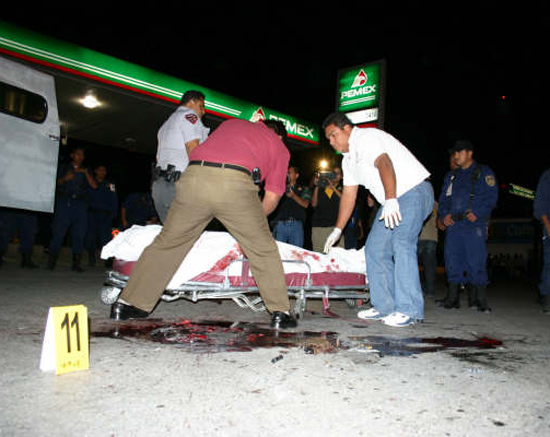
Just before the new year, Castañeda switched off the crime beat. Like the ex-police chief in Lerdo, he cited stress as a reason for the switch. Since his professional interest is based less on covering crime than in reporting generally, it has been an easy adjustment. Now he writes international and national news summaries, studies English in his spare time, and freelances at a new magazine called Magdalenas, which focuses on sexuality in the Laguna.

Mexico as a whole saw a drop of 26 percent in drug-related killings in the first three months of 2009. Some of the biggest drops were in Tijuana (79 percent), Juárez (39 percent), and Culiacán (45 percent) — the same trio of perennially drug-addled cities mentioned by Raphael.

Unfortunately, the Laguna largely missed out on this hopeful trend. More than 120 people were killed from January to March, which would give the Laguna a murder rate greater than any in the United States. In one night in February, 11 people were killed in firefights around the city.

In mid-May, a reporter from La Opinión, one of the two major dailies in the Laguna, was abducted and murdered. He was the first reporter to be killed for his work in the city. In its influential Bajo Reserva editorial column, Mexico City’s most prominent newspaper, El Universal, had the following reaction:

“They tell us that in the Laguna things are very, very dangerous for the press, and for society in general. Two groups are fighting for the city: Zetas and ‘the ones from the house on the hill.’ The former are locals. They tell that the two groups continue giving forced conferences to the press. Be careful. The Laguna is coming apart; some say it could be the next Juárez.”

The civilian population, from the mayor’s office, to the press, to the burrito vendors, remains cowed. The reporters who are able, find safer topics than crime to write about.


Icelandic financial crisis

A mini documentary.

Poet, activist, and newly-elected MP and party group chairman for the Civic Movement Birgitta Jonsdottir speaks about the economic troubles facing Iceland today.

Click here to read an interview with Birgitta Jonsdottir.


Today, finance and trade bailouts are too often in the headlines

But where is justice for the oppressed and the homeless?

raptorial kangaroo courts
 
the walrus and the ostrich
converse on the way of man
seasonal equinox
a burden to his plan
yesterday’s migrations
lost in confetti news
as schedules are no longer
yours and mine to choose
molted are the costumes
and flightless are the days
when raptorial kangaroo courts
feign interest in the strays
 

hidden tents
 
beyond the superstore
canvas replaces walls
hidden from the cameras
and gone with morning dew


Niagara for better or worse

How did a natural beauty like Niagara Falls become so tacky? And how is it that despite that tackiness it still holds a charm?

Driving our minivan down Clifton Hill, Canada’s first tourist trap after the American border, I’m cringing at the Louis Tussaud’s Waxworks (a knock-off of the knock-off) and the giant Frankenstein holding a burger. What I see is carnival craziness. What I’d rather see is a national park with picnic tables, a few deer, and maybe a parking lot where families can pile out of their cars and take a photograph of the falls.

But – driving our minivan down Clifton Hill, Canada’s famous street in the Niagara region, I hear a chorus of "ohhs" and "ahhs" coming from my Hungarian in-laws who are stuffed into the passenger seats behind me. They’re saying things like "wow," and "beautiful" in Hungarian while the cameras are snapping and the DVD recorder rolling.  It’s excitement compressed into a small family vehicle.

And it’s contagious. An hour later, my new husband and I are walking down Clifton Hill with his parents. Muscle cars are parading past, lights are blinking and spinning with color, and we’re laughing at the camera while posing beside the world’s tallest man…and even though I still think it’s one of the tackiest places on Earth, I also can feel the excitement and fun that thousands of couples may have felt on their honeymoon.

I suppose Niagara depends on the eye of the beholder. It isn’t my first choice (or my second, or my third, or even my twentieth) – but it has been fun to share in the excitement of others.  It seems that despite myself, I might actually enjoy my honeymoon.


An urban oasis, a treasure behind the waterfall

I am fascinated by the oases you find in the midst of a desert, or in my case, the midst of New York City. Most of us know about Central Park and have seen a couple of red-tailed hawks nesting in one of the nearby penthouse terraces. New York City is full of oases, from community gardens to the most beautiful live violin music down in the subway you have ever heard in your life.

On Memorial Day, I went hiking in the Tenafly Nature Center in Northern New Jersey. Tenafly is a quaint suburb just ten miles outside of New York City. I had the pleasure of seeing lots of chipmunks, a small garden snake, and a wild turkey. Although there were tons of mosquitoes eating me alive, I walked alongside a lovely lily pond, hearing only the low funny moans of bullfrogs. In fact, I saw the most perfect-looking bullfrog hanging out on the most perfect-looking lily pad.

It is these moments of finding oases that make life worth living. As an artist, I have days when I am parched in the desert sun, dehydrated of inspiration. And then I have a wellspring of water which comes just in time. Who would have ever thought I would find that in this urban jungle? In every jungle there is a waterfall, and behind that waterfall, a secret treasure. I am learning that I find it in the stillness of my mind. It was waiting for me the whole time. 


New in California


But the most interesting thing I found in California is the way the local media is dealing with Prop 8/gay marriage right issue. Yesterday, just hours before the California Supreme Court was to hand down the decision on whether Prop 8 (gay marriage ban) stands, the local news media went crazy. The day I arrived here (two weeks back) the issue was already dominating local news media.

I take no position on the gay marriage issue; it is not for me to comment. What got me fired up is the way local media handled the issue. Their bias is so clear and they make no efforts to hide it. I know it is futile to ask for fairness in the media, especially after the way they handled Hillary Clinton during the primaries and the whole terrorism madness before Iraq was attacked, but I still find it interesting that Fox News is happily attacked for being pro-GOP while the liberal bias of some news outlets is accepted.

personal stories. global issues.