A is for ambivalent

BEST OF IMAGINE 2003 (tie). The rise, fall, and pending resurrection of an Asian American magazine.

I remember reaching for the first issue of aMagazine when I saw it on a drugstore newsstand more than a decade ago. Here, I thought to myself, was a magazine unlike the others that I was reading–Sports Illustrated and Newsweek, at the time. Here was a magazine that purported to speak to and for Asian Americans. Here was a magazine that, well, was supposed to be for people like me.

In the years that followed, I became an on-again, off-again reader, never subscribing but also never failing to flip through its pages when I spied copies on newsstands. I don’t recall ever being thoroughly impressed by it. To me, at least, the magazine smacked of shallow materialism and appeared too preoccupied with pop culture; I thought it was nothing more than a glossy lifestyle publication stuffed with puff profiles of Asian American celebrities. But I always appreciated its existence and visibility. At the very least, aMagazine put a new Asian American face on newsstands throughout the country six times a year, not an unremarkable accomplishment when major news magazines rarely featured Asian Americans on their covers.

So it was with ambivalence that I greeted the news of the magazine’s demise last year. aMagazine had merged with Click2Asia, a website geared toward young, Internet-savvy Asian Americans flush with cash, and when the site shut down last February, it brought down the magazine as well. aMagazine issued its own public farewell. In a terse but heartfelt statement, the staff thanked its contributors, advertisers, and subscribers. I wasn’t sure whether to feel glee or gloom.

In spite of (or because of) my initial impressions of aMagazine, I spent a few days at the New York Public Library reading back issues. At first these sessions confirmed my suspicions about the publication’s editorial direction. Most of the articles left a saccharine aftertaste, but I came to realize that, as far as Asian Americana goes, aMagazine was the best thing out there.

Not just another pretty face

aMagazine arose out of a Harvard campus publication for Asian Americans in the late 1980s. Editor Jeff Yang would become a central figure at aMagazine as co-founder, editor, and publisher. The magazine’s original aim was to fill a void not addressed by either the mainstream press (which appeared not to care about issues pertaining to Asian Americans) or the various ethnic presses (which did not cater to an English-speaking audience).

In true plucky upstart fashion, the founders set up shop in a Brooklyn basement in 1989. A trail of offices maps its ascent: Chinatown, then Soho, then Midtown. Cheap paper and a crude layout gave way to glossy elegance, then a profusion of colors and graphics. The semiannual became a quarterly, and by early 1995, aMagazine had gone bimonthly. By 1999, it enjoyed a circulation of about 180,000 and advertising sales of around $1.1 million. By any reasonable standard, the publication could be considered a success.

A quick review of the archives shows that aMagazine emulated Vanity Fair‘s formula: reel readers in with a celebrity on the cover, then run news-driven or investigative articles within. aMagazine certainly wasn’t going to sell copies by showcasing Paul Igasaki, the vice chair of the Equal Employment Opportunity Commission, or Norman Mineta, the Bush administration’s transportation secretary. (To be fair, it’s not like my mug shot could ever induce anyone to cough up $3.50 either.) So sultry actress Tamlyn Tomita, heartthrob chef Ming Tsai, and tennis standout Michael Chang would have to do the hawking. Of course, whenever the stateside celebrity supply threatened to run out, the overseas reinforcements could always be shipped in: Chinese actress Gong Li or Hong Kong leading man Chow Yun-Fat.

Yang, to his credit, understood the compromise. In 1996, he acknowledged the difficulty of achieving a balance between covering social issues that were important to Asian Americans and wooing advertisers. Furthermore, he recognized the opportunity his magazine had to shine a spotlight on people of political or cultural significance who otherwise may have gone unnoticed by the national press. “There aren’t enough positive, or at least interesting Asian American role models out there,” he told the New York Times. “We want to pull the shroud off of people who have achieved, not just people who have made lots of money but who are lifelong activists or artists.”

To this end, aMagazine brought exposure to such people as emerging playwright Naomi Iizuka, novelist Lois Ann Yamanaka, and politician John C. Liu, the first Asian American elected to the City Council in New York. It also opened its pages to Karen Narasaki, the executive director of the National Asian Pacific American Legal Consortium, and Christine Chen, the eventual director of the Organization of Chinese Americans, who wrote about Congressional legislation mandating an English-only rule in classrooms and the national effort to increase voter participation among Asian Pacific Americans, respectively.

Always a bad sign: an awards show

Still, that precarious balance seemed to shift away from thoughtful articles about politics and culture as the magazine increasingly emphasized lifestyle. In its later years, aMagazine ran articles on food, travel, and health on a regular basis. An advice columnist and horoscopes popped up, and fashion and style dominated the publication more and more. The magazine soon resembled a catalogue; one issue touted cashmere pillows, linen pajamas, and flannel slippers. And nothing could encapsulate aMagazine‘s preoccupation with glamour and celebrity more than the Ammy Awards, an annual gala event started in 2000 to celebrate Asian America’s presence in Hollywood. The awards allowed the magazine’s readers to nominate candidates for such categories as “Best Hollywood Picture” and “Best Performance by an Asian/Asian American Female Actor in a Cinematic Production;” winners were selected by a panel composed of Asian Americans in the entertainment industry.

Yet, amid all this bling-bling and celebrity worship, I found some inspiring, truly insightful journalism. These articles investigated important issues and painted a richer, more engaging portrait of Asian America. One such article was written by Phil Tajitsu Nash, founding executive director of the National Asian Pacific American Legal Consortium. His clear-sighted profile in the February/March 1996 issue of Dinesh D’Souza, the conservative pundit who first gained notoriety with 1987’s Illiberal Education, highlighted the peculiar role of Asian Americans in society. “Being neither black nor white in a society with a bipolar view of race, he personifies the dilemma facing all Asian Americans,” wrote Nash. “They, like South Africa’s infamous ‘colored’ class, must submit to and support a racially unjust status quo as the price of conditional acceptance as ‘model minorities.'”

In addition, writer Terry Hong offered an intriguing exposition of the ideas of Frank Chin, the controversial literary figure and co-editor of Aiiieeeee!: An Anthology of Asian American Writers, in the February/March 1995 issue. Chin claimed that literature written by mainstream Asian American authors such as Maxine Hong Kingston, Amy Tan, and David Henry Hwang are rooted in myth. “These false books are great literary flaws that only work in the Western language, that only appeal to those who believe in the Western stereotype of the Chinese,” Chin told Hong. “It’s white racist text. I mean it .  . . . Their version of Chinese America wants to be white, to think white, to marry whites, and therefore become culturally and racially extinct.” What is so remarkable about Hong’s piece is that it allows Chin to undermine the very sort of figure that aMagazine lived to venerate.

Karl Taro Greenfeld, now editor of Time Asia, wrote an article that also deserves mention. In the August/September 1995 edition, he profiled the emergence of Asian American actresses in the adult video industry. In particular, he examined the lives of porn stars Asia Carrera and Annabel Chong. I was surprised to see that aMagazine didn’t flinch from covering such a salacious topic. (Could you imagine Carrera or Chong sashaying across the red carpet to accept her Ammy Award?) It was a glimpse into the shadows of the Asian American community that presented a more wide-ranging view of Asian American identity.

Another distinguished article, published in February/March 2000, investigated the plight of Wen Ho Lee, the Taiwanese-American nuclear scientist at Los Alamos who was jailed after being accused of passing along state secrets to China. Hindsight reveals that aMagazine‘s piece ran just as Lee’s fortunes began to subtly shift, though few knew it at the time. To bring attention to this civil rights case when it did showed editorial courage and a keen sense of timing.

Out of the ashes?

I couldn’t help but detect the distinct odor of irony when I noticed that both the last issue of aMagazine and the February 18, 2002 issue of Newsweek displayed ice skater Michelle Kwan on their covers. Then I recalled that baseball superstar Ichiro Suzuki had not only recently appeared on the front of aMagazine, but also on several issues of Sports Illustrated. If figures such as Kwan and Ichiro graced the covers of prominent mainstream magazines, did Asian Americans need aMagazine anymore?

After reviewing the history of aMagazine, the answer is yes. Many intriguing political, social, and cultural issues were mined–and still could be. Call me greedy, but it’s not enough just to put Asian American faces on magazine covers. Ask yourself if Newsweek or Time would ever explore controversies in Asian American literature or probe the difficulties associated with possessing an Asian American identity in the political or intellectual arenas? Or just glance at Newsweek‘s puff profile of Kwan last year: “Look for a 21-year-old L.A. babe who’s an A-list celebrity, whose boyfriend is an NHL defenseman and who abruptly canned both her longtime choreographer and her coach last year–in short, a Kwan ready to kick ice.” The piece was thorough, but nary a word about the infamous–infamous, at least, in the Asian American community–headline on MSNBC’s website after the California-born Kwan lost the gold medal to Tara Lipinski at Nagano in 1998: “American beats out Kwan.” Now, I don’t think this issue should have dominated the Newsweek piece, but I would have liked to hear Kwan’s thoughts about it (or see if she would have been willing to talk about it at all). Shedding light on the gaffe could have prevented the same error in the Seattle Times, which ran this secondary headline after Kwan lost at Salt Lake City to Sarah Hughes: “American outshines Kwan.” Whoopsy daisy.

Well, aMagazine might be on its way back. A holding company called GC3 and Associates currently owns Click2Asia and aMagazine, according to Pierre Wuu, associate partner of GC3 and CEO of Click2Asia. GC3 recently relaunched Click2Asia as an online dating site for Asians and is reviewing plans to revive aMagazine.

Unlike its first launch, however, aMagazine will have to take a look in the rearview mirror. Publications such as Yolk, which reads like a dumbed-down version of Maxim, and Giant Robot, which covers Asian pop culture cool, have gained formidable followings. An upstart magazine called Hyphen, based in San Francisco, will release its first issue this March. In contrast to Yolk and Giant Robot, Hyphen will adopt a more generalist approach, mixing serious investigative reporting with light cultural fare. More like aMagazine, in other words.

If aMagazine indeed relaunches, if Hyphen overcomes the inevitable obstacles of starting up, and if Yolk and Giant Robot continue to roll along, the competition will be exciting. The editors of each will all have to keep close tabs on the others. They may also have to vie for the same advertising dollars, and they will certainly be vying for content. The struggle may not be pretty, but collectively, the magazines would cover the Asian American community broadly and allow Asian American writers to make themselves heard on issues long ignored by America’s mainstream media.

Let the battle begin.

STORY INDEX

CONTRIBUTORS >

The writer
William S. Lin, Inthefray.com Contributor

The artist
Marvin Allegro, Inthefray.com Contributor

MARKETPLACE >
A portion of each sale goes to Inthefray.com

Aiiieeeee!: An Anthology of Asian American Writers
Edited by Frank Chin, et al | New American Library | 1974 Amazon.com

Illiberal Education
Dinesh D’Souza | Free Press | 1987 Amazon.com

ORGANIZATIONS >

National Asian American Telecommunications Association
URL: http://www.naatanet.org/
Official website

PEOPLE >

Carerra, Asia
Filmography
URL: http://us.imdb.com/Name?Carrera,+Asia

Chen, Christine
Announcement and profile
URL: http://www.ocanatl.org/news/pr05222001.html
Organization of Chinese Americans

Chong, Annabel
Filmography
URL: http://us.imdb.com/Name?Chong,+Annabel

Chow, Yun-Fat
Filmography
URL: http://us.imdb.com/Name?Chow,+Yun-Fat

Gong, Li
Filmography
URL: http://us.imdb.com/Name?Gong,+Li

Iizuka, Naomi
Profile and catalogue
URL: http://www.newdramatists.org/naomi_iizuka.htm
New Dramatists

Lee, Wen Ho
Official website
URL: http://www.wenholee.org

Liu, John C.
Official website
URL: http://www.liunewyork.com

Naraski, Karen
Profile
URL: http://www.apa.org/ppo/issues/pnarabio.html
National Asian Pacific American Legal Consortium

Yamanaka, Lois Ann
Profile
URL: http://www.infoplease.com/ipa/A0880669.html

PUBLICATIONS >

aMagazine
URL: http://www.aonline.com

Vanity Fair
URL: http://www.vanityfair.com

Yolk
URL: http://www.yolk.com

Giant Robot
URL: http://www.giantrobot.com

Hyphen
URL: http://hyphenmagazine.com

Click2Asia
URL: http://www.click2asia.com

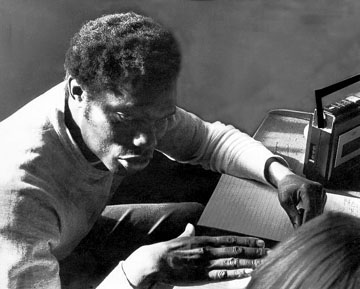
Prisoner with conscience. Ibn Kenyatta, a celebrated writer and artist, has been imprisoned since 1974 for the attempted murder of a police officer. Kenyatta maintains that he is innocent of the crime and has repeatedly and publicly refused parole since he was first eligible in 1988. This photo was taken in 1977 at the prison school of Green Haven Correctional Facility in Stormville, New York. Peter Sinclair

Best of In The Fray 2002

The votes have been counted, and we are proud to present the Best of In The Fray 2002:


Commentary: War in a Time of Ignorance, by Bob Keeler

Culture: Let the Rhythm Soothe You, by Jia-Rui Chong

News: Freedom, Deferred, by Marguerite Kearns

Photo Essay: The High Line, by Jonathan Flaum


Freedom, Deferred, by Marguerite Kearns (February/March 2002), received the most votes of all the pieces published in our pages this year. Below we list some of the comments that we received from readers about this article.

We at In The Fray wish you a very happy New Year. We will not be publishing in January, but will see you again in February 2003.

Victor Tan Chen
Editor, In The Fray
Boston


Freedom, Deferred
Ibn Kenyatta is a writer and artist—and a perpetual prisoner.
February 7, 2002, and March 7, 2002 (two parts)
By Marguerite Kearns

“The Internet is a wonderful medium for providing the intentionally-overlooked news. Choosing just one to vote for is difficult but, yes, I do choose ‘Freedom, Deferred.’ I choose it because although I’m dyslexic, the writing style was so tactile that I forgot I was even reading—this is very rare for me.” —Tobias Bloyd

“I know from personal experience what the New York prison system is like—I was incarcerated for four years myself (thank God it was such a short time). And the ibn Kenyatta facts need to be known.” —Peter Sorensen

“It captures the essence of the case and addresses the pitfalls of our justice system in a compelling and readable manner. The author knows her ‘beat’ and her work serves to enlighten the readers and possibly improve our justice system.” —Yva Momatiuk

“Through her writing, Ms. Kearns helps me identify both with Mr. Kenyatta as a black human being facing the oppression of an injustice system, and also with Ms. Kearns herself as a white human being facing her own ancestors’ history as purveyors of injustice and the urge to be ‘free’ of direct or implied duplicity in the injustice system of today. In this way, she touches on illuminating parallels between Mr. Kenyatta’s refusal to cooperate with the parole system, and her own refusal to simplify her life by letting go.” —Charles Goodmacher

“I’d like to cast my vote for ‘Freedom, Deferred’ by Marguerite Kearns, an engaged and engaging piece of first-person reporting that paints an unflinching portrait of its subject (ibn Kenyatta) while offering a clear-eyed view of the corrupt, brutal, and backward nature of the correctional system that confines him. A great job.” —Mikhail Horowitz

“A talented, sensitive writer who is not afraid to get inside another point of view.” —Nichoe Lichen

“This is a great piece. I really like it. Excellent journalism.” —Stew Albert

“‘Freedom, deferred’ is a well-written, powerful, and thought-provoking piece! I felt that ibn Kenyatta’s story is one that beautifully shows the indomitability of spirit and creativity and how it can flourish in any environment! I will look forward to reading and seeing more from In The Fray.” —Les Mound

“Thank you for this great article on ibn Kenyatta. I trust that you will do all in your ability to bring pressure to bear against this injustice system that denies human dignity, and freedom to Kenyatta, political prisoners, and prisoners in general.” —Chaka

“We like this story because it is both a poignant human drama and at the same time a powerful indictment of the New York State prison system.” —John and Sheila Collins

“Her style is informative, interesting, to-the-point, and is adequately and professionally emotive without being excessive.” —A. Fuller

“The writing is clear and crisp, direct and engaging. Her topic is unique: Rarely have I heard such a courageous man stand by his principles under such pressure, except for [civil rights movement leader] Robert Williams of North Carolina. Ms. Kearns is generous to her subject while giving both sides of the parole argument. If it weren’t for her work in Inthefray, how would we have Mr. Kenyatta’s story known?” —Jane VanDeBogart

Victor Tan Chen is In The Fray's editor in chief and the author of Cut Loose: Jobless and Hopeless in an Unfair Economy. Site: victortanchen.com | Facebook | Twitter: @victortanchen


Let the Rhythm Soothe You

Best of In The Fray 2002. Transforming a neighborhood through art, love, and mindful drumming.

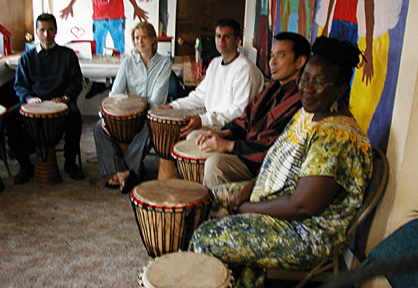
Group of people sitting behind drums

It’s a part of Oakland the kids call ‘Ghosttown.’ They give various explanations for the name: bad things happen here; the streets are vacant, without the hum of thriving businesses; the black people who walk the streets at night look like ghosts. In other words, West Oakland isn’t exactly a destination. Cars may pass through here, but they stick to the interstate freeways along the edges of the neighborhood.

The corner of 33rd and West, however, is a different story. Here, in a duplex that used to be a crack house, the Attitudinal Healing Connection has opened up shop. On any given day, this non-profit community center is a hub of activity. People are constantly going in and out of the front door for after-school art programs or around back to check on their squash in the garden.

The AHC, simply put, is a nontraditional arts center, a school where you can take classes in painting, photography, and African drumming. But it is much more than that. It is a local effort in a national movement called attitudinal healing, which seeks to help people find inner peace by changing their attitudes toward personal problems. It is the most passionate of personal crusades—one family’s effort to transform a blighted city neighborhood, one heart at a time.

Whatever optimistic energy the center exudes, it has apparently been contagious. Near the house, where bougainvillea climbs up the porch posts and young trees sprout out of recently laid sidewalk, the neighbors have been cleaning up their property, too. All this fixing of fences and planting in yards to keep up with the Joneses.

Or, the Clotteys, to be exact.

Before we came here, it was like a Third World country,” says Kokomon Clottey, who opened the AHC in this neighborhood in 1994 with his wife Aeeshah and Aeeshah’s daughter Amana Harris. He points to the house across the street. “In 1994, that house didn’t sleep. They were always drinking or selling drugs. There was always the TV, partying, friends, cars—all kinds of madness.”

A white family, the Belknaps, used to own the house. Though it had a security system and bars on the windows, people still raided the house easily, even hauling a refrigerator out the front door once. The Belknaps were desperate to sell it. They even offered to loan the Clotteys the $10,000 needed for purchase and renovation if the Clotteys would use it for their arts center and live above it. The Clotteys were hesitant at first; it didn’t help that a man was killed across the street as they were considering the deal. But finally they decided they couldn’t refuse the opportunity to get to work in a neighborhood that so needed change.

Eight years later, the Clotteys have not only survived their stay in Ghosttown, but their center has thrived and its offerings have greatly expanded. These days Oakland residents can participate in a variety of programs that include a well-known racial healing circle, an ArtEsteem after-school program for children, after-school mentoring, and personal development retreats that can be counted for credit in some educational and vocational programs. The center’s staff also visits local schools on occasion, where they put on assemblies mixing together storytelling and African drumming.

In those eight years a lot has changed in the neighborhood, too. Prostitutes used to walk the streets nearby, but after Aeeshah insisted on inviting them in to sit for a spell, no one dares to troll for business in front of the AHC. The house also hasn’t been robbed since they moved in—even though the Clotteys have forgotten to lock their doors several times. Once Aeeshah left her purse on the back step and someone brought it around the next day with the contents untouched.

Above the center’s entrance is a saying that sums up the general attitude: “Expect a miracle.”

“The center has a lot to do with pulling the community together. People go into the garden to pick fruits and vegetables. It’s much quieter now and people seem friendlier,” says Robert Ervin, who lives right behind the AHC on 33rd Street. When he moved here in 1990, Ervin says the neighborhood was “pretty raunchy,” with drug dealing and other crimes taking place in the open. But now, he says, “We’re more of a community.”

Lucille Walker, who lives two doors down from the center, plants tomatoes in the AHC’s Forgiveness Garden. Since she arrived in 1973, Walker has seen the neighborhood go through a lot of changes—but nothing, she says, like what has happened since the AHC moved in. A woman of few words, she pats Kokomon on the shoulder, saying, “Since you’ve been here, everything’s been real nice.”

The AHC is an unusually successful example of a community-based program, says Breonna Cole, a nonprofit consultant. “What makes this place very different from other nonprofits that I work with is the ethos that they work from,” she explains. “They’re not afraid to be spiritual and pull together the pieces. This is evident in the work they do, especially the racial healing circle, which seems to benefit especially white people in asking what each of us brings to the table.”

Many city officials, including Oakland Mayor Jerry Brown, have commended the center’s efforts. “The AHC’s programs have clear goals and are open to all Oaklanders,” Brown writes in an endorsement letter. “Their approach is innovative and their programs are sorely needed in the communities they serve.”

A Course in Miracles

I visit on one summer afternoon, to check out for myself exactly what’s so “innovative” about the center. Kokomon takes me around back. “We don’t put a padlock on this gate,” he says as he leads me into the Forgiveness Garden. “We want people to feel welcome and to come help us.” It’s clear, by the look of the place, that the people are coming. Tomatoes, squash, and peppers sprout everywhere. Children have painted portraits of heroes such as Mahatma Gandhi and Congresswoman Barbara Lee on stacks of tires.

As we sit down on chairs built by the East Bay Conservation Corps, Kokomon explains the nontraditional mental health principles behind the work that he, Aeeshah, Amana, and their volunteers do. There are twelve principles of attitudinal healing, he explains, that flow from a book by Helen Shucman, A Course in Miracles, as well as psychiatric research by Jerry Jampolsky. Almost three decades ago, Jampolsky found that children with catastrophic illnesses improved when they changed their mental outlook. Attitudinal healers believe that we are not only responsible for our thoughts, but also for the feelings we experience. Our pain stems from our own thoughts, guilt, and judgments about people, experiences, and events. By exploring these feelings, and coming to terms with them, we can eventually heal them and find inner peace.

“It’s easy to point a finger and say B did that to me. But if you hold onto this, you don’t feel good. You won’t feel well. You have to be responsible for your thoughts and your own feelings,” Kokomon says.

The Clotteys’ contribution has been to take this specific message of love, forgiveness, and the need to let go of fear, and to apply it to the problem of racial healing. “It’s easy to say, ‘Hey, I’m poor,'” Kokomon says. “What are you going to do about poverty? Yes, the government did this to you, but are you going to sit there and let the government put madness on you the rest of your life? If you eat food that is not good for you, it will make you sick. You are responsible.”

Kokomon and Aeeshah make shared stories the cornerstone of the monthly racial healing circles. “Many times we don’t know each others’ stories because we’re afraid of being the recipient of fear, rage, guilt, or shame,” Aeeshah says. Because conversations on race can be incendiary, she believes we must start racial dialogue by connecting all the people in the room through a common ritual. This is the reason that the Clotteys begin their circles with drumming and a reading of ground rules of respect.

“That puts us all on the same page, with the same rhythm,” Aeeshah explains. Adjusting everyone’s sense of rhythm—which affects not just the way you keep a musical beat, but also the way you talk and walk—is important to creating an expressive, honest atmosphere, the Clotteys believe. It brings all of the participants into the space of the room from the various places they have come from and untangles them from their everyday uncertainties—what Kokomon calls the “tapestry of madness and fear.” As he explains: “When we’re in trouble, our rhythm changes. Mindful drumming is about letting go of stress and putting the body, mind, and spirit in alignment. Then, we are really ready.”

This basic work of talking, listening, and (literally) harmonizing with each other, the Clotteys believe, can ultimately heal racism. “You can’t legislate people learning to accept each other,” says Aeeshah. “That requires heart work.”

“We define racism as a life-threatening disease,” Kokomon says emphatically. “It’s killing people. We don’t want to wait until people are dying, but try to take a different angle, with prevention. This is for the people who are living so they don’t get to that point.”

According to Kokomon, committed participants of their racial healing circles have made lasting changes in their lives. White people especially respond to the circles, often working out guilt about their privileged pasts. In their book Beyond Fear, Aeeshah and Kokomon recount the story of Gerd, a German-born engineer who spent many years in Liberia. As he was mourning his status as a childless and single older man, he woke up to the realization that he had fathered a mixed-race daughter in Liberia whom he had turned his back on, more than three decades earlier. “Now, all I have of her are two pictures and three strings of beads—a very personal souvenir of her mother and a whole new way of hearing the country song ‘I’m in love with you, baby, and I don’t even know your name,'” Gerd says in the book. He started searching for his daughter, putting together a computer picture of what she would have looked like at thirty-four years of age. To the Clotteys, Gerd’s story shows the timelessness of all things and the need to face the past to move on into the future. They write: “He spoke of learning more about love and forgiveness in the last few months than in the previous fifty-eight years of his life. He is now actively involved in human rights work in Liberia, with the understanding that Africa is a deeply personal matter for everyone and that every human being is someone else’s daughter or son and deserves love, attention, and respect.”

Though Aeeshah and Kokomon insist their methods have achieved tangible results, it’s also easy to see how people might respond to their unconventional beliefs with skepticism. I raise my doubts with Kokomon at one point. “Spacey? People think it’s more than spacey,” he says. “They often think it’s a cult.” He laughs; it’s hard to think of Kokomon Clottey as an evangelical zealot. Even though he and Aeeshah and Amana live by these twelve principles and hope others will live by them, too, they say their work isn’t about indoctrination. “There’s a difference between being spiritual and being religious or dogmatic,” Kokomon says. “If you’re dogmatic you separate people. We’re nonpolitical and include everyone and everybody.” In his view, the principles of attitudinal healing are nothing more than ground rules for human decency in people’s everyday lives. “We just want to give them tools to improve their life. That might just be planting tomatoes in the garden.”

Amana sees their outside-the-box thinking as an advantage in these times. “Traditional methods and standard thinking are not working for our kids. They’re not living in standard homes. The question is how we support children for these conditions,” she says.

Once they get to know what really goes on at the center, parents seem to support the Clotteys’ methods. Anthony Hall said he hesitated before sending his eight-year-old daughter Kenya to the AHC because he worried that its nontraditional principles had something to do with cult-like behavior. But he eventually came around. “The AHC’s principles are humanistic. They don’t contradict our Christianity,” he says.

Interestingly, both Aeeshah and Kokomon grew up in Christian households—Aeeshah in small-town Louisiana and Kokomon in Gamashie, Ghana. It took them time to come around to attitudinal healing. Aeeshah’s early frustration with the racism she felt as a student at the University of California at Berkeley led her to the Nation of Islam in her search for racial uplift and support. But after seven years with that black nationalist group, she wasn’t sure she had found the answers to her questions. “I had an enormous amount of love in my heart,” she writes in Beyond Fear. “However, it was only shared with a portion of people on earth, and I added to my confusion by teaching this lesson to others. I taught love and fear.” Then Aeeshah attended a seminar where she was introduced to Helen Shucman’s book, A Course in Miracles. She suddenly felt as if she had found her spiritual path. She headed next to Tiburon, California, to meet with psychiatric researcher Jerry Jampolsky, and decided then that she was going to begin a new line of work.

Aeeshah introduced Kokomon to the ideas of attitudinal healing in 1990, as the two of them were collaborating on a tape of spiritual poetry set to African drumming. Kokomon, who was born in Gamashie as a member of the Ga-Adabe people and came to America as a musician in 1977, soon found that the principles of attitudinal healing resonated with the experiences of his own life—in particular his encounters with American racism. He brings all his talents to his work at the center, weaving the principles of attitudinal healing into what he has learned as a medicine man, modern interpreter of the Ga-Adabe’s wisdom and rituals, and master drummer.

Right now, the AHC keeps going through the full-time efforts of Kokomon, Amana, and several dedicated volunteers. Aeeshah’s salary as an assistant program director at Casa de la Vida, a residential psychiatric treatment center in Oakland, forms the basis of the center’s $100,000 annual budget. The AHC also receives substantial supplemental grants and some local contributions, but is still actively looking for other sources of income to expand their programs and their staffing.

Building a Better Oakland, One Popsicle Stick at a Time

In their version of West Oakland, the fish market is in-between the fire station and the senior living facility. A movie theater, bowling alley, pet store, and farm are near the AHC. Hoover Elementary School is on the next block, near the community garden, toy store, clothing shop, and arcade.

It’s a Friday afternoon, and I’m sitting in on a session of ArtEsteem, one of the AHC’s after-school programs. The twenty kids in attendance are busy building a community—one made from popsicle sticks, foam, paint, bits of wire mesh, and glue. These 3-D models are the culmination of fifteen weeks of learning about Oakland’s government, settlement history, sewage and water systems, demographics, and regional ecology under the guidance of ArtEsteem’s director, Amana Harris.

As part of their latest project, the children conducted videotape interviews with local residents, including a social worker, the owner of the liquor store on the corner, and a former drug dealer. After color-coding plots of West Oakland “beautiful,” “ugly,” or “interesting,” the kids decided what to keep, eliminate, or transform. It’s about allowing these kids to dream about a better life in the here and now, explains Kokomon. “We ask, ‘What do you want to do?’ now and plant the seeds. ‘Do you want to be a lawyer? Well, what does it take to be a lawyer? Work on it.'”

Even this little bit of daydreaming can be quite a luxury on the tough streets of Oakland. The city has already seen eighty-four murders this year; in 2001, there were eighty-seven murders. Drugs, prison, and materialism—and music that worships these things—are pervasive in children’s lives here. “The guys want to go to jail even if they’re from decent families,” Amana says. “Here, skills for boys are being able to count money, counting how many crack rocks you have, and standing on your feet for a long time.” While boys are running in the streets learning to be drug dealers, girls are shouldering the burdens of teen pregnancy.

“There are so many forces here that set kids up to fail,” Amana says. “It’s not like school gets closed down if there’s a shooting. Nobody’s really protected.”

That grim reality is all too clear to ten-year-old Tyrese Johnson. “People are already starting to do doughnuts,” says Tyrese, a veteran of the ArtEsteem program. “And there was a shooting near my school a year ago. I didn’t really want to walk home. I was afraid they’d start shooting again.”

Through painting, photography, and other creative outlets for their energies, ArtEsteem seeks to soothe the fears that afflict kids like Tyrese. “This climate is full of conflict,” says Amana. “It’s at school. They bring it over here. But we’re teaching them how to perceive negativity so it doesn’t penetrate them deeply.”

Program graduate Kamilah Craword says ArtEsteem changed her life. When she started attending sessions back in middle school, she had an “attitude” in class. “I was talking back, not doing what I was supposed to … I put all my negative energy on everybody in the class,” she wrote in one of the center’s newsletters. ArtEsteem helped Kamilah to get “back on track.” Now, rather than taking to the streets or sitting at home bored, she volunteers at the center almost every day. She helps Amana run ArtEsteem as the organization’s secretary, and swears by its effectiveness. “If this program wasn’t here I wonder where the kids would be right now. Would they be in jail? Would they be on drugs?”

Tyrese knows what he would be doing: “I’d be sitting at home, looking at the TV, getting fat. Or maybe riding around skating and stuff. But nothing artistic like this.” He gets very excited when talking about his favorite project, the kids’ larger-than-life portrait of themselves as superheroes saving West Oakland. “Super T,” he explains, has laser vision, super-strength, and, most importantly, “the power to change people’s minds, to make bad people good.” You could say that ArtsEsteem has had a similar effect on Tyrese. “I used to litter, but I don’t do it anymore,” he points out.

Breonna Cole, the nonprofit consultant, praises the AHC’s use of art to change children’s attitudes. The center, she says, has become a “place of last resort” for students who have been neglected by the school system. “The schools have no money or resources to invest in the kids,” she says. “The critical issue in Oakland public schools is that we have violence in schools and a disastrous lack of art.”

Parents also respond favorably to the program. Oakland resident and parent Anthony Hall says he particularly appreciates how ArtEsteem grounds art in the community, connecting the children to a larger sense of what it means to live in Oakland. “Here, the kids also develop friendships and relationships with other kids who are not going to the same school. They get to share common interests,” Hall says.

Kids who come to the program are sometimes labeled as troublemakers by their schools. Amana prefers to see them as “incredibly neglected, but full of love.” She has had to deal with so-called “kings of conflict” many times over the years, and under her close care, problem children often calm down and end up having perfect attendance. She remembers one boy who started out belligerent and, after she worked to win his trust, eventually confided in her, telling her in a note: “I need help.” But he later turned out to be too much for even Amana to handle. This boy’s defense mechanism, as she puts it, was “to be as offensive as can be,” and he would constantly antagonize the other kids. In the interest of keeping the program’s atmosphere as positive as possible, Amana had to expel him.

Amana herself grew up several blocks from where the AHC now has its office, and she still lives in the neighborhood with her husband and her daughter Sabah. The curriculum she is developing for ArtEsteem is part of her graduate work in multicultural education at the University of San Francisco’s Center for Teaching Excellence and Social Justice. Amana says she began working at the AHC because she wanted to put her art school degree and teaching background to work for the community. Her belief is that a program like ArtEsteem can help combat the negativity that she says is swallowing up young people.

At the end of each ArtEsteem class, Amana and the children join hands in a circle and observe a moment of silence. Then Amana leads the kids in their daily refrain: “We are a community. We support one another. We are willing to listen and learn and absorb all goodness as we breathe.” At the end of the circle, she asks, “Okay, who’s mature enough for extra responsibility?” If all goes well, everybody.

Skin on Skin

For an hour, no one in our circle of ten spoke. Kokomon’s hands kept moving, weaving in and out of different rhythms, leading us in the weekly Mindful Drumming session. Sometimes our fingers beat the skin of the handmade drums at a feverish pace; sometimes our palms just brushed the surfaces. We were a motley bunch—Latino construction workers seated alongside white and Asian American professionals, gay men jamming with straight women—but we were all keeping time together.

This was my first taste of the AHC’s programming. Much of the power of the center’s curriculum comes from the experience of the activities since, as one participant explained, they don’t aim at the head so much as the gut. So I wanted to make sure I’d taken part in at least one activity.

I was hesitant at first—mostly because I hadn’t ever participated in a drumming circle. But it turned out to be surprisingly easy—or perhaps surprisingly welcoming. There was a clarity to my thoughts as my hands drummed away. The action seemed to work out any nervousness or fatigue. I worried that my drumming sounded different from everyone else’s, but I came to appreciate that this was as it should be. Every set of hands produced a different sound; but we could be one orchestra, sharing one score. I noticed how individual each one of our hands were, yet they were made out of the same gristle and bone and had the same purpose. Hands make and remake constantly, in this way telling others that we exist. Wherever we had come from, whatever our story was, in this room, this evening, there was the fact of skin on skin.

I admit I had been skeptical about how much could be accomplished by sitting around a room beating on animal hide. But then I saw for myself the powerful effect that participating in a common activity and creating something collectively could have on people. After the drumming had ended, we sat in our circle and talked. People very openly shared how their weeks had gone. No one rolled their eyes, but listened with sincerity and patience. An hour of nonverbal expression had suddenly made the mouth and language seem like miraculous things.

Nothing shifted cataclysmically that night, but it seemed very possible that, if people kept coming, longtime frustrations could be vented, priorities reoriented, and habits changed. It seemed very possible that the Clotteys’ vision could come true. I felt much calmer leaving their house than when I had walked in. And stepping outside, I noticed the streets were also calm. A feeling of warmth and goodwill was palpable in the air.

In the distance, cars whizzed by on the freeways. Had their drivers stopped for a second to look toward West Oakland, they’d have seen that one street corner, 33rd and West, shone particularly bright.


The Twelve Principles of Attitudinal Healing

1. The essence of our being is love.

1. The essence of our being is love.

2. Health is inner peace, and healing is letting go of fear.

3. Giving and receiving are the same.

4. We can let go of the past and of the future.

5. Now is the only time there is, and each instant is for giving.

6. We can learn to love ourselves and others by forgiving rather than judging.

7. We can become love finders rather than fault finders.

8. We can choose and direct ourselves to be peaceful inside regardless of what is happening outside.

9. We are students and teachers to each other.

10. We can focus on the whole of life rather than the fragments.

11. Since love is eternal, death need not be viewed as fearful.

12. We can always perceive ourselves and others as either extending love or giving a call for help.

Go back to Let the Rhythm Soothe You.


When suburban goes urban

A look at Silicon Valley's Sunnyvale, a suburban community in search of a sense of place.

A quarter-century ago, quiet Sunnyvale, California, decided it was time to do what every self-respecting suburb was doing: build an indoor mall. Away went the downtown street grid with its clusters of stores and restaurants. In its place arose the Sunnyvale Town Center, a hulking, boxy, brown structure. The town, located in what would become the heart of Northern California’s Silicon Valley, was just keeping up with the rest of modern America.

The mall still stands at the heart of the city, near Sunnyvale’s train station. These days, however, the mall is far from the pinnacle of commercial development it was meant to be. Few cars cruise into its parking lots. Many of its stores have folded, leaving empty, lifeless retail spaces. The shoppers who do come do not tarry long in the dreary corridors. “This mall was a disaster to begin with,” says one resident. “The place right now is like a ghost town.”

Once seen as the future of the city’s retail sector, the mall has gradually become a symbol of everything that’s wrong with Sunnyvale’s downtown: boring, shoddy, ugly, and a poor substitute for the street grid it destroyed in 1976. Now, after more than two decades of downtown stagnation, the town is finally poised to take action. Following the lead of suburbs from Atlanta, Georgia, to Pasadena, California, Sunnyvale’s leaders are talking these days about urbanizing their suburbia. Out with the bland, uninviting suburban streets devoid of people, say urban planners and city officials, and in with the traditional street grid, dense with pedestrians, shops, apartments, and the general bustle of people buying, selling, talking, yelling, and laughing.

This new vision of community life can be seen in the city’s Urban Design Plan, which was unveiled in March. The plan intends to create “an enhanced, traditional downtown serving the community with a variety of destinations in a pedestrian-friendly environment.” In part, it’s a bid to keep Sunnyvale competitive with neighboring suburbs like Mountain View and Palo Alto, which either have or are creating “traditional” downtowns to attract businesses, shoppers, and residents.

After months of deliberation, the plan was approved by the city council and is now undergoing an environmental impact review. Whether it will deliver on its promises, however, is hotly contested by both residents and experts. Some critics doubt whether urbanization schemes like Sunnyvale’s offer anything more than band-aid solutions to the problem of suburban sprawl. After all, they point out, urbanizing Sunnyvale ? a twenty-five-square-mile concatenation of single-family houses, strip malls, office parks, and the scattered remnants of orchard fields that were once its hallmark ? will be a massive undertaking, requiring much more than just a spiffy new plaza and a few office buildings. For its supporters, however, the city’s plan for downtown is the best remedy to what they see as a declining standard of suburban life. Over the years, traffic snarls have worsened, and land has become too expensive and far-flung for the old practice of building low, sprawling developments. The hope is that the increased density of buildings in the proposed downtown layout will ease housing demand and create a more livable environment. “Sunnyvale has a need for a place that it can call its own,” says Robert Paternoster, Sunnyvale’s director of community development. “There’s no ‘there’ there.”

City on the edge

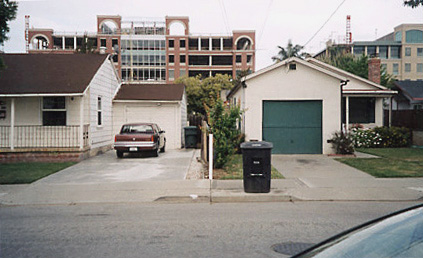
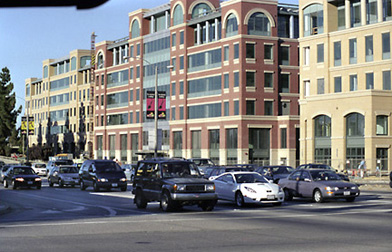
On Charles street, “the city has got that much
closer to our backyard,” says a resident. (Nick Hoff)

Sunnyvale (population 131,000) calls itself the “Heart of Silicon Valley” ? a reference to its geographic location along the Palo Alto-San Jose corridor and to the hundreds of technology companies that make Sunnyvale their home. No longer merely a suburb, Sunnyvale is part of what urban planners call an “edge city” ? a suburb in a dispersed region that has all the jobs and retail its residents require, making a traditional urban core unnecessary.

Critics of sprawl hold that edge cities suffocate cultural and communal life with their low building densities and automobile-centric designs. Another oft-cited problemis “unifunctional zoning” ? regulations that allow only one kind of building, like single family houses, to be built in a given area. “Before unifunctional or negative zoning dictated land use,” writes sociologist Ray Oldenburg in Celebrating the Third Place, “little stores, taverns, offices, and eateries were located within walking distance of most town and city dwellers, and those places constituted ‘the stuff of community.'”

Today, most suburbanites have nothing within walking distance but a 7-Eleven ? if they’re lucky. They have no public spaces that are a pleasure to be in, no places where they can walk and want to walk, no places where they can meet people and feel comfortable talking to them. In today’s anonymous suburban landscape, there are no places with nooks and crannies and walls that create and define spaces, that make you feel like you are somewhere ? not lost in a sea of lawns or undefined streets or whizzing thruways.

Sunnyvale bears the telltale signs of suburban isolation. Its bleak downtown mall, rambling subdivisions, countless strip malls, and lack of a street grid have destroyed whatever pedestrian-friendly prospects the town might have had. Sunnyvale has instead become a broad, monotonous blanket of one- and two-story single-family homes, sliced by major traffic arteries and their attendant Safeways, Wells Fargos, and Blockbusters. In the new Cherry Orchard strip mall (named in honor of the trees it supplanted several years ago), residents sip lattes in the faux authenticity of Starbucks, where the “graffiti” on the milk and sugar stations and the dark (cherry?) wood tables attempt to create precisely the sense of authentic place that Starbucks and Sunnyvale don’t have.

According to locals, the only pleasant part of downtown is a block-long section of Murphy Avenue. Constructed at the turn of the century, the street was built for humans, not automobiles. The street’s width is approximately the same as the height of its buildings ? a rule of thumb for well-proportioned thoroughfares. The buildings come right up to the sidewalk, and there are no garages to break up the flow of shops. From this pedestrian-friendly design arises a sense of enclosed space ? a sense of place ? that makes people feel comfortable being there. It is therefore the hottest spot to go in Sunnyvale for a beer, a cup of coffee, or a plate of pad thai.

The rest of the downtown, approximately thirty square blocks, is made up of small homes, a couple streets with one-story Town and Country shops, and the gargantuan eyesore that is Sunnyvale’s mall. Originally dubbed the Sunnyvale Town Center, the mall nowadays is officially known as the WAVE (Walking and Village Entertainment), though some residents prefer to call it other names ? “the manure pile,” for instance.

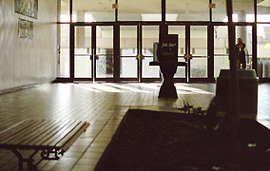
The Walking and Village Entertainment mall, built in 1976. A quick walk-through of its brown-tiled interior reveals empty store after empty store chained up, dark, and littered with the unwanted paraphernalia of the last tenants. Macy’s, JC Penney, and Target are flanked by desolate parking lots on each of the mall’s four corners.

Sunnyvale’s new plan calls for removing the mall’s roof and opening it to pedestrian traffic from adjacent Murphy Avenue. But the mall itself will not be razed: city planners and consultants argue that its anchor stores are great assets. “If you wanted these department stores today, we’d have to spend millions of dollars to get them here,” says Paternoster (even though, he concedes, “you wish you could start from scratch.”). Besides improving the general aesthetics, the mall remodeling effort is aimed at attracting higher-end stores like Barnes & Noble and the Gap, as well as a large multiplex.

Renovating the mall is only one part of the much broader downtown redevelopment plan. The plan also calls for increased density in the surrounding thirty-block area by zoning for over 2,000 units of apartment buildings and five blocks of six-story office buildings. A public plaza, now under construction, will greet train riders returning from work (and, planners hope, arriving to work) in the new downtown. The plaza will also open onto the courtyard of a planned eight-story apartment complex, which will also house retail stores on its ground-level floors ? only a stone’s throw from three office buildings already nearing completion. (So far the only elements of the plan under construction are the office buildings, the plaza, and the two-story parking garages on the mall’s corner lots, all of which were already zoned under Sunnyvale’s current general plan. The other elements are proposed zoning changes that will await a developer if the plan is approved.)

For a city that until recently had no building more than three stories in height, the redevelopment plan promises a radical transformation. And not surprisingly, many Sunnyvaleans ? especially residents who live near downtown ? are concerned about the proposed changes. Even though some of them profess their preference for more traditional, denser downtowns like those in nearby Palo Alto or Los Gatos, they fear that any modifications to Sunnyvale’s center might spell the end of their quiet suburban neighborhoods. In particular, they worry about the increased traffic that a vibrant downtown will inevitably bring.

Sunnyvale resident Mark Matizinger is among those who oppose the plan’s dramatic scope. A forty-two-year-old hardware salesman, Matizinger lives within view ofthe three office buildings already under construction. “I bought my house to get the neighborhood flavor and the convenience of downtown,” he says. “But the city has got that much closer to our backyard.”

Andy Maloney says he is all for a “traditional downtown,” but insists that the plan is a disaster. Maloney is co-director of the Friends of Sunnyvale, a citizens group that says it is in favor of “smart growth” ? that is, development that avoids sprawl. Maloney argues that the plan’s proposals for six- and eight-story buildings will create “stone canyons,” rather than the “traditional” downtown that could be achieved with three-story buildings. Further, the proposed high density will bring such increased traffic that few will enjoy going downtown. The plan will not address the downtown’s central problem ? its lack of a street grid ? because it refuses to uproot the mall, whose stores and parking lots have gobbled up the old grid. As a result, claims Maloney, the plan will do little to boost pedestrian traffic or improve the circulation of cars in the downtown area.

Supporters of the plan counter that something has to be done to improve the downtown situation. Among their numbers are a few long-time Sunnyvale residents, like Monica Davis, of the Charles Street 100 Neighborhood Association, who looks forward to walking to dinner, movies, and concerts in the new plaza. Many of the plan’s supporters, however, are newcomers to Sunnyvale ? young, educated professionals who work in the hi-tech industry that now dominates the region. “I can’t stand sprawl,” says Daniel Simms, a twenty-nine-year-old computer programmer. “I hate driving everywhere. It always feels like more urban areas have a tighter sense of community.”

Driving to your ‘walkable’ community


Sunnyvale’s downtown dwellers will still
depend on their SUvs, sedans, and sportscars. (Nick Hoff)

Even if the numerous proposals for Sunnyvale’s downtown were all carried out, however, they would not change one crucial fact: Most Sunnyvale residents will still have to drive to get downtown in the first place. And so some critics say that the city’s vision of a pedestrian wonderland is just a pipe dream ? beyond the power of Sunnyvale, or any other municipality for that matter, to realize, unless more profound changes in the nation’s outlook and habits take place first. “There will not be much new urbanism if we don’t address our dependence on the automobile,” says Peter Bosselmann, professor of architecture and city and regional planning at the University of California at Berkeley.

In the absence of specific policies to decrease America’s reliance on cars, says Bosselmann, suburban city planning initiatives across the country will at most create small urban oases amidst vast seas of sprawl. Residents will still drive everywhere; it’s just that apartments and offices will be closer together, piled on top of huge parking garages. Given the dominance of the automobile, there’s also reason to doubt that these new urban centers will even be able to get off their feet. When everyone has a car, there’s no incentive for businesses to relocate to more central, and more expensive, locations.

Getting around Sunnyvale will certainly not be any easier if the city’s plan is fully executed. Sunnyvale’s public transit amounts to a sparse bus system, used only by those unfortunate enough to not have access to a car. The denser housing called for in the plan will increase traffic but won’t substantially reduce the number of times that residents will need to get in their cars every day. Even those who live within the new “walkable” downtown will need to drive to buy groceries and other necessities, and probably to get to work. What’s more, the proposed new apartment complexes will need to be equipped with either completely underground garages ? which the mayor of Sunnyvale thinks might be too expensive for developers ? or partially underground garages that take up valuable street-level space.

Sunnyvale’s chief planner, Robert Paternoster, recognizes that “a lot of mistakes were made” in this country’s last century of city planning, when the “automobile was given precedence over people.” But, he notes, in this automobile-dominated culture, urban planners must accommodate the car if they hope to attract people to their projects. Since Sunnyvale, in his opinion, doesn’t and never will have the kind of transit system that could make owning a car unnecessary, Sunnyvale’s plan must welcome the car ? otherwise no one will live downtown or visit there.

Even if the plan can’t do much to change people’s reliance on automobiles, Paternoster sees good things coming out of its proposals. The increased building density, he thinks, will give residents the opportunity to live within walking distance of their jobs and favorite restaurants. Most, he concedes, won’t work downtown and won’t eat their meals at those restaurants ? “but they’ll eat some.” It seems, then, that if the plan creates just a touch of walkable vibrancy it will be deemed a success.

Whether residents will be satisfied is another question. Daniel Simms will still have to drive most everywhere — and to create a sense of community, he insists, you must at the very least “get out of your cars and see people.” Of course, he and other local residents, if they come to the new downtown, will certainly have the chance to get out of their cars — as they walk to Murphy Avenue from deep within the mall’s new two-tiered parking lots.

Editors’ Picks >

If ordered through these links, a portion of the sale goes to Inthefray.com

Celebrating the Third Place: Inspiring Stories About the “Great Good Places” at the Heart of Our Communities
Edited by Ray Oldenburg | Marlowe & Co | 2002
Amazon.com


Homes for the displaced

Rebuilding a country devastated by civil war, one house at a time.

Click here to enter the visual essay.


Testing my faith blindly

Scenes from a hospital on Madison Avenue.

My mom’s face is held together by a surgeon’s delicate wire. They tell me that her jawbones will heal with time. The same for her broken wrist, resting in a Swiss cheese-shaped wedge, made of Styrofoam. They say it is needed for proper circulation. The cream- and orange-colored walls of the hospital on Madison Avenue sicken me. The smells of fruit cocktail, cold cuts and unchanged bedpans hang in the air.

Death creeps along the hallways of the Intensive Care Unit waiting for something–or rather, someone to snatch from this world and take to another. Staking out an inconspicuous corner, Death simply waits. I suspect on some mornings it tiptoes behind the nurses’ station to hear if Mr. So-and-So, who has liver cancer, or Ms. So-and-So, who suffers from pneumonia, will fully recover. Then their fate, I think, comes down to a simple coin toss.

I have never fancied visits to the hospital no matter if I am watching an episode of ER” or if I am wandering the sterile hallways of one in real life, as I did years ago on a preschool class trip. I don’t know proper hospital etiquette either. You can send get-well cards, balloons and bouquets of flowers. But what do you say to a relative or friend who, after having surgery, is left to ponder his or her own fate during sponge baths and snacks of lime Jell-O and crushed pain medicine? Visiting hospitals always tests my patience and faith in science and medicine. And I usually leave visiting hours thinking about life, death and the gods.

The visits I make to the hospital during the winter of 1992 are not exempt from my feelings about hospitals and emergency rooms. I enter my mom’s room on the ICU floor one afternoon in January and stare at her–at her brown skin–as she sleeps. Her nose is not the same nose that appeared on her “other” face–the one before the plastic surgery. Her old nose is now a memory left in our photo albums, in the years before multiple sclerosis paralyzed the cells of her body, turning them into zombies.

Dried blood stains the gauze sticking out like walrus teeth from her nostrils. Her face is still swollen. They are able to get her teeth back into place, I recall my dad telling me. I do not notice them because I am too busy staring at the tracheotomy the doctors have cut into the center of my mom’s throat so she can breathe on her own. I sit next to her on the hospital bed after a day’s worth of school, staring at the blue button on the side of her forehead. I am told that if she starts to choke, I will have to cut the wire around the button. Somehow I know I will not have to cut it because she is a survivor. Several weeks later, they tell me she is recovering nicely. They say she will soon have to switch hospitals. She will need weeks of occupational and physical therapy.

For most of my life, I have been the resident witness to my mother’s battle with multiple sclerosis, a disease that changed her life as well as my family’s. I am the one who sees her fall over a bag of dog food in the pet supply aisle of a grocery store. “Is she drunk?”, a stranger asks. No one stops to help her. I am there when she cannot control her bladder, and later we pretend we do not notice that she changes clothes. I am there when she hits the floor one Ground Hog’s Day and breaks her shoulder. She can no longer wear high-heel shoes or walk without the aid of a cane, which is later replaced by a walker.

My mom’s eyes are the same. I discover, though, that she is no longer perfect. And on January 20, 1992, I am the lone witness when she loses control of our Buick Le Sabre and sends us head on into a telephone pole. I see her broken face and blood on her long, black winter coat and on the front seat of the car. This time someone stops to help. What overwhelms me that day, more than the car accident, is seeing my dad cry. He is sitting on a bench in the hallway of the emergency room. I can see his face from my spot on the metal table as I wait to have my arm x-rayed. I see him wiping his eyes. He is no longer macho. His tough-guy, truck-driver image is gone, and the tears seem to ooze from him uncontrollably. I cannot hear the words my uncle whispers to my dad.

As I wait for the technician to return, I pray for my mom’s recovery. Meanwhile, she is several rooms and hallways away being worked on by doctors and specialists and nurses. She will live, I reassure myself again and again. She does not have a choice because I need her. And now as an adult, I still need her. I want her to tell me how proud she is when I am honored for my work, how to handle life’s let-downs and how important it is to be spiritually grounded. The woman, who fought for her recovery in a hospital room 10 years ago, has to live. The woman, who read bedtime stories to me and taught me how to pray, must live. If not for herself, she must do it for me. “Now I lay me down to sleep I pray the lord my soul to keep If I should die before I wake…”

The woman, who taught me about English and sentences and words, must survive. Eventually, with our prayers, love and assistance from doctors and physical therapists, my mom does just that and more. And she comes home just in time for Mother’s Day, just in time for summer.”


Dead spaces

Artistic expression in dead environments.

Click here to enter the visual essay.


LA@10: The riots revisited

A city reborn, a city forgotten--and a city that has never healed.

Click here to enter the visual essay.


City beaches

Sandy stretches of expansiveness and isolation in Far Rockaway and Coney Island, New York.

Click here to enter the visual essay.


Bolton Hill 21217

Progressive parents face the public school dilemma in Baltimore.

“So where’s Marcus going to school?” Since Sara S. first enrolled her then two-year-old son at Bolton Hill Nursery in Baltimore, the question has become more and more frequent. (The pressure has grown so uncomfortable, in fact, that Marcus and Sara are not their real names.) Now that Marcus is turning five and starting kindergarten in the fall, Sara is starting to avoid the neighbors and acquaintances who broach the subject at nearly every opportunity. To Sara, the judgment in their words and tone is explicit: “It doesn’t imply, it says, these people are going to judge us by the decision we make.”

Sara’s situation isn’t as familiar as it sounds. She’s not just another hyper-competitive urban mother whose child’s future will be plunged into non-Ivy League darkness if not accepted into the perfect prestige kindergarten. The pressure on Sara is of an entirely different nature — a vocal group of parents in the middle-class Bolton Hill neighborhood is encouraging her to enroll Marcus in an experimental public school in one of the nation’s most maligned school systems.

If Baltimore City Public Schools was a brand name, its image would require a massive reinvention. Among many middle-class parents in the city and its suburbs, the mere mention of BCPS evokes incompetence, inefficiency, academic stagnation, and physical peril. Like many cities across the country, Baltimore is experimenting with new ways to restore faith in its schools. Though Maryland is not among the thirty-plus states that have passed legislation allowing charter schools, it did approve the New Schools Initiative in 1995. The nine public schools created under this mandate, like charter schools, have more flexibility in curriculum development and student and staff selection, and are run by outside operators contracted by the school board.

Hardly any of the young professionals buying bargain houses in Baltimore want their children to go to their local public school. This is no less true in Bolton Hill, a gay and arts-friendly neighborhood of nineteenth-century brick townhouses on Baltimore’s predominantly black and poor west side, than in less progressive parts of the city. The idealistic dream of becoming part of a renaissance and moving back to a city where “white flight” has not yet slowed, stalls out on the subject of education. It remains to be seen whether Baltimore’s New Initiative Schools will be able to sell themselves to these middle-class parents, whose needs have historically been met by the city and county’s numerous private schools. And alternative public schools still need to address the generations-old problems of race and class that still divide some parts of Baltimore into a black/white city.

In Bolton Hill, a growing group of parents are deciding whether to return to the public school system. Midtown Academy, a New Initiative School, is gaining converts from the ranks of Bolton Hill Nursery, a popular daycare and pre-kindergarten school. Besides Midtown, there are two other options: the traditionally public Mount Royal Elementary and a host of private schools anywhere from fifteen to ninety minutes away. For Bolton Hill parents, shopping for schools before their child turns five is an agonizing process complicated by a wide variety of practical concerns, moral and political values, and social aspirations. The stakes are high, sometimes pitting dearly held convictions about the value of public school in a democracy against the intense fear of not doing right by a child. One’s choice is closely monitored in this small community, and judged accordingly.

Pounding the pavement

Much of the pressure on Sara S. and other parents comes from Bolton Hill resident John Lau. The ringleader of a campaign to fill the ten kindergarten slots reserved for Bolton Hill kids at Midtown Academy, John lives with wife Iris and daughter Hannah just a few blocks away from both Sara and Bolton Hill Nursery. The upright piano and violin in the corner of their small living room attest to their interest in playing chamber music with friends. Hannah, one of Marcus’s classmates at the Nursery, has her own little desk in the dining room, on which her current projects are neatly organized.

Till now, Bolton Hill has scorned Midtown, with most of the slots going to residents of Reservoir Hill, a blacker, poorer neighborhood whose children mostly attend Mount Royal, a larger K-8 school of 850 students. (The other ten slots of Midtown’s twenty-person incoming class are reserved for Reservoir Hill; any remaining open spaces are filled by lottery.) Midtown is much newer and smaller that Mount Royal, with only one class in each grade. Since it opened in 1997 with grades kindergarten through third, the school has added one grade a year, and will offer eighth grade starting in the fall. John guesses that the upper grades “are probably 90 percent African American, the lower grades probably 70 percent,” and that kindergarten this fall “could be up to 50-50” if the mostly white parents in Bolton Hill follow through on their promises to enroll their kids. “The school’s trying to diversify, but no one wants to be the first,” he says.

John, who first experienced American public schooling when he immigrated to Tennessee from China at age fourteen, is determined to change Bolton Hill’s under-utilization of Midtown. It was he who convinced Iris, who came to America from China only when she was ready to get her MBA, that public school could be valuable. “I think a little adversity is good for kids,” he explains. “I would like for Hannah to be able to see that there are people struggling, that life is not just everything given to you, and appreciate what she has, and that she has to work for it.” He also thinks Bolton Hill’s kids and their well-educated, well-off parents are the key to the school’s success. “I would say that maybe half of the reason [we’re sending Hannah there] is because…we want to see the school succeed.”

The dream of a neighborhood school

John’s optimism seems shared at Midtown Academy itself. Principal Diane Isle is stern as she passes a few stragglers stepping out of line on their way to art class, but her overall effect is that of a determined and enthusiastic cheerleader. Her purple headband, blue velour jumpsuit, and bouncy blond hair don’t hurt either. She shows off her small building proudly. An art room displays models of Grecian pottery that students are attempting to replicate. An English room sports the sign “The Biggest Sin in Writing is to Be Boring!” Most classrooms have at least two adults, twenty-two or fewer kids, and a surprising amount of one-on-one instruction. Part of the explanation is that Midtown has excellent relationships with teacher training programs in the city and benefits from a core of interns. Isle actively courts Bolton Hill parents and knows that a high teacher-to-pupil ratio is a strong selling point. And Midtown, like all schools in Baltimore, is focused on raising its Maryland State Performance Assessment Program (MSPAP) scores. This year the school did well, averaging 41.9 (the goal is an average score of 70 out of 100), nearly twice the average for the rest of Baltimore City’s public schools.

Midtown’s ninety-hour-per-year parent volunteer requirement also virtually ensures that high-powered parents will be directly involved in maintaining the school. At the same time, this requirement may put pressure on poorer, less available families to either shape up or ship out. But for now, the main problem is a lack of space. They’ve been efficient with what they have — their physical education program, for example, is focused around Tae Kwon Do taught in the cafeteria. However they desperately want to expand and are being hampered by some resistance in the neighborhood, primarily from nearby residents who don’t appreciate the sounds of children getting out of school.

But for John, a neighborhood school — noise and all — complements his vision of an ideal city life. He has been in Bolton Hill for six years and describes it as “real community that you can’t find anywhere else.” He imagines the suburbs as a place where “you just drive up and your garage door opens, you pull your car in and the garage door closes, the TV turns on and that’s the end of the day.” So John carries out his campaign, whether at the local swimming club or at the Hidden Bean, the local corner coffee shop. Because there are only ten slots, assigned by lottery, John jokes about being too successful in his efforts to convince other Bolton Hill parents to give Midtown a try. “It’s ironic that we’re now thinking that maybe we should apply to private schools as a back up,” he says, but finishes with a genuine “but that’s good!”

Although Mount Royal is also a neighborhood school only two blocks away from the Lau family, they aren’t considering the predominantly black school, not even as a back up. If Hannah’s “the only person of only one race then she may not feel too comfortable,” says John. “Just to be honest.”

Opting out of the ‘experiment’

WHERE TO NEXT? While their parents contemplate the next step, students get to work at Bolton Hill Nursery school. (Nicole Leistikow)

Sara S. has a smiling brown face and doesn’t hesitate to voice her opinions. An attorney for the state of Maryland, she calls herself “an older mom” at age forty-six, is well-established in her career, and is dedicated to driving Marcus to extracurricular activities such as gymnastics (though she wishes Marcus’s dad would do some of the chauffeuring as well). Her kitchen has been taken over by Marcus, who is building extensive highways for his Hot Wheels out of masking tape. Both the kitchen and the dining room feature elaborate collections of his artwork, toys, and projects. There is a comfortable messiness about the place, a feeling that one could begin a special project, and others would respect it, even if it got in the way, as much as practicality allowed.

In a recent conference with Marcus’s teacher at Bolton Hill Nursery, Sara learned that her son sometimes “refuses to speak in circle time,” an evaluation that has furthered her resolve to consider a private school. “[Marcus] is not pushy,” she explains, “so if someone gets in front of him, most of the time that person can get in front of him.” She was frustrated watching one of his Saturday gymnastics classes. “My kid was constantly overlooked in a class of eleven because he’s quiet and no trouble,” she says, citing “inexperienced teachers” who spent all their time wrangling ill-behaved children back into line. Marcus, Sara says, missed one turn on the rings, one turn on the trampoline, and two turns doing somersaults.

She believes that the small class size and higher teacher retention rate of a private school will be best for her son’s personality, and she seems to relish having the option of sending her son to prestigious McDonogh, the $14,000-a-year private school that’s their number one choice. McDonogh’s campus emulates a university’s, with a separate library and an indoor swimming pool. Sara’s own educational experience was “in an insolated, lower middle-class African American environment. Up until the time I was a teenager I don’t think I ever had, except for in youth orchestra, any regular contact outside of the black community in D.C.” She’s glad Marcus is growing up in a more diverse, more “realistic” setting.

Midtown Academy is Marcus’s parents’ number three choice, after the private Grace and St. Peter’s. Sara was insulted when a white colleague, who had struggled to send her own kids to private Roland Park Country Day, advised her to check out Midtown. Seeing her associate’s suggestion “as some kind of classist-slash-racist statement,” she resented the assumption that because she is black, she doesn’t have the resources to send Marcus to a private school. “She has two girls that she had to raise by herself, but she struggled to send them to a private school,” says Sara of her co-worker. “She stretched it, but I should just settle for this public school? She’s never been and she knows nothing about it, except for what she’s read.” The ability to consider a private school signifies an important advantage to Sara, especially in this city. Even if Midtown were “the number one [public] school in Baltimore City,” she says, “I still would have concerns and still would consider sending him somewhere that I thought he’d be a little bit more protected.”

Sara echoes the refrain of many parents when she says, “I don’t want to experiment with my child.” Though she is in favor of public schooling in general, and although Midtown offers many advantages that Mount Royal does not, it hasn’t been around long enough for Sara to see it as reliable. And she resents pressure from people in the neighborhood “who feel this experiment is the right thing to do, supporting the public school system, and if you don’t do that, you’re doing something that is not the right thing to do, as in wrong, as in politically incorrect and maybe morally also.”

Although Sara has a friend in the school system who told her not to overlook Mount Royal because of its strong reputation and high standardized test scores, she did not seriously consider it for Marcus. She echoes the sentiments of many Bolton Hillers when she says, “I have seen the kids coming back and forth from Mount Royal and I haven’t been particularly impressed with their behavior in public.” Because of resident complaints that the students litter and are rowdy, the school developed a “character education program” and stationed volunteers at problem intersections to supervise children’s behavior on their way to and from school. Despite these efforts, relations with the neighborhood remain somewhat strained.

The school on the wrong side of the street

ON THE OTHER SIDE OF THE NEIGHBORHOOD”: Students on their way to Mount Royal Elementary in Bolton Hill, a Baltimore neighborhood. (Nicole Leistikow)

Few Bolton Hill parents bring up the topic of Mount Royal voluntarily, or can boast of having actually set foot inside the building. And though the school is only a block away from Midtown, one woman located Mount Royal “on the other side of the neighborhood.” It may have been a slip of the tongue, but others also exaggerate the geographic distance of the school. Indeed, there is a cultural and class distance between Bolton Hill and Mount Royal, and that may be what many in the neighborhood unconsciously perceive.

Mount Royal principal Mark Frankel actually isn’t much interested in why Bolton Hill parents, as a rule of thumb, do not even consider Mount Royal as an option. Frankel, in his early fifties, is short and dapper, and looks more like a winning lawyer in his suit and glasses than an elementary school principal. His humor and charm serve him well, because he doesn’t mince words. He is blunt in his surmises about Bolton Hill’s lack of interest in Mount Royal, which he says is 99.8 percent African American. “I think parents want their kids to be with children like them,” he says. “Certain schools are better calling cards.” In Frankel’s ideal world, the main determinant in school choice should be high standards.

And Mount Royal’s high standards have delivered. The school performs in the top 5 percent of schools receiving Title 1 funds (federal monies for disadvantaged institutions). Though 80 percent of its students receiving free or reduced lunch, the school’s MSPAP scores averaged 38.8 this year and its fifth graders typically score first in the state in math. Classes sizes are eighteen and under in the lower school, and twenty-five in grades six through eight. Linda Eberhart, Baltimore City’s teacher of the year, teaches at Mount Royal and touts the school at every public appearance. And while Frankel’s school has had positive coverage on CNN and NBC, Bolton Hillers still aren’t convinced that there’s a jewel hiding in their midst.

But the stigma of being part of BCPS seems impossible to overcome. Parents like Sara, for example, cite concerns about violence at the school. In fact, Frankel had to fight to retain the school police officer — the expense was deemed unnecessary because no incidents had ever been reported. “We don’t market the school,” says Frankel of Bolton Hill. His decision not to focus on recruiting middle-class parents suggests he sees the effort as a losing battle.

Why don’t Bolton Hill parents, who are enthusiastic about public schooling, see Mount Royal as a brand they can trust? Or even a brand they want to know more about? Cindy Patak, who sent two daughters to Mount Royal and now has one at Midtown, suggests possible answers.

What goes unsaid

Cindy is a youthful-looking city planner in her early forties, with spiky hair and black leather jacket. Over coffee at the Hidden Bean, Cindy sighs in frustration. “I know a lot of people in Bolton Hill couldn’t believe I ever sent my kids to Mount Royal,” she says. “I’m just tired of hearing the same response or lack of response — they stutter and they look to find words that are acceptable. They kind of lament about education in the city of Baltimore as a whole.”

Cindy actually lives outside of Bolton Hill in Union Square, a small enclave of middle-class families situated around a green in SoWeBo (southwest Baltimore), which is otherwise one of the poorest neighborhoods in the city. When she moved there in 1988, Mount Royal was accepting students outside its “zone” to its Gifted and Talented Program (since disbanded). She is satisfied with the education her two daughters, Eleina and Lela, received there, though by the time Lela graduated from eighth grade the school was experiencing some difficulties.

Cindy is adamant about her daughters’ right to a free public education, and did consider Mount Royal once again for her youngest daughter. But by that time, getting in from outside the neighborhood was virtually impossible. She is glad that seven-year-old Alicia is in second grade at Midtown, which may not be admitting kids outside the neighborhood this year if Bolton Hill fills up its ten slots. Although Bolton Hill’s previous reluctance to try Midtown may have benefited Alicia, Cindy is critical about neighborhood attitudes. “A lot of parents from Bolton Hill Nursery did not send their kids to Midtown, and while they used a lot of other words for it, I think a lot did have to do with race,” she says. “Everyone talked about how great [the school] was, and what a great idea,” but when it came down to it, only two children followed Alicia to Midtown from nursery school.

Yet Cindy, who is white, is more comfortable with Alicia, whose father is African American, at the more diverse Midtown. She feels Lela and Eleina, who are half Moroccan, may have suffered from an attitude at Mount Royal, typical in Baltimore, that insists on dividing people into black and white categories that don’t always apply. Midtown is more diverse, more bi-racial, and more open. This openness may be what is changing the minds of so many parents in Bolton Hill — parents who have been skittish about choosing a predominately black school for their children — for the first time this year. Midtown offers a convenient compromise.

A new year, a new class, a New School

Next fall, a new kindergarten class will enter Midtown Academy. And even if Bolton Hillers renege on their promises to attend, at least Midtown was in the running. Mount Royal was not. Despite high test scores, a strong reputation, and a principal who excels in obtaining resources, it is seen by many as simply a poor black school — and therefore, quite simply, not a choice. Unfazed, Mark Frankel is focused on serving his majority poor, majority black children and their parents. He does not intend to address middle-class fears, or to change his school’s image to something more attractive to Bolton Hill parents.

Midtown’s success in shaping itself into something more alternative and fashionable is a result of its ability to distinguish and distance itself from traditional public schools like Mount Royal — racially, culturally, and academically. Midtown Academy shows that middle-class parents will come back to the public school system, but only if courted appropriately. In that sense, the experiment has been a success. But for other public schools, it seems, all the work in the world may not change the minds of the middle class.

In the meantime, acceptance letters were mailed out last week. At least twelve Bolton Hill families — a record number — applied to Midtown Academy. For the first time in its history, the school’s Bolton Hill slots are filled, and some families had to be turned down. John Lau describes the competition this year as a “180 degree turn” from last year, when only two Bolton Hill kids enrolled. Hannah Lau was accepted, and her father will find out in the fall if his vision of a neighborhood school is shared.”


Dislocation

Expressive possibilities in lifeless environs.

Click here to enter the visual essay.

Three years passed before I could compose photographs in Providence, Rhode Island. While attending college in one of New England’s post-industrial ports, I repeatedly searched in vain for a frame that might resonate with my adolescent aesthetic, some strain of ‘nature photography.’ This vision stemmed from my childhood in the sublime alpine panoramas of the Colorado Rockies, which I had grown to celebrate through images. But that naive approach was irrelevant in Providence.

Artistically unbound and awash, I finally attempted to define that aesthetic in negative terms, to capture what might constitute its opposite. My sterile engineering classrooms, a bleak parking lot under an indelibly overcast sky, a fluorescent-lit cement stairwell–what could inspire in these entirely forgettable places?

I see this collection of photos as merely a sketch, a rough meditation on some expressive possibilities in lifeless environs. It is highly personal. But what does it mean to you?

personal stories. global issues.