Giving men the vote

“I understand the logistical problem but still we are very depressed that we have not been allowed to vote, this is our right,” stated Iman Qahtani, a female Saudia Arabian journalist, speaking about the first quasi-democratic municipal elections in Saudi Arabia, in which women were banned from voting.
    
Despite the fact that women comprise over half of the population in Saudi Arabia, and despite the fact that the election rules assert that all citizens who are 21 or older, with exception of military personnel, may vote, Saudi women were disenfranchised by a technicality. Voters must have an identification card to register to vote, but only six percent of women requested the necessary ID cards. Citing the impossibility of giving ID cards to all women ahead of the vote, election officials simply banned all women from voting.  

Although women remain disenfranchised, this is the first time men are voting in something that even remotely resembles a democratic system. Saudi Arabian men are currently actually only voting for half of the seats on the municipal council; the other half will be appointed, and the monarchy, which is effectively headed by the crown prince Prince Abdullah Bin-Abd-al-Aziz Al Saud, is still the ultimate power in the kingdom.

The final results will probably not be released until the weekend, but candidates who have Islamist support are projected to win the largest number of seats.

Mimi Hanaoka


MAILBAG: Forcing makeup off women and on men

Makeup is used to enhance a person’s natural look. Every person has a perspective on their own look. That perspective determines if that individual will choose to wear makeup

American corporations are choosing to force women to wear makeup and are being supported by the American Court system. The issue here is the power of American corporations in the American courts. The human rights issue has been totally ignored. The purpose of makeup is not truly what the court reviewed.

The Court, except for one court justice, considered no more than the sexual discrimination issue and not very thoughtfully. The court allowed corporate interests to guide its decisions rather than considering the further ramifications of controlling the use of cosmetics by individuals.

How much farther can corporate control of individual attire go? Can corporations go so far as to control the jewerly that employees wear? Will it soon be acceptable for employers to tell employees that wedding rings cannot be worn on the job?

The unfortunate aspect of the case was that it was based upon sexual discrimination, but the real issue is when do corporations cross the line of human rights? This case should have been about the human rights violation committed against every working man or woman.

The company in this case decided to use personal preferences to the company’s believed advantage without considering the human beings that are forced to conform to those preferences.

The Men’s Fashion Freedom Movement is struggling for men to have total fashion freedom. The human rights violation committed by forcing makeup on women was equally abusive to men in the reverse. The movement is pushing for men to be free to use makeup as they choose. You can read more about the movement at Men’s Fashion Freedom.

—Anonymous


The Dresden Holocaust?

Political parties with the words “national” or “democratic” in their name are often amusingly and tragically totalitarian in their aims, and the National Democratic Party (NDP) of Germany is no different. An extreme right-wing party with neo-Nazi sympathies, the NDP has roiled up a controversial debate about the WWII bombing of Dresden.

As politicians in the eastern German region Saxony, who convene in Dresden, began their parliamentary discussion about how to commemorate the victims of the bombing of Dresden on the 60th anniversary of the event, a dozen members of the NDP refused to participate in the one minute moment of silence dedicated to remembering the victims of the second world war and German National Socialism. The NDP members refused to commemorate the liberation of Auschwitz, one of the most notorious concentration camps. Only those who died when German cities were bombed should be commemorated, they insisted. Juergen Gansel of the NDP later condemned the Allied attack on Dresden as “mass murder,” in “Dresden’s Holocaust of bombs.” Gansel asserted that the NDP is “taking up the political battle for historical truth, and against the servitude of guilt of the German people.”

For two days during World War II, beginning on February 13, 1945, the Allied forces bombed the city of Dresden, which functioned as a strategically important rail and communications hub for the Nazis. Responding to a Russian request, British and then American aircraft rained bombs on the city. Due to the influx of German refugees entering the city from the eastern provinces, some historians suggest that the official death toll of 35,000 is too conservative.

The NDP’s particular brand of historical revisionism seems to carry a starting amount of currency among young Germans; a poll conducted by the newspaper Welt am Sonntag revealed that 27 percent of Germans 30 years old or younger considered it acceptable to call the bombing “ Dresden’s Holocaust of bombs.” In contrast, only 15 of those who were at least 60 years old found the term acceptable. Disturbingly, it is the German youth who are carrying the banner of historical revisionism.

Mimi Hanaoka


Makeup: making gender a little more equal

Women who live in California, Washington, Oregon, Nevada, Arizona, Idaho, and Montana can thank our government for making it legal for an employer to fire women who don’t wear makeup if that employer decides that makeup is a part of the company uniform. According to a federal appeals court ruling, reports Liz Benston of the Las Vegas Sun, it has been ruled legally possible for a Nevada casino company to “impose makeup requirements on its female bartenders without violating U.S. sex discrimination laws.”

Darlene Jespersen, who had been fired in 2000 from her bartending job at Harrah’s in Reno for “failing to follow a grooming policy for beverage servers,” intends to bring the case to a superior court. Judge Edward Reed of Reno explained that Harrah’s grooming policy “did not constitute sex discrimination because it imposed equal burdens on both sexes.”

In case this ruling is still unclear, writer Anne Newitz spells it out in an article posted on Alternet.org:

“Think this through slowly and carefully, girls: if you live in the 9th Circuit … you could be fired tomorrow if your boss decides your ‘uniform’ for work includes makeup. Supposedly this ruling doesn’t run afoul of discrimination law because it doesn’t impose an ‘unequal burden’ on women … [A] rule for women enforcing face paint is ‘equal’ to a rule forbidding men from wearing it. Now there’s some real smart logic. Presence is the same as absence! War is peace! Yup, it’s the kind of analysis that’s gotten very popular in the United States recently.”

The implications of this logic are priceless. Newitz continues,

“Never again is anyone allowed to give me crap about how women naturally want to adorn themselves with makeup, as if there’s some genetic urge to look fake that’s wended its way here on the sparkly pink path of evolution. This ain’t biology … This is some cosmetics executive getting rich on state-enforced gender norms.”

It’s not about whether women are degraded by wearing makeup, Newitz argues. Rather, the question is “whether women who are forced to wear makeup when men aren’t can be described as experiencing gender equality.” Evidently the 9th Circuit admitted that makeup costs both money and time, only to dismiss this fact as ‘academic.’ Newitz questions:

“But if these costs are so insignificant, why not require Harrah’s to pay to keep its female employees looking as if they’d just had a makeover?

Indeed. Here’s another theoretical question: how much makeup would it take to disguise the intentions of a government which leaves a path of illogic in its wake?

—Michaele Shapiro


‘L’ is for loser

A new book, Born Losers: A History of Failure in America, explores failure as a condition, a natural result of ordinariness. Jonathan Yardley of The Washington Post quotes from Scott Sandage’s book a passage so seemingly obvious it makes you wonder how no one before now has written this:

“Failure had become modern, a low hum rather than a loud crash. It meant a fragmented life, not necessarily a shattered one. Anyone could be a failure if that identity required utter stagnation instead of outright misfortune. By the time Mark Twain imagined Tom and Huck fading away ‘under the mold,’ the American idea of failure centered on problems recognizably our own: aimlessness, routine, stress, conformity, loss of individuality, the dead-end job, the disgrace of being ‘merely’ average. Losers plodded their lives away in offices, factories and boardrooms.”

Vinnee Tong


Quote of note

“It is important for the Archdiocese of Boston, in this moment, to again apologize for the crimes and harm perpetrated against children by priests who held the trust and esteem of families and the community… Survivors and families who bear the wounds of these shameful acts are held with great tenderness in our prayers.” — A statement issued by the Archdiocese of Boston in response to the conviction of Paul Shanley, a defrocked Roman Catholic priest, who was found guilty of raping a boy in Massachusetts in 1980. Shanley, 74, may face a sentence of life in prison.

The Archdiocese of Boston has already agreed to pay 85 million dollars in order to settle over 500 civil suits relating to sexual abuse in the priesthood and consequent cover up scandals.

Mimi Hanaoka


Shoving the status quo

issue banner

Last month, InTheFray asked readers to respond to a few questions about America’s cult of excess. Sixty-four percent of you think we are just going to keep getting fatter and fatter, 55 percent of you think the media’s coverage of Tsunami relief donations is distracting attention from victims of the disaster, 100 percent of you are well supplied with electronic gadgets, but not plasma TVs, thank God, and 45 percent of you think the divide between a CEO and minimum wage worker is greater than that between an American and a citizen from a developing nation. What harmony if we could just get rid of the CEOs …

This month, paradoxically, we examine excess through the eyes of writers pushing limits. We start with three experiences abroad in which Americans are defy their own expectations. Chris Verrill, in an excerpt from his travel biography Is For Good Men To Do Nothing, breaks his rule of not giving to panhandlers while walking the streets of Nairobi. Geoff Craig unknowingly does battle with tradition while breaking for target practice in Yemen. And columnist Afi-Odelia E. Scruggs learns a lesson from Senegalese eye shadow practices.  

Back in the United States, our comfortable assumptions are challenged when Kai Ma investigates the national debate over legalizing sex work, columnist Russ Cobb questions the liberalization of the ivory tower, and Claire McKinney reviews Sonia Shah’s Crude: The Story of Oil, which will make you feel much worse than you already did about driving.

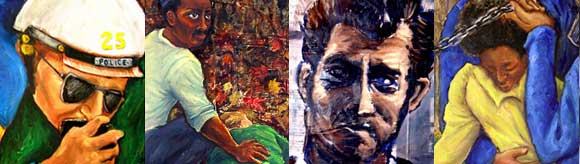
Finally, artist Aliene de Souza Howell paints and writes about the 1979 Ku Klux Klan massacre of five Communist Workers Party members while police stood by. If something like this could happen in 1979, we should be very worried about 2005.

Later this month, on February 21, Pearl Gabel shares her seesaw life as a constant dieter, proving that excess has two poles. Which one do you live at?

Nicole Leistikow
Managing Editor
Baltimore, Maryland

Coming Up

In March: ITF celebrates women’s history month by sharing stories of gender-bending.
In April: The meaning of Belonging.


The Boiling Point

BrickBob Gaybash!

BEST OF THE BOILING POINT (SO FAR)

personal stories. global issues.