Sex on the brain

Swedish researchers have, using brain-imaging techniques, concluded that gay men and straight men respond differently to two different scents that are potentially involved in sexual arousal.  So what does all this sex on the brain mean? Firstly, it may give credence to the notion that humans, like animals, may have pheromones, which are chemicals that invite certain types of behavior, such as sexuality, within a species; secondly, this data may prompt researchers to consider the biological and chemical foundations of sexuality and sexual preference.

The study, however, should only be seen as a beginning and certainly not as proof that there is a biological explanation for sexual orientation and behavior; it is still unclear whether it is sexual behavior that transforms brain chemistry or whether it is the brain chemistry that dictates sexual preference.  Furthermore, Dr. Ivanka Savic of the Karolinska Institute in Stockholm, who headed the study, issued the curiously vague comment that while the subjects in her research included gay women, the results of that aspect of the study were “somewhat complicated” and therefore cannot yet be published. We should, then, cautiously understand this study only as a foray into the biological causes and effects of sexuality and as a door that is beginning to be opened, but not as a definitive statement about sexuality or sexual behavior and orientation.

Mimi Hanaoka


Quote of note

“Freedom to kill is not a true freedom, but a tyranny that reduces the human being into slavery.”

— Pope Benedict XVI at the basilica of St. John’s in Lateran during his installation as the Bishop of Rome, speaking about this “unequivocal” condemnation of abortion and euthanasia.  The 265th Pope has already earned the moniker “God’s Rottweiler” for his unrelenting and inflexible conservatism.

Mimi Hanaoka


The ID with no borders

The so-called Real ID Act , which passed in both congressional houses last Thursday, states that DMVs can only issue national driver’s licenses to qualifying applicants who prove their legal presence in the U.S. and furnish a valid social security number.  

As expected, the act has roused debate throughout the nation, with one side vouching for the “Real IDs” promise to fortify national security, and the other side decrying the act’s oblique “infringements on civil liberty,” its requirement of extra personal documents to “prequalify” applicants for driver’s licenses. Detractors (many of whom are ACLU affiliates) also argue that the act does not target potential foreign terrorists on overstayed Visas as thought, but will intimidate harmless illegal residents, who will forego important driver’s training and licensing procedures for fear of being caught and deported.  

Toyin Adeyemi


Out with evolution

“Evolution is a great theory, but it is flawed … There are alternatives. Children need to hear them. We can’t ignore that our nation is based on Christianity — not science.”

— Kathy Martin, 59, a member of Kansas’s state board of education and a former science and elementary school teacher, who is presiding over the board’s recent inquiry into the role that evolution should play in the science curriculum of the Kansas public schools. Martin, who makes no attempt to hide her religious affiliation, has found many like-minded individuals, and Kansas is not the only state engaged in the debate over the legitimacy of teaching evolution; Ohio has already passed a measure guaranteeing that teachers may, in their classes, challenge the theory of evolution. Far from adhering to the notion of the separation of church and state, Martin and those who are on her intellectual and spiritual horizon are aggressively, legally, and insistently wedging the presence of the church in the ostensibly secular state.

Mimi Hanaoka


What it means to miss New Orleans

New Orleans. Mid-descent to Los Angeles, sinking through the layer of smog to reveal houses swimming in asphalt below us, it seemed as though we had been gone for a year instead of four days at Jazz Fest.

New Orleans is a city I loved entire before I ever walked its pot-holed streets, but for the first 27 years of my life, I was ignorant of its existence. The friends I knew who had ventured to the Crescent City returned with tales of oppressive humidity which far outweighed any of its considerable charms.

Just before April 2003, Taylor Hackford was ready to shoot his magnum opus based on the life of Ray Charles in New Orleans, and my boyfriend Anthony was hired for the job. He had found an apartment in the Garden District when I finished the job I had been working on. Ever the traveler, I made plans to escape the insanity of the film industry by hiding out for a month in his apartment at the intersection of Coliseum and Louisiana, dreaming awake in a place I’d never been before.  

Love descended suddenly. The muggy air was an anchor; the heat beat down. There’s a saying in Italy that to truly love, you must fall in love with a person’s faults. The heat was as enchanting as it was oppressive.

One moment I wouldn’t have noticed if New Orleans had been swallowed by a hurricane, while the next found me shaping my life around its tendrils and vines. As New Orleans resident Andrei Codrescu writes in a piece entitled “Secrets” in Zombification, one of his collections of essays written for NPR, “[T]he fact is that we all know that there exists in the world an order different from that in which we pass our days.”

Perhaps some of the transfixing beauty of New Orleans lies in its distance from the stress of life in Los Angeles. In its awareness of its own identity; in its seductive determination to watch the rat race from afar, without designs to follow the trend of velocity.

—Michaele Shapiro


Ugly children

If we’d smugly thought — or hoped — society had progressed beyond superficiality, we were, apparently, dead wrong; a study out of the University of Alberta claims that parents are culprits of a strangely intuitive but menacing type of favoritism — parents treat attractive children better than they treat ugly children.

The team of researchers at the University of Alberta, led by Dr. W. Andrew Harrell, head of the university’s Population Research Laboratory, scattered themselves across 14 supermarkets, of all places, and then observed over 400 interactions between parents and their children. Having rated the child’s attractiveness on a scale of 1 to 10, the researchers used the following as some of the criteria for how a parent treated his or her child: whether the parents safely belted the child into the seat of the grocery cart, whether the parents’ attention waned or lost focus, and whether the parents permissively or absent mindedly allowed the child to wander away or frolic dangerously in the grocery store. The results of the study — although, to be fair, the findings have yet to be published, so the academic community has not yet had sufficient time to pass judgment on Harrell’s claims — point to the creepy conclusion that parents take markedly better care of attractive children over their less attractive peers.

Harrell, who led the search, insists that, “like lots of animals, we tend to parcel out our resources on the basis of value … Maybe we can’t always articulate that, but in fact we do it. There are a lot of things that make a person more valuable, and physical attractiveness may be one of them.” The treatment of the child, according to Harrell, can be reduced to tendencies that make evolutionary sense, with attractive children and their attractive genes meriting more care.

While academics have not yet had time to sink their teeth into Harrell’s argument, some have already dismissed the study. Robert Sternberg, a psychology and education professor at Yale, pooh-poohed Harrell’s methodology — such as ignoring the socio-economic status of the parents and children who were observed — and dismissed the evolutionary theory as “speculative.”

Regardless of whether Harrell’s theory carries any scientific or intellectual legitimacy and parents do, in fact, enter into some sort of bankrupt aesthetic calculus when deciding how to treat their children, we can at least know that beauty is in the eye of the beholder, and not least in the eyes of the researchers.  

Mimi Hanaoka


Imbibing

issue banner

If April is the cruelest month, then May deserves a stiff drink. But before you reach for that new Australian Shiraz, consider the mood-altering moments you are already soaking in.

Our overall environment, for instance, may be the most overlooked drug. Who hasn’t been transported by a sunset on the beach, felt their brain chemicals paralyzed by a stressful day of work, or developed a different understanding of reality by hanging with a different crowd?

In this issue of InTheFray, we explore the impact of environment in its many forms. We begin on the streets of Brooklyn, home to a pool hall frequented by a diverse mix of teenage boys. While Contributing Editor Anju Mary Paul tries to put her thumb on what being American means for young immigrants in 2005, Through the Looking Glass writer Kristina Alda writes from our northern neighbor, Canada, about her transformation into a typical Canadian “nice girl” after adopting Ottawa as home.

Of course, home can be a complicated place. For some, it’s simultaneously safe and oppressive, straining and joyful. For a wife who becomes caregiver to her husband after an accident, in Susan Parker’s short story Taking care of one another, it is exhausting. For Kelly Barnhill it is a place of warring priorities. Her essay A room of my own with the door wide open, details how becoming a new mother leaves little time to write. And on the Yangtze River in the small town of Wanzhou, where photographer J. Unrau lives, home is intoxicating. As his photo essay illuminates, the daily sounds and smells he absorbs while wandering the hilly streets are his drug of choice.

So imbibe with us, and expand your mind, by sampling our stories all the way from small town China to a Brooklyn pool hall.

And get ready to imbibe a little more this June, when ITF celebrates gay pride month. As part of our celebration, InTheFray would like to showcase photographs of LGBT celebrations and events happening around the United States and the world. Readers can submit original photographs to our Media Gallery, where they will be posted daily. InTheFray asks that you provide a brief caption to be published with the photograph, telling us the who, what, when, and where of your photo(s). Please also include your first name and location.

(A note to our readers: Please complete our 2005 Reader Survey. Your answers will help us to improve the magazine.)

Nicole Leistikow
Managing Editor
Baltimore


The making of an American

A Brooklyn pool hall reveals how to pose as a native son in 2005.

Where young Americans are made: The 9 Ball Pool Club on Coney Island Avenue, Brooklyn.

“Immigrant” is a four-letter word in Brooklyn schools. Much worse than “nigger.”You can call your best friend a nigger if he says something stupid, but to call someone an immigrant is to brand him a misfit, an intruder, someone who doesn’t belong.

Brooklyn is 40 percent immigrant, according to the Newest New Yorkers report, published by New York City’s Department of City Planning in January. In Midwood, the Brooklyn neighborhood south of Prospect Park, most immigrants come from Russia, Ukraine and Pakistan. Each country is well-represented in the trash-talking that goes on at the 9 Ball Pool Club on Coney Island Avenue.

At the pool hall, the teenaged sons of all those Russian, Ukrainian and Pakistani immigrants mix with boys from everywhere else: Afghanistan, Puerto Rico, Palestine and Bangladesh. Catholics, Jews and Muslims. White, brown, and black. They start to drift in from 2 p.m. when Lasha, one of the hall’s owners, opens its doors. Usually they hang around the two San Francisco Rush 2049 video machines by the door, one kid racing his virtual car, others hanging over his shoulders and backseat driving. Lasha sits behind his counter in the far corner of the hall and listens to Russian radio. When the place fills up a little, he switches on the television suspended from a corner of the ceiling that seems to only play MTV music videos.

The All-Americans

On a blustery afternoon in January, Fat Cat and Rabbi Rooski are waiting for someone with money in his pockets to walk through the pool hall door.

Seventeen, born in the United States but with parents from Puerto Rico, Fat Cat has shoulder-length brown hair, a round face and a short, round body. His voice is like a girl’s — a soft and sibilant Hispanic whisper — but each of his eyebrows has two parallel notches shaved out of it — a well-known gang identifier. Fat Cat is an “O.G.” — an Original Gang-member — so you don’t want to try calling him a girl.

Rabbi Rooski is from Ukraine, tall with short-cropped blond hair below a backward-turned baseball cap, and a slightly pimply face. The Rabbi came to the United States nine years ago, when he was eight. His real name is Edward. “Ed-waard,” he tells me, stretching out his name in a put-on Russian accent. (He normally speaks strict New Yorker.) “My name is Ed-uaardo. I come from Uu-kraine: The mah-therland of mah-fia country.”

The two boys are looking for pool partners willing to share the cost of an hour at a table. A tall, dark-skinned boy opens the door to the hall and instantly, the Rabbi is on him. “You got any money?” he asks. The boy, startled, shakes his head and walks right out.

“I’ve got money!” 13-year-old Ahmad from Pakistan pipes up. Ahmed “talks too much shit” according to Fat Cat. He’s been playing San Francisco Rush with Geis but he’d rather shoot pool with the big boys and this afternoon, the big boys can’t afford to say no.

I chip in a couple of bucks as well and together, three cool teens and one 29-year-old reporter, the four of us have enough money — $8 — to pay Lasha for a rack of balls.

Geis who has been abandoned by Ahmed, walks over to watch our game. From Yemen, Geis arrived in the States when he was less than a year old. He’s 13, short for his age, and thin. Geis prefers Bob’s Store, a video arcade down the street on Newkirk Avenue to Lasha’s, because arcade games are a lot cheaper than pool. But Bob gets angry with kids who loiter around his place and shouts at them when they start to fool around. Lasha is a lot more relaxed about a bunch of kids hanging out at his pool hall not doing anything. He shouts at the kids to be careful with his sticks, or to stop playing when their time runs out, but they never listen.

Fat Cat (right) with his friend David outside the Newkirk Avenue subway station.

The Non-Americans

The boys call Lasha an immigrant. It doesn’t help that he wears tight-fitting, brown corduroy pants and a beige, long-sleeved, turtleneck t-shirt with a sleeveless, brown leather jacket on top. He is a heavy-built bear of a man, who arrived in the United States from Georgia three years ago and has yet to acquire an American fashion sense or accent.

“Can you be an American if you weren’t born here?” I ask the boys, just to be sure.

“No!” Fat Cat and Ahmad reply immediately in unison. “Then you’re an immigrant.” To them it’s an either/or situation — American or Immigrant — you can’t be both. (They all see themselves as American.)

“You can try,” suggests Geis, but his undertone sounds doubtful.

“Can you tell just by looking at someone if he’s an immigrant?”

“Yeah,” the boys say confidently. “It’s the way he looks, the way he speaks, and all that. His dress is different. His voice.” They point out Shanl who’s been standing on the periphery of our conversation, quietly listening.

“He’s an immigrant! For sure!” they shout, happy to have found another one.

“How can you tell?”

“Just look at him!”

Shanl retreats inside his jacket and his eyes dart between the boys and me. He wants to be an American — he tells me afterwards that he is one — but he’s wearing the wrong kind of clothes: a white-and-blue striped, cotton polo t-shirt underneath a black jacket with a fur-trimmed hood. His jeans are the wrong shade of blue and his black-and-white sneakers are a no-brand variety. The other boys are in North Face, Nike and Sean John. They talk with a Brooklyn accent: the softened T’s, the rounded vowels. Shanl, who arrived in the United States from Pakistan a year ago, has yet to master this style of talking. He rarely speaks but when he does, his voice betrays his recent arrival.

Kamal (bottom) with his “brothers” (left to right) Asif, Mike, Angel, Chris, and Louis in the basketball court of Kamal’s old primary school: PS217 in Midwood.

“So what if you was born here?”

An American teenager living in Midwood, Brooklyn needs to have seen the new Usher video and the latest Will Smith blockbuster. An American teenager needs to know the rudiments of pool and basketball and football. He must know who is in which gang — whether it’s the Crips, the Latin Kings, or that Afghani gang across the street. He’s got to know how to talk — not to parents or inquisitive female reporters — but to other kids. Talk slang, talk back, talk big. An American teenager needs to have a command of the various accents of his neighborhood so he can make fun of friends’ backgrounds. In Midwood, that means being able to fake a passable Russian accent and a bad Pakistani one.

But there are immigrant children who can do all this — who look and speak like Americans — but who refuse to call themselves American.

When Kamal Uddin, a short 17-year-old, walks into the pool hall, in his bright red jacket and his slicked down fringe, he makes it a point to shake the hand of all the boys there. He tells me each of their names and the schools they go to. He grabs Fat Cat round the neck and tells me that Puerto Rican Anthony is his cousin. Wasif, from Afghanistan, is his best friend. Then he leans close and whispers that he used to have a crush on Geis’ sister from Yemen. As soon as the words come out, he straightens and says it was rather she who had a crush on him. He says there are no cliques drawn along ethnic or racial lines in the mixed pool hall crowd. “There’s just like a brotherhood thing, you know?”

But when I ask Kamal if he thinks of himself as an American, he says no. He tells me how after September 11th, the kids in his school started calling him names because of his brown skin and his Muslim faith. They started calling him an immigrant. Kamal says he never answered back. But one day, his principal heard one of the kids teasing him in the hallway. “You know what?” the principal reprimanded the girl, “You’re not a citizen either. You’re an immigrant too. We’re all immigrants except the Native Americans.”

Since that day, Kamal has worn the badge of an immigrant with pride. And that too is a peculiarly American trait. “I was born in Bangladesh. That’s my country,” he tells me. “I can’t just come to another and say, ‘This is my country.’ Nobody can come and tell me that this is my country. So what if you was born here? You still have a background, you know? Those people who are born here, those are the people who say, ‘Yeah, I’m American straight up. American, born and raised.’ But come on, so what? You still have a background. We’re all immigrants. Speak the truth, we’re all immigrants.”

STORY INDEX

TOPICS > IMMIGRATION IN NEW YORK >

The Newest New Yorkers Report 2005
URL:  http://www.nyc.gov/html/dcp/html/census/nny.html

ORGANIZATIONS >

The Council of Peoples Organization
URL: http://www.copousa.org


The Tao of the street

Navigating life in western China.

Click here to enter the visual essay.

The Chinese word Tao means path or way, or street. This idea is the root of the Taoist religion. While most places in China aren’t that religious these days, life here is filled with streets, and the streets with life.

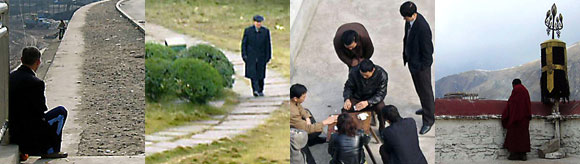
The way can be difficult to navigate. I live in a small mountain city called Wanzhou, which is on the banks of the Yangtze River, in the Sichuan region of western China. The river and the mountains combine to prevent any street from being straight. I spent months getting lost whenever I strayed from the main roads. There are stairs everywhere, making each walk an exercise in three-dimensional thinking.

In all these wanderings I have yet to find a street that’s been far from the click of mahjong tiles. Mahjong is a tile-laying game that occupies almost everyone’s free time. And free time is in great supply. The streets are loaded with small shops and all of them have more  employees than it seems they could possibly need. Unless they are needed precisely to defeat neighbouring shop employees at the game. Players at green-topped game tables congregate in parks and alleys and spectators gather. But it’s not just mahjong on which people spend their time. Cards use less expensive equipment and can be played with a stool and lots of shouting. People talk about Sichuan people having fiery tempers to go with the spicy food they eat. Big — yet good-natured — screaming matches often ensue.

There are more sedate pastimes. Old people sit and watch kids running by or meander through parks. The gentle clicking of metal spheres being slowly rotated in hands often accompanies these walks. I’ve been told that rotating these spheres is a way to maintain longevity. Another common technique is walking backwards in circles. Many of those old pedestrians seem as aimless as me. They’re just walking to see what there is to see, especially the ones walking backwards.

In Wanzhou sunny days are rare. But when they do occur, the kite flyers come out. Carefully spaced old men, tethered to their contraptions far above, line the banks of the Yangtze. These are the kinds of kites on which I can imagine trying to send a person into space. Those sunny days also turn into impromptu flag ceremonies when people can actually expect their clothes to get dry.

While Wanzhou is a small city, it is technically part of Chongqing, a huge metropolis a couple of hundred kilometers upriver. Chongqing is known for its spicy food. I’m assailed with more than the jingles of fast food restaurants when I travel through the city. Independent vendors attack your sense of smell directly as they fry up noodles or potatoes or anything you can put on a stick. The spiciness that wafts from tubs of takeout causes your mouth to water as beautiful girls try to find places to sit and eat. Or at least I tell myself it’s the peppers. Then the burning coal they use to cook on the street, where there are no gas lines or electricity, always give me coughing fits, and the girls are out of sight by the time I recover.

I also coughed in the mountains, where people burn yak dung in fireplaces and incense in offering pyres. The idea of a path takes on even more significance in Lhasa as Tibetan pilgrims circumambulate temples, prostrating themselves all the while. On the ground around the Jokhang Temple the rasping of the pads that protect the pilgrims’ hands and knees sliding over rocky tiles is omnipresent. But you can get away from all of that; get above it all with monks who’re listening to the rituals happening below.

Then it’s time to find the way home. Even though my apartment is away from the noise of the street, all that stuff is waiting just outside. The paths are filled with life.


A room of my own with the door wide open

Musings on motherhood and Virginia Woolf.

In the 5 a.m. darkness, I slip out of bed, turn off my alarm clock quickly and slide on whatever clothes I can find on the floor, careful not to lose my balance and fall. I cannot afford to make a sound. I tiptoe out of the room, relishing the sounds of open-mouthed breathing coming from the bedrooms. In my head I am already writing. The half-written story, started the previous morning, is sharp and clear, and I am eager to enter into it. But halfway down the stairs I am interrupted by a terrific wail. And there is the dilemma: Do I let the baby bawl herself to sleep — and run the risk of waking up the four year-old? If so, I would have two people awake and no writing done. Or do I wake up the sleeping husband, hand him the baby and attempt to write while listening to unhappy baby yelling at unhappy daddy and, eventually, unhappy big sister?

Three people awake. No writing done.

I sigh and pick up my child. Her skin, soft and pliant as bread dough, smells of sugar and milk. Instantly, she buries her face in my neck. We lie down next to her sleeping father, curl up and relax. The story I was writing in my head slowly ebbs away until I no longer remember what I was doing out of bed so early. I rub my baby’s back, her legs, her tummy, breathe in the scent of her sparse hair, love her with my guts.  

In the disappearing moments before I drift asleep, the black-and-white image of that English woman reappears in my memory. Her hair is falling out of the knot at the nape of her neck, her wool jacket and loose silk scarf at her throat fade at the sharp pallor of her face. Her eyes look past the photographer, out of the doorway, into the other room.

Her own room.

God damn you, Virginia Woolf. You were right, you are right, you always will be right.  

Happy?

I now detect a gleam in the motionless gray eye, a slight curl of the lip that was not there before. It says, I told you so.  

The life I envisioned at 20, with a copy of A Room of One’s Own stuck in my backpack, is a far cry from the life of interruptions and revolting tasks that I now lead and love.  

For me, it begins with a tumor.

Let me explain.

I am sitting in the lobby of the student clinic writing in very small letters. I can barely fit my name in its designated spot. Under the heading “Reason For Visit” I write this inside a 3 cm by 1 cm box: “cessation of menstrual cycles but don’t even bother giving me a pregnancy test because i’ve taken four already all negative and i think i have some sort of tumor.”  

Date of last period: October 20.  
Today’s date: January 8.

The nurse smiles. I don’t think she even read the words that I painstakingly jammed into that tiny box. She takes a pregnancy test off the shelf and sends me into the bathroom to pee. This is fine, I tell myself. I now see why our health care costs so much — a bunch of nervous-Nellies and their insatiable desire to order more tests.  I perform the usual routine. Wipe with alcohol pad. (Ouch.) Spread legs apart. Hunch over. Lean in to get a better view. Pee on hand anyway.  

I place the sample in the metal cupboard and slide the door shut.  

On the other side, a door slides open, and the lab assistant takes the sample out.  

I wash my hands confidently. Perhaps now we can get down to business.

My mother had a uterine cyst several years before, so it would make sense that this is what I have. This is the reason why I am so bloated all the time. This is the reason for my insane cravings for milkshakes after two years of veganism. This is the reason why I have been falling asleep at the computer, on the bus, in the student lounge, at the library. This is the reason why I nearly threw up on two heavily-perfumed girls, as they walked into the Creative Writing class I was student-teaching. I am ready for surgery or drugs.

I just want to feel better.

The nurse walks me to the exam room. She is chipper and bubbly and says it will take a few minutes. She is not looking down at the test. I am. I am walking down the hall behind a nurse holding a small white plastic square with a gigantic red “plus” sign.

I sit in the exam room and cry. I see every plan my boyfriend and I have made over the last two years disintegrate. Thailand, Guatemala, New Zealand, Tibet. These were places I could teach, and he would tag along. I could finish my novel, he could write travel essays. We would come back and work for the Park Service again.  He would study architecture. I would teach for five years in the roughest schools I could find and then go to school myself for that MFA. I would write essays. Publish a volume of poetry. We figured we would have children in our thirties, if at all, but now …

Were you trying to get pregnant?

The nurse is kind, concerned about my puffy eyes, my gray skin.

No.

Are you married?

No.

Did your boyfriend have any idea that you might be pregnant?

No.

How do you think he is going to react?

I don’t know.

Do you want to keep the baby?

I don’t know.

Have you ever even thought about motherhood?

Maybe. I can’t remember.

Would you like information on …

Wait, I say. I don’t want her to continue.

I’m sorry?

Yes, I say. My eyes begin to burn. My hands tremble, grip my jeans, tremble again.

Yes what?  

Yes. Yes. I do want the baby. I do want to be a mom.  

I imagine that I have grown taller. That my hands are claws, and my eyes, flame.

The nurse looks at me. Her eyes are blank.

Yes, I tell you!  

I am crying freely now. It is a relief, and my face relaxes. The nurse looks at me as though I’ve gone crazy, horrified that I have just shouted.  

Yes, I whisper.  I put my hand instinctively on my stomach. Haven’t yet learned that the womb is actually much lower, but never mind. The nurse purses her lips and gives me a stack of brochures. Crisis counselors. Midwives. Abortion clinics. Anti-abortion clinics. A social worker. Discount maternity clothes. Adoption information.
  
I shove it all into my school bag and head for my car.

Seven months later I am pushing so hard that my eyes bug out and my skin rips open. My sisters are there and my mother and all are gasping with joy and revulsion and pain and astonishment. After three colossal pushes she emerges, knees and elbows moving chaotically through the birth canal, spit out like a watermelon seed and almost slipping out of the tired and cranky doctor’s hands. My baby is laid upon my belly, and she is red and gooey and bellowing. Prettier than prose. Sweeter than any poem I will ever write. Her heart-shaped face and rosebud mouth are wrinkled with rage and confusion as I vainly attempt to shade her eyes from the overly bright room.  

“Can we turn down the lights?” I ask.

“No,” says the cranky doctor with a look that keeps my mouth shut.  Apparently I have already been enough of a bother.  

I imagine that we have already returned to our apartment in South Minneapolis, with its lilac walls and pale green sheets on the bed. I have already prepared a little spot for her between her father and me. As she screeches and squirms, sucks and falls asleep, I plan out our days lounging and writing together — baby at the breast, pencil in the hand, notebook on the knee. She would play quietly, amuse herself while I explored the vast terrain of linguistic possibility.  

Ha.

Two months later and only one paragraph into the master’s thesis (the computer is currently covered in diapers, receiving blankets, and toys), I discover that the daily poetry journal’s last entry was two days before my daughter was born. A simple, four-sentence note to my landlord takes six days to compose. I discover that I need to re-evaluate my relationship with writing and re-learn.

My first attempts went like this:  

Day one. Find notebook. Place notebook on table. Find pen. Place pen next to notebook. Sit down. Baby starts to cry. Decide to let baby cry, and maybe she will calm herself down. Wait six very long  seconds. Pick up baby. Sing to baby. Read story to baby. Take baby on walk. Forget about notebook.

Day two. Put baby down for nap. Discover notebook on table. (What luck!) Sit down to write. Consider writing ode to dirty diapers. Consider writing sonnet about spit-up. Decide to free-associate, writing down words and allowing the poem to form. Inexplicably, the word “whereas” is written 16 times down a neat little column.  

Day three. Head out with baby in backpack, blankie around waist, spare diaper shoved in jeans pocket, notebook and pen in hand. Lay baby on blanket in the grass. Lie down next to her. Smell the warm soil, the fading grass, the falling leaves of early autumn. Write. Time, space disappear. Three poems and the first eight pages of a story later, I am satisfied. Roll around in the grass with baby. Show baby colored leaves, flowers, grass, sky. Kiss baby. Bring baby home. Forget notebook at the park. It is gone forever.

At night, I dream of Virginia Woolf. Words first encountered in college have lain dusty and ignored in the recesses of my brain, but now, like the dry bones in that barren and wasted field, suddenly spring to life, animation, and power. My new life as mother, teacher, wife, and frustrated writer has opened a window between our lives, and I can’t get Woolf out of my head. A life superimposed on sadness and despair, her writing life transcends gender, class, illness, and expectation. Every limitation falls away on the page, every prison disintegrates in the freedom of her own room.  

And now, five years into the new millennium, I discover that I am the woman that she wrote about. I am the woman who lays art aside to play the mother to my kids, my adult siblings, my neighbors, my friends. I am the woman whose soul-crushing love for her children creates disorganization of thought, disordered creativity, and desperation. I am the woman who feels guilty for any minute spent in the pursuit of art.  I am the woman in desperate need of a room, not just in my house, but a room in my head. Like the millions of other women who haven’t picked up a paint  brush in years, who can’t find a sitter when her band practices, whose desk has been co-opted by fingerpaints and crayons, I have allowed motherhood to trump artistry.

The sun glares on my computer as I write this one-handed. My squirming baby tackles my shoulders, tugs on my hair, struggles against my arm crooked firmly around her waist. My nose wrinkles at the acrid smell of her diaper, but I decide to let it slide for a minute.

“Nuss, nuss,” says the baby, peering under my shirt to make sure they were still there.

“In a minute,” I say, “Mommy is finishing her sentence.”

My room, unfortunately, has an open door and often invites wrestling children, half-done art projects, a rancid diaper pail, and the constant cries of rage and protest. But at 5 a.m. it is just me, the stories forming from my fingers and the click-click of my computer, if the baby doesn’t cry.  

STORY INDEX

PEOPLE > WOOLF, VIRGINIA >

Biography
British author, feminist
URL: http://en.wikipedia.org/wiki/Virginia_Woolf

WORKS > A ROOM OF ONE’S OWN >

Stub
URL: http://en.wikipedia.org/wiki/A_Room_of_One%27s_Own

personal stories. global issues.