A generous Ramadan indeed…

“It’s not something bad to have increased shopping in Ramadan. The more people buy, the more they share.”

—Mohammed Mahgoub, Advertising Committee Member

Giving new meaning to “ramadan kareem” (the traditional Ramadan greeting, meaning, “a generous Ramadan,” The New York Times reports today that the holy month of Ramadan is becoming increasingly commercialized in the Arab world.

Laura Louison


Next stop: marriage laws

For the sake of protecting marriage, more and more states are making it illegal for gays to marry. If we allow gays to marry, we will be breaking down this historical institution. Now, marriage needs someone to rush to its defense. After all, over half of all marriages end in divorce. If a company produced a product that failed fifty percent of the time, it would go bankrupt, and we witness the bankruptcy of marriage. So in order to protect marriage, I pose the following possible solutions:

1)Make divorce illegal. What better way of protecting marriage than by not allowing citizens to get out of it except by death? We can take away everyone’s civil rights and protect marriage all at the same time!

2)Since marriage should create an environment for positive and healthy families, let’s allow only people of child-bearing age who are fertile to get married. Women with potential pregnancy complications need not apply.

3)Everyone is only allowed one marriage. If your first husband or wife dies or is abusive, well at least you got the one shot.

The point is that all of the laws we pass or policies we create are going to be as ridiculous as the last one. On September 29th, the Terminator terminated a bill that would have legalized same-sex marriage in California—and maybe this is necessary. Perhaps the voters of California will vote for same-sex marriages, and Schwarzenegger’s veto will become a waste of media space.


“In da Bginnin God cre8d da heavens & da earth.”

Terrible spelling and choppy, stuttering sentences no longer need to be restricted to teenagers and text messages; the Bible is now available in SMS text message format, replete with absurd spellings and, apparently, a very accessible message. The SMS Bible begins with the proclamation that “In da Bginnin God cre8d da heavens & da earth.”

The Bible Society in Australia has translated the Bible and all its 31,173 verses into text messages, after six weeks of labor on the part of Mr. Michael Chant, who translated the Bible into SMS messages.

Apparently the Bible can do with a little positive marketing and image re-appraisal, as it is now also available in camouflage. “The old days when the Bible was only available within a sombre black cover with a cross on it are long gone,” stated Mr. Chant, speaking about the Bible Society in Australia’s Bible designed and tailored specifically for the nation’s armed forces.

The SMS Bible follows in the wake of the recent innovative gimmick that is the 100-Minute Bible; Reverend Michael Hinton in England has, after years of work and vicious editing, edited and published the new Bible, miniature both in content and in style, for distribution in British churches and schools. The Bishop of Jarrow, Rev. John Pritchard, served as a consultant on the book and offered a rigorously non-theological take on the 100-Minute Bible, in which all 66 books of the Christian holy text have been condensed like a literary cheat sheet.  “This is an attempt to say, ‘Look, there’s a great story here — let’s get into it and let’s not get put off by the things that are going to be the sub-plot. Let’s give you the big plot,’” was the Reverend’s sunny outlook.  
  
While Mr. Chant insists that only the spelling of the Bible, and not its language, has been changed with the SMS Bible, one wonders if something doesn’t get lost in translation.  

Mimi Hanaoka


Critically Speaking:  Forty Shades of Blah

In the last hundred years of filmmaking, there have been different eras where a vast array of subjects, styles, approaches, and themes have been taken to new levels.  For instance, in the late 60s and early 70s, directors took on serious subjects and presented them in a very real, raw, and groundbreaking manner.  Films such as Midnight Cowboy, Five Easy Pieces and Carnal Knowledge exposed audiences to lifestyles and characters never before experienced.

Then came Jaws and Star Wars which brought on the blockbuster era of action and special effects, and the small film that took on real-world issues fell to the wayside.  During the 90s, the so-called independent movement took hold, fueled by an infusion of foreign cash and the desire by many filmmakers to take on serious subjects again which created an influx of films — some good, such as The Crying Game, and many not so good (you know who you are).  The “Indie” movement has cooled somewhat and now what you get are these small films that were good enough to win festival awards with great acting but stories that leave you empty.  That leads us to First Look PicturesForty Shades of Blue, directed by Ira Sachs (The Delta), written by first-timer Michael Rohatyn and Ira Sachs, and starring Russian standout Dina Korzun, Rip Torn (Men in Black), and Darren Burrows (Ed in Northern Exposure).

Forty Shades of Blue is about a young Russian woman, Laura, who lives in Memphis (hometown of director Sachs) with a much older legendary music mogul, Alan James, and has a young son with him.  She’s the typical lonely trophy wife, beautiful and kept and expected to act accordingly.  Laura’s life would probably have continued without change if not for the intrusion of Alan’s estranged son from a previous marriage, Michael, who returns home to escape troubles with his wife.  Michael’s jealousy, anger, and resentment towards his father, fueled by an attraction to Laura, become the center of the film.  The story is simple, the characters are not, and that is what makes this Sundance Film Festival 2005 Grand Jury Prize winner worthy of viewing; but like some good Kung Pao chicken, it leaves you a little wanting by the end.  

I was mesmerized by the simple but affective performance by Dina Korzun, who really does show forty shades of blue (as well as other colors), but the script never allows her the full opportunity to win the audience over.  Much of the publicity has gone to Rip Torn for a part that many actors could have played stereotypically.  Torn, who has a long history of great stage and screen performances, brings a very three-dimensional depiction of a man who can have anything he wants and is adored by thousands but who can’t achieve the love and respect from those closest to him.  Darren Burrows brings the same understated performance that he gave to Ed Chigliak in Northern Exposure as the son who never achieved the same greatness as his father but has to fight all the same, inherited, bad traits.  Understatement can sometimes get in the way of great storytelling, and in this case, the key relationship between Laura and Michael becomes so under the wire that you end up not caring what the characters end up doing.  You just want to shake them into realizing that there are people with real problems in the world, and when you put them in perspective, their lives really aren’t that bad.  Forty Shades of Blue deserves a viewing, but unless you like dramatic films that drop you in the middle of character’s lives and then ends with just a splotch of enlightenment, then I’d wait for the DVD.
  

Forty Shades of Blue is now playing at Film Forum in New York and starts Friday, October 7 at the Landmark’s Nuart  in Los Angeles and nationally throughout October.


How not to fight a war

Well, it’s been two years since the Iraq invasion, and it seems the Bush administration still needs to learn how to pick its battles. The U.S. Senate voted 90-9 yesterday to …

Well, it’s been two years since the Iraq invasion, and it seems the Bush administration still needs to learn how to pick its battles. The U.S. Senate voted 90-9 yesterday to prohibit the “cruel, inhuman, and degrading treatment” of prisoners in U.S. custody. In reality, the measure — an amendment to a military spending bill — merely clarifies rules of prisoner treatment that had been thrown into ambiguity ever since the invasion of Afghanistan, when the Bush administration decided to toss out the Geneva Conventions as a binding standard for military behavior. Nevertheless, the vote drew fierce opposition from the White House, which threatened a veto of the entire $445.5 billion Defense Department spending bill if the measure was not removed. The anti-torture amendment, said White House spokesman Scott McClellan, “would limit the president’s ability as commander-in-chief to effectively carry out the war on terrorism.” (The proposed ban on torture, by the way, doesn’t apply to the Central Intelligence Agency, nor does it prevent the military from moving prisoners to other countries where torture is allowed.)

Fortunately, many Democrats and Republicans — chief among them, Senator John McCain of Arizona — are standing up to the White House on this issue. An explicit ban on torture is the only moral and sensible thing to do, they say. “We have to clarify that this is not what the United States is all about. This is what makes us different from the enemy we are fighting,” said McCain, a former Navy pilot who was held and tortured as a prisoner of war in Vietnam.

In his remarks McCain cited a letter written to him by an officer in the 82nd Airborne Division, Capt. Ian Fishback, who served in both Afghanistan and Iraq. “Despite my efforts, I have been unable to get clear, consistent answers from my leadership about what constitutes lawful and humane treatment of detainees,” Fishback wrote in a September 16 letter to the senator. “I am certain that this confusion contributed to a wide range of abuses including death threats, beatings, broken bones, murder, exposure to elements, extreme forced physical exertion, hostage-taking, stripping, sleep deprivation and degrading treatment.” Fishback said he had complained to superiors for 17 months that soldiers were operating under conflicting views of what was humane treatment, and yet no one was able to point him to any explicit standards.

Fishback was the officer interviewed in the Human Rights Watch report on prisoner abuse that I mentioned in a post last week. While the Abu Ghraib investigations netted the convictions of nine low-ranking soldiers, the claims made by Fishback and others suggest that the problems at Abu Ghraib and elsewhere began at the top: with the generals and politicians who refused to impose clear standards of conduct. McCain took this case to the floor of the Senate yesterday. “We demanded intelligence without ever clearly telling our troops what was permitted and what was forbidden,” he said. “And then, when things went wrong, we blamed them and we punished them.”

Given all the other political fights it needs to focus on, it’s puzzling why the Bush administration is so intent on keeping its policy of no policy in place. Forty-six of the 90 senators voting for the amendment were Republicans. More than two dozen retired senior military officers, including Colin Powell and John Shalikashvili, have also come out publicly in support of the measure. The fact that so many members of his own party are opposing a wartime president on his wartime policies must be disquieting and humiliating for Bush. Of course, there’s still a good chance that the commander-in-chief will get his way: The House version of the military spending bill does not include the torture provision, and McCain and other supporters worry that it could be gutted in the negotiations to reconcile the two bills, if not axed by presidential veto.

As the White House well knows, the widespread, well-publicized abuse of prisoners at Abu Ghraib became a sort of Pearl Harbor for Muslim extremists around the world: If they had any doubts that the fight against the American Satan was a cause worth spilling blood for, now they could rest easy in their paranoia. Top officials in the Bush administration recognize the serious damage caused by the prison abuse scandals. What’s more, it is clear to some — including Bush-appointed CIA Director Porter Goss — that the American occupation, plagued as it has been by a host of tactical and moral failures, has become a rallying point “to recruit new, anti-U.S. jihadists.” How, then, can the administration persist in its belief that having a clear, consistent policy against torture will somehow endanger its war on terror? Having no policy clearly doesn’t seem to be helping things.

Now, what definitely seems to be harming things is the vitriol from anti-Muslim extremists like Republican Senator Ted Stevens of Alaska. “I believe we are seeing the beginning of a crusade against freedom from the militant terrorist Islamic entities throughout the world,” said Stevens in opposing the amendment. “If this amendment passes, the United States will not have effective control of those people.”

Crusade”? “Effective control of those people”? Did I say they were paranoid?

Victor Tan Chen

Victor Tan Chen is In The Fray's editor in chief and the author of Cut Loose: Jobless and Hopeless in an Unfair Economy. Site: victortanchen.com | Facebook | Twitter: @victortanchen


Girls just want to have fun

Muslim girls in Brooklyn let their hair down at their girls-only Islamic prom.

Pretty in Pink: Sahar Zawam’s prom dress was a baby pink confection with a white underskirt and matching pink shawl, bought from Kids’ World on Church Avenue.

Palwasha Khan sits on the bottom corner of her bed while her cousin stands behind her, spritzing, combing, and curling Palwasha’s hair, scolding loudly each time the teenager moves to answer her phone. Palwasha and her sister’s beds are strewn with shawls, salwar kameezs, hair dryers, hairspray bottles, make-up kits, cell phones, handbags, and pink and purple Pokémon lunch boxes full of gold bangles and necklaces. On the TV, a Bollywood movie — Yes Boss — is playing on mute but everyone is familiar with the story, a complicated love triangle in which an ad exec unhappily woos the girl he loves for his boss. On the wall by the door, stickers describe the primary teachings of Islam: “Who is Mohammad?”, “What is the Quran?”, “What was the effect of Islam on the world?” The girls’ mother walks in and out of the room every so often, checking on her daughters’ progress, which is way too slow.

It’s pre-prom madness Muslima style…

Brooklyn blues

The first time Sahar Zawam realized that being Muslim could make a dent in her social life was when she realized she wouldn’t be able to attend her high school prom.

That particularly American rite of passage was off-limits to the Egyptian-American teenager studying at Midwood High School because Islam forbids its female followers from removing their headscarves or wearing revealing clothes in front of men other than family members.

A lot of Muslim girls at Midwood High, which caters to a large Pakistani and Arab population, were facing the same dilemma. But rather than break the dictates of their religion for the sake of a party — even if it was their prom — last year, two Midwood seniors decided to organize a prom exclusively for Muslim girls.

Abitssam Moflehi, a Yemeni-American, and Farrah Abuzahria, a Palestinian-American, had heard about Islamic proms being held in Dearborn, Michigan. If Muslim girls could party in Michigan, why not in Brooklyn, they asked themselves.

The two seniors rented a small hall in Midwood and sold tickets to Muslim girls (Muslimas) they knew at $15 a head. They promoted the event not only at Midwood High but also in other neighborhood schools, and in mosques and youth centers. Girls who were going told other girls about it and, very quickly, word got around.

On the day of the prom, almost 80 girls showed up at Widdi Hall, coming from all over the Midwood area and beyond.

“The girls were unbelievable!” Sahar recalls. “You know, before they get inside the hall, they still have to wear the hijab. So these girls walk in with their black hijabs, they walk in, and they were like whoosh!” Sahar mimes a girl dramatically pulling apart the edges of her all-concealing, black drapes to reveal the dazzling gown she is wearing inside.

“It was like these girls had never had a party in their whole lives. You should have seen the smiles on these girls’ faces. They were so happy!

That was last year, 2004.

This year, Sahar was president of the Midwood High School Islamic Society and a senior to boot, so responsibility for organizing the 2005 Islamic Girls Prom fell on her shoulders.

Salwa Zawam (left) models the figure-hugging leopard fur print dress she wore to the prom while her younger sister, Noha (right), shows off her Black and pink floral print dress. Their seven-year-old sister, Zainab (center), wears a scarlet two-piece outfit she would have worn to the prom if she had been allowed to attend. Zainab now says that she never wanted to go but her older sisters remember her crying at home because she wasn’t going to the party with them.

Making-up is hard to do

The morning of the prom, the two Pakistani sisters, Palwasha and Sabah Khan, rush to Midwood High to pick up their report cards, then go shopping for hair spray and other accessories, returning home at one — having skipped lunch — to start getting dressed.

The sisters have decided to wear matching salwar kameezs — a traditional Pakistani outfit consisting of loose pants and a knee-length, matching tunic on top — made of translucent black chiffon with flowers embroidered in gold thread all over the bodice.

But an hour and a half later — only an hour before they are supposed to be arranging chairs and blowing up balloons in Widdi Hall, the venue for the prom once again — Palwasha is still having her hair done.

Sabah hasn’t even changed yet. She and her friend, Aisha, are still straightening their hair while Aisha’s cousin, Mishi, is in the adjacent bedroom, working on the computer.

Another Midwood girl, Anam, arrives, dolled up in a tight-fitting sheath with a blue-and-gold diagonal stripe design. Over it, she is wearing a gold knit jacket. Her false nails have been painted a copper sulphate blue to match her bright blue eyeshadow and bright blue sandals. Anam has come from having her hair done at a nearby Chinese salon but doesn’t like the results. (She’d wanted her hair swept up but the hairdresser did it down. She’d wanted fancy but the hairdresser did simple.) She has come to Palwasha’s for moral support and hairstyling advice.

Just then, Mishi walks in, having changed into her prom dress: a simple silk salwar kameez in blue. But she hates it. “I look like a married person!” she wails, looking ready to burst into tears. Anam rushes to console her, forgetting her own predicament. “It’s okay because your face is pretty,” she tells Mishi and herds her back to the bathroom to jazz up the outfit.

More friends turn up at the door and through it all, Palwasha’s cell phone rings constantly with girlfriends calling to ask for last minute advice about what to wear. One girl calls from Canal Street where she is still looking for the perfect dress. Another calls for a second opinion on her selection, and Palwasha asks back: “Which shoes are you wearing? The fashionable ones?”

By four o’clock, the girls are nowhere close to being ready for the prom that is supposed to be starting now. They stand in a row, the first girl fixing the second girl’s dress with pins, while the second girl straightens a third girl’s hair. Palwasha’s hair is not yet finished; she’s been moving around and answering her cell phone so often that her cousin hasn’t finished setting her curls.

An hour late, (from left) Sabah, Irum, and Palwasha rush to get to the prom.

Get the party started

Over at Widdi Hall, the venue for the prom, a steady stream of Muslim girls are being dropped off by their parents, only to find that the main doors to the hall locked.

Worried phone calls to Sahar Zawam reveal that the party’s main organizer is still at home, frantically getting ready herself.

Sahar and four of her younger sisters arrive half an hour late at four thirty and get to work, setting up tables for the trays of food they have brought with them, bringing down the stereo system from the upstairs office, and arranging a corner of the room for photo-taking.

Sahar has roped in her entire family to help with preparations. Her restaurant-owner father has been cooking since seven this morning, making macaroni-and-cheese, fried chicken cutlets, barbecued ribs, salad, jerk chicken, and fried rice for the party. Sahar’s mother has been ferrying her daughter to and from the bakery and supermarket all day, buying a large rectangular cake with the words “Muslima Prom of 2005” written in icing.

Chairs are pushed to the sides to clear the central floor space for dancing. Tables and more chairs are set up along the ends of the room for people to sit and eat.

As the hall is being readied, more girls arrive, including Palwasha and Sabah Khan who have finished dressing at last.

As they enter, the girls nearest the door turn to check out the newcomers. For a few seconds, there is a pause as each side tries to recognize the other without the usual scarves they wear in school. Then realization dawns and the screaming and hugging starts.

Girls who see each other only once a year at the prom reunite like long-lost lovers in a Bollywood movie. One girl who studied at Midwood until 11th grade and then moved to Boston with her family, has returned to New York City solely for the prom. A girl from upstate New York who found out about the prom during a mosque camp in Brooklyn two days earlier, had her father drive her three hours from home so she could attend. Girls whose friends and cousins attended the prom last year, turn up this year to see what all the hoo-ha was about. Two girls attending a Palestinian baby shower being held in the adjacent hall hear the commotion and decide to switch parties, buying their tickets at the door.

Almost 75 girls are inside Widdi Hall tonight: Pakistanis, Egyptians, Sudanese, Yemenis, Palestinians, Kosovars, Puerto Rican and African-American girls who have converted to Islam, Bangladeshis, Turks, and Afghanis. The entire female Muslim world is represented in this small hall in Brooklyn tonight, wearing every color imaginable (though pink seems to be the hot favorite).

Papa, don’t preach

Outside the main hall, in the small lobby area that is the only way in, Nureen Abuzahria, a hefty Palestinian mother of five with a thick Brooklyn accent, sits and watches the door, making sure that only those people who are supposed to gain entry.

Nureen was the chaperone-cum-watchman at last year’s prom as well, and she agreed to fill that role again this year since three of her daughters are attending the party.

Muslim parents have a reputation of being very protective of their daughters but Nureen fully supports the party. “This party is something to let off steam,” she tells me in between spoonfuls of fried rice and three different types of chicken curry. “The girls do here what they can’t anywhere else. Instead of going into the bedroom and dancing in front of the mirror, they can dance here.”

Tanzeen Rahman, a 10th grader at Midwood High whose parents emigrated from Bangladesh, takes a break from the wild dancing going on inside the hall, pleading two left feet, and sits with me in the lobby for a while. Tanzeen, in a deep red sari with a gold border, explains it like this: “I wear a hijab, see? And no one gets to see my hair. And all the girls who do show their hair, and put on make-up, they look all pretty. This prom gives me a chance to actually feel like a girl. I can do up my hair and feel pretty.”

Tanzeen plans on attending both proms — Islamic and American — in her senior year though she prefers the former. “Even though there aren’t guys to dance with here, it’s even better, you know what I mean? You get to be yourself. You get to have fun with your girlfriends.” But Tanzeen still wants to attend her American prom. She sees it as a chance to say goodbye to her entire class, not just her Muslim girlfriends. She considers her parents more liberal than most and is confident that they will let her attend the American prom.

But other parents are more wary. Some refused to give their daughters permission to attend even the Islamic prom, although this is the second year that the prom is being organized. A few mothers drop by the hall unannounced while the party is in full swing to make sure that there really are no boys around. Nureen interrupts her dinner to meet them at the door and explain that no men will be allowed to enter the hall on her watch.

When they finally realize what the party is all about, some mothers are overwhelmed. One mother hugs Sahar repeatedly, saying, “I can’t believe you would think of something like this. Thank you so much! Thank you for giving this opportunity to my daughter.”

Because the night

Not only religion prevents these Muslim girls, mostly from working class backgrounds, from attending their school’s American prom. Financial factors are another reason.

“The [prom] at Midwood High School, you had to pay $125 for the ticket because they took them to the Hyatt Hotel in Manhattan,” Sahar tells me afterwards. “Girls were spending $400 for their dress not to mention $100 for the nails and makeup and hair. And the limos! $150 for the limos. I had girlfriends coming back after the day of their prom and when I asked them about it, they said they spent over $1,500.”

Sahar and her sisters spent less than $150 each for their dresses, shoes, and other accessories. Add to that the $15 ticket price, and you get less than $200 for a night to remember. (No girl arrived in a limo.) Both Muslim girls (and boys) find it difficult asking their parents to foot a $1500 bill for a party that many Muslims find rather licentious.

Many Muslim students in Midwood did not attend their school’s graduation ceremony because it cost too much as well. According to Sahar, tickets for the Midwood High School graduation cost $120.

So halfway through the Islamic Prom, after most of the girls have arrived and most of the photos have been taken, and the afternoon Asr prayer observed, Sahar announces over the microphone that there will be a graduation ceremony for all the seniors who missed their schools’ function. She calls the seniors on stage one at a time to loud applause, much catcalling and even a few tears. She gives each one a gift box, and then makes them wear the Midwood High cap and gown (no matter which school they come from) while a Polaroid photo is taken.

After that, the party starts in earnest. A pile of discarded shoes — sandals, slippers, and heels — forms in a corner of the hall. “The heels, they were not working,” Sahar tells me. Hairpins are discarded as stylized dos are pulled back into simple ponytails. Fancy shawls and jackets are cast aside. Make-up is washed away by perspiration as the girls shake, wiggle, and boogie non-stop.

Everyone has brought their favorite dance CDs with them and is bombarding the two DJs — Sahar’s twin sisters — with requests. The twins have devised a system where they play two songs from each ethnic/national group until they run through all represented groups, and then start all over again. So there are two Egyptian songs, then two Spanish songs, two English songs, two Bhangra songs, and so on, while everyone is on the floor bopping away.
    
They form a large circle in the middle of the dance floor and when, say, an Urdu or Hindi song comes on, the Pakistani girls go to the middle of the circle and start swaying their hips and clapping their hands in time with the music. Everyone watches for a while, and then they jump in, creating variations of the steps they have just seen. When they can’t manage that, they dance to an inner beat. Two girls start doing the Macarena and pretty soon, the entire hall is following their moves even though a Middle Eastern pop song is playing on the music system. Later, while everyone else is dancing to a Bollywood hit, the two girls start dancing the tango, their locked hands pointing forward as they cut through the crowd, going from one end of the hall to the other.

“Each one shows their cultural dance,” Nureen says, as everyone joins hands and forms a big circle to start learning the steps of a Palestinian folk dance. Tap your right foot twice, then kick forward, while bending your knees slightly. Keep doing that as the circle turns to the right with each kick. “But guess which dance they all know? The American dancing! The hip-hop! Usher comes on and they all know what to do! It joins them together. God bless America!”

Every night, in my dreams…

As the clock strikes eleven, it is finally time to wrap up the party. The hall has only been booked until ten; the girls are already an hour late in closing.

But when Sahar announces that the prom has to end, a furor breaks out. “One more song! Just one more song!” the girls shout.

But when the DJs give in and play one last song — a Hindi number — the Arabs start shouting, “That’s not fair! You have to play one Arab song as well!” And so the DJs have to put on an Arab number.

Then the Turks start complaining.

Eventually Sahar’s mother steps in. She walks over to the hi-fi and pulls out the plug. “That’s it!” she says. “The party’s over!”

The girls start calling their parents to come pick them up.

But even without the music, some girls don’t want the night to end. Salwa, another of Sahar’s sisters, starts singing the theme song from the movie, Titanic, “Every night in my dreams, I see you, I feel you…” and soon other girls are singing along and slow-dancing to the lyrics.

When the new school year starts, Salwa will be President of Midwood High’s Islamic Society and therefore the organizer of the 2006 Islamic Girls Prom while her big sister attends Pace University in downtown Manhattan.

“Next year, hopefully, we’re going to have almost double the number of girls,” Salwa says, dreaming aloud. “We’re going to have to find a bigger hall.”

Expand it beyond Brooklyn, one girl suggests. Someone else suggests a grander venue. Maybe the Waldorf. More sponsors for the party. Maybe Mayor Bloomberg.

If not the mayor then at least the school principal. Salwa plans on asking Midwood High School’s principal, Steve Zwisohn, and other high school principals within the area, to help sponsor next year’s prom. “What’s the difference between us and everyone else who gets to have a prom?” she asks. “We work as hard in school. We have 90 and above averages in school. We all passed our Regents [state exams]; we’re all good people; we all do community service. What’s the difference between us and them?”

But school sponsorship comes with restrictions. The girls would need security officers, signed letters of permission from parents, and additional chaperones: all conditions that Principal Zwisohn says must be met before the school can sponsor a student party. So maybe there won’t be any school sponsorship. Maybe instead the girls will ask local Muslim businesses to help defray some of the costs.

“It would be so cool to look back on this one day,” muses Sahar, thinking of future Islamic proms years from now. “Like, oh my god, we started with 70 people and now, it’s 3,000. It would be so cool.”

Outside the ballroom, after all the girls have left, the Zawam sisters pile into their mother’s car for the drive home. They relive the night during the drive back, arguing about who danced the best, laughing at how girls didn’t recognize each other without their scarves, sharing which part of the party was their favorite. As they reminisce, they massage feet aching from too much dancing.  

At home, their father is waiting up to ask, “How was the food?”

The girls reassure him. The food was so good there was none left behind — people ate seconds and thirds and packed more to take home.

Then throwing off their fancy dresses and jewelry, but without bothering to remove make-up and hairpins and false nails, the girls collapse into bed. Their once-a-year Cinderella night is over; they will be back to wearing hijabs tomorrow.


Bible 101

A national study of high school English teachers conducted by Concordia College found that, overwhelmingly, English teachers believe that Biblical literacy is an advantage for students tackling advanced reading materials. Now, there’s a textbook to help them do it. The Bible Literacy Project, a non-partisan organization based out of Virginia, has developed a textbook to teach the Bible as literature in high schools.  Their tagline is “An educated person is familiar with the Bible,” and that’s hard to argue with given how frequently the Bible is referenced in Shakespeare, Hawthorne, or Faulkner — all canonized authors we expect well-educated men and women to be knowledgeable of.

In an age when the theories of intelligent design are encroaching upon classrooms, one would expect this new textbook to be attacked by liberals on the grounds that its inclusion in the curriculum violates separation of church and state.  And that’s where they’d be wrong. The Bible is already in English classrooms, and to cloak that in ambiguity only further positions the evangelical right in the position of wronged martyrdom they so adore. By shedding light on the Bible’s influence on literature, teachers can acknowledge the complex intersection of religion and history and arm their students with knowledge — far more powerful than censoring their reading materials.

Laura Louison


The Muslim market

There are 1.5 billion Muslims in the world, but the collective GDP of the 57 nations that are part of the Organization of the Islamic Conference, or OIC, is a trifling five percent of the world total, even if you round up the numbers. The solution to this incongruity? An Islamic common market.
  
The Organization of the Islamic Conference — whose member nations include oil-rich Saudi Arabia with its GNI of $10,430 as well as the desperately poor Chad, with its GNI of $260, and the until very recently war-torn Sierra Leone, with its GNI clocking in at US $200 — convened in Malaysia for the first World Islamic Economic Forum (think Davos, transported to Kuala Lumpur). Abdullah Ahmad Badawi, the OIC chairman and Prime Minister of the host country, touted the financial and political benefits that could be accrued from unfettered — or, at least, less bureaucratically hindered — free trade between the 57 nations.  

Should such a trade agreement come to fruition, the nations would no doubt benefit; even some of the poorest member nations, such as Chad and Seirra Leone, are rich in gold and diamonds, respectively. The hinderances are the breathtaking levels of corruption within the countries that are making the nations’ economies underproductive, not to say crippled.  

Mimi Hanaoka


They are a-changin’

issue banner

This issue of InTheFray explores the complexity of cultural change and the unpredictable outcomes that evolve when one way of life challenges another. This month, we explore the loss, liberation, conflict, and carnival that can ensue when old and new collide.

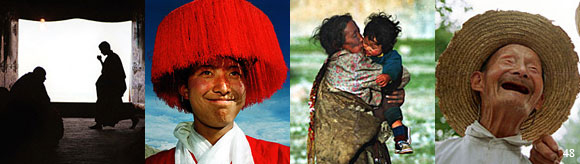
We start with the bad news. Modernization and assimilation often sound the death-knell for under-resourced minority groups. Pulitzer Prize-winning photographer John Kaplan documents the fast fading indigenous cultures of China, Bolivia, and Thailand in Vanishing heritage.

Yet some old traditions die hard. Irene Kai’s The Golden Mountain chronicles four generations of Chinese women escaping the yoke of submission. In her review of the memoir, Always know your place, and in her interview with the author, Old traditions die hard, ITF Culture Editor Laura Madeline Wiseman explores both the limitations of a victim’s viewpoint and the liberation that comes of writing about suffering.

Former Peace Corps Volunteer Kathryn Brierley, in her essay Reflections on a new democracy, also shows that change comes slowly. Ten years after the end of apartheid, the writer encountered a South Africa that still bears many scars.

The good news, however, is that change can sometimes bring inspiration. In Girls just want to have fun, ITF Travel Editor Anju Mary Paul‘s second story on young Muslim women in the United States, innovative teenagers plan and execute an all-girls prom, joining in an American tradition, Muslim style. If only change were always reason for a party.

Meanwhile, here at ITF, we’re sure to inspire your inner media critic with our latest addition: weekly TV, film, and DVD reviews available only in our PULSE Web log.

Nicole Leistikow
Managing Editor
Baltimore, Maryland

Coming Up

In December: ITF publishes its 50th issue. To celebrate, we’ll highlight the best of the magazine so far — and introduce some new perks. Take a minute to vote for your favorite ITF stories from the past.


Vanishing Heritage: China

Best of In The Fray 2005. Rapid industrialization is making it difficult for ethnic minorities in China, Bolivia, and Thailand to preserve their cultural identity. Part one of a three-part series.

Click here to enter the visual essay.

Three nations on opposite sides of the globe are linked by indigenous culture and the threat of industrialization to its preservation.

In China, Tibetans have for decades struggled to regain their freedom. But now, for the first time, Tibet’s people are becoming a minority in their own homeland as their culture is quickly evaporating into the Chinese landscape. To many there, political freedom is no longer a realistic quest but the freedom to preserve a centuries-old cultural heritage remains in question.

In Bolivia, the autonomy of more than 300 minority ethnic groups is threatened by the rapid modernization of Bolivian society. Tibetans and the people of Bolivia’s largest minority community, the Aymara, share a striking physical resemblance; some anthropologists claim that an ancient migration across the continents may in fact connect the cultures by blood.

In Thailand, the society of the Akha minority group is now losing its cultural identity. As electricity comes to each village, in turn, its inhabitants begin to realize the homogenized and idealized life portrayed on satellite television. The young often choose to leave the simple village life behind, in search of work and the other lures of city life.

As a documentary photographer, it is my goal to document the traditions of rapidly fading indigenous cultures before they completely disappear; it is my hope that viewers may consider assisting in their preservation.

Part 2: Bolivia

Part 3: Thailand

For information on obtaining prints from the Vanishing Heritage series, please contact John Kaplan at kaplan-at-writeme-dot-com.


personal stories. global issues.