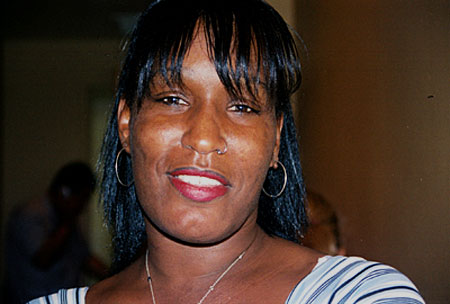
Tanya Smith experienced sexual harassment and medical neglect while incarcerated in California prisons.

Gender Outlaws

Best of In The Fray 2005. Transgender prisoners face discrimination, harassment, and abuse above and beyond that of the traditional male and female prison population.

Tanya Smith, former prisoner
Tanya Smith experienced sexual harassment and medical neglect while incarcerated in California prisons.

In Idaho, inmate Linda Patricia Thompson wanted a transfer to a women’s prison. A male-to-female transgender woman, or MTF, she had been living as a woman for several years, had changed her name legally, and was taking black-market estrogen when she could. Thompson had never been able to afford sex reassignment surgery, nor could she obtain hormones legally: the signatures of two physicians and a psychiatrist were required, and she couldn’t afford the visits. Still, Thompson was assertively feminine, even in handcuffs. At the time of her arrest, she wore a dress and high heels.

But prison officials refused to transfer Thompson or to provide her with estrogen. Inmates are housed on the basis of genitalia, they told her, and in their eyes she was incontestably male. So Thompson took matters into her own hands — literally. In two separate incidents, she amputated her own male genitalia, nearly bleeding to death in the process.

“I thought she had to be nuts,” recalls attorney Bruce Bistline, who handled Thompson’s case. “But apparently that sort of self-mutilation is not extraordinary in the transgender prison population. The level of desperation is just that high.”

“I’ve been raped, physically beaten, extorted, pimped out/sold, intimidated, manipulated, threatened, humiliated, [and] harassed by both officers and inmates,” writes transgender prisoner Meagan Calvillo of her experiences in various California prisons since 1999. Calvillo’s description is not unusual. Outside of prison, transgender people are among the most marginalized in the United States; inside it, they confound a system that’s ill-prepared to serve them, or even to decide where to put them.

“There’s no real legal standard” for determining the placement of transgender prisoners, says Chris Daly, director of the Transgender Law Center in San Francisco. At present, most California prisoners are assigned to male or female prisons on the basis of their genitalia, the same method applied by most states. “There’s a state-level mandate that prisons be segregated by sex, which they’ve interpreted to mean genitalia. Every prison we know of has interpreted it the same way.” As a result, transgender people who choose not to undergo sex reassignment surgery — or lack the means to do so — are housed with people of their birth gender.

“For instance,” says Daly, “someone who’s male-to-female, if she hasn’t had surgery or hasn’t been able to access it yet, will be housed with men — regardless of how long she’s lived as a woman, or what her gender presentation is like.”

One such person is Dee Farmer, an MTF whose landmark 1994 Supreme Court case, Farmer v. Brennan, found that prison authorities are liable for “deliberate indifference” to inmates’ safety, including situations of likely sexual assault. Farmer brought the suit in 1990 after she was brutally raped and beaten by another inmate in an Indiana prison. The assault occurred two weeks after she was placed in the general male population, despite her breast implants and longtime use of estrogen.

When housed with male prisoners, MTFs rapidly become the targets of sexual assault, as Farmer’s case illustrates. Some, like Farmer, have developed breasts from surgery or years of estrogen treatment. Others, though male in appearance, are immediately relegated to the bottom of prison’s social hierarchies by virtue of their feminine self-presentation.

As for female-to-male transgender people, “while they don’t face the same type of violence [from fellow prisoners], they face a lot of oppression on the part of guards,” explains Judy Greenspan, cofounder of the Trans/Gender Variant in Prison Committee (TIP). “When they’re strip-searched, many FTMs who have had their breasts removed or take hormones are put on display. It’s psychological brutality … They’re demonized.”

Everyday humiliations for both MTFs and FTMs include verbal harassment, frivolous strip searches, and gender-stereotypic “grooming standards,” which set requirements for men and women’s hair length, facial hair, and use of cosmetics. “Prison guards refuse to call them by their chosen names or use their correct pronouns,” says Greenspan, exasperated. “They look at trans- and gender-variant prisoners as deviant.”

Attorney Alex Lee
Attorney Alex Lee directs the Transgender, Gender Variant, and Intersex Justice Project, based in Oakland, California.

Protective custody for so-called vulnerable inmates, including those who are HIV positive, offers a modicum of safety to transgender prisoners — at least from assaults by other inmates. Another, more common option is to confine transgender prisoners individually, in what is known as administrative segregation.

“It’s pretty much standard throughout California — except for San Francisco — that housing tends to be separate” for transgender prisoners, explains James Austin, a physician affiliated with the Sacramento Sheriff’s Department. “So most of the facilities are single cells. We don’t have any ability to accommodate them otherwise.”

However, when assaults come from prison guards, as they frequently do, administrative housing isn’t safe, either, and may even be worse. Many individual confinement pens are intended for short-term punitive stays, or for highly aggressive, violent prisoners.

“Administrative segregation is basically punishment,” explains attorney Alex Lee, director of the Transgender, Gender Variant, and Intersex Justice Project (TGIJP). “In prison, people call it the jail. It’s much more restrictive, and a lot of trans folks in prison get put there … simply because the prisons don’t know how to take care of them, and they’d rather err on the side of being more restrictive than not.”
In 2004, a Wyoming judge ruled that prison officials violated the constitutional rights of Miki Ann Dimarco, a person with an intersex condition, by placing her in an isolated high-security lockup for over a year. At the time of her conviction for check fraud, Dimarco was placed at the Wyoming Women’s Center: an unintentionally appropriate choice. Born with genitalia that might either be classified as a microphallus or an enlarged clitoris, Dimarco identifies and lives publicly as a woman.

However, when medical staff saw Dimarco’s genitalia, flustered officials decided to hold her in complete isolation in the prison’s maximum-security wing. Though a prison evaluation placed Dimarco at the lowest possible risk level, and doctors concluded she posed no sexual threat (she was “not sexually functional as a male,” according to staff), she was subjected to the same living conditions and restrictions as the Center’s most dangerous prisoners.

Administrative segregation “may ostensibly be a safer place,” Lee remarks, but “where are they going to put you to be away from the guards?” Many of Lee’s own clients won’t report abuse from other prisoners for fear of being placed in isolation. Or, as in the case of Tanya Smith, they’ll endure abuse to avoid it.

In 1995, when Tanya Smith was first incarcerated, she was immediately isolated as “a threat to the safety of the jail population, as a transgender,” she recalls.  Smith is a tall African American transwoman with warm, dark eyes and a dainty silver nose ring. Recalling isolation, she purses her lips. “I couldn’t access any visitors. The mental health ward would not come see me at all.” Smith suffers from borderline personality disorder and requires a steady hormonal regimen. After six months, she was finally released to the general men’s population, a situation she found far preferable to isolation, which she refers to as “the hole.”

Three years later, when Smith returned to prison, a prison guard came on to her, saying “‘Ooh, you’re a real woman. Do you fuck?’” Smith says she sometimes stripped for officers to get medical attention, but this guard wanted more. “He threatened that I’d go back to the hole if I didn’t have sex with him — or oral copulation.” In exchange for sex, claims Smith, the guard kept her out of administrative segregation, protected her from other prisoners, and provided her with food, medicine, and clothing, even alcohol and drugs. When asked how she felt about the officer, Smith merely shrugs. “It was a way of survival,” she says simply. “Why complain when I’d get thrown into the hole?”

In California, the most notorious isolation facilities are known as Security Housing Units, or SHUs. Antoine Mahan is a board member of California Prison Focus, which opposes the use of SHUs. He is also a former prisoner who spent two years in a SHU at Corcoran State Prison. Mahan’s rounded face is both feminine and masculine at once: he wears his hair long, and favors women’s blouses and headbands. “People think I’ve taken hormones,” he divulges, “but I never have. That’s just my androgynous features.” He identifies as an African American gay male cross-dresser, but in prison, he says, “I was seen as transgender.”

Homeless, drug-addicted, and HIV positive, Mahan ricocheted between prison and the street from 1991 to 1997. Like Smith, he was approached by officers and prisoners for sex, regardless of his HIV status. Some assailants may have been HIV positive already; others may have wanted oral sex, which has a relatively low transmission rate.  At a reception center for HIV-positive inmates, an officer began courting Mahan with food and gifts, hinting that he wanted sexual favors. Later, at the California Men’s Colony (CMC), Mahan says, “I had a lot of guys getting at me, and a lot of officers harassing me sexually. I was what they call in prison terms ‘fresh booty.’”

But the SHU, says Mahan, was far worse. In 1997, following a scuffle with another CMC prisoner, Mahan was transferred to Corcoran State Prison, one of the few California prisons equipped with an SHU. There, he says, “I went through more hell than I’ve ever been through in my life.” Mahan describes the SHU as “a nine-by-five cell — nine by five by six, that’s the length, the width and the height. It was a box. No ventilation whatsoever.” According to California Prison Focus, SHU prisoners spend at least twenty-three hours a day in their cells, have no phone access, compromised medical care, and no work training or educational programs.

It is unclear whether transgender prisoners are routinely assigned to California’s few SHUs, but California Prison Focus alleges that inmates accused of gang affiliation are regularly assigned there, regardless of their behavior, in a “draconian” effort to wipe out gangs. If transgender prisoners are perceived as making trouble — or provoking it — a similar rationale might apply.

“There were a lot of queens in jail,” Mahan mentions offhandedly. Transgender and gender-variant people, as a population, are incarcerated at even higher rates than the general population of African American men, although the majority of those incarcerated are also people of color. In San Francisco, a 1997 study conducted by the city’s Department of Public Health found that 67 percent of MTF respondents and 30 percent of FTM respondents had a history of incarceration. Almost a third of MTF respondents had been jailed in the past year. The numbers are staggering: among U.S. adults, only 3 percent are or have been incarcerated. Overall, “unless they’re rich, [most transgender people have] spent a little time in jail,” says Judy Greenspan.

TIP volunteer Nedjula Baguio, an MTF, offers one explanation: employment discrimination. Trans people are at a disadvantage in today’s service economy, she says, regardless of whether they can “pass.” Trans people who pass are more easily recognized as their presented gender: they may have taken hormones for many years or opted for breast implants or removal. Those who don’t pass are less easily categorized. Some are mid-transition, some lack the funds for hormones or surgery, and others feel at home between — or across, or beyond — the categories of male and female.

“I don’t think I ever pass,” says Baguio, despite her lean figure and softly curving mouth; she recalls a tense stop at a rural diner while en route to Vacaville, and winces. Her light skin is patterned with evocative tattoos: a heart being sewn up, a marionette cut from its strings.

Trans people who don’t pass “freak people out,” Baguio says simply, and in a service economy, that’s fatal. “Most people don’t want to have anything to do with you as a potential employee, for all the obvious reasons. Your gender presentation is going to be perceived as ‘freakish,’ and nobody will want to deal with you, period. You’re seen as interfering with moneymaking.”

Smith agrees. Drug-free and out of prison, her job search hasn’t been easy, as a former inmate or as a transwoman. “There’s not a lot of people willing to hire us,” she complains.

But finding work is no picnic for trans people who pass, reports Baguio. When supplying references or a work history for employers, they face another dilemma. If a prospective boss calls a former employer and asks about Susan — only to hear all about Sean — their reaction may not be charitable.

Consequently, a disproportionate number of trans people engage in sex work. Many turn to drugs to cope with the degradation they experience as transgender people and as sex workers, and are eventually incarcerated for prostitution or drug-related offenses — what Lee calls “survival crimes.” Others develop mental illness, another risk factor for landing in jail. Because employment discrimination, arrests, and sentencing patterns fall hardest on low-income people — predominantly people of color — transwomen of color are the majority of the trans prison population.

“It affects queer and transgender people across the board,” explains Baguio, “but for those communities [low-income people and people of color], you’re dealing with a double whammy.” Baguio offers her own experience as a multiracial transwoman for contrast. “I’m perceived as lighter-skinned. I’m not targeted a lot. I live in a neighborhood with a lot of hip artists; I’m not living in Lincoln, Nebraska. I have a job where they’ve been accepting of my transition, and it’s not an issue. I make a decent wage and have been able to spend a fair amount of money on my transition, including electrolysis, health care, and access to hormones.”

Baguio also transitioned after college, insulating her from the hazards of the service economy. She hasn’t needed to engage in sex work, and hasn’t been exposed to its attendant health risks.

Dr. Lori Kohler is the founder of California’s only health clinic for trans prisoners, located at the California Medical Facility in Vacaville. The dominant health issue among trans prisoners, she reports, is HIV/AIDS. “Anywhere from 60 to 80 percent [of transfeminine prisoners] at any given time are HIV infected,” she says. “And many are also Hep-C infected. The next greatest problem is addiction.”

Most of the prisoners Kohler sees are transwomen of color, incarcerated for nonviolent offenses related to drugs or sex work. Like Baguio, she cites the cycle of unemployment, sex work, and drug addiction. “These are not women that are working to pay for their drugs — these are women who are working for their lives, and end up using drugs to tolerate the life they’re forced into.”

Kohler has been working with transgender patients since 1994, when she took a job at the recently founded Transgender Clinic of the Tom Waddell Health Center in San Francisco. In 1999, the chief medical officer of the Vacaville facility approached Kohler and asked her to establish a clinic for the prison’s trans inmates. At the time of the clinic’s founding, the chief medical officer estimated that Kohler would be serving a total population of ten to fifteen patients. Six years later, Kohler says she’s seen roughly 3,000 unduplicated patients, and that there are about sixty trans prisoners at CMF at any given time.

Kohler says that her exposure to trans health issues is unusual among health professionals. “Care of trans people is not something that most medical people understand,” she says, and sighs. This ignorance is manifested most clearly, she says, in the issue of cross-gender hormone provision.

“As far as I know of, CMF and now CMC [California Men’s Colony] are the only two prisons in the country that actually have a physician who’s dedicated to providing good care, including cross-hormone therapies,” says Kohler. “In all other California prisons, access to cross-gender hormones is not guaranteed. It’s sporadic and inconsistent, and only given to very few people.”

In 2003, a U.S. District Court in Boston ruled that transgender prisoner Michelle Kosilek was entitled to hormone therapy; in the same year, New Hampshire ruled in favor of similar claims by state prisoner Lisa Barrett. Courts have generally recognized the responsibility of prisons to continue hormone treatment and psychological therapy, in compliance with the Eighth Amendment’s prohibition of cruel and unusual punishment, which courts have interpreted to include the deliberate withholding of medical treatment.

However, prisons have often been reluctant to provide hormone therapy if inmates do not have an existing prescription. Because low-income transwomen of color usually acquire hormones through the black market, few can furnish legal prescriptions.

As a result, explains Kohler, “most transwomen who are incarcerated end up being taken off of their hormones unless they can get a court order — they have to use the legal system to have access to their appropriate medical care.”  And in other states, she adds, “it’s virtually impossible for them even to get a court order to access care.”  Side effects of hormone deprivation can include depression, heart problems, and irregular blood pressure.

Undeterred, Kohler prescribes cross-gender hormones to any trans-identified prisoner: a renegade position among prison medical staff, who routinely ignore her prescriptions. “I’d say about half the medical staff will refill my medical orders if I’m not around, and the other half will not recognize my recommendations,” she says. “But I don’t think that’s any different than the medical community outside the prisons.”

Photos of female and trans prisoners
Photos of female and trans prisoners cover the walls of Lee’s Oakland office.

After her life-threatening self-mutilation and the lawsuit that followed, Linda Thompson was eventually transferred to Kohler’s Vacaville facility in California. She was also granted a cash settlement contingent upon a confidentiality agreement about the suit. However, Bruce Bistline’s cocounsel, Lea Cooper, says that Thompson chose to violate the terms of the settlement agreement, foregoing most of the settlement money.

“Linda decided that she wanted to get the word out,” says Cooper. “That meant more than money to her.”

In California prisons, Thompson was finally able to access estrogen. Because her genitalia are not readily identifiable as female or male (something of a conundrum for prison assignment), she was housed in a small facility with other transwomen and gay men. After her release, Thompson sought jobs in Oregon, Wyoming, Los Angeles, and Washington, but couldn’t find paid work — not even sex work.

“She said she was too masculine to turn tricks,” Cooper explains. Eventually, at a loss for what to do next, Thompson got arrested for stealing copper wire from a construction site. “She told the judge she did it [got arrested] on purpose, because she didn’t have any more options,” Cooper says. Thompson is currently incarcerated at the Monroe Correctional Center in Monroe, Washington; on the basis of her birth genitalia, she has been housed in the men’s facility. As Cooper describes it, “Linda jokes, ‘What do I have to do, start menstruating to be considered a woman?’”

Though both do work that benefits trans prisoners, neither prisoners’ rights groups nor transgender advocates have specifically taken up their cause. “Transgender issues are not on the radar screen of most prisoners’ rights groups,” says Judy Greenspan, “and the transgender movement may not be prioritizing prisoners’ issues because they’re involved in trans survival and support services on the street.”

The Trans/Gender Variant in Prison Committee, cofounded by Greenspan, and the Transgender, Gender Variant, and Intersex Justice Project, founded by Alex Lee, are two notable exceptions. Greenspan identifies as a gender-variant white woman: biologically female, she doesn’t conform to societal expectations of female behavior or appearance. She wears men’s clothing, cuts her hair short, and is occasionally taken for a man. For twenty years, Greenspan has worked with transgender prisoners, including Dee Farmer of Farmer v. Brennan. Lee is an FTM Asian American attorney who became interested in prison issues during law school and sought to connect them to transgender advocacy.

Lee believes the void in advocacy results from mainstream queer organizations’ “assimilationist politics … They want to pretend that we are all law-abiding citizens, that we’re perfect angels who want to be just like ‘normal’ straight people.” In doing so, he says, such groups jettison trans prisoners, who are predominantly low-income people of color.

Both TIP and TGIJP advocate for trans prisoners who are currently incarcerated, but Lee says that the long-term change needs to happen “before people go to prisons.” As Greenspan explains, “prison mirrors what’s going on in the outside, so-called free world. There are really no rights in the community, unless you’re living in San Francisco.”

But even in San Francisco County Jail, reports Tanya Smith, trans people are reviled. “You’d think the officers out here would think outside the box, in this liberal city, but they don’t. It’s horrible.”

In light of this reality, Linda Thompson’s choice to be rearrested makes sense, despite the harassment she continues to face as a prisoner. For many trans people, all the world’s a prison — on both sides of the bars.

UPDATE, 3/8/13: Edited and moved story from our old site to the current one.


Who’s the best Hollywood president?

Before all the holiday blockbuster and Oscar-bait movies get to a theater near you, I wanted to do a little politicking myself with a self-induced caucus on the best fictional president in film or television.  I decided to conduct my own very unscientific poll with a very biased pool of one person — myself.  I limited the possible candidates to those films or television shows after 1960, and I came up with certain criteria based on what Mr. and Mrs. Joe Schmo would use to help make up their minds.  I graded each on a scale of one to ten with one being bad and ten being excellent on the following criteria: character, intelligence and ability, charisma, family life, trust and honesty, experience, decision-making, political skills, and leadership. I added up the scores from all the categories with the result being what I call their Q rating.  

The group consisted of 16 candidates from 11 films and three television shows.  They must have all been fictional characters (no biopics), and they had to be either the lead or a very major supporting role.  After exhausting study and analysis, here are the results of the best Hollywood presidents, according to me.

The top president is James Marshall from the action blockbuster Air Force One portrayed by Harrison Ford.  His Q rating was 77 out of a possible 90.  Marshall scored high in all categories by showing his ability to not only thwart a group of terrorists threatening to kill his family but by being a president that we’d all want on our side — and women tell me he’s not bad to look at either.  Next is a tie.  First in line is Andrew Shepherd, the widowed head of state played by Michael Douglas, who becomes smitten with Annette Bening’s lobbyist from Rob Riener’s romantic comedy The American President.  Shepherd was able to gain a 72 Q rating by being tops in most categories save for political skill.  Dating a lobbyist trying to persuade your administration to change opinion on key legislation isn’t the smartest of career moves but, again, he’s not bad to look at.  Also gaining a 72 Q rating is a president from another blockbuster — Tom Whitmore (Bill Pullman), the jet-flying, alien-busting president from the action sci-fi film Independence Day.  Whitmore’s only bad marks come in the family life category because he’s too busy saving the world to worry about his wife, though he does give a good pep talk.  We then go back to the 1960s and to Henry Fonda in the film Fail Safe where he’s simply referred to as The President.  Fail Safe is a Cold War thriller directed by Sidney Lumet reflecting all the fears of nuclear annihilation brought upon by the Cuban Missile Crisis.  Fonda’s president is cool, collected, and able to make hard decisions that will affect the entire world.  If he wasn’t willing to let his family die in a nuclear blast just to save the world, he may have gotten more than a 69 rating.  

The highest TV president on the list is Jed Bartlett of The West Wing, played by the politically active Martin Sheen, with a 68 Q rating.  President Bartlett brought intelligence and consciousness to his presidency and a heartfelt desire to lead the American people through challenging times.  If he hadn’t lied about his medical problems, he would have scored a lot higher.  Next, we have another sci-fi president in Tom Beck, the first African-American chief played by the Academy Award-winning actor Morgan Freeman.  In the film Deep Impact, Freeman’s president has to play the tough father figure to a world that is certainly going to be hit by a giant comet.  What Beck lacks is charisma, but if push comes to shove, I wouldn’t mind having him in the oval office whenever a large object is heading our way.  We go back to television for our next president, the greenest member on the list and the first female, Mackenzie Allen, played by another Academy Award-winner, Geena Davis.  In Commander In Chief, you have a vice-president who assumes the presidency after her boss dies off.  She has to battle public opinion and a ruthless speaker of the house, played to the hilt by Donald Sutherland.  In the Allen White House, you have a husband who assumes a greater role than most first ladies have before him and three kids all facing the hardships of growing up with a mom who could drop a bomb whenever she pleases.  Allen still has some proving to do, experience to gain, and political moves to master but, given time, she could move up in the polls and raise her 61 rating.  We change networks for our next president, David Palmer (Dennis Haysbert) from the first couple seasons of the show 24.  After facing not only a threat on his life and an actual assassination attempt, he had to deal with a back-stabbing evil wife turned ex-wife who would do anything to get her man back.  Being able to help keep America safe and Jack Bauer (Keifer Sutherland) alive is a lot for any president to handle.  I’m sure his advice would be to get rid of a crazy wife before running for president.  Q Rating, 58.  

Finally, one of my favorite presidents isn’t really a president — he just plays one on the movie screen.  In Dave, Kevin Kline plays Dave Kovich, an everyman who happens to look like the president and assumes those duties when the real president falls into a deep coma after a sexual dalliance with an assistant.  Dave’s president wins the hearts of the people, balances the budget, and falls for the real first lady.  The only problem is he’s really just an owner of an employment agency and can’t really be president.  If only it were that easy.  Dave only gets a 58 but deserves more.  Perhaps in a sequel where Dave can move from city council to the presidency of the United States, he’ll be able to move up on the list legitimately.

Here are the rest of the presidents and their ratings.  No time for explanations, but since they’re the worst of the lot, who cares?  Matt Douglas (James Garner) and Russell Kramer (Jack Lemon) from My Fellow Americans, 57 and 54, respectively; John Travolta’s Jack Stanton from Primary Colors, a 49 rating; Mars Attacks’ James Dale gets a 47 as played by Jack Nicholson; a 42 is awarded to Peter Sellers’ Markin Muffly in Stanley Kubrick’s Dr. Strangelove; and the two most vile presidents on the list, each getting a 34 and 42, respectively, are Gene Hackman’s Alan Richmond in Absolute Power and Dan Aykroyd’s William Haney from My Fellow Americans, each putting themselves way ahead of the American people.

The fortunate thing is that all of these films and television shows are first-rate and deserve to be viewed many times over.  I’d also like to hear your opinion on the best Hollywood president.  I’ll tally up your votes in an upcoming column — no hanging chads, please.

Rich Burlingham


Making new gods

With almost one in every seven Americans repudiating religious affiliations, it’s no surprise that Americans are creating their own religions, and in droves; Universism is one such faith.

“Universism seeks to solve a problem that has riddled mankind throughout history: the endless string of people who claim that they know the Truth and the Way…to dispel the illusion of certainty that divides humanity into warring camps,” is how the religion’s 28-year-old founder describes its aim.  With no definite dogma — uncertainty is one of the religion’s core tenets — it’s difficult verging on the impossible to identify what, precisely, identifies Universism or many of its similarly fragmented offshoots as a religion.  

When I visited the Church of Fools last year, I was warned that the “Church of Fools is currently not suitable for children.” Undaunted by the “often colorful and occasionally offensive,” language that apparently litters the church, I knocked on its virtual door only to be told: “Sorry, but Church of Fools is closed at the moment.”

The Church of Fools is one of the newest ventures into what can loosely be defined as religion. The online church claims to be the United Kingdom’s first 3-D, Web-based church, and its target audience is the religiously marginalized. The church began as three-month “experiment” in 2004, and during that time it drew a virtual congregation of up to 10,000 visitors a day. The pious may choose a character, sing, pray, and jubilantly exclaim Hallelujah!”

Absent any sense of accountability, the aptly named Church of Fools and the vaguely named creed of Universism (with an online congregation of 8,000 strong) are certainly creating potential breeding grounds for demagoguery and charlatanism in the anonymous and amorphous space of new religion.

Mimi Hanaoka


‘Tis the season … to be socially conscious

With Thanksgiving, Channukah, and Christmas looming, we’re about to embark on about five weeks of rampant overconsumption. Seeing the families displaced by Katrina, now forced to find homes of their own since FEMA has decided to cut them off early, as well as suffering and hunger across the globe, I have mixed feelings about the holidays. Don’t get me wrong — this is my favorite time of year. But it also makes me incredibly cognizant of the ridiculous amount that we consume — whether it’s on our Thanksgiving dinners, luxurious vacations,  our lavish gift wishlists, or, as one story in today’s New York Times reveals, spending $27,000 on Dolce & Gabbana dresses for our daughters to wear to their Bat Mitzvah parties, while forgetting about the (far) less fortunate — in the face of others’ suffering.

So I’ve done a little research and discovered some ways to celebrate the season by giving more socially conscious gifts. For example, Network for Good, a website that accepts online donations for thousands of different charities, sells non-traditional gift baskets. That is, a pre-selected handful of organizations geared toward a specific area, such as education, animals, health, families in need, children, and hurricane recovery, that the gift giver’s donation gets divided up among. Not a bad idea for all of those hard-to-shop-for teachers an animal lovers (amongst others). Sure, it’s not a gift that the person you’re making the donation in honor of can use, per se, but let’s be honest: Most of us have a lot of “stuff,” plenty of which gets used once or twice, if ever. Why not give a gift that both you and the person you’re shopping for can feel good about — while making the season a little less difficut for someone else?

Of course, if you’re indecisive or don’t know which charities the person you’re shopping for would like to support, JustGive.org offers Charity Gift Certificates, which allow the recipient to select which charity or charities he or she wants to support.

Of course, these ideas don’t just have to be limited to the December holidays. There are people in need year-round. As I was pleasantly surprised to discover from my research, JustGive.org has a wedding registry, where the soon-to-be-wed and soon-to-be-committed can select charities that they’d like their friends and family to donate to in honor of their special day. This isn’t just a good idea for the couple that already has a lot of stuff. It’s also a good idea for any couple because, as the Jewish tradition of the groom breaking a glass at the wedding reminds us, even while the couple experiences great joy, there are plenty of others whose pain and sadness we cannot forget.

There are, of course, dozens of other ways you can give. But I’m guessing that none of those (or these) will appear on most wishlists this year. Why not change that? Go ahead, give a little …

—Laura Nathan

Tanya Smith experienced sexual harassment and medical neglect while incarcerated in California prisons.

Gender outlaws

Best of IDENTIFY 2005

Transgender prisoners face discrimination, harassment, and abuse above and beyond that of the traditional male and female prison population.


In Idaho, inmate Linda Patricia Thompson wanted a transfer to a women’s prison. A male-to-female transgender woman, or MTF, she had been living as a woman for several years, had changed her name legally, and was taking black-market estrogen when she could. Thompson had never been able to afford sex reassignment surgery, nor could she obtain hormones legally: the signatures of two physicians and a psychiatrist were required, and she couldn’t afford the visits. Still, Thompson was assertively feminine, even in handcuffs. At the time of her arrest, she wore a dress and high heels.

But prison officials refused to transfer Thompson or to provide her with estrogen. Inmates are housed on the basis of genitalia, they told her, and in their eyes she was incontestably male. So Thompson took matters into her own hands — literally. In two separate incidents, she amputated her own male genitalia, nearly bleeding to death in the process.

“I thought she had to be nuts,” recalls attorney Bruce Bistline, who handled Thompson’s case. “But apparently that sort of self-mutilation is not extraordinary in the transgender prison population. The level of desperation is just that high.”

When genitalia — not gender identity — decides placement

“I’ve been raped, physically beaten, extorted, pimped out/sold, intimidated, manipulated, threatened, humiliated, [and] harassed by both officers and inmates” writes transgender prisoner Meagan Calvillo of her experiences in various California prisons since 1999. Calvillo’s description is not unusual. Outside of prison, transgender people are among the most marginalized in the United States; inside it, they confound a system that’s ill-prepared to serve them, or even to decide where to put them.

“There’s no real legal standard” for determining the placement of transgender prisoners, says Chris Daly, director of the Transgender Law Center in San Francisco. At present, most California prisoners are assigned to male or female prisons on the basis of their genitalia, the same method applied by most states. “There’s a state-level mandate that prisons be segregated by sex, which they’ve interpreted to mean genitalia. Every prison we know of has interpreted it the same way,” says Daly. As a result, transgender people who choose not to undergo sex reassignment surgery — or lack the means to do so — are housed with people of their birth gender.

“For instance,” says Daly, “someone who’s male-to-female, if she hasn’t had surgery or hasn’t been able to access it yet, will be housed with men — regardless of how long she’s lived as a woman, or what her gender presentation is like.”

One such person is Dee Farmer, an MTF whose landmark 1994 Supreme Court case, Farmer v. Brennan, found that prison authorities are liable for “deliberate indifference” to inmates’ safety, including situations of likely sexual assault. Farmer brought the suit in 1990 after she was brutally raped and beaten by another inmate in an Indiana prison. The assault occurred two weeks after she was placed in the general male population, despite her breast implants and longtime use of estrogen.

When housed with male prisoners, MTFs rapidly become the targets of sexual assault, as Farmer’s case illustrates. Some, like Farmer, have developed breasts from surgery or years of estrogen treatment. Others, though male in appearance, are immediately relegated to the bottom of prison’s social hierarchies by virtue of their feminine self-presentation.

As for female-to-male transgender people [FTMs], “while they don’t face the same type of violence [from fellow prisoners], they face a lot of oppression on the part of guards,” explains Judy Greenspan, cofounder of the Trans/Gender Variant in Prison Committee (TIP). “When they’re strip-searched, many FTMs who have had their breasts removed or take hormones are put on display. It’s psychological brutality … They’re demonized.”

Everyday humiliations for both MTFs and FTMs include verbal harassment, frivolous strip searches, and gender-stereotypic “grooming standards,” which set requirements for men and women’s hair length, facial hair, and use of cosmetics. “Prison guards refuse to call them by their chosen names or use their correct pronouns,” says Greenspan, exasperated. “They look at trans- and gender-variant prisoners as deviant.”

Isolation is no safe haven

Protective custody for so-called vulnerable inmates, including those who are HIV-positive, offers a modicum of safety to transgender prisoners — at least from assaults by other inmates. Another, more common option is to confine transgender prisoners individually, in what is known as administrative segregation.

“It’s pretty much standard throughout California — except for San Francisco — that housing tends to be separate [for transgender prisoners],” explains James Austin, a physician affiliated with the Sacramento Sheriff’s Department. “So most of the facilities are single cells. We don’t have any ability to accommodate them otherwise.”  

However, when assaults come from prison guards, as they frequently do, administrative housing isn’t safe, either, and may even be worse. Many individual confinement pens are intended for short-term punitive stays, or for highly aggressive, violent prisoners.

“Administrative segregation is basically punishment,” explains attorney Alex Lee, director of the Transgender, Gender Variant, and Intersex Justice Project (TGIJP). “In prison, people call it the jail. It’s much more restrictive, and a lot of trans folks in prison get put there … simply because the prisons don’t know how to take care of them, and they’d rather err on the side of being more restrictive than not.”


In February 2004, a Wyoming judge ruled that prison officials violated the constitutional rights of Miki Ann Dimarco, a person with an intersex condition, by placing her in an isolated high-security lockup for over a year. At the time of her conviction for check fraud, Dimarco was placed at the Wyoming Women’s Center: an unintentionally appropriate choice. Born with genitalia that might either be classified as a microphallus or an enlarged clitoris, Dimarco identifies and lives publicly as a woman.

However, when medical staff saw Dimarco’s genitalia, flustered officials decided to hold her in complete isolation in the prison’s maximum-security wing. Though a prison evaluation placed Dimarco at the lowest possible risk level, and doctors concluded she posed no sexual threat (she was “not sexually functional as a male,” according to staff), she was subjected to the same living conditions and restrictions as the Center’s most dangerous prisoners.  

Administrative segregation “may ostensibly be a safer place,” Lee remarks, but “where are they going to put you to be away from the guards?” Many of Lee’s own clients won’t report abuse from other prisoners for fear of being placed in isolation. Or, as in the case of Tanya Smith, they’ll endure abuse to avoid it.

Former prisoners: Sex was “a way of survival”  

In 1995, when Tanya Smith was first incarcerated, she was immediately isolated as “a threat to the safety of the jail population, as a transgender,” she recalls.  Smith is a tall African American transwoman with warm, dark eyes and a dainty silver nose ring. Recalling isolation, she purses her lips. “I couldn’t access any visitors. The mental health ward would not come see me at all.” Smith suffers from borderline personality disorder and requires a steady hormonal regimen. After six months, she was finally released to the general men’s population, a situation she found far preferable to isolation, which she refers to as “the hole.”

Three years later, when Smith returned to prison, a prison guard came on to her, saying “‘Ooh, you’re a real woman. Do you fuck?’” Smith says she sometimes stripped for officers to get medical attention, but this guard wanted more. “He threatened that I’d go back to the hole if I didn’t have sex with him — or oral copulation.” In exchange for sex, claims Smith, the guard kept her out of administrative segregation, protected her from other prisoners, and provided her with food, medicine and clothing, even alcohol and drugs. When asked how she felt about the officer, Smith merely shrugs. “It was a way of survival,” she says simply. “Why complain when I’d get thrown into the hole?”

In California, the most notorious isolation facilities are known as Security Housing Units, or SHUs. Antoine Mahan is a board member of California Prison Focus, which opposes the use of SHUs. He is also a former prisoner who spent two years in a SHU at Corcoran State Prison. Mahan’s rounded face is both feminine and masculine at once: he wears his hair long, and favors women’s blouses and headbands. “People think I’ve taken hormones,” he divulges, “but I never have. That’s just my androgynous features.” He identifies as an African American gay male cross-dresser, but says that, “in prison, I was seen as transgender.”  

Homeless, drug-addicted, and HIV-positive, Mahan ricocheted between prison and the street from 1991 to 1997. Like Smith, he was approached by officers and prisoners for sex, regardless of his HIV status. Some assailants may have been HIV positive already; others may have wanted oral sex, which has a relatively low transmission rate.  At a reception center for HIV-positive inmates, an officer began courting Mahan with food and gifts, hinting that he wanted sexual favors. Later, at the California Men’s Colony [CMC], Mahan says, “I had a lot of guys getting at me, and a lot of officers harassing me sexually. I was what they call in prison terms ‘fresh booty.’”  

But the SHU, says Mahan, was far worse. In 1997, following a scuffle with another CMC prisoner, Mahan was transferred to Corcoran State Prison, one of the few California prisons equipped with a SHU. There, he says, “I went through more hell than I’ve ever been through in my life.” Mahan describes the SHU as “a nine by five cell — nine by five by six, that’s the length, the width and the height. It was a box. No ventilation whatsoever.” According to California Prison Focus, SHU prisoners spend at least 23 hours a day in their cells, have no phone access, compromised medical care, and no work training or educational programs.

It is unclear whether transgender prisoners are routinely assigned to California’s few SHUs, but California Prison Focus alleges that inmates accused of gang affiliation are regularly assigned there, regardless of their behavior, in a “draconian” effort to wipe out gangs. If transgender prisoners are perceived as making trouble — or provoking it — a similar rationale might apply.

Sky-high incarceration rates among trans people

“There were a lot of queens in jail,” Mahan mentions offhandedly. Transgender and gender-variant people, as a population, are incarcerated at even higher rates than the general population of African American men, although the majority of those incarcerated are also people of color. In San Francisco, a 1997 study conducted by the city’s Department of Public Health found that 67 percent of MTF respondents and 30 percent of FTM respondents had a history of incarceration. Almost a third of MTF respondents had been jailed in the past year. The numbers are staggering: among U.S. adults, only 3 percent are or have been incarcerated. Overall, “unless they’re rich, [most transgender people have] spent a little time in jail,” says Judy Greenspan.

TIP volunteer Nedjula Baguio, an MTF, offers one explanation: employment discrimination. Trans people are at a disadvantage in today’s service economy, she says, regardless of whether they can “pass.” Trans people who pass are more easily recognized as their presented gender: They may have taken hormones for many years or opted for breast implants or removal. Those who don’t pass are less easily categorized. Some are mid-transition, some lack the funds for hormones or surgery, and others feel at home between — or across, or beyond — the categories of male and female.

“I don’t think I ever pass,” says Baguio, despite her lean figure and softly curving mouth; she recalls a tense stop at a rural diner while en route to Vacaville, and winces. Her light skin is patterned with evocative tattoos: a heart being sewn up, a marionette cut from its strings.

Trans people who don’t pass “freak people out,” Baguio says simply, and in a service economy, that’s fatal. “Most people don’t want to have anything to do with you as a potential employee, for all the obvious reasons. Your gender presentation is going to be perceived as ‘freakish,’ and nobody will want to deal with you, period. You’re seen as interfering with money-making.”  

Smith agrees. Drug-free and out of prison, her job search hasn’t been easy, as a former inmate or as a transwoman. “There’s not a lot of people willing to hire us,” she complains.

But finding work is no picnic for trans people who pass, reports Baguio: When supplying references or a work history for employers, they face another dilemma. If a prospective boss calls a former employer, and asks about Susan — only to hear all about Sean — their reaction may not be charitable.

Consequently, a disproportionate number of trans people engage in sex work. Many turn to drugs to cope with the degradation they experience as transgender people and as sex workers, and are eventually incarcerated for prostitution or drug-related offenses — what Lee calls “survival crimes.” Others develop mental illness, another risk factor for landing in jail. Because employment discrimination, arrests, and sentencing patterns fall hardest on low-income people — predominantly people of color — transwomen of color are the majority of the trans prison population.

“It affects queer and transgender people across the board,” explains Baguio, “but for those communities [low-income people and people of color], you’re dealing with a double whammy.” Baguio offers her own experience as a multiracial transwoman for contrast. “I’m perceived as lighter-skinned. I’m not targeted a lot. I live in a neighborhood with a lot of hip artists; I’m not living in Lincoln, Nebraska. I have a job where they’ve been accepting of my transition, and it’s not an issue. I make a decent wage and have been able to spend a fair amount of money on my transition, including electrolysis, health care, and access to hormones.”  

Baguio also transitioned after college, insulating her from the hazards of the service economy. She hasn’t needed to engage in sex work, and hasn’t been exposed to its attendant health risks.

HIV prevalent, hormone provision a battle

Dr. Lori Kohler is the founder of California’s only health clinic for trans prisoners, located at the California Medical Facility in Vacaville. The dominant health issue among trans prisoners, she reports, is HIV/AIDS. “Anywhere from 60 to 80 percent [of transfeminine prisoners] at any given time are HIV-infected,” she says. “And many are also Hep-C infected. The next greatest problem is addiction.”  

Most of the prisoners Kohler sees are transwomen of color, incarcerated for nonviolent offenses related to drugs or sex work. Like Baguio, she cites the cycle of unemployment, sex work, and drug addiction. “These are not women that are working to pay for their drugs — these are women who are working for their lives, and end up using drugs to tolerate the life they’re forced into,” she contends.

Kohler has been working with transgender patients since 1994, when she took a job at the recently founded Transgender Clinic of the Tom Waddell Health Center in San Francisco. In 1999, the chief medical officer of the Vacaville facility approached Dr. Kohler and asked her to establish a clinic for the prison’s trans inmates. At the time of the clinic’s founding, the chief medical officer estimated that Kohler would be serving a total population of 10 to 15 patients. Six years later, Kohler says she’s seen roughly 3,000 unduplicated patients, and that there are about 60 trans prisoners at CMF at any given time.

Kohler says that her exposure to trans health issues is unusual among health professionals. “Care of trans people is not something that most medical people understand,” she says, and sighs. This ignorance is manifested most clearly, she says, in the issue of cross-gender hormone provision.

“As far as I know of, CMF and now CMC [California Men’s Colony] are the only two prisons in the country that actually have a physician who’s dedicated to providing good care, including cross-hormone therapies,” says Kohler. “In all other California prisons, access to cross-gender hormones is not guaranteed. It’s sporadic and inconsistent, and only given to very few people.”

In 2003, a U.S. District Court in Boston ruled that transgender prisoner Michelle Kosilek was entitled to hormone therapy; in the same year, New Hampshire ruled in favor of similar claims by state prisoner Lisa Barrett. Courts have generally recognized the responsibility of prisons to continue hormone treatment and psychological therapy, in compliance with the Eighth Amendment prohibition of cruel and unusual punishment, which courts have interpreted to include the deliberate withholding of medical treatment.

However, prisons have often been reluctant to provide hormone therapy if inmates do not have an existing prescription. Because low-income transwomen of color usually acquire hormones through the black market, few can furnish legal prescriptions.

As a result, explains Kohler, “most transwomen who are incarcerated end up being taken off of their hormones unless they can get a court order — they have to use the legal system to have access to their appropriate medical care.”  And in other states, she adds, “it’s virtually impossible for them even to get a court order to access care.”  Side effects of hormone deprivation can include depression, heart problems, and irregular blood pressure.

Undeterred, Kohler prescribes cross-gender hormones to any trans-identified prisoner: a renegade position among prison medical staff, who routinely ignore her prescriptions. “I’d say about half the medical staff will refill my medical orders if I’m not around, and the other half will not recognize my recommendations,” she says. “But I don’t think that’s any different than the medical community outside the prisons.”

No option but jail: Linda Thompson today

After her life-threatening self-mutilation and the lawsuit that followed, Linda Thompson was eventually transferred to Dr. Kohler’s Vacaville facility in California. She was also granted a cash settlement contingent upon a confidentiality agreement about the suit. However, Bruce Bistline’s co-counsel, Lea Cooper, says that Thompson chose to violate the terms of the settlement agreement, foregoing most of the settlement money.

“Linda decided that she wanted to get the word out,” says Cooper. “That meant more than money to her.”

In California prisons, Thompson was finally able to access estrogen. Because her genitalia are not readily identifiable as female or as male (something of a conundrum for prison assignment), she was housed in a small facility with other transwomen and gay men. After her release, Thompson sought jobs in Oregon, Wyoming, Los Angeles, and Washington, but couldn’t find paid work — not even sex work.

“She said she was too masculine to turn tricks,” Cooper explains. Eventually, at a loss for what to do next, Thompson was arrested for stealing copper wire from a construction site. “She told the judge she did it [got arrested] on purpose, because she didn’t have any more options,” Cooper says. Thompson is currently incarcerated at the Monroe Correctional Center in Monroe, Washington; on the basis of her birth genitalia, she has been housed in the men’s facility. As Cooper describes it, “Linda jokes, ‘What do I have to do, start menstruating to be considered a woman?’”

“Prison mirrors what’s going on in the outside, so-called free world”

Though both do work that benefits trans prisoners, neither prisoners’ rights groups nor transgender advocates have specifically taken up their cause. “Transgender issues are not on the radar screen of most prisoners’ rights groups,” says Judy Greenspan, “and the transgender movement may not be prioritizing prisoners’ issues because they’re involved in trans survival and support services on the street.”

The Trans/Gender Variant in Prison Committee, cofounded by Greenspan, and the Transgender, Gender Variant, and Intersex Justice Project, founded by Alex Lee, are two notable exceptions. Greenspan identifies as a gender-variant white woman: biologically female, she doesn’t conform to societal expectations of female behavior or appearance. She wears men’s clothing, cuts her hair short and is occasionally taken for a man. For 20 years, Greenspan has worked with transgender prisoners, including Dee Farmer of Farmer v. Brennan. Lee is an FTM Asian American attorney who became interested in prison issues during law school and sought to connect them to transgender advocacy.


Lee believes the void in advocacy results from mainstream queer organizations’ “assimilationist politics … They want to pretend that we are all law-abiding citizens, that we’re perfect angels who want to be just like ‘normal’ straight people.” In doing so, he says, such groups jettison trans prisoners, who are predominantly low-income people of color.

Both TIP and TGIJP advocate for trans prisoners who are currently incarcerated, but when asked, Lee says that “the [long-term] change needs to happen before people go to prisons.” As Greenspan explains, “prison mirrors what’s going on in the outside, so-called free world. There are really no rights in the community, unless you’re living in San Francisco.”

But even in San Francisco County Jail, reports Tanya Smith, trans people are reviled. “You’d think the officers out here would think outside the box, in this liberal city, but they don’t. It’s horrible.”

In light of this reality, Linda Thompson’s choice to be rearrested makes sense, despite the harassment she continues to face as a prisoner. For many trans people, all the world’s a prison — on both sides of the bars.


Don’t believe the hype

A trip Beyond the Down Low offers an honest look at stereotypes about sex and sexuality in Black America.

(Carroll & Graf)

Keith Boykin has no idea what he has just done. Apparently, he thinks he has written a book about duplicity. Nothing could be further from the truth. In the first chapter of his latest book, Beyond the Down Low: Sex and Denial in Black America, Boykin, former Special Assistant to President Clinton and one of the nation’s leading commentators on race and sexual orientation, writes, “This is a book about lies.”  As a literary device, this statement works as a hook to lure readers in.  But as a summary, it fails to capture both the breadth and depth of the text. Boykin has not written a book about lies. What Boykin has instead created is a book of truths.

Beyond the Down Low: Sex and Denial in Black America stands as the most accurate and informed treatment of homosexuality, sex, blackness, and the AIDS epidemic to date. Previous coverage of this topic by Linda Villarosa in The New York Times and Benoit Denizet-Lewis in the New York Times Magazine failed to capture the intricate social and political webs buttressing this “phenomenon.”  Just as the title of his book promises to take readers Beyond the Down Low, Boykin goes beyond the sensationalized and, according to him, fallacious media hype about “down low” (or “closeted”) gay and bisexual black men spreading AIDS to black women, to give us the truth and nothing but the truth, so help him God.  According to Boykin, the truth is that the “down low” phenomenon in neither a new occurrence, nor exclusive to black men.  

Black men lurking in the dark

From racial lynching to racial profiling, the history of black men in the United States is a minefield of stigma and dishonor. And the term “down low,” which refers to black men who secretly sleep with other black men while maintaining heterosexual relationships, is just the latest dishonor to curse black men. Black gay men suffer a double hardship, living as an oppressed minority not only in America at-large, but also in both the gay and black communities. Amidst such doom and gloom, the lyricism of James Baldwin, the activism of Bayard Rustin, and the vocalism of RuPaul serve as beacons of light, flags of hope waving from distant shores. There is, unfortunately, a gaggle of sensationalists and worry mongers who threaten to extinguish these lights. Their tool of choice: the “down low” phenomenon.

Inspired by J. L. King and his book, On The Down Low: A Journey Into the Lives of Straight Black Men Who Sleep with Men, journalists and other media personalities have flurried around this so-call new phenomena of “straight-acting” black men sleeping with other black men.  The New York Times, the Chicago Sun-Times, the San Francisco Chronicle, Jet Magazine, and the Village Voice have all run articles alluding to the down low. Many of the articles related the “down low” men with the spread of the AIDS virus.  

According to J. L. King, the salacious and unsafe practices of down low black men are the primary reason for the increasing prevalence of HIV and AIDS among heterosexual black women. “If I was a gay man, I may want to be in a relationship with another gay man and play house,” King told Oprah during his 2004 appearance on her show. “But when you are on the ‘down low,’ all you want to do is have sex.” Here, King reduced gay and bisexual black men to sex-starved, sex-crazed liars, reminiscent of D. W. Griffith’s 1915 portrayal of black men as villains and violent rapists in Birth of a Nation.  In Griffith’s film, which pays homage to the Ku Klux Klan, an animalistic black character chases an innocent, chaste white woman in hopes of sexual conquest.  The misinformation conveyed in the “down low” media hype is especially deleterious because it fosters the stereotype of black men as devious, sex-starved ruffians, a stereotype activist and civil rights leaders have worked three centuries to unravel.

Let there be light!

In the wake of this skewed portrait of the black male as sex fiend, along comes Boykin, illuminating the intricacies of the down low phenomenon with Beyond the Down Low . Fusing critical analysis with opinionated essay, Beyond the Down Low skillfully deconstructs popular myths about black male homosexuality and bisexuality. In the chapter entitled “It’s Not Just a Black Thing”, for instance, Boykin de-racializes the down low phenomenon by providing examples of prominent white men, such as former New Jersey Governor James McGreevey, former Congressman Michael Huffington, and music mogul David Geffen, who have lived on the “down low.”  

In his book’s aptly titled third chapter, “Everybody’s Doing It”, Boykin launches a rapid-fire attack on the term “down low” itself. Borrowing lyrics from TLC, Brian McKnight, Salt-N-Pepa, R. Kelly, and other music artists, Boykin traces the etymology of “down low,” only to discover that the term has heterosexual roots.  In heteronormative discourse, “down low” merely referred to secret intimacy outside a relationship.  This term, whose roots are centered in black pop culture, not black homosexual culture, rose to popularity in the early 90s.  Heterosexual slang evolved, moving on to terms such as “creepin’” and “playin’” to refer to “down low” relationships, while black gay men continued to employ the latter argot.  “Down Low” was not considered a term specific to black gay men, inside or outside of the community, until it was deemed such by the media.  

The chapter entitled “D. L. Detectives” offers a more critical look at J. L. King’s On The Down Low, the book to which Boykin is obviously responding.  Boykin challenges King’s assertion that there are five  “DL behavior types,” (ranging from the “Rough Neck Players” to the “Brooks Brothers Brother”) bringing to light the circular reasoning on which King’s down low book relies.  After delineating the five behavior types, King states, “DL men don’t stand out.”  “But if that’s the case,” Boykin asks, “then why go through the whole exercise of writing a chapter about five behavior types?”

Boykin’s 32-page reproof of King’s down low book, however founded, walks the floss-thin line of exposé, with such statements as “I knew much more about [J. L. King] than I could say on the phone call … I knew men who had dated him and I knew men he had tried to date.”  At points, Boykin clicks his heels on the side of unabashed ridiculing, after which he straightens his tie and resumes his journalistic composure.  “To listen to [J. L. King] on the telephone,” Boykin writes, “I did not get the impression that he was the most articulate communicator …” Despite these minor bobbles, Boykin balances the bulk of the text well, using an effective combination of personal anecdotes and investigative reporting.  Boykin ushers us through his personal interactions with King to chronicle the evolution of King’s contradictory and misinformed narrative on the down low phenomenon.  

In doing so, Boykin acts as a DNA test for an unjustly convicted criminal. With Beyond the Down Low, Boykin reopens the “down low” debate and performs a second, more thorough autopsy. And the verdict?  Sexuality, as postwar sexologist Alfred Kinsey found, is determined by a complicated fusion of biology, psychology, sociology, and politics.  Black men are not the culprits in the war against AIDS, and the fight isn’t as simple as stitching a scarlet “DL” on the label of same-gender-loving black men in America. Tackling the AIDS epidemic requires open dialogue, not scapegoating. As Boykin suggests, “Sex is a wonderfully healthy form of human expression, and we would be wise to learn to talk about it.” And thanks to Boykin, perhaps we — black, white, gay, straight — can finally begin to engage in that conversation.


Stupidity rather than courage

Congressman John Murtha of Pennsylvania, a conservative Democrat who received two Purple Hearts as a marine in the Korean and Vietnam Wars, gave a speech on Thur…

Congressman John Murtha of Pennsylvania, a conservative Democrat who received two Purple Hearts as a marine in the Korean and Vietnam Wars, gave a speech on Thursday in which he laid out the case for withdrawing U.S. troops from Iraq. As a sort of pilgrim’s progress from hawk to heavily armed dove, Murtha’s speech is worth reading in its entirety, but I wanted to focus on an excerpt:

I believe with the U.S. troop redeployment the Iraqi security forces will be incentivized to take control. A poll recently conducted — this is a British poll reported in The Washington Times — over 80 percent of Iraqis are strongly opposed to the presence of coalition forces, and about 45 percent of Iraqi population believe attacks against American troops are justified. I believe we need to turn Iraq over to the Iraqis. I believe before the Iraqi elections, scheduled for mid-December, the Iraqi people and the emerging government must be put on notice. The United States will immediately redeploy — immediately redeploy. No schedule which can be changed, nothing that’s controlled by the Iraqis, this is an immediate redeployment of our American forces because they have become the target.

All of Iraq must know that Iraq is free — free from a United States occupation, and I believe this will send a signal to the Sunnis to join the political process. My experience in a guerrilla war says that until you find out where they are, until the public is willing to tell you where the insurgent is, you’re not going to win this war, and Vietnam was the same way. If you have an operation — a military operation and you tell the Sunnis because the families are in jeopardy, they — or you tell the Iraqis, then they are going to tell the insurgents, because they’re worried about their families.

There are two points worth emphasizing here. One is that the insurgency feeds on the presence of U.S. troops. No longer is it just an extremist fringe that opposes having foreign soldiers in the country: The vast majority of Iraqis want them out. Almost half believe attacks on American troops are justified. In such a poisonous climate, U.S. soldiers will find it harder to tell friend from foe; more innocents will be imprisoned or killed; and these wrongs will fuel further hatred and further bloodletting.

The second related point is that the United States cannot win a guerrilla war in Iraq without the support of the population. The insurgents know the terrain and enjoy the protection of local communities who either approve of their actions or are too frightened to resist. It is difficult to root them out, and the general population’s distrust of the occupiers means that the insurgents can easily recruit more followers.

America faced a similar situation in Vietnam, as Murtha alluded to. But perhaps the more telling example is Afghanistan. There, a communist regime with the overwhelming balance of military power and no apparent vulnerability to popular protest at home was unable to beat down a determined guerrilla resistance. The Soviets expended 10 years and 15,000 of their own soldiers in their quest to keep Afghanistan communist, and in the end they still failed. Iraq is quickly becoming the third modern example for military historians of why the better-armed, better-trained forces do not always win.

Those who want to stay the course in Iraq assert that “cowards cut and run.” It’s true that good soldiers stand their ground. But it’s also true that good leaders do not send their soldiers into battles that cannot be won. Foolhardiness is no way to respect the sacrifice of young lives.

A man of some intelligence once said, “It is stupidity rather than courage to refuse to recognize danger when it is close upon you.” In his speech last week, Murtha had the courage to acknowledge the facts on the ground in Iraq — that Iraqi support is minimal, that the occupation is toxic, that the U.S. military is weakening. Murtha has been bitterly attacked for his words. Meanwhile, an administration blind to danger, unpleasant news, and the consequences of its own mistakes continues to slog through the Iraqi morass, showing at every lethal bend in the road rashness instead of valor, obsession instead of leadership.

Victor Tan Chen

Victor Tan Chen is In The Fray's editor in chief and the author of Cut Loose: Jobless and Hopeless in an Unfair Economy. Site: victortanchen.com | Facebook | Twitter: @victortanchen


Quote of note

“…this was a politically motivated decision that came down from the highest levels at the FDA.”

The Government Accountability Office released a report yesterday revealing that the FDA’s decision to reject sale of emergency contraception over the counter was “highly unusual.” The decision involved top agency officials in addition to ignoring the recommendations of an independent scientific panel and agency staff.

Laura Louison

personal stories. global issues.
