Quote of note: Stories about real people

When people can be honest about their lives and their sexual orientation as just one part of their life, then we can move past the unknown and allow people to just be real. I think that's what these films…

When people can be honest about their lives and their sexual orientation as just one part of their life, then we can move past the unknown and allow people to just be real. I think that’s what these films have significantly helped America see.

They’re stories about real people. They’re neighbors, they’re co-workers, they’re friends, they’re family members. That does, I think, over time translate into advancement for equality and against the defamation we face.

—Neil Giuliano, president of the Gay and Lesbian Alliance Against Defamation, commenting on the outcome of Monday night’s Golden Globes, where films with gay and transsexual characters racked up the awards: Brokeback Mountain won four Golden Globes, including best motion picture and best director (Ang Lee); Capote’s Philip Seymour Hoffman won best dramatic actor; and Transamerica’s Felicity Huffman won best dramatic actress. In her acceptance speech, Huffman said, “I would like to salute the men and women who brave ostracism, alienation, and a life lived on the margins to become who they really are.”

Victor Tan Chen

Victor Tan Chen is In The Fray's editor in chief and the author of Cut Loose: Jobless and Hopeless in an Unfair Economy. Site: victortanchen.com | Facebook | Twitter: @victortanchen


The once and future King

Boston Globe columnist Adrian Walker interviews the historian Taylor Branch, who has just publishe…

Boston Globe columnist Adrian Walker interviews the historian Taylor Branch, who has just published the third, and last, installment of his critically acclaimed series on the Rev. Martin Luther King Jr. At Canaan’s Edge follows King in the last three years of the activist’s life, as he fought to extend his message of justice beyond Jim Crow while struggling to inspire a movement increasingly disillusioned with nonviolent protest.

In Parting the Waters we saw King rise from obscurity as leader of the 1955 Montgomery Bus Boycott, a young, charismatic black preacher in a South boiling with racial hatred and violence; in Pillar of Fire we watched him give a hopeful nation a glimpse of the promised land as the legendary orator of the 1963 March on Washington, inspiring legions amid the firestorm unleashed by Freedom Rides and congressional legislation, bombings and assassinations. But it is in the last years of his life that we see King tested as never before. Young Americans turned away from his teachings. Mainstream America turned its back on his increasingly caustic criticisms of the Vietnam War. We sometimes forget how hated King became in those years, even among the liberal intelligentsia: TIME magazine called one of his speeches “demagogic slander that sounded like a script for Radio Hanoi,” and The Washington Post argued that King had “diminished his usefulness to his cause, his country, his people.”

“He became more and more lonely, in my view,” Branch says of these last years of King’s life.

But King’s willingness to expand the horizons of his activism in those years is perhaps the reason he is most relevant to us today. Four decades earlier, he was talking about poverty in the global South, joblessness in America, and the moral and social costs of warmongering abroad and — yes — capitalism at home. “What does it profit a man to gain the whole world, and forfeit his soul?” Jesus proclaimed to his followers, and King, addressing strikers in Memphis, Tennessee, in 1968, echoed those words:

What does it profit a man to be able to eat at an integrated lunch counter if he doesn’t have enough money to buy a hamburger? What does it profit a man to be able to eat at the swankest integrated restaurant when he doesn’t even earn enough money to take his wife out to dine? What does it profit one to have access to the hotels of our cities, and the hotels of our highways, when we don’t earn enough money to take our family on a vacation? What does it profit one to be able to attend an integrated school, when he doesn’t earn enough money to buy his children school clothes?

Political liberties were not enough, King said. Economic equality was also necessary, for without it there would be no dignity to speak of, no freedom to defend. And so King and other activists organized the “Poor People’s Campaign,” which sought to rally a “multiracial army of the poor” on behalf of an economic bill of rights that would bring opportunity to America’s poorest communities.

This struggle that King championed in his final years remains with us today, from the rusting factories of America’s heartland to the broken cities of its urban core, where workers of all races and ethnicities continue to struggle for a living wage and basic healthcare.

“His Nobel acceptance speech said that the triple evils are racism, poverty, and war,” Branch said in the Globe interview. “And that nonviolence and democracy are equipped to address these both politically and spiritually.” That political stance became increasingly controversial in the late 1960s, but King did not back down. At a time of deep national divisions over the war in Vietnam, he dared to call America “the greatest purveyor of violence in the world today,” a bellicose nation that sought to occupy Vietnam as its “colony” — words that would likely place him among the reviled ranks of Noam Chomsky and Michael Moore today. At a time when American eyes were fixated on their military’s travails in Vietnam or the social strife and malaise within their own borders, King looked elsewhere, calling for an end to American support of brutal generals in countries like Venezuela, Guatemala, Colombia, and Peru. “The war in Vietnam is but a symptom of a far deeper malady within the American spirit, and if we ignore this sobering reality we will find ourselves organizing clergy- and laymen-concerned committees for the next generation,” he said in 1967.

He was searching for the big solutions. The problems besetting America did not lie merely with lone racists and tyrants, King came to believe. They were more deep-rooted than that. Speaking to a New York church audience exactly one year before his death, he declared that the entire system of economic and social injustice needed to be transformed:

True compassion is more than flinging a coin to a beggar; it is not haphazard and superficial. It comes to see that an edifice which produces beggars needs restructuring. A true revolution of values will soon look uneasily on the glaring contrast of poverty and wealth. With righteous indignation, it will look across the seas and see individual capitalists of the West investing huge sums of money in Asia, Africa, and South America, only to take the profits out with no concern for the social betterment of the countries, and say: “This is not just.” It will look at our alliance with the landed gentry of Latin America and say: “This is not just.” The Western arrogance of feeling that it has everything to teach others and nothing to learn from them is not just. A true revolution of values will lay hands on the world order and say of war: “This way of settling differences is not just.” This business of burning human beings with napalm, of filling our nation’s homes with orphans and widows, of injecting poisonous drugs of hate into veins of people normally humane, of sending men home from dark and bloody battlefields physically handicapped and psychologically deranged, cannot be reconciled with wisdom, justice and love. A nation that continues year after year to spend more money on military defense than on programs of social uplift is approaching spiritual death.

It was King at his most fiery, his most controversial, his most defiant. He was ignored by many then. Even decades later, the King who emerged in those last three years of his life remains forgotten, eclipsed by the anti-segregation crusader who stood so tall in Washington.

Perhaps another generation will live to see his parting words remembered and their truth recognized.

Victor Tan Chen

Victor Tan Chen is In The Fray's editor in chief and the author of Cut Loose: Jobless and Hopeless in an Unfair Economy. Site: victortanchen.com | Facebook | Twitter: @victortanchen


Slamming it

Ten years after the war, members of a Bosnian volleyball team are bound together by their wounds.


At the precipice of a hill on the outskirts of town sits a dark and smoky room. In the colossal shadow of the mosque across the street, the room seems Lilliputian, stuffed with haze and breathless afternoon sunlight. The men in the room — and there are only men, save for a female reporter — cluster around a table, where cards are falling, slip-slap, slip-slap, into mysterious and intricate patterns.

A man with a coarse suggestion of stubble and a slow grin circles the room with a grandiose and practiced air. He pours Turkish coffee into porcelain teacups, empties the loaded ashtrays, sweeps away vacant beer bottles and replaces them with full ones, sweating with frost. He appears out of place, alien. He’s the only man in the room with two working legs.

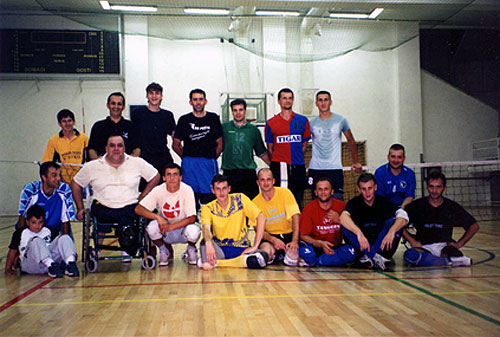
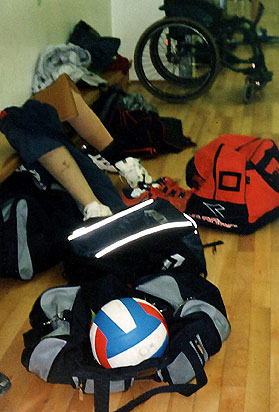
Every Tuesday and Thursday during practice season, a sitting volleyball team meets here, in this clubhouse of sorts. They are called “Fantomi” — the phantoms. They play cards, chain-smoke, and eventually head across the street to the mosque, where they practice in a basement-level gym. The slow-grinning man helps those in wheelchairs descend the short staircase to the pavement; those with prosthetic legs lend their hands too. There aren’t any elevators or wheelchair ramps here. Then it’s down another long set of stairs to the gym, where these men — some with only half-bodies — become both graceful and vicious, athletes exulting in near-superhuman feats.

This Tuesday, Nihad Radonja isn’t practicing with the rest of Fantomi. Coach Sevro Numanovic has temporarily suspended him for — well, he prefers not to say what for. Radonja, like most of his teammates, lost his legs during the war that consumed Bosnia-Herzegovina from 1992 to 1995. Widespread disabilities were caused in large part by the millions of landmines laid down on Bosnian soil, turning more than 10,000 soldiers and civilians into landmine victims. Radonja, like his teammates, comes to practice religiously, sweats buckets, plays like he means it. Like his teammates, Radonja wants nothing more than to kick ass on the volleyball court. You can tell it’s killing him not to play this week.

Relegated to the corner by his unnamed transgression, Radonja catapults himself out of his wheelchair like a bow-legged pelican lifting its massive wings into flight, dons a blue #4 jersey (respectfully turning his back to the lady) and lopes to the sidelines, where he begins batting — rather, slamming — a ball against the wall by himself.

Meanwhile, Radonja’s teammates in good standing with Coach Numanovic are immersed in various pre-game endeavors. Two men with one leg between them slap a ball back and forth; when they lose it, a wispy, boyish young man in a green #12 shirt limps around to retrieve it. His left leg ends abruptly at the ankle, rounded into a bulbous knob tied up in athletic tape. A few players stretch prone on the waxy floor, their shortened limbs splayed like sunning starfish. Coach Numanovic, in all his Buddha-belly glory, surveys the scene from his wheelchair, gnarling wooly eyebrows. He doesn’t look pleased: he’s going to give them one hell of a practice.


Searing anniversaries

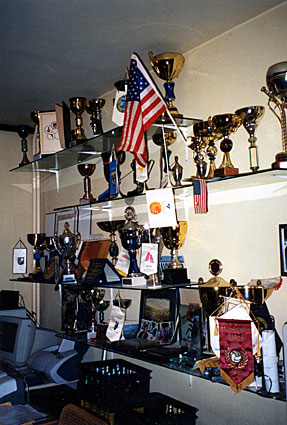
In recent years, Bosnia has become a formidable presence in the sport of sitting volleyball, with over 30 clubs nationwide. The country took the gold at the 2004 Special Olympics in Athens, defeating four-time champion Iran; Fantomi won the European Cup that same year. Sitting volleyball, which was introduced in Holland in 1956 and became a Paralympic competition in 1980, is played in much the same way as standing volleyball (six players to a side, five sets of one game each, a two-point lead required to win), but on a smaller court with a lower net. At all times, the players must maintain direct contact between their pelvis and the ground. The action is fast and most of it happens 45 inches above the floor.

Tonight, Fantomi splits in two to scrimmage in preparation for the World Club Sitting Volleyball Championships one month away pitting Fantomi against former rival Iran as well as Hungary, Russia, Germany, and Croatia. But something more than competitive pride draws the players back to the gym twice a week: the camaraderie forged by loss.

“If we were not doing sport and training, we would stay closed in the house,” explains Ismet Godinjak, who, like most of his teammates, spoke through a translator. “We would be introverts. But now, we have a good time together. The main reason is to gather together and not think about what happened.”

What happened was the war, which claimed an estimated 200,000 people and left tens of thousands of Bosnians disabled. According to the Bosnia and Herzegovina Mine Action Centre (BHMAC), the number of communities affected by mines plus the level of impact on the population make Bosnia the most mine-affected country in the world. As of May 2004, there were still 18,319 minefields in the country, containing an estimated 260,751 anti-personnel mines, 51,447 anti-vehicle mines, and 3,635 unexploded explosive ordnances. Injuries sustained from stepping on these devices are horribly disfiguring.

With the exception of one young man with a birth defect, all of Fantomi’s members were disabled in the war. With unequivocal clarity, all remember the exact date they lost their limbs. For Godinjak, that date was June 8, 1994. He was in the woods, scouting the front lines, when he stepped on a mine. His friends carried him to the hospital, where his left leg was cut off below the knee. By that point, Godinjak says, “it was usual to see amputees and injured people, so it was not shocking when it happened to me. I saw women and children killed; many of my friends were killed. So I did not consider it a big tragedy.” He developed gangrene and the amputation had to be repeated three times.

Godinjak is one of the taller players on the team, and his disability is not readily apparent until he takes off his pants and unhooks his prosthetic leg. Once crouched on the floor, he maneuvers towards the center of the court by using the support of his right leg and the sinewy muscles of his arms. It looks like a dance, a surreal underwater choreography in which six feet of man are collapsed and rearranged. He says that being on the court makes him feel normal again.

“When you play sports, it lets you know that you are normal,” he explains. “In time, you must learn to accept yourself with your physical injury. You accept the fact that you are not different.” Godinjak plays out this resoluteness on the court, vehemently ka-WHACKing his palm against the ball, the warm salt of his sweat and breath soaking the air as the game heats up.

According to Danijel Hopic of Sarajevo’s Handicap International, an organization that works with landmine victims, playing sports can shatter perceptions — both community-wide and self-imposed — that serious, body-altering disabilities, such as those sustained by many Bosnians in the war, are permanently inhibiting. “When a person becomes disabled, he feels a gap within himself. He sees no sense in his life,” Hopic says. “But with sports, the environment can be adapted to the person’s disability. Society imposes standards on people with disabilities, but sports defy the rules. Sports are crashing those standards down.”
 

Ground rules

Another thing sitting volleyball is crashing down is the lingering animosity between Bosnia’s ethnic groups who fought aggressively against one another in the war. While Bosnians can be dismissive of lingering tensions between Muslims, Serbs, and Croats, such antagonism isn’t extinct. Much like the racist attitudes that persisted in the United States after the elimination of segregation against blacks, people in Bosnia often talk grandly of unity while harboring staid convictions against opposing ethnic groups. In response to a description of Fantomi as a “Muslim team,” Radonja quixotically replied, “here in Bosnia, we have no ethnicities, only good people and bad people.”

But the reality is that many sitting volleyball players likely fought against each other on the battlefield. Usually, however, members of rival teams (which are not formed by ethnicity but by location) talk about obliterating each other on the court with only a playful malice. They are bound by their collective trauma, and now by a sport that has eradicated even the slightest inclination to wallow.

Dzevad Hamzie, a member of Fantomi rival team SPID (Sportsko Invalida Drustvo, another Sarajevo-based club), confirms this unity across ethnic lines. “Being a member of a group that has the same problem as you, being hurt in the war, we had that understanding between each other,” he says. “No one feels sorry for each other because we do not need it. There is no need for sorrow or pity.” Hopic says this competitive motivation is what makes sports so healing: “It makes [the disabled] want to prove themselves, to fight to show everybody that they can do it. If I accept you as my opponent, I validate you as worthy to be my opponent. The cooperation of the team means that we are all equal, no one needs to help each other, you do not need to help me, and I can help you.”

Hamzie is another tall, lanky player who walks without a trace of a limp — you don’t know his left foot is missing until he folds his pant leg upward. He speaks through exhaled cigarette smoke about August 13, 1995, one month before the war ended, the day that he lost his foot by stepping on a mine. After more than 100 days in the hospital, he spent a year learning how to walk again. He began attending volleyball practices in 1996, after he saw a local television documentary about the sport. Public transportation was still down, so Hamzie had to walk for more than an hour to the center of the city for practice — now, he can do the walk in 20 minutes. “When you are practicing all the time,” he boasts proudly, “you do not need to go to the doctor.”

Although the prevalence of landmines during the war made amputees a common sight on the streets of Sarajevo, the process of normalizing these injuries and accommodating the disabled back into the community has been difficult. Many public places — including the gym in which Fantomi practices — are still not wheelchair accessible. In fact, this lag in public perception of the handicapped is paradoxical: As international nonprofits maintain less of a presence in Bosnia due to the improvement of the political climate, local nonprofits are becoming more essential to the integration of the disabled — the very places where cultural misperceptions of disability may persist. “We as a society still see the disabled as a burden,” Hopic says. “Their families need to carry them places, they always need someone with them.” Hopic sees the difficulty of being without any aid, playing with only the ground for a prop, as freeing: “But once they are released [onto] on the ground, everything on [that] ground becomes the ground rules.”

All of the sitting volleyball players talk about the emotional uplift brought on by a good game. Delalic Sabahudin, SPID’s captain, says that “doing a sport like this is like having a job: You travel, you meet people. Those who do not are passive … depressed. This sport makes you very involved. Home is only for sleeping.”

Sabahudin, too, talks of the day a grenade blew off his left leg — December 5, 1992 — and how playing sports enabled his rehabilitation, both physically and psychologically. “There is the aspect of gathering and hanging out, the training. It makes you forget one part of your disability. It does not make it disappear, but one part of it can be accepted,” he says. “There is a very large difference between people who do sports and who do not. Those who do not are psychologically unstable, they cannot deal with their problems, they are closed to society, they are introverted. They mostly stay at home, which also becomes an economical issue. Asking the state to pay for your injuries is like waiting for nothing. But sport lets you figure out how to solve existential problems.”

Worth less or more?

As for the men of Fantomi, their practice session is winding down, but Coach Numanovic relentlessly works them till the end. He glides down from his wheelchair to join the team, battling it out amid pools of sweat gleaming on the waxed floor. The guys are tired, but no less tenacious in their efforts. To catch their breath, they recline backward onto their arms, but they don’t rest very often. During set-ups, there is a hushed, expectant silence, punctuated by panting breath.

Godinjak makes his way back to the sidelines to gulp water and check on his elementary school-aged son, who has accompanied him to practice tonight. The boy has been playing with the exiled Radonja in the corner and retrieving wayward balls from his dad’s game, pitching them back to the servers with a serious look. He watches his father and tries to imitate his particularly stellar plays. Godinjak knows his son looks up to him, which is a reason why he brings him to these practices. “You can be a model for all people, not just injured people. It does not have to mean you are worth less than other people,” he says. In a country where the official unemployment rate is 44 percent, Godinjak, with full-time office work, is indeed better off than many. “Doing this gave me a totally normal existence,” he says, “I have a home, family, a job. I have earned more than many people I know who are not injured, who were worried about me and how I would deal and go through life.”

Now night is falling and it’s time for Fantomi to abandon the court. Most of the men head back to the clubhouse, back to the cigarettes and card games. But Radonja, fired up with untamed energy after an evening on the sidelines, offers the lady a ride home. Two of his teammates help him to his car; one lifts him out of his wheelchair and into the driver’s seat, the other collapses the chair and secures it in the trunk.

As he speeds down the mountain through chilled layers of air, windows cranked down, radio cranked up, Radonja talks about the main reason Fantomi has been so successful. “It’s because we have heart,” he says simply. He drops his guest safely at her residence and bids goodbye, vanishing into the night.

Three months later, in the world championships last September, the Bosnian team, which in 2004 had stolen what would have been its fifth consecutive Paralympic gold medal from Iran, lost to this archrival. In November, Fantomi made a comeback to win the Euro League gold.


Reeking havoc

It’s hard to believe that Havoc didn’t generate more inquisition or outrage during its initial release.  It’s one of the most racially condescending films I’ve ever seen.  Havoc is the modern equivalent of Shirley Temple learning valuable lessons from her shucking and jiving servants.  Who would have thought THEY could teach US?  

Havoc follows the gapingly empty lives of rich, L.A. white kids who build their identities around a parody of hip-hop culture:  slang-drenched vernacular, rap video clothing, and a propensity for senseless displays of aggression and violence.  Their lives take a turn for the worse once they decide to cruise across the tracks to the “bad” part of town in search of slumming “realness.”  But at least one of the girls, Allison (Anne Hathaway), finds the illicit and violent drug culture to be sexually titillating and decides to start hanging out with the same drug dealer who put a gun to her boyfriend’s head.  At first, you think that this will be yet another Romeo and Juliet regurgitation, but this movie aims much lower than cliché, instead leading into one of the most uncomfortable sex scenes I’ve ever seen in a movie.

Drug dealer Hector (Freddy Rodriguez) doesn’t want a relationship with Allison, he really just wants her to roll the dice to figure out how many of his friends get to gangbang her and her “I’m so drunk” friend.  Allison ends up opting out, but her friend goes forward only to have to scream her way out once the pile-on begins.  She accuses them of raping her, though the movie implies that she’s lying despite a few moments that most viewers would readily identify as rape.  That’s the major problem with Havoc — the fact that it flows like it’s written by the immature, inane, and carnivorously vacuous main characters.  Though Havoc clearly wants to indict these white teens for skimming a minority culture without developing a nuanced view of the people they’re shoplifting from, it really ends up being more often than not passive-aggressively racist.

The drug-dealing Latino gang has absolutely nothing redeeming in their lives which include hotel rooms stuffed to the brim with their babies’ mommas, gang bangs as entertainment, and one scene in which they oafishly try to cruise through the rich neighborhood looking to beat the hell out of the girl pressing charges for rape, only to be stopped by the racially profiling police.  Given the film’s portrayal of minorities as sociopaths on the fringe of culture, tempting pretty white girls who soon learn better, it’s impossible to draw any conclusion other than the fact that this “hip-hop culture” thing, whatever it is, is unambiguously bad for the white children of promise, who will be torn from their potential by a culture of unremitting pathology.  Sadly, I don’t think this is what director Barbara Kopple intended, but her fumbling after-school-special dialogue and Crayola character scribbles take complicated interactions and commit cookie-cutter massacres of them.  

Terry Sawyer


A victim, now victorious

Today Michelle Bachelet was elected the first woman president of Chile. With her victory, Chile has come full circle.More than two decades of dictatorship under Gen. Augusto Pinochet ended in 1990, but the S…

Today Michelle Bachelet was elected the first woman president of Chile. With her victory, Chile has come full circle.

More than two decades of dictatorship under Gen. Augusto Pinochet ended in 1990, but the South American country has always remained deeply divided between those who saw Pinochet’s dictatorship as a necessary corrective to left-wing extremism and those who saw it as a human rights nightmare of epic cruelty — a nightmare that the United States helped bring about. With Pinochet’s recent indictment for human rights crimes, and Bachelet’s victory today, it appears that history is finally imposing its own corrective upon Chilean politics: Bachelet was herself a victim of torture at Villa Grimaldi, one of the dictatorship’s most notorious detention centers. Her father, a general loyal to the administration of President Salvador Allende, died after enduring continuous beatings in the months following the September 1973 coup, which toppled the democratically elected government and brought Pinochet into power.

Bachelet’s mother was also detained and tortured by the Pinochet regime. Her boyfriend, Jaime López, was detained and tortured, then “disappeared.”

“Michelle Bachelet belongs to the generation that suffered the most after the coup,” Andrea Insunza, a Bachelet biographer, told The New York Times. “The majority of those imprisoned, killed, tortured, and exiled came from that group, which is why I say her election represents the triumph of history’s defeated.” Bachelet also represents change to the status quo in other ways — as a pediatrician who previously served as health minister and then defense minister, a mother of three who separated from her husband and raised their children (remember that Chile only legalized divorce in 2004), and a self-acknowledged agnostic and socialist in a predominantly Catholic country. In fact, as defense minister Bachelet once joked with military commanders that she represented “all the sins together.”

In her victory speech, the president-elect spoke of extending the prosperity that Chile had achieved under her predecessor, President Ricardo Lagos, to the country’s poor and disadvantaged. “Ours is a dynamic country — one with the desire to rise up — one all the while more integrated into the world — a country of entrepreneurs who with ingenuity and creativity have created prosperity,” Bachelet said. “But in order to dare to innovate, Chileans also need to know that the society in which they live protects them. My promise is that in the year 2010 we will have put in place a great system of social protection.” The Chile that her administration hoped to build, Bachelet said, was one where “everyone — women and men, those living in the capital and those on the periphery, people of all colors, creeds, and convictions — can find a place.”

Bachelet’s words struck a more personal note when she spoke of her family’s history under Pinochet’s dictatorship:

There is someone who in this moment would be very proud. A man whom I wish I could embrace tonight. This man is my father. Alberto Bachelet Martínez, general of the Chilean Air Force. I inherited from him his love of Chile and of all Chileans without distinctions, his admiration for the natural beauty of our country, and his selfless sense of public service.…

You know that I have not had an easy life. But who among us has had an easy life? Violence entered my life, destroying that which I loved. Because I was a victim of hatred, I have devoted my life to reversing hatred, and converting it into understanding, tolerance, and — why don’t we say it? — into love. One can love justice and, at the same time, be generous….

With her election, Bachelet joins a handful of other woman presidents in South American history. Those few who preceded Bachelet, however, were either the widows of prominent politicians or not democratically elected, or both. Bachelet, the “doctora,” earned her victory today with a wider margin than her mentor, President Lagos, garnered in 2000. Given her background as a victim of the dictatorship, Bachelet’s presidency may be just what her country needs to reconcile with its brutal past and move forward.

Those of us north of the equator may also see her victory as a painful reminder of how little success women here have had in attaining their countries’ top posts. In Canada, there was Prime Minister Kim Campbell (who served five months in 1993), and in the United States … well, there was Mackenzie Allen on ABC’s fall drama Commander in Chief. (There was also an African American president, David Palmer, on Fox’s 24, but he was gunned down tonight, I’m sad to say.)

Victor Tan Chen

Victor Tan Chen is In The Fray's editor in chief and the author of Cut Loose: Jobless and Hopeless in an Unfair Economy. Site: victortanchen.com | Facebook | Twitter: @victortanchen


Jack Bauer is back on ‘24’ and ready to kick more terrorist butt

Though professionally I have to watch a lot of television shows I really don’t care for very much, there are few that are truly must-see TV for me.  Fox’s 24 is one of those shows, and I have been happy to see that the producers have been able to continue a premise that could have easily been a two-season splash-and-crash like Stephen Bochco’s season-long murder trial series, Murder One.  The exploits of the maverick agent Jack Bauer (Kiefer Sutherland) and his breaking-all-the-rules way of saving the world is a stream of action, drama, and seat-of-your-pants thrilling suspense that easily sucks people into watching each week.  Last season I knew that I would be unable to catch every episode week to week, so I taped the entire season and watched it almost within a two-week period.  All I can say is that it was hard not to watch all 24 episodes in one sitting, and I came as close to being an addict as I would wish.

If you haven’t had the chance to catch 24 yet and you like non-stop Energizer Bunny drama, then I oblige you to watch the four-hour, two-night premier beginning this Sunday and continuing Monday.  24 is probably the only show for which could extend a premier over two nights.  As you probably know or could guess, 24 follows a storyline that takes place in one day with each episode comprising one hour of that day.  If you can suspend the belief that in many episodes Jack or other characters seem to navigate the streets of Los Angeles in a record amount of time, the real-time scenario is quite compelling, and to the writers’ credit, the show seems to keep one step ahead of what is happening in the news each week.   When recent headlines dealt with U.S. torture policy and possible illegal wiretaps, viewers of 24 can’t help but think of Jack Bauer and his dubious exploits that usually circumvent regulations, treaties, and laws but always seem to get the bad guy.   For those who are critical of officials, like Jack, who overstep their bounds, the show doesn’t let him go unpunished — just look at all he’s gone through: wife and daughter kidnapped, wife killed, electric shock torture, having to kiss the woman who killed your wife, fired from your job, being shot at constantly, becoming a heroine addict undercover, demotion, having to fake your own death, and the list goes on.  It’s not a pretty sight.

The show’s center is the aforementioned government agent Jack Bauer who happily breaks every rule in the book to help prevent some kind of disaster from occurring, from assassinations to nuclear bomb attacks.  And the writers have thrown everything they could possibly think of at him to keep him from achieving his objective — which is what makes the show so exciting.  Besides Jack and a few key characters, the cast is ever changing but always revolves around Los Angeles’ Counter Terrorist Unit, or CTU, as the agency Jack always seems to return to work for and is somewhat of a character in itself.  I wonder if college students are playing drinking games like they used to do with The Bob Newhart Show where they would take a shot every time a character would say “Hi, Bob” on that 70s sitcom — in this case, it would be whenever a character says CTU.  I don’t think anyone would be conscious for too long.

It’s hard to find another show on television with as much stuff packed into each episode, including storylines, characters, and action.  According to Jon Cassar, series producer and director of most of the key episodes (including the four hour premier), “You have to understand that we do what amounts to about ten to twelve feature films each year and I would say that the quality of our shows are equal or better than anything in theaters right now.”

According to Cassar, the decision the writers and producers made at the end of season one was key in making 24 one of television’s best series.  “When they decided to kill off Jack’s wife Teri (Leslie Hope) it ended up being the best thing we could have done because after that anything could happen.  No character is safe no matter how loved they are by the fans.  It’s funny to see the actors all rush to see if they’re the next one voted off when they receive new scripts.”  Even Kiefer Sutherland has said in interviews that he knows that Jack Bauer himself will have to be killed off at some point in order for the show to keep its edge.

To understand the reach the show has made worldwide, there’s an interesting anecdote that Cassar related.  During the filming of a close-up of someone punching in phone numbers for season one, the prop man, doubling as the actor, dialed his own cell phone number.  Usually, in films and TV shows, the 555 exchange is used in place of a real phone number to prevent anyone dialing a real person.  The show aired as shot and no one thought much about it until one afternoon while in production on season two, the prop man’s phone rang and on the other line was a curious fan from Sweden who had just seen the episode in question and decided to see whose number the character dialed.  The prop man talked with the fan for a little bit and then passed the phone around the set.  They began getting more and more calls from around the world and what they found was that the fans were not only avid about the show but offered terrific feedback that helped the writers and producers in the development of future episodes.

24 is a cornucopia of action, suspense, thrills and chills, great drama, and some of the most interesting characters on television (or in movies, for that matter).  This season looks like an even bigger thrill ride, and I highly recommend you catch every episode of this terrific series.  I bet that you’ll be riveted to your television set and so disappointed each week when the hourly time counter rolls over to the next hour.  24 premiers on Fox this Sunday at 8 p.m. ET, continuing on Monday at 8 p.m. ET, and settles in its 9 p.m. ET Monday slot the following week without any preemptions until the season finale in May.

Rich Burlingham


Quote of note: Conan’s transatlantic alliance

They have red hair. And same kind of nose.—Markku Jaaskelainen, campaign manager for Finland’s president, Tarja Halonen, on the alleged physical similarity between his candidate and…

They have red hair. And same kind of nose.

—Markku Jaaskelainen, campaign manager for Finland’s president, Tarja Halonen, on the alleged physical similarity between his candidate and American late-night talk show host Conan O’Brien. According to the Associated Press, Halonen’s reelection bid has received an unexpected boost from O’Brien, who has shown a keen interest in the political contest across the Atlantic, regularly mentioning Halonen on his show and praising her positive impact on Finnish carp production. O’Brien says he supports Halonen because she shares his piscatory values and “good looks.”

Victor Tan Chen

Victor Tan Chen is In The Fray's editor in chief and the author of Cut Loose: Jobless and Hopeless in an Unfair Economy. Site: victortanchen.com | Facebook | Twitter: @victortanchen


My Dear Pattern

I was given a body—what should I do with it,
So unique and so mine?

For the quiet happiness to breathe and to live,
Whom, say, should I thank?

I am the gardener, I am also the flower,
In the dungeon of the world I am not alone.

On the windowpane of eternity,
My breathing, my warmth have weighed down.

A pattern is being imprinted on it,
Recent yet unrecognizable.

Let the mist of the moment drip—
the dear pattern cannot be crossed out.

translated from the Russian by Motýlí Voko

Дано мне тело—что мне делать с ним,
Таким единым и таким моим?

За радость тихую дышать и жить
Кого, скажите, мне благодарить?

Я и садовник, я же и цветок,
В темнице мира я не одинок.

На стекла вечности уже легло
Мое дыхание, мое тепло.

Запечатлеется на нем узор,
Неузнаваемый с недавних пор.

Пускай мгновения стекает муть—
Узора милого не зачеркнуть.

~1909~

About the poem: In the symbolist stronghold of St. Petersburg, Osip Mandelshtam’s debut collection Kamen (Rock, published in 1913) rallied readers for whom words evoked a physical world of razor-sharp contours, rather than standing for an imagined realm of perplexing abstractions.

Jan Vihan is a contributing writer for In The Fray.


How to stop worrying and love Iran’s bomb

This week, once again, the big international news is the continuing progress of Iran’s nuclear program.  It seems fair to assume that the ultimate goal is to create nuclear weapons.  Why else would they risk the inevitably painful economic and political consequences?

Most news stories and magazine articles simply take it as a given that Iran having nuclear weapons is a bad thing.  At one level, of course it is.  No matter how small the chance of any particular government using nuclear weapons is, more countries means a greater chance of some city being devastated.  It may also be that Iran’s acquisition of nuclear weapons will lead other countries in the region to step up their own efforts to counter it.

Some worry the danger of Iran having nuclear weapons is that it might hand off nuclear weapons to international terrorists.  This is specious.  Iran has a functioning state, and no government is likely to hand its most important weapon to a bunch of guys in a cave and tell them to do what they like with it.

Finally, there is the most important argument.  A nuclear Iran would change the balance of power in the region, fundamentally threatening the interests of Israel and the United States in particular, and the other states in the world more generally since everyone is dependent on the oil.

Iran is within range of at least six nuclear states: Israel, America, Pakistan, India, China, and Russia.  Of these, Israel and the United States are implacable enemies.  Both have made multiple military strikes in the Middle East, and each has invaded and occupied another country in the region in the past 25 years.  Pakistan is an unsteady neighbor — a possible threat to become an anti-Shia theocracy at any time.  India, China, and Russia are currently business partners, but none of these connections probably looks too reliable from the Iranian perspective.  How could any Iranian government not pursue nuclear weapons?

The current western solution to the problem is to punish Iran if it doesn’t submit to manifestly inadequate conditions.  This is stupid.  Given Iran’s military position, no punishment is likely to be strong enough.

Another option is to provide some guarantee of Iran’s security, as well as some serious consideration of its demands concerning the regional political order.  This would need to come from the United States, which is clearly the most frighteningly aggressive and hostile threat.  It is also the one power that could ensure that Iran would be safe from the others.  The American government needs to realize that sticks will never work and start offering a whole bunch of carrots.

Otherwise, there will be a nuclear Iran, and the U.S. and Israel will need to learn how to deal with a true regional power unlikely to be very sympathetic to their designs for dominance.  It’s not immediately obvious that this situation would be worse for the locals than what is happening today.  A stalemate of non-interference might be the result.

America needs to decide now which course it prefers.  The current situation is untenable.  Waiting much longer to offer a non-nuclear future will guarantee the opposite.

—Pete DeWan


Getting our priorities straight

If you’ve been looking for a good reason to get hot and bothered about the state of America’s healthcare system, look no further. While The New York Times’ current series on diabetes is occasionally redundant, today’s article illuminates the stark realities of insurance coverage for diabetics.  As insurers refuse to pay the costs of preventative care, such as nutritional counseling or podiatry appointments, diabetics — predominantly poor populations and /or racial and ethnic minorities — are left to flounder until the gravity of their disease requires amputations or other drastic surgeries. As Dr. Bernstein of Beth Israel Hospital stated, “Until we address the financing and the reimbursement structure, this disease is going to rage out of control.”

As the Times reports, diabetes is already out of control. Without preventative care, the epidemic crippling America’s poor will become a plague.

Laura Louison


Clash of civilizations (the high school remix)

Director Marco Siega’s Pretty Persuasion begins with an essential fake-out of its mood, leading you on to believe that it’s just a slightly edgier take on the cut-throat puberty politics immortalized in Heathers. By the time the movie reaches its tragic, gutting ending, you realize that the film’s slicing superficiality belied a far darker core just as its lead character, Kimberly, wasn’t so much a misguided popular girl as a sociopath in bloom.

It’s easy to criticize this movie for biting off more than it could possibly chew, and in the end, the cultural criticisms levied in the story would be far better serviced if not embedded in the Hannibal Lecter rewrite of Mean Girls. But at least Pretty Persuasion tries to envision why the exporting of American values could prove traumatizing as it’s the story of Muslim transfer student, Randa Azzouni, who ends up at the martyred end of a web of sex, lies, drugs, and the trampling pursuit of fame.

Granted, this Muslim innocent eaten by the American devil-girl reeks of a simplicity that assumes being a woman in the Muslim world doesn’t come with its own indigenous trauma. Yet, watching her life rended into meaningless at the cross-section of our institutions — high school, the media, and the courtroom — it was difficult not to feel like perhaps our obsessions, our shames, and our pecking orders that reward pathology make living life from an authentically spiritual center next to impossible. Or, at the very least, fruitless.

Pretty Persuasion also seems to be asking us to consider our culture as an incubator for sociopathic behavior. As Kimberly, the main character, manipulates the school, her friends, family, and the entire media with oral sex and a marionette’s instinct for the pettiness of humankind, one wonders why these institutions seem ready-made for psychotic pliance. From the gullible jurors to the narcissistic journalist who can’t wait to get Kimberly into bed, everyone in the movie seems too morally compromised to be able to figure out the truth before Kimberly is ready to have the truth revealed.

As with most movies, the plot’s message amounts to little more than boxy clichés, and it’s the characters who carry the real weight and nuance. The final scene crops close to Kimberly’s face as we watch her discover that she’s imperially unparalleled in manipulation but emotionally barren. She quietly implodes under the weight of her own amoral, absolute power while never allowing her howling realization to disturb a single grain in her beautifully crafted surface. While it’s easy to pick at the film for its crass reductions of a complicated conflict in cultures, Pretty Persuasion deserves credit for showing us with disturbing clarity how easily high school can be paradigmatic for the entire world.  


The Family Stone rocks!

The holiday season is always inundated with new releases — big-budget spectacles and smaller indies vying both for your attendance and the tiny attention spans of Motion Picture Academy members — but usually inside the stockings all hung with care is a film that fits in the middle and deserves to be seen.  The Family Stone is 2005’s holiday “happy” — a well-crafted film that doesn’t hit you over the head with visual effects a la King Kong or try to nip at social norms like Brokeback Mountain.  It’s just a fun film to enjoy in the moment before moving on to fulfilling your New Year’s resolutions.

Though it has been out several weeks and overshadowed by the other big films of the season, this funny but surprisingly touching dysfunctional family dramedy deserves a viewing now that the holiday season has come and gone.  The Family Stone revolves around the Stones’ Christmas holiday in a tony Westchester County suburb as stalwart sibling Everett (Durmot Mulroney) brings home his intended fiancée Meredith (Sarah Jessica Parker) to meet the family even though he knows that they will find her rather waspish nature difficult to handle.  What he doesn’t know is that his sister Amy (Rachel McAdams), who has already met Meredith, has painted a rather unflattering picture of her to parents Kelly and Sybil (Craig T. Nelson & Diane Keaton) and the rest of her family, which includes a deaf, gay brother (Tyrone Giodarno) and his African-American partner (Brian J. White).  The fish out of stormy water is the primary plot element and source of most of the humor, but as the film progresses, it becomes obvious that everyone in the family has some kind of quirk or issue that equals that of Meredith and makes the audience feel very much at home.

When Meredith’s easy-going sister Julie (Claire Danes) arrives to help cope with the desperate situation, her self-assuredness and sanity is like a dose of strong medicine that forces a recovery for a family that didn’t realize they needed help.  The Family Stone graciously balances serious, emotional family dynamics with the almost farce-like humor, allowing the audience to experience empathy for all of the characters in the end, even Meredith, because to most of us, our own families aren’t much saner than the Stones — and are probably far worse.

As for the cast Diane Keaton stands out as the post-sixties open-minded but stubborn matriarch who only wants her kids to have happy lives.  The underrated Craig T. Nelson has the difficult task of being ringmaster when he himself must battle his own fears while masking it all from his kids.  Sarah Jessica Parker does her best Wall Street careerwoman impression but shines even more when slacker brother Ben (Luke Wilson) melts away her frozen veneer.  The best performance goes to Rachel McAdams whose acerbic Amy is out to defrock her brother’s fiancée at all costs only because she knows in her heart Meredith isn’t the girl for him.  The rest of the cast excels in their own way, giving their characters a full life even with less screen time.

The Family Stone may not win during this year’s award season, but it’s a fun film that will stave off the winter blues.  So take a break from your own family’s trials and tribulations to experience the enjoyable chaos that is The Family Stone.  In theaters nationwide.

Rich Burlingham

personal stories. global issues.
