Happy ever after

Even a death in the family cannot dampen the joyful Nigerian spirit.

The reception after the memorial service took place in a part of Lagos known as Mile 2, a large sub-division undergoing a sprucing up. We set up in a grassy area between two rows of buildings. Those pictured on the right still reflect years of neglect.

I smelled Lagos before I saw it, before I even stepped off the plane. That first inhalation of the city and each subsequent breath overwhelmed me like flood waters spilling over a river’s muddy banks.

It was the effect — I would soon discover — of imbibing through my nose the reality of Third World urban living: too much heat, too much carbon dioxide, and too many heaps of roadside trash. This was my first trip to my parents’ homeland, to attend a service commemorating the twenty-fifth anniversary of my grandmother’s death, and over the next couple of weeks, there would be much more for my senses to absorb.

For the moment, however, I was hours away from stepping out into any of it. I still had to get through the long customs line, which comes before baggage claim in Lagos. Probably because the customs agents know the baggage handlers nab any valuable contraband we passengers might have hidden in our suitcases. Two hours of waiting under epileptic fluorescent lights while baggage handlers presumably ransacked my bags gave me plenty of time to try and decipher the olfactory puzzle that is Lagos.

Of course, I couldn’t. The American-born-and-raised nose cannot isolate the sweet, unctuous aroma of thousands of diesel generators revved up after the electricity has gone out. Again.

A family friend adjusts my headdress made of stiff gold damask, the latest trend, which my inexperienced hands cannot maneuver. In the background, my mother works on her identical headpiece.

On-the-ground realities

A lifetime of Western media exposure had prepared me for the worst this geographically small but socially and economically substantial country — home to a sixth of Africa’s population — could offer. The months before my December visit, the headlines from Nigeria were filled with words like corruption, AIDS, death toll, malaria, Internet scam, ethnic violence, poverty.

Around the time of my trip, The New York Times ran an article, “Blood Flows with Oil in Poor Nigerian Villages.”

The story covered the Niger Delta region around Port Harcourt that is constantly — literally — aflame as militants burn oil pipelines in an attempt to pressure the government and multinational oil companies to share more petro-profits with natives. They’re fighting for more than just a few kobo, Nigerian coins made obsolete by rampant inflation. Nigeria is the tenth-largest crude oil producer in the world and the fifth-largest supplier to the United States. The stakes rise as hostages’ lives are increasingly brought to the table as bargaining chips.

Life for most Nigerians, however, precludes international intrigue. In Lagos in particular, the daily business of survival is more than stressful enough for the poor and middle class.

In the hazy morning light of my first full day, what I had assumed the night before were several new building projects on the road from the airport revealed themselves to be ancient high-rise developments. The unpainted cement buildings seemed on the verge of collapse, having received little cosmetic attention since being built four decades earlier. Despite their dilapidated state, people lived in them. Many left laundry drying on the balconies while they camped in their regular spots on the roadside below, selling anything that could be grown or manufactured in mass quantities: clothing, produce, and various housewares made from wood, plastic, and cheap metals like tin and aluminum.

On day-long vigils lasting well into the night, thousands of Lagosians lined the streets, shoulder to shoulder, stall to stall. Drivers trapped in the traffic jumble of the city’s narrow streets often rolled down their car windows to buy bottled drinks or long-distance calling cards from the hawkers who weaved between the bumper-to-bumper traffic trying to make a sale.

Two days into my trip, I bought a handkerchief while sitting with my mother and aunt in the backseat of a car, on the way to pick up outfits for the memorial ceremony. The salesman looked about 15. Traffic began rolling again before he could collect his money, so he ran between the moving vehicles to catch up with us. His job was dangerous for sure, but he was lucky to have made any money at all. He competed with countless others: older men, boys from the country, and immigrants from all over Africa working the streets.

As I wiped sweat and grime from my face, browning my cheap white handkerchief, I tried to ignore the incessant honking and black exhaust plumes from the cars around us. Sedated by the heat, I felt like yawning but tried hard not to: the filthy haze in the air made me fearful of taking deep breaths. It struck me then that my family and the people of Lagos breathed this air daily. The thought chilled me despite the energy-sapping heat. It had never occurred to me that just getting sufficient oxygen might be one of the daily struggles Nigerians faced, smiling all the while.

Considering their determination to overcome difficult circumstances, I tried not to fret over the next day’s memorial service. But I continued to view the ceremony with my American mind, one that finds dealing with death awkward and depressing. At the very least, I saw it as a chore: attending the funeral of someone I hardly knew largely out of a sense of obligation.  

Finding the silver lining

But, to Nigerians, death can be cause for a celebration. Many things are.

Despite their unrelenting social, economic, and environmental woes, Nigerians express a relentless optimism and sincere exuberance. They see through the suffocating smog that blankets their capital to the fecund (if fast-disappearing) tropical forests in the rest of the country. They hear over the constant commotion of traffic the drumbeat of a rich musical history that includes the internationally influential Afrobeat and the lively Fuji — a hybrid of traditional beats and an ’80s synthesizer aesthetic — named so by a musician who was inspired by the famous volcano in Japan. They read between the headlines that daily spell out political doom, finding instead an opportunity for change and constructive leadership.

Faced with the tumult of the world around them, most Nigerians hold fast to religion — be it Christianity, Islam, tribal beliefs, or some sort of fusion faith — focusing not on death, but on the celebration of a life well-lived and a wonderful afterlife to follow. As a result, the Nigerians I encountered were truly a joyful people.

For me, the day of my grandmother’s memorial service was an interface of all aspects of this diverse culture. The Catholic church service was solemn and prompt, but the day ended the way many things seem to end in Nigeria: with a party.

More people attended the reception than the church service. As we early birds sat outside under a large tent, waiting to be served, I looked at everyone’s attire, which seemed like an attempt to showcase every color imaginable.

It was the third party that week for one of my aunts, a 50-year-old school headmistress. Four parties a week is not unusual for her, so she has a stack of colorful outfits, nearly as tall as I am, to wear for such occasions. In that stack are iro and gele, wrap-around skirts with matching headdresses worn with a buba, a blouse that might match or contrast the color of the skirt.

Nearly every woman at the party wore one of these traditional outfits. Someone wore white with a blue diamond pattern; another wore gold with wine-red flowers. Someone else had on a black buba with gold polka dots and green French-script swirls. Both men and women donned ornately embroidered materials, and members of the same family usually wore matching outfits. In this way, clothing was an expression of two important sources of Nigerian happiness: strong family ties and an impeccable sense of style.

The clothing in all of its scintillating intricacy — and downright costliness in some cases — called to mind another Nigerian value: wealth. Everyone at our party had his or her best foot forward, likely encased in a brand new, flashy shoe. Likewise, wrists, necks, fingers, and ears displayed the most expensive (or most expensive-looking) jewelry people owned. Anything less is barely better than turning up in jeans and a T-shirt to Nigerians. Real gold is precious and treated like a family heirloom. Those of us who could not afford the real thing — and I believe that included a good portion of the attendees — proudly sported inexpensive knock-offs.

The food, when it arrived, was some of the finest (if basic) Nigerian cuisine, cooked by paid women who had been peeling, boiling, and stirring outdoors since the night before. Bits of roasted goat meat and vegetables decorated jolof rice made red by cooking in a tomato sauce. Side dishes included moyin moyin, or bean cake, a soft mound of ground beans mixed with water and steamed inside banana leaves, and egusi, a spicy spinach dish with shrimp and meat. Sweet fried plantain, another staple, barely left room for even the thought of dessert. Everything was served hot — cool food is blasphemy in Nigeria — with a soul-lifting combination of tastes, textures, and colors.

The various elements of the party seemed designed to appeal to all five senses. After the guests had eaten their fill, the music started and partygoers of all ages let loose. There was not only dancing, but also “spraying,” a local custom in which dancers place cash on one another’s faces, necks, and shoulders, all the while moving to that irresistible beat. At times, perhaps at a wedding reception where a new bride is the focus of spraying, Nigeria’s multicolored bills actually float in the air, and it’s easy to see where the custom might have gotten its name.

Why they dance

In some ways, the vigorous Nigerian social life is a response to the country’s downtrodden condition. Certainly, it’s a great way to deal with the day’s frustrations and release energy that seems futilely directed elsewhere, say, at environmental protection.

But there’s something more, I think.

Nigerians hold on to what cannot be quashed by the turbulence of the modern world. They have music, ever present, with instruments such as the talking drum, which for centuries has perfectly mimicked the intonations of the Yoruba language. And they have each other, revered elders and cherished children. And for these things, they are truly grateful.

It’s right there in the language. When one person asks another in Yoruba, “How are you?” the second responds “Mo dupe,” or “I give thanks.”  It’s not just senseless giddiness that keeps them smiling and laughing.

At my grandmother’s party, the most unique elements of Nigerian culture came together like a talented jazz ensemble, playing off one another, giving the best of what they had well into the night and then a little while longer. Friends conversing would suddenly break into a popular song. We younger ones danced to before-our-time favorites that morphed seamlessly, in the middle of a long music set, into Christian praise hymns.

And although the invitation had expressly said “no night party” in red letters, by 9 p.m. the dancing had only just begun.

This idyllic atmosphere did not unfold in a vacuum. The cost of the service, along with the choir, cooks, photographer, and caterers, proved to be a financial strain, despite the combined resources of family and friends. And for all the enthusiasm displayed, illness or death kept some seats conspicuously empty. But this was taken as all the more reason to dance harder, laugh louder, chat longer.

It was death that had brought us together that evening, but I was hard-pressed to remember it when I looked at the jubilant faces of my grandmother’s children and siblings. Perhaps they would save their sadness for another day. But even so, I’m sure it would soon dissolve into the bliss of another long night of festivities.


Bearing to look, daring to look

An up-close look at the 2005 Srebrenica Commemoration.

Click here to enter the photo essay.

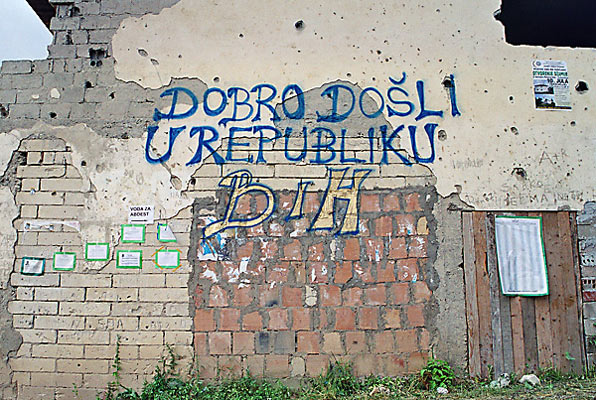
Between July 12 and 16, 1995, up to 8,000 Bosniak men and boys were killed by Bosnian Serbs under the command of the indicted and still at-large former General Ratko Mladic.  July 11, 2005 marked the ten-year anniversary of the massacre. On that day, 610 victims of the Srebrenica massacre were buried at the Potocari commemoration center in the Serbian Republic of Bosnia-Herzegovina.  

There was a time when I was afraid to look at these photographs.  

I developed them at the end of August, after a summer of reporting in Bosnia-Herzegovina.  Though images from the Srebrenica commemoration still intermittently flashed through my mind without warning — bullet-punctured skulls in a mass grave, an old man sobbing and clutching his grandson’s coffin as it was lowered into earth — the thought of looking at them seemed somehow more threatening than my fractured, yet fierce, memories.  

For several days they sat on my desk, bulging in their sealed envelopes. Could I bear to face what I’d experienced? I didn’t know how to make sense of it myself, and nothing and no one had helped so far.  And of course by now the newspapers had no mention of Srebrenica, as if the real story was a one-day ceremony and not the daily lives of people in the area — Bosniaks, Bosnian Serbs, returned refugees, family members of victims, and victimizers.  
    
After the commemoration, friends and I drove through the winding roads of the Serbian Republic and back to Sarajevo.  Around 1am I arrived in Bascarsija, the historic Ottoman section of the city where I was living, and phoned my parents.  “You don’t know what I’ve seen!” I told my father.  “I won’t be able to sleep.  I saw a father jump into the grave of his son who’d been killed … How can I forget this?”

I told him I was sure I’d have nightmares that night and every night afterwards.  “You won’t dream about it,” my father assured me.  He was right.  Instead, images flickered through my mind during unpredictable times of the day:  the lyrical, cyclical movement of coffins as men passed them from hand to hand to hand; the despairing duplication of rows of green shrouded caskets lying in the old battery factory where the Dutch troops were headquartered in 1995.  At other times, phrases, not pictures, jarred me back to the experience:  the comment of a young Bosnian Serb woman living in Srebrenica — “It’s hard to live here because it’s hard to always live between the past and the future,” or the refrain often heard from those whose family members were killed — “We don’t need a commemoration — all we want are our relative's bones.”

When I finally looked at my photographs, I was shocked by how innocuous they were.  I’d had nothing to fear. Everything was so inappropriately static and calm. The images of the mass grave we visited just outside Potocari didn’t reveal the haunt and hush as it was unveiled.  Missing, too, was the tremulous voice of the translator for President of Bosnia Herzegovina’s State Commission for Missing People, Amor Masovic, as he told us the shattered vertebrae and bones we were looking at were approximately 50 of those “who never made it” as they fled Srebrenica for Tuzla.  Masovic then soberly explained that almost all these bodies were incomplete. The remains of each individual might be scattered throughout multiple graves. It could take years to make positive identifications and inform victims’ families.  

The wide angle shots of the commemoration couldn’t capture the cacophony of disparate yet interconnected sounds: the dzenaza (funeral) prayer, whose final lines implored, “That Srebrenica / Never happens again / To no one and nowhere!”; the whir of European Union Force helicopters circling above, monitoring the events on the ground; the muffled, crackled voices of officials as they condemned the massacre, one after another.  No image could convey how the mist hovered over the lush surrounding hills like uneasy, heavy spirits, ready to descend — hills that almost certainly contain more scattered remains of those massacred around Srebrenica.

There was a moment during the commemoration when I and the Serbian journalist with me put down our cameras to offer tissues to a woman with tears streaming down her face as she bailed rain water out of her son’s still-empty grave.  I had the humiliating realization that this was perhaps the most significant thing I had done that day.  

Are these photographs evidence of witness bearing, or merely being there? I’m still not sure.  To me they are merely a reminder of the importance of looking, and of remembering — and understanding the complex responsibilities that accompany both.


The Girls of Riyadh

The lesbian aspect of it, the gay son — that’s not been talked about before. Obviously it happens…but to say it in public doesn’t show the other rich elements of Saudi… I don’t think it’s a very balanced portrayal of Riyadh.

—Hani Khoja, producer of a youth TV program in Saudi Arabia, commenting on Rajaa al-Sanei’s new book, titled Banat al-Riyadh, or The Girls of Riyadh.  The 24-year-old dentist’s new book addresses issues of lesbianism, cross-dressing, homosexuality, and sex in the kingdom.  To the chagrin and horror of some, the book recently gained permission to be sold in the conservative kingdom, which is governed, in large part, by statues of Wahhabist Islamic codes.

Mimi Hanaoka


Please disregard the frightening statistics. The world is a safer place.

Always release the bad news midday on Friday, for brief mention in the ill-read Saturday paper.Yesterday the U.S. State Department released its second annual Country Reports on Terrorism (click …

Always release the bad news midday on Friday, for brief mention in the ill-read Saturday paper.

Yesterday the U.S. State Department released its second annual Country Reports on Terrorism (click here for the report). This year, there were statistics. According to the government, there were 11,000 terrorist attacks around the world in 2005, which killed a total of 14,600 people. Iraq alone accounted for about one-third of these attacks and more than half of the fatalities. At a news conference announcing the report’s findings, the State Department’s counterterrorism coordinator put a happy face on the numbers, insisting that the world is becoming a safer place and the fight against terrorism can’t be measured “month by month or year by year.”

So how exactly are we doing in the “war on terror”? Do we have any idea of how last year compares to previous years? The National Counterterrorism Center (NCTC), which compiled the report’s statistics, says that the 2005 figures cannot be compared to previous year’s figures because the center started using a new methodology for identifying terrorist attacks. This new methodology counts not just incidents of “international terrorism” (“incidents that involve the territory or citizens of two or more countries”), but acts of terrorism more broadly.

Perhaps I’m missing something here, but a browse through the NCTC’s online data pulls up not just the 2005 data, but also the 2004 data — beginning on January 1 and including incidents with victims from just one country (i.e., the broader definition of terrorism). These are the figures we get for 2004: 3,168 incidents of terrorism, 7,717 fatalities, 18,865 injuries, and 6,086 hostages. In 2005, there were 11,110 incidents, 14,602 fatalities, 24,755 injuries, and 34,780 hostages.

On all counts, the numbers have gone up — way up.

Now, I’m not sure when the methodology change occurred, or if it even applies to the data online (the difference may be between what’s online and the previous reports, for example). But assuming that the change occurred in May 2004 — as the Counterterrorism Blog suggests — then the figures later in the year should be comparable. In December 2004, there were 455 incidents and 692 deaths; in December 2005, there were 888 incidents and 1,013 deaths. In October 2004, there were 323 incidents and 628 deaths; in October 2005, there were 927 incidents and 1,377 deaths.

Again, the 2005 figures are substantially higher.

So is the world really a safer place? I’m not sure, but the numbers here don’t look promising. We should also remember that the government has quite a history of spinning terrorism numbers. Last year’s Country Reports on Terrorism did not include statistics after a controversy over what to categorize as “terrorist incidents.” Counterterrorism officials declined to use an alternative accounting method recommended by Secretary of State Condoleezza Rice’s office that would have reported fewer significant attacks. Rice’s office responded by creating the Country Reports on Terrorism — which replaced the previous series, Patterns of Global Terrorism — and refusing to include any numbers in the 2004 report. (At the news conference announcing that report, however, State Department officials did provide figures: 1,907 people had been killed and 9,300 wounded in terrorist attacks in 2004, they said — the highest ever.)

Before that, there was a flap over the 2003 report, which the government hailed as showing a decline in terrorism when first released. After a barrage of criticism — including allegations from two academics that the numbers were being manipulated — the government revised its estimate upward two months later and admitted a “slight increase” in terror.

Here’s some insightful background on the government’s international terrorism reports from the Counterterrorism Blog.

You have to wonder how the U.S. government is going to win this war on terror if it can’t even get the numbers right.

Victor Tan Chen

Victor Tan Chen is In The Fray's editor in chief and the author of Cut Loose: Jobless and Hopeless in an Unfair Economy. Site: victortanchen.com | Facebook | Twitter: @victortanchen


Religious shopping

A mall with no cafes, no cinema, only headless mannequins and a strict bar against admitting any men on its upper floor may sound like an unappealing shopping center, but the novel outlet aims to fill a niche market: shopping for ultra-Orthodox women in the Bnei Brak neighborhood of Tel Aviv. The mall features 20 stores, all designed to meet the ultra conservative tastes of its clients. Even the beds here are only available in the snug single size, due to the ultra-Orthodox injunction against sleeping in the same bed, even for married couples.

The owner, Yehuda Amar — whose prior forays have been in the apartment building construction business — insists that business is good: “Business is good, and it’s better because it’s women-only… It’s what the people in this area want. They can look at the lingerie and make-up without worrying about men lurking behind them.”

Mimi Hanaoka


Statistics that kill

“As the world continues to turn away from the use of the death penalty, it is a glaring anomaly that China, Saudi Arabia, Iran and the USA stand out for their extreme use of this form of punishment as the ‘top’ executioners in the world.”

Irene Khan, Amnesty International Secretary General, speaking about the death penalty statistics for 2005 generated by the organization. Amnesty International catalogued at least 2,148 people executed in 22 countries in 2005, 94 percent of whom were executed in China, Iran, Saudi Arabia, and America. China accounted for the majority of executions, with approximately 1770 deaths.  

Mimi Hanaoka


Progressives gather to watch film, discuss issues

Both in political and film appreciation circles it seems that conservative groups, or those marketing to them, have been far more successful in attracting large amounts of people to gather in one place, usually a church setting, to hear candidates or watch movies that appeal to their sensibilities. The film The Passion of the Christ was a great example of niche movie marketing that drove box office of the Mel Gibson-directed film, one entirely in Aramaic and Latin, off the charts.  Not to be outshined, the Southpaws of politics have decided that perhaps those Righties know what they’re doing and have decided to duplicate their successes.  The national organization, Ironweed Films, is such a progressive group that is trying to bring like-minded people together in non-traditional ways to rally around political issues, and movie screenings seem to be an easy method to test.

Next week, voters around the country – from D.C. and Decatur to St. Petersburg to Seattle — will gather in homes, halls, dorms, and theaters for the first-ever “Progressive Movie Night Week” (April 23-30).  The events will showcase the 2006 Oscar-nominated film, Street Fight, about the hard-fought 2002 Newark, NJ mayoral race. Following the screenings, guests will discuss the film with neighbors and local progressive candidates at the federal and local level, and their hope is that they will be as successful as conservative groups with a similar strategy.  

Ironweed Films founder Adam Werbach made history as the youngest-ever elected president of the Sierra Club at age 23 and is now heading up this effort.  Similar liberal-leaning media efforts, such as Air America radio, haven’t been too successful, but if it worked for Mel, it can work for others, no matter which way they hold a bat.  If you’d like to be part of a gathering, go to Ironweed Films’ website to see about participating in next week’s gatherings.

Rich Burlingham


A victory for freedom

Yesterday, the CIA fired Mary McCarthy over leaks about secret prisons in Europe.  Super-hack Senator Pat Roberts of Kansas was of course congratulatory.

Could there be a more perfectly clear case of using “national security” to protect political interests rather than the country?  The argument that the revelation somehow helps international terrorists is so ludicrous that it’s difficult to even state.  Assuming that the CIA actually didn’t arrest the wrong guy, one would have to believe that the leadership didn’t notice their people being abducted until The Washington Post pointed it out.

Frightening, isn’t it?  Just think how effective a killing machine al Qaeda will be now that they know the CIA is after them and the NSA might intercept their phone calls.  Before these dangerous revelations, they didn’t bother to conceal their identities and made operational plans over the phone.

Pete DeWan


Hiroshima’s crucifix

Last week I visited the peace park in Hiroshima, where a U.S. bomber dropped the first nuclear weapon to be used in war. Walking through the memorials, it is impossible not to remember the exact moment of the bomb’s det…

Last week I visited the peace park in Hiroshima, where a U.S. bomber dropped the first nuclear weapon to be used in war. Walking through the memorials, it is impossible not to remember the exact moment of the bomb’s detonation: 8:15 a.m. on August 6, 1945. Clocks in the city stopped because of the awesome power of the atomic blast, and the distinctive face of the A-bomb watch — minute hand stretched level to the right, hour hand splayed out slightly lower to the left — is Hiroshima’s own crucifix, displayed in wristwatch relics that survived the bombing as well as modern-day memorials. By the end of 1945, an estimated 140,000 people had died from the A-bomb attack, slightly less than half the city’s population. An astounding one in ten of the dead were actually Koreans, many of them brought over to Hiroshima as slave laborers.

I remember a while back there was a flap over an exhibit in the Smithsonian Institution commemorating the 50th anniversary of the bombing of Hiroshima. American veterans groups were angry that the exhibit focused too much on the casualties inflicted by the bomb and not enough on how it — and the atomic bomb dropped on Nagasaki three days later — brought about a thankfully swift end to the war. The Smithsonian exhibit was eventually canceled. More anniversaries have come and gone, but the debate is still not resolved. Supporters of the bombings, including some Japanese historians, have argued that the war would have gone on for many months longer without the use of atomic weapons and that the cost of conquering Japan, in military casualties on both sides as well as Japanese civilian deaths, would have surpassed the nuclear death toll. Opponents of the bombings, including General Dwight Eisenhower and other top U.S. commanders during the war, have said that Japan was all but defeated by August 1945 and the use of such an awesome and indiscriminate weapon could not be justified militarily. The latter is the view expressed in the Hiroshima peace museum. Clearly, the Japanese war machine needed to be stopped — the exhibits in the museum make pointed reference to Japanese war crimes in China and Korea — but the atomic bombings were not the solution. The museum makes the case — one that I never heard growing up in the U.S. — that the entry of the Soviet Union into the war against Japan would have ended the war quickly, without the need for atomic weapons. (The Americans refused to wait, the museum claims, because they did not want the communists to establish any further footholds in Asia once the fighting ended and the victorious powers began carving up their post-war spheres of influence.)

Which military scenario would have brought about the least loss of life is just one of the questions to consider, however. We sometimes forget that bombing Hiroshima was more than just the taking of civilian life — it was the taking of life in the most gruesome way imaginable. The horror is captured in heartbreaking detail by the museum’s exhibits. Men, women, and children walked through the burning city like zombies, their skin charred and hanging off their bodies in tatters. Black rain fell from the skies, the detritus of a poisoned earth; bomb victims mad with thirst drank the radioactive waters. The black-and-white photographs of the carnage are difficult to behold, but for me the most moving images were the sketches drawn by the survivors themselves. In raw colors and sometimes child-like scrawls, they depict the most terrible suffering. Naked bodies and tortured flesh, like a scene of hell from the dark imaginations of medieval Christian painters. A mother wailing over her son’s disfigured body as it lies in a field of unclaimed dead. Such suffering did not end on the day of the bombing. Those who were within one kilometer of the blast radius died within days. Others drowned themselves in the Motoyasu River because the pain of their wounds was so great and the available treatment so little. Still others suffered for years to come, bearing keloid scars and other disfigurements and eventually contracting diseases linked to their radiation poisoning. (They included the young girl Sadako Sasaki, just two years old when she was exposed to the bomb’s radiation, who died of leukemia at the age of 12 and whose spirit is remembered in the peace park’s especially moving memorial to Hiroshima’s young victims.)

Since the bombing of Hiroshima, the city’s mayors have written letters to the leaders of the world’s nuclear powers, reminding them after each nuclear test they conduct that they are dishonoring Hiroshima’s dead and killing the hopes of the bomb’s survivors for an end to war. The last two letters featured in the museum were sent in February to U.S. President George Bush and British Prime Minister Tony Blair. Sixty years after Hiroshima, the United States and Great Britain persist in testing sophisticated new forms of nuclear weaponry, even while reprimanding hostile nations like Iran and North Korea for their arms development.

Since the U.S. and British governments still have not given up their addiction to nuclear weapons, citizens of these two countries may find a trip to the city’s peace museum all the more important. For American visitors in particular, the scenes of blasted buildings and soot-covered victims may evoke memories of the horrors of the September 11 terrorist attacks. It seems that the power to perpetrate mass killings of civilians, and the politics to justify them, remain very much with us today. Until the world lays down its arms, Hiroshima, too, will remain with us, as the cross of our shared suffering.

Victor Tan Chen

Victor Tan Chen is In The Fray's editor in chief and the author of Cut Loose: Jobless and Hopeless in an Unfair Economy. Site: victortanchen.com | Facebook | Twitter: @victortanchen


I Went to the Woods

See you all at the end of May.

Yours truly,

Motýlí Voko

Jan Vihan is a contributing writer for In The Fray.

personal stories. global issues.