Ghosts of conflict

issue banner

In this issue of ITF, we explore the tricky proposition of peace. It’s a state more often missed than celebrated, more often yearned for in its absence than lauded in its presence. In many parts of the world, it remains fragile, held together by borders, troops, and guns, the very forces that often threaten it. Often imagining peace and making it the subject of our words and music is a laborious task.

What separates us from others anyway? Guest columnist Brigid Moriarty kicks off this issue by positing the provocative idea of doing away with borders in Waging peace by deconstructing what keeps us bound.

Next, in Through the Looking Glass, ITF Contributing Writer Penny Newbury remembers her time in East Timor, digging latrines and chasing ghosts, after the massacres that followed the 1999 vote for independence.

Then, in Off the Shelf John Bringardner reviews Elias Khoury’s Gate of the Sun, a novel narrated by a Palestinian doctor trying to keep his dying friend conscious by telling stories in this modern  version of Shahrazad’s project in 1,001 Arabian Nights. The result is a window onto the life of Palestinian refugees, displaced by the world’s inability to make peace in the Middle East a reality.

Finally, Vanessa H. Larson writes about a member of a Palestinian Israeli band and the consequences of his attempts to make music with the other side.

Waging peace. If anything, it involves embracing ghosts, burying the dead, somehow accommodating the past while learning to sing new songs.

Nicole Leistikow
Managing Editor
Baltimore, Maryland


Remembering Valerie

Valerie Burgher — a contributor to this magazine, a journalism colleague, and a dear friend — passed away last week. She and I had worked together at the sa…

Valerie Burgher — a contributor to this magazine, a journalism colleague, and a dear friend — passed away last week. She and I had worked together at the same newspaper several years ago, and last fall she became involved with InTheFray. I believe the last article she wrote was published in these pages.

Valerie was an exceptional writer, whose personality shone as brightly in her prose as it did in person: at turns bold or light-hearted, spirited or wry, thoughtful or mischievous. She was a determined reporter who had a passion for social justice and a heartfelt concern for the ordinary people whose lives she put to pen. She also had a brilliant wit, lethal when skewering celebrities at the Oscars or politicians at a legislative session.

She was intelligent and gifted beyond belief, always surprising friends with new talents. Like that time when she got up in front of the newsroom and strummed a guitar. Or her recent decision to embark on a promising new career in filmmaking.

She also suffered, like many people, from bipolar disorder. Yet Valerie managed in spite of this to do great things, and leave so many of us the wiser and happier for having known her.

I remember her laugh — a laugh so full of life you’d have to call it a guffaw. I remember the gleam she’d get in her eye when telling a joke. I remember how, in 34 years of work and play, she succeeded in making a life of her art, and an art of her life.

I’ll remember Valerie for all the ways she blessed us, before she left us too soon.

Victor Tan Chen

p.s. Valerie’s memorial service will be held at 1 p.m. on Tuesday, June 6, at Christ Evangelical Lutheran Church, 4714 Glenwood Street, Little Neck, N.Y. 11363. The Burgher family writes:

“Friends who would like to share thoughts about Valerie are warmly invited to do so at the service. I am hoping this will be more of a celebration of Valerie. Burial will be following the service at Pinelawn Cemetery [on Long Island].

“Valerie’s mom, Sonia Burgher, has asked that instead of flowers, contributions be made in Valerie’s name to NAMI, the National Alliance on Mental Illness (nami.org).”

Victor Tan Chen is In The Fray's editor in chief and the author of Cut Loose: Jobless and Hopeless in an Unfair Economy. Site: victortanchen.com | Facebook | Twitter: @victortanchen


Open all the borders

Waging peace by deconstructing what keeps us bound.

(www.sxc.hu)

Open all the borders, close all the schools. A radical thought. Perhaps even so radical as to be dismissed either as mockery or incendiarism. And yet when a friend offers this as the solution to war, to strife, to the struggle so many have accepted as an intrinsic part of life, it seems so obvious. Here we sit, all of us, at every location in the globe, isolated by imaginary lines drawn by mapmakers of old or plotted using state-of-the-art GPS technology. We allow these arbitrary divisions to cause death and destruction by clinging ever so tightly to the identity formed by them. I won’t let go, I won’t. I belong to this portion of the globe. This line distinguishes me from you. We are not the same. I am here. You are there. We create obstacles to traversing these boundaries. We sneak around them. We have things stamped upon entry. We believe so firmly that borders exist, we do not question them. I am American; I live within these meridians and therefore it makes me so. Where does this fervent desire to identify oneself with a region come from?  

“I pledge allegiance to the flag of the United States of America … ” And so begins the inculcation. Even before our children can critically interpret information, our schools are molding future Americans. Curriculums create boundaries. Graduation from high school after 13 years of schooling, including kindergarten, prepares you to be an American, but how about to be an inquisitive, compassionate, engaged human being?

My remedy?  Close the schools. Do we need to know Shakespeare? Chemistry?  Should everyone be required to read the same books and do the same number of math problems?  As if there exists one standard body of knowledge, which any successful being must attain. That certainly depends on your definition of success, but for now, please, do not think for yourself until you’ve been properly fed.  

We must stifle individuality, creativity, expression. If we don’t stay on task and check off these many bullet points from the list of topics to be covered — it’s hard to remember who exactly provided them, probably God? — these children will suffer. They will not integrate well into American culture. Gasp.  Requiring each student to learn the same information, in the same order, at the same rate, seems preposterous. We are not all the same, even within the confines of the United States. But managing education in such a way is efficient. In doing so, we set the stage for individuals not only to expect but to crave homogeneity. With a system that demands sameness, whether in interpreting historical documents or reading renaissance poetry, students are shown that this is good, easy, and correct.

I know you have questions and interests, but we can’t address those here. You see, it’s just not in the curriculum, and if we focus attention on you, the rest will suffer. We are taught time and again to capitulate to the greater good, even though our individual selves may not feel that such acquiescence accomplishes good.

(www.sxc.hu)

Sprinkle all these lessons with a few nationalistic underpinnings, like honoring our flag and raising and lowering it during special occasions, and we have ourselves a sovereign state. Yeehaaw. We must now secure the borders and wage war with any who threatens us. This war occasionally escalates to a physical battle but generally manifests itself as the desire to keep others out when not to our benefit.  

The U.S. House of Representatives recently introduced tough immigration legislation, which triggered rallies across the country in support of immigrant rights. On the National Mall, thousands of people gathered — Peruvians, Mexicans, Senegalese, Eritreans, Indians, Koreans … it would seem as though every nationality were represented. But there persists a mindset that we must find a superficial way to distinguish residents — the residents from the alien intruders. You there can claim a stake to this fraction of the globe, but you sir, who also live and work here, may not. You who lack the necessary paperwork — dated, signed, and notarized — YOU are NOT American.  

What is American? Is it the strongest military in the world, the most robust economy, the highest standard of living — or is it that looming body of knowledge we all acquired at the same rate, in the same order, to the same end? From what are we hiding behind these borders? The thought of losing all that, the thought that being American comes with it a sense of security not conferred elsewhere and therefore we must deny entry by some bureaucratic decree to those not deemed worthy?

Is there something within these borders that makes us unique? The Rocky Mountains? The Chicago Bulls? We are America. We are strong, we are free.  

So open the borders. What would become of the people, the cultures? Would nationalities blur, and is that wrong? Do we need these nationalities? What are they providing us, aside from a sense of security in being part of one — and a wall to keep out the others?

Clinging to these border distinctions provides us with enough anonymity to carry out horrific acts of greed, fear, revenge, or just plain evil, and to evade any personal responsibility for them. After all, it’s for the good of the country.

Let’s do away with borders. Erase every last one of them from them maps and destroy the curriculums that embed them. Perhaps then we can realize that being an American means nothing, and we’ll stop trying to boss others around, take their stuff, and keep them out. “I want that. You need to do this. And get off my property you mongrel!” Yeah, that’s pretty much what we’re doing. Who knew we were so ridiculous.  


An occupation

Searching for peace of mind in newly independent East Timor.

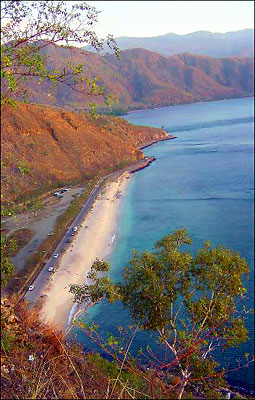
The view from the foho (mountain) toward Dili. This is the north side of the island; the interior is entirely mountainous, one of the reasons for the triumph of the resistance army over the invaders. (Mark Majalca)

You go somewhere, you want a connection. That’s why McDonald’s and Alcoholics Anonymous meetings are so popular in strange lands — an instant fellowship, a slow letting out of a frightened breath held. And yet for so long, in East Timor, there was no connection for me.

On Sundays — the only day I don’t work — I’d walk the five miles to the statue of Cristo Rei, past the lagoon filled with pig shit and the Portuguese soldiers drinking at Sagres Beach, and I’d say to myself, Keep breathing. Do what is familiar. Find what is familiar. What do you see?

I’d begin the list: Animals loose in the road. Kids staring at me. The oppressive heat hanging like a net. Potholes. Deteriorating stucco houses with peeling pale limestone paint. Lizards. Garbage. Shit. And still I did not feel I could connect this place with anywhere, or anyone, I had ever been.

Oh, sure, there were ghosts. I knew that. I knew they had to be everywhere. I’d run along the water’s edge before the United Nations workers woke up, miles of white broken coral glowing in the early morning light, and try not to imagine what I couldn’t help imagining — that the whole shore was nothing but a beach of bones.

I live at a place called the Hotel Turismo. It’s not very turismo really — all moss-covered stucco and stone — unlike most of the other hotels here, the Dili 2001, the Timor Lodge, that are made from cargo containers. Hotel life in East Timor is but a few years old. Big ships arrived one day and offloaded empty cargo containers. The containers filled the vacant craters in downtown Dili where colonial Portuguese mansions had been and became … the ministry of justice, the health department, embassies. And hotels.

The hotels are apartments really, because the U.N. civilian police and a zillion other do-good groups need housing for a year, two years. Others only stay a week or two. They’re contracted, on loan from the parent agency somewhere in Europe or San Francisco. Oxfam. Asia Foundation. World Bank. Commission on Truth and Reconciliation. Consultants. They stay at the hotel; we see them sometimes at the Turismo, and then one day — poof! — they’re gone. But the agency has rented the room permanently. The people are transient; the service, or the idea of the service, is not.
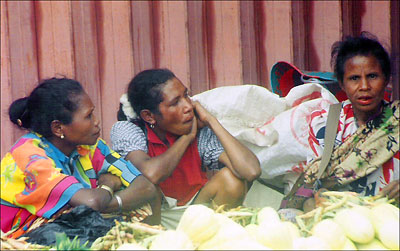
Market sellers in Maubisse, one of the larger cities. Maubisse means “iron man” in Tetun; the name comes from the mountain‘s supposed properties that give the people their extraordinary strength and fortitude.

The tiny island sags under the weight of its peacekeeping force. The white Land Rovers and troop carriers with the big black U.N. decals rumble by from dawn to dusk, making it impossible to run on the quiet white coral bone beach, impossible to feel you belong here, are loved here. You are hated here.

There are too many of us, each truck a different country. There is an Irish PKF, a Thai PKF, a Fijian PKF. The Fijians are the most respected. They go into the bush to find the thugs who are beginning to resurface on this side of the border. Groups of nine, they are drawn to their old homes, but they are bad, bad men in a land with no word for ‘bad.’

There are Portuguese and Brazilian and Japanese and Turkish and Malaysian and Pakistani and Korean and Chinese and Mozambiquan and Nigerian and British and Spanish and Russian and even Bosnian police. They have turned the capital city into a nightclub — a false cosmopolitan Mecca, and there are things in stores like Lipton instant rice mix and granola bars and Gatorade and condoms and Tampax and plastic shower organizers.

There are some old buildings standing, of course, but most have been ravaged and firebombed. First in 1975, when Portugal fell, losing its colony of 400 years, and the world gave tacit approval to Indonesia to take on the role of overlord, and then again, 24 years later, by the Indonesian army and those desperate Timorese they commandeered into destroying each other.

The colonial beauty of these public offices and private sprawling villas is made all the more delicate and majestic by the twisted girders where roofs had been, the haloes of soot where explosions burst through the windows. The best ones have been appropriated by those who finally drove Indonesia out or at least underground, and converted into living quarters for visiting dignitaries needing to be entertained, official representatives needing home-country amenities. The international community spends a hundred and twenty thousand dollars per house to showcase development organizations advocating for a free economy in which the living wage is three dollars a day. But who’s to say East Timor is any different from Kosovo, from Mozambique, from Angola and Darfur in that respect? Who’s to say that a peacekeeping force isn’t just an invading force that doesn’t kill you?

But what do I know?

Not much.

About anything, or anywhere.

Except about the Hotel Turismo, which is old and genteel in a crusty, decaying way, with gardens at its center and goldfish pools and narrow upper corridors leading to railings that drop off into the black unknown. It is a labyrinth of metal and dark vines and dripping ceramic spouts. Journalists stayed here in 1999, to monitor the elections. Most left soon after, when the killing started again.
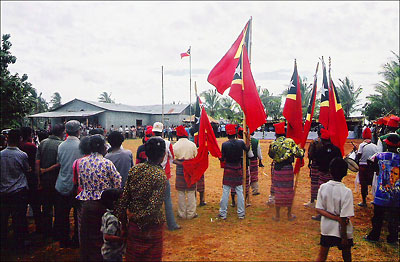
In 2003, the Prime Minister and his cabinet visited outlying villages to bring the “town meeting” to remote locales and give local leaders a chance to report on their communities’ needs. Due to the different languages spoken in the mountains, the results of this initiative were mixed. The East Timor flag symbolizes the mountains, blood, the sun, and peace.

In every documentary of that sad time, there’s footage of this hotel — famous now, really — with scattered gunfire sounding from next door. There’s no sleeping at night even now because the ghosts run down the tiled corridors trying to escape the bullets — over the fence and into the yard of another stucco former mansion, now called Timor Aid, where 2,000 people hid after the referendum in 1999, when the United Nations said it was pulling out since there was nothing else to accomplish.

The entire country — people, animals, coral reefs, bridges — was threatened with annihilation by Jakarta if it voted for independence. Independence was on the table because the Timorese Falantil resistance had smuggled out a bookish, gawky young soldier who’d landed in New York, picked up English and a cheap suit, and for 24 years hounded the United Nations until it listened. On that day in that tiny country in 1999, over 90 percent of the voting population climbed down out of the foho, the mountains, and into the cities and voted almost to a person for independence, marking X’s on ballots and knowing they would be killed for it. The films of that September show ancient men and women behind the wall of Timor Aid, grabbing at the knees of U.N. election officials, begging them to stay. Some did. But most did not. And the Timorese were slaughtered.

I am here in East Timor three years later and I dread making a friend, even if it were possible. After all, how do you get past the part where you say, “I’m so sorry,” and you need to say that to everyone, every day, because you know that 80 percent of everybody’s family died three years ago? You’re here as a “development professional” and you are trying to “help” and your assistant or driver or interpreter is Timorese, and how stupid is it to ask every morning, “So, how are you today?”

The East Timorese do not have a phrase in Tetun for ‘How are you?’ They also do not much go in for ‘I hope,’ as in “I hope to see you soon.” They do not say, “I believe.” They do not say, “Good luck.” Rather, they say, “Okay, or not?” They say, “I might see you soon.”  They say, “I feel.”  They say, “Fight.”

Every day here, I feel like more and more of an asshole.

There’s no word for that either. Surprisingly.

And there’s no word for ‘bad,’ as in “bad person.”  A bad thing can happen but no man or woman is bad.

I cry a lot here.

How are you today?

Okay, or not?
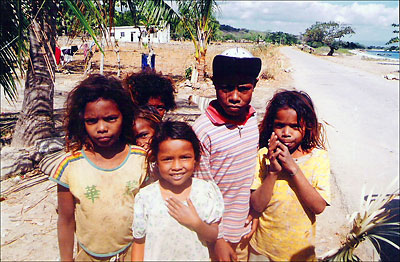
A salt seller’s kids on the road to Metinaro, about two hours east of Dili.

Two streets up and over, at the Tropical Hotel, the ghosts are worse. That’s one of the places where the pro-integration forces carried out their torture. One of the places.  And Tasi Tolu, Three Lakes, a level park outside of Dili where the Pope visited in 1989, and anti-occupation banners were pulled out from under shirts to show the international cameramen. Later, as a warning, the Indonesian militia mowed down 200 people, then threw their bodies in the shallow lakes. More ghosts.

Santa Cruz, the massacre at the walled cemetery in 1991. 250 people killed at a memorial service for a pro-independence fighter. For honoring the dead. My young interpreter Luis tells me, as casually as he can but looking away, and so quietly I can hardly hear, “I slept with a corpse once. My cousin. He was in Santa Cruz that day. My mother told me not to leave him until the family could come for him. So I didn’t leave him.”  

No connections to anything. I just wander and cry, and try to do some of the things for which I was hired.  

I was hired to train Peace Corps volunteers. My first job is to find families outside of Dili, the capital, for the volunteers to stay with. The villagers are shy and warm and have no idea why foreigners would like to stay with them. The Timorese do have a word for ‘foreigner.’ It is Malae, after the Malaysians who were the first foreigners here years ago: successful, pushy, relentless. Now, a Timorese who makes any money at all is called Malae.  

My village families have three-room houses and live 14 to a house, no latrine. So I’m building latrines. I go around with a Toyota Hilux 4×4 and Luis — he’s an ex-priest who helped refugees get back across the border from Dutch-occupied West Timor in 1999 — and ask families if we can build latrines for the Malae who will stay with them. They smile and say, “Sure, go ahead. We’ll even dig the hole.”

They think I am insane.

I find a nonprofit — CARE — that is teaching people how to build latrines and seek out the director.

“Where do they go now, if there are no latrines?” I ask, having looked in the dirt backyards, the undergrowth, the beachfronts, expecting to see shit stretching to the horizon.

“The pig shed,” says the director. He’s from India and he smiles. He loves that he gets to tell me, “The pigs have to eat, too.”

Nothing familiar.

And then one day my past catches up with this place.  

When I was younger, I hung around Manhattan, where my sister lived, because I missed her and because I was fascinated by the Beat poets, even though most of them were gone by then. But you could feel their ghosts all over town, and they got in my way back then, living 30 years behind me when anything seemed possible. Maryan and I still saw Allen Ginsberg from time to time. She lived on MacDougal Street, and he was still there, still real, when nearly all the others were dead.  

I read everything they wrote — the poems, the half-finished scripts, the love letters, the drunken musings on cocktail napkins now preserved in Special Collections at libraries with climate-controlled vaults — until I felt I was one of them. I knew that if only the time were right and the planets aligned, I could walk down Minetta Lane — their old back-from-the-clubs shortcut and the street between my sister’s apartment and Bleecker Street — and I’d see Jack Kerouac’s ghost. And I’d be given the sign, the signal, that I had a right to be here, that they knew me, that they would not begrudge me this space at least, this tiny piece of asphalt, this glimpse of grace.

Every chance I got I’d walk down skinny Minetta Lane and check it up and down, for Jack or Neil, or maybe Jackson or Joyce or Bill or Diane, skittering up, smoking and drunk and loud, oblivious to me, to the overhanging yards perched on the tall walls lining the alley, to the hour, to who they were and what they might mean or represent. I looked for them every time. I strained to hear their voices, weaving and tiptoeing up Minetta Lane in fading night and next day dawning. Because this is what I thought in those days: that when ghosts got to be ghosts, they somehow made peace with the world. What did I know then about ghosts? About peace?  

So I was sure I would see them — that it had to happen. But something else happened instead. How long ago was it? 1986, maybe? Earlier? I was, what, 25?

I was padding down Minetta Lane, though it was barely dawn … when I saw my ghost walking towards me in the light of the antique lamps that line the lane. He wasn’t on the sidewalk but angling toward it, a little unsteady and deliberate, a little drunk maybe, and I felt no fear, because it was time, dammit, for someone to be one of them, for this real shadow to give me something. As he came closer, I saw he had on a sport coat, not too fashionable, and dark pants, and in the shadowy folds of his jacket was more darkness and I thought as I stared that I could see a soft, dark heart.

His hair, still in silhouette, was kind of too much, too wild — I could see it frizzy and curly in the lamplight and I didn’t want to see his face. A dark, dark face — no, it was a beard — dark eyes, shadows covering who this ghost was, so he could become whoever I needed him to be. He cocked his head towards me — he had seen me walking, seen me slow down, somehow knew I wasn’t frightened and that I wanted to prolong the moment — and he stopped, just a second, a half-second, to sniff, it seemed. He sniffed the air around him, we were four feet from each other. He saw me smiling, he smiled back, he had a beautiful smile, he looked nothing like Jack or Neal or Alan. He looked mostly like what I thought he was — a half-drunk businessman on his way home up Minetta Lane, stopping just that half-second, a past instinct, of danger long gone — a jerk of his head my way with an eyebrow up to see if he recognized me, an amused look when he didn’t.

“I thought you might be Jack Kerouac,” I said.

“Jack . . . who is that?” His voice low, with a catch in it, as if he hadn’t spoken in a while. Three words and I knew he came from far away. He’s no one, I said to myself. It’s alright, he’s no one.

“It’s okay,” I said. “He’s just a dead writer. I thought you might be him.” In a sport coat badly cut and shiny with age. A black shirt underneath, looking impossibly soft. Hands in pockets, a halo of yellow streetlight.

As we nearly crossed each other, he said, “I was, well, I didn’t know. Who you might be. But now I see you. That’s better.”

And he grinned again. He didn’t seem that drunk now. Maybe a little. And so, a little afraid of getting rolled. Because I’m a big girl, with big arms, out alone in the alley, so who knows what he thought.

“Don’t worry,” I said.

“All right,” he said.

Oh, clever, clever me. I thought they all loved me, even the ghosts.

And like other memories before, it buried itself, like a little shore animal until years later. Out of desperation to know something, anything, about this new, sad place I am living in, I go to a USAID worker’s house, a woman with a collection of documentaries about East Timor, the war, the occupation. Some in Tetun, some in Bahasa, a few in English. And she is showing a film called Scenes from an Occupation, and there is the government building in Dili, and there is Hotel Turismo, and there is his face, the face of my past on Minetta Lane, the jaunty ghost.

He has won a Nobel Prize for his country. His name is José Ramos Horta, the foreign minister. He was the young soldier sent to New York to convince the United Nations to recognize that East Timor was filled with brave, proud people who would give their lives for independence. In the film, he is in his bowtie and sport jacket clomping around the United Nations, around SoHo, and years earlier, on the waterfront street of Dili by the port, leaning against a truck dressed in fatigues, in a halo of gunfire smoke and with a voice like gravel thrown against plate glass. And I wonder, Did I need to see this to believe that it was all right for me to be here?

And sooner or later, because the world is so small, so tiny, really, I know I will have to see him again, and he will not recognize me, and I will have to let that be okay, because we did not figure into each other’s lives. He was a ghost of someone I did not know, and I was some brief apparition, some trick of the streetlight, that he had to be careful of back then, and forget, and keep going.

May 2002


Story-bound

Memories sustain — and muddle — the fight for Palestine in Elias Khoury’s Gate of the Sun.

Arak is a clear, aniseed-flavored liquor consumed throughout the Middle East that drinkers typically dilute with water to create a cloudy white concoction. In Gate of the Sun, the 11th novel by Lebanese novelist and critic Elias Khoury, meals are often accompanied by a glass — or three — of arak, and the author manages the same alchemical transformation with his book, pouring one story into another to create a murky, rambling account of Palestinian villagers living in exile.

Eight years after it appeared in Arabic, Khoury’s tome, in Humphrey Davies’ English translation, is a cavernous monologue of more than 500 pages. Khalil, our narrator, tells the story of the Palestinian people since the Nakba, or “disaster,” as they refer to the founding of the state of Israel, through a disjointed stream of consciousness, waxing philosophic at each twist of his conflicting memories. One moment, he recalls figures of the resistance, big and small, in anecdotal digressions that take the reader through painfully vivid background. In another, he delves into the minutiae of a Palestinian family’s escape to the Lebanese border, citing each village through which they passed. Roughly 80 percent of the Palestinian population left Israel during al-Nakba (though exactly how many were forced to flee and how many left voluntarily remains a sensitive question), and the event has had a profound effect on Palestinian identity, most visibly in the demand for the Right of Return, one of the main tenets of the Hamas platform, and a non-starter in Arab-Israeli negotiations for more than 50 years. The overall effect of Khalil’s meandering yarns is a story more interesting and important for its view onto the Palestinian experience than it is consistently enjoyable to read.

Khalil is a peasant doctor in the Shatila refugee camp outside Beirut, site of a 1982 massacre perpetrated by Lebanese Maronite Christian militias for which Ariel Sharon, among others, was later found indirectly responsible. He has sequestered himself in a dilapidated hospital with his old comrade, Yunes, who lies unconscious and dying. There Khalil reminisces ad infinitum in a one-sided discussion. In his unorthodox medical opinion, storytelling can sustain and even resuscitate Yunes where conventional medicine has failed. It has kept the Palestinian struggle alive, though Khalil points out that the videotape has come to replace the storyteller. “We sit in front of the small screen and see small spots, distorted pictures and close-ups, and from these we invent the country we desire,” he says. “We invent our life through pictures.”

Khalil’s story bounds back and forth over the last 60 years, threading vignettes together in an attempt to capture the Palestinian experience as lived and remembered by the people themselves. He was born in a village in Galilee but grew up in refugee camps in Lebanon. The physical and psychological wounds inflicted by the Nakba feed Khalil much of his material. He populates his narrative with mothers, grandmothers, husbands, sons, and fighters — all attempting to live a life on hold. They cannot return to their homes in Israeli territory, and the Lebanese won’t grant them work permits (a policy guided by the quixotic belief that the Palestinians would soon be able to return home, turning them into permanent refugees).

The tales begin with the death of Umm Hassan, a childless midwife in the Shatila refugee camp. From there it roams through the Palestinian resistance under the British mandate in the 1930s to the forced evacuations of Palestinian villages after the founding of Israel in 1948, to French actors looking for inspiration in their production of Jean Genet’s Quatre heures à Chatila, but always returning to the women in their lives. Khalil is fascinated by the story of Yunes and his wife Nahilah, who met only in secret over the decades of their marriage because he was wanted by the Israelis as a “saboteur.” Again and again, Yunes would sneak to his wife’s village in Israel over the mountainous border from Lebanon. They would meet in Bab al-Shams (Arabic for “Gate of the Sun”) to make love and talk of the resistance. The Israelis, who are trying to capture Yunes, harass Nahilah. She resists in the only way she can, insisting that she is pregnant because she is a whore rather giving up her husband. Khalil retells these stories to the comatose Yunes while contemplating his own tragic affair with a sensuous, iconoclastic woman who murdered her husband but suffered his family’s ultimate revenge.

The power of these stories lies in their mixture of tragic hardships with Khalil’s frank criticism of himself, the Palestinians, and the feeble attempts by Arab armies to repel the onslaught of the Israeli army in 1948. Each is revealed in the spiraling, sometimes confusing patterns of oral storytelling. And in retelling the stories of other refugees Khalil weaves his own life into the patchwork fabric of the Palestinian refugee experience, replete with worn threads, holes, and loose endings.

The literary model for Khoury’s work may be 1,001 Arabian Nights, but whereas Scheherazade told her stories in order to escape her own death at the hands of her listener, Khalil regales Yunes in order to keep him alive. “I’m trying to rouse you with my stories because I’m certain that the soul can, if it wants, wake a sleeping body.” He keeps Yunes alive because he’s not sure what would become of him without his fallen comrade, a hero of the Palestinian resistance. Yunes’ coma gives Khalil an excuse to wallow in a state of suspended animation, of permanent reminiscence. “If you die, what will become of me?” he asks.

To recreate the Palestinian experience in the Galilee and Lebanon — thus far told to the outside world almost entirely by Israeli historians — Khoury purportedly conducted extensive archival research and interviews at the refugee camps outside Beirut. While those same Israeli historians have disputed some of his accounts, Khoury’s narrator admits his claims of atrocities and hardships are unsound. Khalil is retelling second- and third-hand stories that he might not believe in the first place. They aren’t necessarily fictional, but the same story often has multiple variations depending upon the teller. It is in the accumulation of these tales, full of contradictions and half-truths as much as shocking accounts of injustices and injuries, that Khoury/Khalil builds his Palestinian epic. “Like all prisoners, I live on memories. Prison is a storytelling school: Here we can go wherever we want, twist our memory however we please. Right now, I’m playing with your memory and mine.”

Gate of the Sun takes on the individual stories of refugees who cling to hopes of returning to their villages that have become Israeli suburbs. But more enlightening are the issues of memory, identity, truth, and how the storytelling process itself affects all of these issues. The end result is profound and haunting (the description of “sun baths,” a torture tactic used by Israeli soldiers, is horrifying), but it also feels slightly hollow. The reader is left with an impression of little more than a permanent state of suffering among the Palestinians. Lamentation is rarely balanced with stories of humor, of life lived in between the tragedies and the disappointments.

But in his nuanced description of the Arab-Israeli conflict, Khoury is able to escape political rhetoric and touch on the truths so often left out of the headlines. “Palestine was the cities — Haifa, Jaffa, Jerusalem, and Acre. In them we could feel something called Palestine. The villages were like all villages. It was the cities that fell quickly, and we discovered that we didn’t know where we were. The truth is that those who occupied Palestine made us discover the country as we were losing it.”


The buzz about the bee

For the first time in its 79-year history, the final rounds of the Scripps National Spelling Bee were televised live during primetime on ABC television.  What does this say either about our culture or about the state of network television?  Let me spell it out.

It took two hours and ten minutes of primetime to deliver a champion, Katherine “Kerry” Close of Spring Lake, New Jersey, and I must admit that even though the broadcast followed a typical live sports script, it was compelling television that included kids with unique and quirky personalities and a building tension as one by one each contestant is eliminated.  It is obvious that the success of American Idol, which follows a similar format, made the powers-at-be at ABC/Disney look at the Bee as a possible primetime special.  The event’s second day has been televised on sister cable station ESPN since 1994, so it was an easy change to move the finals to the bigger stage.  As reality TV becomes part of our culture’s zeitgeist and these types of programs remain cheap to produce, the big broadcast networks will gravitate to them as their share of audience declines — the bottom line comes first.

But even if the bee was given a green light because of business reasons it is still deserving of its prime network spot, and after 79 years has become a competitive institution embedded in American culture, not unlike the Westminster Dog Show or the Kentucky Derby.  Thursday evening’s competition delivered all the essential elements needed in a top television show, including a sports-like image when the finalists spontaneously gathered in a huddle and chanted “One-two-three-spell!”  (It should be noted that the previous moment happened during a commercial break and had to be recreated by the kids for the live feed.)  

It’s my contention that if the bee ran for a whole season, audience members would most likely become attached to both the format and the contestants, just like they have with other reality-based shows.  I wouldn’t be surprised if next year you see a show called American Speller or even Celebrity Speller, where each week a different has-been celebrity is eliminated after trying to spell a series of odd words, most likely with a sexual connotation.  The only problem is trying to find how to incorporate the viewing audience — the key to Idol’s giant success.

The live show on ABC was hosted by Good Morning America’s Robin Roberts, with accompanying analysis by former bee finalist (1990) Paul A. Loeffler and sideline interviews from ABC News correspondent Chris Connelly. What I liked about ABC’s coverage was that it wasn’t too exploitative and kept mainly to the live drama, only peppering with Wide World of Sports-type, up-close-and-personal segments that took viewers to some of the finalists’ hometowns to find out just how they became spellaholics.  These well-edited mini-bios were just the right length to show not only how dedicated and studious these kids really are, but also the nuances of their personalities that drive them to compete.  One 13-year-old home-schooled boy from Scottsdale, Arizona, Jonathan Horton, even purported that if he spent the same amount of time at practicing basketball as he did studying words, he could be as good as Steve Nash or Michael Jordan.  With attitudes like that, these kids will no doubt succeed in whatever avenue they choose (except in Mr. Horton’s case, I hope he stays off the court).

Champion Kerry Close may not become a household name like American Idol Taylor Hicks, but at least her win doesn’t lock her into a multi-year spelling contract.  She’ll return to her schooling, though she says she may come back next year and try for back-to-back wins, never before accomplished at the bee.

Now that spelling bees have become popular (as subjects of movies, Broadway musicals, and documentaries), I hope that ABC continues to run the finals of the bee in primetime and keeps it as an annual event without exploiting the concept and turning it into something more than it is — a simple spelling contest.  It is nice to see something on television where kids can see other kids working hard and achieving greatness.  So much of television is filled with shallowness, violence, and a perception of kids as either little adults — participating in activities beyond their age — or as shiny, assembly-line boys and girls who seem to be manufactured in some warehouse in the San Fernando Valley (see Disney Channel).  If you missed Thursday night’s broadcast but want a glimpse into the world of spelling bees, you can always go see the new film Akeelah and the Bee, still in some theaters, or rent the compelling Oscar-nominated documentary Spellbound or Bee Season, starring Richard Gere and out on DVD. Also, there’s the touring company of the two-time Tony award-winning Broadway musical The 25th Annual Putnam County Spelling Bee.  All I know is I couldn’t spell most of the words given to the contestants during the finals, so I hope they are given the respect and awe we give to star athletes who, as a culture, we worship everyday.  If the ratings prove right, The Scripps National Spelling Bee will truly be a revenge of the nerds.

Rich Burlingham


Why do they hate us?

I am not surprised by what happened in Haditha because Americans are terrorists and killers. And this is the way of life now. I don’t care if they punish the American soldiers because they cannot bring ba…

I am not surprised by what happened in Haditha because Americans are terrorists and killers. And this is the way of life now. I don’t care if they punish the American soldiers because they cannot bring back the lives of the dead.

—Baghdad sandwich vendor Murthada Abdel Rashid, 29, when asked for reaction to the alleged murder of Iraqi civilians by U.S. Marines in the northwestern town of Haditha last fall. According to news reports, U.S. military investigators have found that as many as 24 civilians, including women and children, were shot in retaliation for the death of a Marine lance corporal, and not killed in a roadside bomb blast or crossfire as the military previously said.

Victor Tan Chen

Victor Tan Chen is In The Fray's editor in chief and the author of Cut Loose: Jobless and Hopeless in an Unfair Economy. Site: victortanchen.com | Facebook | Twitter: @victortanchen


Blogging from the big house

Here’s your occasional dose of inspiring news: Alaa Abdel-Fattah, an Egyptian pro-democracy activist who was arrested in early…

Here’s your occasional dose of inspiring news: Alaa Abdel-Fattah, an Egyptian pro-democracy activist who was arrested in early May, is continuing to blog from prison — somehow getting slips of paper with his scribbled posts past his jailers and into the safe havens of cyberspace. He and his wife Manal Hassan run a popular blog that has become a beacon within Egypt’s political reform movement, and a thorn in the side of President Hosni Mubarak’s authoritarian regime. You can read the blog here (it includes articles in English).

Victor Tan Chen

Victor Tan Chen is In The Fray's editor in chief and the author of Cut Loose: Jobless and Hopeless in an Unfair Economy. Site: victortanchen.com | Facebook | Twitter: @victortanchen


Gay in Moscow

In our country, homosexuality and lesbianism have always been considered sexual perversions, and were even prosecuted in the past. Currently, the stated actions are not prohibited by law… but their agitation, including gay festivals and a parade of sexual minorities, is in fact propaganda of immorality, which may be prohibited by law.

—Moscow Deputy Mayor Lyudmila Shevtsova, banning Moscow’s first gay rights march, which was planned for May 27, the 13th anniversary of the decriminalization of homosexuality in Russia. Officials banned the rally on the grounds that it would incite violence.  The rally, nevertheless, went ahead, during which scores of protesters — including gay rights activists as well as nationalists and members of religious groups who condemned the march  — were arrested.

Mimi Hanaoka


Still looking for the Right Thing

I just watched Do the Right Thing, Spike Lee’s masterpiece, for the second time (my wife is doing an interview with Rosie P…

I just watched Do the Right Thing, Spike Lee’s masterpiece, for the second time (my wife is doing an interview with Rosie Perez, so this was technically “research”). I had first seen it maybe 10 years ago, and I remember being annoyed at the time about how the only Asian characters, the Korean American grocers, speak painfully pidgin English and come across as money-grubbing jerks. This time, however, it didn’t bother me so much. The portrayal is less than flattering, but that goes for all the characters in the film — from Sal the pizzeria owner to Radio Raheem the Public Enemy fan. The truth is, men and women like this exist in real life.

I agree with Roger Ebert, who points out that the brilliant achievement of Lee’s film is that there are no clear-cut heroes or villains. Every one of his characters is depicted sympathetically at some point in the film. Every character is also shown to be capable of vicious hate and racism. For Sonny the grocer, both come at once, at the incendiary climax of the film. Waving his broom violently to keep the crowd from his store, Sonny insists, “Me no white! Me black!” It’s a hopelessly naïve remark that shows how little Sonny knows about his African American customers, but also reminds us (and the crowd, which gives up on burning down his store) that he — a downtrodden immigrant struggling to survive — is also worthy of our empathy.

On this second viewing, it made perfect sense to me that Mookie (Spike Lee’s character) throws the trash can through the window of Sal’s pizzeria at the end of the film. Mookie is the character we most empathize with in the film, and someone we expect to “do the right thing.” His actions show the very human anger he feels at the death of a friend. They also remind us how all of us — even an intelligent, thoughtful man like Mookie — add our portions to this boiling pot of racial rage in America. No one is blameless in Lee’s film, and no one comes out unscathed. Just like in real life.

It’s sad but true that so many years after Lee’s film, the racial incident that inspired Do the Right Thing — the 1986 assault of three African American men by local teenagers in Howard Beach, New York — was replicated last year in the very same neighborhood. (The trial started this week.)

Victor Tan Chen

Victor Tan Chen is In The Fray's editor in chief and the author of Cut Loose: Jobless and Hopeless in an Unfair Economy. Site: victortanchen.com | Facebook | Twitter: @victortanchen


United 93 helps us not forget

It’s been in theaters for a few weeks, but I thought the first dramatic film to take on the daunting task of grappling with what happened on September 11th, 2001, United 93, warranted a critique because I believe it is a film everyone should see and not forget.  For those few of you who may be unfamiliar with what happened that day, the film focuses on the doomed airliner scheduled to fly to San Francisco from Newark that was highjacked by al-Qaeda operatives who intended to run it into the United States Capitol Building in Washington, D.C.  If not for the heroic interference by the passengers aboard, who took it upon themselves to try to take back control of the plane, the highjackers probably would have achieved their objective.

The film is superbly written and directed by Paul Greengrass (Bloody Sunday & The Bourne Supremacy), who skillfully employs both unknown actors and the actual people involved playing themselves.  Even with the film taking a dramatic turn, as opposed to the docu-drama that appeared on cable a few months back, United 93 doesn’t glorify or over-dramatize any of the events that day, unlike a typical action movie such as Air Force One, to use a film with a somewhat similar plot.  For the viewer, the knowledge that what appears on screen actually happened is enough drama for one sitting. Greengrass uses a simple visual style and pacing to follow the events of that day without tricks or creative storytelling techniques.  He begins with the highjackers preparing for their day and other passengers arriving at the airport and going through security. Watching the security check now gives one chills as we witness the ease with which the Muslim operatives get the necessary equipment to overtake the airplane without a hitch.

Greengrass is also quite adept at introducing all of the characters, from the highjackers to the passengers to the air traffic controllers, with efficiency and is able to highlight a few players with just enough small bits of human interest to make them three-dimensional figures, such as the co-pilot’s description of his family.  The best-drawn character happens to be one played by himself, Ben Sliney, the National Operations Manager who fatefully experienced his first day on the job in a rather dismal baptism.  Many others also played themselves, such as several Air Force personnel, and each were more than adequate.  Sliney comes across as the only human on Earth who took the responsibility upon himself to try to keep the country safe and secure and cursed the military for not being more proactive.  He was also the first to figure out that the first plane to hit the first World Trade Center tower was not a small plane as initially reported by CNN but one the size of an airliner.  His order to shut down the air transportation system over the U.S. was both gutsy and heroic.  

I have to admit that I got pretty emotional watching the film, especially as the passengers on board call their loved ones to wish them goodbye.  I was living in Manhattan that day, and I was as stunned as anyone watching the second plane hit the second tower and even more horrified when the towers collapsed.  The strongest memories for me were in the weeks that followed when the posters and signs with pictures of the missing hung on practically every light pole in the city and by memorials set up in gathering places like Union Square or the streets adjacent to Ground Zero with more candles and flowers than I’ve ever seen anywhere before or since.

United 93 only depicts the particulars of one of the four planes to wreak havoc that day.  Of course, we’ll never really know what actually occurred or the thoughts that went through the minds of passengers, crew, and highjackers, but as a piece of visual history, this film is so craftily made that it should be considered one of the pieces of entertainment regarding the events of 9/11 that acts as an official remembrance.  I’m not sure how much Oliver Stone’s World Trade Center or any of the others now being prepared for release will be a cathartic experience, but I know the experience of sitting in a dark theater watching United 93 will stay with you forever.  In the end, the film will wind up doing two things: help release the pent-up anger, fear, and despair that still lingers even after almost five years and act as a vivid reminder of what happened that day for those who may soon forget.  In order to keep the same violent acts from happening again on our soil, we must all be aware that those who died on September 11th, 2001 are not only heroes but also bookmarks to remind us to turn back the pages of history and reread a grievous and sobering chapter in the history of our great country.

United 93 is still being shown in select theaters.  Running time: 111 minutes. Released through Universal Pictures.  Rated R and may not be appropriate for kids under thirteen, but if they can stand the troubling nature of the film, it may do them a lot of good in the long run (if accompanied by an appropriate adult).  For everyone else, it’s a must-see.

Rich Burlingham

personal stories. global issues.
