No Easy Walk

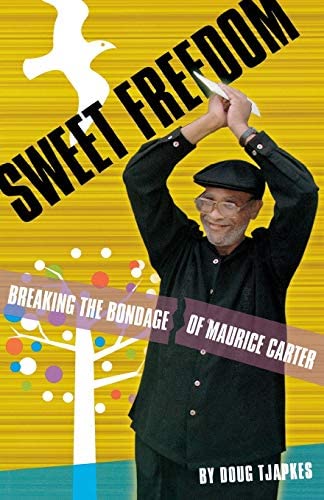
In Sweet Freedom, Doug Tjapkes recalls the long, faith-filled journey to overturn Maurice Carter’s wrongful conviction.

On December 20, 1973, off-duty police officer Tom Schadler was shot and injured at the Harbor Wig and Record Shop in Benton Harbor, Michigan. In a hotel room a block away, Maurice Carter, was just waking up. The unassuming and soft-spoken Carter was a high school dropout, down-on-his-luck and scouting the neighborhood in an attempt to relocate from the rough streets of his native Gary, Indiana. Local police picked him up as he exited the hotel and asked him to walk past the Harbor Wig and Record Shop’s front window, where Gwen Jones, an employee who had witnessed the shooting, declared that the light-skinned Carter did not resemble the darker-skinned perpetrator in size, shape or color—and he was released.

But the case remained embarrassingly unsolved, and Carter was arrested in 1975 after a friend perjured himself, fingering Carter as the culprit of the 1973 shooting in an attempt to escape drug charges. In spite of a dearth of physical evidence and flimsy testimony, the all-white jury sentenced Carter to life on a charge of “assault with intent to murder a police officer.” For two decades, he languished in prison—until retired broadcast journalist Doug Tjapkes walked into his life in 1992. In Sweet Freedom: Breaking the Bondage of Maurice Carter, Tjapkes recounts the painstaking fight to clear Carter’s name and bring to justice the true culprit, as well as the unlikely friendship that developed between activist and prisoner as their lengthy battle unfolded. “No arrest was made for two years, which was not a good thing in a racially troubled area where a black man had shot and injured a white cop,” says Tjapkes, who was introduced to Carter through Floyd Caldwell, another wrongfully convicted prisoner. “This case needed closure.”

Continue reading No Easy Walk


A matter of perspective

issue banner

As temperatures rise and the mosquitoes bite, it can be difficult to tell the sunshine from the heat. In this month’s issue of InTheFray, we put things in perspective.

We begin on U.S. soil, where Rachelle Nones, in her review of journalist Doug Tjapkes’ book Sweet Freedom, sheds light on the racial biases inherent in our justice system. And Caroline Cummins spends an evening with This American Life host Ira Glass, only to discover the rock star-like commentator hasn’t yet figured out how to handle a live audience.

We then turn our sights overseas, where James Mutti learns just how normal India can be after a rickshaw driver asks him to explain why foreigners are always so rude to Indians.

We conclude this month’s journey in Rwanda, where Melanie Wallentine discovers that the courage required of a marathon runner in pain is nothing compared to that expected of the rebuilding nation’s citizens each day.

Thanks for reading!

Laura Nathan
Editor
Buffalo, New York


The colonialist railway

China plans to use the railway to transport Chinese migrants directly into the heart of Tibet in order to overwhelm the Tibetan population and tighten its stranglehold over our people…. (The railway is) engineered to destroy the very fabric of Tibetan identity.

Lhadon Tethong, a Tibetan living in exile, decrying China’s new Qinghai-Tibet railway as an opportunistic colonialist ploy. The railway runs from the Chinese capital of Beijing to the traditional Tibetan capital of Lhasa for 4,000 kilometers, the final 1,110 kilometers of which links what was until July 3rd the final frontier of the Chinese rail system to the Qinghai-Tibet railway and into Lhasa. The final 1,110-kilometer segment of the railway takes passengers through the ether of Tanggula Pass, which stands at 5,072 meters (16,640 feet) and makes the railway the world’s highest, complete with oxygen tubes and controlled oxygen levels, windows with UV filters to deflect the sun, and a budget of $4.2 billion to build.

While China touts the railway as a lifeline that will bring opportunities and accessibility to the region, some Tibetans condemn the project as an attempt to import ethnic Han Chinese immigrants into the region to further obliterate the Tibetan culture.  The Dalai Lama, the spiritual leader of the Tibetan community, has been living in exile in India since 1959, nine years after the People’s Liberation Army marched into Tibet to occupy the nation in 1950.

Mimi Hanaoka


Telling tales about India

Beyond poverty and spirituality, a student reveals the hidden side of India.

The Saturday market along the main road through tiny Fatehpur Sikri brings the whole town out in search of clothes, toys, supplies for the home, and more.

On the January night when I flew into Delhi, my ride didn’t show up at the airport. I flagged  down a cabbie who tried to get me as drunk as he was, and who tried to get me to switch accommodations to his choice of hotels. My arrival in Delhi was pretty typical — the stuff of many a travel story set in India. In the end, it wasn’t the nightmare it could have been.

My driver was an eager conversationalist despite his slurred, broken English. After assuring him repeatedly that I did not want a swig of the whiskey he’d received from a German tourist, and that I did not want to go to a different hotel, he went out of his way to find the correct address amidst the narrow lanes of Delhi’s Paharganj neighborhood. We parted cordially outside my hotel, wishing each other a happy new year. The experience typified what I both love and hate about India — the often threatening unfamiliarity and superficial chaos of the place; that friendliness could be either genuine or concocted to take advantage of me, a gullible foreigner; the allure of new sights, sounds, and smells; the joy that is often found once the inconveniences are overcome.

This was my third visit to India. My first trip had been thirteen years earlier, when I visited Chennai with my family. While Mom and Dad handled the travel arrangements, that brief trip whetted my appetite for all things Indian. After growing up in Washington, D.C. and small Wyoming and Iowa towns, it was my very first trip abroad. Without a doubt, it left a lasting impression. My next trip was five years later, as part of a semester-long college Buddhist Studies program. We spent the duration of our stay in the small town of Bodh Gaya in the northeastern state of Bihar. There, I was able to experience India on a deeper level than many travelers are afforded, although I was still granted the security of belonging to a large group of students and professors.

I could tell that this third trip was going to be different. Graduate school had offered two years of intensive reading, writing, and researching. In pursuit of my M.A. in South Asian Studies, I debated and discussed Indian history, contemporary politics, media, religious beliefs, social movements, literature, and cultural practices. After three years of Hindi language classes and dozens of Bollywood movies, I had set off to India as someone who no longer a tourist. I was newly aware of the preconceptions and ignorance I had carried with me on my earlier trips, and I was finally ready to see a new side of India.

I would also be on my own in a country viewed with awe and wariness even by seasoned globetrotters. Prior to my arrival in India, I had been visiting my brother in Vietnam. On a touristy boat ride in Ha Long Bay, a middle-aged American man who had lived for extended periods in the Philippines, Thailand, and Vietnam commented, “I’ve always wanted to go to India, but it seems like it would be so hard!” A Canadian couple told me, “We’d like to do some traveling in other places before we go to India.” A twenty-something Australian woman, halfway through a year of solo traveling, said she was impressed that I would be going to India on my own.

Having been there before, however, I felt I knew what to anticipate. I had even half-expected to be stood up at Delhi airport, but I still didn’t like it.

It was a warm winter day in Nawalgarh, Rajasthan. On a narrow side street, a group of boys played marbles. When I was asked to join them, I couldn’t say no.

The unfamiliar and the familiar

Every traveler to India has an “India-is-so-crazy” story (“There were people riding on top of the train!”). Just as many have an “India-is-so-enlightening” story (“Their way of life is so spiritual and real!”). There are numerous “India-is-so-poor” stories (“Begging children followed me for 20 minutes!”), and “Indian-culture-is-so-old” stories (“The temple is the same as it was a 1,000 years ago!”). Learning about India showed me the flaws and limitations of accepted Western understandings of this country. Perhaps it is no different than China, Russia, Brazil, Nigeria or any other country with a complex, vast or long-lived civilization. Even so, India stands apart in my mind.

I imagine our knowledge of India has not changed much since the days of European colonialism. The idea that the country is somehow timeless has created equally timeless stereotypes. India calls to mind images of poverty, exotic wild animals, destructive natural disasters, kings and extravagant palaces, religious fanatics, oppressed women, idyllic rural farm life, the horrifying slums of its megalopolises, and superstitious, uneducated masses trapped by the caste system. The failure of the Western imagination to evolve in this regard has resulted in the all-too-common tendency of travelers and writers to present an India that is exotic and alien. At the same time, it is easy to see why countless negative stereotypes of India persist in the Western mind. After all, stereotypes are inherently simplistic and superficial. In general, these things do characterize most foreigners’ experiences there, mine included.

As I dutifully traveled between the major tourist destinations described in my guidebook — Delhi to Rishikesh to Nainital to Agra to Jaipur — it was difficult to see the deeper aspects of Indian society. Instead, the glaring differences between Indian life and U.S. culture jumped out at me. In India, there were cows and monkeys and piles of garbage on the streets. I was regularly surrounded by noisy crowds unused to the concept of personal space. Shops, cars, trains, temples, and homes often appeared to be in disrepair. Temples and mosques and their openly religious followers were everywhere. Tenacious rickshaw wallahs, shop owners, and begging children confronted me every day.

Even after my previous visits and all my studying, and despite my love for the country, it was hard to feel fully at ease. I was acutely aware that my white face and red cheeks, brown hair, and blue eyes made me stand out in a sea of brown skin and black hair. I knew that I was ridiculously privileged, and that no matter what I did it would be impossible to see “the real India” — that tantalizing myth of the extreme travelogue. Street kids called me tomater, Hindi for tomato. I was cursed out for the United States’ treatment of Cuba. I was forever being overcharged for anything I bought. Sometimes I thought I might be better off ignorant of India’s history, languages, politics, cultural beliefs, and religious practices. My knowledge did not prevent me from enjoying myself, but it did make me realize that seeing India through the filter of stereotypes provides some comfort and assurance about the world, and one’s place in the world, that I was sorely missing.

New ways of seeing

A conversation with an amiable rickshaw driver towards the end of my trip proved to be a wake-up call. I was walking through the fabled Pink City of Jaipur in the northwestern state of Rajasthan, in search of lunch on a sunny and pleasantly warm day. Outside the magnificent City Palace, standing by his black and yellow rickshaw, was a stocky young man wearing a dark green button-down shirt. He watched me approach and we made eye contact.

“Excuse me,” he said in English. “Maybe you can tell me. Why are foreigners always so rude to Indians?”

Now, that was a good question.

I don’t know why I had a hard time answering him. Some foreigners feel like they’re often taken advantage of when they get into conversations with Indians during their travels, that something unpleasant — usually a sacrifice of their time or money — will be required. Did I feel some need to feign ignorance to avoid offending him, or was I thrown by his assumption that all foreigners (myself included) were rude? Before I could stammer an answer, he went on to tell me that one day, in a coffee shop, he had seen a foreign traveler sitting at a table with a thick guidebook. He approached the foreigner and offered his advice about where to go in the city. He was a native of Jaipur, had driven a rickshaw for years, knew all the sights, and was eager to speak with pride about his city. He had no intention to coerce the man into his rickshaw, he told me. It was his day off, after all.

Instead of thanking him for his suggestions, the foreigner flew into a rage. “Leave me the fuck alone!” he shouted at the rickshaw driver. “I don’t need your help! Get away from me!”

The rickshaw driver went on to describe many other occasions when his offers were rudely rebuffed by foreign travelers. “How would that make you feel,” he asked me. As I thought back to the times I had snapped at rickshaw drivers or pushy street vendors, I answered, truthfully, that it made me feel terrible. “Yes, it is terrible,” he agreed, insisting that rejecting a rickshaw ride could be done politely, with a smile and a bit of humanity.

And he was right. I had been consciously taking an even-handed approach with rickshaw wallahs, shop owners, pesky kids. They were all fellow human beings who didn’t deserve to be treated like servants or pets. But this conversation got me thinking seriously about how I appeared through the eyes of these people. I saw them every day. Even if I thought I was treating them respectfully, was I seen as just another bossy, tightfisted, standoffish, white foreigner with pockets full of money?

When I was the one bearing the brunt of a negative stereotype, it became easy to see the folly in thinking in terms of over-generalizations, no matter how convenient it might seem. People, and certainly entire countries, cannot be explained in such simplistic terms.

Everyday life in everyday stories

Now that I’ve returned home, I’ve changed the way I view and understand India, as well as the way I talk about it. I am much more conscious that the experiences I’ve had are minute tiles in a vast and ever-changing mosaic — that India is more than my shallow experience there. I make an effort to address the inevitable questions about its poverty, the caste system, and Hinduism, while also telling them something new about India that they’ve probably never heard before. Instead, I tell them something that is more familiar to their American lives. During my visit, I sat in a coffee shop in Lucknow with a crowd of locals watching India-Pakistan cricket matches — the biggest sports event in the country, and the equivalent of Superbowl Sunday in the States. I talk about going to the movies at Jaipur’s Raj Mandir Cinema, packed with locals for the opening weekend of the latest Bollywood hit Rang de Basanti. I relate how I spent many a morning in parks and restaurants reading the newspaper alongside Indian men, discussing the latest political news or sports scores. I talk about staying in a small town in the deserts of Rajasthan with a welcoming family whose 10-year-old son taught me to fly the small paper kites I saw over towns all across northern India. I reminisce about sitting around evening fires all along my journey, late into the cold night, discussing religion, friendship, marriage, family, and the mundane aspects of everyday life.

Such familiar activities are part of many travelers’ experiences, but they seem to fall through the cracks in favor of wowing friends and family with stories of wild adventures and foreign drama. Their stories further the myth that life abroad is utterly alien. Instead, the tall tales I tell are about how normal India can be.


Shattered Glass

Will the real Ira Glass please stand up?

Ira Glass at Wordstock. (April Cottini)

Last night I went to a church in downtown Portland, Oregon and watched a radio show.

It was the last day of Wordstock, the city’s annual literary festival, and the closing event was billed as “An Evening with Ira Glass.” Glass, the 47-year-old creator and host of the perennially popular National Public Radio show This American Life, sat at a table behind a mixing board and microphone and proceeded to give a performance blending radio snippets, iPod instrumentals, and disarmingly personal patter.

“Okay, so this is probably more than you want to know about me, but I have operated an ATM while on LSD,” he confessed.

Glass, who told the audience that he began his radio career at 19 as an editor at NPR, specializes in mixing things up. He strode onto the stage sporting a sleek, gray suit and pale yellow tie, the very image of the smooth broadcast professional. But once he was seated behind the table, his thick dark hair and trademark Buddy Holly glasses took over — the visible signs of the proud geek that he is. He dispensed facts and stories with charm and aplomb, reminding listeners, “We’re on 500 public-radio stations, with an audience of 1.7 million,” more than once, and cueing music to enhance his own improvisatory chatter. But he littered his rapid speech with more “likes,” “you knows,” and “I dunnos” than a teenager.

He was entertaining a crammed church with the zeal of P.T. Barnum while confessing to that same audience as if it were a composite confidante, a Dear Abby sitting in the dark on the other side of the microphone. For most of us, listening to the radio is a solitary activity — we listen in the car, in the shower, in the bedroom — and while Glass is a regular on the lecture circuit, he understands the oddity of actually seeing a radio personality.

“When I was an editor at NPR, I’d spend all day editing interviews in a room the size of this table,” he told us, his lips moving but his voice emanating from the two tall speakers framing him on the stage. “And then, when I actually met one of the interviewers, like Bob Edwards, I couldn’t believe that the voice coming out of their mouth was the same one I listened to all day in the editing room. It was uncanny.”

Except Glass didn’t say it this way; what he actually said was something like, “It was, like, totally uncanny.”

Like his episodic radio show, Glass moved sporadically from topic to topic, beginning the evening with a radio clip about Jesus and Martin Luther King, Jr., before launching into a series of jokes and manifestos, tossed together like a salad.

His audience, a congregation of the converted, applauded both his humor and his opinions. They giggled at the increasing intolerance of the Federal Communications Commission (“Yes, Ira, it’s okay to run the piece about the hippopotamus with a leech up his ass.”) and cheered This American Life’s increasingly political slant, with episodes about prisoners in Guantánamo, sailors in the Middle East, and victims of Hurricane Katrina.

As befits the producer of a radio show that gained a following for its quirky, heartfelt stories about ordinary people, Glass asked journalists to stop falling prey to seriousness and start looking for “the surprise, the joy, the humor in life.” He blamed this epidemic of seriousness on the tyranny of the topic sentence, and then winsomely admitted that his demand for the abolition of the topic sentence was itself a topic sentence.

Glass also talked about how he compulsively analyzes television story lines, citing such popular shows as The Sopranos, Gilmore Girls, and South Park.  The recognition goes both ways. Glass re-enacted his own shock at hearing his show mentioned on Fox’s drama The O.C. by leaping from his chair. Then he played the TV audio: “Is that that show where those hipster know-it-alls talk about how fascinating ordinary people are? God.”

“I couldn’t ask for a greater compliment,” Glass beamed.

People love Ira Glass. He’s intelligent, funny and sexy in a nerdy way. And he demonstrates his trust for his audience by confiding in them and assuming they’re just as offbeat and witty as he is. Most public personalities guard their privacy with the ferocity of Dobermans. But Glass embraces his fans even from behind a mixing board.

During several of his serious interludes, Glass explicated the story structure used on This American Life. “It’s easy, it’s simple, and it works,” he said. “First you have an action, which leads to another action, and another action, and then you step back and have a thought about it.” His exposition turned into a lovely reminiscence about his childhood rabbi and a spiel about how rabbis and Glass really have the same job.

“You know a rabbi, or a minister or a preacher or a priest, is really good when the kids stay to hear the sermon,” Glass explained. His rabbi told stories from the Old Testament and then explained them in a way Glass found irresistible. “I’d be sitting there, thinking, ‘You know, this is pretty cool. You get to say your piece once a week and then people go out thinking about what you’ve said. That’s a cool job. That’d be nice.’”

But it was hard to tell how much Glass had really listened to his own lecture. He was precise about the story structure of This American Life, but his rabbi anecdote was a little fuzzy, with asides about his parents and a trip home to Baltimore that distracted from the original inspirational story of the rabbi. He mocked his own speech habits, saying that this is what he sounds like without the benefit of editing.

His entire talk — performance? ad-lib? — seemed both rehearsed and improvised at the same time. On tour to promote his show (and its upcoming television version on Showtime), Glass understandably recycles many of the same anecdotes. But does he also recycle the charming confusion he displays on stage? He’s a performer begging journalists to stop performing and start being natural. That’s impossible. Despite the intimate trust he’s built with his audience over years of radio shows, Glass will never be anything but a performer. It’s like, you know, totally unnatural to ask otherwise. But perhaps that’s the secret of his success.


Journal of a Marathoner for Peace

“Cour-age! Cour-age!”

Shortly before eight o’clock in the morning, marathoners get ready for the start of the race. (Elizabeth Yuan)

“Hot and hilly. And amazing.” When people ask, that’s how I sum up the International  Peace Marathon of Kigali that I ran on May 14, 2006.

When Liz’s alarm went off, I groaned and slowly sat up. “How ya feelin’?” Liz asked.  “Completely exhausted and depleted,” I answered. I had been sick with stomach problems the day before and wasn’t sure if I was going to be able to run the race. I took some Cipro, tried to rest and rehydrate, but I still wasn’t feeling well.

Two of our Rwandese friends, Robert and Banga, met us and our two American friends, Hunter and Alice, and we all six piled into the car for Amahoro Stadium, where the race would begin and end. I had just finished a small bottle of Gatorade and was clutching another bottle of water and an energy bar. Robert was behind the wheel wearing his cool white rasta cap, and his car was booming to hip-hop music, which immediately gave me a mental lift.

The idea behind the marathon is peace, and it was the brainchild of a Luxembourg woman, Bettina Scholl-Sabbatini, who has been to Rwanda nearly 20 times and loved it. Her group, Soroptimist International of Europe, undertakes projects geared towards women in developing countries, and the marathon was conceived under a program called “Women Building Peace.” The inaugural race last year was so successful that organizers wanted to make this event an annual one.

At the starting line, Liz and I met a few of the other foreigners, among them Simone Kayser, winner of the Marathon des Sables, the weeklong 155-mile (250 kilometer) ultra marathon across the Moroccan Sahara. Most of the runners around us were Africans, mainly Rwandese.

I lined up at the back of the pack. The race began and the overall pace was F-A-S-T. I was the last one out of the stadium, and I had to remind myself for the first few kilometers not to worry about trying to keep up.

The fastest of the half-marathoners, many of them running in bare feet, stampede past the rest of the crowd about a half-mile into the race. (Elizabeth Yuan)

About five minutes later, the half-marathon started. The runners approaching from behind sounded like they were part of a stampede. I glanced over my shoulder and then quickly faced forward. They were upon me. Arms brushed mine as legs flew by, jarring me slightly out of rhythm. For a moment, I really thought I’d get trampled.

The equatorial sun beat down hard. By 8:30 a.m., it was already 70 degrees Fahrenheit (21 degrees Celsius) and very humid. I love heat!  But running 26.2 miles (42 kilometers) in that temperature with the sun bathing my head for at least the first half was taxing. Runners soon poured water on their heads and in their mouths and then back on their heads. I did the same.

Sometimes I was carrying two water bottles at once. Whenever that happened, I soon lost one to a thirsty runner along the route. “Give me water,” the runner would plea, with an outstretched hand and a rapid pace.

Melanie Wallentine, in white shirt and white cap, runs several yards past a sign indicating hills. (Elizabeth Yuan)

Rwanda is known as the “land of a thousand hills.” I’d say there are 10,000. Before I left Utah, a friend said, “I imagine you’ll hit at least 30 of them in the marathon!” I don’t know how many there were, but it was hilly!

And it was a four-lap course. So, by the third lap, I had those hills memorized. And, I knew I still had one more lap.

Early on, cheers from the side of the road sounded initially to me like, “C-rash! C-rash!”  And they seemed to contradict the kindness and gentleness I had experienced up until then in Rwanda. I was stunned. But, after about the 20th time, I realized the spectators and runners were shouting, “Cour-age! Cour-age!” and were offering full support.

Also early on, several young runners, primarily half-marathoners, grabbed my hand, shouting, “Quickly, quickly,” and pulled me along at their pace. I actually felt lighter, as if they were carrying a part of me. I don’t remember the last time I ran that fast in a long distance race. (Ok, never.) But, for a few minutes, I did feel like a deer prancing along in the woods. Still, even the lightness couldn’t counteract the reality that my breath was becoming labored. After a few minutes, I patted the person on the back, said, “Thank you,” and dropped back to my pace. But the gesture of support was endearing.

A few kilometers later, a young girl in pink began running with me at my pace. Her name was Lucy, and she was 15 or 16. We ran side by side for many kilometers. We talked a little, and I thoroughly enjoyed her company. At one point, someone in the crowd playfully taunted her, yelling in Kinyarwanda, “Hey, that white person is beating you! Hurry up!” Later, she seemed to get dizzy or disoriented. She muttered, “I’m … tired.” I handed her one of my gels and said, “Take this.”  It seemed to help, and I was happy I brought extras.

Melanie gives fellow marathoner Gaspard Nsengamungu, a native Rwandan, a little sponge help over the head. (Alice Hou)

Then out of nowhere appeared two or three of Lucy’s friends who were also running the half, or the “semi,” as they called it. They scrambled around me, so that I was in the middle, and we all ran together for a while, elbow to elbow. Another priceless experience.

There were constant shouts of “Umuzungu!” which means, “White person!” in Kinyarwanda. One time I turned to one of the shouters, pointed to myself, nodded my head and acknowledged, “Yes, Umuzungu …” That drew a few chuckles.

As I was completing the half, the stadium crowd began to roar. They could NOT be cheering for me, I thought. And then, the epiphany occurred. The first place marathoner must be right behind me. I looked back to see a Kenyan plowing towards me. I scurried across the finish line, so that I wouldn’t get run over. Yup, a Kenyan had won — and I still had two laps to go.

In my first three marathons, I still felt good when I reached the halfway point. In this marathon, I felt awful and wanted the race to be done. The third lap was mentally and physically the toughest. I was running out of gas and beginning to feel a bit nauseous. I told myself I wouldn’t quit unless it was medically necessary, so I’d better work on a strategy. “Carbs, water, and keep moving” became my mantra. I pulled out my SHOT BLOKS that my friend Edwin had given me before I left, and said, “Ok, these had better work.” Soon the nausea went away.

I was still tired but feeling a little more functional. I also thought of everyone who had supported me during my training. And I sent a silent Mother’s Day wish to Mom and Grandma. I thought of my late brother, Victor, and felt him near. And I thought of the people of Rwanda and knew they’d been through so much more pain than I could ever feel on a marathon.

Somewhere in that second half, a Rwandese guy started running with me. We ran side by side for much of the second half. I’m not sure which was more limited, his English or my Kinyarwanda, but it didn’t matter. We communicated just fine. When his energy reserves began to deplete, I shared my SHOT BLOKS with him, and we kept going. With about 7 or 8 kilometers (4 to 5 miles) to go, he began to hang back, but I kept my pace.

Melanie and the girl who joined her in the final kilometers of the marathon head down the homestretch toward the finish line in Amahoro Stadium. (Hunter Pape)

Just as I was feeling my own energy deplete with about 5 kilometers (3 miles) to go, a smiling little girl in sandals and a multi-colored dress started running with me from the side of the road. I thought she would just run a few steps, laugh, and then go back home. But, she kept running – and – running – and – running – and – running. Arms swinging hard, she took two to three steps for every one of mine. But she kept up with my pace. I looked down. She looked up. I smiled. She smiled. We ran.

We glanced at each other from time to time, and I was spurred on by her determination and enthusiasm — and her luminous smile.

As we entered the stadium, I took her hand, and we ran the final lap around the stadium. Some cheers rang out from the few remaining in the crowd. After we crossed the finish line, I picked her up and swung her around. She wasn’t out of breath at all. I gave her my last SHOT BLOK and some water. Through a friend, I asked the girl’s name and age and “Is your family worried about you?”

With stoic confidence and poise, the seven-year-old responded, “No. I told them where I was going.”

Out of 253 people, 96 finished. I came in at around 5:08 with a small handful of people behind me. Trust me, I was just happy to finish. It was my most difficult marathon so far.

What a thrill to run a marathon in Rwanda! I would encourage any runner who truly wants an exhilarating running experience to run a marathon with Africans — in Africa.  There’s nothing like it.

Melanie’s roommate was InTheFray Contributing Editor Elizabeth Yuan, who was among the majority of runners who did not finish the race.


Inconvenient truths and irrevocable consequences

The other day I saw the Al Gore movie An Inconvenient Truth. Let’s get beyond, for a moment, the issue of how likeable Gore is (certai…

The other day I saw the Al Gore movie An Inconvenient Truth. Let’s get beyond, for a moment, the issue of how likeable Gore is (certainly more animated and witty now that his campaign handlers are gone) or what his chances are as a presidential draftee for 2008 (denies any thirst for a rematch, but then again, so did Nixon). The film is worth seeing on its own merits. It’s the clearest presentation I’ve ever seen of the science of global warming, and the most convincing analysis I’ve heard of what the future likely holds if we fail to act soon. Forget duct tape. Maybe we should be more worried about the sea level rising up to engulf Lower Manhattan and the panhandle of Florida, not to mention large swaths of vulnerable coastland around the world. That’s just one of the disturbing scenarios that the film contemplates.

It’s remarkable that some of the important developments on the environmental front are completely lost on many Americans. I consider myself fairly informed (some readers of this blog may disagree), and yet I had no idea about the progress that has already been made in fighting ozone depletion. Remember the holes in the ozone layer that so alarmed everyone about a decade or so ago? Thanks to global cooperation in enforcing bans on chlorofluorocarbons, there is evidence that the depletion rate is finally slowing. On the flip side, I also had little understanding of just how much the planet’s temperature has been rising in recent years, relative to normal fluctuations, and what the consequences of this unprecedented climate shift are. We watch the TV meteorologists talk every day about record temperatures and record numbers of hurricanes, tornadoes, and floods, but no one talks about the connection between the two. We read news articles that present the White House talking points (provided courtesy of the energy lobby) that global warming is not manmade, but merely a naturally occurring up-tick in the planet’s thermostat — as if this were a legitimate scientific position.

As the film makes clear, the international scientific community believes, with certainty and unanimity, that human beings are responsible for the vast majority of global warming. And the danger of this trend could not be more obvious. It is already a reality for those people who live in the path of rising water levels, strengthened hurricanes and tornadoes, and disease-carrying insects that thrive in heat. Yet few politicians talk about doing anything substantive to address the problem. When we start redrawing our maps to take into account the world’s shrinking land mass, it will probably too late then to do much about it.

It’s a climate shift that may be compared to a seismic shift in the way it will — sooner or later, but probably sooner than we realize — transform the optimism we hold about the future and the appreciation we have for our ultra-convenient modern lives. If we’re smart, it may also influence the politics we support and the lifestyles we lead. If not, the Earth may have other corrective measures planned. Like tectonic plates slowly moving underground, the change may seem imperceptible — a degree or two here, a few more there — until a tipping point is reached. And when the reckoning comes, we may open our eyes too late to see a landscape irrevocably changed, and irreparably disfigured.

Victor Tan Chen

Victor Tan Chen is In The Fray's editor in chief and the author of Cut Loose: Jobless and Hopeless in an Unfair Economy. Site: victortanchen.com | Facebook | Twitter: @victortanchen


The long road from Gaza

A Palestinian musician finds that playing with Israelis leads across more than one border.


Zaher parks his 2001 Chevy stick-shift on Main Street in Paterson, New Jersey.

“When I go to Paterson, I feel like I’m in Gaza,” he says happily.

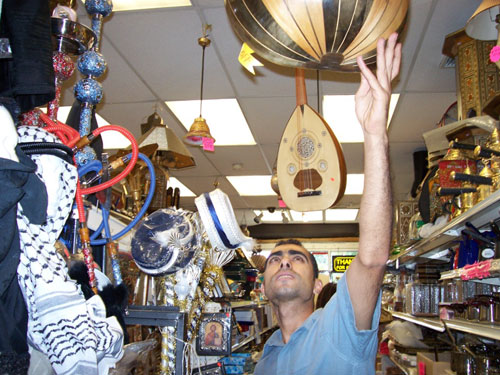
On Main St., where at least half the shops and restaurants are Arab-owned, he makes his way into Nouri’s Brothers, an enormous Middle Eastern general store selling everything from fresh olives to halal marshmallows, gold jewelry to backgammon sets, Arabic and Turkish pop music to electronics.

But what Zaher, a slim, unassuming Palestinian from the Gaza Strip, has come to look at are a couple of ouds — Middle Eastern lutes — hanging from the ceiling.  He runs his fingers along the deep bowl of one and then lightly touches its strings.

“This is good for a beginner,” he says, explaining that the strings are a little too close to the fingerboard for his taste.  He might have to go into New York City to find what he’s looking for, he adds.

Buying another oud — he owns two already — is no small undertaking for Zaher.  If it weren’t for his ability to play the oud, he probably never would have come to the United States or obtained political asylum here.  (To protect family members still in Gaza, Zaher asked that his last name not be used in this article.)


Ancient music made new

Once upon a time, back when he lived in Gaza, before the second intifada started in 2000, Zaher played the oud in a joint Palestinian-Israeli band based in Tel Aviv.  The band was called “White Flag,” a name that represented its members’ hope for a cessation of violence on both sides and a peaceful solution to the Israeli-Palestinian conflict.

Now, more than half a decade later, Zaher lives in Clifton, New Jersey (one town over from Paterson), works at a Domino’s Pizza, and waits for the day this fall when he is eligible to apply for a green card.  He borrows books on Renaissance painting and CDs ranging from classical music to Celine Dion from the public library and dreams of getting a master’s degree in the U.S.

“I was lucky,” he says about coming to the U.S. and getting asylum.

Indeed, Zaher’s experience is very uncommon:  it is hard for Palestinians, especially those from Gaza, to travel abroad, and few Palestinians are granted asylum in the U.S.  But it’s also a testament to Zaher’s innately upbeat personality that he feels lucky in spite of the difficulties he’s faced, like threats from Hamas and a three-month stint in an immigrant detention center in New Jersey.

Zaher’s dark hair and eyes frame a face that seems older than his 29 years.  He dresses nicely, never sloppily:  tan pants, tan leather dress shoes, button-down shirt, black leather jacket.  But when he goes into work at Domino’s, he becomes just another guy in a red Domino’s shirt and a white cap.  At first meeting he is serious, but he soon reveals himself to be someone who likes to laugh.

“He is quiet, and he doesn’t make a problem, and when you ask him to do something he does it.  And he’s smart,” said his sister, Abeer Haj Ahmmed, who immigrated to the U.S. seven years ago and also lives in Clifton.

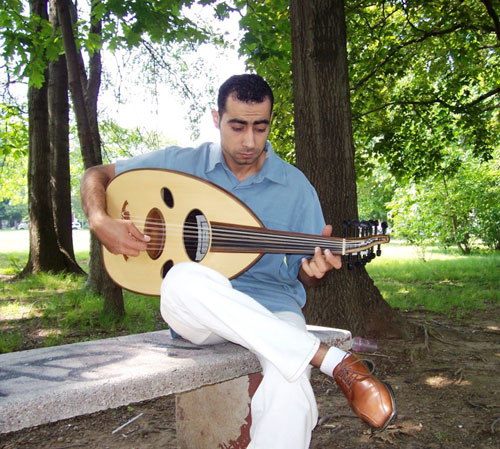
None of these qualities seem surprising in someone who taught himself to play the oud while growing up in a refugee camp, Deir al Balah, in the Gaza Strip.  The oud, a popular Middle Eastern instrument that is the origin of the Western-style lute, is difficult to learn.  “In all the Arab world, there are maybe a maximum of 10 people really playing the oud,” Zaher says.  Arguably the most well-known oud player in the West is Simon Shaheen, an Israeli-born Palestinian who lives in New York and incorporates non-traditional musical styles such as jazz into his work.

“We didn’t study music in the schools.  We didn’t know anything about music,” Zaher recalls.  Nevertheless, while in high school and later while studying special education at the College of Rehabilitation Studies run by the Palestine Red Crescent Society in Gaza, he taught himself the oud from books and by watching other musicians; later, he also learned to play the violin.

Eventually, Zaher joined a traditional Arabic music ensemble in Gaza called “Orient Strings,” composed of about 15 musicians playing Middle Eastern instruments like the oud, qanun (zither), ney (flute), and darbuka (drum), as well as violins and a cello.  The group performed classical Arabic music —  some of it as old as the muwashahat, a body of songs that originated during the period of Muslim rule in Spain — as well as more contemporary music by Arab divas like Umm Kulthum and Fairuz.



Making music across borders

In 1998, Zaher went to Tel Aviv for the first time with his friend Shadi and another musician, a trip that would change his life.  There, they performed in a fundraiser for Windows, an organization that promotes relations between Palestinians and Israelis and with which Shadi was already connected.

That era, after the 1993 Oslo Accords but before the second intifada began in 2000, was a time of greater optimism than today.  “The relation between the Palestinians and the Israelis was great:  a lot of people coming and going; there is no war, no intifada, no nothing,” Zaher recalls.  “We made this concert and it was very nice; there were also some Israeli musicians.  There was one [Israeli] guy, Mark.  He told us, ‘How about if we make a band?’  [We said,] ‘A great idea, but how?  We cannot come here; it’s difficult.’”

Since 1991, the Israeli policy of “closure” has restricted to varying degrees the entry of Palestinian residents of Gaza and the West Bank into Israel.

According to Ilana Feldman, a professor in Near Eastern Studies at New York University who has done anthropological fieldwork in Gaza, “The first closure policy happened during the Gulf War but it wasn’t made permanent … till Oslo.  No Palestinian can cross the Green Line without a permit … Most of the permits were given to people who worked in Israel.”

Zaher’s father worked as an electrician in Israel until 1991, when it became too difficult for him to get to work; he then opened a grocery store below the family’s house in Gaza.

For males under 35, who are seen as a potential security threat, it is particularly difficult to obtain permits to enter Israel, which meant that Zaher and his musician friends were at a disadvantage.  However, with help from Windows, they were able to obtain permits that allowed them to travel back and forth for rehearsals and performances.

“You cannot play again with this band”

Zaher and the other Palestinian and Israeli musicians formed a band, and Zaher himself came up with the name White Flag.  He chose it, he said, because it symbolized a truce.  “The white flag means between two sides, two parts of a problem, between Palestinians and Israelis, [if] they want to stop this war, they have to take a white flag.  Both sides.”

The band performed songs in Hebrew, Arabic, and English, and drew from a range of musical styles and traditions.  “We call it street fusion, because we cannot find a name for this music,” Zaher says.  “We want to make music from the heart.”

But the dream came to an abrupt end when the second intifada began in September 2000 — literally during the Bereshit festival, in which the band was to play.

“That day was the last day in Tel Aviv,” Zaher recalls.  “The intifada started when we were in the festival.  We heard by the news, there are problems in Gaza and there are like twenty people killed.  Now, we didn’t play yet, but we heard about this news.  How’re we going to play?  And we sat together, all the band — the Palestinians and the Israelis — and we said, what are we going to do?  We said, we want to play.  Because we make music, and we play for this problem.  Maybe we’ll fix something.”

Zaher says the audience, most of whom had not previously heard of White Flag, reacted positively to their music and their message.  “The people were dancing,” he remembers.

But after the concert, Zaher returned to Gaza and the political realities of the intifada changed everything.  Because the Bereshit festival had been shown on TV, Zaher’s peace advocacy through White Flag had become known in his community and he was seen as a “collaborator” with the Israelis.

A member of Hamas, the militant Islamist Palestinian movement, came into his family’s store one day while he was working.  “They give me a letter,” Zaher says.  “They told me you cannot play again with this band”— or else his life would be in danger.

Members of Fatah, the more moderate political party that was then running the Palestinian Authority, also paid him visits.  They came “as friends,” he says, but their message was similar.  “They told me, it is better for you if you leave [White Flag].  It’s dangerous for you.”  Zaher says he felt his life to be in danger after the threats and stopped being openly involved with White Flag — which, due to the intifada, which made travel impossible, had effectively been put on hold anyway.  But he and the other members of the band kept in touch by phone.

Zaher had reason to fear what might happen to him.  Shadi, his friend who became White Flag’s keyboard player, had also been threatened and then, after the Bereshit festival, imprisoned by the Palestinian Authority.  “They think he is a collaborator, but they have to make some proofs.  They kept him in jail for like a month,” recalls Zaher.  Shadi was eventually released when the P.A. couldn’t prove his culpability, and he escaped to Switzerland, where he lives today.

Nearly five years later, when Zaher applied for asylum in the U.S., his case rested largely on the threats he had received from Hamas and Fatah and on a “credible fear” of further persecution if he returned to Gaza.

As his lawyer, Thomas Mungoven, explains, “It was a textbook collaborator case…[T]here’s a pattern and practice of persecution of collaborators in Gaza.  Collaborators are regularly killed … by Hamas.”

The future is here

Zaher is glad to be in the U.S. now, and not just because he has escaped further political persecution in Gaza.  “There is no future there,” he says.

His sister Abeer is also delighted to have him here.  “I have seven brothers.  But I love Zaher so much,” she says.  “I’m so happy, I’m so glad.  Because no one from my family [was] here.”

In fact, Abeer is the reason that Zaher came to the U.S. in the first place.  In 1998, Abeer got married and joined her husband — a Palestinian who had originally come to the U.S. to study — in New Jersey.  In 2004, she sent an official invitation for Zaher and their mother to visit her and her family.  But getting into Israel to go to the American Embassy in Tel Aviv was still difficult.  With help from the director of Windows, Rutie Atsmon, Zaher was able to obtain an entry permit.

When they got to the Embassy, Zaher recalls, “I don’t imagine [that] they’re going to give me a visa.  It’s not easy.”  But in the interview with the U.S. Consul, he talked about his involvement with White Flag, and the Consul was impressed.

“And she gives us a visa!” he says, laughing wholeheartedly, as if still surprised about it.  “You know, I’m sure, if you check the last ten years, there is nobody [who got] a visa from Gaza — just me I think.”

Zaher is not the only Gazan to have gotten a U.S. visa in the last decade, but anecdotal evidence suggests that there have not been many.  Feldman says this is in large part because “it was much harder, after Oslo, for Palestinians to get out of Gaza,” which is completely fenced in, than the West Bank, which, until the last few years, had a more porous boundary with Israel.

According to Karen Pennington, a lawyer based in Dallas who has represented a number of Palestinian asylum-seekers, “Tracking any numbers on Palestinians is very difficult in the U.S. immigration service.  Because if they were born in the Occupied Territories after 1967, they’re listed as Israelis.  If they have any other citizenship, they’re listed that way, not as Palestinians.”  But Pennington agrees that few Gazans make it to the U.S.  “I only represent a handful of people from Gaza.  Almost everyone I represent is from the West Bank or diaspora Palestinians.”

Nonetheless, for Zaher, getting the visa proved to be the easy part, compared to leaving Gaza.  Flying out of Gaza is impossible, both because Israel does not allow it and because it destroyed the Gaza airport’s runway in 2001; therefore, Gazans traveling internationally must fly out of neighboring Egypt.  But at the time, the Gaza-Egypt border crossing at Rafah was closed for three weeks.  Zaher’s mother had by then decided not to go to the U.S. because her daughter-in-law in Gaza had just had a baby.  But Zaher was determined to go.

Laughing at the absurdity of it, he describes the situation:  “Every week I go two, three times, and take my luggage, and I say [bye] to my family and I go [to the border] and I come back.”

It ended up taking him a couple months, and at least half a dozen attempts, before he could leave.  The border was finally opened but, at first, only for women; then, men older than 35 were allowed to cross.  Finally, younger men were allowed to leave, but only if they applied in advance for approval and waited for the Palestinian Authority to announce their names over the radio.

“They told us, who[ever] hears his name on the radio, he can come next day to the border.  And all the day, you’re hearing news.  And when I hear my name — check!” he says, laughing.

Once past the border and into Egypt, the waiting continued.  “When I entered [Egypt] it was Friday, but my ticket was [for] Monday.  I had to stay three days in Egypt.”

Zaher had been to Egypt once before, in the mid-1990s, also for three days.  In those years, it had been easier for Palestinians to obtain visas for Egypt, and Zaher and a friend from his college took a pleasure trip.  From the border with Gaza they took a half-day bus ride to Cairo, where, among other things, they each bought an oud, of higher quality than any they could get in Gaza.

But this time, “Because I don’t have an Egyptian visa, I could not travel in Egypt,” he explains.  “I had to be in the airport for three days.  In one big room, there were like 50 people waiting;” they slept on mattresses.  “Also it was Ramadan, and we were fasting.”

In late 2004, Zaher finally made it to the U.S., where he stayed with his sister and her family.  He wanted to study in the U.S. but learned he could not do so because he had a visitor’s visa.  “I was really trying to enter school but it was very difficult, because I don’t have a student visa.  They told me you have to go to your country to get a student visa, and you come back … Impossible!  How am I supposed to get this visa?”

So Zaher began to familiarize himself with life in the U.S. while trying to figure out what to do next.

“Exile” and return

In 2005, with help from a Swiss television company that had begun a documentary about White Flag before the intifada, the band was invited by the city of Lucerne to do a summer-long residency.  The Swiss Consulate initially told Zaher he would have to go back to his home country to get a visa but, thanks to a letter on his behalf from the mayor of Lucerne, Zaher obtained a three-month visa to travel to Switzerland.  There, the band members were reunited for the first time in almost five years.  They performed in two festivals and recorded their first album, “Exile.”

After the summer in Switzerland, Zaher decided to return to the U.S.  “I thought to myself, okay, I have a visa to go to United States; it is multiple entrance.  By the law I don’t make any mistake,” he says.

But U.S. Immigration detained him at JFK airport, threatening to send him back to Gaza.  As later became clear, Zaher had, unaware, been registered under the Department of Homeland Security’s “Special Registration” program when he had first arrived in the U.S.  Registered individuals are required to inform DHS when they leave the country but, not knowing that he had been registered, he had not done that.

According to Mungoven, Zaher should never have been registered, because Palestinians are not on the list of nationalities subject to registration.  “It was total racial profiling,” says Mungoven.  Furthermore, “they lied about it when I called up … They said he was from Jordan.”

Zaher, who knew nothing about the special registration program or its requirements, was confused, though not exactly surprised, by what happened.  “I was feeling … something’s going to happen … I think, from 9/11, [for] all the Arab people, if they read your name — Zaher, Muhammad, Abdallah, Musharraf, these names — I think they put like a red sign.  I don’t know.”

Fearing further threats from Hamas and Fatah if he returned to Gaza — especially given that White Flag’s performances in Switzerland had been publicized back in Israel and Palestine — he decided to apply for asylum in the U.S.  “Because I don’t want to go back to my country,” he says.  “A lot of problems.  I don’t want to live there.  This is no life.”

Zaher spent the next three months in the Elizabeth Detention Facility, in Elizabeth, N.J., with other immigrants and asylum seekers, waiting for his asylum case to be heard.  The detention conditions were tolerable, he says.  “If you make problems, maybe it’s going to be bad.  And there’s rules you have to follow … but I don’t remember anything bad.  They have good food,” he says. On Ramadan, he and other Muslim detainees were even able to fast and have their meals brought when they wanted them.

But even though detention wasn’t miserable, it was still a difficult experience for Zaher.  “I was in shock.  Because there is no life there.  You just sleep, wake up, sleep, wake up.  I was dreaming to get my oud there,” he says.  (He had one oud with the luggage he had brought to Switzerland; the other — the one he bought in Cairo — is back in Gaza.)  “I requested, but they said no.”

Abeer went with her children to visit Zaher in Elizabeth, but it was a hard experience for all of them.  “I’m sad when I see him like this.  It’s not easy when you see your brother in jail,” she says.  “I went just two times.”  After that, “he said, ‘Don’t come.’  Maybe because I cry when I see him.”

Through case workers and fellow detainees, Zaher got in touch with Mungoven, who works at Catholic Charities of the Archdiocese of Newark on pro bono immigrant detention cases.  The asylum process was as complicated as every other stage of coming to the U.S. had been.

Asylum

“When I applied for asylum, they said, ‘no asylum,’” Zaher says, speaking of the U.S. authorities.

Pennington, the Dallas lawyer, says it has become “extremely” difficult for Palestinians to get asylum in the U.S. Of “20 to 25 or perhaps more” Palestinian asylum cases she’s taken on since September 11, 2001, “about seven were granted,” she says. And while there are significant numbers of Palestinians applying for asylum because of persecution by Israelis, U.S. judges have been showing less willingness to grant those cases than collaborator cases.

For example, Pennington describes the recent case of a banker from Ramallah who was detained and fired on by the Israel Defense Forces (IDF) on several occasions. “I demonstrated in that case that the behavior of the IDF violated the written regulations for live-fire.  And [the court] still found that it was state policy,” she says. “The judge said it didn’t have anything to do with American foreign policy, but …” Pennington, for one, believes otherwise.

Even though Zaher’s case was a “collaborator” case and theoretically easier to win, the judge did not grant Zaher asylum at his court hearing in late October 2005. Instead she gave Zaher “withholding of removal.” He would not be sent back to Gaza, but neither would he have asylum, and he would have none of the privileges of a green card. But it was better than nothing.

Zaher returned to the detention facility and prepared to be picked up by Abeer that night. But DHS and ICE (Immigration and Customs Enforcement) had changed their minds, apparently: They now told him that they were going to send him back to Switzerland. (His “withholding of removal” status only prevented him from being sent back to Gaza.)

Zaher called Mungoven, who spoke to the judge, and two days later the case was reopened. Mungoven was furious at what had happened, but so was the judge — who didn’t like DHS trying to undercut her. “It was like fighting between the judge and Immigration,” says Zaher. The judge ended up giving Zaher full political asylum, to his great relief, and he was released from detention.

Since then, Zaher has been working at Domino’s taking phone orders and making pizzas, while continuing to settle in to life in the U.S. and considering his next step.

Abeer seems to know exactly what she wants for her brother: “I hope he goes to college and gets a master’s here. I hope he marries too. He needs a family here,” she said.

As for Zaher? He wants those things too. But first, he’s still looking for another oud.


NBC is looking for Talent and Treasure this summer

If, after a fun day at the beach or pool, you just don’t feel like relaxing on the veranda and sipping a piña colada, there are some new major network shows peppered amongst all the reruns — but your time may be better spent among the fireflies and mosquitoes.  

Struggling at the bottom of the broadcast network ratings game, NBC has decided that originality isn’t a solution to building an audience — but ripping off successful concepts from other networks is an easier way to spin Nielsen gold this summer.  They must have thrown a lot of money at American Idol’s Simon Cowell in order to get him to produce the Idol-like America’s Got Talent, hosted by the legendary Regis Philbin, who himself was involved with a summer blockbuster many years ago called Who Wants To Be A Millionaire?.  In this latest incarnation of the variety talent show that began back on radio, called The Original Amateur Hour, producers scoured the nation for talent, but being that they were more interested in the kind that frequented the 1970’s syndicated The Gong Show than real, honest-to-good entertainers, you’re really witnessing more of a show that should be called America’s Got Issues.  Where American Idol and The Amateur Hour are and were serious ventures where winners actually do become recording stars (Frank Sinatra, Pat Boone, Kelly Clarkson, Clay Aiken), America’s Got Talent seems to be Simon Cowell trying to exploit his power and influence and adding one more reality show that we really don’t need.  

Like with Cowell’s American Inventor series on ABC, which was a terrific turn on the concept and was quite entertaining and moving — though ratings-challenged — Cowell wisely stays away from the judging bench (probably only because of a contractual limitation with Fox) but decides to bring in the B team to take his place and that of his Idol cohorts.  Playing judge on America’s Got Talent is TV and European recording star David Hasselhoff, who, I’m guessing being a producer himself, has the cred to judge others’ talent, though if you’ve ever watched an episode of Baywatch, you may wonder about that.  Sitting next to Hasselhoff is the now-grown-up teen singing sensation and TV’s Moesha, Brandy Norwood, who is a poor man’s Paula Abdul, and that’s saying a lot, considering Abdul’s place in the grand hall of entertainment is somewhere on the first few floors.  Simon’s alter ego in the designated British-only chair is another infamous acerbic Englishman, Piers Morgan, a former editor at the London Daily Mirror and, I’m guessing, an authority on American entertainment.  In this incarnation, the judges collectively can stop a performance when all three hit their buzzers, a la The Gong Show.  I’m guessing that the producers believe that American audiences won’t sit through a show unless there’s tension between judges and odd, talentless, bizarre individuals making fools of themselves on national television.  Perhaps they’re right, but I have more faith in the general public.  Regis is underutilized here and the judges overused.  I believe that America has oodles of talent, but only a sliver is presented on this show — purposely.  If you’re in need of some talent-oriented TV this summer, stick with the other Freemantle show on Fox, So You Think You Can Dance?, which sticks to Idol’s serious tone and shows very talented young dancers in a straight but entertaining competition.

With Treasure Hunters, NBC looked at CBS’s successful The Amazing Race and thought they needed their own travel log competition series, so they went to Brian Grazer and Ron Howard’s company, Imagine Television (Arrested Development), for assistance.  The beauty of The Amazing Race is its simplicity and its focus on spotlighting countries around the world.  Treasure Hunters expands on the challenges that Amazing Race uses to help even the competition by making the hunt for treasure the focus of the show — teams of three, who also have a previous relationship, must figure out clues and solve puzzles which will ultimately lead to a key that will open a million-dollar treasure chest somewhere hidden in the world.  Like Amazing Race, they must travel from one location to another and go through both physical and mental challenges.  So far they’ve stayed within U.S. borders and, unless they venture to exotic spots in the world, Treasure Hunters may lose audience attention, which Amazing Race discovered when they tried a family edition that, for the most part, kept teams U.S.-bound.

Being an Amazing Race fan, I was not expecting much from Treasure Hunters, but after watching the first few episodes, it has grown on me and I’m beginning to root for certain teams — a key to the success of these types of shows.  The producers have rightly decided not to linger too much on the clues, but what they do show of the teams working together to figure them out is just enough to be interesting without being tedious.  If the show travels around the globe and the hunt remains slightly interactive — allowing the audience a chance to figure out the clues themselves — then I think Treasure Hunters may become appointment television.  My only big negative comment is with the host, Laird Macintosh, a bland, soap opera-type who just doesn’t add anything to the table. Here, the host appears on cell phones to relay information, but without the interaction that Amazing Race’s Phil Keoghan or Survivor’s Jeff Probst have with competitors, Macintosh comes across as some digitized, computer-generated “hostitron.” If he didn’t appear with the contestants at least during some portions, he might as well have been a pixel-only host.  I say put the axe to America’s Got Talent, and give Regis a visa to go Treasure Hunting around the globe.  Better yet, why doesn’t NBC just give us viewers the money spent on these shows and let us go travel around the world ourselves?  It would be a whole lot more fun.

For your summer dose of reality television, I say check out Treasure Hunters and So You Think You Can Dance?, but skip America’s Got Talent.  See local listings for times and channels.

Rich Burlingham


Silencing the opposition

This is a severe slap in the face to all those who advocate democracy and freedom of expression in Egypt.

Ibrahim Issa, Egyptian journalist and chief editor of Al-Dustour, an independent weekly newspaper, speaking about his one-year prison term for defaming Egyptian President Hosni Mubarak.  Issa’s publication, Al-Dustuor, reported the case of Said Abdullah, who filed a lawsuit against President Mubarak for effectively pilfering and squandering public funds when state-owned enterprises were privatized. Sahar Zaki, the reporter, and Said Abdullah, the plaintiff, were also handed one-year prison sentences and crippling fines of $1,743 in a country where gross national income per capita is $1,250. Bravo, Hosni.  

Mimi Hanaoka


The Bush executive: more equal than others

Reading the U.S. Constitution, one might think that the legislative, executive, and judicial branches have equal power. But, judging by its …

Reading the U.S. Constitution, one might think that the legislative, executive, and judicial branches have equal power. But, judging by its contempt for Congress’ lawmaking powers, the Bush administration believes that some branches are more equal than others. For instance, George Bush has decided to impose his own exceptions upon Congress’ ban on torture, which passed the Senate by a wide margin. The reason? The Constitution told him to do it. “If the Constitution and the law conflict, the president must choose,” an administration spokesperson said. Never mind that the Constitution has something explicit to say about torture, too.

Victor Tan Chen

Victor Tan Chen is In The Fray's editor in chief and the author of Cut Loose: Jobless and Hopeless in an Unfair Economy. Site: victortanchen.com | Facebook | Twitter: @victortanchen

personal stories. global issues.