Where do you get your news?

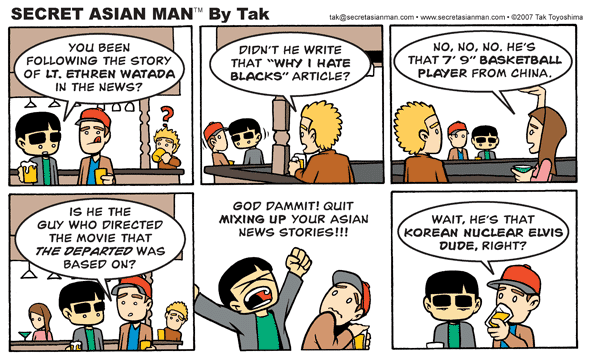
What is Walter Reed, and who are Alberto Gonzales, Dick Cheney, and Ted Haggard? Jay Leno had to answer each of these questions during his monologue Tuesday night before the audience could "get" his punchlines. Of course, in an profession where laughs judge competence, Leno quickly made the public's ignorance of current events into, what else, a laughing matter.  But with all jokes aside, it seems that Leno was performing a valuable community service. 

A 2004 study released by the Pew Research Center says that 20 percent of young Americans under age 30 "regularly" receive their news from comedy shows. And although the cable news shows were still listed as the number one source of information for this age group, the study suggests that an increasing number of younger audience members are choosing comedy shows as their first choice for news and current events. This can be linked in part to the ability of humor to humanize the most complex of issues as well as the sudden popularity of Comedy Central's Daily Show and Colbert Report, to name but a few.

It seems audiences will have to make a choice next time they decide to watch their favorite comedy show: either pick up a newspaper first so they can laugh at the jokes, or else take notes during the show to discover what's going on in the world. Where do you get your news?


Terrorism in a suit

Gritty desert sand blowing, tan brick fading in the harsh sun, Arabic letters sprawling across signs and banners, women winding through streets wearing the hijab. Old cars honking as they make their way through traffic, long beards waving in a breeze, what do you see? Improvised explosive devices buried by roads? AK-47s with half-empty magazines? Terrorists?

You are in Iraq, but you probably guessed that before I told you. Imagery commands strong associations, and sometimes those associations help us make sense of the world and predict events. But make no mistake, those associations can just as easily lead us to misguided conclusions. You might think of terrorism when you see a Muslim, or when images show up in the paper of a far-off Arab land, even if you don't think that individual is a terorist. I want you to challenge those assumptions and look inward. Even the American government, under an objective definition, can be a terrorist.

Joshua S. Goldstein, professor of political science at American University in Washington, D.C., and Jon C. Pevehouse, with the University of Wisconsin-Madison, define terrorism in their 2006 edition of International Relations as “political violence that targets civilians deliberately and indiscriminately.” By that definition, America commits terrorism, too.

For an example, look no further than the United States’s bombing of Afghanistan in ironic retaliation for the Sept. 11, 2001, attacks. As Noam Chomsky, prolific political author and professor of linguistics at MIT, explained in an interview with the Canadian Broadcasting Corporation, George W. Bush on Oct. 12, 2001, “announced to the Afghan people that we will continue to bomb you, unless your leadership turns over to us the people whom we suspect of carrying out crimes.” He didn't show a shred of evidence about crimes they might have committed. Then the U.S. bombs started dropping.

What about the American crimes? Professor Marc W. Herold from the Whittemore School of Business & Economics estimates that the U.S. air war on Afghanistan killed more than 3,000 Afghani civilians and psychologically traumatized many more. His explanation? “The apparent willingness of U.S. military strategists to fire missiles into and drop bombs upon, heavily populated areas of Afghanistan.”

Understandably incensed by the atrocious terrorism in New York only a month prior, it seems the American public turned a blind eye to what Noam cites as a “textbook illustration of international terrorism by the U.S.’s official definition.” However, I will be the first to recognize that one argument does not the debate make. For brevity’s sake let me direct the reader to further examples. I simply suggest the American public pull the American-flag-colored wool off their eyes and recognize the hypocrisy before them. Read more of the evidence and debate me. I welcome it.

Senseless fear does no good. As Chomsky once famously said, “Everybody's worried about stopping terrorism. Well, there's a really easy way: stop participating in it.” I ask that each of us stop lying complicity by while the powers you vote for perpetrate terrorist violence. Challenge assumptions and examine the facts because sometimes terrorists wear a suit.


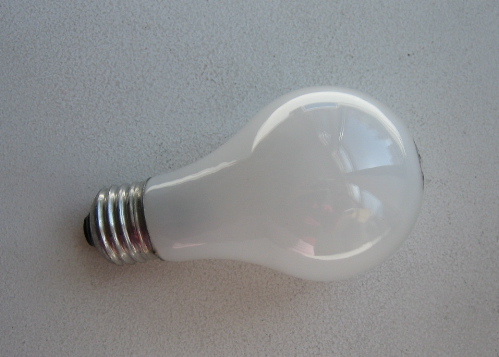
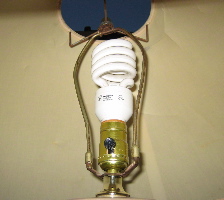
Incandescent light bulbs out, saving energy in

More and more countries and states are realizing that saving energy as well as the environment is as easy as changing a light bulb. As energy consumption grows and demand creates a need for alternative energy sources, governments are looking toward the source to solve the problem. Mandating energy-saving light bulbs is becoming the embraced legislation to quickly resolve these energy problems. And the environmental benefits are just one of the many pluses in doing so.

Energy-saving light bulbs are 75 percent more energy efficient than incandescent and last 10 times as long. Installing them cuts down on energy consumption that in turn cuts down on pollution spewed from energy-generating plants. The less energy we consume from traditional energy plants helps the environment and also helps our monthly bills.

Australia is the first country to systematically phase out incandescent bulbs and hopes to do so within the next three years. The goal is, by 2010, to have installed only energy-saving bulbs nationwide and to have eradicated the energy-wasting incandescent ones. The country already has legislation regulating energy consumption for appliances and wants to do the same for lighting. And the reduction of greenhouse gases from less energy consumption is one of the main reasons for mandating restrictions on lights and appliances. Environment Minister Malcolm Turnball told The New York Times, “Electric lighting is a vital part of our lives; globally, it generates emissions equal to 70 percent of those from all the world’s passenger vehicles.”

The European Union is also mulling over legislation to phase out incandescent bulbs. At a recent summit, EU leaders asked the executive branch to think of a two-year plan to introduce the energy-saving bulbs. German Chancellor and summit leader Angela Merkel told the Associated Press, “We need to give people a little time to change all their bulbs. We are not saying they should throw out all bulbs in their house today, but everybody should start thinking about what's in the shops.”

Countries that already have energy-saving light bulb programs include Cuba, Venezuela, and Chile. Cuban President Fidel Castro introduced the bulb program to counter his country's energy shortage. Castro's program influenced Venezuela's President Hugo Chavez to hand out free energy-saving bulbs to his citizens. Chile's bulb changeover is suggested in its new energy-efficiency plan, which calls for the use energy-saving appliances.

In the U.S., states such as New Jersey, Texas, and California are urging bans on the bulbs as well. California hopes to ban sales of incandescents by 2012.

Greenhouse gas emissions from energy producing plants are slowly being cut down by governments' own volitions. The world is realizing that reducing energy use and decreasing harmful pollutants go hand in hand. And regulating simple things like light bulbs make a huge and positive impact.

keeping the earth ever green


With a little help from mom and dad


Watching Animal Planet with my son, I am drawn to the plight of a  baby hippo who has wandered too far from his mother.  The infant was caught up exploring his underwater playground and did not notice the crocodile eyeing him for dinner.  As Animal Planet is prone to do, the natural consequences of the baby hippo followed, his young life ended by the gulp of a crocodile's mouth.  At this point the cameras zoomed onto the face of the mother, whose impassive eyes betrayed no sign of loss.  Her face so unaffected in this moment of grief, underscores the human need to protect our children at all costs.

While protecting our children is how our species of animal has survived, through the centuries we have upped the ante.  As income has increased, our mindset has evolved from protection into "what can I do" for my child.  Parent financed cars, vacations, and educations are the norm for occupants of particular zip codes.  The trappings of a successful life, they have moved from luxuries to entitlements.  In a quote attributed to Ryan Philippe, he referred to the extras in his own life and then discussed how he sometimes wondered how difficult it would be for his children to give all of this up.  The implication being that they would one day have to fend for themselves.  Yet, in today's world is such a notion realistic?   

Sunday's New York Times looks at one aspect of the question through its details of how local real estate prices are changing the relationship between parent and child.  Sky high real estate prices have made property ownership a challenge for many New Yorkers.  As condominiums and co-ops require ten to twenty percent of the purchase price as a down payment, the $30,000-40,000 a young person may have managed to save just isn't enough.  As more and more 20 and 30 year olds turn to mom and dad for assistance, the definition of independence changes.  According to those interviewed for the NY Times article, parents continue their parenting roles as rule setters as they underwrite the costs of their child's living space.  From the "no boyfriends moving in" rule to serving as tour guide for out of towners, these families renegotiate the boundaries of independence.

Child development experts will tell you that encouraging your child's independence should be a cornerstone of your parenting plan.  For a young child there are a multitude of ways to foster self growth, infants can begin feeding themselves, toddlers start to pick up their toys, parents eventually do less and less for their child.  What happens, however, when you add a bit of consumerism to the mix?  Is anyone thinking about the consequences of buying a two old year yet another stuffed animal?  What about those teen years, when fashion and Sweet 16's costing as much as a wedding, have consumption rearing its ugly head?  Children raised as consumers eventually become the consumed, eaten up with the need for things.  Emotionally desiring independence yet unable to acquire the lifestyle desired without assistance, a younger generation remains tied to their parent's success.

Life in the animal kingdom seems so much easier.  Mothers protect and feed their offspring, providing them with just the right amount of guidance, stepping in when necessary, standing back when it's time to let go.  Today's parents must wade through an onslaught of suggestions, navigate their way past commercial ladened minefields, to somehow produce an independent, responsible, compassionate human being.

The eyes of that mother hippo haunt me.  As the crocodile devours her infant, she blinks and with each blink, exposes her expressionless eyes.  A natural consequence, the narrator intones, "there is nothing she can do," as the crocodile continues his feed.  Not enough, too much, here's to finding peace among the crocodiles.                              


“Hitlerian” marriages

"The era of plurality and diversity is permeating Mexico City."
Julio Cesar Moreno, a Mexico City councilor who presided over one of the first gay civil unions in Mexico City.

On Friday, civil unions between same-sex couples were legalized in Mexico City, despite prior opposition from the Roman Catholic Church —the faith to which approximately 90% of Mexico’s 107 million residents subscribe—and the denouncement of the legalization of the unions, curiously, as “Hitlerian” by some officials from the Catholic Church.

While the civil unions now give the same rights to homosexual and heterosexual couples with respect to property, inheritance, and retirement funds, it does not include the right to adopt children, which remains a privilege of marriage.


Sontag’s last stand

If you haven't already done so, get your hands on a copy of Susan Sontag's At the Same Time. To read this book — the collection of nonfiction pieces Sontag was working on at the end of her life — is to realize what a bold mind and voice we have lost. But this collection, though less groundbreaking than its predecessors — Against Interpretation, Illness As Metaphor, On Photography, also reassures us that Sontag’s writing, her wit, grace, and resolve, will continue to influence serious readers, curious minds, and the politically concerned for generations to come. Each essay published in its unedited form, these pieces, right down to the collection’s structure, were shaped by Sontag’s hands alone.

Its unsentimental foreword penned by Sontag’s son David Rieff, At the Same Time illuminates the late writer’s many passions: literature, translation, beauty and aesthetics, politics, free speech, and, of course, photography. Featuring forewords Sontag wrote for translated works like Leonid Tsypkin’s Summer in Baden-Baden and Anna Banti’s Artemisia, the collection’s first third gives us an intimate portrait of Sontag the reader. Written in a way that reads like curling up with a glass of wine and talking to a good friend, the forewords all but ensure that we readers will becomes fans of the authors Sontag celebrates.

With its focus on September 11, the second third of the collection initially feels pedestrian. But read alongside Sontag’s reflections on September 11, 2002, and Abu Ghraib, these essays reveal the power of candor when it was eschewed, courage when it was confused with consent. Considering how quickly Sontag said what few other Americans dared to mutter, they remind us how Sontag has changed our understandings of this post-9/11 world.

It seems fitting that the collection’s back cover includes a picture of a note that says, “Do something. Do something. Do something," for the collection’s concluding pages relay this urgency through Sontag's final public speeches. Illuminating the ethical importance of translating foreign works, of writing and truth telling, of resistance, they are a lasting reminder of the inseparability of politics and literature, one that confirms Sontag’s belief that “in a time in which the values of reading and inwardness are so strenuously challenged, literature is freedom.”


For the Comfort Women

According to an article published Friday by the Associated Press, the Japanese government said it has no evidence that Japanese women were forced to work in World War II military brothels, according to a statement made on Friday.

The government has not come across anything recorded in the materials it has found that directly shows so-called 'coercion' on the part of the military or constituted authorities," the statement read, as presented in Tokyo.

These women, better known as comfort women, were a part of an atrocious history of sexual slavery on the Asian continent sixty years ago. During World War II, the victims, according to a report complied by Amnesty International, up to 200,000 women were enslaved sexually by the Imperial Army, between 1932 until the end of World War II.

Following these devastating acts, these

Sixty years later, these women have been unable to find justice from the government that ultimately led to their physical and emotional discomfort.

While the American government has watched from afar, it remarkably has not remained silent. In 2005, and again this year, members of the United States Congress have sponsored legislation which would plead for an official apology for the women involved.

There are few times that there is extreme bipartisan support of a measure, especially when it deals with international relations. However, both Democrats and Republicans in Congress see the requests of the comfort women as valid, and want our government to demand this simple act of justice. I stand with them.

There is a striking possibility that the surviving comfort women will never hear a "sorry" from the Japanese government, and an even more likely possibility that they will die before recognition is made. The surviving women are in their 70's, roughly, and have broken their silence to speak out against the sexual violence attributed to war. Breaking their silence, in the Japanese community, led to shame and ousting from mainstream society. But these women outweighed their own discomfort for a greater good, and for that, I admire them.

I personally became connected with the story of the Comfort Women as an actor in the Vagina Monologues on my college campus. Eve Ensler, who compiled the monologues, interviewed several of these courageous women, and made them the topic of the 2005 spotlight.

Theatre is a powerful tool that liberates those who perhaps can not free themselves from societal entrenchment. The comfort women, though few in number, will be heard. Each year, thousands of women will relate their tale on college campuses across the country. These women will trouble the community to take action, to remember, and to speak out against acts of violence against women in times of war.

When those in our global community have no voices, we must be their voices. When those in our community can not achieve justice on their own – we have to help them find that inner peace.

Perhaps the Japanese government will never recognize these atrocities verbally. There is a striking chance that their history will not appear in the country's history texts – those things, those institutional barricades to truth, are not things we are able to control.

But we have to remember the comfort women.


What we know

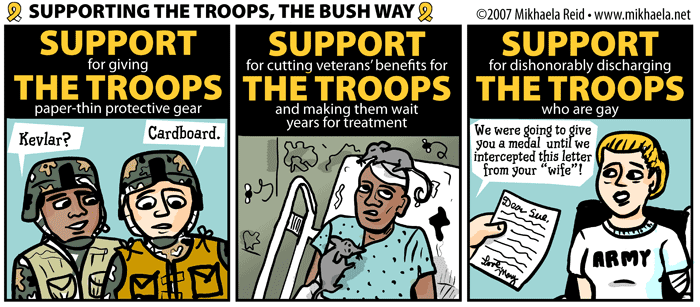
Every time I hear a Republican saying that Democrats and liberals undermine the troops by demanding that they not get killed for nothing, or by writing articles exposing their pain, I think of how the Republican congress voted, five days before the war began in 2003, in the middle of the night on a Friday when no one would know about it, to cut veterans' benefits by 40%. When I think of troop morale, I think of the troops' first Thanksgiving in Iraq, when the President showed up with a full feast. But once the cameras were gone, the turkey and the chicken-in-charge were packed back onto the plane and the troops hit the desert again without so much as a cranberry. I also think of Mr. Rumsfeld telling a soldier asking why they didn't have enough armor and protection well, we don't have any, so tough. I read the WaPo article on Walter Reed. The blog written by an injured soldier inside the center is just as heartbreaking.

"The stress has come from being here. From being inside these four-gated walls. From seeing what becomes of the broken soldiers. We go from being the team leader to just a specialist. We go from being convoy commanders to being just another sergeant. We are broken down by our name, rank, and sex; sometimes even our injuries. And that is the sum of who we are. We are what has been cropped from the canvas. We are the cost of war." (via boingboing)

The first two tidbits were provided by What We've Lost by Graydon Carter back in 2004. Imagine what else we've lost in the three years since.♦

The literary giants from Latin America had a 30-year feud over a woman. I expected more from these two.♦

It's Sunshine Week. For those of you who don't know:

"Sunshine Week is a national initiative to open a dialogue about the importance of open government and freedom of information. Participants include print, broadcast, and online news media, civic groups, libraries, non-profits, schools, and others interested in the public's right to know." (From sunshineweek.org.)


UN global initiative, safe water

Worldwide, more than one billion people lack access to an improved water source, such as a rainwater collection or wells. Two billion still need access to basic sanitation facilities.

By 2015, the international community, working through United Nations' Millennium Development Goals adopted in September, hopes to reduce by half the number of people without safe drinking water and basic sanitation. drinking_water-nigeria.jpg


In the developed world, the moment a drop of water hits the ground it goes into the water system until it becomes wastewater. Then it's treated and put it back into the system.

"We have a large-scale infrastructure in the United States to provide clean water," said Joseph Hughes, chair of the Georgia Institute of Technology School of Civil and Environmental Engineering. "Using our current approach will not provide the rapid fix the United Nations is looking for in developing countries. It would take decades."

Hughes outlined four steps to solving the developing world's water and sanitation problems. First, researchers must determine how big the problem is, then analyze the water distribution process, understand the complexity of the systems required and, finally, create new approaches to water supply and sanitation through research and development, which might include new methods of storing, treating, and disinfecting water and developing sanitation systems that minimize pathogen release.

Urbanization, climate changes, water scarcity, and economic development will affect where water will be available in the future and where concentrated amounts of water will be required to meet the needs of large populations, Hughes says. The United Nations projects that two-thirds of the world's population will live in areas that face water scarcity by 2025.

"Historically we've tried to go to groundwater sources, such as a well, to initiate improved water sources, but there's a very finite capacity in groundwater," Hughes noted. "We have to work much harder to make ocean or surface waters safe."

The water must be safe and in reliable quantities

"We need to go beyond providing better water," Hughes added. "We need to provide water that you and I would drink and consider safe. If a pregnant woman drank it, she wouldn't be worried about her health or the baby's health."

In the United States, the only thing consumers need to know about their water supply is how to pay their bill and call a plumber if there's a leak, said Susan Cozzens, who organized the AAAS session on water and sanitation in developing countries. But a family in a developing country with a latrine needs to know a tremendous amount  how to build the latrine and how to maintain it.

"If a part breaks, what does that family do? Does the family stay in touch with the organization that came and provided the service or part originally? Is there someone who assumes the role of civil engineer in every town?" asked Cozzens.

Cozzens, in order to answer these questions, plans to investigate how communities in developing countries share their knowledge. She will conduct case studies in urban as well as rural locations in Mozambique, South Africa, Costa Rica, and Brazil.

Cozzens' goal is to provide insight to international and local water authorities helping developing countries set the right conditions for people to learn and solve the problems of unsafe water and sanitation.

TECHNICAL CONTACTS:
1. Susan Cozzens (404-385-0397); Email: susan.cozzens@pubpolicy@gatech.edu
2. Joseph Hughes (404-894-2201); Email: joseph.hughes@ce.gatech.edu

personal stories. global issues.