In Beirut, some things never change. Legend has it that a nightclub near downtown stayed open during last summer’s war between Israel and Hizbullah, with DJs even turning up the bass to drown out the thump of falling bombs. Despite civil war and invasion, Beirut still tries to be, as it once was, the Paris of the East.
Crowded, smoke-filled cafes and haute couture fashion line the streets of Beirut’s ritzy Hamra district. Stroll down rue Hamra in the evening, and watch women in stilettos and miniskirts walk with young men in tight jeans and popped collars out on the town. Many head to the Gemmayzeh, Beirut’s nightlife district, for an evening of booze, drugs, and sex. Most like to party in the newer rooftop clubs, away from car bombs and other street-level annoyances.
You can forget you are in the Middle East at times — women in lingerie stare seductively from large back-lit ads, and young couples neck in the corners of cozy bar-lounges. It was this douceur de vivre, or sweetness of life, that drew the well-off from all corners of the Arab world and from Europe to come dance, drink, and rave with the Lebanese when the bombs weren’t falling.
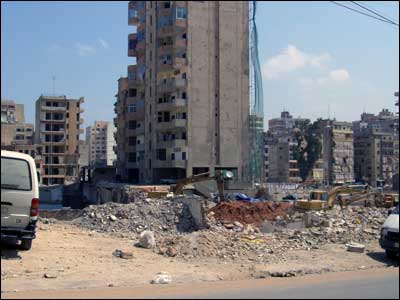
If this terrace-level Beirut seems frozen in time, then so too do the streets below, but for different reasons. Away from Hamra’s lingerie models and cafes there lies a very different Beirut. Most of the city has yet to fully recover from last summer’s war and the Hizbullah-backed general strike of early 2007.
Like a fly in amber, Beirut’s twisting streets and narrow alleys feel stuck in 1974, the year before Lebanon’s brutal 15-year civil war began. Everywhere, young men in urban camo-wear and berets clutch Kalashnikovs and patrol the streets. The military has erected checkpoints throughout the country, and the slightest provocation can lead to assault or arrest.
On the road from the airport, billboards displaying a smiling woman with long, uncovered hair inform visitors that the city’s reconstruction from last year’s war was made possible thanks to Iran. The road north to Tripoli is flanked by billboards showing soldiers planting the Lebanese colors atop smoldering ruins, set in an Iwo Jima moment, beckoning the highway traffic to support the army’s assault on the Palestinian refugee camp Nahr al-Bared.
The Solidere, a downtown area lavishly reconstructed by assassinated Prime Minister Rafiq Hariri, used to draw rich Gulf families — men with white robes and enormous bellies, with their wives and children in tow. Today’s Solidere lies empty, with its restaurants scaled back to lunch-only menus, and the splendid Place de l’Etoile is devoid of life but for the nearby tents of Hizbullah supporters.
My Lebanese friends throw their hands in the air when I ask about the situation here.
“What can I say,” Munir replies, exasperated. “This country is hopeless.”
Munir and his friends, too young to remember the civil war, nonetheless had their own dose of destruction and hopelessness when they lived through last summer’s Israeli invasion. And they watch as the country slowly becomes repolarized along sectarian lines, a hallmark of the 15 years of civil war.
When the equivalent of 1,000 kg of explosives tore a chunk off St. George’s Hotel in West Beirut in early 2005, taking Prime Minister Hariri’s life, the fault lines of division deepened. Later that year, on March 14th, over one million Lebanese took to the streets, demanding an end to Syria’s near 30-year presence in the country. Syrian forces left by the end of the following month, but Syria remains to many the éminence grise of Lebanon.
Mainstream Sunni politicians, some Christian groups (led by the right-wing Phalange Party, which was behind the massacres of the Sabra and Chatilia refugee camps in 1982), and other prominent business and political leaders formed the March 14th Alliance to protest Syria’s continued influence in Lebanese affairs and to promote pro-Western policies.
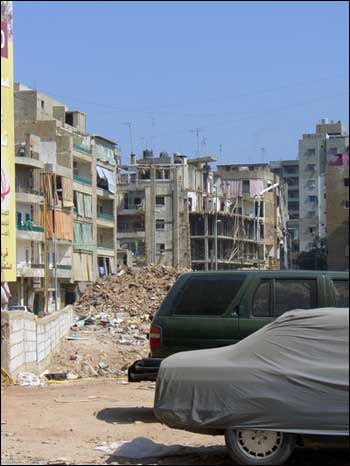
On the other side of the divide are masses of poor Shi’a, who are given organizational expression through Syria-friendly Hizbullah and other related groups. So Syria remains the bugbear that covers the real divisions in Lebanese society — divisions between the rich and the poor, between the terraces and strobe lights of the Gemmayzeh and the dense, packed warren called the Dahiyeh.
Munir took me to the Dahiyeh, the poor, predominantly Shi’a suburb in the south of Beirut, which bore the brunt of the bombing last year. Today one can find young armed men directing traffic, and posters of Ayatollah Khomeini and Hizbullah leaders covering the walls.
Just a year ago, however, the Dahiyeh was a mass of crumbled concrete and collapsed bridges, a city destroyed by Israeli weaponry. Hizbullah has since rebuilt some of these southern suburbs as well as a good portion of southern Lebanon. Most Dahiyeh residents are poor and working-class, and most have never even been to the Gemmayzeh. Here, in Hizbullah country, the promises of leaders in business suits, in capitals both near and far, mean little.
“We don’t want Bush here,” one resident tells me. “And we don’t want [the] March 14 [Alliance] here either. They are controlled by Bush. We just want to be left alone.” He adds, “But they will never leave Lebanon alone.”
Pessimism springs eternal in Beirut. When Irish peace activists visited recently to give a history of the conflict in Northern Ireland, they spoke of the horrors of their own civil war and of the ways in which ordinary Catholics and Protestants overcame the sectarian divide in just 10 years. But this meant little to my Beiruti friends.
“Do you know where we will be in 10 years?” Foutemeh asked, a bit annoyed. “We will be in the middle of a civil war, that’s where.”
Some manage to bring a sardonic edge to their cynicism. En route to the Sabra camp, my taxi driver explains, “I feel strange when there is no war, no sound of gunfire. I grew up in war; bullets remind me of my childhood — they make me happy.” He adds, after a moment’s reflection, “I’m sure I will be reminded of my childhood again, soon. Here in Lebanon, all we know is war.”
When the threat of war is everywhere, it is easy to become inured to it. Groups of armed men wielding machine guns or lounging on the swivel seats of armored personnel carriers are no longer surprising or even bothersome. When a series of loud explosions interrupts my conversation with Foutemeh, she looks up lazily and says, “It is probably a bomb.”
It isn’t — the multicolored night sky attests to a firework display somewhere off in the distance. But there has been a series of explosions and assassinations in the past few months, including two high-profile attacks on parliament members. And the northern Palestinian refugee camp of Nahr al-Bared lies in ruins, much like the Dahiyeh after last year’s war.
The election to replace the assassinated MPs has just concluded, and dozens of young men on motorcycles holding huge flags with a stylized cedar tree emblazoned across the front — the Phalange Party emblem — are honking their horns and chanting loudly.
Nearby at the Metrobar, a trendy dive with soft red lighting and ’80s music, my Lebanese friends try to teach me the Debke, a traditional Lebanese folk dance. It’s quite difficult: you must move your feet to complex, syncopated rhythms while dancing around in a circle. But they are patient with me.
Every once in a while, we break from the dancing to nibble on some tabouleh and hommos, while Saseen and Hamid break into song, usually funeral dirges for fallen Hizbullah soldiers.
“We Lebanese know funerals better than anyone else,” Hamid explains, with a smirk.
The waiter arrives with a round of tequila shots, and Hamid raises his glass, with tongue firmly in cheek, to martyrdom. “To martyrdom!” we cry in unison before swallowing the cheap Texas spirit that burns all the way down. We drink late into the night.
Outside, at dawn, Hamra streets are quiet. As the muezzin welcomes the morning with a tuneful call to prayer, a flatbed truck full of armed men trundles by. The morning headlines of the Daily Star exalt the bomb-free election of the day before.
I watch the sunrise with a young couple from Italy.
“This city is dead,” the woman complains. “We’ve been going to the Gemmayzeh the last few nights, but there isn’t much else going on here.”
They walk off, past a pair of disinterested soldiers, toward their hotel nearby. Like the few other tourists here, they came looking for the Paris of the East. They instead found Beirut.
Anand Gopal
Dear Reader,
In The Fray is a nonprofit staffed by volunteers. If you liked this piece, could you
please donate $10? If you want to help, you can also:


 Letting the bedbugs bite.


 Made in China.