RAYMOND

Finding friendship in West Africa.


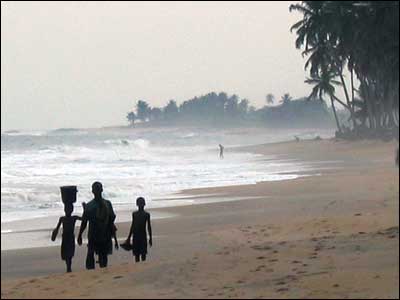
The women next to me are crying. Silently, to themselves, but unabashedly. As the men in the truck bed look over the terrain, their faces are abnormally blank and sullen. My face is squished against the window in the crowded back seat, and I notice the ubiquitous red dust (a staple of West Africa) flying off of the road as we drive. Like it does every day, today it coats the banana leaves, cocoa trees, and assorted green bushes that cover Ghana. People are still walking along the road with baskets on their heads, smiling at everyone they meet and maneuvering around goats that flood the streets and bleat loudly. 

But unlike these people who move to the normal, almost ineluctable West African rhythm, today does not feel like a normal day for me. In shock, I can’t believe that I’m driving along a dusty road in Ghana, with the wind whipping in through open windows, and my dead friend Raymond wrapped in a blue bed sheet on the truck bed behind me.

•••

I’d only met Raymond once before that day. About a week into my six-week volunteer stint in Ghana, I began working in the Accidents and Emergencies Ward in the Volta Regional Hospital — a different experience from being in American emergency departments, because the hospital had no ambulances, defibrillators, or electrocardiograms (EKGs). The primary emergencies that they managed were broken bones, sutures, or diabetic emergencies requiring IV fluids.
 
Because I didn’t speak the native language, Ewe, I felt like I was being ignored in the hospital ward. After about a week-and-a-half of this, I wandered over to the General Male Ward where I knew some other volunteers were working. I spotted Katie, with her short, curly hair escaping from the pigtail braids she had tried to wrestle it into, and the top half of her head bleached blonde from the sun. She had taken out her large, silver nose ring, but I could still see the two bluebird tattoos peek out from behind the straps of her tank top. Amy, a quiet, blonde volunteer, was hunched over a shopping bag on a windowsill. As I entered the ward, she looked up and kindly smiled before pulling a package of adult diapers out of the bag.

Katie called me over to where she was, sitting at the head of a bed with the remnants of a Fanchoco ice-cream bar coating her hands. “This is Raymond,” she explained, gesturing to a rail-thin figure lying on the bed next to her, “and he is here from Togo.” 

Immediately I felt excited because I could practice my French with him. Katie patted his arm and told me that he had “eaten some bad beans” that made his stomach hurt, and that medicines from an herbalist had only made him more sick. The family took him to one hospital, but the hospital’s operating room “couldn’t help him,” and so they sent him to the Regional Hospital. In the meantime, the wound from his surgery dehisced so that the intestines basically spilled out through the hole. They were held in only by the diapers that he wore in the hospital.

Without much muscle mass, Raymond was basically a skeleton wrapped in a sheet of his own skin. I stared at his huge feet attached to twig-like legs. His knees were by far the largest part of his legs, bulging out like two baseballs between two muscle-less sticks. When Katie told Raymond my name, he looked at me with velvety brown eyes. His eyes reflected a thousand pains, but they were also the strong eyes of a 17-year-old boy. Reclining amidst a sea of sheets, he held out a limp hand with long fingers for me to shake.

•••

We all chatted for a while, learning about each other’s lives. Raymond told us how his sister sold green beans in the marketplace in their hometown, Aflao. He eventually asked Katie when she was returning to the United States. I translated for Katie while she pointed to a date in her planner. August 4. “That is when I go home,” she said, being careful to speak without contractions like the Ghanaians did.

Raymond turned his wide eyes to me and stated matter-of-factly, “I will go with her then. Tell her I go to America, too.”

As I relayed the message to Katie, I shifted my feet beneath me and glanced at Amy, who was still sitting on the windowsill next to Raymond. Katie looked at me with thoughtful, slightly sad brown eyes, and then playfully patted Raymond’s hand. “I’ll try,” she said grinning at him, “but you have to get some more muscle before then!” 

I decided to translate “try” as essayer. Once Raymond understood me, his eyes bulged with alarm, and his whole body writhed as he shouted, “No! Not try! Will! Will! You will bring me with you!”

Katie stared pensively at Raymond’s smooth hands as he assured her that he would be big and strong in three weeks. Nodding along, she untwined her fingers from his and turned his palm over delicately. Sliding her hand over his, she wrapped her fingers around his wrist. “OK, Raymond,” she said, noticing how her fingers made a complete circle around his arm, with room to spare on all sides, “I will. But remember, big and strong.”

Raymond nodded at her and found a pencil from a table next to his bed. With shaky but deliberate movements, he leaned over Katie and wrote his name, RAYMOND, in her planner underneath August 4. “Now it is a plan,” he explained, pulling up a sheet so that it covered his diaper. “I am going to America.”

•••

About a week later we went to the hospital again and brought more volunteers. I was laughing as Katie stomped and banged on her Jimbe drum, imitating our drum teacher, Joseph, and his testosterone-filled teaching style. The drum had a resounding, hollow, but somehow pure sound that broke up the relative silence in the ward. As we walked in, one of the nurses (in Ghana, nurses are “Sisters”) smiled sheepishly from behind the administrative desk. Her hand stopped its casual lilt on the page, and hesitated for just a moment. “You are here to see Raymond?” she asked out of complete stillness.

“Yes,” we answered, blundering into the room and talking amongst ourselves.

“Ah.” Pause. “We lost Raymond this morning.”

I turned my head to the Sister, whose hand was still frozen on the page, and Katie stopped drumming. We all stood still. The Sister’s words hung in the air like reverberations from a musical performance, and in their silence they were almost as loud as the sounds from the Jimbe drum. The sudden change from loud to quiet echoed the unexpected news we had just received, and I couldn’t believe what had happened. 

•••

It was a particularly warm day when we got Raymond’s body from the morgue. It’d been about a week-and-a-half since he died, and his body had been kept in refrigeration. When they brought Raymond out, I was shocked by how peaceful he looked. He was so still that it was as if he had eternally extended the pause between inhaling and exhaling so that there was a breath trapped inside of him. His mother and Katie couldn’t stand to see him, and so I cleaned his body with two of his aunts and Becca, a nursing student volunteer with a sunny disposition and a go-getter attitude. 

I kept wondering why I was cleaning his body in the first place. Holding his lifeless left hand, I realized that I had only met this boy once before, and that I hardly knew him at all. I wasn’t sure why I even cared about what happened to him. But as I wiped his elbow with a rag, I thought about how happy it had made him that we came to visit him. I realized that the whole reason I came to Ghana was to connect with new people and to learn from their life experiences. I’d certainly met many people when I observed a physician, blood lab technicians, or a traditional bone healer. By spending time with these people I was able to learn a lot about their life stories. 

But I just sort of stumbled upon Raymond and his story, and it still impacted my life. I realized that these informal relations are clearly important ways to make a connection with other people. Even more significantly, I understood that by making Raymond even a little bit happier, I had affected his life as well. Gazing into his slightly sunken, matted eyeballs, I realized that I was giving back to him for what he had taught me. It became clear that these sorts of informal connections, with Raymond and with other West Africans, were not only important, but actually some of the most significant ways through which I gave back to Ghana.

Back with Raymond, I still felt confused as I moved the rag between his bony fingers, but I also felt in awe of our own connection and what it meant.

•••

It is almost afternoon by the time we leave the morgue and arrive at Raymond’s family’s house in Aflao with his body. We plow quickly through the unpaved streets, which are more like glorified paths, and dodge chickens and avoid hitting huts on either side by six inches. 

When we pull into a clearing, people are milling about between the noises of chickens and goats. Jumping out, the men seem to know what to do and start speaking in Ewe. Against the backdrop of a dialect that sounds like a rushing brook, I feel completely confused.

Raymond’s mother grins at me with the type of smile that turns complete strangers into instant friends. Other volunteers had mentioned that she had been extremely distraught over her son’s death for about a week, but it looks like she has finally calmed down and is able to interact with other people. She waves me over to a group of people who are the rest of Raymond’s family. I almost cry when his younger sister looks at me with her huge eyes and holds out a hand that also has long fingers like Raymond’s. 

The men hoist Raymond’s body onto their shoulders and carry him to a sandy area. I guess this is a cemetery, though the only grave markers are Coke cans and plastic wrappers. One of the family members starts digging a large hole to my right. I am still confused about what I should be doing, and so I stay back with Becca, kicking the sand with my flip-flop. I watch Raymond’s father lower his son into the hole, and I watch the different layers of sand cascade around Raymond. “No grave marking,” everyone explains to me, but “maybe the family will plant a tree later.” I take a last look at the grave, now a wet patch of sand, and go back to the compound, stepping on a dusty Fanchoco wrapper on the way.

Back in the clearing, in the huts, I meet members of Raymond’s extended family. I shake about 20 hands, and I see so many faces that are creased with age and worry, but they crinkle even more with warm smiles for me. I feel embarrassed, like I haven’t done anything to deserve this kind of unstinting love from strangers. Raymond’s mother gives me a huge hug as she sobs silently, and Raymond’s sister kisses me on the cheek as she walks back elegantly to her father, like a dignified queen, even though she is crying.

Continuing this generosity, someone hands me a coconut he has just chopped open and his eyes simply say, “Thank you.” As I drink the milk, another relative throws more and more coconuts back into the pick up truck. After convincing them that I cannot take coconuts with me, I slide back into the truck and wave goodbye. 


When rape becomes normal

Brutality against women as a weapon of war.

[Click here to listen to podcast.]  


In an open-air hospital waiting room in Bukavu, a city in the Democratic Republic of Congo, 400 women sang a song, asking God to bring peace.
 
They were tired, sick, and ashamed, all of them victims of rape, which has become the disturbing signature feature of the Congo’s unending war during the last decade.

Much attention has been paid to the brutality against women in the Congo’s war, but despite the worldwide news coverage, rape in the Congo has become standard.

Each day, more than 250 rape victims come to Panzi Hospital to be treated.

Dr. Denis Mukwege Mukengere, chief of obstetrics and gynecology at Panzi, has found himself at the forefront of the crisis. “You see thousands upon thousands upon thousands of people who are completely destroyed and left lifeless, and you know the world knows about this,” he said. “I’ve begun to lose my faith in mankind.”

He hasn’t always been the spokesman for tens of thousands of rape victims, but it was when he was working in rural areas that the crisis unraveled before his eyes.

In the late 1990s, Dr. Mukwege calculated that he saw about 50 women every year who had genital mutilation from violent rape. The war was to blame, and the number of rape victims grew “exponentially,” he said.

“I had never seen women with wounds to their genitals like this,” Dr. Mukwege said. “They shot them in the vagina or cut them with a bayonet.”

Rape has proven to be an effective strategy for the armed groups, forcing people to flee their homes, he added. Women who are raped face death, either by HIV (the AIDS virus) or infection. Men face shame, because they are often forced to participate in the rape acts. Villages go empty, except for the children, livestock, and goods left behind as booty for the rebel groups, he explained.

Dr. Mukwege works 14-hour days, seven days a week, and is the only surgeon around qualified to perform complex gynecological surgeries. Twenty-five percent of the rape victims who come to Panzi must undergo surgery to repair their torn tissues, he said.

In the surgery ward, hundreds of thin women lay on metal beds next to each other, wearing but threadbare cloths and protected by patchwork mosquito nets. Rubber hoses drip into open plastic buckets at the feet of their beds.

Inside his office, Dr. Mukwege spoke with a mix of outrage and exhaustion. His experiences with rape victims were documented in the 2002 Human Rights Watch report The War within the War: Sexual Violence against Women and Girls in Eastern Congo.

And he has been telling the international press about this crisis for years.

But despite coverage by media outlets that include BBC, CNN, and The New York Times,
the gruesome violence has turned even more troubling: It has become normal to both the international community and the local people, Dr. Mukwege said.

“That’s my fear, because we’ve shouted ‘Rape, rape, rape!’ And when nothing is done, it’s total impunity. Those who commit these acts — they know they can get away with it,” Dr. Mukwege said.

The result is a problem “so vast, but also in a sense forgotten, in terms of the international radar screen,” said Pernille Ironside, a child protection specialist for UNICEF in Eastern Congo.

“But in reality, what we are seeing in terms of sexual violence in the Congo is unparalleled in any other country.”

Listeners of Radio Okapi, a local station, can listen to daily reports of rape, but Dr. Mukwege feared the routine reporting was leaving the community numb.

Additionally, his patients have come to see their lives as worth nothing, Dr. Mukwege said.

One woman described her life as less valuable than that of a chicken, he said. “A chicken is someone’s property, and they protect it. And if you kill your neighbor’s chicken, the neighbor says to you, ‘You’re a bad person, why did you kill the neighbor’s chicken?’” he recalled her explaining to him. “But when I go out and get wood and other things, they just take me and rape me,” she told him.

Dr. Mukwege said he no longer listens to his patients’ stories. They are too emotionally draining, so he just sticks to performing operations.

“I thought I could help them,” he said. “But in the end, I understood that I got more and more depressed.”

Dr. Mukwege hosts reporters in between surgeries, but is skeptical of the value.

“I’ve seen important people in this world pass through the hospital. I’ve seen them in tears, and then nothing is done,” he said. 


My pioneer

Women have no wilderness in them.


Grandma wore blue mascara
to chop dinner chicken heads. The women
cut her dead, those whispering farmwives.
 
To begin again, she tractored across the prairie
with sons and machines. Wheat fields waved in new opinion.
 
She named her girls after jewels & flowers.
Earmarking the exits for later, she harassed the neighbors
with metaphor.
 
Memories detach from surrounding tissue
as generations of us wait for our lovers.
When they show up, it’s never that great.
 
When Xmas candles ignite the fir tree
shall we remember only light and loveliness?
 
Hardscrabble landscapes breed hardsell seductions:
We stay, but we count on our talent for escape.

Author’s notes:
When I think of International Women’s Day, I remember my great-grandmother, Ida Arsby. She traveled from Norway to marry a man she barely knew, and farmed a parcel of land with him for years. They had 11 children. When her husband began to abuse her, accusing her of having affairs with the neighbors, she was so insulted, she left him. She was past 40 when she rode her tractor into Canada, accompanied by some of her children, and began to farm another parcel of land, this time on her own. That farm had oil on it.
 
I met her when she was 94. She still had blonde hair in her white braid, and bright blue eyes. I asked her what was most important in life. She told me, “Dignity, dear, is everything.”
— Cheryl Snell


Spin

This lie burns like a candle — at both ends.

[Click here to listen to the poem.]  


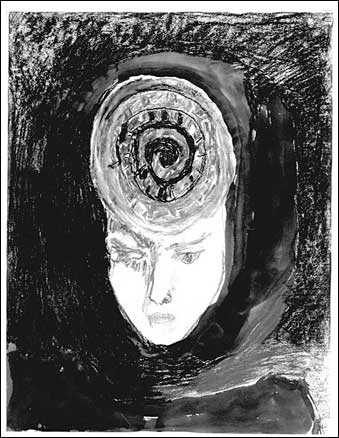
"Dreamscape" (Janet Snell) 

Artist’s notes:
The spiral staircase effect in "Dreamscape" may make a statement about circular thinking, or maybe it asks a more lyrical question about fantasy. The viewer has to decide. — Janet Snell

At dinner, he tells a lie. It flickers like a candle. It drizzles down its dazzle.
He tries to blow it out. It singes all his fingers. He reaches over to pinch its little wick,
but the lie won’t die. It opens to interpretation, gathers force, spreads like rumor,
hides and seeks. It can’t stop. No one will let it. It’s there on Thanksgiving at Uncle
Bob’s, Easter at Aunt Sylvia’s. It goes on for a day, a month, a year. A spotlight
hovers over it, search beams crisscross it. It begins to run. It passes over asphalt
and swamp, cell towers and landlines. Calls are dropped. The man wasn’t answering
anyway. The lie has confused him. It’s no longer the same. The ending has changed.
All of the details. Some of the names.

A peek inside the creative process
“Spin” got its legs after I tried it as a prose poem. Stanzas slowed it down where I wanted speed, and the block form let it find its own tempo. — Cheryl Snell


Outpatient

Healing hands and killing-fields.

[Click here to listen to the poem.]  

Artist’s notes:
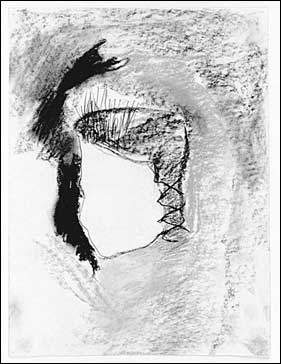
“Therapy” shows a corseted head to represent bound-up, traumatic memories. A lot of my work has to do with disorganized thinking, or states of mind. — Janet Snell

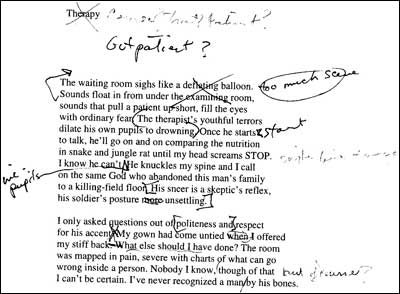
From this…

"Outpatient," first draft.

to this…

Once he starts to talk, the therapist
goes on and on comparing the nutrition
in snake to jungle rat.
 
My head screams STOP, but I know he can’t.
 
His pupils dilate to drowning as he knuckles my spine,
and I call on the same God who abandoned his family
to a killing-field floor.
 
I only asked questions out of respect
for his accent. What else should I have done?
 
My gown had come untied. I offered up my stiff back 
in the room mapped with pain, severe with charts
of what can go wrong with a person.
 
Nobody I know, though of that I can’t be certain.
I’ve never recognized a man by his bones.

A peek inside the creative process
"Outpatient" came directly from my first meeting with a new physical therapist, a refugee from Biafra. I had to weed out many of my impressions of the room and the man to get to the heart of the poem, as you can see in the rough draft. — Cheryl Snell


He peels his love like an apple

All apples sweeten in the dark.

[Click here to listen to the poem.]  


"Romance" (Janet Snell) 

Artist’s notes:
“Romance” connects the man’s heart to the woman’s back because the woman often carries the burden of the relationship. I used blue and purple, because to me they are more erotic and unexpected than red and pink. — Janet Snell

The man wants the lady apple. 
It’s unripe, but he’s hungry now,
and there are plenty of other fruits
in the fridge.
 
All apples sweeten in the dark,
so it doesn’t matter which one
he chooses. Peel spirals below his knife.
He brings the flesh to his mouth.
 
A worm’s sudden slither is the last thing
he expects to see — the apple
hollowed out, juice running bitter
down his chin.

A peek inside the creative process
In “He peels his love like an apple,” I was aware of the danger of cliché, so I had the worm — that tiny serpent in the garden — make a surprise appearance in an unusual setting. — Cheryl Snell

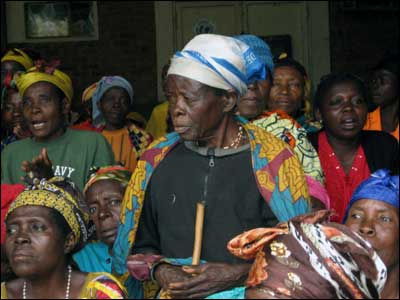
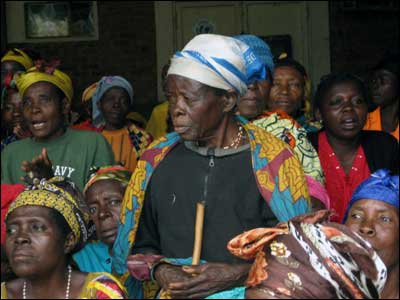
Women waiting outside Panzi Hospital sing to God for peace.

When Rape Becomes Normal

Despite worldwide news coverage, the brutality against Congolese women has become standard. Rape has proven to be an effective strategy for the armed groups in the country's unending war.

Click here to listen to podcast.

Women outside Panzi Hospital in Bukavu, Democratic Republic of Congo
Women waiting outside Panzi Hospital sing to God for peace.

In an open-air hospital waiting room in Bukavu, a city in the Democratic Republic of Congo, 400 women sing a song, asking God to bring peace. They are tired, sick, and ashamed, all of them victims of rape, which has become the disturbing signature feature of the Congo’s unending war during the last decade.

Despite worldwide news coverage, the brutality against Congolese women has become standard. Each day, more than 250 rape victims come to Panzi Hospital to be treated. Dr. Denis Mukwege Mukengere, chief of obstetrics and gynecology at Panzi, has found himself at the forefront of the crisis. “You see thousands upon thousands upon thousands of people who are completely destroyed and left lifeless, and you know the world knows about this,” he says. “I’ve begun to lose my faith in mankind.”

He hasn’t always been the spokesman for tens of thousands of rape victims, but it was when he was working in rural areas that the crisis unraveled before his eyes. In the late 1990s, Mukwege saw about fifty women every year who had genital mutilation from violent rape. The war was to blame. “I had never seen women with wounds to their genitals like this,” he says. “They shot them in the vagina or cut them with a bayonet.”

Since then, the number of rape victims has grown “exponentially,” Mukwege says. Rape has proven to be an effective strategy for the armed groups, forcing people to flee their homes. Women who are raped face death, either by HIV (the AIDS virus) or infection. Men face shame, because they are often forced to participate in the rape acts. Villages go empty, except for the children, livestock, and goods left behind as booty for the rebel groups.

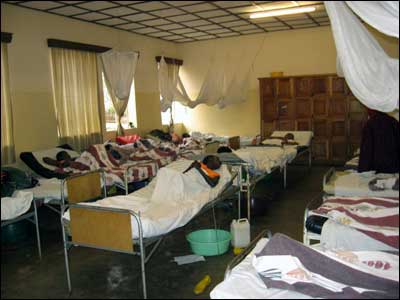
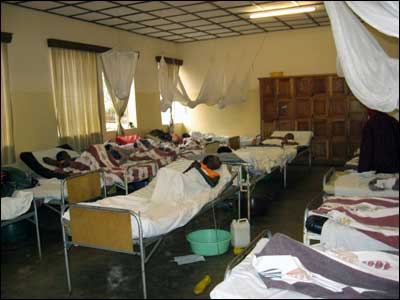
Women in beds at Panzi Hospital in Bukavu, Democratic Republic of Congo
Women recovering from fistula surgery.

Mukwege works fourteen-hour days, seven days a week, and is the only surgeon around qualified to perform complex gynecological surgeries. Twenty-five percent of the rape victims who come to Panzi must undergo surgery to repair their torn tissues, he says.

In the surgery ward, hundreds of thin women lay on metal beds next to each other, wearing threadbare cloths and protected by patchwork mosquito nets. Rubber hoses drip into open plastic buckets at the feet of their beds.

Inside his office, Mukwege speaks with a mix of outrage and exhaustion. (His experiences with rape victims were documented in the 2002 Human Rights Watch report The War within the War: Sexual Violence against Women and Girls in Eastern Congo.) He has been telling the international press about this crisis for years. But despite coverage by the BBC, CNN, and the New York Times, the gruesome violence has turned even more troubling: it has become normal to both the international community and the local people, Mukwege says. “That’s my fear, because we’ve shouted ‘Rape, rape, rape!’ And when nothing is done, it’s total impunity. Those who commit these acts — they know they can get away with it.”

The result is a problem “so vast, but also, in a sense, forgotten, in terms of the international radar screen,” says Pernille Ironside, a child protection specialist for UNICEF in Eastern Congo. “But in reality, what we are seeing in terms of sexual violence in the Congo is unparalleled in any other country.”

Listeners of Radio Okapi, a local station, can listen to daily reports of rape. Mukwege fears the routine reporting is leaving the community numb. His patients have come to see their lives as worth nothing.

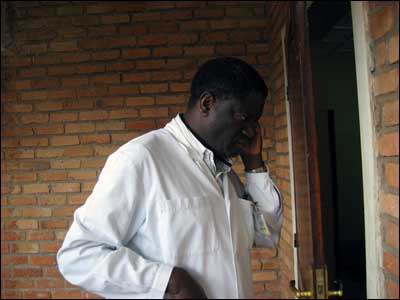
Dr. Denis Mukwege Mukengere outside Panzi Hospital in Bukavu, Democratic Republic of Congo
Dr. Denis Mukwege Mukengere, leaving his office at Panzi Hospital.

One woman described her life as less valuable than that of a chicken, he says. “A chicken is someone’s property, and they protect it. And if you kill your neighbor’s chicken, the neighbor says to you, ‘You’re a bad person, why did you kill the neighbor’s chicken?’” the woman explained to Mukwege. “But when I go out and get wood and other things, they just take me and rape me.”

Mukwege says he no longer listens to his patients’ stories. They are too emotionally draining, so he just sticks to performing operations. “I thought I could help them. But in the end, I understood that I got more and more depressed.” He continues to host reporters in between surgeries, but is skeptical of the value.

“I’ve seen important people in this world pass through the hospital,” he says. “I’ve seen them in tears, and then nothing is done.”

UPDATE, 3/8/13: Edited and moved story from our old site to the current one.


Ghostbusters and state radio

As much as I enjoy paying for the right to view movies, it can get a little tough in Seoul where English movies, especially the non-big-budget ones, are hard to come by. So, like everyone else over here, I watch them on the Internet. While relaxing at home on my bed. Laying in the sunlight. It’s been a gray week in Seoul. Squinting at the screen. Video piraters are not known for a high-quality product.

An interuption here. I’ll never buy another pirated video, though. I purchased what I thought was all three Godfather movies from a street vendor. It contained two blank disks. I got the best one, number one, but I really, really wanted number two. What a waste of 10,000 won. I suppose it was the karma fairy exacting her penalty.

I watched Be Kind Rewind. At first I was a bit incredulous. But it got me in the scene where Mos Def and Jack Black attempt to reshoot Ghostbusters, including the famous (ok, to me) opening scene with the librarian. The movie touched on all those themes that white people love: (please see the blog www.stuffwhitepeoplelike.wordpress.com for clarification on this statement) gentrification, community involvment, and the corporate strong arm.

Watch it. For free or not. Perhaps we’ve entered a time when art can be free to the masses via a solid Internet connection. À la Radiohead. Of course, they already had a following. I don’t suppose this movement helps all you starving artists out there. But I should talk, my field (print reporting) is becoming obsolete because of Internet reporting and blogging. But that’s another story.

I’m falling in love with State Radio’s new album Year of the Crow. Check them out online at www.stateradio.com. They are intellectual. Angry. Punk. Sometimes acoustic. All you Dispatch fans will likey. My favorites: "The Story of Benjamin Darling" and "The Fall of the American Empire."


Barack Obama caught with plastic bags

Presidential hopeful-senator-supposed environmental advocate Barack Obama proves in this week’s US Magazine that he’s "just like US!" by happily accepting groceries in non-biodegradable plastic bags: 

One of ever green’s very first posts in January 2007 was about the continuing scourge of plastic bags. The very first paragraph could be applied directly to this photo of Senator Obama:

Here’s a familiar scenario. You go to the grocery store, get your items and, at the checkout counter, a bagger puts your items into several plastic bags. The bags are never filled to capacity, sometimes only a few items are put into each bag, and usually the bags are doubled. You then head out of the store with many more bags than you need.

Look closely at the two bags Mr. Obama accepts in the picture…they are barely full. He could have at least only used one bag instead of two.

Evironmental responsibility rests on many things, but it’s really the individual person — as elected officials campaigning surely know about — that can make change for the better.

One would think that for such an important campaign and the environment as a high priority, Senator Obama’s advisors or supporters could have given him a reusable canvas bag for him to shop with.

I looked around and found a nice bag for him to use: 

Mr. Obama may have scored a lifetime League of Conservation Voters score of 96 out of 100 for his first two years in the Senate — but ever green gives him a 0 just from this picture alone.

On the other side, Senator Hillary Clinton has a LCV score of 90 for six years service and her campaign is carbon neutral. Ever green has endorsed her as Democratic presidential nominee.


keeping the earth ever green

Check out another early ever green photo essay on plastic bag litter

personal stories. global issues.