Blog


The Jewel of Medina

“All this saddens me. Literature moves civilizations forward, and Islam is no exception.”

Asra Nomani decries the indefinite postponement of the publication of Sherry Jones’ novel, The Jewel of Medina, which was originally slated for publication on August 12th.  The novel ostensibly the first in a two-book, $100,000 deal with Random House portrays the life of A’isha, who is typically characterized as the prophet of Islam Muhammad’s favorite wife.  The novel charts A’isha’s life from her engagement to the Prophet Muhammad at age six up through his death. 

Nomani, a former reporter for The Wall Street Journal, argues that Random House cancelled the novel’s upcoming publication due to fears that Jones’ book would instigate an upheaval similar to that caused by Sir Salman Rushdie’s Satanic Verses.  Sir Salman’s 1988 novel was condemned as blasphemous, and Iran’s late Ayatollah Khomeini declared a non-binding legal opinion, or fatwa, urging the execution of Sir Salman. Nomani penned an opinion piece this past week in The Wall Street Journal that laid the blame for the book’s cancellation on Denise Spellburg, Associate Professor of History and Middle Eastern Studies at the University of Texas at Austin.  Spellburg served as a consulting historian and was asked to comment on the book by Random House.

Defending herself against accusations that she derailed the publication of The Jewel of Medina, Denise Spellburg wrote in The Wall Street Journal:


As a historian invited to "comment" on the book by its Random House editor at the author’s express request, I objected strenuously to the claim that "The Jewel of Medina" was "extensively researched," as stated on the book jacket. As an expert on Aisha’s life, I felt it was my professional responsibility to counter this novel’s fallacious representation of a very real woman’s life. The author and the press brought me into a process, and I used my scholarly expertise to assess the novel. It was in that same professional capacity that I felt it my duty to warn the press of the novel’s potential to provoke anger among some Muslims.

Random House neutrally insists that the decision was made "for the safety of the author, employees of Random House, booksellers and anyone else who would be involved in distribution and sale of the novel.”

Readers will have to judge the work for themselves. The only excerpt currently available includes Jones’ portrayal of the consummation of A’isha’s marriage to the Prophet Muhammad: "the pain of consummation soon melted away. Muhammad was so gentle. I hardly felt the scorpion’s sting…”

It may be that this feat of fictional imagineering may have almost nothing in common, save for its foray into the politically and religiously sensitive, with Sir Salman’s novel.


Chinese pollution vs. U.S. pollution: media misses the big picture

There is no escape from the frenzy of Beijing Olympics coverage. And the one thing that all the American media can’t talk enough about is how polluted the city and/or country is.

There are daily haze reports, particulate meter readings, algae bloom cleanups, athletes arriving in the airport in masks, athletes training in other countries to only enter Beijing on the day of their event, etc.

China is polluted; there is no doubt about that. But the media coverage so far makes it seem like China is the only country at fault for polluting the Earth and ruining the environment.

All this pollution watch coverage doesn’t deflect from the fact the United States still is one of the top per capita carbon emitters on the planet. But the media seem to overlook this and none have mentioned this in any of their reports about China’s pollution.

China’s population is 1.3 billion people and growing; but each person’s carbon footprint is minimal compared to individual Americans. Most Americans own a car; sometimes a family owns more than one car. And most need to drive to get to work, or run errands, or even to get to spots where we can enjoy nature. We usually live in houses that consume a lot of energy from electronics like computers, flat-screen televisions, washing/drying machines, etc. A lot of rural Chinese don’t have electricity or large houses or cars. Those that live in cities usually live in apartments, which use less electricity than houses, and get around by public transportation or bicycle.

But the Chinese lifestyle and country has changed over the past decades. The opening up of the economy has lifted many of its citizens out of poverty but, in return, has turned them into consumers. Many of the nouveau-riche now want cars, electronics, and other things that make their lives more comfortable, but at the cost to their environment. But why should the media criticize the Chinese for wanting and creating lifestyles that are similar to Americans at the same financial levels yet not pointing out the polluting ways of ourselves?

Foreign companies moved into China to take advantage of cheap labor and thus are directly responsible for creating factories that spew out the pollution that everyone is so critical to the Chinese about. The Chinese government is to blame because they should have put regulations in place to control the levels of toxins emitted instead of just seeing dollar signs in their eyes. But the foreign companies, many of them American, are responsible too, yet they turn a blind eye and also see only profit margins and moneymaking ability.

The media needs to dig deeper in their China pollution coverage to uncover the unpopular truths about who really is to blame and is responsible for the unfortunate environmental problems that China is dealing with now.

They would find that their coverage is hypocritical and irresponsible, especially considering all the airplane rides and energy-consumption their Olympics coverage is using up.

keeping the earth ever green


Is our food made from petroleum?

Everything you were afraid to ask about Pringles and petroleum. 

A reader E. commented on my post, "The politics of Pringles," asking whether the claims in it were true. I wasn’t sure if E. was talking about the post itself or another reader comment, which claimed that the food we eat is made from petroleum. In any case, here are the facts on both claims:

Are Pringles potato chips, or some potato-like substance in a can?

The latter. Their potato content is less than 50 percent, and Procter & Gamble, the maker of Pringles, has itself argued in a British court that the Pringle cannot be considered a "potato crisp" (the British term for "potato chip"). For corroboration, see the links in my previous post, or this BBC article

Now, there is a silly Internet rumor floating around that Pringles are made from leftover McDonald’s French fries, which is untrue, as this post at urbanlegends.about.com makes clear. That said, there is also a lot of funny business that goes into making McDonald’s French fries taste so good, as you can read here.

Is our food made from petroleum?

It depends on what you mean by "made from."

Today’s industrial farms grow crops like corn and wheat using chemical fertilizers and pesticides, both of which are derived from petroleum. Fossil fuels are also needed to plow and irrigate the fields and ship the harvest to market. (See this New York Times article about how rising fuel costs are hurting American farmers.)

So, our food is made using lots and lots of petroleum. Even in organic industrial agriculture, the fossil-fuel tab is considerable: Michael Pollan says that the 80 calories of energy in a single, one-pound box of lettuce requires the burning of 4,600 calories of fossil fuels to produce and ship.

Is petroleum actually in our food?

If you are like most Americans and eat food with artificial dyes in it, then yes.

Synthetic food dyes are "derived primarily from petroleum and coal sources," according to the Food and Drug Administration. In fact, this U.S. News article points out that the fears about the ill effects that petroleum- and coal-based artificial dyes may have on children are prompting companies to switch to natural, carmine-based dyes. The problem is, carmine is made from ground-up insects. Carmine also happens to be an allergen.

And so it goes.

Victor Tan Chen is In The Fray's editor in chief and the author of Cut Loose: Jobless and Hopeless in an Unfair Economy. Site: victortanchen.com | Facebook | Twitter: @victortanchen


Stand up, speak out

Freedom of speech is one of the most basic rights we enjoy in the United States. It is something so deeply engrained into our shared culture that we often forget that there is always a price to be paid for speaking out against injustice. Be it the scorn of others who disagree with one’s activism, or be it governmental censorship and outright oppression, social activists often suffer consequences for their views, words, and actions. In this month’s issue, we share stories of people who make their voices heard (and one who doesn’t) and the cost of such freedom.

We begin with Amy Brozio-Andrews’ review of Janis Hallowell’s novel She Was, in which a 1970s Vietnam War protester crosses the line between activism and terrorism. The consequences of this error in judgment follow her as she builds a new life as a suburban mother and community volunteer.

Often the price of speaking out is the feeling futility. In Will Harlem lose its soul? , William Bredderman talks to Philip Bulgar about Manna’s, the Harlem eatery that’s been serving some of the best soul food New York has to offer for more than 20 years. As gentrification spreads into Harlem, the building that houses Manna’s has been purchased and slated for demolition and redevelopment. Bulgar and the residents of Harlem know that a community landmark is in danger, but their voices seem buried under the voices of the wealthy, who stand to make a fortune from a new shopping plaza on the location.

Tumen Ulzii knows more about the consequences of speaking out than most. In Writer in exile , Ming Holden tells of the Inner Mongolian dissident’s struggles against the Chinese government as he tells the story of the oppression of the Inner Mongolian people.

Sometimes, though, the price we pay for not speaking out is just as high. In Dialects , a poem by Rokshani Chokshi, the white skin of the poem’s subject does all her speaking for her. Marlon Rachquel Moore shares the emotions she bears when she stays silent in the face of a common injustice in her article Confessions of a female boxer .

Whether the consequences are physical and oppressive as with Tumen Ulzii, or internal and psychological, as with Marlon Rachquel Moore, the decision to speak out or remain silent always bears a cost. It is for each of us to determine for ourselves if the price of activism is one that we are willing to pay, or if we can afford to remain silent.

I am a writer/editor turned web developer. I've served as both Editor-in-chief and Technical Developer of In The Fray Magazine over the past 5 years. I am gainfully employed, writing, editing and developing on the web for a small private college in Duluth, MN. I enjoy both silence and heavy metal, John Milton and Stephen King, sunrise and sunset. Like all of us, I contain multitudes.


Examining the Environmental Protection Agency

On its website the EPA claims:

The mission of the Environmental Protection Agency is to protect human health and the environment. Since 1970, EPA has been working for a cleaner, healthier environment for the American people.

The EPA, that many could now call the Environmental Polluting Agency, has taken some hits during the current Bush administration. Mr. Bush set his environmental agenda early by pulling out of the Kyoto Protocol (the greenhouse gas reduction treaty) shortly after coming into office, declaring it "fatally flawed."

In 2001 President Bush appointed former Governor of New Jersey Christine Todd Whitman as EPA Administrator. She resigned two years later after butting heads with the government over issues such as global warming and greenhouse gas emissions reduction. Ms. Whitman has also been questioned about her role in the environmental ethics of the agency when she was called to testify before Congress in 2007 about whether she misled World Trade Center site workers and residents about air-quality safety post 9/11. The EPA claimed the air was safe to breathe days after the attacks, subsequent collapse, and cleanup of the area in lower Manhattan – yet many people have been stricken with respiratory problems directly linked to having inhaled the tainted air.

Current EPA head Stephen Johnson has been called on to resign this week by four senators on the Environment and Public Works Committee. In a letter to Attorney General Michael Mukasey, the senators claim that Johnson abused his position by lying under oath. They say he hindered a waiver for California to set their own vehicle emissions standards under the Clean Air Act due to presidential policy preferences, "rather than the lack of compelling and extraordinary circumstances." 

Last December, the EPA blocked California’s request to set their own law regarding vehicle emissions. Mr. Johnson said the decision was because "the Bush administration is moving forward with a clear national solution, not a confusing patchwork of state rules."

Sixteen states that wanted to adopt the California emissions standards could also back California if legal action is taken.

California’s Attorney General Edmund G. Brown Jr. also threatened the EPA with legal action if they don’t start regulating the greenhouse gas emissions coming from port vehicles such as container ships and trucks.

"Ships, aircraft and industrial equipment burn huge quantities of fossil fuel and cause massive greenhouse gas pollution. Because Bush’s Environmental Protection Agency continues to wantonly disregard its duty to regulate pollution, California is forced to seek judicial action."

The EPA has also come under fire this week by Florida U.S. District Judge Alan Gold who ruled that the agency failed to protect the Everglades under the Clean Water Act. Judge Gold said the agency turned a "blind eye" to the mandated cleanup program limiting the amount of damaging phosphorus runoff from sugar and dairy farms. The pollution reduction was set with a 2006 deadline, one that the sugar industry blocked with a bill that favored a more lenient 2016 gradual reduction schedule. Phosphorus is blamed for native vegetation die-off.

The agency that was built around the premise to regulate and help protect the environment has grown corrupt and needs some regulation of its own. The Bush Administration seems content to corrupt and manipulate the environment for its own agenda – and it seems to be happy to ruin the environment up until Mr. Bush’s last days in office.  

keeping the earth ever green


Eco-shaped bottles — better for the environment?

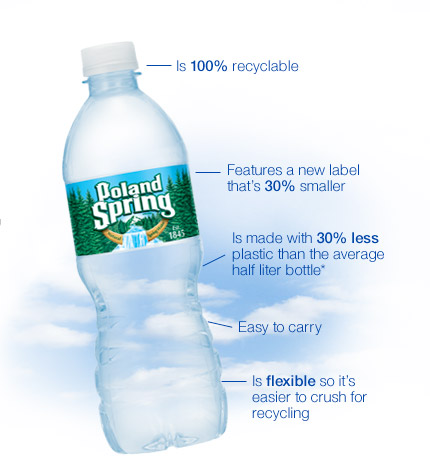
Half-liter eco-shaped bottles seem to be everywhere now, and they have already caused notice from environmentalists.

The Numbers Guy, Carl Bialik, from The Wall Street Journal noticed these slimmer bottles last December and crunched all the numbers and stats about them. The Carbon Conscious Consumer really criticizes the so-called "oxymoron" of this environmentally-friendly bottled water. And Planet Trash slams the new shape as marketing hype.

So what is the big deal about these so-called more environmentally-friendly bottles? Most of the bottle water companies claim the following points:

1) Less plastic is used to manufacture the bottles.

2) The eco-shape bottle is 100 percent recyclable.

3) Other eco-features touted include a smaller label, the bottle can be crushed for recycling, and it’s easy to carry.

The bottled water manufacturers are claiming that the eco-shape cuts down on the amount of plastic used to make one bottle — 30 percent less to be exact. But that’s only 30 percent less plastic than the old bottles; the new bottles themselves are not made out of recycled plastic, which is what it seemed like the eco-shape was about.

They are being misleading when claiming that one of the new features is that the eco-shape bottle is 100 percent recyclable. They make it seem like the old bottles weren’t recyclable when, in fact, they were 100 percent recyclable, too.

But it seems that the half-liter bottle size is the only plastic bottle with the new eco-shape. All the other sizes appear to look the same as they have for decades and there hasn’t been any eco-hype about more enviro-friendly liter or gallon bottles.

The bottled water companies are at least going in the right direction. Although buying and drinking bottled water has been frowned upon, it is still healthier to drink water than other bottled alternatives like soda pop.

In an old ever green post about shooting down the negatives of drinking bottled water, the media was criticized for blaming bottled-water manufacturers with clogging up the world with plastic bottles. All bottled drink manufacturers, not just bottled water companies, have the responsibility to the planet for having easily recyclable containers — which for the most part they do. Aluminum cans and plastic bottles are all easily recyclable.

So the good news about the new eco-shape bottle is that it uses less plastic in the manufacturing process. No matter if the product is 100 percent recyclable, starting from the beginning by having less to recycle is always good.

But the most eco-friendly way to drink water is from the tap. Bringing your own refillable water container to work or wherever is always a better alternative than buying one — even if it is in an eco-shape.

keeping the earth ever green


An honest audience

My last experience playing a musical instrument of any kind was about 15 years ago. I was in the supposedly soundproof practice rooms of my college’s music building.

After I spent not an insignificant amount of time tuning my borrowed guitar, I launched into a show-stopping rendition of "Row, Row, Row Your Boat." When I finished I distinctly heard a beautiful melody coming from the next room in which there apparently was a protégé of Yo Yo Ma doing Bach.

I know everyone has to begin somewhere, a journey of 1,000 miles begins with one step, etc., etc., but since then I’ve not been inclined to play the guitar while any souls are within a 100-yard radius. Considering I live in spitting distance of eight million people, you can safely conclude I don’t play at all. Note: This also applies to karaoke no matter how many drinks I’ve had.

So I admire the folks who put themselves out there, get up on stage, and bare their souls. It’s indeed a strange exercise to subject oneself to extreme vulnerability on a regular basis. (You writers know what I’m talking about, too.) The hardiest of these is the subway busker. Some are great and some should take a vow of silence, but either way, these people have guts. They play in hostile environments trains roaring into the stations, brakes squealing, heat, gross stuff being thrown into their instrument cases, and possibly the worst, people just ignoring them. It’s a bit masochistic if you think about. Most do it, not for the pittance of change they get, but because they are driven to play music for people.

That’s one of the reasons I invited Don Witter to play at the book release party for The Subway Chronicles at the New York Transit Museum, housed in a converted subway station. He left his job in 1994 as a computer network troubleshooter to play classical guitar full time. He considers playing in the subway “as natural as anything else.”

Grand Army Plaza is his preferred station. I see him every Wednesday morning. He positions himself on a stool under his banner and plays one soothing tune after another. My favorite is "Girl from Ipanema." Yeah, I’d rather be on a beach in Brazil than 100 feet underground on my way to work.

Recently at Grand Army Plaza there has been a man playing a full-size harp. I mean, good gracious, how dedicated (read crazy) you must be to lug that thing from your apartment, all the way to the station, and then down at least two flights of stairs to the platform. (See the November 27th post.)

It’s a misunderstanding to think that buskers perform in the stations because they can’t get other gigs. Don, who is a member of Music Under New York (MUNY), an MTA group that boasts membership of 100 musicians and organizes the stations and times of their performances, regularly plays around the city, including venues like Lincoln Center. The musicians in MUNY range from the Big Apple Quartet (barbershop) to the Ebony Hillbillies (left) to Sean Grissom, the Cajun cellist (linked on YouTube). From what I understand the auditions are fairly rigorous.

But I’m just not sure what to make of the Saw Lady. I guess if teenage boys can turn plastic containers into drums, why can’t she wield music from a saw? She’s performed in Paris, Rome, Florence, Prague, and Tel-Aviv but likes busking in New York best. “New Yorkers make an honest audience.”

I think that’s all that anyone, be it musician, writer, tax attorney, is looking for: an honest audience. Validation is a powerful thing. When I ask trusted friends to read my work, the absolute worst response I could receive is, “It’s good.” If I wanted an answer like that I’d just give it to my mom, who thinks everything I put on paper is better than Hemingway. (Thanks, Mom!)

That’s the blessing and curse that buskers live with instant feedback. As Don put it, “You have to have character to play there.” He has also learned some valuable tips from playing on the platform. "If someone is hanging around too long, do not have too much money in your case. Play every single note well and bring your business cards because you never know who might hire you."

That’s probably Susan Cagle’s mantra: "You never know." More on her during the next post.

Listen to Don Witter play "Girl from Ipanema" here.


The race war in Darfur

Here's one of the most concise pieces I've seen detailing the genocide in Darfur.

Here’s one of the most concise pieces I’ve seen detailing the genocide in Darfur:

It seems to me that not enough attention is being paid to the racial component of the killings. This 60 Minutes piece describes the African Arab militias known as the Janjaweed as “racist,” which is an apt term but one I’ve rarely heard, even though it might translate the genocide there into terms that Westerners can better understand. The social categories in Sudan are complicated, as they are everywhere, but that said the genocide there is not unlike the lynchings and other kinds of Jim Crow-era violence that whites used to intimidate, terrorize, and drive off African Americans.

Victor Tan Chen is In The Fray's editor in chief and the author of Cut Loose: Jobless and Hopeless in an Unfair Economy. Site: victortanchen.com | Facebook | Twitter: @victortanchen