- Follow us on Twitter: @inthefray
- Comment on stories or like us on Facebook
- Subscribe to our free email newsletter
- Send us your writing, photography, or artwork
- Republish our Creative Commons-licensed content
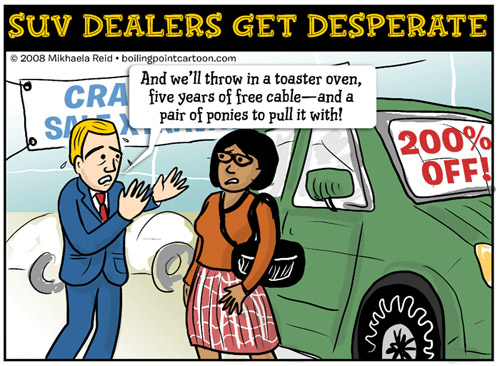
Free ponies!
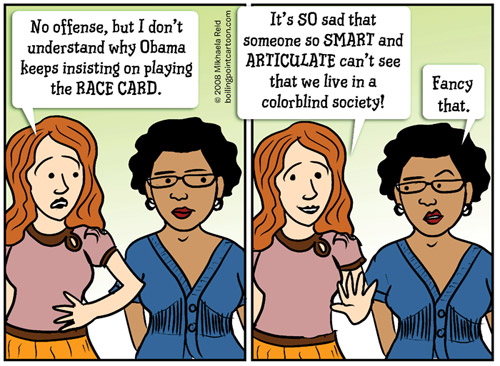
Race card.
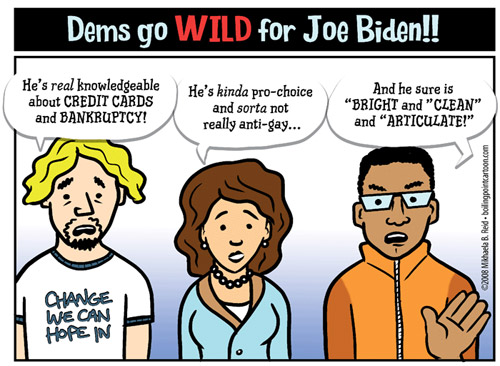
Sqeeky clean.
The history of humanity is a history of movement. As the first humans wandered out of Africa and began to spread across Europe and Asia, and then North America and South America, they became the world’s first immigrants. Just as with those who immigrate today, these mass migrations were made up of hundreds or thousands of individuals and families, each with their own story of how they uprooted themselves from their homes and ventured out into the unknown, encountering unfamiliar environments and searching for a better life. In this month’s issue, we feature a few of these personal stories of immigrants, refugees, and migrants.
Our journey begins with The jaunt, a story by Ashish Mehta about a journey with no obvious destination. Two people leave their home with nothing, one following the other, walking into the unknown with a purpose deeper than understanding.
Like these two people, David Ngaruri Kenney left his home in Kenya for the unknown, fleeing persecution for a U.S. basketball scholarship. In A "little death penalty" case, Scott Kuhagen talks with Philip Schrag about Kenney’s legal struggle for political asylum in the United States.
The pressure to assimilate can weigh heavily on a new immigrant, but nostalgia about what’s been left behind can be stronger. In Feeding the need, Amy Brozio-Andrews reviews Broccoli and Other Tales of Food and Love by Lara Vapnyar, a book of short stories about how familiar food can assuage the loneliness of an unfamiliar country.
Immigrant communities can be another way to ease the pain of transition. Rose Symotiuk, who emigrated from Poland as a young child, grew up in the United States without this sense of community. In Notes from a "white immigrant", she writes of what it feels like to grow up as a "stealth foreigner": someone whose skin color doesn’t advertise her place of birth.
As immigrants settle, they gradually become residents, giving birth to children who call their adopted country home. Ties to the "old country" begin to fade as the generations progress, until eventually a family has little connection to its ancestral lands. Jane Varley, the great granddaughter of Lithuanian immigrants, writes in Where the moon is a hole in the sky of her encounter with her great grandparents’ homeland.
In Scenes from a party in Uganda, Jennifer Lee Johnson gets a taste of a newcomer’s cultural disorientation when she discovers that Ugandan relationships function in a very different manner than American relationships — and realizes that this isn’t a bad thing.
Finally, we turn to Adam Marksteiner, who brings us to San Lucas Tolimán, Guatemala for their Holy Week celebrations in his stunning visual essay Semana Santa.
The movement of people has shaped our world in the past and will continue to do so in the future. While those who leave are shaped by the country they move to, so too is their adoptive home shaped by the culture and traditions they bring with them. Far from diluting the dominant society, the culture immigrants bring with them rather enhances a country, bringing the spices, flavors, and ideas from another part of the world and adding them to the mix. It is this constant flow of people from one part of the world to the other that keeps culture vibrant and alive, a growing entity that is beautiful and strong.
Aaron Richner I am a writer/editor turned web developer. I've served as both Editor-in-chief and Technical Developer of In The Fray Magazine over the past 5 years. I am gainfully employed, writing, editing and developing on the web for a small private college in Duluth, MN. I enjoy both silence and heavy metal, John Milton and Stephen King, sunrise and sunset. Like all of us, I contain multitudes.
The stadium-sized acceptance speech that Barack Obama gave tonight has been compared to those of FDR and JFK, but the note he struck by the speech's end reminded me of a Republican: Ronald Reagan.
Obama's Denver speech was a mirror image of Reagan's acceptance speech in 1980, in which the California governor called for an end to big government:
As your nominee, I pledge to restore to the federal government the capacity to do the people's work without dominating their lives. I pledge to you a government that will not only work well, but wisely; its ability to act tempered by prudence and its willingness to do good balanced by the knowledge that government is never more dangerous than when our desire to have it help us blinds us to its great power to harm us.
Reagan was riding a wave of popular protest against government waste and excess. Obama spoke tonight at a time when a lack of good government — from a crippled FEMA to shoddy bridge maintenance to unaffordable health care to unscrupulous military subcontractors — is the problem. Big government "harms," Reagan said, and to that Obama answered tonight: So does an impotent government.
Ours is a promise that says government cannot solve all our problems, but what it should do is that which we cannot do for ourselves — protect us from harm and provide every child a decent education; keep our water clean and our toys safe; invest in new schools and new roads and new science and technology.
Our government should work for us, not against us. It should help us, not hurt us. It should ensure opportunity not just for those with the most money and influence, but for every American who's willing to work.
(In his defense of government, Obama also channeled Roosevelt's "rendezvous with destiny" acceptance speech: "Better the occasional faults of a government that lives in a spirit of charity than the consistent omissions of a government frozen in the ice of its own indifference.")
Reagan's 1980 acceptance speech chastised the Carter administration for breaking the compact between elected leaders and the people, by betraying the values of the American people:
"Trust me" government asks that we concentrate our hopes and dreams on one man; that we trust him to do what's best for us. My view of government places trust not in one person or one party, but in those values that transcend persons and parties. The trust is where it belongs — in the people. The responsibility to live up to that trust is where it belongs, in their elected leaders. That kind of relationship, between the people and their elected leaders, is a special kind of compact.
Obama, too, talked of the disconnect between Washington's leaders and the American people, but he gave this sentiment a more populist slant. His candidacy, he declared, was about people rising up on behalf of a new politics — not placing their trust in a leader, but bringing about change themselves:
But I stand before you tonight because all across America something is stirring. What the nay-sayers don't understand is that this election has never been about me. It's been about you.
For eighteen long months, you have stood up, one by one, and said enough to the politics of the past. You understand that in this election, the greatest risk we can take is to try the same old politics with the same old players and expect a different result. You have shown what history teaches us — that at defining moments like this one, the change we need doesn't come from Washington. Change comes to Washington. Change happens because the American people demand it — because they rise up and insist on new ideas and new leadership, a new politics for a new time.
Reagan spoke of an "American spirit" that transcends the differences that divide Americans, that rests in hard work and love of freedom:
Tonight, let us dedicate ourselves to renewing the American compact. I ask you not simply to "Trust me," but to trust your values — our values — and to hold me responsible for living up to them. I ask you to trust that American spirit which knows no ethnic, religious, social, political, regional, or economic boundaries; the spirit that burned with zeal in the hearts of millions of immigrants from every corner of the Earth who came here in search of freedom.
Some say that spirit no longer exists. But I have seen it — I have felt it — all across the land; in the big cities, the small towns and in rural America. The American spirit is still there, ready to blaze into life if you and I are willing to do what has to be done; the practical, down-to-earth things that will stimulate our economy, increase productivity and put America back to work. The time is now to resolve that the basis of a firm and principled foreign policy is one that takes the world as it is and seeks to change it by leadership and example; not by harangue, harassment or wishful thinking.
Obama invoked again this "American spirit," this unifying creed built on the backs of immigrants, but he emphasized its moral and spiritual dimension, in Americans' constant striving toward the immaterial, the "unseen":
Instead, it is that American spirit — that American promise — that pushes us forward even when the path is uncertain; that binds us together in spite of our differences; that makes us fix our eye not on what is seen, but what is unseen, that better place around the bend.
That promise is our greatest inheritance. It's a promise I make to my daughters when I tuck them in at night, and a promise that you make to yours — a promise that has led immigrants to cross oceans and pioneers to travel west; a promise that led workers to picket lines, and women to reach for the ballot.
Finally, Obama's speech, like Reagan's, was a direct appeal to national unity, attempting to bridge an intensely partisan political landscape. Reagan, who as president would draw fierce criticism for policies hostile to minorities, reached out explicitly to them in his acceptance speech — "When those in leadership give us tax increases and tell us we must also do with less, have they thought about those who have always had less — especially the minorities?" He broadly appealed to "Democrats, Independents, and Republicans" with an optimistic message that combined the moral tenets of American liberalism and conversatism: compassion and personal responsibility, "the shared values of family, work, neighborhood, peace and freedom" — while making the conservative case that American could be more compassionate if government was less powerful.
Together, let us make this a new beginning. Let us make a commitment to care for the needy; to teach our children the values and the virtues handed down to us by our families; to have the courage to defend those values and the willingness to sacrifice for them.
Let us pledge to restore, in our time, the American spirit of voluntary service, of cooperation, of private and community initiative; a spirit that flows like a deep and mighty river through the history of our nation.
Obama, too, sought to downplay political differences, while making overtures to a segment of the electorate skeptical of Democrats: national security voters. "Patriotism has no party," he said. "Democrats and Republicans and Independents" fighting abroad "have not served a Red America or a Blue America — they have served the United States of America."
In a nod to conservatives, he spoke of the importance of both "individual responsibility and mutual responsibility" — even as his political purpose was to emphasize the latter, casting the moral imperative of compassion in biblical language:
That's the promise of America — the idea that we are responsible for ourselves, but that we also rise or fall as one nation; the fundamental belief that I am my brother's keeper; I am my sister's keeper.
"I believe that this generation of Americans today has a rendezvous with destiny," Reagan said in his 1980 speech, an explicit reference to FDR's 1936 convention speech. Now Obama has taken the rhetoric of Reagan and used it in the service of a diametrical vision of compassionate government and shared prosperity.
Obama has himself talked about how Reagan "changed the trajectory" of America, and it seems that Obama desires to lead a similar transformation of the country's politics — though in the opposite ideological direction. The echoes of Reagan in his acceptance speech suggest that he already has this goal in mind.
So, if the 2004 election was a repeat of the Goldwater-LBJ election, perhaps 2008 will be a replaying of the 1980 election: an unpopular president succeeded by a charismatic leader, who brings a new consensus to national politics. We will have to wait three months to see whether Obama has his rendezvous with destiny.
Victor Tan Chen Victor Tan Chen is In The Fray's editor in chief and the author of Cut Loose: Jobless and Hopeless in an Unfair Economy. Site: victortanchen.com | Facebook | Twitter: @victortanchen
There are several things one doesn’t expect to see while riding the subway, among them: wheelchairs, pets, people having sex, aerobeds, Santa Claus, and rain inside the station. I’m not saying that these things never appear on the subway, but it’s rare. So when you happen upon one, you are stirred out of your general comatose-like state and take notice.
I awoke yesterday to find, instead of the torrential downpour predicted, nary a drop on the ground, so I was already in a good mood when I got to Grand Army Plaza, not having had to trudge through it all. Then the train came quickly and I got the last seat in the car. Monday was off to a kick-ass start.
The man on my left looked impeccable — tailored trench coat, cuff links peeking out from the sleeves, wing-tipped shoes. His hands rested on a monogrammed duffle bag on his lap. I would have sworn he had a manicure.
I had my book open (Amy Bloom’s latest Away), but felt my lids were sinking, sinking closed. (This is in no way a commentary on Ms. Bloom’s novel.) I thought I felt something brush against my thigh, but nothing alarming. Then I felt it again, a little harder. My eyes flicked open. Generally, touching of a fondling or pick-pocket nature doesn’t happen while one is sitting and usually only on very crowded trains. My mind wasn’t grasping what was going on.
A dog — a ten-pound, brown dachshund — had his two front paws on my leg and his two back paws on the man to my left. First thought: “Whaaa?” Second thought: “Awww!”
The man, flustered, attempted to lift the dog off of me. “I’m really sorry. He just leapt out.” He pointed to the duffle bag. Then, he talked to the dog. “Pickles, you have to stay in the bag. You know that.”
Pickles did not want to go back in the bag. He resisted in the style of a Tom and Jerry cartoon where Tom splays all limbs across a doorway to avoid being pushed through. I’ll admit I was a little flattered that Pickles was interested in me.
“Don’t worry. He probably just smells my dog,” I said. I returned to my book, trying not to stare at adorable little Pickles.
But Pickles was a sly one. He lay down on the man’s lap and gave him a don’t-worry-about-me-I’m-just-resting glance. The second the man relaxed, Pickles was up like a shot and sniffing all around my legs, leaving gobs of drool on my coat. This was going too far — Pickles and I barely knew each other.
The man was trying to rein him in a sort of lackluster way while Pickles was pointing his long snout in my pocket, rooting around. I tried to grab his collar to pull him off when he backed away all on his own, triumphant in his victory. From my pocket Pickles emerged with a rawhide I must have forgotten to give to my dog before I left the apartment.
Note to self: Prior to entering the subway station, empty pockets of all keys, money, cell phone, and dog treats.
Forget the hybrid vehicle or even a bicycle; the most eco-friendly way to get to work is by your own two feet.
Transportation options for the environmentally inclined are fuel-efficient vehicles, bicycles, or public transportation.
The government even gives tax rebates to people who buy hybrid vehicles; but cars — no matter how environmentally friendly — still use gas.
Biking is pretty good for the environment; but you need a bike, a lock, a helmet, and a good sense of not being hit by crazy traffic.
But no one is advocating just walking to work. Granted most people don’t live close enough to be able to do this, unless they live in cities like New York. It’s a shame because walking is one of the nicest and most eco-friendly ways to get to work; I should know because that’s what I’ve been doing for over a year.
It takes me around 30 minutes to walk to work, and not being tethered to subway or bus is freedom.
I’ll answer some questions below about my experiences:
Why did you start walking?
I actually started walking because the public transportation fares were going up. I figured it takes almost the same amount of time to walk as it does to: get to the subway, wait for it, get out at the stop, and walk the rest of the way to the office. It’s also better for the environment, plus I get to enjoy nature along the way.
What about when the weather is bad?
I try to walk all the time, even if it’s cold, really hot, or even raining. Walking, especially when it’s raining, is really the quickest way, because sometimes the subways flood so the trains can get delayed. Sometimes when it’s really hot, I’ll go to the gym first which is fairly close to work, so I won’t arrive all sweaty.
What do you see on your walk?
I see lots of different people out and about. There are dog walkers, tourists, and sometime movie or television production people setting up. Sometimes I see interesting wildlife; I’ve seen a raccoon, falcons, a dead rat, and lots of pigeons. In the subway you only see live rats.
What’s the best thing about walking — and the worst?
The best thing is getting fresh air and knowing exactly when I’ll get to my destination. When I walk I never have to worry about if the train will get me there on time or exactly what time I’ll get there. Walking gives me the freedom to set my own time. The worst is when strange men make comments and get offended when I don’t respond, and also if the weather is bad.
What about when you get to work — do you walk up the stairs too?
I do very occasionally walk up the stairs. I figure taking the elevator at that point is something I deserve. But I do walk up and down the stairs of my apartment building.
keeping the earth ever green
Pringles are not potatoes. And now Hershey's Kissables are no longer "candy coated milk chocolate," but "chocolate candy."
From the Candy Blog [via Consumerist]:
The new version is called Chocolate Candy which is code for chocolate-flavored confection, or candy that contains chocolate but can’t be called chocolate because it has other stuff in it that’s not permitted by the FDA definitions (like more oil than actual chocolate).
That's not the only Hershey's chocolate whose chocolate has been diluted, apparently:
It strikes me as odd that Hershey’s new Pure Chocolate campaign comes on the heels of their attempts to dilute the definition of chocolate and have changed the formulation on many of their favorite candies (5th Avenue & Whatchamacallit) to include new coatings that are not pure chocolate any longer.
What's next? Non-corn Corn Flakes? Non-wheat Wheat Thins? Non-cheese Cheese Whiz? (Okay, maybe you already have your doubts about that last one.)
Victor Tan Chen Victor Tan Chen is In The Fray's editor in chief and the author of Cut Loose: Jobless and Hopeless in an Unfair Economy. Site: victortanchen.com | Facebook | Twitter: @victortanchen
Every news outlet that is reporting from Beijing during the Olympics always has the same slice-of-life report about eating barbecued bugs on a stick. They only care about the ick factor, not about the eco-friendly nature or history of why Chinese would eat bugs in the first place.
The reporters are usually non-Asian reporters from Western countries and always go for the most disgusting-looking bug-skewer. But as usual these Western media reporters didn’t learn the history behind why these types of foods are eaten in China, nor do they delve into how eating these insects is much better for the environment than eating beef.
The Chinese province of Guangdong (also known as Canton) has an old saying: "Any animal, whose back faces sky, can be eaten." And Cantonese are known to eat everything, including snakes, snails, frogs, bugs, etc. But the real reason they started eating whatever was because when their crops failed, which happened often, they still had to eat. So if any of those reporters from NBC actually knew what it was like to starve and be so hungry they would even eat bugs, then maybe they could be justified in making fun of things like eating fried scorpions on a stick.
But there are other countries besides China, like Mexico and Southeast Asia, that have old cultural traditions that include eating insects; some were even considered delicacies only fit for royalty. Some of these countries are now encouraging poor people to raise insects as food, helping to lift them out of poverty. Insects are an ideal alternative to traditional protein sources, especially for developing countries because bugs are high in protein and easy to raise.
Eating insects helps save the environment because raising them has a much lower impact than raising stockyard animals.
From a previous ever green post: Eating meat worse for environment than driving or flying:
According to a United Nations report [Livestock’s long shadow: environmental issues and options] published last November, animal agriculture emits more global-warming gases into the air than does transportation. And greenhouse gases aside, the report also shows how livestock degrade and pollute land and water sources.
This shows that rich first-world nations, such as the U.S., Europe, and Japan, directly cause environmental problems because of their high beef consumption.
So the Western media’s fascination with insect kabobs has just skimmed the surface of the reasons why those types of alternative foods are available over there. What would happen if Chinese came over to the U.S. and started making fun of how fat everyone is because they eat so much meat?
And another thing that the media hasn’t seemed to realize is that the markets that they got the skewers in were most likely in really touristy areas; so the bugs-on-a-stick could be just as touristy as getting your picture drawn in New York’s Times Square.
For more on eating insects in China, here’s a great clip from YouTube, where ethnic Asians from Hong Kong are breaking the stereotype that Asians actually enjoy eating bugs:
keeping the earth ever green
When I was planning the book launch event for The Subway Chronicles two summers ago, I knew the party wouldn’t be complete without good music. It was apropos to ask a subway busker to play.
I sent invitations to a few members of Musicians Under New York (MUNY), and then I stumbled on Susan Cagle’s CD at the cash register of a local coffee shop. Of course it caught my eye. It’s titled, The Subway Recordings. I found her website, her agent, her MySpace page and proceeded to shamelessly stalk her. And then I learned why she wasn’t responding and probably never would.
Susan Cagle had hit the big time. In the subway.
She and her band were discovered performing in the Times Square station by famed music producer Jay Levine. Faster than you can say "stand clear of the closing doors," Susan Cagle was recording her first album for Sony/BMG. Listen to a sample of her song "Shakespeare" (actually recorded in the subway) with WMP.
"If you can play in the subway and get a crowd and be successful, you can play pretty much anywhere," said Susan. It’s up to you, New York, New York. Here she performs in the Times Square station for an MTV video. The song began as a letter she wrote in her diary when she was 16, so she titled it "Dear Oprah." Then Oprah answered Susan’s letter last year by having her on the show.
The same principle doesn’t really apply to writers. I’ve penned a number of "Dear Oprah" letters in my day, but as yet she hasn’t responded. I’ll share one with you now, which goes something like this:
Dear Oprah,
Please choose my novel for your next book club selection. I promise I won’t snub you the way Jonathan Franzen did. I’ll let you put as many book club stickers on the cover as you want. I have no problem ‘selling out’ to crass commercialism.
Yours truly,
A Writer, formerly known as A Poor Starving Writer.
Though, let it be known that one writer did get discovered on the subway. Mr. Heru Ptah is the author of A Hip-Hop Story, a modern version of West Side Story. He self-published his book and began selling it while walking through the subway cars. Between November 2002 and July 2003, he says he sold 10,000 copies, which is an astounding rate.
Then one night in 2003, Jacob Hoye, publishing director of MTV Books, purchased A Hip-Hop Story while riding the A train home to Brooklyn. He read the entire thing in one night and left a message for Ptah at 3:30 in the morning.
Hoye said he normally ignores salespeople on the train, but the author had such a charming spiel. "I’m a young writer," he recalled Ptah saying. "It doesn’t cost a thing to take a look. Just a glimpse? A glance? A peek? This is going to be the number one book in the country. One year from now, number one in the world. You see me here today. Tomorrow you see me on Oprah."
Get in line, Mr. Ptah. Get in line.
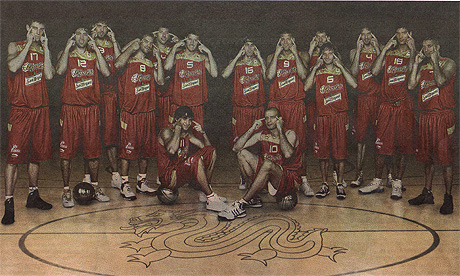
A Hollywood ending in yesterday's team finals in men's gymnastics, and a racist beginning for Spain's basketball team.
Talk about a Hollywood ending in yesterday's team finals in men's gymnastics at the Beijing Olympics. You had a Chinese team avenging with extreme prejudice the drubbing it had received in the 2004 Athens Games. You had a Japanese team that faltered horrifically, only to pull the silver from the jaws of defeat. And you had an American team that, with the loss of two star gymnasts to injuries, was counted out of medal contention by many observers, only to snag the bronze. (Here's the video of the finals, and here are some pics.)
This U.S. team truly showed America as its best: diverse, full of spirit and camaraderie, underdogs dreaming big. Kevin Tan, the son of Chinese-born immigrants, now representing America at Beijing. Joe Hagerty, whose father Mike was watching from the stands at Beijing in halo, still recovering from a serious car accident. Raj Bhavsar, an alternate in 2004 and again this Olympics, only to step in after Paul Hamm's injury to become one of the team's most consistent performers.
And Alexander Artemev, the son of an Russian gold medalist, who was originally selected as an alternate because he was thought to be too erratic to depend on. Artemev had a chance to redeem himself with the team's very last performance of the day, and he did so with a jaw-dropping turn on the pommel house, successfully fending off a last-minute challenge from Germany for the bronze.
If this American team has embodied the spirit of the Games, Spain's basketball team has shown its opposite. In this full-page, pre-Olympics ad in the country's largest newspaper, the men's team is shown making slit-eyed gestures on a basketball court emblazoned with a Chinese dragon.
Victor Tan Chen Victor Tan Chen is In The Fray's editor in chief and the author of Cut Loose: Jobless and Hopeless in an Unfair Economy. Site: victortanchen.com | Facebook | Twitter: @victortanchen