- Follow us on Twitter: @inthefray
- Comment on stories or like us on Facebook
- Subscribe to our free email newsletter
- Send us your writing, photography, or artwork
- Republish our Creative Commons-licensed content
"The party in the Northeast is all but extinct; the party on the West Coast is all but extinct; the party has lost the mid-South states — Virginia, North Carolina — and the party is in deep trouble in the Rocky Mountain West, and there has to be a message and a vision that is compelling to people in order for them to come back and to give consideration to the Republican Party again."
—Steve Schmidt, McCain campaign manager
It’s been four days now since the Republicans’ “big tent” officially imploded. Like Schmidt says, the party is basically defunct in the majority of the country. We appreciate the sentiment, Steve—always the wishful thinker. But sorry. Watching the party canibalize itself over the past four days, it’s obvious to anyone without an NRA membership: The party’s over. Forever.
The decimation of the Sarah Palin campaign (this election was never about John McCain) exposed a devastating reality for the GOP: all of the awful divisions born during the 1960s culture wars are, for the majority of Americans, over.
The country is certainly just as God-fearing and moral as it has ever been. But until Democrats make some outward and obvious attack on religion or gun rights, the days of riding into national office on the backs of social issues ended sometime during George W. Bush’s second term.
This reality is lost on the people who showed up en masse to Palin’s rallies. For this collection of backwoods half-wits, the culture war is like the war on terror or drugs — endless and omnipresent. These are the Republican Party’s new loud and boisterous base, focused so intently on saving America from eternal damnation, they would rather vote against gay marriage than in favor of their own economic interests.
These mobs are small and shrinking in lockstep with the number of good jobs in small-town America. Yet these mobs have, throughout the Rove years, become the face of the GOP, and remained that way throughout Palin’s cartoon campaign. The party’s microscopic intellectual wing can gasp and choke on the stupidity of the party’s base until they turn blue, but it won’t help. Who else would vote for Republicans now?
At some point, one side of the party is going to lose their voice entirely. It will be wildly entertaining to see which half can suffocate the other first. Will it be the orphaned children of Reaganomics, left to flounder aimlessly after their theories on deregulation and trickle-down wealth redistribution were buried under the weight of the economic disaster they caused? Or will it be the lunatic fundamentalists, whose ugly, racially-tinged rhetoric was exactly what the party needed if it wanted to get blown out in every conceivable electoral way.
For most, I think the answer is: Who cares? Let the two halves of the GOP gut each other until they both bleed out. At this point, it looks like it might happen; the nasty and very public in-fighting over the degree of Sarah Palin’s ignorance and selfishness during the campaign might well be the first wounds of the death match. At the end of the day, it might be all for the best. The party can’t and won’t survive as it is, with two rotting ideological corpses as its central premises, its main talking points.
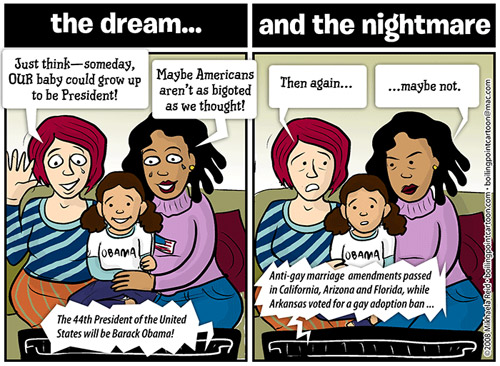
In Ana Marie Cox’s terrific interview with Schmidt, he talked about moving the party to the ideological center — the home of most American voters. Again, Steve is always the optimist. The Republican base detests the center. The center is the bastion of gay marriage, of upholding Roe v. Wade, of enforcing the division of church and state. The base would flee, and if they lose the base, they lose the few remaining loyal Republican voters in America.
Maybe Schmidt knows this and just doesn’t care. They’ve lost everything already. Maybe he knows as well as we do that the party can’t be repaired. It has to be ripped apart and reconstructed, from the ground up.
Store-bought lip balms are expensive and contain ingredients that probably aren't very good for you, so I decided to make my own.
Lip balm is one of those essential things that you have lying around the house in various places; in pants or jacket pockets, in the bathroom, or in various handbags. I have several tubes in case of a dry lip emergency and if I ever forget a tube and have to go a whole day without, my lips definitely suffer.
I've usually been buying the store-name brand, just because they are usually cheaper than the Chapstick or other brand names, but the ingredients are sketchy and I felt like I was always slathering up my lips more than should seem needed.
So the last time I ran out, instead of going and buying more, I decided to take the matter in my own hands and make my own. After making my own non-chemical house cleaners, I also started thinking about all the other store-bought things like cosmetics, shampoos, lotions etc. that have harsh chemicals that probably aren't that good for you either and decided to see if making these things would be possible and easy.
If you search up lip balm recipes on the internet, there are so many ones that I decided I should take the plunge and make my own. First I had to decide what type to make; I tried Burt's Bees once and liked it (but not the price of over $4) so I thought making a similar one would be easy.

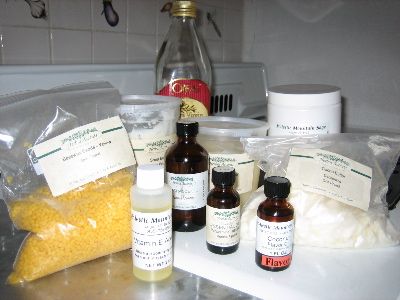
There were lots of different ingredients but I chose to use a beeswax base with familiar moisturizers like cocoa butter, shea butter, and olive oil.
The one essential melting tool I needed was a glass Pyrex measuring cup; this can either be microwaved or used as a double-boiler to melt all the waxes and oils together.
Once I ordered the ingredients online and got my lip balm tubes and everything else, it was time to experiment. I chose to mish-mash a few of the recipes I found online together since none had the exact oils I wanted to use. So I just measured out equal parts of the beeswax and the oils into my Pyrex cup, which I put into a pot of water slowly heated up. I mixed my waxes as they melted and after they were done, I removed the Pyrex from the heated water, added the essential oil (this is a natural preservative), and poured the mixture into the lip balm tubes.
After they cooled I tried one out and it was a tingly peppermint surprise that really moisturized my lips. I was amazed at how easy it was to make and more than happy with the results.
keeping the earth ever green
There exists no line between propaganda and information, but rather a continuum. From the very decision regarding what constitutes news to the interpretation of the facts of a given event, human bias is impossible to remove. Our media is the expression of our culture in the public sphere, and as such, it will always reflect the biases of the underlying culture. In the United States, these biases include American exceptionalism, the supremacy of democracy, the primacy of the individual, the notion that one’s place in life is earned through hard work and perseverance, and many more. Some of these have a positive effect and reinforce a positive group culture, but others have a negative effect and reinforce a negative group culture.
In our November issue, we explore the continuum between information and propaganda and how it manifests itself around the world. We begin with Neil Fitzgerald’s piece Propaganda’s children, which takes a look at the children of Vietnam who have lived their entire lives under the communist regime. In 101 billionaires, Rob Hornstra turns his camera on post-communist Russia and looks at some of those who haven’t benefited from the transition to capitalism. Leyna Lightman takes us to Istanbul, Turkey, in Attempting a_ure.
Still, we cannot avoid the long shadow of the US presidential election completely. The propaganda flying in the last 20 months has been too thick to ignore. Amy Brozio-Andrews and I review Free Ride: John McCain and the Media in When the foxes guard the henhouse. Jeffery Guillermo takes a look at the US media’s addiction to danger and drama in Disaster for sale. Terry Lowenstein ruminates on the rituals of the campaign season in Disinformation revealed. Finally, Keith Olsen tears into the media coverage of Sarah Palin in his article A moose-flogging, cheerleading dominatrix?
Whether the result of deliberate intent, or the result of simple human nature, the news media will always exert a level of influence over a population. In the days following the upcoming election, there will be handwringing and recriminations regarding the influence of the media in the campaign. There will be a temptation for some to blame their electoral loss on a media bias, ignoring the role of their own policies and decisions. They will do this to their own detriment. While the "liberal media" may be a good scapegoat, they are not a functional substitute for a political ideology or agenda.
Aaron Richner I am a writer/editor turned web developer. I've served as both Editor-in-chief and Technical Developer of In The Fray Magazine over the past 5 years. I am gainfully employed, writing, editing and developing on the web for a small private college in Duluth, MN. I enjoy both silence and heavy metal, John Milton and Stephen King, sunrise and sunset. Like all of us, I contain multitudes.
Ask Bush White House reporter and Pulitzer Prize winner Barton Gellman what he thinks of Dick Cheney, and he might give you some nice, clean reporter answer. He was a powerful man, he might say. A man who demands things be done his way, and at his whim.
Those things are all certainly true. But let’s put the Cheney era another way: Cheney’s influence over the Bush administration has been so vast and so dangerous, it will take a generation of historians to put it into perspective.
He dictated domestic and foreign policy. He championed wars for the sake of deterrence. He manhandled government agencies in the name of big businesses, sometimes stomping on the wishes and promises of his President in the process. He wielded unprecidented power — more than any vice president in history, John Adams included.
Now, just two days until the election that will draw the curtain on the Cheney era, the role of the next vice president within the White House is again unclear. Cheney’s reign changed what is possible from the country’s second-in-command. On Tuesday, one of two very different people will have to decide what to take and what to leave from the Cheney model.
And only one candidate — Governor Sarah Palin — appears poised to wield the power Cheney established.
Like Cheney, Joe Biden would enter the vice presidency knowing Washington inside and out. He’s spent almost four decades inside the beltway, far more time than the man at the top of his ticket, and will certainly have a role in helping Barack Obama push policy and navigate Congress. Obama, however, will need no Cheney-esque assistance. Obama is now the standard-bearer for the Democratic Party. Regardless of what Hillary Clinton supporters might say or think, the policy of the party now runs through him, and should Obama win, he’ll take this mandate to the White House. Biden will, at the end of the day, offer advice and guidance if he’s asked but will not dictate to a man whose voice needs little assistance.
Palin is in a different position. McCain is far from popular in certain sects of the Republican Party. Until Palin’s selection, his base barely noticed he was running. Now, it’s her rallies that elicit reaction, her name that is most often mentioned as the future of the party.
It’s hardly McCain’s fault. He has done all he could the past eight years to become the candidate his base wanted. He’s kissed the asses of everyone from big business and its lobbyists to the evangelical right, all in an effort to become what his party required. He’s succeeded to some extent — hell, he won the nomination. In his mind and the minds of his loyalists, these eight years of sacrifice have earned him his place as the party’s face and voice should he win Tuesday.
But the far right of the party may have other designs. Two days after Tuesday’s election, the Republicans’ conservative elite will gather in rural Virginia to discuss what will come of their dysfunctional, fractured party. Should McCain win, the plan is simple, according to Politico: Palin will serve as the right wing’s voice and vote inside the White House:
If the Arizona senator wins, the discussion will feature much talk of, "How do we work with this administration?" said the attendee, an acknowledgement that conservatives won’t always have a reliable ally in the Oval Office.
Under this scenario, Palin would be seen as their conduit to power. “She would be the conservative in the White House,” is how the source put it.
Should McCain win Tuesday, Palin will enter the White House without even a sliver of the Washington experience that allowed Cheney to gain power so quickly. But she won’t need it. The connection between Palin and the far right of the party will provide her that power. Even if she doesn’t know what she’s doing — and trust us, she doesn’t — the people that would guide her hand certainly do.
Cheney’s hijacking of the Bush administration led to eight years of astounding policy disaster. Should Palin be allowed to take take his place, it seems the far right of the party will use her to ensure those policies continue.
Watching the disorganized and backstabbing McCain campaign suffer through its final throes this week will be unsurprising and in every way fair retribution for his party’s disgusting behavior. The entire Republican platform has been filthy, maybe the dirtiest pool ever played in presidential politics. But if the young staffers working on the McCain campaign leave with any lesson except "this party is a complete disaster, top to bottom," those in the GOP who have maintained some semblance of sanity should get ready to french kiss what remains of the GOP goodbye.
These young staffers, McCain’s cursed class of ’08, have spent the past year or more breaking their backs for a campaign built around the most primal and sick kind of politics. If this endless election season ends in anything but a landslide, there’s a better-than-good chance they leave the campaign with a belief that if they just had more time or had pushed the whole terrorist-Muslim-commie-traitor-Obama angle a bit harder, they just might have won.
For years, playing dirty was a winning game plan for the GOP. While other politicians would drag their opponents’ names through the mud, Karl Rove drug Bush adversaries — McCain included — into the fucking La Brea Tar Pits and stomped their heads below the surface. Looking at the Republican platform over the past month, it’s obvious the Bush cronies who have been forced to toil away on the lost-at-sea McCain campaign believed the Obama brand would tarnish just as easily as John Kerry’s four years earlier.
But the world has changed since then. The country is mired in two endless and expensive wars, jobs are extinct, and so on. During times of crisis, people vote for stability, for intelligence, for people with a plan and a single, steady voice. Voters want people who talk about something, and the Republicans right now can’t do that.
Then, there is the larger, almost meta-problem: For, what, two decades, the GOP has been more organized, more consistent, and more able to impose their will on a world of rushed and gullible reporters with no real resistance. What they said appeared in newspapers and on televisions and computer screens unfettered. If the Republican machine said war hero John Kerry was a traitorous liar who made up shit to get his Purple Hearts, so be it. No one raised their voice until Kerry’s ill-prepared campaign finally decided to deny the charges, weeks later, and by then it was too late.
But not anymore. A network of Democratic bloggers and think tanks and rapid-response outfits have changed that. Now, the Democrats’ messages travel just as far just as quickly as the Republican machine’s. The world changed, but the Republicans haven’t — cursed to bounce from smear to smear and wonder why none of them are working.
John McCain’s class of 2008 will live with this curse, the same way Democrats lived with their massive organizational gap for years. The class of 2008 — which includes every McCain staffer young and impressionable enough to take away some message from his doomed campaign — will go home with some half-cocked and dangerous concept of how a campaign should be run. Avoid the issues. Stoke fear. Play to your base’s weaknesses — namely a viral dislike for the unfamiliar, the frightening, the exotic.
These staffers, should they continue trudging through the dark world of right-wing politics, will implement these lessons in their city halls, their state representatives’ offices, their congressional districts. And their map to running a campaign will feature only one road: the lowest one possible.
In some places, these tactics may scare up enough votes from the Republicans’ new insane base to succeed. But in most places — even those in historically Republican areas — people will look long at their shuttered factories, their underperforming schools, hell, their freaking checkbooks — and consider that perhaps the high road is the one that will lead to better times.
Unfortunately, McCain’s genius plan to take the White House by convincing some winning fraction of Americans that Barack Obama is an commie terrorist bent on stealing your paychecks and handing them out to the homeless has permeated far beyond his own campaign. Politicians around the country running their own reelection campaigns — with their own class of ’08 staffers — have mirrored his failing message.
That means even more young staffers who understand politics only as a series of borderline-racist smears and innuendo. It’s hard to imagine this is the kind of campaign McCain wanted to run. But now, the messages the right wing of the party has chosen to propagate are out of his control. The party may take generations to recover from them.
So, sane GOPer, start asking whatever god it is you pray to for a Democratic landslide, the kind of loss that can only result in a total re-evaluation of your party and its direction. If not, oh lord help us all, the class of ’08 just might leave the McCain campaign believing that lowbrow, Sarah Palin politics might yet save the GOP.