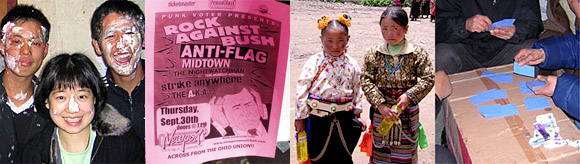
Presidential elections always demand a degree of individual and collective introspection, ranging from questions of policymaking, patriotism, and citizenship to the utility (or futility) of indirect elections and grassroots political activism. For the candidates, the media, activists on the street, and even InTheFray readers, this election season has proven to be no exception to — and, at times, an exaggeration of — this political rule.
In this issue of InTheFray, we examine the many faces of democracy and the subject that has dominated the news, dinner conversations, and rallies of all varieties throughout the United States — and across much of the world — since at least last spring: the 2004 U.S. presidential election. While InTheFray Assistant Editor Michelle Chen discloses how her trip to China inspired unexpected patriotism in The other half, our literary channel, IMAGINE, borrows a chapter from Opio Sokoni’s Making struggle sexy to elucidate how the American criminal justice system thrives on institutional racism and classism to fill prisons.
Looking beyond the policymaking and cultural concerns of the election, InTheFray moves Inside the beltway, outside politics to explore the deliberations of a traditionally apathetic U.S. citizen, Marna Bunger over whether she and millions of other undecided — and often uninspired — voters can make their votes count in what many have termed “the most important election of our lives.” In Clout concerns, meanwhile, Christopher White takes a look at another angle of the democratic process: the struggle of College Republicans to help their party win the election one college student at a time — with GOP support that is far from five-star quality.
Of course, given that the 2000 election shook so many people’s faith in the electoral process, it’s worth asking whether politics as usual — with thousands of new voters thrown into the mix — can restore faith in the democratic process this year. To answer this question, InTheFray Editor Laura Nathan takes Salman Rushdie’s Step Across This Line Off the Shelf to make sense of this election — and the American democratic process — from a non-native’s perspective in Where the two elections shall meet. While the answers may not be written in stone, this month’s book club selection just may hold the keys to American democracy’s creative potential or prove that progress is off-limits.
There’s only one way to find out. So don’t just sit there. Get out and read — er, vote.
Laura Nathan
InTheFray Editor
Brooklyn, New York
Laura Nathan-Garner
Dear Reader,
In The Fray is a nonprofit staffed by volunteers. If you liked this piece, could you
please donate $10? If you want to help, you can also:

 A really sick joke.
 Expanding the minds of morons everywhere.


