Blog


Dying for democracy

Ahead of the elections to be held today, insurgents in Iraq fired a rocket into the U.S. Embassy in Baghdad on Saturday in an attack that killed two Americans and wounded five others. Despite the overnight curfews that are in effect in Iraq, on Saturday a suicide bomber killed eight in Khanaqin, while mortar and machine gun fire continued to ring through the capital.

If the Americans are hoping to hear the true voice of the Iraqi population and its 14 million eligible voters through this election, the prospects are grim; according to a poll conducted by Zogby International, a staggering 76 percent of Iraqi Sunni Arabs, who are the populational minority, declared that they “definitely would not vote,” while only a feeble 9 percent expressed their intention to cast their ballot. In stark contrast, the same poll revealed that 80 percent of Shiites claimed they will likely or definitely vote.  

What the Iraqis are even voting for is somewhat confusing. The Iraqis are electing a 275-member national assembly, whose task it will be to write the permanent Iraqi constitution. This 275-member assembly isn’t to be confused with the permanent assembly — there will be another election in December to choose a permanent national assembly. Additionally, the Iraqis are voting on provincial parliaments, while the Kurdish population in the north of the country is selecting candidates for the Kurdish regional government, which was set up in the aftermath of the 1991 Persian Gulf war.

Some American politicians have abandoned even the pretense of a safe and inclusive Iraqi election. Speaking from the comfort of the haven of Davos, Switzerland, where the World Economic Forum is being held, Senator John McCain admitted that some “some pretty horrific things” may occur today in Iraq. Easy for you to say, Senator; even as you speak, the Iraqis are dying for democracy.  

Mimi Hanaoka


PC really stands for progressively challenged

Last November, my manager, John, at my campus cafeteria told me a funny story. Supposedly, when he realized the newspaper vendor had shortchanged him, he said “I’ve been gipped” out loud. Not far away was an aging hippie who scolded him for saying such a thing:

“Gip is a terrible thing to say. It’s offensive to gypsies.”

Usually, I ignore what hippies say, but this incident got into my skin pretty deep. Did this man in the Grateful Dead t-shirt feel a sense of pride in saving the dignity of the Gypsy population? Is this the same guy who talks about animal rights and saving whales? Is it offensive of me to say any of these things?

I find it pitiful that a handful of nutcases have successfully warped the minds of fine human beings into thinking thier ideology of “what is offensive” is actually legit.

Political correctness has done nothing for the American people but halt any progress between expunging bigotry of any kind. Instead, we’re all walking around on eggshells afraid of saying anything to anyone different from us and are being fooled into thinking everything is alright. Aren’t you tired of being called a racist for no apparent reason? Are you sick of people getting your jobs because the companies need to make staus quo but you’re more qualified? Is the term “people of color” one of the dumbest things you’ve ever heard of? I agree, and this is coming from a gay, black, quarter-Jew dude.

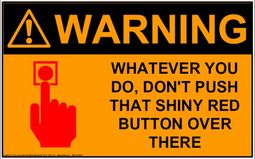
Unfortunately, political correctness is very much like the black hole. It has grown to such a connundrum of crap that I won’t be able to cover all of its fallicies. I’ll get to the more critical problems it has caused. One is called the Discrimination Alarm. It looks like this:

The Emergency sign, however, goes unnoticed most of the time. What was once used for serious crimes of prejudice has turned into toy for tattling. It’s been misused and abused so many times it can’t be taken seriously anymore. For instance, “black” to many in the community is an unacceptable term. Many say they prefer “African-American.” Well that’s sort of stupid considering most of the people who want to be referred to by this term aren’t from Africa at all! Do we call those of German decent German-American? Or others Irish-American? If that’s the case, I prefer to be called Kenyan-American because I too want to be identified by the country my ancestors came from! I think it’s discrimintory otherwise. What’s next, Nubian Kings and Queens? Caucasian is such a great word too. Why say something with one syllable like “white” when you can say three?

Dare I say the status quo is PC’s greatest warrior? Indeed it is so. To end racism, somebody says let’s keep a percentage of each race in each school. I find it very difficult to understand that a person decided to use racism as a means to smolder it. That’s like someone actually using fire to fight real fire. It’s completely idiotic. Status quo has only gotten us to point systems in colleges, students getting rejected because of their race, and pissed off white people. Central High School in Louisville, Kentucky (my hometown), had gotten in trouble becuase they weren’t accepting enough white people. The fact that Central High was the only high school to accept black people isn’t even important (which was the constant reiteration, not to mention the WRONG one). Could it be the fact that not many white students applied there at all or even wanted to?

In addition to the point system the nation argued over years ago, scholarships targeted at minority students have not been discussed. If you search through a scholarship award book, you can see many for blacks, Asians, Latinos, gays, etc. Could you imagine the riots that would ensue if a white-only scholarship was awarded, or even a heterosexual one? Uh oh … DISCRIMINATION ALARM! BEEP! BEEP! BEEP! BEEP!

Reverse discourse seemed to be a great way to turn racist slurs into positive jargon. Too bad it was a failure.

Most of you, I’m sure, have seen the movie Rush Hour. In one scene, Chris Tucker’s character is referring to his all-black buddies who are hanging out in a bar as his “niggas.” Jackie Chan’s character (Tucker’s detective partner) follows him into the bar, new to American culture, and only imitates his partner to fit in. Instead of getting the respect and handshakes Tucker received, he’s almost on the receiving end of ass-kicking until Chan shows them he’s another karate-chopping Asian dude, (uh oh…) and beats them all to kingdom come. You’d think that little skit mocking our problems would point out its fault in our culture. As popular as that movie was, it’s deplorable to see its audience didn’t capture the gist of what the skit was saying.

Honestly, I call all of my friends niggas. White, black, Korean, I don’t care and neither do they. They call me that too. If anything, we are mocking communities and groups who think just because they have adapted words that were once deragotory to them, it doesn’t give them the right to claim others are unable to use them as well. When I see something I find inane, I’ll say, “Man, that is so gay.” At the same time, I will never tell a heterosexual that he shouldn’t say it either. No one should be a dictator of diction. Usually, someone who uses these terms is doing so in a joking manner, and jokes aren’t racist/sexist/etc. It’s only when they are used in a bigoted manner that they become so, and that is the only problem.

Black skin is a pigment. Gay means I’m attracted to men and I have emotions for them romantically. Jew means I like bagels. I do not misuse and abuse these things for any gain morally or whatnot.

Luckily, there are antagonists to this terrible flaw in our culture. TV Shows like South Park and Family Guy are constantly jabbing a fork in the PC meat. These shows are so great, they have probably offended every group and community out there. That’s what I call equal opportunity. Humorous social commentary sites like Mad Maddox and The Morphine Nation are popular places that also continue to fight the dirty fight. Look at these sites with an open heart and open mind (and hopefully with your sense of humor).

I wish I could be idealistic and say one day, all of this will dissapear, but I realize that there will always be hippies.

But the next time someone proudly proclaims they are PC, you’ll know what they really mean since I have taught you the true acronym for it. So tell them to do these three things:

1. STOP (Talking)
2. THINK (About How Stupid You Sound)

3.
Airplane Radio


Attack of the killer filibusters

Does anyone need a quick refresher on the filibuster and how it has been used by various political parties in the United States over the last two centuries? A website designed by the People For the American Way takes a look at the history of the filibuster in action, as well as current myths surrounding it, and how its disappearance might affect the American ecosystem.

The first Supreme Court nomination approaches as the Bush administration begins another four-year term. Use of the filibuster by Democrats during Bush’s last term successfully impeded 10 of Bush’s 52 appeals court nominees. As a result, Republicans contend that Democrats are “trampling on the Constitution” with their “abuse” of the filibuster, according to an article last month in The Washington Post by reporters Helen Dewar and Mike Allen. Senate Majority Leader Bill Frist has suggested he “may resort to an unusual parliamentary maneuver, dubbed the ‘nuclear option,’ to thwart such filibusters.”

An editorial available on the PFAW website argues the merits of the key role the filibuster process plays in the legislative process. It explains,

“The modern-day filibuster, a Senate procedure that requires sixty senators to agree to a vote on significant issues, is an essential check on the abuse of majority power and can be an effective strategy for achieving bipartisan cooperation.”


Popular arguments against the use of the filibuster claim that in the past, senators have exploited its use. A United States Senate website notes these arguments, as well as the ends toward which filibusters have been implemented.

“Many Americans are familiar with the hours-long filibuster of Senator Jefferson Smith in Frank Capra’s film Mr. Smith Goes to Washington, but there have been some famous filibusters in the real-life Senate as well. During the 1930s, Senator Huey P. Long effectively used the filibuster against bills that he thought favored the rich over the poor.”


What if the use of nuclear weapons were protested based upon the potential that the wrong people might exploit their use? What if such protests were effective?

Activists interested in signing a petition to save the filibuster can find it on the PFAW website.

—Michaele Shapiro


A question of honor

The sexual mores of Egyptian culture confine sex to marriage, but marriage in Egypt is an expensive enterprise.  For the upper middle class, it requires rings with diamonds — and many of them — a furnished apartment and lavish engagement and wedding parties to entertain the entire extended family.  Families with less money haggle over the prices of refrigerators and washing machines.  The expense and stress of what can be viewed only as a thinly veiled business deal between two families intent on solidifying their relationships means that marriage is often postponed until both parties are in their late 20s.

While furnished apartments and bathrooms with marble, not tile, may be the topics of discussion during these family negotiations, the consummation of an Egyptian marriage ultimately rests on the woman’s virginity. Since there’s no male virginity test, women bear the responsibility for upholding their culture’s sexual morals, and they pay a high price for it. In rural and poor communities, honor killings, like this recent one in Kuwait, are carried out by relatives in an attempt to preserve their families’ honor, and rid the family of both the shame and economic burden of having an unmarriageable female in the family).  Among the middle class and wealthy, losing your virginity before the wedding night entails a visit to a plastic surgeon to have your hymen reattached.  Unlike in the United States, single mothers aren’t a demographic, or the target of social services programs — they simply don’t exist.

Or, to be more accurate, they don’t exist publicly; or at least, they didn’t, until now. Hind el-Hinnaway, a 27-year-old Egyptian costume designer and single mother, has captured national attention and sparked what many hope will blow open discussion about women and sexuality in Egypt.  El-Hinnawy has filed a paternity suit against the famous television actor Ahmed el-Fishaway, demanding that he take responsibility for their child. The two met on the set of his television show and allegedly entered into a civil marriage — a contractual relationship that does not require a wedding, but permits a couple to cohabitate. She became pregnant, and chose to go ahead and have the child rather than have an abortion. When el-Fishaway chose to ignore her, she took him to court and is now suing him in a landmark paternity case — the first in Egypt to use DNA testing.

El-Hinnawy hopes the case will force Egyptians to examine the hypocrisy embedded in their society, which increasingly embraces a model of gender relations embedded in what many consider a dangerously conservative interpretation of Islam.

“I did the right thing: I didn’t hide, and eventually he will have to give the baby his name,” she said. “People prefer that a woman live a psychologically troubled life; that doesn’t matter as long as it doesn’t become a scandal.”

Laura Louison


MAILBAG: God’s politics, but whose god?

Jim Wallis’s new book and his engagement in political life is welcome and beneficial. Finally left-leaning theists are getting a high-profile voice to expose the hypocrisy of the Republicans’ policies.

Why, though, must he use the term “Christian evangelical?” Does he really have to alienate a large percentage of the voting public that way? There is a long and abusive history of repression by evangelicals. Even to say “Christian values” is a slap in the face for Jews, Muslims, Hindus, etc.

Why not just say God’s values? We all worship the same one God in different forms. In each religion His/Her professed values are virtually the same, except of course to the fundamentalists and atheists.

Mike M.

micmusic@hotmail.com


A writer on reading

A whole slew of less-than-thrilling books have been written about writing. Many others have been written that belong to the category of writers on reading. Nick Hornby recently published one of these.

Of course, there has been an article written about the book that Mr. Hornby wrote about reading other books, or not reading them, as he readily admits and then writes about. (Read on for details about the book, titled The Polysyllabic Spree: A Hilarious and True Account of One Man’s Struggle With the Monthly Tide of the Books He’s Bought and the Books He’s Been Meaning to Read.)

Shockingly, the article by Carol Iaciofano in The Boston Globe actually made me want to buy the book. She writes, “But buying books is half the fun. For anyone who’s ever browsed around a bookstore, reading Hornby’s accounts of how one book led him to another, or how he discovered a new author nearly by accident, is like reconnecting with an erudite friend.”

Who knows, maybe I’ll buy the book — or even read it.

Vinnee Tong


Quote of note

“Neither religious nor secular fundamentalism can save us … but a new spiritual revival that ignites deep social conscience could transform our society.”

— Jim Wallis, Christian commentator, editor, and author, most recently of God’s Politics: Why the Right Gets It Wrong and the Left Doesn’t Get It.    

Jim Wallis characterizes himself as a “progressive evangelical,” — not to be confused with a Democrat, since his views can veer to the right of center — and he condemns both the Republican and Democratic approach to faith and political life. In his recent book, Wallis claims that while the conservatives have successfully harnessed the power of religious language for political gain, the Democrats, in propounding the secularist cause, have both lost the most recent elections and lost sight of what Wallis believes should be the American goal — to move beyond partisan politics while embracing Christian values.

The left “doesn’t get it” because it refuses to reintroduce Christian values into the Democratic platform, which allows the Republicans to enjoy a stranglehold on the religious voice in American politics. The right, on the other hand, is “wrong” because it manipulates religious language for a political agenda that is inconsistent with the Christian tradition. The way to change the status quo, Wallis claims, is not for the Democrats to move away from Christian values; the solution is for Democrats and, indeed, all Americans, to embrace and reintroduce Christian values into the political spectrum.  

Mimi Hanaoka


Quote of note

“Things are now clearer than ever: We have the right to feel a chill down the spine. To describe Bush as a madman with a mission at the head of a state bristling with weapons does not really get us any further … and, although insulting, it is no longer even particularly original. And yet this U.S. administration sends a chill down the spine of anyone unwilling to become accustomed to listening to this madness.”

— the German publication Die Tageszeitung, responding to President Bush’s second-term inauguration.  
  
While George W. Bush escaped the controversy and legal wrangling that sullied the presidential election four years ago, his domestic approval rating now only scrapes in at around 50 percent, which is staggeringly low; the previous second-term president to have had such a low approval rating was Dwight Eisenhower in 1957.

Mimi Hanaoka


The inauguration photos the mainstream media failed to publish

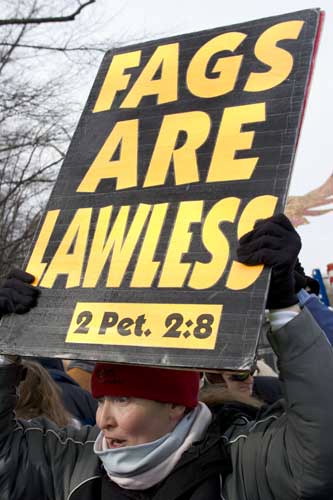
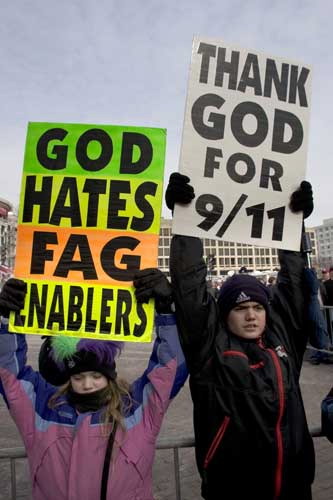
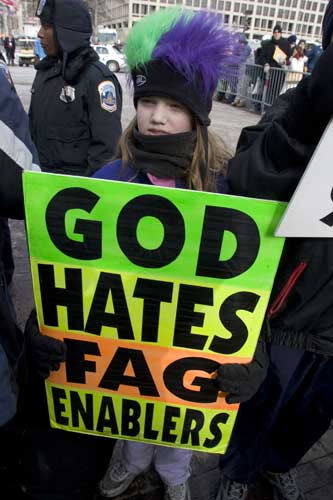
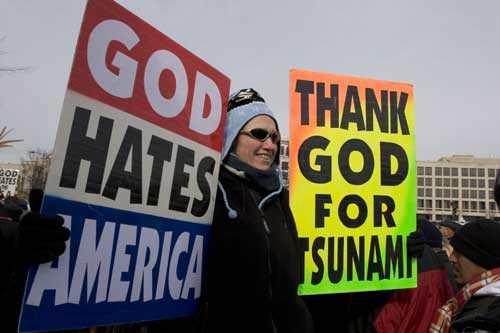
When InTheFray Visual Consultant Dustin Ross attended President Bush’s inauguration on Thursday, he saw the predictable protesters — and some unbelievably uncompassionate conservatism. See for yourself:

Members of the Westboro Baptist Church of Topeka, Kansas, protest George Bush’s inauguration. I overheard one of the members saying “God hates
fags, God hates fag enablers, therefore God hates George Bush.”

Lines stretched for blocks as people tried to enter the parade area for President Bush’s inauguration. Security checkpoints only let a few people in at a time, and people with bags were not allowed into the area.

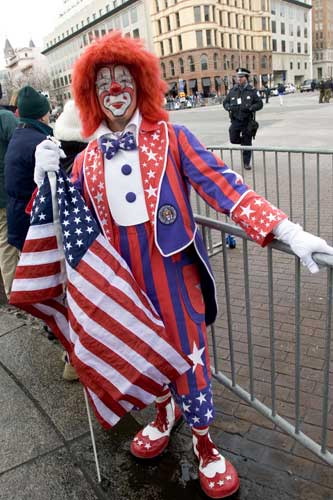
Star, a patriotic clown, by the parade route during the inauguration for President George Bush.

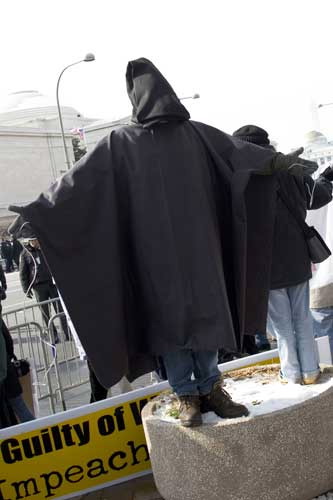
A protester dresses as a prisoner from Abu Ghraib prison in Iraq.


A dream of dissent, undeferred

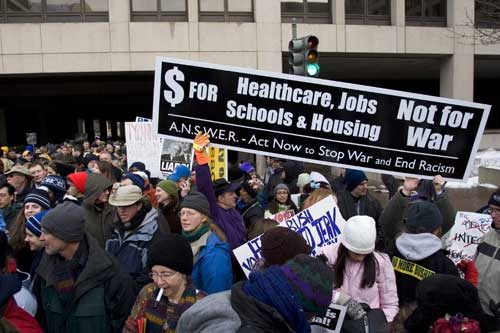
The last line in a letter written by the activist group Ladies of Liberty reads, “Remember: Dissent is Patriotic.” Their message is timely. On Thursday, President Bush will be re-inaugurated. The rage which inspired activism after Bush claimed the presidency in 2000 appears to have subsided into a lethargic response of depression and denial, as The Stranger’s Amy Jenniges reports:

“For lefties who became political activists for the first time in their lives last year, the realization that their hard work didn’t turn Bush out of office has translated into feelings of grief, frustration, depression, apathy, and denial — but not anger. Anger can inspire people to protest. Depression and denial lead people to hibernate, drink, and check out of politics.”

With many freedoms at stake, the Ladies of Liberty are one of several protest groups who will march in counter-inaugural rallies this Thursday, January 20th. The Ladies have organized a peaceful protest in the form of a funeral procession and will be accompanied by a New Orleans-style jazz band in mourning for “the multiple blows to the American people dealt by the Bush Administration (and the prospect of four more years of the same), as well as [in celebration for] the possibilities of rebirth and regeneration.” The blows the Ladies cite include those to the areas of women’s rights, gay rights, reproductive rights, social security, the democratic process, environmental conditions, free speech, principles of inclusion, economic equality and freedom from arbitrary imprisonment.

Some American citizens view Bush’s majority win in 2004 as a justification for silence, although they oppose his administration. Still others envision his victory as a last-ditch effort on the part of conservative America to protest the increasing speed of life in the 21st century by grasping at any straw which might slow the process down. Groups like the Ladies of Liberty voice the belief that multiple perspectives are not only rooted in American culture, they must be nurtured and provided with plenty of sunlight.

“Now the trumpet summons us again,” said John F. Kennedy in his 1961 Inauguration Speech, “not as a call to bear arms, not as a call to battle, but a call to bear the burden of a long twilight struggle, year in and year out, rejoicing in hope, patient in tribulation.”

—Michaele Shapiro


Quote of note

“Yes, if you want to say that I was a drum major. Say that I was a drum major for justice. Say that I was a drum major for peace. Say that I was a drum major for righteousness. And all of the other shallow things will not matter. I won’t have any money to leave behind. I won’t have the fine and luxurious things in life to leave behind. But I just want to leave a committed life behind. And that’s all I want to say. If I can help somebody as I pass along, if I can cheer somebody with a word or song, if I can show somebody he is traveling wrong, then my living will not be in vain.”

— Martin Luther King, Jr., in his 1968 sermon titled “The Drum Major Instinct.”

Coretta Scott King, the wife of the late Reverend King, has written an essay for The King Center in which she explains the meaning of today’s holiday, which celebrates the life and legacy of Martin Luther King, Jr.  

Mimi Hanaoka